Category: Manufacturing Process

  • Denim Pollution – Solutions To Sulphur Dyeing Wastes

    denim dyeing wastes

                            This is a guest post by Harry Mercer
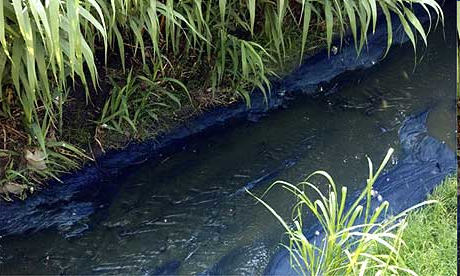
    The problem of treating wastewater from denim dye waste is significant in many developing countries. Either the costs of treating these wastes affects profit margins or the waste goes untreated and is discharged directly into rivers.

    The most serious pollution problem results from the use of sulfur dyes in denim. Once the sulfur dye is applied the cotton is squeezed and washed. Typically, 50% or more of the sulfur dyes are washed off, producing water contamination that is difficult to remove from water.

    Techniques have been developed to greatly reduce and even eliminate sulfur dyes as a source of textile pollution:

    • Unlike most types of cotton dyes, sulfur dyes can be recovered and re-used. The contaminated water from sulfur dyeing usually contains enough dye and chemicals to produce lighter shades without additions of dye or chemicals. For example, the wash-water from sulfur-black dyeing can be concentrated through evaporation, filtration or it can be re-used by adding enough dye and chemicals to produce the standard shade. There are methods for titrating sulfur dye with copper sulfate, reducing agents can be added to bring the ORP to the correct level and the alkali can be titrated with a 2-endpoint titration with HCl and formaldehyde. Using these techniques, the sulfur dye can be recycled which saves money and ends the pollution. It should be noted that sulfur dyes precipitated with an acrylic type flocculant cannot be re-used.
    • I have developed methods for sulfur dyeing that fix the dye completely, so that none is lost in washing, leaving the wash water completely clear. Depending on the quality of the dye,  which reducing agents are employed and the pH of dyeing, various inexpensive buffers can be employed that will fix 100% of the dye which eliminates the colored waste and also reduces the amount of dye needed by a sulfur black shade by 50% or more.These  methods were developed over a 20 year period and have employed them  in Brazil, Ecuador, Indonesia,  Phillipines and Thailand.
    • There are also cold-dyeing methods that also eliminate the dye waste 100%, saves energy and has colorfastness approaching that of a vat black.
    • Reducing agents are a major source of Chemical Oxygen Demand. Sodium dithionite sold commercially as sodium hydrosulfite has a COD of 0.22 kilograms per kilogram of 100% hydrosulfite. Since it is normally produced using zinc metal as a catalyst, there is also  some presence of heavy metal contamination. There are non-polluting substitutes that can be used with many Indigo-dyeing methods. Sodium sulfide-type reducers are commonly used, however they can be easily replaced for hot-dyeing methods with reducing sugars which includes sugar, dextrins (corn-sugar) and molasses. These have been offered by chemical companies for decades and basically break down under conditions of high temperature and high pH (11) into hydrogen and alcohol, which both escape into the air.
    • Sulfur blacks do not require chemical oxidation, in fact peroxide will reduce the colorfastness of sulfur blacks and acid-oxidation will weaken the yarn. – After applying sulfur black, it should be allowed to cool in air which takes the dye out of reduction and allows oxidation with atmospheric oxygen. The initial washing should be  cold in order to avoid washing off any color and also to allow further oxidize with  oxygen-rich cold water. The final wash should be warm, about 60 degrees, which will  remove alkalies and residual reducing agents. If noticeable color is removed, the dyeing procedure requires adjustment.


    imageThis is a guest post by Harry Mercer. Mr. Mercer has 30 years experience in the denim business including 3 prominent U.S. denim companies.He is an expert colorist for measurement and color matching as well as textile testing.

  • Denim Sewing Threads – Garment Stitching Recommendations And Guide

    image American & Efird (A&E) is a global leader in denim threads manufacturing. With over a century of experience in industrial threads , they come out with number of technical bulletins to help and guide denim garment manufacturers to optimize seam performance in denim stitching so that not only rejections due to stitching are minimized but also the life of the garment is extended with better stitching.

    Here are some recommendations from A & E to optimize seam performance.

    Denim Jeans – Optimizing Seam Performance

    Selecting the proper thread for denim garments is very important to minimize sewing and seam performance issues. There is an old saying that:

    Thread only makes up a small percent of the cost of the finished product … but shares 50% of the seam responsibility.

    A typical pair of adult size jeans will have from 200 to 250 yards of thread in them depending on the seam construction. Most major jean manufacturers have experimented with different thread types to reduce cost but most have found that corespun threads give the best overall
    performance. Most jean manufacturers put their products through various wash processes after manufacturing and some of these processes can be very harsh. The cost of these wash processes can be from $.75 to $3.00 per jean or more depending on the chemicals, stones, enzymes and process time required. The amount of thread used in a jean typically costs between $.25 and $.30 while the wash-process can cost up to $3.00 per jean.
    The thread must be able to withstand all of these processes … and hold the seams together for the life of the garment.
    When you talk about sewing denim, there are four key issues that need to be considered:
    1) What is the weight of  denim fabric?
    2) How large  topstitching thread is required?
    3) What finishing procedures will the jeans be subjected to?
    4) What quality issues need to be addressed?
    With these questions answered, you will be able to produce jeans that meet the requirements for today’s  huge variety in Jeanswear. From a basic 5-Pocket Jean to the most creative pair of High-Fashion Jeans, your sewing plant can produce the quality for each.
    The thread of choice used by most quality denim garment manufacturers for topstitching and stress seams include corespun threads ie

    What Are Corespun Sewing Threads?

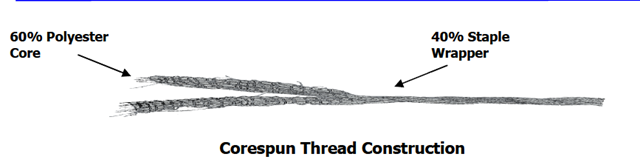
    Core threads are made by spinning a wrapped of cotton or polyester staple around a bundle of continuous filament polyester fibers to form a yarn and then two or more of these yarns are twisted together to form a corespun thread. Generally the core makes up approximately 60% of the thread construction contributing to a more uniform and higher tenacity sewing thread as compared to a 100% spun polyester sewing thread. For example, a T-60 PW Core thread will have a breaking strength of approximately 8.7 lbs. while a T-60 Spun Polyester thread will have a breaking strength a little over 5 lbs.

    core spun denim thread

    Corespun Thread Construction

    Cotton wrapped  core spun threads have very good needle heat resistance. When wrapped with a polyester wrapper, core spun threads have excellent chemical resistance and color fastness. The fibrous surface on either thread reduces the shiny look and also contributes to superior frictional characteristics as the thread passes through the sewing machine.

    • Some designers prefer the thread to wash-down during the wash processes and if this is the case, you would select a Cotton-Wrapped Core thread . Degrees of color fastness will vary with particular shades. With this known factor, a user of Cotton-Wrapped Core should look at all wash codes to ensure that the thread color will be appropriately maintained. Also  recommended is  doing pre-production wash testing to assure that the wash-down look will
      be acceptable.
    • On the other hand, many jean designers want the thread to maintain its color for the life of the garment and offer a signature look.  If color fastness is key, then select a Polyester-Wrapped Core thread . Also with Polyester Wrapped products you have the option of picking the desired color from a color palette to obtain the look you want after the wash procedures. This will allow greater shade control, which will be maintained after continual washes by the consumer. Doing pre-production wash testing prior to going into production is still recommended.
      Cotton-Wrapped and Polyester Wrapped Core threads offer excellent abrasion resistance to the varied wash codes the denim garments may be exposed to.

    Thread Size

    Both of these thread types are available in sizes to meet the variety of denim fabric weights. From a Tex 40 to a Tex 120, you can achieve the desired performance throughout the sewing floor and after the varied finishing processes. Utilize the correct size to obtain the desired look while maintaining seam integrity. Some basic sizes utilized in today’s denim manufacturing are:

    Needle Thread Looper Thread Serging Application
    Tex 150 – T-300 Tex 80 or Tex 60 T-40 or T-60 Extra Bold appearance
    Tex 120 to T135 Tex 80 or Tex 60 T-40 or T-60 Bold appearance
    Tex 80 or Tex 105 Tex 60 or Tex 40 T-40 or T-60 Normal
    Tex 60 Tex 60 or Tex 40 T-40  
    Tex 40 Tex 40 * T-40  

    *8 oz denim usage or Chino twills

    Cut or Broken Stitches

    denim stitchingMost manufacturers of denim and twill  garments that pre-wash garments after they are assembled have experienced problems with excessive “cut” or “broken” stitches. In fact many manufacturers have found this problem to be significant reaching in excess of 30 to 40% of the
    products being sewn
    .
    Many times this problem occurs when adenim stitching thread  previously sewn stitch-line is crossed during a subsequent sewing operation and the needle damages the thread in the seam. Broken stitches can also occur when there is excessive abrasion or chemical degradation of the thread during the wash process. Let’s now discuss what are some  of the solutions to these problems.

    Solutions To Cut Or Broken Stitches

    • Many manufacturers have significantly reduced the number of “cut” and “broken” stitches by using high-performance sewing threads on stress seams. Make sure the correct thread type and size are being used in both the needle and bottom (looper) positions. Core threads that have a continuous filament polyester core are much more resistant to cutting and degradation than 100% spun polyester thread constructions.
    • Usually the larger the thread size, the more resistant the thread is to being cut by the needle or failure due to chemical degradation or heat. Because of this many manufacturers have increased the thread size on critical operations including waistbanding, seat seaming, etc. Typical thread sizes used on heavy denim run from T-105 down to T-60 depending on the desired look. Typical thread sizes used on twills used in the manufacturing of chino pants run from T-40 to T-60.
    •  Inspect the needle point at regular intervals and check for sharp or burred points. If the needle point is damaged, replace the needle. Many companies have found that it is best  just to replace the needle on critical operations once or twice a day.
    • Check for signs of needle heat or excessive heat exposure during laundering that may be melting the thread. Usually if the thread has been damaged by heat, the thread will have a hard melted surface that can be felt or seen using a magnifying glass. If you suspect
      that needle heat is a problem, try using a special coated needle or needle coolers to  reduce needle heat. Make sure the thread has the proper type and amount of lube. Most major thread suppliers have developed high-performance lubricants to minimize heat
      damage on polyester threads. A cotton wrapped core thread may be more resistant than a 100% polyester thread.
    •  Use proper thread tensions. Make sure the stitch on the seam line is loose and able to move if it is hit by the needle. Tight machine thread tensions will NOT allow proper flexibility in the stitch and will increase “cut-stitch” damage. Generally on chainstitch seams, the ideal stitch balance is when the needle loop on the underside of the seam lays over half way to the next needle penetration. This can be checked by unraveling the looper thread and observing the needle thread on the underside of the seam or checking the ratio of needle to looper thread. It is normally recommended that this ratio be
      approximately 60% needle thread to 40% looper thread consumed.
    • Check the edges of the needle plate and presser foot needle holes to make sure they do not have any sharp edges or burrs that can damage the thread during sewing. Properly remove all burred or sharp surfaces making sure not to oversize the needle holes which
      can lead to excessive “flagging”.
    • Inspect the feed dog teeth directly behind the needle holes and make sure they are not sharp. If required, buff the feed dog teeth with a wire wheel or with a stone if they appear to be sharp. Be careful not to remove too much of the feed dog teeth that could hinder the feeding or interfere with chaining.
    • Use the minimum amount of presser foot pressure to get a uniform stitch length. Excessive presser foot pressure can cause the thread to be damaged when it is compressed against a relatively sharp surface. On some machines it is sometimes necessary to use a presser spring with fewer coils per inch to give more consistent pressure even when crossing heavy seams.
    • The proper type and capacity folder should be used to prevent stalling when crossing heavy seams. Feed stalling will increase the chances of “cut” stitches.

    DAMAGE DURING PRE-WASHING

    Sometimes partially damaged thread from the sewing operation will fail during stone washing or other processes. Most of the time this damage is difficult to detect but should be investigated using the suggestions mentioned on the previous pages. On the other hand, many seams are damaged during the wash processes due to excessive abrasion, chemical degradation, and heat degradation.

    denim stitching problem

    To reduce damage to the thread in the seams,  the following is suggested:

    • Make sure the correct thread type, construction and size is being used. For example, the product  Perma Core® NWT.
    • Work with your laundry to develop standards with regard to the type and amount of chemicals, rocks, cycle times and temperatures that are being used in both the washing and drying processes. You should monitor and properly test the following:
      a) Any changes of rocks and chemicals from one vendor to another
      b) Changes of cycle times
      c) Changes in temperature during the washing or drying cycles
    • Evaluate the best way the garment should be processed, whether it should be inside-out or right-side-out, the fly buttoned or not buttoned, etc. Care should be taken if the garments are turned right-side-out when they are still wet. Extra moisture in the garments can cause excessive whipping of the bottom hem seam causing excessive
      damage.

    To know more about denim stitching , different types of threads and guides on stitching ,  visit here.

  • G2 Waterless Denim Washing Machine From Jeanologia

    image Jeanologia is  a company from Spain dedicated to providing eco friendly finishing solutions for  garments – specially denim.  With a corporate tagline of  “The Science of Finishing” it has been their mission for last 15 years to enhance industrial garment finishing through technology & know how.

    The concept of ‘Sustainable Denim’ – an eco friendly approach to denim is being enhanced by their various machines , the foremost of which is the G2 Waterless Washing Machine. This is a unique washing machine which washes denim jeans with about 60% less water  and almost no chemicals…….!!  In  Hongkong, Jeanologia had a large hall dedicated to their “Truth & Light show” where they displayed their uniquely washed garments.  The visiting denim experts were asked to select , from pairs of jeans, the jeans which had naturally aged and the one which had been made by Jeanologia with the help of their laser technology and unique G2 washing machine.Most of them could not differentiate between the two . It was an interesting way to understand that real aging effects could be achieved with eco friendly washing methods.

    How does G2 work ?

    Air from atmosphere is transformed into a blend of active oxygen and ozone called ‘Plasma’.This plasma is used to age garments. The plasma is transformed into purified air before it is returned to the atmosphere.

    What kind of  washing effects can it provide on the jeans ?

    G2 can provide various effects on the jeans like

    •Casting:

    • Aged Cotton – unique yellow cast for true vintage looks in Pure Indigosimage
    • Gray casts for a retro look

    •Cleaning:

    • Removes backstaining & loose indigo without detergents

    •Bleaching without the bleach!

    •Eliminates the need for Potassium Permaganate spraying.

    •Blacks and grey denim fade without turning brown.image

    •Eliminates yellow from bleach look.

    •Improves crocking in dark finishes.

    •Provides various other fashion finishes.

    If so less chemicals are used, how are these washing effects attained?

    Jeanologia use laser technology instead of chemicals to mark the washing details.If desired, further effects can be given manually by grinding and scraping. The laser maps out the washing details required and then the garment is given a short wash. The garments are then placed in G2 where the laser effects are brought out with the plasma. The garments are then rinsed and dried. This is how the washing details are attained.

    Is it possible to duplicate washing effects of an existing jeans ?

    Yes, with their laser technology, the washing effects of an existing jeans can be mapped out and then replicated on new garments . This does away with the trial and error approach to replicating vintage washing effects.

    What is capacity of the G2 machine in terms of load factor ?

    The machine has a capacity of 50 kgs ie it can wash about 3000 jeans in a day. G2’s programmable software system automatically adjusts gas concentrations to reflect load conditions (i.e., jeans, tees, wet, dry, etc).

    From a case study of actual production in the US,the company claims that using G2 can result in 67% savings in energy and water, 55% savings in time and 85% saving in chemicals and can thus provide a saving of $0.44 per garment washed besides contributing to environmental protection and reducing health hazards for the workers.

    Denim jeans  washing is one of the most environment polluting activity in  the apparel industry . According to Professor John Anthony Allan from Kings College London, a Kg of jeans comes to us after about 10,850 litres of water has been used ie 1 Kg of jeans has this much of embedded water . Of course this includes even the water used in growing cotton. But the carbon  footprint of jeans is very high.  In the recent years , the increased requirement for specialized washes has further increased the environmental impact of denim production. In such a scenario, any technology that makes it possible to cater to fashion requirements and at the same time contributes to environmental protection, should be welcomed .

    Here is a slideshow presentation on G2 Machine

    Jeanologia can be contacted here : Michelle Branch

  • Indigo Blue Dye: Not Only Blue – Some Interesting Facts

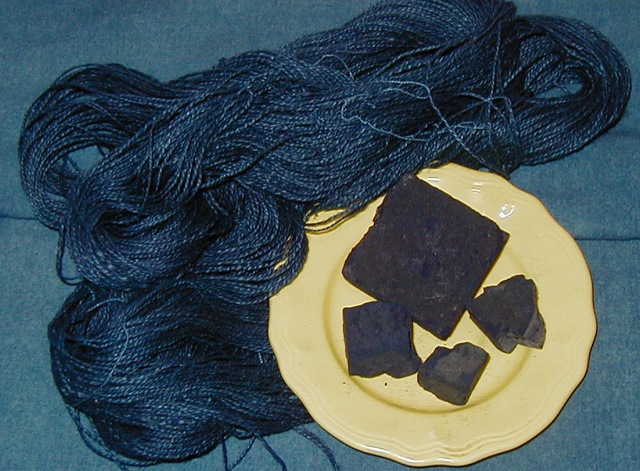
    indigo dye Indigo has been in use as a blue colorant for thousands of years as a natural dye, which was produced from the Indigophera plant in India and China and with woad in Europe. Indigo cultivation was introduced in the Americas in the 18th century, first in the West Indies and then in South Carolina. Indigo has throughout history been the colorant most in demand and current production levels are reported to be around 17,000 tons per year. Indigo was employed as a blue dye for wool primarily, until the 20th century, in fact, Indigo is a better dye for wool than cotton, being much easier to apply. There was another natural Indigo that was produced by shellfish at the eastern end of the Mediterranean Sea, known as Tyrian Purple, famous for producing the “royal purple” shade in antiquity. This dye is chemically different from the plant-derived Indigo only by the presence of bromine in the structure.

    In 1897, the BASF company began marketing synthetic Indigo which 002 - Indigo Dyegreatly increased the supply of Indigo-dyed fabrics. Once the technology for production of synthetic vat dyes was developed, a wide range of new colorants based on Indigo were available by the 1920’s. The COLOUR  INDEX , published by the Society of Dyers and Colourists in the 1924 edition, lists 54 colorants that were variants of Indigo !. The color range included the

    • Reddish brominated Indigo
    • Indigo Red
    • Indigo Yellow
    • Indigo violets
    • Oranges
    • Browns
    • Greys
    • Scarlets.

    In the 19th century natural Indigo was commonly used for printing and many of these new colorants were used for printing, especially of calico fabrics. The blue Indigo that is familiar as C.I. Vat Blue 1 is also referenced as C.I. Pigment Blue 66, when it is applied in printing.

    Other Indigoid colorants include:

    C.I. Vat Blue 5 produced by brominating Vat Blue 1 in nitrobenzene. In the 1990’s one U.S. denim company, Avondale, used this dye on a small 12-rope range to produce a fabric that was wildly popular in the fashion denim business.

    C.I. Vat Red 41, a bright red thioindigo which can be produced withindigo molecule thiosalicylic acid. This is a very versatile vat red in that it can be blended with blue Indigo in alkaline sodium hydrosulfite as in normal Indigo dyeing, be applied like a sulfur dye with sodium polysulfide in continuous or batch opertions as well as garment dyeing. Thioindigo possesses the unusual characteristic of photochromism, changing color on exposure to light. One way to test the dye in order to assure that it is thioindigo, is to disperse it in chloroform in which the color shifts from a violet to a yellowish-red.

    C.I. Vat Black 1 and C.I. Vat Brown 42 are simply mixtures of blue Indigo and thioindigo.

    C.I. Food Blue 1 is produced by sulfonating Vat Blue 1 in order toindigo food molecule produce 5,5′ indigotin disulphonic acid. This version is also listed as C.I. Acid Blue 74 and when insolubilized with aluminum salts becomes C.I. Pigment Blue 63. The highly-pure Food Blue 1 is used for coloring beverages, toothpaste, candy, mouthwash – in short, anything edible that is blue will use this form of Indigo, as well as use as a hair dye. Indigo has also been long in use to produce the blue color in fireworks !.

    Is Indigo Safe For Living Things?

    Indigo is so safe for living things that is has long been used to color medical sutures of  polyester, which is required because undyed-white sutures appear much like nerves and when the surgeon removes the sutures, the color prevents a nerve from being mistakenly cut. Originally, medical sutures were dyed with Indigo with solvents under pressure, but since then Indigo is dispersed in melted polyester resins, which are then extruded as filaments.

    All forms of Indigo exhibit the special brightness that is characteristic of the Indigoid structure and a full range of Indigo colors can be achieved readily on standard Indigo dyeing equipment by blending. Most of these dyes have steadily disappeared from market, having been largely replaced by the anthraquinones, however, they are simple to produce and perhaps there is a dye supplier that is interested in marketing this range of dyes, especially for the denim market !.

    imageThis is a guest post by Harry Mercer. Mr. Mercer has 30 years experience in the denim business including 3 prominent U.S. denim companies. He is an expert colorist for measurement and color matching as well as textile testing.

  • Pocketing for Denim Jeans That Go With The Vintage Looks

    Pocketing material is used in most trousers including denim jeans. It comes in various qualities going from 100% cotton to nlyon and polyester pocketing. 
    Normally denim jeans use white, cream or similar lighter shades of different qualities of  pocketing fabrics . But what pocketing do you use if you are creating a vintage jeans and want your pocketing material to completely align with the looks of the jeans ? You want to show that your pocketing is as aged as your jeans ?

    Normal pocketing fabrics do not work in such a case . One has to use specialised pocketing fabrics which actually fade with the washing processes done on the jeans.. However, that is not enough – one has also to ensure that the fading of the pocketing fabric stops at certain stage and it retains color which does not bleed on to the undergarments.

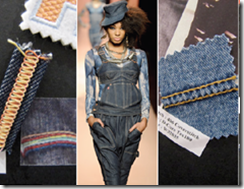
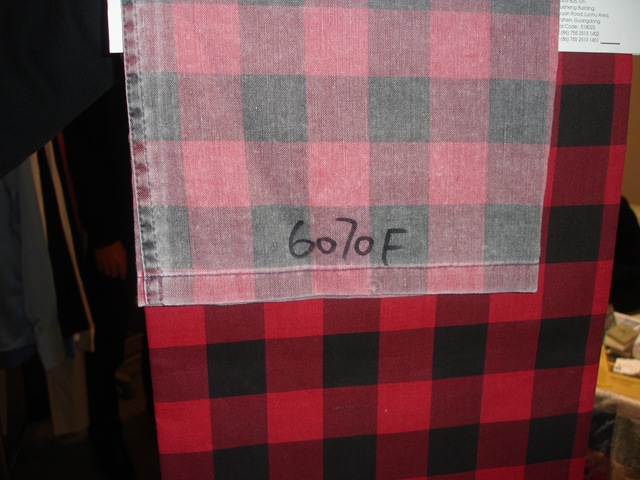
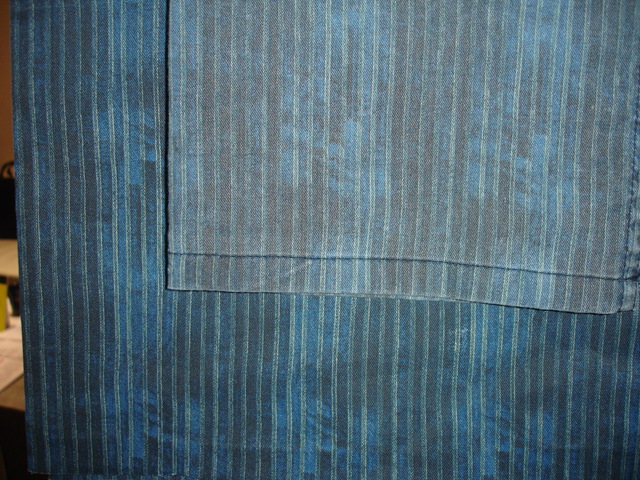
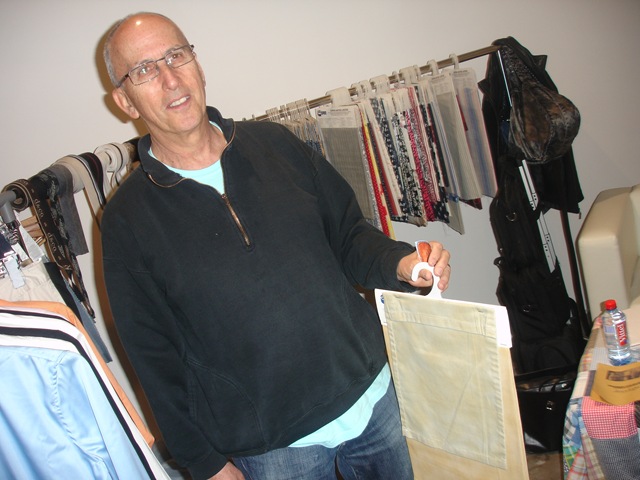
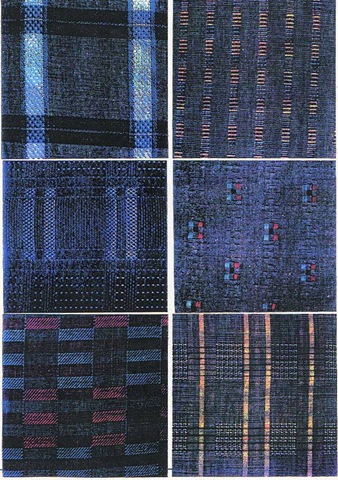
    I came across some fabrics from Copen at Kingpins Hongkong , which actually have all the characteristics mentioned above.  I found the fabrics quite interesting – some of them are shown below :

    DSC05019 DSC05020

    DSC05023

    Barry Emanuel from Copen showed me a number of such interesting fabrics which they supply to almost all major denim brands in the US. With the premium denim space getting more competitive, the brands are always looking at various ways to distinguish themselves from other brands and as Barry told me

    “ In a premium denim jeans everything has to be premium whether it is fabric, the pocketing, the rivets, tags or any other accessory’ .
    He also says “We have made pocketing fabrics – which is otherwise a very boring product – into a very interesting and lively product”. Agreed..

    About Copen :
    Copen was established in 1946 and has been in business for over 55 years. The company was originally a waistband manufacturer with a factory located on a military base in Jackson Tennessee. The company manufactures pocketing fabrics , waistbands ,printed bias tapes etc at various locations around the world.

  • Denim Constructions

    Here are some typical denim grey fabric constructions

    Weave: twill 3/1 Z

    3/1 Denim Fabric Constructions

    Warp(ends/cm) Weft(ends/cm) Warp Tex Weft Tex Weave
    24 16 7 84 6 98 3/1
    25 16 7 84 6 98  
    24 16 7 84 5.5 107  
    20.8 15.5 7.4 80 6 98  
    27 19 7.5 78 6.7 88  
    24 17 7 84 6 98  
    23 15 11 8.5 11.8 50  
    23 16.5 7 84 7 84  
    24.6 16.5 6 98 7 84  
    30 18 8.6 71 7 84  
    25 26 7 84 5.5 107  
    26 21 11.8 50 11.8 50  
    22.8 16.5 6.7 88 6.7 88  
    25 18 7 84 7 84  
    27 18 7 84 5.5 107  


    Chambray Fabrics – Weave :Plain or 2/1

    Warp Weft Warp Tex Weft Tex Weave
    24 20 24 25 24 25 1/1
    27 16 24 25 24 25 1/1
    21 12 12 49 12 49 1/1
    23 16 12 49 14 42 1/1
    25 15 9 66 7 84 1/2
    23.3 16 16 37 12 50 1/2
    25 16 16 37 16 37 1/2
    25 15 9 66 12 50 1/1
    23 19 20 30 20 30 1/1


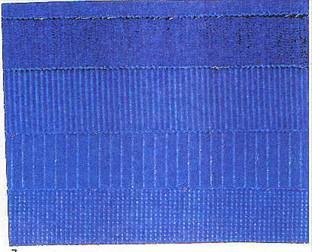
    Denim with stripes

    Combination twill 3/1, plain 1/1 whipcord. Possibilities to achieve different fabric appearance.

    clip_image002clip_image003

    clip_image004clip_image005

       Stripes twill 2/1 + ½             Stripes twill 2/1 + plain

    clip_image006clip_image007

       Whipcord narrow strips       Whipcord weave strips

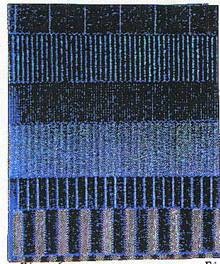
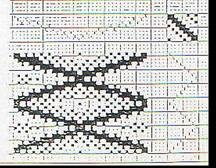
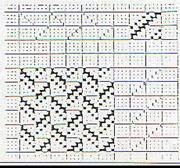
    Fancy fabric woven on dobby

    (fig. 3 + 5 woven on tappets) by inserting Lurex or count. Viscose filament in weft

    clip_image009clip_image010

    Fig. 1                                                 Fig. 2

    clip_image011clip_image012

    Fig. 3 Reversal drafting           Fig. 4 Fancy drafting

    clip_image013clip_image014

    Fig. 5 Broken drafting                Fig. 6

    Effects are achieved with multicolor WM and warp beam in high pos.

    clip_image016

    About the author: Adnan is a textile engineer and working with a reputed denim garment company in Pakistan.He is looking after new denim developments.

  • LATENT DEFECTS in DENIM FABRICS

    This is  guest post by Harry Mercer

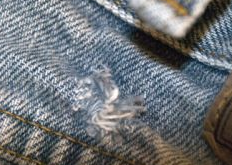
    Latent defects are ones that are not apparent in finished denim fabrics, but will appear after garment laundering. They are usually a result of procedures in denim sizing, dyeing and finishing that interfere with garment processing or cause spots, holes or streaks in garments. The most well-known is garment seam twist which results from incorrect skew adjustment.

    Holes :

    image These result from weak places in the fabric, often where knots are in the fabric from repairing broken yarns in spinning or weaving. The problem occurs often in fabric that was re-finished, especially fabric re-Sanforized in order to correct shrinkage or skew. Fabric that has been re-finished has lower strength, inferior hand and a different washed appearance. For that reason, re-finished denim should not be mixed with denim finished only once and re-finished denim should not be sent to demanding customers.

    Spots : 

    These are usually caused by chemicals used in finishing or sizing that are not easily removed by laundry de-sizing or are not soluble and precipitate in garment de-sizing and re-deposit on the garments. Mineral oils, some cationic compounds, polyvinyl alcohol and other compounds often cause these problems. Chemicals that cause spots can be analyzed for their chemical composition and chemical treatments can be devised to correct these problems in the laundry. Also, the fabric supplier can be requested to cease using offensive products.

    Alternating Light and Dark Streaks :

    When an Indigo dyeing machine stops for more than a few minutes, the yarn that is immersed in the dye boxes will over-reduce and appear as light streaks after garment laundering. The yarns that are in the airing sections after the dye boxes will appear as dark streaks after laundering. The fabric producer can segregate this problem by identifying the yarn that was in the machine during the stop from just after the pre-wet section though the end of the drying section. The standard procedure of submitting a small washed sample of a fabric roll will not allow prediction of the presence of this type of streaking because the sample is taken from one end of a fabric roll and does not represent the appearance of the entire roll. These streaks appear and disappear in the fabric. For that reason, yarn that is involved in an Indigo machine stop should be segregated. The yarn from a machine stop produces such low quality fabric that it is almost not worth weaving. The causes of machine stops need to be rigorously investigated and action taken to eliminate them.

    Crack Marks:

    These are light streaks that usually appear in garments that do not follow warp yarns. These have often been caused by the use of acrylic hand-builders that result in very inflexible fabric. When the garment is entered into the washing machine, the acrylic film breaks forming a crack and the garment fades more along the area of the crack.

    Sudden Shade Difference After Laundering :

    After garment laundering a single leg panel, for example, will have 2 completely different shades, 1 light and the other dark, with a distinct, sharp break in color. This results when Indigo-dyed fabric is located on drying cylinders when the finishing machine stops for more than about 5 minutes. Applying high temperature to Indigo for long periods causes the Indigo in the deepest part of the yarn to sublime or evaporate and after surface Indigo is removed in laundering, the fabric part that was on the drying cylinders will be lighter. Therefore, this can not be seen in the original fabric.

    Sizing Spots or Streaks:

    Basic laundry de-sizing procedures are used to de-size carbohydrate-based sizes like starch or guar gums. Polyvinyl alcohol sizes can be more difficult to remove, especially from yarn that was over-dried in sizing. If not completely removed, polyvinyl alcohol can react with hypochlorite bleaches and result in permanent spots or streaks.

    image This is a guest post by Harry Mercer.Mr. Mercer has 30 years experience in the denim business including 3 prominent U.S. denim companies. He is an expert colorist for measurement and color matching as well as textile testing.

  • Acidic Damage in the Sulfur-Black Dyeing of Denim

    This is a guest post by Harry Mercer. His brief bio is given below the post.

    Dyeing of denim yarns and fabrics with sulfur black can present a number of problems that affect fabric profit margins as well as the quality and performance of black jeans. Problems include :

    • Dye waste (normally 50% or more in washing after dyeing
    • Color variation after garment laundering
    • Lower weaving efficiencies with black yarns
    • Contact dermatitis etc. All of these problems were solved in the past, unfortunately the technical expertise in using sulfur black has greatly diminished in recent decades.

    One of the most easily correctable problems is related to acid-damage to black yarns and fabrics, which results from the generation of a sulfur-based acid, possibly sulfuric acid. This results when the pH of the black-dyed cotton is too low to buffer this acid before they can attack the cellulose chain of cotton fibers. Sulfur black-dyed materials are unusual in that they should have a pH of around 11, after dyeing and before the cotton is dried. If significantly lower, the acid generated will result in lower fabric strength or higher yarn-breakage rates during weaving.

    Damage Resulting from Chemical Oxidation of Sulfur Black

    Sulfur dyes belong to the class of dyes known as “vats”. Vat dyes are insoluble in water and cannot be carried by water into fibers until made water-soluble. Solubility of vat dyes requires that they be first chemically reduced. The reduced dye enters the fiber where it must be oxidized to form the originally insoluble dye. Once made insoluble again, the dye is mechanically trapped inside the fiber.

    The chemical oxidation of most sulfur colors can be carried out with agents such as hydrogen peroxide or sodium bromate. Chemical oxidation of these dyes must be conducted at a low pH(4.5-5.5), which requires that an acid be incorporated. For sulfur colors other than black , including greys, browns, blues, violets, greens, turquoises etc., acidic chemical oxidation is necessary to produce bright, consistent and colorfast shades.

    Sulfur blacks are an important exception to this. As a rule, sulfur blacks should not be chemically oxidized. There are 2 reasons for this:

    • First, lowering the pH of a sulfur black with acid will result in the liberation of a strong, sulfuric-type acid that will attack the cotton cellulose.
    • Secondly, if sulfur black dyes directly contact acids directly, there will be a release of dangerous hydrogen sulfide gas.

    This occurs often on continuous yarn or fabric dyeing machines used for denim. Water in the the wash boxes after dyeing become heavily contaminated with sulfur dye, which is often carried over into the acidic oxidation box causing the reaction that releases the gas.

    There is a rule-of-thumb regarding how easily a vat dye can be oxidized: if a dye is easy to reduce, it is difficult to oxidize; conversely, if difficult to reduce, easy to oxidize. Sulfur blacks require high temperatures (85-90ËšC) for reduction, while all other sulfur colors can be successfully reduced and applied at temperatures as low as 30ËšC.

    Since they are difficult to reduce, sulfur blacks can be readily oxidized by atmospheric oxygen, in the same manner as Indigo, i.e., by passing the yarn or fabric through air. If the time between the dye box and the 1st washing is adequate to allow the cotton temperature to cool to 40ËšC, oxidation will be complete. The first washing should be conducted with cold or warm water since hot washing will promote re-reduction of the dye, resulting in unnecessary dye loss and inconsistent color.

    Oxidation of Sulfur Blacks in Batch Equipment

    In sulfur black dyeing in batch processes, air oxidation can be conducted on sulfur blacks after dropping the dye bath and circulating the fabric through air before washing. In package dyeing equipment, a compressed air line can be installed that is used to force air from the inside of the yarn package to the outside. In garment machines, uniform air oxidation is difficult and chemical oxidation of sulfur black may be the only option. However, hydrogen peroxide should not be used for sulfur blacks, this would result in a loss of colorfastness. This is probably because the huge sulfur black molecule is broken down into shorter units by peroxides which have less resistance to washing. If chemical oxidation is necessary, then a milder oxidizer such as sodium bromate should be used. After oxidation, the sulfur black dyed material should be buffered to a pH of 11.

    A good laboratory predictor of potential strength loss in storage is AATCC Test Method # 26:

    Ageing of Sulfur-Dyed Textiles: Accelerated

    A sulfur black-dyed sample of fabric or yarn is placed in a chamber where it is exposed to heat and humidity and dried. The material is allowed to condition and is tested in order to determine strength loss after ageing. The method can be demonstrated simply by placing a sample in a forced-draft oven with about 500 cc’s of water and removing it about 30 minutes after all the water has evaporated.

    harry mercer denim consultant This is a guest post by Harry Mercer.Mr. Mercer has 30 years experience in the denim business including 3 prominent U.S. denim companies. Also, as a result of being the laboratory manager of the American Association of Textile Colorists and Chemists (1986-1989, he is an expert colorist for measurement and color matching as well as textile testing.

  • Dyes Used For Denim Dyeing – A Description


    This is a technical writeup on various types of dyes used in Denim Dyeing by one of our guest writers – Adnan

    Indigo Dyes

    Background

    Indigo, or indigotin, is a dyestuff originally extracted from the varieties of the indigo and woad plants. Indigo was known throughout the ancient world for its ability to color fabrics a deep blue. Egyptian artifacts suggest that indigo was employed as early as 1600 B.C. and it has been found in Africa, India, Indonesia, and China.

    The dye imparts a brilliant blue hue to fabric. In the dying process, cotton and linen threads are usually soaked and dried 15-20 times. By comparison, silk threads must be died over 40 times. After dyeing, the yarn may be sun dried to deepen the color. Indigo is unique in its ability to impart surface color while only partially penetrating fibers. When yarn dyed with indigo is untwisted, it can be seen that the inner layers remain uncolored. The dye also fades to give a characteristic worn look and for this reason it is commonly used to color denim. Originally extracted from plants, today indigo is synthetically produced on an industrial scale. It is most commonly sold as either a 100% powder or as a 20% solution.

    History

    The name indigo comes from the Roman term indicum, which means a product of India. This is somewhat of a misnomer since the plant is grown in many areas of the world, including Asia, Java, Japan, and Central America. Another ancient term for the dye is nil from which the Arabic term for blue, al-nil, is derived. The English word aniline comes from the same source.

    The dye can be extracted from several plants, but historically the indigo plant was the most commonly used because it is was more widely available. It belongs to the legume family and over three hundred species have been identified. Indigo tinctoria and I. suifruticosa are the most common. In ancient times, indigo was a precious commodity because plant leaves contain only about small amount of the dye (about 2-4%). Therefore, a large number of plants are required to produce a significant quantity of dye. Indigo plantations were founded in many parts of the world to ensure a controlled supply.

    Demand for indigo dramatically increased during the industrial revolution, in part due to the popularity of Levi Strauss’s blue denim jeans. The natural extraction process was expensive and could not produce the mass quantities required for the burgeoning garment industry. So chemists began searching for synthetic methods of producing the dye. In 1883 Adolf von Baeyer (of Baeyer aspirin fame) researched indigo’s chemical structure. He found that he could treat omega-bromoacetanilide with an alkali (a substance that is high in pH) to produce oxindole. Later, based on this observation, K. Heumann identified a synthesis pathway to produce indigo. Within 14 years their work resulted in the first commercial production of the synthetic dye. In 1905 Baeyer was awarded the Nobel Prize for his discovery.

    At the end of the 1990s, the German based company BASF AG was the world’s leading producer, accounting for nearly 50% of all indigo dyestuffs sold. In recent years, the synthetic process used to produce indigo has come under scrutiny because of the harsh chemicals involved. New, more environmentally responsible methods are being sought by manufacturers.

    Raw Materials

    The raw materials used in the natural production of indigo are leaves from a variety of plant species including indigo, woad, and polygonum. Only the leaves are used since they contain the greatest concentration of dye molecules. In the synthetic process, a number of chemicals are employed as described below.

    SOURCES AND USES: –

    A variety of plants, including woad, have provided indigo throughout history, but most natural indigo is obtained from those in the genus Indigofera, which are native to the tropics. In temperate climates indigo can also be obtained from woad (Isatis tinctoria) and dyer’s knotweed (Polygonum tinctorum), although the Indigofera species yield more dye. The primary commercial indigo species in Asia was true indigo (Indigofera tinctoria, also known as Indigofera sumatrana). In Central and South America the two species Indigofera suffructicosa and Indigofera arrecta (Natal indigo) were the most important.

    Natural indigo was the only source of the dye until about 1900. Within a short time, however, synthetic indigo had almost completely superseded natural indigo, and today nearly all indigo produced is synthetic.

    In the United States, the primary use for indigo is as a dye for cotton work clothes and blue jeans. Over two billion pairs of jeans around the world are dyed blue with indigo. For many years indigo was used to produce deep navy blue colors on wool.

    Indigo does not bond strongly to the fiber, and wear and repeated washing may slowly remove the dye.

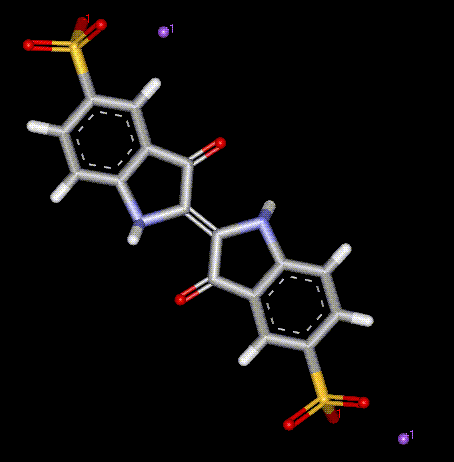
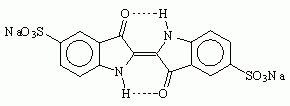
    Indigo is also used as a food coloring, and is listed as FD&C Blue No. 2. The specification for FD&C Blue No. 2 includes three substances, of which the major one is the sodium salt of Indigotindisulfonate.

    Indigotinesulfonate is also used as a dye in renal function testing, as a reagent for the detection of nitrates and chlorates and in the testing of milk.
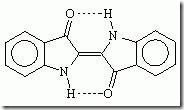
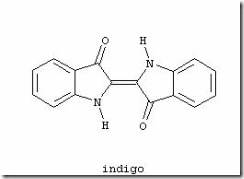
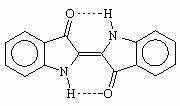
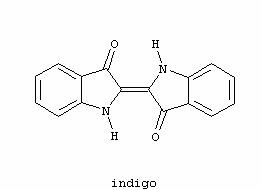
    clip_image002INDIGO MOLECULE

    CHEMICAL PROPERTIES: –

    Indigo is a dark blue crystalline powder that melts at 390°–392°C. It is insoluble in water, alcohol, or ether but soluble in chloroform, nitrobenzene, or concentrated sulfuric acid. The chemical structure of indigo corresponds to the formula C16H10N2O2.

    The naturally occurring substance is indican, which is colorless and soluble in water. Indican can easily be hydrolyzed to glucose and indoxyl. Mild oxidation, such as by exposure to air, converts indoxyl to indigo.

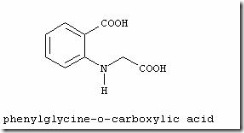
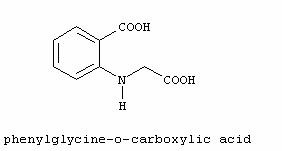
    The manufacturing process developed in the late 1800s is still in use throughout the world. In this process, indoxyl is synthesized by the fusion of sodium phenylglycinate in a mixture of sodium hydroxide and sodamide.

    Several simpler compounds can be produced by decomposing indigo; these compounds include aniline and picric acid. The only chemical reaction of practical importance is its reduction by urea to indigo white. The indigo white is reoxidized to indigo after it has been applied to the fabric.

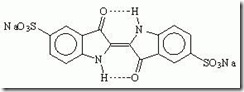
    Indigo treated with sulfuric acid produces a blue-green color. It became available in the mid-1700s. Sulfonated indigo is also referred to as Saxon blue or indigo carmine.

    Tyrian purple was a valuable purple dye in antiquity. It was made from excretions of a common Mediterranean Sea snail. In 1909 its structure was shown to be 6,6′-dibromoindigo. It has never been produced synthetically on a commercial basis.
    clip_image004

    INDIGO CARMINE

    HOW THE DYE WAS PRODUCED IN INDIA 

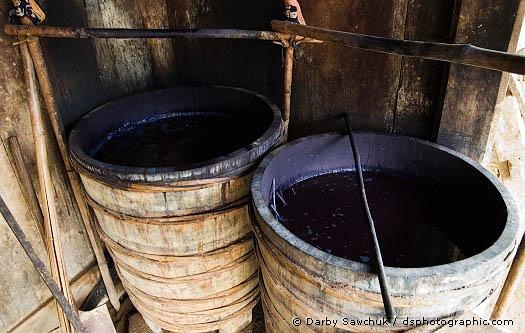
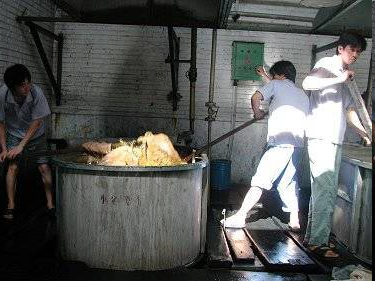
    The cut plant is tied into bundles, which are then packed into the fermenting vats and covered with clear fresh water. The vats, which are usually made of brick lined with cement, have an area of about 400 square feet and are 3 feet deep, are arranged in two rows, the tops of the bottom or "beating vats" being generally on a level with the bottoms of the fermenting vats. The indigo plant is allowed to steep till the rapid fermentation, which quickly sets in, has almost ceased, the time required being from 10-15 hours. The liquor, which varies from a pale straw colour to a golden-yellow, is then run into the beaters, where it is agitated either by men entering the vats and beating with oars, or by machinery. The colour of the liquid becomes green, then blue, and, finally, the indigo separates out as flakes, and is precipitated to the bottom of the vats. The indigo is allowed to thoroughly settle, when the supernatant liquid is drawn off. The pulpy mass of indigo is then boiled with water for some hours to remove impurities, filtered through thick woollen or coarse canvas bags, then pressed to remove as much of the moisture as possible, after which it is cut into cubes and finally air-dried Nature 1 November 1900

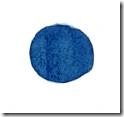
    Indigo dye is an important dyestuff with a distinctive blue color (see indigo). The natural dye comes from several species of plant, but nearly all indigo produced today is synthetic. Among other uses, it is used in the production of denim cloth for blue jeans. The form of indigo used in food is called "indigotine", and is listed as FD&C Blue No. 2.
    clip_image006

    PHYTOCHEMISTRY OF INDIGO

    Now just a bit of chemistry about how the compounds in plants are converted into indigo…

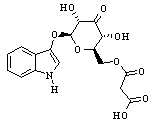
    clip_image008

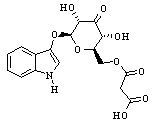
    In Indigofera species, the precursor of indigo is indican 
    (left), indoxyl-β-D-glucopyranoside,

    While in woad it is mainly isatan A (right)
    clip_image010

    INDUSTRIAL SYNTHESIS OF INDIGO

    Current world production of indigo is 17,000 tons/year, mostly (40%) produced by BASF in Ludwigshafen. That is where things started in July 1897, using a process developed by von Heumann. It started with naphthalene…

    clip_image011clip_image012clip_image011[1]clip_image012[1]clip_image012[2]clip_image014clip_image016clip_image018clip_image020clip_image022clip_image024

    VAT DYES

    Vat dyes are used in the dyeing and printing of all types of cellulose fibres, and also of blends of cotton with polyester. In their coloured form they are insoluble pigments, so their applications depend on reversible reduction-oxidation (redox) reaction. In dye bath the pigment is converted into a water-soluble form using a strongly alkaline solution of a powerful reducing agent. This form the sodium “leuco” compound of the dye, which is soluble in water but often different in colour from the original in pigment. It is then allowed to dye the cellulose in this water-soluble from once exhaustion is completed the leuco compound is oxidized.

    REDOX REACTIONS

    Oxidation-reduction reactions (redox reaction) are important in textile colouration because they are an essential part of the process of the application of vat and sulphur dyes. In rather oversimplified terms, when a compound id oxidized it gain oxygen when something is reduced it loses oxygen. Reduction of a substance can also be thought of as gaining oxygen atoms, and oxidation as losing hydrogen atoms. For example when hydrogen reacts with oxygen to form water the hydrogen to become oxidized and the oxygen is reduced. In a redox reaction there is always a compound acting a reducing agent (hydrogen in this example). The reducing agents become oxidized the reaction by the compound that is being reduced, which is acting as an oxidizing agent. (In this case oxygen)

    clip_image025 NaOH Na+ + OH

    Sodium Sodium Hydroxide

    Hydroxide ion ion

    In the water molecule each hydrogen atom shares the only electron it possesses by pairing with one of the six electron of the oxygen atom, to form a covalent bond. Thus the hydrogen atom has lost one electron to become oxidized and the oxygen atom is reduced by gaining electrons. This is a more general way of expressing the phenomena of oxidation and reduction.

    Oxidation = entails the loss of electrons by the oxidized compound

    Reduction = entails the net gain of electrons by the reduced compound

    vat dyes such as indigo and compounds derived from anthrequinone are applied after the temporary reduction of two carboxyl group in a conjugated chain, this convert the dye in to a colorless water insoluble form. The conversion is carried out using a strong reducing agent and in this reaction the two oxygen atom becomes reduced –O – and the two hydrogen atoms are oxidized to H+. The reduced form is called the leuco vat acid, and is applied from an alkaline. Once on the fibre it can be re -oxidized back to the insoluble carbonyl form by air or by the use of an oxidizing agent.

    Sulphur dyes are also applied using a redox reaction mechanism, in which sodium sulphide is used as the reducing agent,

    CHEMICAL NATURE OF VAT DYES

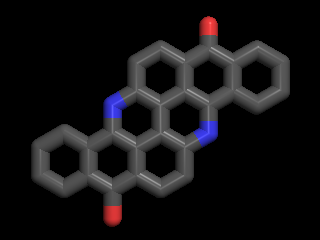
    A large majority of vat dyes are based on the anthraquinonoid or the indigo (or thioindigo) chromophores; indigo, one of the oldest dyes still in use, remains popular through the wide use of indigo-dyed anthrequinone dyes are complex polycyclic quinines (Appendix 1), and they all possess two carbonyl groups (C = O) linked by alternate single and double bonds in a conjugated chain. The molecular arrangement is responsible for the easily reversible redox reactions on which the application of vat dyes depends.

    In earlier countries, when all textile colorants where obtained from natural sources, indigo plant is steeped in a large vat. It is forming this ancient vatting process that the term fermentation vat dyes are derived. Fermentation converts one of the plant constituents into the soluble leuco dye, which diffuses out of the plant. The replacement of the natural by synthetic indigo at the end of the nineteenth century gave the imputes to research on other syntheses vat dyes have since followed.

    Synthetic vat dyes are costly because they are difficult to prepare, so their use is usually directed to the higher quality fabrics. Nevertheless, they are widely used and noted for their high fastness to light, in the dyeing of fabric for uses such as awning, curtains, upholstery, military and naval uniforms and high quality gabardines.

    High fastness to bleaching is another strong point of the anthraquinonoid group. This is exploited in the production of patterned fabric from vat-dyed yarn in which the white areas of the can be safely bleached out after weaving.

    Anthraquinonoid vat dyes are widely used in the manufacturer of for example good quality, shirting’s, table cloths, towels, sportswear, high quality over all, fabrics of women and children clothing and tropical suiting, and yarns and effect threads where repeated washing will be required. With careful dye solution, the use of vat dyes allows is that the range lacks scarlet, maroon and wide shades.

    APPLICATION OF VAT DYES

    Both the extent of reduction and the rate at which equilibrium between the reduced and oxidized from is achieved are of practical significance. Vat dyes vary in the speed with which they go undergo reduction (Na2S2O4), which is capable of completely reducing even the most stable of vat dyes. As a result any difficulties in vatting can be over come by raising the vatting temperature, increasing the concentration of reducing agent or prolonging the vatting time. The vatted dyes must be kept in a strongly alkaline solution, because its leuco from is an insoluble acid. If instead of being formed as its water soluble salt, it will not readily oxidize to the coloured form.

    There are still some application methods in which reduction and adsorption in the fibre take place rapidly and almost simultaneously. Under those conditions the rate and extent of reduction can be decisive factors in the dye stuff choice for example, in textile printing. Premature oxidation of the leuco compound in his print paste must also be avoided during both storage and steaming. This condition is usually met by using as the reducing agent sodium formaldehyde sulphoxylate (Formosul) a compound that is fairly stable in air at room temperature and develops the necessary action during steaming.

    Variables such as pigment practical size and crystalline from can affect the rate of reduction but these are controlled by the dye manufacturing. Consequently the colourist needs to concentrate only on the temperature and the concentration of reducing agent.

    Leuco compounds can be applied by batch wise methods similar to those used for other dye classes, but there are difficulties in obtaining leveling dyeing. The necessary high concentration of sodium hydroxide and reducing agent affect the exhaustion. The difference is that the option of reducing the concentration of the addition is not available, because they are needed to form the leuco compound. Serious leveling problems can be lessened by raising the temperature of dyeing and then cooling to obtain satisfactory exhaustion, or by using a dye bath auxiliary that restrains the rate of exhaustion. A different approach is to use specially formulated to stable dispersion of the pigment, in which form they are evenly distributed on the fabric by padding (pigment padding), followed by working the padded fabric through a of caustic soda and sodium dithionite on a jig. Pre-pigmentation can be carried out using package, jig, winch or beam dyeing machines provided specially formulated vat dyes are used. Once the pigmentation is completed, sodium hydroxide and sodium dithionite are added to the dye bath to reduce the pigment and allow the leuco day salt to diffuse into the fibre.

    Oxidation in air or in solution is then used to regenerate the pigment. A soaping treatment is given to the fabric at the end of the dyeing process this is essential, both for cleaning the dyed fabric and for developing the final shade. In some cases a change in the crystalline form of dye accompanies the change in shade.

    SOLUBILISED VAT DYES

    The need to reduce vet dyes before use makes their application a cumbersome process. Although it is possible to isolate the reduced form of the dye. It is too readily oxidized in air for the manufacturer to provide the dyer with the leuco compounds. it is possible however to convert the leuco acid into the leuco ester, a derivative that has greater resistance to oxidation and grater solubility in water. Such ester can be formed by the reaction of a hydroxyl group of a leuco acid with sulphuric acid forming a sulphuric ester. The sodium salt of such esters are stable and can be stored until required for use. Since the ester group is only weakly attached to the rest of the dye molecule, it is easily removed by the action of sodium nitrate in dilute sulphuric acid. The regenerated leuco compound may then be oxidized back to the pigment form.

    Solubilised vat dyes are less rapidly taken up than are the more conventional vat dyes and are mainly used for the production of pale shade. As with ordinary vat dyes application under alkaline condition is essential, thus eliminating wool from the list of possible substrates because alkaline condition modifies the wool fibres. The low up take and higher cost of solubilised vat dyes make them uneconomical for deep shade however and for theses normal vat dyes alternative have to be used.

    A interesting property of solubilised vat yes is their sensitivity to light in the solubilised state. This is used to produce “photographic” print on fabric.

    clip_image026R – OH + H2S2O4 R – OH + H2S2O4 + H2O

    Leuco vat sulphuric sulphuric ester

    Dyes acid

    SULPHUR DYES

    Deposition of insoluble pigments inside fibres may achieve more cheaply using sulphur dyes. But with these the shade gamut is restricted to back, mauves, olives, Bordeaux and reddish-browns. One of the earliest and best known sulphur dyes is Cl sulphur black 1, which is popular black with good fastness properties still in use today.

    Like vat dyes, sulphur dyes are reduced and applied as soluble leuco compounds that need to be kept under alkaline condition, but sulphur dyes need only sodium sulphide to act as both alkaline and reducing agent. A simplified the version of the reaction is represented in following equation. The structure of the chromophores of sulphur dyes is complex and unknown. Again like vat dyes, these dyes can not be applied to wool without damage to the fibres due to the action of sodium sulphide on the cystine cross links. After exhausting the dye bath for approximately 1 hour at 60-90Co the fabric is thoroughly rinsed and exposed to the atmosphere, where oxidation generates the mechanically entrapped insoluble pigment.

    One disadvantages of certain sulphur dyes (although, strangely, this problems appears to arise with the black shade only) is that dyed material stored under condition of high humidity and temperature can lose its nature strength. This is because inadequate washing-off after dyeing can lead to the slow generation of sulphuric acid in the fibre, arising from the presence of sulphur.

    Sulphur dyes are used mainly in the dyeing of cellulose fabrics and in blend of cellulose with polyester, nylon and acrylic fibres. Typical application is for heavy drill fabrics. Corduroys, overalls, denim, awning and canvas. Limited quantities are also consumed in the colouration of silk, paper and more widely, leather.

    clip_image026[1]Ar’ – S – S- Ar’ Reduction with Na2S Ar’ – S – S- Ar’

    About the author: Adnan is a textile engineer and working with a reputed denim garment company in Pakistan.He is looking after new denim developments.

  • Indigo Dyeing – Various Methods Explained And Compared

    The indigo dyeing and processing methods -currently used – for dyeing indigo warps were introduced from 1978- 1987 to obtain a higher productivity and savings in dyeing or to achieve the required darker shades (hard rock washing, super blue, soft denim), or softness of the yarn for final finishing. The following table gives you a comparison of the possible processing stages such as:

    1- Indigo rope dyeing process

    2- Indigo one sheet dye slashing

    3- Indigo double sheet dyeing

    4- Loop dye 1 for 6 (continuous dye slashing)

    5- Loop dye 1 for 6 with dyemer (continuous mercerization dyeing and sizing).

    For the five major Indigo dyeing methods for the basic denim, super blue denim, soft denim, stone wash denim, we also must take into consideration that a certain appearance of the garments is only achieved after a certain washing method. (Chemical washing, stone washing, hard rock washing), use of certain sizing agents (soft denim) or irregular appearance in warp or weft direction by using a yarn with slubs and neps (antic denim).

    The final finishing methods have influence on fabric construction and dyeing methods.

    CHEMICAL WASHED DENIM

    The creator of snow wash denim or of f-side denim is Edwin Co. Limited Japan. These chemical washed types of ready made garments show less tensile strength and a harder hand.

    STONE WASHING

    With soft stones it takes 20 – 30 min. to achieve the desire surface appearance.

    DRY BLEACH

    Soft rock are socked with chloride and the garment treated in washing machines.

    HARD STONE WASHING

    Treatment takes approx. 3 – 4 hours. A very soft hand the garments is achieved. Due to the extended time of treatment in washing with hard rocks the strength of fabric is influenced. This treatment requires improved yarn quality and deeper dyed shades. Hard stone washing fades out partly at hems and stitched lines.

    SUPER BLUE

    Deepness shade is achieved by dyeing in 8 – 12 dye boxes with rope dyeing methods. With mercerized yarn where the colour stays at the surface of the yarn (ring dyeing) with continuous loop dye range with integrated mercerizing and dyeing unit (dyemer).

    BLACK DENIM

    Sulfur dyed, padazoic dyed etc. on continuous dyeing sizing machines or loop dye ranges.

    INDIGO DYESTUFF AND ITS CHARATERISTICS

    Indigo has despite many other blue dyestuffs kept its popularity. This by no doubt is achieved by the fact that Indigo has a number of properties which have in this combination not yet been achieved by other single dyestuffs.

    The main properties are:

    • Pleasant colour shade.
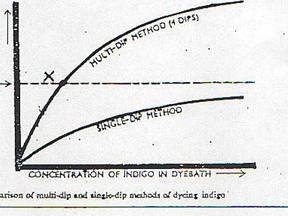
    • Possibility to achieve by simple repeated dipping, deep marine blue shade.
    • Possibility to dye cotton in cold dye bath.
    • Competitive in price.
    • Possibility to achieve an acceptable colour fastness and the exceptional advantage by repeated washing of fading colour, to keep the colour shade that always a clear, pleasant blue shade result.

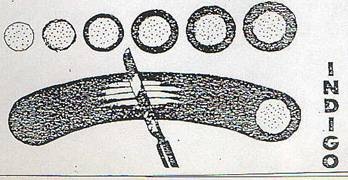
    The following drawing shows the symbolic  built-up of dye stuff of the yarn according to the multi-deep process.

    indigo dye denimThe sketch shows how Indigo layers one after the other are placed on the surface of the yarn then again scraped off, similar to knife through force or tension or by washing.

    An Indigo has only a very low affinity and the depth of colour of the fibre is achieved by repeated dipping / oxidation. Each dipping cycle occur in a certain balanced manner as dye stuff is observed by the fibre at the same time and part of the already oxidized dye stuff is reduced and migrates from the fibres.

    indigo dye denim

    With increasing dipping operations , the  balance of absorption / migration moves towards migration.

    A very important factor for the reduction of migration is the squeezing effect and the oxidation which follows. A high squeezing effect promotes a quick and thorough oxidation and reduces the migration and reduction in the following bye bath.

    With the low squeezing effect ie  with high liquid absorption, the purely visual impression of a good oxidation can be deceptive as the outer colour skin looks blue. In the core of the thread however  less vat dye stuff may be deposited

    indigo denim dye image

    Let us have a close look at the different dyeing systems.

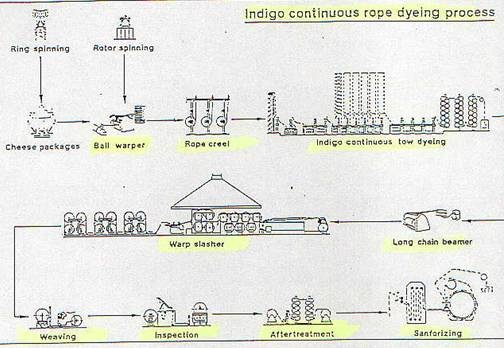
    CONVENTIONAL CLASSICAL CONTINUOUS INDIGO ROPE DYEING

    The classical rope dyeing system is very labor intensive and consists of:

    • Ball warping
    • Indigo dyeing
    • Rebeaming on long- chain-beamer
    • Sizing

    Yarn from the ring spinning machine is wound on automatic winding machines on to a suitable package either cylindrical or 5057 cone. The winders are directly linked to the ring spinning frames and the cops joint by splicing. OE yarns are directly creeled up on the Ball warper.

    The required No. of ends (usually 380 – 420 ends) are assembled into a rope. These ends are wound onto a core. The rope is guided similar as a cross wound package and wound into a ball, length of ball approx. 12 – 15.000 meters.

    A lease is inserted at the start and end of the rope. The facilitate Rebeaming every 1000 meters an additional lease is inserted. Usually 18 – 24 ropes are simultaneously process on the rope dyeing machine. Prior to dyeing, the ropes are boiled out and treated with caustic-soda and wetting agent to remove from the cotton oil, impurities which could influence the fastness for the dye.

    To dye with indigo, the ropes are immersed into the dye-bath. To dye in rope 30 – 60 seconds immersion (20 meters yarn) and 60 – 180 seconds are required for the oxidation of the Indigo dyestuff to ensure that also ends in the centre of the rope are equally dyed. Please note that squeezing pressure is important- 5 tons- as fastness of colour and shade depends on even squeezing pressure. The comparatively long immersion and oxidation time requires a comparatively expensive equipment of machinery.

    In order to obtain the required deep shade of blue colour the ropes are  immersed 5 – 6 times in a sequence of dye boxes with an oxidation range – so called skying – after each dye box. (Indigo belongs to the group of the vat dyes which is water-soluble in reduced solution and becomes an insoluble pigment when oxidized.

    ROPE DYEING PROCESS

    Having passed the dyeing and oxidation rage the ropes are guided through 2 or 3 washing boxes to wash off excessive dye .In the last box softener are added to ease the opening of the ropes. They are dried in a series of cans. The dried ropes which contain 380 – 420 ends are then deposited into large coilers .Rebeaming with 300 – 380 ends per rope is easier. These coilers are placed behind the long chain beamer where the Rebeaming and opening of the ropes takes place. In order to guarantee even yarn tension through Rebeaming on to a back beam ready for sizing the ropes are guided over a tension device which is placed approx.  10 -11 meters distance from the long chain beamer. Broken ends which very really happen during process of the rope dyeing are repaired at this process stage. Initially these machines were supplied without yarn stop motion but are available now a days on special request. This is of major importance as lost ends, fluff, 3 – tail ends and yarn remnants can cause inferior performance in weaving.

    The so prepared beck beams are now sized in a sizing machine preferably with 2 size boxes. The size pick up varies between 8 – 10%. In Europe mainly modified starches with binders are used, whilst in USA certain low % of PVA is applied in combination with starches by some companies. Depending on the final finishing process (washed denim) with no filler also CMC gives excellent performance in weaving. Special size mixes for soft denim will be discussed separately. We recommend however not to use PVA for sizing of denim as a surface of denim may show a leather skinned appearance.

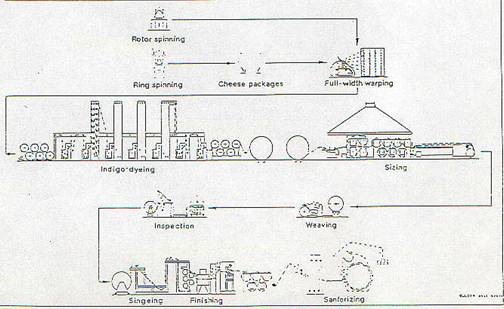
    CONTINUOUS SLASHER DYEING SYSTEM

    Contrary to the Indigo rope dyeing system, for the continuous slasher dyeing and sizing back beams are used. That means that the total No of ends required for a weavers beam are dyed, dried, sized and dried simultaneously. The back beam contains similar to rope 380 – 420 ends but distributed evenly over the width of 140 or 160 cm between the flanges so the end lay parallel to each other, warp length 12 – 15.000 meters, similar to the rope dyeing system the full No of ends are pretreated (washed) dyed in 4 dye boxes and oxidized, no softener are used in the last wash box.

    CONTINUOUS INDIGO DYEING AND SIZING PROCESS

    SLASHER DYEING

    We must however consider that the squeezing effect is lower and therefore the danger of streakiness and shade variation from centre to out side is also higher. Consequently it would be better to reduce the warping width rather to 140 cm instead of using warper beams with 160 – 180 cm warping width.

    The immersion time in the dye boxes is approx. 10 – 15 seconds and time for oxidation 30 – 60 second. The final result is a weaver’s beam. This system allows the installation of less expensive dye rage and less additional preparatory machinery.

    One of the disadvantages previously when warp preparation (knots, weak, thick places) was not kept at a very high level was that ends sown in the dyeing range could cause major color variation through machine stops.

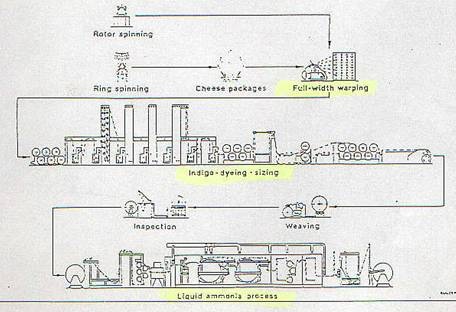
    DOUBLE SHEET CONTINUOUS DYEING

    Patents applied for double shade dyeing by E. Godau date back as 1976. With the system dyeing sizing is done in 2 operations. The main reason for dyeing of 2 sheet simultaneously is achieved a more even dyed sheet, that means 8000 – 8200 end are dyed, oxidized, dried and the full length of the warper beam 12.000 – 15.000 meters flange diameter. These beams are transported with the aid of air cushions to the sizing machine and the yarn sheet sized in double size boxes. Immersion time and oxidation time is the same as with continuous slasher dyeing.

    Indigo full-width warping process

    double sheet dyeing process

    With double sheet dyeing the linear warp thread density is doubled. Therefore:

    • Squeezing effect is increased,
    • An even squeezing over the whole width is achieved,
    • Condensation and concentration of ends at one spot show compared to single sheet dyeing no colour strips formation, streakiness or shading in the finished fabric.
    • The production out put of the dyeing is increased by 75%.
    • Dyeing of 3 layers of yarn simultaneously is possible but very difficult to control the beaming on 3 big warp batches.

    Unfortunately the double sheet dyeing machine as well as the rope dyeing range cannot be linked with a sizing machine which must be regarded as disadvantage as the processes of dyeing and sizing must be carried out separately.

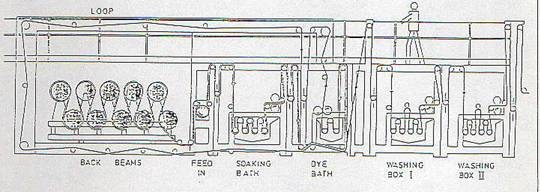
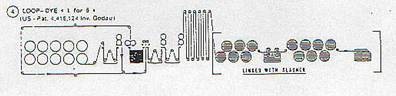
    Loop dye system 1 for 6

    Similar to the sheet dyeing systems 10 – 16 warper beams with the total number of ends required for the weaver beams are used. The warper beams are placed in a moveable warp creel which can be loaded whilst one set is in potation.

    loop dyeing process

    The yarn sheet is guided to the soaking bath through a feed-in system with tension compensation rollers. The soaking bath has the task to prepare the yarn for the following dyeing operation.

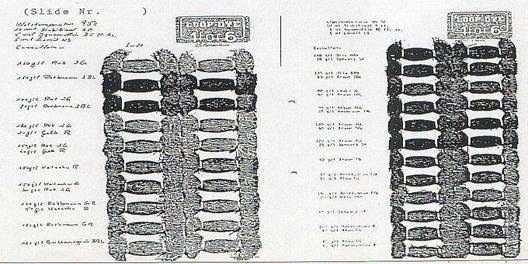
    The yarn sheet after having been immersed into a single indigo dye bath runs into a long loop where oxidation takes place. As you can see from the slide the back beams are inside the yarn sheet passes through the dye box as often as necessary to obtain the required deepness of shade. One of the advantages is:

    Ideal, utilization of Hydrosulphite through squeezing 4 – 6 layers simultaneously and oxidation of yarn in a comparatively long oxidation loop. After the oxidation the yarn sheet is guided through 2 washing boxes into a yarn accumulator and finally on to a series of drying cans, dried up to 25 – 30% final moisture content prior being immersed into size boxes, dried and wound onto a weavers beam.

    loop dyeing system

    The molecules are controlled DC drive to maintain warp tensions. Temperatures are automatically controlled as well as the PH value in the dye box. The automatic control unit of the PH value supplies automatically hydrosulfite and caustic soda to stabilize the present value from the start to end of a dye set.

    All rollers arein  contact with the dyed sheet are fluted, they keep the sheet in position and reduce deposit of dye and build-up of other deposit (fluff). In addition to width is controlled by guides to ensure even distribution of the yarn layer over the whole width of the dyed sheet.

    All accumulators placed between washing boxes and drying cans guarantees a continuous production of the dye range when a weaver beam has to be exchanged at the head stock.

    The creels can be loaded with back beam with 1200 mm diameter which allows to warp approx. 36.800 meters of yarn, count No 7, 5 (tex 78) or 50.000 m count No 10 (tex 60). This means that depending on the count normally one cyl-spool is used in warping to fill a warper beam.

    WARPING SPEED

    PRODUCTION

    Speed varies between 1000 m/min, 35 m/min. No 5, 5 (tex 107) and 42 m/min. No 10 (tex 60)

    MACHINE STOPS DURING SIZING

    For 36800 m, 4 recorded on expansion comb.

    WASTE OF MATERIAL

    Approx. 15-20 kg per set.

    TIME REQUIRED FOR CHANGE OF SET

    2 hour

    Linear warp densities in the squeeze.

    The linear density in the nip is calculated in the same manner as for sizing.

    Q= linear thread density

    F= ends in cm -1

    D= diameter of yarn

    clip_image016clip_image017clip_image016[1]D= 0,921 mm = 0,921 = 0, 29125

    clip_image018clip_image017[1]clip_image018[1] Nm 10 = 3.1622

    Q= F x D

    As already mentioned previously the warp density has an influence on colour fastness. A higher squeezing effect is achieved due to the over laying of the watp ends this also gives more side to side squeezing, therefore reduce strips formation. The high squeezing effect results also in better, quicker and proper oxidation and better colour fastness.

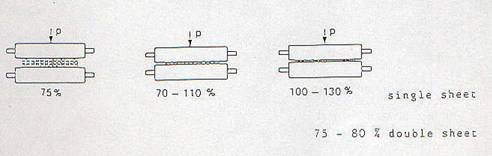
    It must be mentioned that recommended dip and oxidation times on warp dyeing ranges are of little use if not the squeezing effect is taken into consideration. Under a given squeeze pressure, for instance 500 kg the squeezing effect of the mentioned 4- dyeing systems can be compared. We can see that similar squeezing effect can be achieved with the loop dyeing system 1 for 6 (75%) as with rope dyeing 70 – 110%. Double dyeing with 2 layers width with 150 cm gives approx. 80% squeezing effect, whilst single sheet slasher dyeing varies depending on count between 100 – 130%.

    Loop dye 1 for 6 Rope-dyeing Slasher-dyeing

    clip_image020

    As only one short indigo dye bath is deeded only one feeding tanks, no separate feeding of chemicals is necessary.

    Dye liquor is use in 1500 1 instead of 6-4500 1, therefore less chemicals are in  use at same time.

    • Lowe power consumption.
    • Fine counts can be dyed as well (No 30)
    • For dark shades, black shades or other shades needed by fashion, other indanthrene dye stuff can be directly added into the indigo dye bath (indanthrene yellow or orange).

    LOOP DYE 1 FOR 6 COMBINED WITH DYEMER

    The demand for dark shades specially dark marine blue for super blue denims also led to new ideas in indigo dyeing ranges have been increased between 8-15 dye boxes with corresponding oxidation ranges.

    loop dye system

    In some cases Hydroxyaceton has been specially treated with high frequency. Besides achieving a darker shaded with the desire greenish touch it is very suitable for biological treatment.

    In order to achieve ring dyeing, mercerized yarn has also been used. Mercerizing prevents penetration of dye stuff into the inner code it is suitable for this purpose to obtain an optical blue effect and superior colour fastness and behavior in washing. Mercerizing is very costly, therefore new ways in continuous mercerizing and indigo dyeing was found.

    DYEMER

    The dyemer range is integrated.

    For impregnation padder for hot caustic solution is placed after the heating system. The yarn is guided over cold cylinders and with an adjustable roller the tension of the yarn sheet can be adjusted according to the required tension prior to the scouring in 2 more boxes.

    After having passed this, the yarn sheet is immersed into the dye box and the same process as with the loop dye method is repeated.

    CONTINUOUS DYEING AND SIZING ON THE DYEMER RANGE

    dyemer range

    If fashion needs other colours than indigo blue it is comparatively simply to dye and size on this range.

    Slasher Dyeing Vs Rope Dyeing – A comparison

    Comparison On Slasher Dyeing Rope Dyeing
    Required Space Less More
    Mercerizing Easy Difficult
    Manpower Less More
    Dye bath Less capacity More
    Yarn Can use Ne 1-30 without major change Can use Ne1-16 without major change
    Flexibility Flexibility to produce denim in different colors and small quantities Less flexible. Difficult to change colors.
    Cost Cost of production is lesser compared to Rope Dyeing Cost of production is more compared to Rope Dyeing

    About the author: Adnan is a textile engineer and working with a reputed denim mill in Pakistan.He is looking after new denim developments.

  • Vintage Denim – At What Cost To Environment ?

    image

    Readymade garment sector is booming world wide & specially in 3rd world countries, and garment processing has emerged as one of the important production routes towards meeting quick changing demands of the fashion market. In this article we look at processing of denim garments & its impact on environment.

    Brands seeking to improve their environmental credentials can look beyond the use of organic cotton to a range of new products and technologies that lower the levels of chemicals, stones residue, rivets, buttons, hand tags, water and energy needed to manufacture denim fabric & garments.

    The spread of denim culture, all over the world brought with it a trend of fast changing fashions. One after another, several washes were introduced such as stone wash, acid wash, moonwash, monkey wash, show wash, frosted wash, white wash, mud wash, distressed wash etc. Over the last 6-8 years, India has probably seen the most dramatic and exciting changes in the washing of denim garments.
    Although the denim industry has long been known to be resource intensive, a full picture wasn’t known publicly until Levi Strauss & Co. shared results of its life cycle assessment on what went into making one pair of its iconic Levi’s 501 style. 
    Examining the 2006 production year for jeans headed to the U.S. market, Levi’s found that making one pair of 501s required almost 920 gallons of water, 400 mega joules of energy and expelled 32 kilograms of carbon dioxide. Levi’s said this was equivalent to running a garden hose for 106 minutes, driving 78 miles and powering a computer for 556 hours. 

    Faded, ripped scrunched and ‘distressed’ to the ultimate degree are very costly denim garments for well-known brands cost USD 100 plus for a pair! However, hot this distressed denim might appear on the runway there is an more depressing tale to tell apart from the overpricing, regarding the production of denim in general and the techniques and practices employed in the stonewashing and distressing process with various chemicals.

    There are huge ecological and ethical concerns as this business is an enormous affair. To give an example , more than 520 million pairs of jeans are sold in USA alone each year. The majority of which will have been coloured with dyes, acid bathed, sandblasted and chemically doused to give the aged , worn in look we all so desire.

    • The life cycle of denim starts with the cotton boll, amid the vast cotton crops recorded as covering 2.4% of the world’s farm land. If not organically grown the valuable crops will be drenched in toxic pesticides to protect them from insects and weeds. Organophosphates are used which are poisonous and ultimately pass into the soil and reek havoc with wildlife.
    • Cotton fibres are spun into yarn and the denim yarn is "sized" using starch to give it strength and "mercerized" in caustic soda. Starch is biodegradable but if released into the rivers the microbes that devour it also consume the oxygen. This in turn kills off the aquatic life in the water as does the toxic caustic soda.
    • Other shocking facts are that it takes 1,500 gallons of water to produce 1.5 lbs of cotton needed to make one pair of jeans.
    • To achieve the correct blue shade, the denim in doused in vats of synthetic indigo. Environmental regulations are not upheld in many developing countries. Apart from the initial dyeing the stone washing or distressing of the denim is achieved by repeated washing and rinsing and bleaching, chemical blasting with such toxic substances such silica, dye stripped or bleached with potassium permanganate. All toxic to wildlife if let into the waterways and to the workers who breathe it in.
    • Very recently we came to know similar situation of untreated water was going in to rivers & waste was spread every where on streets in Lesotho. Worldwide many water sources and land are affected by untreated water from Laundries & Denim plants.

    Is Anything Can Be Or Being Done To Control The Damage

    1. There are  many up and coming companies producing friendly denim using organic cotton and more eco friendly ways of distressing the fabric, such as using ozone to fade the denim It is the responsibility of the consumer to search these enlightened businesses out by checking for labels such as Fair Trade and Global Organic Standard certification and the Recycling logo.
    2. Some designers have solved the problem in another way by recycling old denim, naturally aged and worn by time, and re-styled and modelled it into new and inventive fashion designs. Denim seems to be an ongoing favorites on the fashion scene and as such needs to clean up its act totally to keep in step with the environmental and ethical requirements that are so rightly being put into place as a global fashion and textile effort.
    3. There are many eco friendly ways being introduced & keep coming. Reducing chemicals consumption and Stone usages , Enzymes being introduced in each process step.. desizing , Abrasion & now its being used bleaching enzymes also…. these are bio degradable products hence eco friendly. At fabric front Denim Mills started producing quicker wash down denim to have faster distress look with minimum efforts & usage of chemicals.
    4. Many chemical companies making their products keeping in mind the Global Restricted substances of toxic chemicals to produce environment friendly products. All most all leading brands started critical testing’s of their merchandise through third party testing for these banned chemicals.A large chemical company – Clariant – recently introduced a product – Advanced Denim – which it claims water usage by 60% during wash process.
    5. Recently one of the leading innovation company Jeanologia has Launched water free bleaching process machine, which works on OZONE called G2 technology , that produces various shades of denim using air technology as opposed to water and chemicals. According to the article, Jeanologia, the owner of the G2, estimates that if every company were to adopt their machine, the amount of water saved could supply the entire country of Spain with clean drinking water for 8 months. This machines saves water & energy both and has no impact on environment. clip_image001
    6. Buildinggreen.com is using denim waste to create cotton insulation products
      image 

    However, these steps are far few and make hardly any impact. It is only when the governments the world over realize the impact of denim that we will see real innovations towards creating products which will help in reduction of the same.

    About the Author : 3E’s Consultants, Group of experts, focused on Denim Fashion, Providing consultancy to all Denim Garments Finishers..Contact for further info : email here

  • Acid Washes On Denim Jeans


    acid wash denim jeans acid wash denim jeans

    Acid wash is again becoming popular on denim jeans and we are going to see more of acid washes in the coming seasons. Here , lets have a quick look at the acid washing process .

    An acid wash finish treatment creates significant contrasts in the color of the denim material. It can be done on Indigo & Sulphur base fabric garments. As the randomly faded, acid washed style came into vogue in 1980s, the process of treating denim in such a way began to become increasingly refined. Some tried to use a method similar to the stonewashing, yet the fading did not occur as dramatically or throughout the material.

    In 1980’s this washed being launched as first innovative finish on denim ever. This was being done by soaking stones in Bleach and making acid wash effect followed by neutralization. But this process was not so re find to get some how consistent & smooth effect on denim. In early 2000 some laundry tried doing the same wash soaking thermocol bolls in bleach or pp solution to get this desired effect.

    While this process can be done using either light bleach, chlorine , potassium permanganate etc. The most popular is PP Bleach and will produce the best acid washed results. Doing the process is very simple , but following all parameters in correct way to have right & repeatable results. The load size of garments, machine drum diameter, quantity of soaked stone / towels & skilled operator.

    Initially, the Acid Wash process involved soaking pumice in Industrial Strength Chlorine .However, it was discovered that potassium permanganate was more controllable and just as strong an oxidizer. They simply marinated pumice stone in it and then vacuum packed the stone to the required moisture level. Acid wash was a chemical process on  denim that stripped the top layer of color off to a white surface with the undertones of navy blue remaining in the jeans.

    The Materials

    The process of acid washing jeans involves porous pumice stones or small towel pieces and chlorine or Pp Bleach, such as you would put into a bucket or in drum for soaking process. Sodium-bisulfate is used in the second washing for Neutralization. Also recommended is access to two separate washing machines. One for Acid Washing & another one for further process i.e. Neutralization etc.

    The Acid Washing Process On Denim Jeans

    The process of acid washing jeans used chemicals, stripping off the color of the top layer, leaving the white fabric exposed. The color remained in the lower layers of the material, giving it a faded look. Acid washing could be done overall or made to look splotchy.

    pumice stones for acid wash jeans acid wash denim jeans process

    1.Soak porous pumice rocks or pieces of towels in chlorine or PP bleach solution for about 20 minutes to an hour. The longer you soak the pumice or towel, the more prominent the effects will be.

    2.Once the stones are saturated with chlorine/pp, remove excess water from stones/towel then put the stones in machine followed by the jeans in a washing machine for about 20 minutes. Make sure machine do not have single drop of water, open the drain during complete process

    3.At this time, check on the jeans to ensure they look acceptable, and then move them to another washing machine for a regular washing process. Too long in the first machine can totally bleach or ruin the jeans, and too little time may not produce the desired results or can make patchy appearance. Check on the jeans once every 10 minutes or so during the second wash process of neutralisation to ensure the desired look is achieved.

    4.Next, fully dry the jeans in a dryer that gets nice and hot.

    Precautions

    Any time we mess with chemicals such as bleach or chlorine or PP, be sure to protect workers by wearing mask & aprons , so it is best to be fully prepared. Also, protective rubber gloves and safety glasses are highly recommended. These products can burn skin and eyes pretty badly.

    About Author : 3E’s Consultants, Group of experts, focused on Denim Fashion, Providing consultancy to all Denim Garments Finishers..Contact for further info email here