VIETHONG textiles is one of the most important denim mills in Vietnam and has been operating for over 20 years. They are one of the most regular participants in our D&J show in Vietnam and will be joining the 7th edition of D&J-Denimsandjeans Vietnam B2B event in HO Ch Minh City. We speak to the Marketing Head Mr Romeo Ordas to understand more about the company and its vision in a Q&A below :
VIET Hong Textile is one of the biggest fully integrated denim fabric mill in Vietnam. Please shed a light on your journey?
Viet Hong Textile originated from the mother company Viet Huong Group, which started by producing instant noodles and food flavoring years after they built 2 Industrial Park in Binh Duong Province. In 2005, Viet Hong Textile was established to cater to the growing demand for Denim fabric locally and internationally. From a mere production capacity of 300K meters a month, Viet Hong Textile is producing 1M to 1.2M meters and planning to increase capacity to 1.5M to 1.8M meters a month in 2026 by investing in new weaving machinery and dyeing machines. Viet Hong is also not new in the international market, continuously reaching out to other customers and penetrating new markets such as Europe, Russia, and Canada.
Why do you believe in Vietnam and why do you think it has a great future especially denim?
I believe that Vietnam is in a perfect position in terms of apparel and textile manufacturing, as we have established ourselves as the denim manufacturing hub in ASIA. We have young, trainable, and skilled workers, not to mention our competitive pricing and high productivity.
Vietnam will have a great future, anticipating 10 more years in the apparel business. Vietnam companies are always ready to invest and improve our textile and apparel ecosystem. We have diverse raw material sources to satisfy ever-changing buyers’ requirements.
In addition, we have eight existing FTAs with different nations, including CPTPP (Comprehensive and Progressive Agreement for Trans-Pacific Partnership) and EVFTA (EU-Vietnam Free Trade Agreement). We support our environment towards sustainability and innovations by adopting more sustainable dyeing/washing processes, which include waterless and non-harmful chemicals that protect our workers and the environment.
Lastly, the good support from our government is also a plus factor.
What are the latest innovative products from your stable which you feel proud about?
European governments are steadily coming out with regulations relating to sustainability. How do these regulations affect you – are you changing your technologies to be ready for the same ?
Our market share in Europe is still minimal, and since the EU is an important market, some practices and procedures are already in place in our production cycle. Our technology and process upgrades, like investing in water-saving dyeing machines, are coming, and the ERP system will be implemented soon. Our product line also consists of organic cotton, recyclable yarns, and biodegradable materials. We have global certifications such as the Higg Index, GRS/RCS, and OEKO-TEX. We are traveling to Europe in September to learn more about the EU market and its comprehensive requirements.
What do you think will be the effect on Tariffs by USA in the denim industry specially from Vietnam’s perspective?
Tariffs will strongly impact the denim industry in Vietnam, especially since we do not have an FTA agreement with the USA. However, Vietnam is not the focus of the US government due to our strong relationship with them. Besides, we are the preferred alternative to China by most US buyers.
With Vietnam’sstrong manufacturing ecosystem, shifting global sourcing trends, and focus on sustainability, we are in a better position.
What are the main products that you shall be showcasing in the Denims and jeans Vietnam show in June 2025?
Romeo M. Ordas – Seasoned executive with multinational experience in textile and apparel sales, merchandising, product, and business development. With over 35 years of experience in the garment industry, he is well-connected with various garment and textile manufacturers, owners, and buyers. Well-traveled to the USA, Europe, Canada, South Korea, Japan, Hong Kong, and other Asian countries. He is a tailor from the Philippines and a textile engineer with previous work experience for companies such as Mode International, Mitsubishi Corporation, Li & Fung Export Ltd. (Saipan), PROTRADE Garment, and currently the Business Development Director at Viet Hong Textile.Â
Founded in 2011 in Damietta, Egypt by EroÄŸlu Global Holding, DNM is an innovative denim fabric manufacturer using 100% Turkish capital, focused on sustainability and advanced production technologies. Denimsandjeans welcomes them at the first edition of its Egypt show on Februray 2-3, 2205 at Cairo, Egypt. We recently had a word with Sedat Sualp-Sales and Marketing Director from DNM with below insights.
DNM Denim is a renowned denim mill in Egypt with investment from its parent group Eroglu . How do you see the significance of Egypt increasing for various global brands in near future.
Egypt is becoming an increasingly attractive hub for textile manufacturers for several reasons. The QIZ free trade agreement with the United States, which exempts garments exported to the U.S. from customs duties, makes Egypt a crucial sourcing point for U.S. customers. Transit times to the U.S. and the EU are comparable to those of other Mediterranean countries and significantly shorter for EU customers than for suppliers in the Far East, further reinforcing Egypt’s strategic advantages. Moreover, Egypt’s position as a crossroads between the Far East and Europe enhances its ability to source raw materials and chemicals efficiently . Cost competitiveness is another area where Egypt excels. The country offers lower labour and operating costs compared to other Mediterranean countries and beyond. In addition, the availability of natural energy resources provides further advantages in manufacturing operations.
You are having 100% ZLD on water . It is an amazing sustainability achievement . Besides , what other sustainable initiatives are you proud of?
We’re proud to operate a 100% Zero Liquid Discharge (ZLD) system, which means we recycle all the water we use, achieving an impressive level of sustainability. Beyond this, we’re also actively working to reduce our carbon footprint by increasing clean energy usage. This year, we commissioned both solar and thermal energy systems, which have been instrumental in advancing our sustainability goals. In terms of materials, we are incorporating more alternative fibers into our designs, focusing on recycled materials to lessen our environmental impact. Additionally, we’re making strides in reducing energy, water, and chemical consumption in the garment washing process, supported by our innovative color developments. These steps reflect our commitment to sustainability at every level.
What would be the key collections that you will bring to the Denimsandjeans Egypt show in Feb’25 . Do you see that the European customers are sourcing similar products that they normally want from the Turkish market or do you see Egypt developing a different flavour for the brands.
We see that the same products are being requested, so we will present our SS26 collection.Since this is the SS26 collection, we focused on creating products that offer comfort and ease of use, aligned with the seasonal conditions. Our lightweight fabrics, developed without compromising the authentic denim look, are designed to meet diverse needs with their distinct features. Our rigid, vintage-style fabrics offer comfort while preserving a classic denim appearance, even in hot weather conditions. Meanwhile, our drapey fabrics, with a smoother finish, combine comfort and elegance, offering a wide range of colors and various constructions we believe that timeless denim is a part of sustainability. That’s why, with our Signature concept, we include timeless fabrics in every collection, designed to meet the demands of every fit and style. In addition, our Beyond soft concept is another concept that includes special products that we focus on soft touch
What kind of investments do you feel that might be needed by your group in the near future in Egypt to sustain the growth that may be required. Any plans you would like to share
We already have a capacity expansion plan underway for next year. To better meet the needs of both new and existing customers, DNM is currently increasing its capacity from 2.6 million meters per month to a total of 3.5 million meters per month, with full operational capacity expected by the end of 2025.
In an exciting development for the denim industry, Adriano Goldschmied – the legendary denim Godfather , Knitidigo – a specialist in Indigo knits have joined forces with Soko, renowned for its innovative and sustainable practices, Together, they are set to unveil a groundbreaking product category that promises to redefine comfort and style in denim at the Kinpins Amsterdam !
A New Era of Denim
The collaboration aims to introduce Soko Authentica, a new line of knit jeans that combines the cozy feel of knits with the authentic aesthetic of traditional denim. This innovative product line emerges as a response to the challenges associated with washing knit jeans, an area traditionally fraught with difficulty. By leveraging Soko’s patented technologies, including Soko Lumia—known for its eco-friendly dry ozone washing—this partnership aims to elevate the quality and versatility of denim. With this new washing method, the aim is to go to a new era that moves beyond traditional permanganate washes. This innovation opens up new possibilities in the indigo market, creating a fresh category of jeans and knits. By merging the comfort of knit fabrics with the authentic appearance of denim, they are introducing an exciting new option to the denim industry.
Soko’s commitment to sustainability is reflected in its efficient use of water and energy, setting a new standard in the textile industry. The company’s recent projects division focuses on developing tailored solutions for brands and fabric producers, showcasing a dedication to meeting the evolving needs of the fashion industry.
The Expertise Behind the Innovation
Knitdigo, founded in 1981 in Taipei, Taiwan, has long been a player in the denim market, focusing on comfort without sacrificing style. Their innovative fabric combines the best of knit and indigo, resulting in a product that feels as good as it looks. Utilizing traditional Japanese rope dyeing techniques, Knitdigo ensures rich, deep colors while maintaining superior quality control across all production stages.
Adriano Goldschmied, often referred to as the “Godfather of Denim,” brings over 50 years of experience and a wealth of knowledge in denim innovation. A champion of sustainability since the 1990s, Goldschmied has been instrumental in transforming the denim landscape, advocating for responsible production practices that respect both people and the planet.
With three generations of history to tell, Soko represents the tradition and the innovation of the Italian research dedicated to textile. Having its background in the chemical sector, today Soko offers studied and advanced solutions for conscious finishing process. Being a Denim lover, Soko has developed several new techniques in its researching center in Florence “The Innovation Hub”, with the aim they will be part of the path of the future jeans washing.
As the fashion industry increasingly shifts toward sustainable practices, this partnership highlights the potential for innovation when leading minds come together. The introduction of Soko Authentica not only redefines the boundaries of denim comfort but also aligns with a larger movement toward circular fashion.
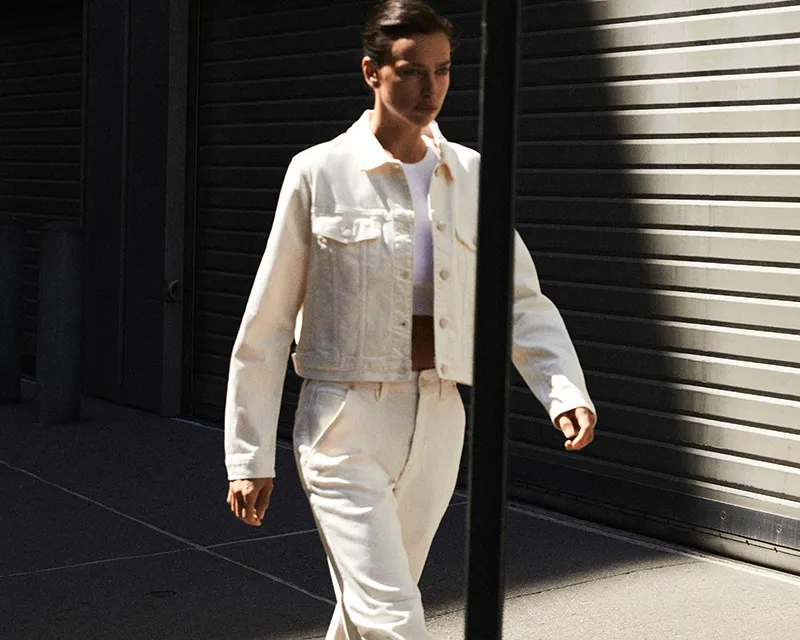
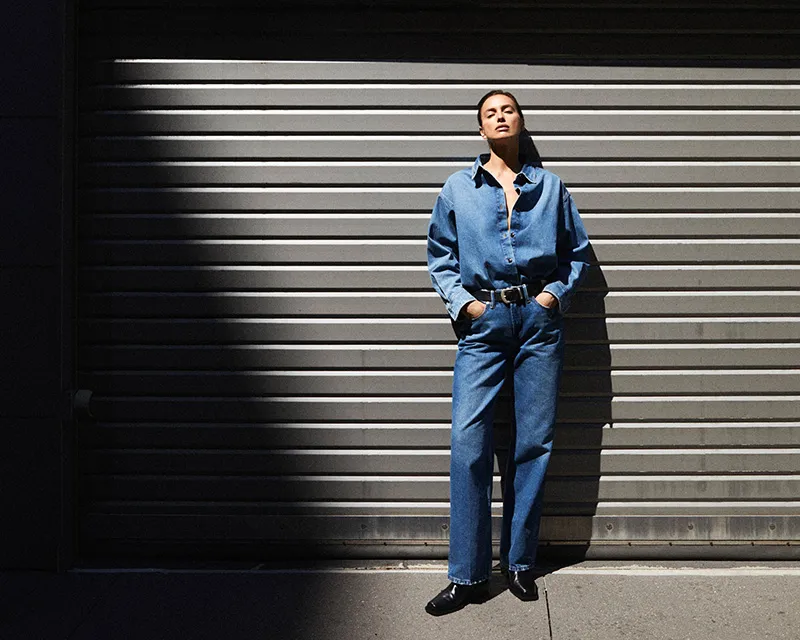
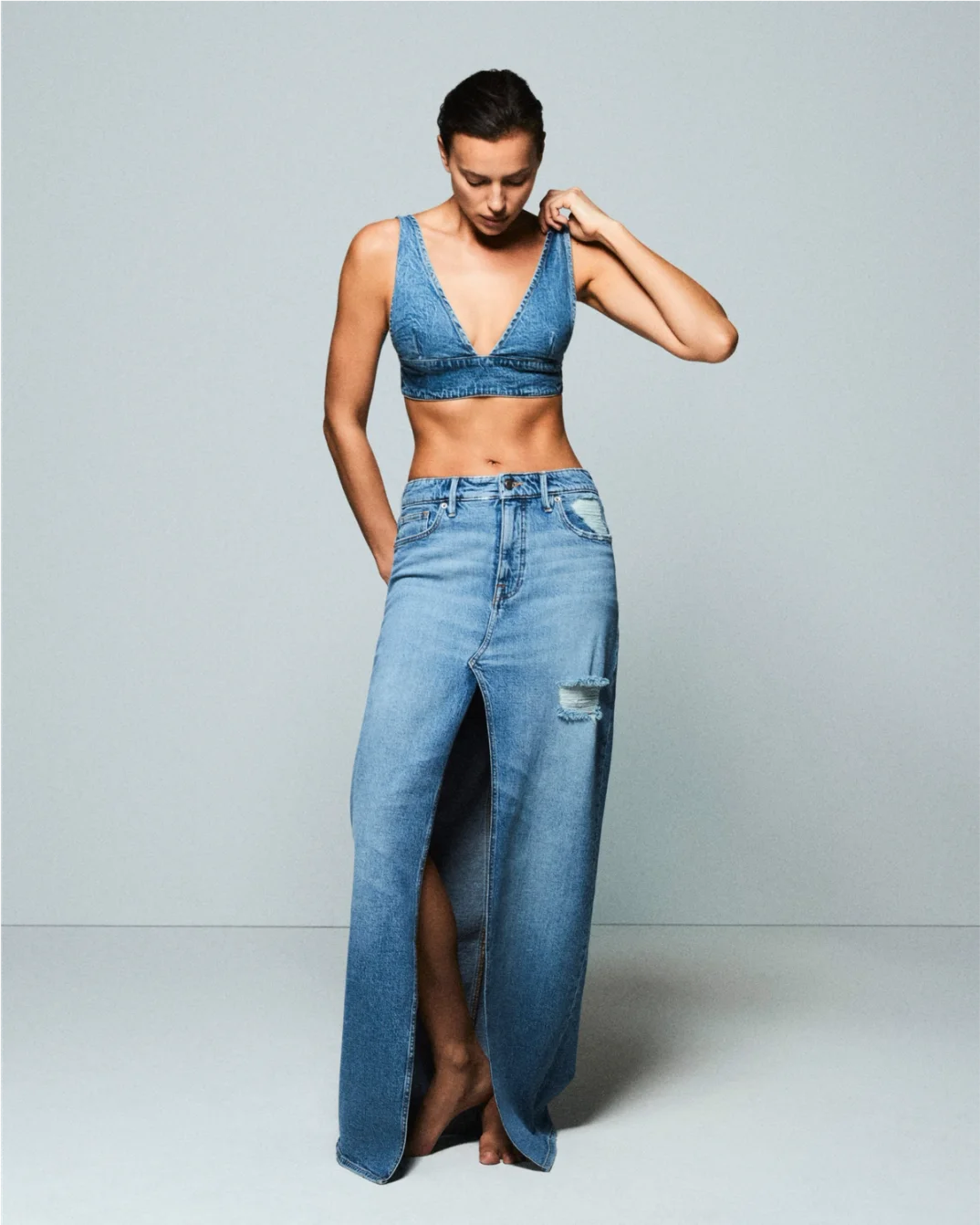
Shayk’s contributions to the collection are deeply inspired by the 1990s, offering a blend of modern comfort and nostalgic style. Highlights include a chic striped button-down shirt, body-sculpting Scuba Bodysuits, and the effortlessly cool Good ’90s Carpenter and Good ’90s Relaxed denim fits. These pieces are designed to seamlessly integrate into your summer style, whether you’re dressing up or keeping it casual.
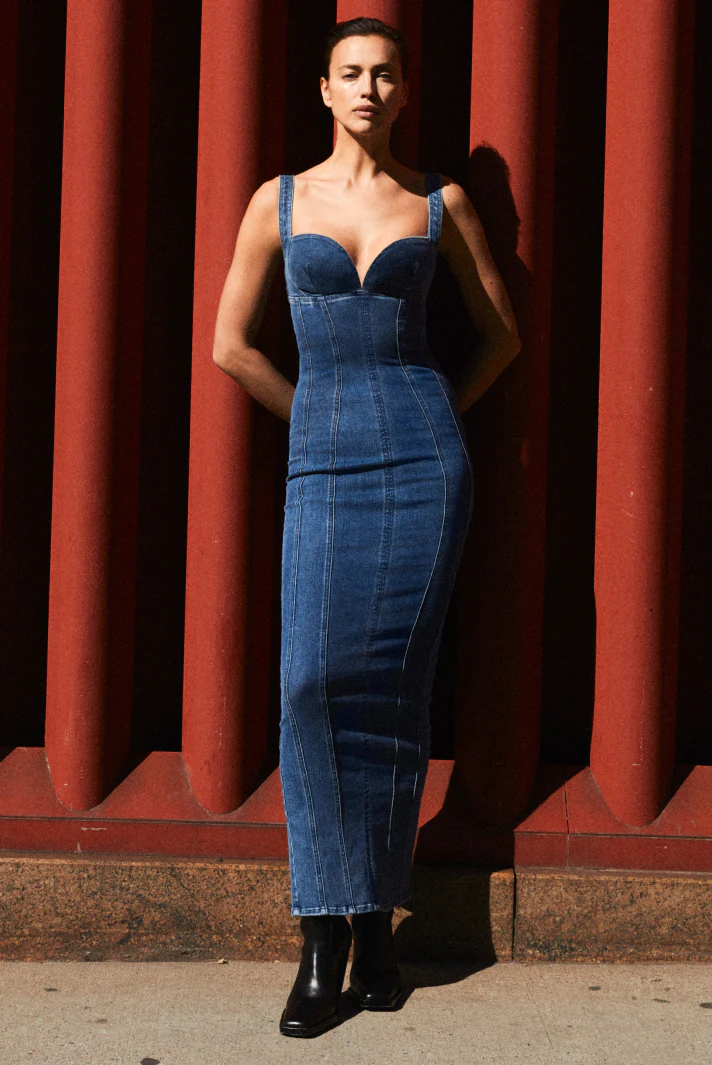
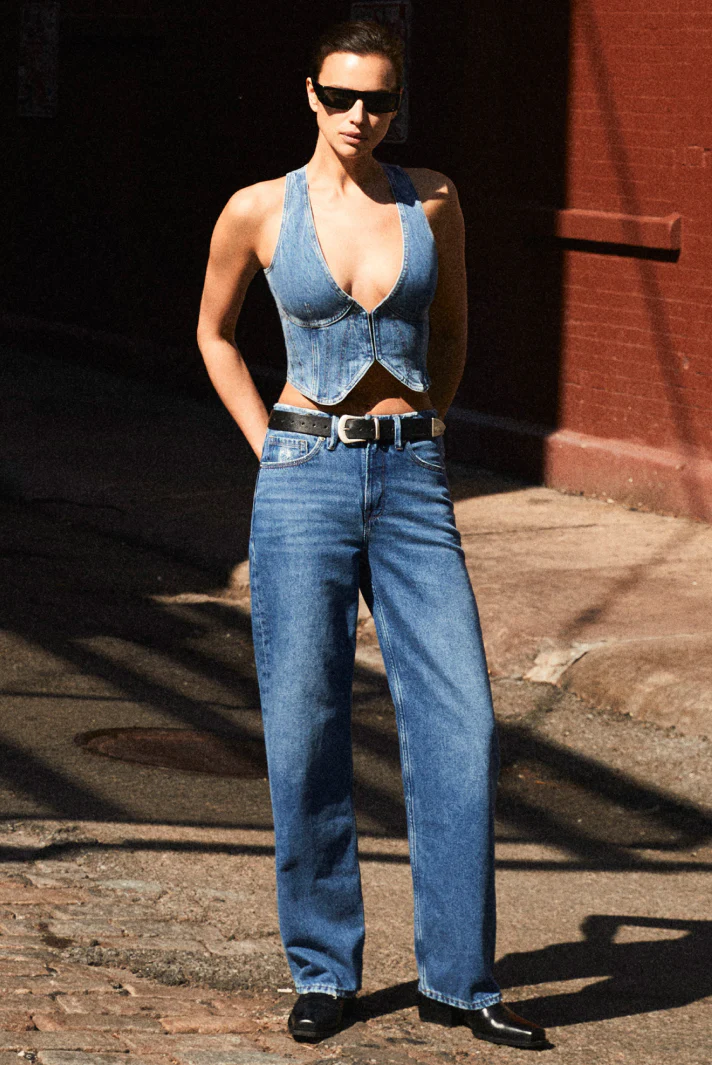
In the campaign, Shayk showcases a variety of the collection’s standout items. From a denim maxi dress and coats to a denim vest that nods to the resurging vest trend, each piece is designed to bring out the best in summer fashion. Shayk herself expresses her love for denim, saying, “Denim has always been a staple in my wardrobe. You can never go wrong with a great pair of jeans. Right now, I’m really into the oversized denim-on-denim look. Good American jeans not only look cool but also fit really well and are super comfortable.”
Angel Reese in Good American
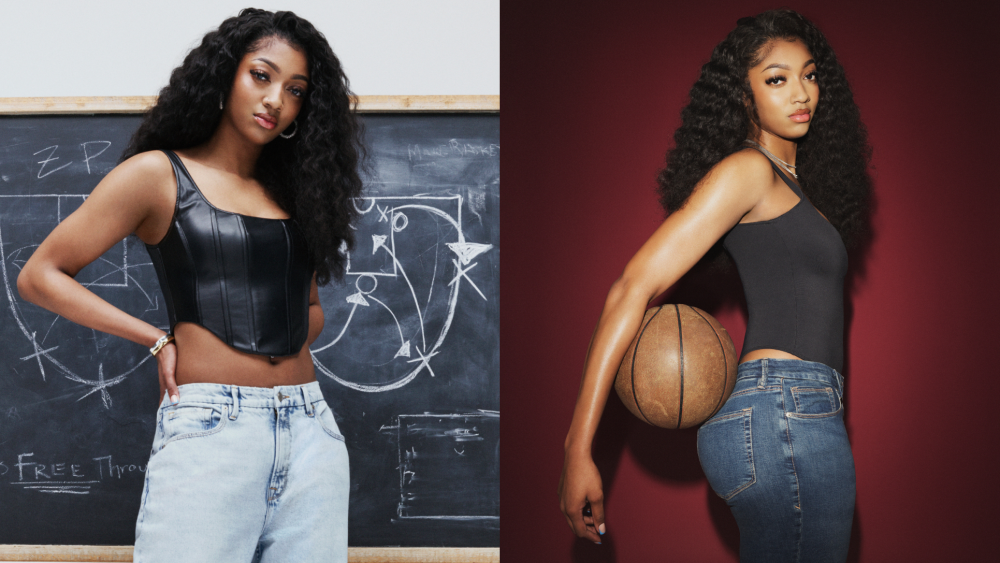
2024 has seen Good American expand its roster of campaign stars. In May 2024, WNBA player Angel Reese joined the brand to highlight their Long Inseam Denim collection, which is tailored perfectly for tall women. Reese’s personal experience playing professional basketball served as a major inspiration for the series of images featuring her. Similar trends can be seen in this campaign, which show the model in an off-duty cityscape setting.
Since its inception in 2016, Good American has evolved from selling just denim to becoming a comprehensive apparel brand. This journey culminated in June 2023, with the opening of their first physical store at Los Angeles’ Westfield Century City Mall, transitioning from an exclusively online presence to a tangible retail experience.
With this latest collection, Good American continues to redefine modern denim, combining high-quality craftsmanship with versatile styles that are perfect for any summer occasion. Explore the new collection on Good American’s website and find your new favorite summer staples.
Andrea Skatto has been in the textiles world for about 3 decades, developing fabrics collections, mainly into denim, flats & shirting for a variety of suppliers worldwide, and working to find marketing solutions in Italian, European and Chinese markets.
He has worked with companies like The Bonazzi Group/ Montebello and Tessilbrenta in Italy, La Panama flats, and C.C.CLUB/ Pianeta Tessile, again flats and outerwear fabrics. In Turkey and with Calik Denim for 7 years. Besides Arvind mills, Fifth Avenue and SuryaLakshmi Azgard 9, Naveena in Pakistan, Brandix, Foison, etc have been part of his clientele in his long career.
Among brands, he was hired by Diesel -Italy to renew their denim fabrics choices and currently works with the Italian brand H.T.C ( HOLYWOOD TRADING CO.). He loves to take care of all processes in a mill, from choosing raw materials to yarn sizes study to actual fabrics with a special focus on chemical finishes.
We thought about taking his views on various aspects of development in the industry today and he shared some of his ideas.
Q. Andrea, what changes do you see in the retail market of denim and flats post covid? Do you see strong positives or even negatives?
A. – Denim is still doing pretty well, as is the sale of fabrics and garments that I see currently.
Flats need changes. Positive on flats, it can happen if mills start to not just follow the big buying group, they need to get Brands designers interested with new ideas, using different yarns and finishes. Today I do not see many innovations.
Since the times the Italian suppliers practically disappeared, no one really takes this market and its product study as it should be. The real innovations, I feel, are amiss.
Q. – You have a long experience in denim fabric structures and compositions. Do you want to highlight anything important for the same?
A.- To have interesting, saleable, and usable structures mills need to use a higher number of shafts as possible with rapier looms. Normally all denim makers work max with 8 shafts. We could take as an example the geometrical shirting type of designs reported in denim. I always see too many ugly structures.
Again, mills should work on new yarns and versatile looms to bring out good designs.
Q.- Brands are also looking to differentiate themselves among their fabric suppliers based on their own requirements. How important is this for suppliers?
Brands are also looking to differentiate among their fabric suppliers, based on their own requirements. Can you share some examples which show how their respective functioning and requirements are different?
A. – I always believed, through my experience, that SUPPLIERS should differentiate themself, finding the “hot spot”, as, what their CLIENTS would like to buy.
When I started my career in Italy, we did create tendencies of FABRICS which were almost never asked by clients. We worked mainly with Brands. Then the huge retailers arrived, with their price requirements, quality, ultra-fixed deliveries, penalties, etc. The game changed.
We need as fabrics makers to work more and better in developing what we are good at. From raw materials to yarns, to fabrics, finishes, and presentation, all must be reseen, thinking about better margins through new products, new researches, that will allow suppliers to get and keep retailers vivid interest, that brings better sales of what is considered Basics Fabrics as well.
Q.- What trends do you see in both flats and denim in the next 2 years?
A. Flats can and will gain a lot if they let us work…and it is easier than designing garments.
Covid itself calls more to the protections of nylon or other technical fiber, but even 100% cotton can have a gore-tex Infinium coating, as an example.
Denim unless we build mills with relatively more versatile looms and use more finishes, I cannot see huge progress in the long run. Kids live different lives everywhere, they don’t even know most of the huge denim brands still around that were big in the 90′, after that it has been big retailers, but not much of brands.
Q.- Since you have worked with so many mills and brands, what do you think is the key today for mills to get more traction with buyers
Ideas, the world is itself improving through ideas.
We don’t need to talk about Leonardo da Vinci or Mr.Bezos…but all improve with new ideas, and in textile fabrics, ideas are made of raw material, yarns types, structure and finishes, simple or more inclusive waxing or coating, as mechanical as all types of brushing, preaching, etc.
I would focus on getting the interest of clients first to my product range, which involves sustainable processes as a standard, but i would count on developing novelties in tight cooperation with clients’ designers,using the experience of fabrics we hold,in order to follow clients in a commercial way.
Vietnam is getting to be one of the most important countries when it comes to exports of denim. A number of large manufacturing units have been developed which are working for large retailers and brands. The FTA with the EU has further strengthened exports from the nation. However, the US continues to be the dominant region where exports are happening from Vietnam. In this report, we have done a detailed analysis of the imports of denim jeans from Vietnam into the US in 2021. The detailed report shows the imports by the US over this period.
PARTICULARS
Table showing top 15 US denim buyers from Vietnam in one year
Graphs showing total jeans imported by Top 15 US buyers from Vietnam over 12 months
Table showing the top 15 suppliers to the US from Vietnam
Graphs showing the top 15 suppliers to the US from Vietnam
Table showing the top three buyers of top ten suppliers
1.TOP 15 US DENIM BUYERS FROM VIETNAM
[private_special]
The table shows that AEO bought the largest quantity which is 4.2 million pcs with an avg. price of 11.8 USD/piece and has approx. 11% of the total share, followed by GAP INC with approx. 4.1 million pcs and the avg. price of 10 USD/ piece in a year (from 1st Jan 2021- 31st December 2021) Total Percentage share of these 15 companies holds 71% of total jeans quantity imported into the US from Vietnam.
BUYER
QTY(in million)
%SHARE
AVG. PRICE(USD/pc)
No. Of Suppliers
AEO – AMERICAN EAGLE
4.21
11
11.8
7
OLD NAVY / GAP
4.1
10
10
10
TARGET GLOBAL SOURCING LIMITED
3.28
8
9.7
3
AMBIANCE APPAREL
2.01
5
5
1
ABERCROMBIE & FITCH
1.82
5
9
3
MGF SOURCING FAR EAST, LIMITED
1.75
4
12.1
3
FASHION NOVA
1.62
4
5.2
2
EXPRESS / MGF SOURCING
1.38
4
10.5
3
LEVI STRAUSS
1.29
3
10.3
2
TORRID MERCHANDISING, INC
1.29
3
13.2
1
SHINSUN INVESTMENT HOLDING LTD
1.07
3
8.1
1
HIDDEN JEANS / CELLO JEANS
1.06
3
5.7
2
KANCAN WH
1.05
3
7.5
3
Y.H.TEXPERT CORPORATION
1.01
3
3.9
3
QUETICO LLC
0.96
2
6.9
2
TOTAL
27.9
71
–
46
29% share is the total of other small companies apart from these 15 companies
2. TOP 15 DENIM SUPPLIERS TO US FROM VIETNAM
PHONG PHU INTERNATIONAL JSC supplied the largest quantity of pieces that is approx. 9.9 million pieces with an avg. price of 11.6 USD/pc and the total number of buyers the company has dealt with are 31 followed by YDVL – YI DA VIETNAM LIMITED which is a part of the CRYSTAL group of HK with approx. 5.8 million pieces with an avg. price of 9.7 USD/pc .
SUPPLIER
QTY(in million)
%SHARE
AVG. PRICE(USD/pc)
NO. OF BUYERS
PHONG PHU INTERNATIONAL JSC
9.94
24
11.6
31
YDVL – YI DA VIETNAM LIMITED
5.82
14
9.7
15
NIEN HSING GARMENT (VIET NAM) CO., LTD
3.95
9
11
22
TRUC XANH CLOTHING ONE MEMBER COMPANY LIMITED
3.39
8
4.8
9
KIM BINH GARMENT CO., LTD
3.28
8
9.9
5
TCE JEANS COMPANY LIMITED
2.97
7
5.6
15
GATEXIM – SAIGON 3 GARMENT JOINT STOCK COMPANY
2.19
5
12.4
9
SAITEX INTERNATIONAL
1.89
5
20.7
23
TCE CORPORATION
1.51
4
8.8
7
SX-TM KIM SUN COMPANY LIMITED
1.11
3
7.1
4
VIGAWELL GARMENT TRADING COMPANY LIMITED
1.11
3
9.2
10
JUNZHEN GARMENT COMPANY LIMITED
1.07
3
8.1
1
TEXHONG THAI BINH GARMENT COMPANY LIMITED
0.99
2
11
11
VITAJEAN CO.,LTD
0.44
1
7.4
2
QUANG NAM BLUE WAY ONE MEMBER CO., LTD
0.24
1
5.7
1
TOTAL
39.9
95
10.1
165
Apart from these 15 companies, there are also a few other companies holding a 5% share of the total.
3. Top Three Buyers Of Top Ten Vietnam Suppliers
PHONG PHU INTERNATIONAL JSC
The company has been growing consistently and in 12 years they have grown to one of the leading apparel manufacturers in Vietnam and are supplying known US and European Retailers.
BUYER
QTY(in million)
AVG. PRICE(USD/pc)
TARGET GLOBAL SOURCING LIMITED
2.06
9.2
MGF SOURCING FAR EAST, LIMITED
1.48
12.2
TORRID MERCHANDISING, INC
1.29
13.2
YDVL – YI DA VIETNAM LIMITED
YDVL is a part of the Crystal Group of Hong Kong. Crystal International Group Limited was founded in Hong Kong in 1970 and is now with 20 apparel manufacturing facilities in Asia employing approximately 70,000 people worldwide. They provide comprehensive one-stop solutions to international brands covering lifestyle wear, denim, intimate, sweater, and sportswear and outdoor apparel..
BUYER
QTY(in million)
AVG. PRICE(USD/pc)
OLD NAVY
1.29
9.7
LEVI STRAUSS
1,.28
10.3
TARGET
1.21
10.6
NIEN HSING GARMENT (VIET NAM) CO., LTD
NIEN HSING TEXTILE CO., LTD. is a Taiwan-based company principally engaged in the manufacture and distribution of garments and textile products. The products of the Company include denim and casual wear, denim cloth, casual cloth, and ring-spun yarns. Their main clients are GAP, AEO, Kohl’s, VF, others In Vietnam Garment/Knitwear
BUYER
QTY(in million)
AVG. PRICE(USD/pc)
GAP INC
0.61
10.5
ABERCROMBIE & FITCH
0.34
7.8
EXPRESS USA
0.34
13.6
TRUC XANH CLOTHING ONE MEMBER COMPANY LIMITED
They are engaged in the export of apparel.
BUYER
QTY(in million)
AVG. PRICE(USD/pc)
FASHION NOVA
1.62
5.2
Y.H.TEXPERT CORPORATION
1.10
3.9
HIDDEN JEANS / CELLO JEANS
0.75
5.2
TCE JEANS COMPANY LIMITED
As one of the oldest denim factories in Asia, TCE has been trusted by customers since 1956 for its long history of stable quality & customization. The largest fabric capacity in Vietnam is 3.5 million yds/month And garment- 1.3 million pcs/month Number 1 vertically integrated denim supplier from fabric to washing in southern Asia by full sustainability.
BUYER
QTY(in million)
AVG. PRICE(USD/pc)
AMBIANCE APPAREL
2.0
5.0
HIDDEN JEANS / CELLO JEANS
0.32
6.7
H & M HENNES & MAURITZ AB
0.14
4.5
KIM BINH GARMENT CO., LTD
Kim Binh Minh Co., Ltd was established in 2001, located in Ho Chi Minh City, Vietnam. As a manufacturer and exporter to Japanese and USA markets, they specialize in producing apparel products.
BUYER
QTY(in million)
AVG. PRICE(USD/pc)
OLD NAVY / GAP
1.87
10.4
ABERCROMBIE & FITCH
1.40
9.3
SAITEX INTERNATIONAL
Saitex is one of the most well-known denim factories around the world. It has also been sometimes classified as the ” Cleanest denim factory “. With a very strong focus on sustainability, Saitex is employing most of the clean technologies for its denim apparel production. The company also became the first factory in Asia and the only large-scale manufacturer of denim with B Corporation™ Certification, a score of 105.6 .
BUYER
QTY(in million)
AVG. PRICE(USD/pc)
MADEWELL INC
0.84
18.5
EVERLANE
0.36
25.9
J CREW
0.27
23.0
GATEXIM – SAIGON 3 GARMENT JOINT STOCK COMPANY
GATEXIM – Saigon 3 Garment Joint Stock Company is one of the leading garment exporters in Vietnam, specializing in all kinds of jeans, khaki pants, and sports pants with a total output of more than 12 million units,2 garment factories, 1 completing center, 3,000 machinery equipment, 47 sewing lines, 3,000 skilled workers. The export market includes Japan, USA, Europe, Asia. Saigon 3 always concentrates on the quality of products and services towards the satisfaction of customers, as the foundation of the company.
BUYER
QTY(in million)
AVG. PRICE(USD/pc)
EXPRESS / MGF SOURCING FAR EAST, LIMITED
0.92
12.2
GTEX INC.,
0.32
11.2
3RD TR8 APPAREL, INC
0.37
14.1
TCE CORPORATION
Founded in South Korea in 1956, TCE is one of the oldest denim companies in Asia. It relocated its entire production to Vietnam in 2014 and now produces only denim at its TCE Vina Denim mill, which occupies a 110,000m² site two hours outside of Hanoi. It has the largest capacity fabric in Vietnam of 3.5 million yards per month. In garments they have two units TCE VINA DENIM with 300,000 pcs per month and TCE JEANS with 1 million pcs per month. TCE exports 100% of its production overseas, with Europe, at about 45% being the largest market, followed by the USA at 30%, and Japan and Korea the other main export destinations.
BUYER
QTY(in million)
AVG. PRICE(USD/pc)
KANCAN WH
1.00
7.5
CHICOS RETAIL
0.30
11.7
TCE CORPORATION
0.21
11.2
SX-TM KIM SUN COMPANY LIMITED
SX-TM KIM SUN is a garment processing factory that supplies, manufactures, trades, and processes in the field of apparel, clothing, footwear, products, and articles using fabric materials and finishing products. domestically and internationally
The Greensboro, N.C.-based firm established a new denim supply chain alliance with Arvind Limited and Cone Denim on Wednesday, with the goal of improving vital data used in the Higg Material Sustainability Index (Higg MSI).
Kontoor Brands, a leading global lifestyle apparel company with two of the world’s most iconic consumer brands, Wrangler® and Lee®, has introduced a major supply chain collaboration of denim industry leaders to enhance critical information incorporated into the Higg Material Sustainability Index (MSI), as mentioned above, the apparel sector’s most broadly utilized way to evaluate and examine product environmental impact.
Arvind Limited, India’s premier lifestyle and fashion giant, and Cone Denim, a worldwide leader in denim authenticity and sustainable innovation, will exchange vital data from the denim dyeing process that is presently not considered into the Higg MSI as part of these efforts, according to the business. The purpose is to consolidate value chain sustainability measurements and provide garment firms more visibility throughout product creation and development. By summer 2022, the firms hope to make the improved Higg MSI tool available to all garment brands.
Dhruv Agarwal, Kontoor Brands’ Senior Director of Global Innovation, Sustainability, and Product Development, stated- “Data-driven decisions produce the best outcomes. We believe the Higg MSI is an invaluable tool for assessing the environmental impact of processes and materials utilized in our products. Through this work, our industry will be able to have a more complete picture of denim’s impact, and our product development teams will have better insight into the environmental footprint of our products, empowering us to make more sustainable design choices.â€
The Higg MSI was established a decade ago to assist designers and product makers in making more sustainable material choices and comparing the environmental consequences of various materials, trimmings, and packaging. The technology, which is based on scientific data and metrics, is designed to assess environmental effect throughout the manufacturing process. The Higg MSI assesses five aspects of environmental impact: global warming potential, water pollution, chemistry, water shortage, and fossil fuel depletion.
Despite the fact that the denim industry leads in sustainable innovation, executives have spoken out about the information gaps that exist, cautioning businesses against comparing their outcomes to old data or data from unknown sources. However, establishing a baseline against which to assess the impact of output is the first step toward improving procedures.
The collaboration builds on the firms’ different environmental initiatives.
To improve water conservation, Kontor launched the Indigood Facility Certification in 2021. Textile manufacturing facilities that use 90 percent less freshwater than traditional fabric production, based on 2018 statistics, may be eligible. Arvind’s Naroda factory was the first to receive the certification.
Arvind has also partnered with TextileGenesis, a blockchain-based digital transparency platform that allows for the digitalization and traceability of any textile asset, including fiber, yarn, fabric, and garments.
President Steve Maggard of Cone Denim stated the mill has made “significant capital expenditures†in production to create ethical and sustainable goods. It was the first denim mill to use the MSI tool to create unique materials for their whole Spring/Summer 2022 fabric range in 2021. Customers may utilize this step to acquire fabric Life Cycle Assessments and comparative data for further information on particular materials used in Cone’s textiles. It moreover accomplished its first authentication of origin audit with Oritain, a company that specializes in product and supply-chain traceability.
“We are excited to explore and advance tools and resources, like the Higg MSI, that align with our customers’ goals to design and produce sustainable apparelâ€, said the president of Cone Denim Steve Maggard, and also added, “We welcome the opportunity to collaborate with like-minded companies, such as Kontoor, to bring transparency to the supply chain. Cone Denim has made considerable capital investments in our manufacturing focused on creating responsible and sustainable products and look forward to verification of our initiatives’ results.â€
The fashion industry has put in a lot of work in recent years to digitally convert and adapt fashion to the digital world. Non-fungible tokens (NFTs) and blockchain technology are being used by brands to attract, authenticate, and engage with customers all around the world. But what precisely is NFT? Recently, a new trend of using NFTs to combine blockchain technology with creative intellectual property has emerged. The concept has grown across all market sectors, and today premium fashion merchants are now participating in the NFT business. Because changes are so important and complicated, the luxury fashion and beauty sectors have created extensive documentation to better comprehend the competitive environment. Without a doubt, the blazing fires of NFTs have ignited a burning desire for blockchain technology in the fashion industry.
WHAT ARE NFTs?
NFTs are cryptographic assets created with the use of blockchain technology. It allows for the transfer of value across a non-replicable medium. It can be a one-of-a-kind, non-recurring token that cannot be partitioned but can be used to depict real or virtual world items, including the token’s own attributes and ownership, all while staying inside a blockchain representation. This equips NFTs with the distinct characteristics that make them so appealing. Smart contracts, which are software programmes that regulate actions such as authenticating ownership and restricting their transferability, are used to generate NFTs.
When a person creates an NFT, they write the smart software code that governs the NFT’s properties and contributes those qualities to the NFT’s blockchain. NFTs are digital files made as jpg, png,.mov, or 3D fashion files prior to getting minted (connected) to a blockchain. They are more than simply a chase to cryptocurrency. NFTs are controlled and authenticated as digital assets via digital accounting records or blockchains, and they are kept in digital wallets in the same way as cryptocurrencies and other assets are, and they serve as valuable objects sold in the digital environment.
In simple language, NFTs cannot be copied or hacked and are not mutually interchangeable, which means, no two NFTs are the same. They are non-fungible, which signifies that instead of obtaining an actual object that you may wear (and which almost certainly has many replicas in the real world), you will instead receive a one-of-a-kind JPG file that cannot be replicated.
ROLE OF NFT IN FASHION INDUSTRY
The fashion and beauty industries have made a determined effort in recent years to enhance a true and precise knowledge of business developments in order to encourage new terms that are consistent with current corporate practices. Fashion’s the only chance of re-entering the fast-paced digital train was to build NFTs, as it had entirely missed the boat with E-commerce. When e-commerce first emerged, a huge number of businesses were completely disinterested in exploring the new channel. The fashion business has become significantly more cautious since then. Sustainable fashion and beauty is a big incentive for younger millennials and Gen Z market groups. Prestige companies may use NFTs to create unique experiences for their customers, increasing brand awareness, engagement, and revenue. Despite the apparent advantages, however, fashion has yet to find out the ideal way to utilize NFTs.
NFT fever had gripped the year 2021. With the growth in Google searches for NFTs, the NFT business saw $2.5 billion in revenue during the first half of 2021, up from $13.7 million the year before. With the fashion business seeking to unlock the technology’s capabilities, it’s no surprise that Karl Lagerfeld has already stated that another release is in the works after their premiere in the virtual world.
As popular as the Karl Lagerfeld NFTs have been, it’s critical for companies to grasp how NFTs vary from other sectors that are more acclimated to selling digital items. This is mostly due to the fact that conventional fashion firms, who are known for their reluctance to digitalization, are finding it difficult to let go of their physicality. As a result, individuals who follow this business are often left wondering what NFTs are, why everyone is eager to cash in, and what they imply for a market that has stayed steadfastly physical for so long.
PLUSES AND MINUSES OF NFTs IN FASHION INDUSTRY
As a designer, an NFT may produce virtual fashion goods that are separate from real-life products, addressing the problem of digital apparel reproduction. NFT broadens the selection of one-of-a-kind things. A fashion company may utilize it to offer its own show video or customized backstage photos. When it comes to digital copies, the NFT makes it simple for collectors to find the original copy they desire. NFT might have an influence on the resale market not only by keeping track of changes in ownership of a given item but also by paying corporations a premium whenever their goods are sold in the second-hand high-end market, for example.
Regardless of their individual advantages, however, NFTs are still a pretty modern investment strategy that may provide buyers with unexpected challenges. Some issues to be aware of and investigate more before purchasing NFTs, such as the fact that anybody can take a picture of the artwork, upload it to a blockchain, and sell it, therefore purchasers must ensure that they are purchasing NFTs from the artist or that the seller has the authorization to sell the NFT. By themselves, NFTs are unable to link the production or ownership of an NFT to a real person in the physical world or to verify that the NFT’s creator has the fundamental entitlements to connect that NFT with a certain creative work.
BIG FASHION BRANDS JOINING NFT MARKET
Below is a breakdown of the many brand tactics for handling the NFT area in the fashion industry, including specific adjustments, how bitcoin carbon emissions are being mitigated, and what’s next in the space.
RTFKT’s Virtual Sneakers
The RTFKT brand was founded in 2019 and quickly established itself as a leader in the virtual sneaker market. Early in 2021, the company worked on a project with “Fewocious,” a well-known crypto artist who was only 18 at the time. He created three virtual sneakers that buyers could “try on” via Snapchat before entering an auction to buy them. The top bidder was also given the opportunity to receive a tangible pair of sneakers to try in person. The partnership lived up to the expectations, selling 600 pairs of sneakers in just 7 minutes for a total of 3.1 million dollars.
Since then, RTKFT has expanded its portfolio by collaborating with “The Fabricant” to produce a new collection of seven virtual products, which received $8 million in their most recent financing round.
GUCCI Selling NFTs
Gucci was the first luxury house to venture into the world of non-traditional textiles. The NFT of the legendary Italian fashion business was inspired by a movie by their “Aria” collection in cooperation with Alessandro Michele, rather than being patterned after fashion products. Christie’s auctioned this four-minute clip for a whopping 25,000 million dollars.
Louis Vuitton- NFTs collecting Game
On the occasion of its founder’s 200th birthday on August 4th, Louis Vuitton merged fashion and technology by releasing “Louis the Game,” an adventure-style game in which players must navigate around Vivienne’s dollhouse.
Aside from that, gamers flocked to various locations to acquire 200 candles to commemorate the 200th anniversary of their birth. The trip included 30 hidden NFTs and 10 NFTs created in partnership with prominent NFT artist “Beeple.” This game’s NFTs are free to gather and not for sale to the general public.
Prada’s Partnership With Adidas
In the latest incarnation of luxury in the metaverse, Prada is presenting its first NFT in collaboration with Adidas: an audience digital work in a Beeple-style collage.
Anyone may register to upload an image using a specifically developed filter that will be modified, jumbled up, and 40% of the image erased to make the image anonymous starting on January 24. Three thousand of the individual images will be chosen at random and minted as one-of-a-kind NFTs by Adidas for free. The owner of the artwork will be the person who submitted it, and they will be able to sell their NFT on the secondary market. Zach Lieberman, a digital artist, and creative coder will subsequently merge the selected photographs into tiles into one massive patchwork NFT.
Burberry With Blankos Block Party
Burberry collaborated with a video game company to create its own NFTs. After the triumph of its own game, B Bounce debuted in 2019, the brand went into the digital world by collaborating with Mythical Games’ Blankos Block Party on a charming shark Blanko that can be acquired, updated, and sold in-game. The Burberry NFT, unlike Ethereum, does not function on the energy-intensive Proof of Work crypto paradigm, but rather on a proprietary EOSIO blockchain protocol that uses a significantly less energy-intensive Proof of Authority methodology.
Overpriced- Scannable Hoodies
Overpriced, the world’s first NFT-driven fashion business, has created a real-life sweatshirt with a scannable code that allows the hoodie’s owner to show it around. This sweatshirt is being auctioned for $26,000 USD on the NFT site “BlockParty.”
Because most fashion labels, such as Balenciaga and Fortnite, place their NFTs inside closed systems, the concept of a virtual wardrobe that moves across multiple gaming platforms and digital worlds is still a work in progress. Polygon, for example, is attempting to alter this. Dolce & Gabbana, a luxury fashion business, has launched NFTs on the platform, emphasizing the ease with which their clothing may be moved between many digital “worlds.” “There’s going to be a lot of money in the NFT fashion industry,” said Joseph Pallant, the creator of the Blockchain for Climate Foundation and an NFT specialist.
FUTURE WITH FASHION & METAVERSE- UNLOCKING LIMITLESS POSSIBILITIES WITH NFT MARKET
The co-founder of stablecoin Tether, William Quigley said, “I’m betting that the revenue model for the metaverse is going to be NFTs.†The Bitcoin pioneer, Quigley, sees the Metaverse as “a massive economic force that will profoundly affect people’s lives in the years ahead.†The fashion industry must grasp that NFTs are all about digital item ownership, and the Metaverse is merely extending that notion into one or more virtual worlds in order to prepare for the metaverse’s future. Despite the fact that the Metaverse as a business model is still in its infancy, NFTs are turning this creative playground to life.
Neuno, created by Natalie Johnson, sees the promise of NFTs as well. Neuno is urging the fashion industry to reach a digital utopia where one may possess a unique piece of “fashion history” by bridging the gap between the actual world and NFTs.
You can’t discuss NFTs and the Metaverse without mentioning the recent emergence of NFT markets, which provide users with a location to purchase and trade NFTs. Investors such as billionaire entrepreneur Mark Cuban, music tycoon Jay-Z, and Google Ventures, which give seed, venture, and growth-stage capital to digital firms, have taken notice of some of these sites. The vocabulary of the future will revolve around NFTs, cryptocurrency, blockchain, skins, and metaverse.
Circularity has been discussed by Dame Ellen MacArthur since 2010, although the concept has only lately gained popularity. After retiring from sailing 12 years ago- MacArthur being the first woman to solo around the globe- she founded the Ellen MacArthur Foundation to bring together the worlds of business, education, fashion, agriculture, and beyond to conceive a dramatic transformation to a “circular economy.” A circular economy, in contrast to our existing linear concept of creation, consumption, and disposal, entails reducing waste, keeping items in circulation, and renewing nature.
MacArthur launched the book on the 2nd of December, 2021, at Business of Fashion VOICES. Circular Design for Fashion was created in honor of fashion’s enormous potential to change to a circular economy, as well as its creatives – enthusiastic disruptors who are always looking for new ways to innovate. The book introduces a new design approach and inspires designers to think about how they might help shape a more resilient and successful fashion sector that addresses climate change and biodiversity loss. Investigate the challenges of creating with three concepts in mind: reducing waste and pollution, cycling products and resources, and renewing nature. The book presents an assorted mix of voices, well-known names like Stella McCartney, Gabriela Hearst, and Eileen Fisher, as well as upcoming designers like Bethany Williams and Duran Lantink, upcycling professionals like ADIFF’s Angela Luna and Loulwa Al Saad, regenerative agriculture assets like Fibershed and FarFarm, Gucci and its parent company Kering, and some of the industry’s most successful corporations like Inditex, Fast Retailing, and H&M.
SUBSISTENCE BY CIRCULAR DESIGN
Many firms and designers in the fashion field have begun to take initiatives to remove waste and pollution from their product lifecycles in recent years. Elodie Rousselot, the strategic design manager at Ellen MacArthur Foundation says, “I think we’re witnessing a beautiful moment in the industry, where many are actively looking at how they can change their businesses and the way they design products to be fit for the circular economy.†The goal of circular design is to create goods and services that don’t have a linear life cycle with a beginning, middle, and conclusion. The goal is to create goods that can “be produced to be made again,†as ex- CEO of IDEO, Tim Brown phrased it.
The move to a circular economy (CE) presents designers with a variety of new issues and necessitates particular knowledge, tactics, and methodologies. The CE idea broadens the scope of the design process and encourages the incorporation of new knowledge domains and abilities. Throughout all phases of the design process, substantial engagement with stakeholders and specialists is required for the CE to be implemented successfully in reality. Design firms have responded to the CE by forming dedicated CE research and design workgroups, facilitating information flow, constructing their own circular strategies and techniques, and pursuing long-term client relationships that encourage designers to become involved in the lifecycles of crafted artifacts rather than viewing design projects as one-time events. Many designers have taken the initiative too. Amongst such designers are the six contributors, highlighted by Rousselot in MacArthur’s book, who are at the forefront of the movement towards the circular fashion industry.
ORANGE CUTURE BY ADEBAYO OKE-LAWAL
Adebayo Oke-Lawal creates gender-neutral clothing with a 90 percent indigenous Nigerian supply chain that includes everything from material procurement to dyeing and printing. The designer tries to guarantee that money stays in the community through his Lagos-based label Orange Culture, while also training his suppliers and staff about sustainable manufacturing processes so that they may apply what they’ve learned to other initiatives.
“They’ve also begun encouraging shoppers to return undesired clothing so that it may be turned into new outfits and sold again. It’s more than just a repair service. It’s almost as though the clothing had a new narrative to tell.” Rousselot said, “Orange Culture uses the offcuts from its manufacturing process to form new products or elements such as lining.â€
RAEBURN BY CHRISTOPHER RAEBURN
Whilst pursuing fashion design in London in the early 2000s, Christopher Raeburn began working with excess fabrics and clothes, purchasing unworn military coats from the 1950s for £1 apiece and reworking them into new outfits. Since then, he’s pushed to expand the use of reused materials in mass production with his own British Fashion Award-winning label Raeburn, along with switching ‘Timberland’ to regeneratively cultivated leather as creative director for the footwear company.
“He was one of the first to bring this practice to a commercial scale, in a way that is attractive and different from what you would expect from an ‘eco brand,†Rousselot said.
ICICLE BY YE SHOUZENG AND TAO XIAOMA
Icicle, a Chinese company founded in 1997 by husband-and-wife team Ye Shouzeng and Tao Xiaoma, uses five primary materials – cashmere, linen, wool, silk, and cotton – that is sustainably sourced and lightly treated to preserve the attention on the fibers’ inherent beauty. To maintain transparency and protect the welfare of garment workers, the company does all of its design and manufacture in-house at its own facilities.
Rousselot quotes about the innovative couple- “They are bringing this different perspective to a circular design, which is based on traditional Chinese philosophy and runs counter to the Western idea that we’re born, we die and then that’s itâ€
MARINE SERRE
Aside from her signature crescent moon motif, French designer Marine Serre is recognized for using repurposed materials such as household linens, carpets, and towels in 50% of her designs. Serre’s work, which was awarded the esteemed LVMH prize in 2017 and is distributed by big shops like Selfridges and Browns, demonstrates that waste materials, notwithstanding their nasty reputation, may have a place in the premium fashion industry.
“She’s extremely cutting edge in the way she designs with these textiles,†Rousselot said. “In fashion design, usually what students are taught to do is to define a color palette that will guide their collection and then find the fabrics to match.â€
FIBERSHED
Fibershed is a non-profit organization that assists businesses in gaining access to hyper-local textile supply chains by employing regenerative agricultural techniques that retain carbon in the soil rather than releasing it. Designer Phoebe English recently produced a line of outfits for the COP26 climate conference in conjunction with its regional arm in South East England, for which all fabrics were farmed, dyed, spun, and processed within a 250-kilometer radius of her London studio.
Rousselot quotes- “This approach means you are not growing hectares of cotton, you’re growing different types of crops that naturally thrive in the area such as nettle or hemp.â€
NKWO BY NKWO ONWUKA
Nkwo Onwuka, a British-Nigerian designer, created Dakala, a new African textile that looks like hand-loomed fabric but is manufactured by stripping and putting together discarded denim pieces. She currently instructs indigenous women in Abuja to use their traditional textile crafts abilities to manufacture new garments from the heaps of garment trash transported to Nigeria from western nations, with the goal of “weaving waste into prosperity.”
“She’s also started looking at sourcing cotton locally,†Rousselot explained. “Nigeria doesn’t grow a lot of cottons but unlike in Kyrgyzstan, where it’s a cause of desertification, in Nigeria, it can grow rain-fed so it doesn’t require extra irrigation.â€
CIRCULAR FASHION: THE CURRENT SCENARIO
The circular fashion industry is being embraced by more than just independent or eco-friendly apparel manufacturers. 64 of the world’s largest fashion brands, including Adidas and Inditex, inked a pledge in January 2018 to speed the transition to a circular business model. Adidas, for example, decided to address the issue of materials by gradually implementing a 3-Step Loop Strategy, in which Step 1 is to use recycled materials, Step 2 is to make those recycled materials part of a loop that can be reused, and Step 3 is to bio-fabricate the materials of the future so that when they come out of the loop, they are biodegradable and can be returned to nature without endangering it.
Denim is a wardrobe must for millions of individuals all over the world. The manufacture of a single pair of jeans in traditional way consumes 3,781 liters of water, which is a fact that the majority are unaware of. However, of late, we have seen that Ellen MacArthur foundation and other initiatives in the industry have ensured that the industry moves firmly in the direction of circularity and we hope to see huge changes very soon.
The Ellen MacArthur Foundation had created The Jeans Redesign, a set of recommendations aimed at encouraging the denim industry to embrace the circular economy more effectively. Hundreds of companies have already signed on and committed their support. Among them are Gap, H&M, Wrangler, and a many other well-known brands. In June 2021, the first redesigned jeans utilizing the criteria was finished, proving that circular jeans may be made now.
IMPORTANCE OF CIRCULAR FASHION ON PLANET
“Cradle to Cradle is like good gardening; it is not about “saving†the planet but about learning to thrive on it,†a quote by Michael Braungart says it all. The contemporary industrial infrastructure’s design goal is to provide an appealing product that is inexpensive, complies with rules, performs well enough, and lasts long enough to fulfil market expectations. With a projected worldwide population of nine billion people by 2030, nature will face unprecedented challenges in meeting human demands. The purpose of circular fashion is to guarantee that clothing is manufactured from safe and renewable materials, that innovative business models increase its usage, and that old clothing is reused. We want to see the garment industry progress to a future where every material is securely used and reused, ecosystems are protected, and people have meaningful jobs. This is the circular fashion philosophy, as well as why it is so vital.
Clothes are an outward manifestation of our personality, and while variety is important, we should be more careful of how much we really need.
Continuing our weekly news snippets, here are some interesting ones for Week 51.
AEO COMPLETES QUITE LOGISTICS ACQUISITION
Quiet Logistics has been bought by American Eagle Outfitters for a total of 360 million dollars. The deal was initially revealed in November, and it would give the fashion giant more control over its supply chain. In Boston, Chicago, Los Angeles, Dallas, St. Louis, and Jacksonville, the logistics company maintains a network of fulfillment facilities that use cutting-edge technologies, including robotics. Quiet Logistics, which will be an American Eagle wholly-owned subsidiary, will continue to operate independently. According to AEO, the network will support the retailer’s future expansion while also creating economies of scale as it expands its customers to include more brands and retailers looking for advanced logistical capabilities.
“I am thrilled to officially welcome Quiet Logistics into the American Eagle Outfitters Inc. portfolio, cementing a collaborative partnership that has meaningfully contributed to our financial results over the past 18 months.†said Jay Schottenstein, executive chairman and CEO, American Eagle Outfitters.
INDITEX MAKES A €238 MILLION INVESTMENT IN THE NEW ZARA HEADQUARTERS
Zara has invested 238 million euros on a new headquarters within Inditex’s Arteixo complex, which will house the Zara sales and design teams. Construction on the new headquarters will begin in January, assuming all necessary approvals, and will take around two years. The new facilities are intended to reinforce the horizontal work dynamics among designers, patternmakers, and sales professionals, which are backed by creativity and articulated around open collaboration and communication. They are being designed with a focus on their lines, broad open spaces, energy efficiency, and sustainability credentials. The new five-story building (with two additional basement parking levels) will match the visual character of the nearby offices, which hold the zara.com operations.
The new headquarter will be equipped with a next-generation facility management system that will ensure that all of its components work together in perfect harmony at all times, responding to changes in interior and outdoor temperatures and air quality. In the spirit of sustainability, the impact of the construction process will be reduced by employing technology during the design phase.
M&S EXPANDS ITS SPORTSWEAR BRAND GOODMOVE AS ACTIVEWEAR SALES BOOST
With a new January campaign, Marks & Spencer has unveiled the SS22 range of its athletic brand Goodmove. New developments in the Goodmove line, which is endorsed by guest brand Speedo, include front-adjustable sports bras. The campaign will run throughout the whole month of January, with the goal of capturing customers’ health and wellness mindsets. M&S Family Matters data supports this, indicating that customers are contemplating significant lifestyle adjustments in early 2022. According to the survey, 64 percent of respondents want to take their health more seriously than previously, and 63 percent want to exercise more. Goodmove has evolved to be the company’s largest in-house brand, with 275 items in womenswear, menswear, and kidswear. Every year, the shop sells 1.6 million Goodmove goods, with activewear becoming a major focus.
“Shaping the future of M&S clothing means continuing to maximise the strength of our own brand product: consistently focusing on everyday style & value, heroing product categories that matter most to our customers and developing our unique in-house brands. Goodmove is our biggest own brand, a credible competitor in the growing activewear market and a truly relevant offer for our customers. With health and wellness more important than ever for our customers, we’re starting 2022 with a bold campaign for Goodmove that highlights both the trusted value of the product and the important innovations within the range.†said Richard Price, MD M&S.
H&M AND FOTOGRAFISKA JOINED FORCES TO PROMOTE TEXTILE SUSTAINABILITY
Sweden’s non-profit H&M Foundation and famed photography gallery Fotografiska have teamed together to inspire action in support of the UN’s Sustainable Development Goals through the power of visual communication. It will look at what a planet-friendly fashion sector may look like, as well as how to speed up the development of inclusive communities. The two-year project begins with Tobias Gremmler, a visual artist and multimedia pioneer, and his show The Changing Room at Fotografiska Stockholm. The artist leads Fotografiska’s guests on a trip to imagine a world where clothing may grow directly on human skin through a variety of imaginative notions in a scenographic media exhibition.
In the 3D inspiration room ‘The Future is Here’, seven examples of planet-friendly solutions that may revolutionise the fashion industry are shown to further raise awareness about how innovation can drive transformation. According to a press release from H&M, this online tour allows anybody to learn more about these concepts from the comfort of their own home.
PATAGONIA SHUTS THEIR STORES AND OFFICES FROM CHRISTMAS TILL NEW YEAR
Leading US outdoor apparel and gear company Patagonia has announced the shutdown of its shops, offices, and warehouses in the United States and Canada for the whole week of Christmas and New Year. While the goal is to give all of the company’s employees a much-needed vacation, the decision is remarkable since staff will apparently be paid time off during this time. While the website will remain online, shipments will be delayed until after the holiday week, according to the brand.
Though it is uncertain how many funds Patagonia would lose by closing its shops, offices, and warehouses, the company earned 60% more sales in a December week in 2020 than it did in any of the previous 11 months. It was significantly greater for clothes businesses, at 85 percent and higher. At a time when Patagonia’s workers are struggling on a social and economic level, the action reaffirms the company’s concept that it doesn’t simply talk the talk when it comes to people and the environment; it always does the walk.
EUROPEAN E-RETAILER ZALANDO ANNOUNCES A NEW MANAGEMENT BOARD
Zalando has announced a new management board setup, which will take effect on March 1, 2022. David Schröder, the company’s chief financial officer, will take on the newly established job of chief operating officer (COO), which will be responsible for establishing and growing Zalando’s distinctive skills in order to support the company’s development. Dr Sandra Dembeck has been named new chief financial officer (CFO) by the Zalando supervisory board, and she will be in charge of the finance and group governance teams. According to a press release, the changes align the setup with Zalando’s future needs in furthering its strategic agenda of being the Starting Point for Fashion and growing the business to more than €30 billion in Gross Merchandise Volume by 2025, as laid out at its Capital Market Days in 2019 and 2021.
Zalando is continuing to focus on three strategic dimensions: expanding its active customer base and enhancing customer connections, accelerating the shift to a platform business, and developing a sustainable platform with a net-positive impact on people and the environment.
Continuing our weekly news snippets, here are some interesting ones for Week 50.
COTTON PRODUCTION LIKELY TO GROW OVER 350 LAKH BALES, AS PER INDIAN COTTON FEDERATION
The Indian Cotton Federation (ICF) predicts that India’s cotton production would exceed 350 lakh bales during the cotton season 2021-22 (October to September). According to J.Thulasidharan, President, ICF , the rise in the minimum support price (MSP) has encouraged farmers and helped preserve the area under cotton. It has also encouraged farmers to implement improved crop management methods. Simultaneously, demand for exports was strong as well. At the Federation’s annual meeting, the office-bearers elected new officers, including J. Thulasidharan (President), P. Natraj and Adhitya Krishna Pathy (Vice-Presidents), and Nishant Asher (Secretary).
J. Thulasidharan also emphasised the need of addressing concerns such as fibre quality, correct grading, improved seed, and measures to achieve higher output. He went on to say that the next revolution will only come through increased yield. With the appropriate measures, Indian farmers may achieve a 1,000 kg output, which should be a priority for all stakeholders.
LEE JEANS LAUNCHES THEIR NEW VIRTUAL STORE
Lee Jeans has unveiled its first virtual store, allowing buyers to visit its Europe flagship in Antwerp and learn more about the brand’s ‘For A World That Works’ (FWTW) sustainability initiative. Consumers may browse an interactive three-dimensional retail area, exploring things in a store setting before effortlessly adding purchases to their purchasing basket, in the virtual store. The goal of digital shopping is to offer a real-world experience without the stress that often comes with in-person purchasing. The immersive experience also allows Lee to highlight its FWTW sustainability platform through a series of interactive buttons and movies that highlight innovations and activities geared to lessen the effect on people and the environment.
The virtual store’s navigation has been developed to allow consumers to come in from the street, enter the store, and browse products such as men’s and women’s clothing, as well as the exclusive Lee 101 collection. The virtual store is accessible via the Lee Jeans’ website and social media platforms.
PVH AND ECOVATIVE COLLABORATE ON A SUSTAINABLE FASHION COOPERATIVE
Ecovative has formed an international sustainable fashion cooperative with Bestseller and PVH Corp. Both Bestseller and PVH Corp. will get first access to Ecovative’s mycelium technologies and will collaborate with the company on the development of mycelium materials for goods and consumer applications. Ecovative has been generating mycelium for a variety of partners across the world, and will offer ForagerT Hides, an alternative leather material, in 2021.
Ecovative’s mycelium produces a ready-to-finish product that is free of plastic scrims and petroleum-based coatings. It is totally comprised of bio-based materials. Designers from Bestseller and PVH Corp., as well as Ecovative’s engineers, will collaborate with Fashion for Good Cooperative members to create, build, and test a research and development plan. Together, the cooperative will develop mycelium materials for the consumer market. “Working directly with fashion brands and tanneries, we make beautiful, high-performing and sustainable materials without harming animals or the planet,†said Gavin McIntyre, Ecovative co-founder and chief business officer.
PATAGONIA TO DONATE PROCEEDS FROM BLACK FRIDAY SALES FOR THE PLANET
US-based clothing brand, Patagonia, received an amazing $10 million in Black Friday sales, five above its own expectations, and will donate every penny to help save the environment as pledged. The high-end outdoor apparel and gear retailer revealed the record-breaking haul, stating that its customers’ “enormous passion” for the environment will benefit hundreds of grassroots environmental organizations worldwide. According to corporate spokeswoman Corley Kenna, the idea for the “fundraiser for the world” originated during an internal brainstorming gathering following the U.S. presidential election. Patagonia was looking for a means to raise awareness about the importance of the environment and climate change.
According to a press release, the funds earned via Patagonia’s Black Friday campaign will benefit grassroots environmental groups, many of which are small, underfunded, and off the radar, who are “working on the front lines to safeguard our air, water, and land for future generations.”
FOREVER 21 ENTERS METAVERSE WITH ROBLOX TO CREATE VIRTUAL FASHION STORES
Forever 21 collaborated with Roblox to create a digital experience. Users will be able to develop, own, and operate their own own business within the game, dubbed the Forever 21 Shop City. Clothing and accessories from Forever 21 will be available for purchase. As players strive to become the top store in the experience, they may hire non-player characters as employees. The experience is a community-focused game that will be accompanied by a number of partnerships. Roblox users @Builder Boy, @Beeism, @OceanOrbsRBX, and @JazzyX3 have collaborated to design an unique apparel collection for Forever 21 Shop City.
The shop will also have stores developed specifically by influencers such as KrystinPlays, Shaylo, and the Sopo Squad. Builders can choose and swap their locations anywhere in the game, perform tasks like stocking inventory and assisting customers, customise the interior, obtain merchandise that Forever 21 has released in its physical stores, and use architectural themes like cottage core and cyber punk for their stores. Obstacle courses, entertainment, a food court, and a yellow carpet will be available in Forever 21 Shop City’s four themed districts.
MARKS & SPENCER APPOINTS DIGITAL PRODUCT CHIEF TO BOOST ITS OMNICHANNEL OPERATIONS
Krista Nordlund, Marks & Spencer’s first chief digital product officer, has been appointed to strengthen the company’s digital capabilities. Nordlund is presently the chief product officer of RentPath, a digital rental marketplace in the United States that she joined in 2016. Her CV also includes posts at consumer-facing companies such as USA Today, Expedia, and US Airways. She will join M&S in January and will be responsible for developing improvements to the company’s app and website in order to improve the consumer experience across all digital touchpoints.
M&S has been undergoing a digital transition in recent years, with the goal of putting digital first rather than just seeing it as an extension of its physical operations. According to the company, this concentration has resulted in tremendous digital growth, as indicated by a 50% rise in app users by 2021. It currently has 14 million members in its redesigned Sparks loyalty programme.
“It’s a great time to be joining M&S as increasing numbers turn to online shopping and the business builds its omnichannel offering. I see a huge opportunity to support the next phase of our transformation by taking the digital experiences we offer customers to the next level.†said Nordlund on her appointment.
Continuing with the sustainable progress of denim brands, we provide you with some more brands that design jeans with eco-wise and sustainable efforts to aid you with the best possible buy this year.
1. BOYISH
LA brand Boyish is a member of The Jeans Redesign project from the Ellen MacArthur Foundation, which outlines circular economy guidelines including making durable products. It also uses an ozone wash instead of chlorine bleach, a natural enzyme instead of polluting potassium permanganate, and REFIBRA, a fabric made using upcycled clothing and fabric scraps with Tencel. The brand also uses organic cotton certified by the Organic Content Standard (OCS Certified) and recycled cotton, which is the most sustainable cotton fiber source according to the Sustainable Apparel Coalition’s Higg Index. Its denim is cruelty-free and PETA approved. By 2023, 100% of the brand’s products will be made from plant-based fibers. It also plans to expand brand’s core collection to be more size inclusive and exceed living wage by 2023.
2. OUTERKNOWN
A brand established from an understated approach to design and an overstated approach to quality, material and consciousness, Outerknown launched its New Denim Project with Madewell on a capsule collection that featured coats, skirts and tops. Brought in WellThread X Outerknown collection made with single fiber polyester and cotton is fully recyclable down to the labels and snaps. The brand also launched Women’s stretch jeans with Coreva Stretch Technology from Milan’s Candiani mill. Ninety percent of the fibers the brand sources are organic, recycled or regenerated, and 100% of its trunks are made with recycled or renewable fibers. It also opened FutureShop, a planet-friendly online marketplace. Its goals comprise of: Making 75% of fabrics and 50% of products circular by 2030. To serve as a key catalyst and leader for circular innovation industry initiatives by 2025 and advocate to protect worker rights, safety, and livelihoods.
3. UNSPUN
Unspun won Marie Claire UK Sustainability Award for Best Sustainable Jeans 2021. It used AI and 3D modelling to create custom and on-demand jeans that are unique to every customer. This first-of-its-kind custom-fit denim collection was a big leap in the fashion industry as each pair of jeans is made-to-measure, cutting out excess waste. The brand is reducing the industry’s emissions by 30%. It also launched PanHemp, a new denim fabric in collaboration with Pangaia.
It also launched its Genesis Jeans which comprises of the fabric made with 99 percent GOTS certified organic cotton denim and 1 percent Lycra, and is washed using 100 percent recycled water and Greenscreen-approved chemicals. Unspun also ensures transparency element to its Genesis Jeans collection by including fashion tech firm Eon Group’s scannable CircularIDs to the jeans. Unspun’s 2021 sustainability goals include phasing out all cotton that is not recycled, organic or BCI and to eliminate all virgin poly from its fabrics. Other goals are reduce Co2 impact by 53% in near future and reduce global carbon emissions by 1%. The brand aims to 100 percent biodegradable and compostable packaging and use low-impact transportation to ship fabrics.
4. CLOSED
Closed’s sustainable gains include the launch of the world’s first 100 percent degradable stretch denim made with the biodegradable stretch yarn Coreva. The innovative jeans are part of Closed’s “A Better Blue†denim line, which is manufactured with sustainable materials, low-impact dyeing processes and environmentally friendly washing techniques in Italy to save resources. Closed also introduced Jacron back patches for its jeans as a sustainable vegan-alternative to leather.
Half of the men’s jeans, and 41 percent of the women’s denim in Closed’s Winter ’21 collection are a part of the A Better Blue line. The company followed the addition of organic cashmere in the F/W 21-22 range. It claims that it has saved 6,882,870 litres of water, 649,455 kWh of electricity, and 77,262 kg of solid waste of chemicals. Its future plans include: to provide PETA-approved vegan labeling, focus on making carbon-neutral supply chain and increasing the volume of A BETTER BLUE products to limit water, electricity and chemical consumption.
5. WARP+WEFT
The brand is on a mission to create the best sustainable denim in the world. Since the brand’s launch in 2017, they’ve sold more than 477,000 pairs of jeans and saved more than 572.4 million gallons of water. 98% of the water that goes into its denim is treated and recycled for additional use. To be completely transparent about its manufacturing process, Warp + Weft highlights elements like responsibly sourced cotton, eco-friendly dye from Dystar, water-saving techniques, and solar power. The brand also employs Ultra-absorbent Tencel fibers and waterless Dry Ozone technology, replacing bleach. It aims to launch a partnership with NGOs to provide clean drinking water in developing countries. For this it partnered with Charity: Water to provide a lifetime supply of water for 3,300 people for each pair of jeans sold.
6. PRIMARK
Leading retailer Primark has pledged to make clothes that can be “recyclable by design†by 2027. In addition, it plans to work with suppliers to halve carbon emissions throughout its supply chain while eliminating single-use plastics from its operations by 2027. Primark has also committed to pursuing a living wage for workers in its global supply chain by 2030 and has partnered with material innovators Unifi, Inc to bring their REPREVE Our Ocean fibre to its newest denim style.
The brand also partnered with Yellow Octopus, for a textile takeback service to divert garments from landfills in reusable pieces. It uses Sustainable Cotton Programme to trace the source of its sustainable cotton and is committed to training and educating 160,000 cotton farmers on more environmentally friendly farming practices by 2022. The brand launched its C2C Certified Gold Jeans which comes in a mom-fit and is made using a minimum of 50% renewable energy and 100% organic cotton. It has become a participant in the Circular Fashion Partnership, led by the Global Fashion Agenda that supports the development of the textile recycling industry in Bangladesh. The brand plans to provide living wage for its global supply chain workers by 2030.
7. KINGS OF INDIGO
Since 2012, Kings of Indigo has curated sustainable denim collections, making itself known as a leader in sustainable fashion. Fully PETA (vegan) approved since 2020, the brand uses 100% certified organic cotton; GOTS or OCS and EIM scored denim washes. It launched 100% Recycled jeans 40 pieces collection that contain 100% recycled fibres and uses TENCEL Lyocel fibres for denim production. The brand uses fully recycled and sustainable trims – metals, pocketing, paper. It launched Re-Gen: a capsule denim collection made from NO new cotton (50% recycled fibers and 50% Refibra Lyocell). 6. Ensures elimination of PP spray on denims.
KOI also uses ‘Retraced’, a new technology that maps out a brand’s full supply-chain, ruling out any and all greenwashing. The brand incorporates 100% carbon neutral Transport. Its plans to only use recycled natural or man-made fibers by 2025. KOI aims to use sustainable washing techniques for their denims by 2025 and also become carbon positive. It also strives to have full transparency through total supply chain by 2022.
8. KUYICHI
All denim produced by Kuyichi is made with one hundred percent organic cotton which reduces carbon emissions by up to sixty percent and some pairs incorporate post-consumer recycled denim. The boldest commitment Kuyichi made is its limit on the jeans it makes. To curb overconsumption and focus on jeans a customer will always wear, Kuyichi only sells a few timeless styles. All of their pure goods are produced in a conscious and innovative way, with a focus on quality denim with a perfect fit.
Kuyichi stopped making seasonal collections and doing sales to make a statement against fast fashion. It is a member of The Dutch Agreement on Sustainable Garments & Textiles (AGT). The brand is vegan and has a responsible business conduct (RBC) code. Some of its goals include: Make all denim with low impact washes and dye all denim fabrics with improved techniques by 2025; All denim will be sewn with ecoverde recycled Polyester sewing threads; Launching a new circular Business model pilot by 2021.
9. PATAGONIA
American clothing brand Patagonia has partnered with Finnish circular fashion and textile technology group Infinited Fiber Company for its regenerated textile fibre Infinna created out of textile waste. Additionally, Patagonia has collaborated with Natural Fiber Welding (NFW), a US-based material science company in a joint commitment to develop and scale circular solutions in textiles. Through its collaboration with NFW, it reaffirms its commitment to its customers to never compromise – on performance, on aesthetic, on responsibility for the planet.
The brand works hard to keep their products out of landfills. They collect and refurbish their old gear as part of five waste combating principles: Reduce, Reuse, Repair, Recycle and Reimagine. A program called “Worn Wear†allows consumers to buy used, as well as trade-in and fix their gear. The brand aims to be 100% carbon-neutral across entire supply chain by 2025 and source 100% of their energy from renewable projects. By 2025, the brand’s packaging will be 100% reusable, home compostable.
10. ÉTICA
ÉTICA is a sustainable lifestyle brand focused on premium denim and knits. It claims to have reduced water use by 90%, energy consumption by 63% and chemical use by 70% compared to industry standards. The company is a member of the Better Cotton Initiative, and some of its mills are also certified to OEKO-TEX Standard 100, Cradle to Cradle and GOTS. It also uses recycled cotton, REFIBRA, and Tencel in its denim lines and seasonal collections are made with deadstock and upcycled fabrics too.
As of 2021, the company’s fabrics are all free of microplastics, and all products are vegan-friendly as they are 100% free of animal materials (including fur and hide, with no trims, softeners, dyes, or other additives used that are derived from animals). ÉTICA’s Hang tags are made with soy-based inks and 100% recycled paper. The company aims to be plastic free at its headquarters and factories by 2022, become 100% potassium free and develop sustainable botanical dyes.. The brand owns Re/Make Seal of Approval for Environment, Transparency, Labor Rights certification.
11. GAP
Global retailer Gap has launched ” Generation Good” capsule made of 100% natural fibres and recycled fabrics. It has also launched five exclusive sustainable denim styles as part of the Ellen MacArthur Foundation’s Jeans Redesign Project. Currently, 91 percent of Gap denim is part of its water-saving Washwell programme, which it notes is better than its original 2021 goal of 75 percent. The brand also announced its first-ever brand of home essentials – Gap Home which features sustainable items that are made from organic cotton and recycled materials.
Gap collaborated with Kanye West for its Yeezy Jacket that is made up of recycled nylon and also acquired Drapr, an ecommerce startup and online application based on technology that enables customers to create 3D avatars and virtually try on clothing. The brand has committed to source 100 percent more sustainable cotton and is committed to converting 60 percent of its traditional polyester into recycled polyester by 2025. It also aims to eliminate plastic shopping bags by 2023.
12. WRANGLER & LEE (KONTOOR BRANDS)
Kontoor-brand Wrangler has been working on making jeans from regeneratively grown cotton. It also launched the Retro Green Jean collection made from sustainably produced cotton, hemp, or recycled fabric. Wrangler opened its new platform WeCare Wrangler to inform consumers of its sustainability goals, current measures, and partnerships centered around three core themes: planet, product, and people. The brand collaborated with Infinited Fibre Company, to use regenerated, recyclable fibre Infinna in its Autumn2021 denim collection.
Kontoor Brands also expanded its Indigood program in which its denim uses a foam dyeing process with no water, 89 percent fewer chemicals and 65 percent less energy with no discharge water. Lee teamed up with AppHarvest to be the exclusive denim provider for the company’s employees at its greenhouse. Kontoor brands sustainability goals include: save 10 billion litres of water by 2025, use 100 percent sustainably sourced cotton by 2025, increase Indigood-dyed products every year through 2025.