Tag: bangladesh denim

  • UK Denim Market: Bangladesh’s Exports (Sep’22 – Sep’23)

    UK Denim Market: Bangladesh’s Exports (Sep’22 – Sep’23)

    The denim market in the UK serves as a significant chapter in the global fashion narrative, distinguished by intricate supply chains and calculated retail strategies. This report examines the intricate web of transactions between the UK’s retail giants and their Bangladeshi suppliers, focusing on the period between September 2022 and September 2023. We examine four critical aspects: the comparative supplier overview, a detailed analysis of the suppliers to the top brands, fiscal year import figures, and a broader market analysis. Our assessment aims to decode the purchasing patterns, quantify the volume and values, and provide clarity on the market positions of the suppliers involved.

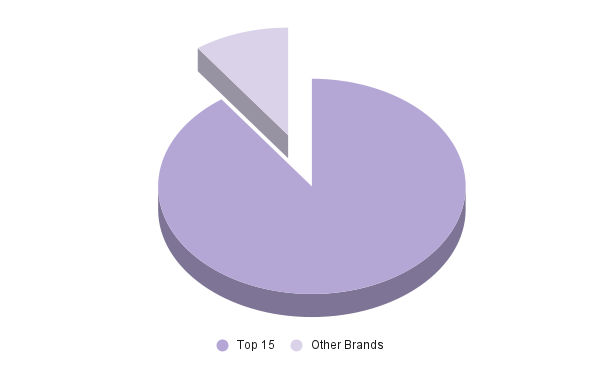
    One of the key highlights is that major UK brands accounted for an impressive 90% of the overall denim purchased from Bangladesh.
    [private_special] Note: This report only reflects the shipments that were made to United Kingdom. If any shipments were made by these brands to other destinations, they would not be covered here.

    Top Brands Dominating the UK Denim Purchases From Bangladesh

    The denim market in the UK has been largely influenced by several key players in the retail sector. This analysis covers the period from September 2022 to September 2023, focusing on the brands that have imported denim garments from Bangladesh to meet the demand within the UK market. It is important to note that this report only considers the denim purchases that are designated for the UK market, excluding any quantities intended for other international markets.

    Market Share Overview – Sept’22 – Sept’23

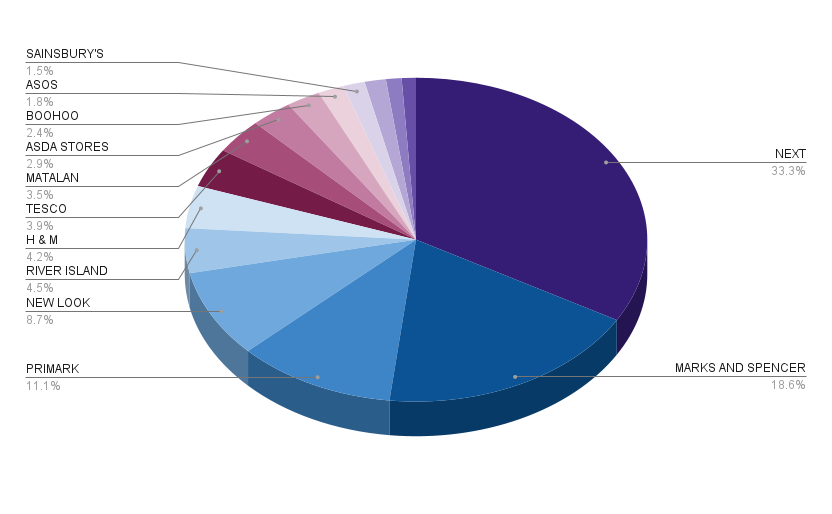
    • Next: Dominates the UK market with a substantial 33.3% market share, reflecting its prominent position in sourcing denim from Bangladesh.
    • Marks and Spencer: Holds a significant stake with an 18.6% share, indicating its strong reliance on Bangladeshi denim.
    • Primark: Not far behind, with an 11.1% share of the imports, showcasing its notable presence in the UK denim landscape.
    • Smaller yet influential shares are held by New Look at 8.7%, River Island at 4.5%, and H&M at 3.9%, each contributing to the diversity of denim offerings in the UK market.
    • Other retailers like Tesco, Matalan, ASDA Stores, Boohoo, ASOS, and Sainsbury’s collectively contribute 15.7%, reflecting the competitive nature of the market with various players vying for consumer attention.

    Market Insights

    The dominance of NEXT in the UK’s denim imports from Bangladesh indicates a strategic alignment with Bangladeshi suppliers, likely due to favorable pricing, quality, or both. Marks and Spencer’s significant share also suggests a targeted approach to stocking their shelves with denim products that resonate with their customer base.

    Primark’s strong market share further emphasizes the demand for affordable denim in the UK, aligning with the brand’s positioning as a value retailer. The presence of multiple retailers like New Look, River Island, and H&M indicates that the UK denim market is diverse, with consumers having a broad array of choices from various price points and styles.
    Further sections of this report will delve into the implications of these figures and offer insights into the dynamics of the denim industry.

    Purchasing Analysis of Top UK Companies Buying Denims

    This segment of report analyzes the denim purchasing habits of the UK’s top retail companies from Bangladesh, over the period of September 2022 to September 2023. We examine the quantities purchased, average prices paid, and the total value of denim procured by each company.
    High-Volume Buyers

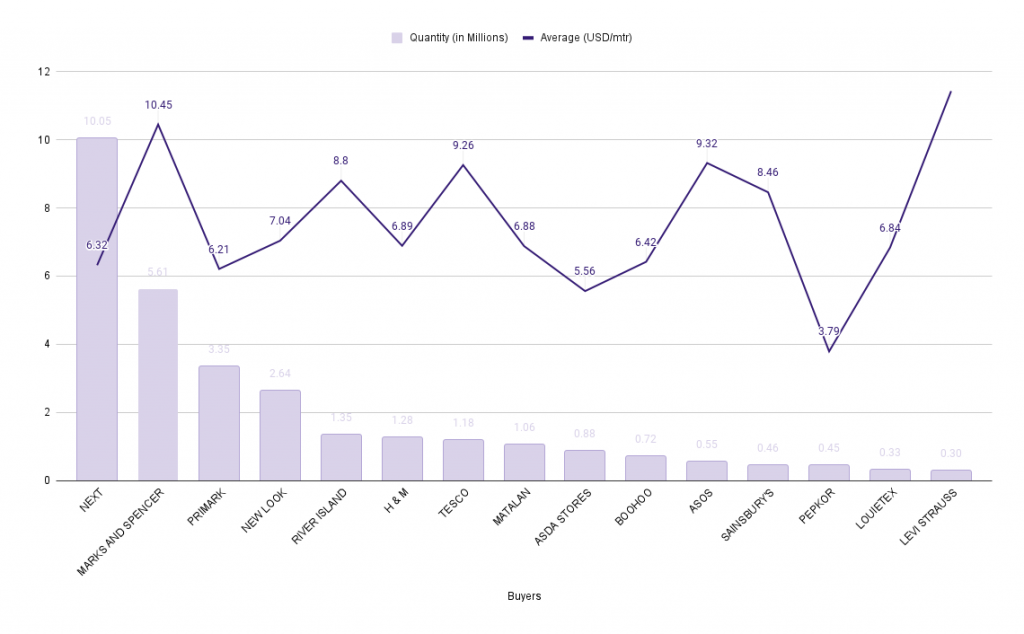
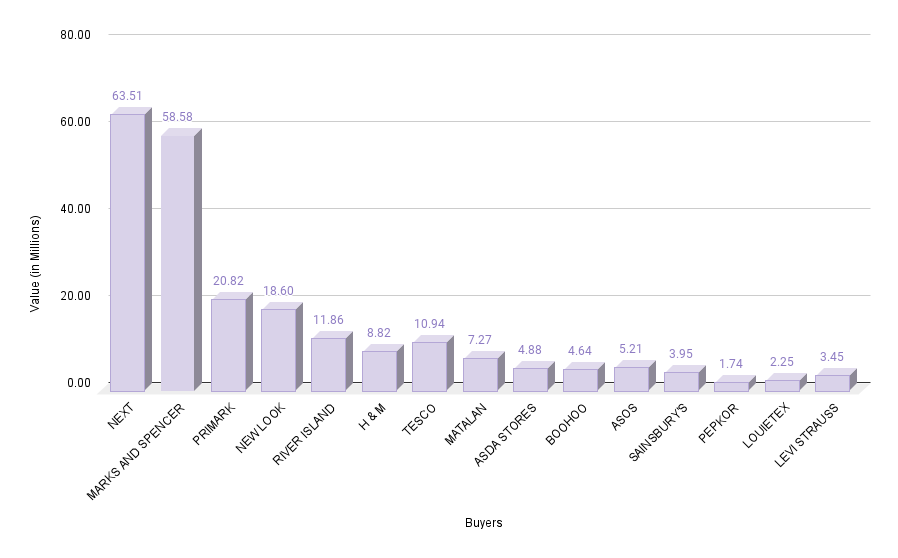
    • NEXT: The leading buyer with 10.05 million units at an average price of USD 6.32 per piece, culminating in a total value of USD 63.51 million.
    • Marks and Spencer: Procured 5.61 million units at a higher average price of USD 10.45 per piece, indicating a premium sourcing preference, with a total expenditure of USD 58.58 million.

    Value-Focused Retailers

    • Primark: Acquired 3.35 million units at a cost-effective average price of USD 6.21 per piece, amounting to a total value of USD 20.82 million.
    • New Look: Purchased 2.64 million units at USD 7.04 per piece, reflecting a moderate price strategy, with a total value of USD 18.60 million

    Mid-Level Purchasers

    • River Island: Bought 1.35 million units at USD 8.8 per piece, with a total spending of USD 11.86 million.
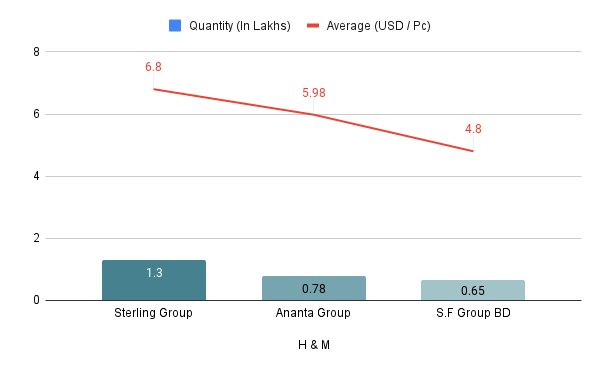
    • H&M: Imported 1.28 million units at USD 6.89 per piece, totaling USD 8.82 million.

    Additional Buyers

    • Tesco, Matalan, and ASDA Stores: These retailers showed a balanced approach with average prices ranging from USD 5.56 to USD 9.26 per piece and total values between USD 4.88 million and USD 10.94 million.
    • Smaller-scale buyers such as Boohoo, ASOS, Sainsbury’s, Pepe Jeans, Louitex, and Levi Strauss varied in both quantities and average prices, indicating diverse purchasing strategies aligned with their brand positioning.

    The purchasing patterns from Bangladesh indicate a dynamic UK denim market where NEXT and Marks and Spencer are leading the way in terms of volume and value, respectively. Primark’s strategy showcases a focus on affordability, while River Island and H&M occupy the mid-range market segment. The varying average prices reflect each retailer’s unique market approach, targeting different consumer demographics. This report underscores the significance of strategic buying decisions in maintaining competitiveness within the UK’s retail apparel sector.
    Analysis of Garment Suppliers for UK’s Top Retail Brands

    This overview captures the strategic relationships between UK retail brands and their garment suppliers, highlighting how each brand aligns its sourcing strategies with its market positioning and customer base.
    Supplier Insights

    Armana Group

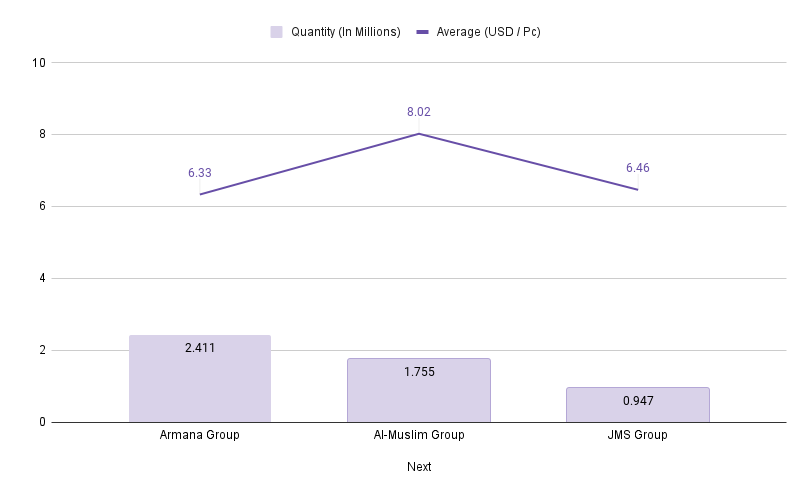
    • Next: Largest contributor with 2.411 million units at the most economical average price of USD 6.33 per unit.

    Hirdaramani Group and Pacific Jeans

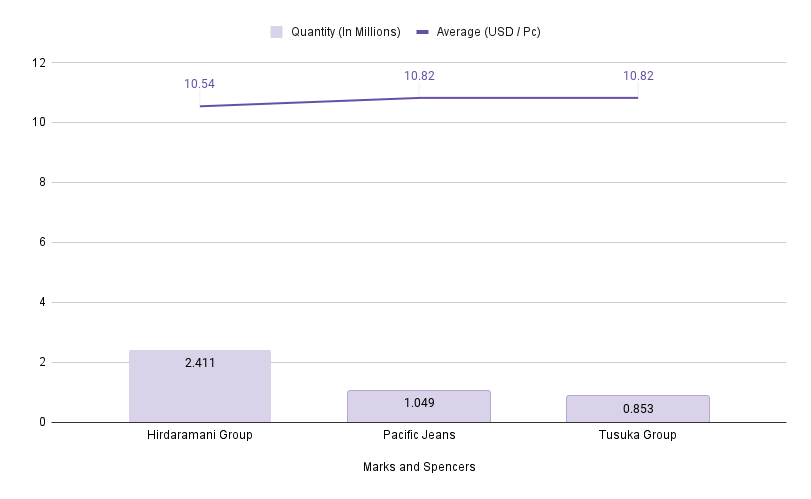
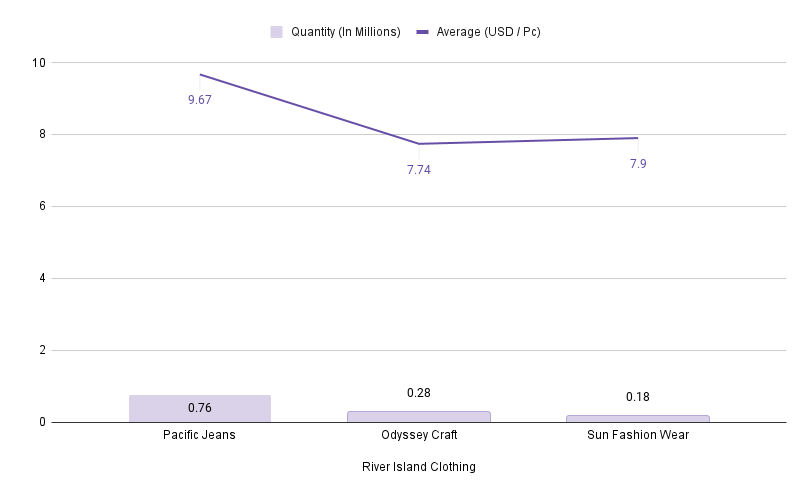
    • Both catered to Marks and Spencer with 2.4 million and 1.049 million units, respectively, at a premium average price exceeding USD 10.50 per unit, reflecting Marks and Spencer’s emphasis on quality. Pacific Jeans shows versatility by also supplying River Island with 0.76 million units at USD 9.67 per unit, suggesting a flexible operation catering to different market tiers.

    Soorty Textiles

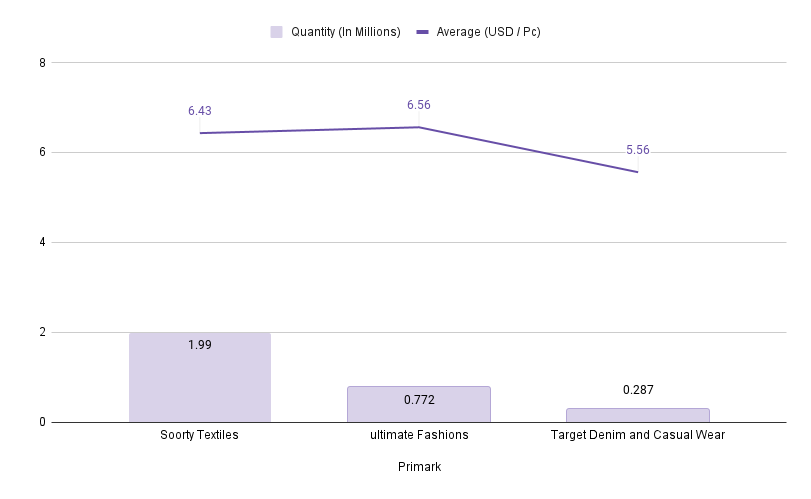
    • A major player for Primark, providing 1.99 million units, combining high volume with a relatively low average price of USD 6.43 per unit, aligning with Primark’s affordability strategy.

    JTC Group and MidAsia Group

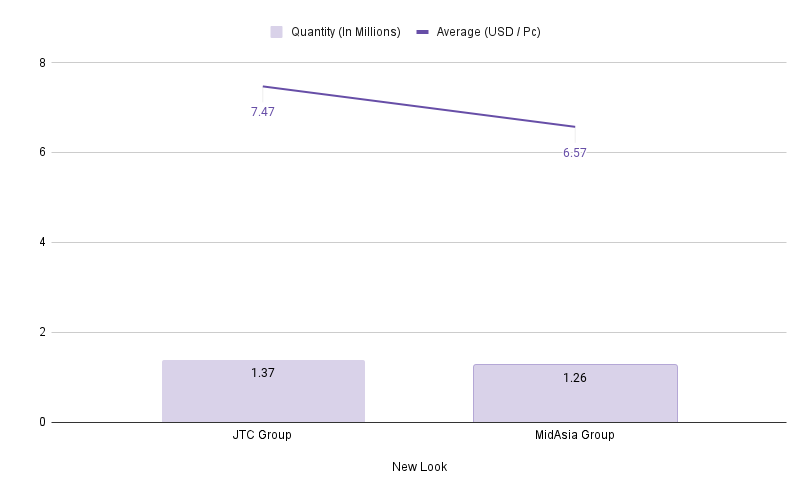
    • Supplied New Look with 1.37 million and 1.26 million units, respectively, with average prices around USD 7.00 per unit, indicating a mid-market positioning.

    Overview

    • Largest Volumes : Next and Marks and Spencer are the largest recipients, indicating their dominant market share in the UK denim sector
    • Highest Prices : Marks and Spencer stands out for paying the highest average prices, which likely correlates with their brand positioning towards higher quality merchandise
    • Best Value : Primark achieves the best value proposition, balancing large volume procurement with lower average prices

    The substantial total of over 33 million units acquired by UK brands, with a dominant 90% attributed to major players, showcases not only the scale of operations but also the strategic alliances with suppliers. Brands such as Next, Marks and Spencer, and Primark have each carved out their niche through volume, value, and a blend of both strategies. [/private_special]


    Check out the other reports below:

    1. 15 Indian Denim Brands Retail – A Detailed Report And Analysis
    2. Denim Exports from Vietnam To Europe
  • Pioneer Denim @ Japan – A Talk With Hasibul Huda

    Pioneer Denim @ Japan – A Talk With Hasibul Huda

    Continuing our series of interactions with various globally reputed manufacturers of denim, we today bring out a talk with the marketing head of Pioneer Denim Bangladesh – Hasibul Huda. Pioneer denim is one of the fastest growing vertical operation of denim globally with a special focus on sustainability at all levels of their operations. As Pioneer Denim joins our show in Japan on March 26-27 2024 for the second edition , we try to get more insights into what they are doing . Hasibul Huda shares his views with us .

    We welcome you back to our Denimsandjeans Japan show ! What was your feeling about the last edition?
    We are really excited and looking forward to taking part in Japan’s show. Last edition was great in all aspects. The experience was memorable as we got the opportunity to showcase our new collections, innovations and expertise to a group of new growing denim brands. The passionate denim lovers and visitors showed a lot of enthusiasm and interest on the denims displayed in the show. Visitors were good in numbers and we received very positive feedback from them. We believe, the next edition is going to be even better.  

    Pioneer group is growing so wonderfully. We understand that in spite of the poor business climate, the company has been progressing very strongly. What do you think is the secret sauce ?
    Yes, we are having a steady growth despite of having the current hostile market situation. Thanks to our policy and strategy makers as their leadership paved the way to overcome this situation. We always tried to stick to our core operational strategy in last few years, such as, producing good quality and market oriented products, offering better lead time and maintaining a healthy partnerships with our business partners around the world with direct communication.        


    Garmenting, we understand , is your next dream segment which will make you completely vertical. What are the plans for the same and how it will affect your business
    This is no longer a dream; It is a reality now. Because, the garmenting infrastructure is almost ready to go for production in large scale. In fact, a pilot project is already running and producing fewer pieces of garments each day taking fabric from its own mill. The group is witnessing an excellent vertical integration of its operation as it has created a production chain from fiber to fashion. In near future, the garment unit will have a mammoth production capacity and will have a lot to offer to our partners. Such as – shortest production lead time, excellent quality consistency and development support.      
    What are the most important products that you have created recently which have been highly appreciated
    We are focusing more on performance oriented denims at this moment. Most of our recent developments include blended and performance yarns. Our latest remarkable developments are indigo free denim, fabric made with wools blended yarn and so on. In addition, we are now also focusing on fashion oriented product development as denim is no longer a basic apparel any more.  


    5.What collection are you going to present to Japanese customers? Will it differ from that in other markets ?
    We will mainly showcase some price point collection in this edition due to the market condition. However, there will also be some premium collections and innovations exclusive focusing on traditional unique Japanese market taste. As sustainability is concerned, we are also including our sustainable range which will include , ecofriendly dyeing and finishing, different new color casts, etc.  

    Mail to this email id for more details and contacting the exhibitor .

    About : Md Hasibul Huda with his 16 years of denim experience has been leading the marketing team of Pioneer Denim since its first day of commercial production in 2018. With the vision to grow beyond the traditional market and to reach end-buyers directly to understand and cater their needs for sustainable business growth, is the key success for Pioneer Denim led by Hasib.
  • Denim Exports from Vietnam To Europe

    Denim Exports from Vietnam To Europe

    In this report, you’ll find a comprehensive analysis of the denim export from Vietnam to Europe over the course of a year ie from March 2022 to March 2023. We have meticulously covered various aspects, including the purchasing practices of major European brands, their engagement with Vietnamese suppliers, trade dynamics, and detailed data on quantities supplied and average prices.

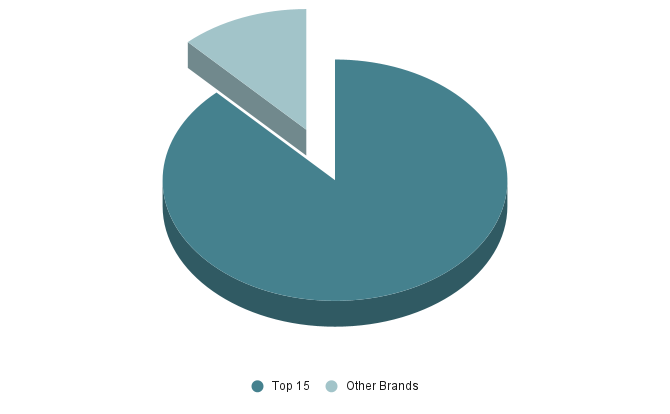
    One of the key highlights is that major European brands accounted for an impressive 88% of the overall denim purchased from Vietnam. Get ready to explore the ins and outs of this dynamic denim industry!

    [private_special] Note: This report only reflects the shipments that were made to Europe. If any shipments were made by these brands to other destinations, they would not be covered here.

    Top Brands Dominating the European Denim Purchases From Vietnam

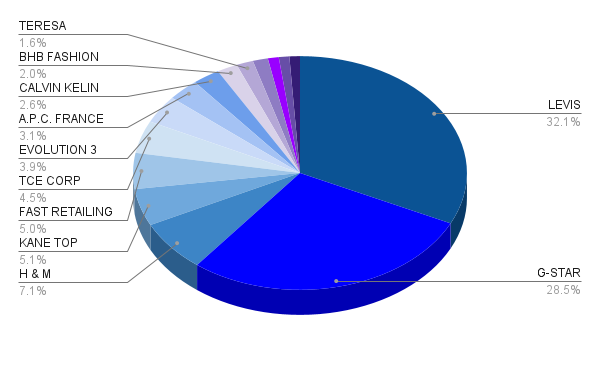
    The accompanying pie chart vividly illustrates the market shares of these top brands, highlighting their hold on the European denim industry. Discover the dominance of these renowned brands and their contribution to the denim trade between Vietnam and Europe in this insightful report.

    • Levi Strauss and G-Star lead the pack, holding an impressive 32.1% and 28.5% share of denim garment purchases from Vietnam, showcasing their strong market presence. Of course Levi’s sources much more garments for their US and other markets from Vietnam, but in this report , we are just covering those that are being sent to EU only .
    • H&M follows closely, capturing 7.1% of the denim market, while Kane Top and Fast Retailing secure a decent 5.1% and 5% share respectively of European denim imports from Vietnam.
    • The

    We will be focusing on this data to further analyze in details in the ensuing sections.

    TOP 5 COMPANIES BUYING DENIMS

    This exclusive section unveils the purchasing dynamics of renowned European brands, highlighting their quantities and average prices in sourcing denim garments.

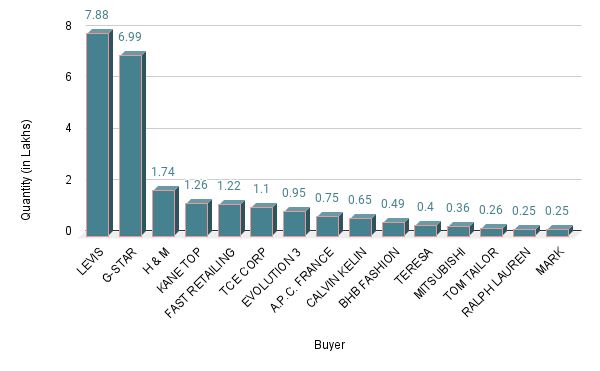
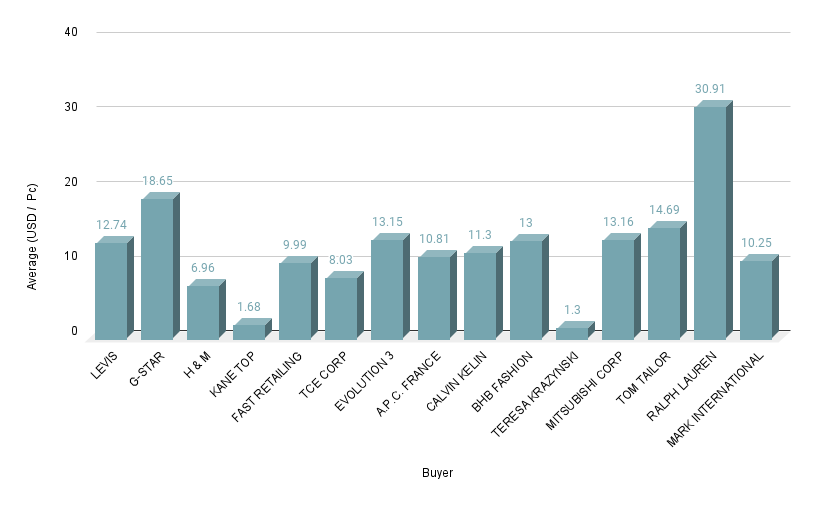
    • Levi Strauss and G-Star emerge as industry giants, securing their position as the leading buyers with quantities of 7.88 lakhs and 6.99 lakhs units of denim garments respectively. Levi’s purchased denims at an average price of 12.74 USD/meter, while G Star opted for a higher average price of 18.65 USD/meter.
    • Ralph Lauren, although purchasing a smaller quantity of 0.25 lakh units, paid a higher average price of 30.91 USD/meter, showcasing their premium denim preference.
    • H&M, Kane Top, and Fast Retailing cement their presence in the market with decent purchases of approximately 1.74 lakhs, 1.26 lakhs, and 1.22 lakhs quantities respectively, paying commendable average prices of 6.96 USD/meter, 1.68 USD/meter, and 9.99 USD/meter.

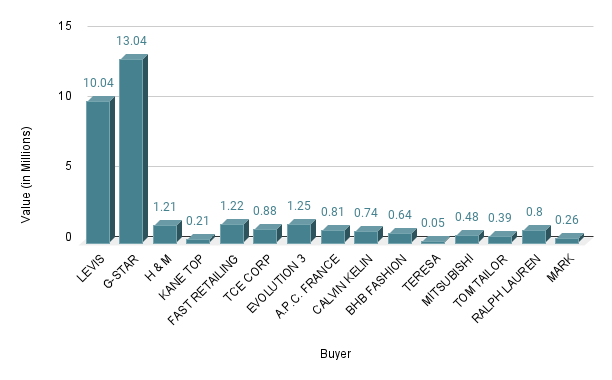
    Recently, G Star has emerged as the leading purchaser of denim garments from European manufacturers, purchased an impressive 6.99 lakh units valued at 13.04 million USD.

    GARMENT SUPPLIERS OF THESE BRANDS

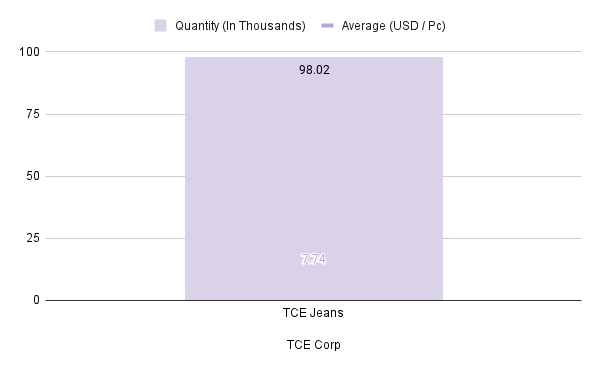
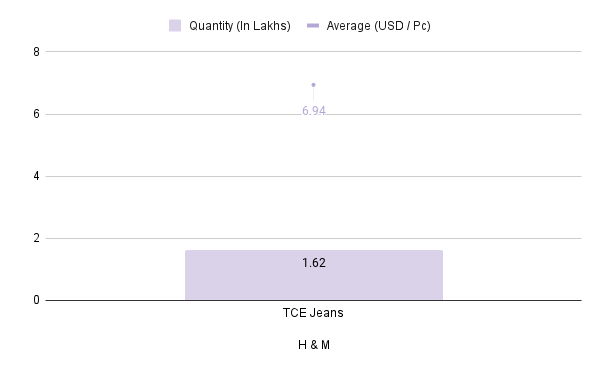
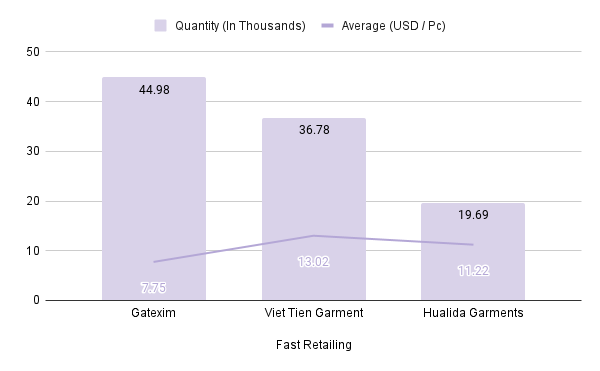
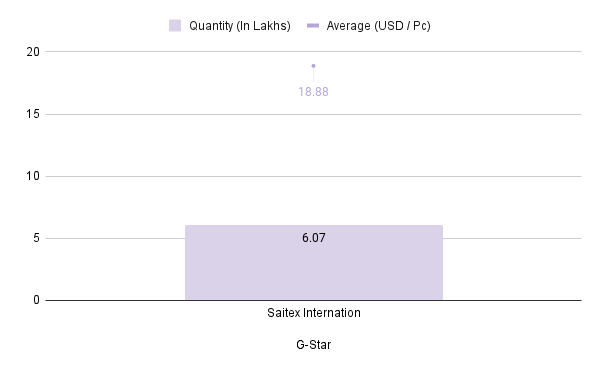
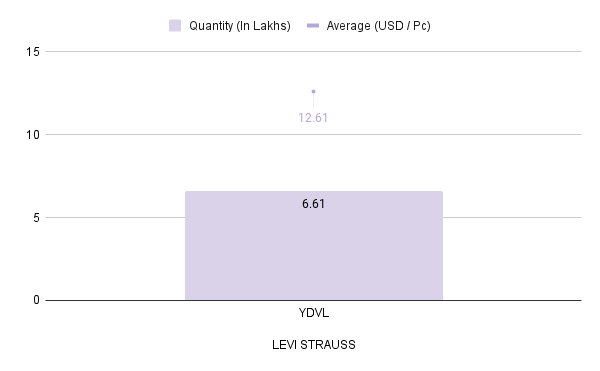
    In this section, we will delve into the key suppliers of the prominent retail brands, including G-Star, Levi Strauss, Fast Retailing, and H&M. Here we will discover insights into these suppliers, where we have presented data on the quantities and average prices at which they have procured denim garments, giving you a comprehensive understanding of their purchasing patterns. When we look at TCE corp, we need to understand that they are a big Korean group which also has a factory in Vietnam for fabric and garments. They themselves buy their own garments on behalf of other brands and supply to them. So in some case s it may appear that they are both buyer and supplier as well.

    [/private_special]

  • Denim Exports from Vietnam To Japan In 12 Months

    Denim Exports from Vietnam To Japan In 12 Months

    This comprehensive report uncovers key insights into the purchasing practices of major Japanese brands in the denim industry, with a special focus on their engagement with Vietnam as a sourcing location. Covering the period from March 2022 to March 2023, we dive deep into trade dynamics, presenting data on Vietnamese companies exporting garments to Japan, including details on quantities supplied and average prices.

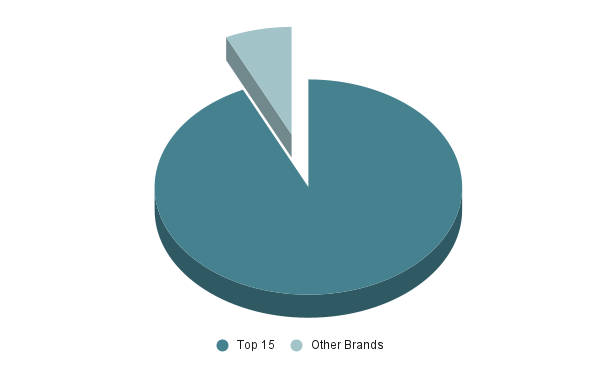
    A significant finding in this report is that major Japanese brands were responsible for around 93% of the overall denim purchased from Vietnam. [private_special]

    Note: This report only reflects the shipments that were made to Japan. If any shipments were made by these brands to other destinations, they would not be covered here.

    Share of Each of Top Brands

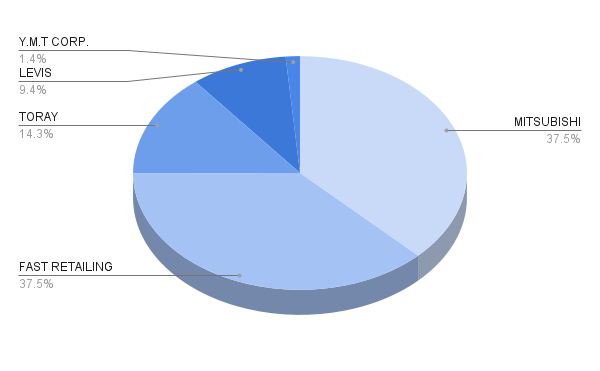
    The accompanying pie chart vividly illustrates the strong presence of Mitsubishi and Fast Retailing (UNIQLO) , highlighting their equal hold on the market.

    • Mitsubishi and Fast Retailing emerge as the frontrunners, securing a dominant position with a remarkable 37.5% share of denim garment purchased from Vietnam.
    • Toray closely follows, capturing 14.3% of the denim market, while Levi’s makes its mark with a decent 9.4% share of the Japanese denim imports from Vietnam.

    We will be focusing on this data to further analyze in details in the ensuing sections.

    TOP 5 COMPANIES BUYING DENIMS

    This exclusive section unveils the purchasing dynamics of renowned Japanese brands, highlighting their quantities and average prices in sourcing denim garments.

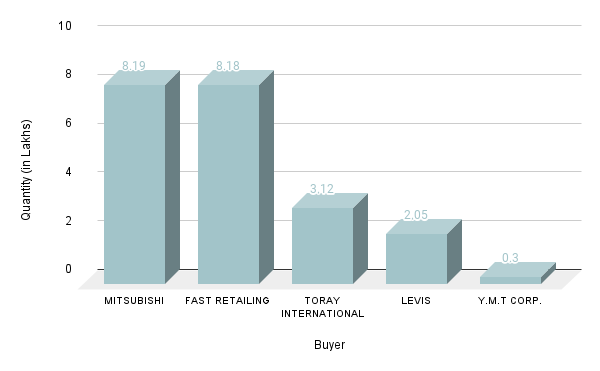
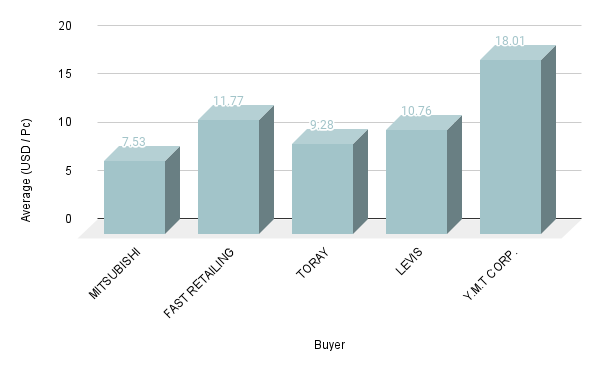
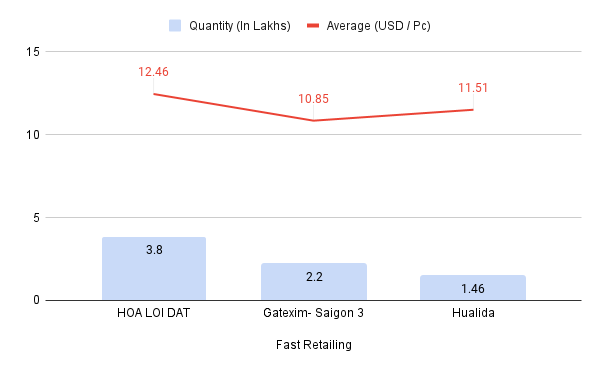
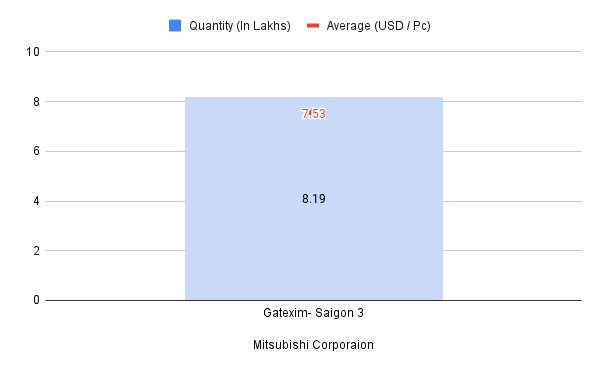
    • Mitsubishi and Fast Retailing: These industry giants have solidified their position as the leading buyers, acquiring an impressive quantity of 8.19 lakhs units of denim garments. Mitsubishi purchased denims at an average price of 7.53 USD/meter, while Fast Retailing (UNIQLO) purchased denims at an average price of 11.77 USD/meter.
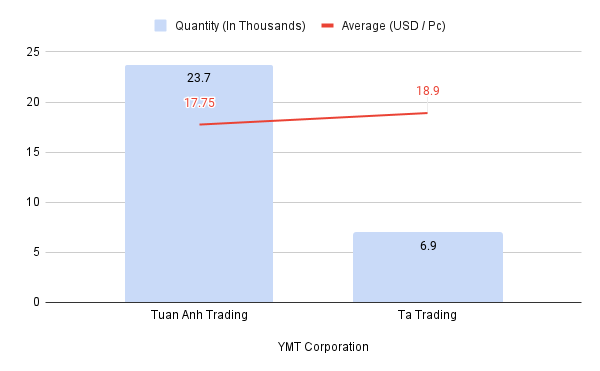
    • Y.M.T Corporation: Although purchasing a smaller quantity of 0.3 lakh units, Y.M.T Corporation paid a higher average price of 18.01 USD/meter.
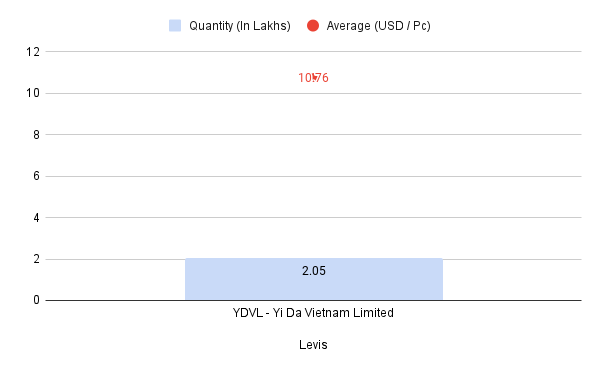
    • Levis: With an extensive purchase of approximately 3.12 lakh quantities, Levis cemented its presence in the market by paying a commendable average price of 10.76 USD/meter.

    One more point that needs to be considered is that the details in this report show only the shipments made to Japan. So if Mitsubishi has ordered for shipments to be made to other countries, it will not reflect in this report.

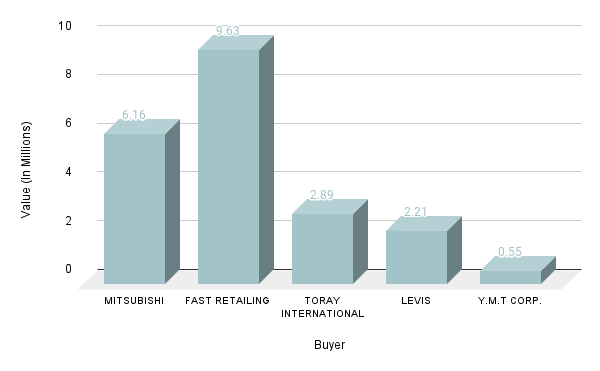
    Recently, Fast Retailing has emerged as the leading purchaser of denim garments from Japanese manufacturers, purchased an impressive 8.18 lakh units valued at 9.63 million USD. Not far behind is Mitsubishi, with their purchase of 8.19 million units of denim garments at a value of 6.16 million USD.

    GARMENT SUPPLIERS OF THESE BRANDS

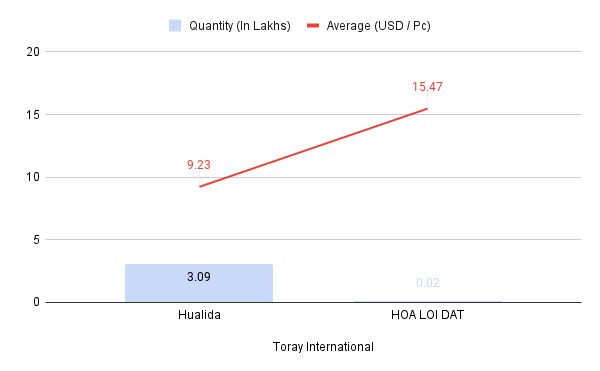
    In this section, we will delve into the key suppliers of the prominent retail brands, including Mitsubishi, Fast Retailing, Toray, Levis, and YMT Corporation. Here we will discover insights into these suppliers, where we have presented data on the quantities and average prices at which they have procured denim garments, giving you a comprehensive understanding of their purchasing patterns.

    Based on estimates, Japanese brands procured approximately 2.34 million units of denim apparel from Vietnam during the period of 2022-2023. The actual quantities could be higher than this. [/private_special]

  • Denim Exports from Bangladesh To Canada In One Year

    Denim Exports from Bangladesh To Canada In One Year

    The report offers valuable information on the purchasing behavior of prominent Canadian brands within the denim industry, focusing on their interactions with Bangladesh as a sourcing destination. Spanning from May 2022 to May 2023, it delves deeper into the trade specifics, providing data on Bangladeshi companies exporting garments to Canada, including information on quantities supplied and average prices.

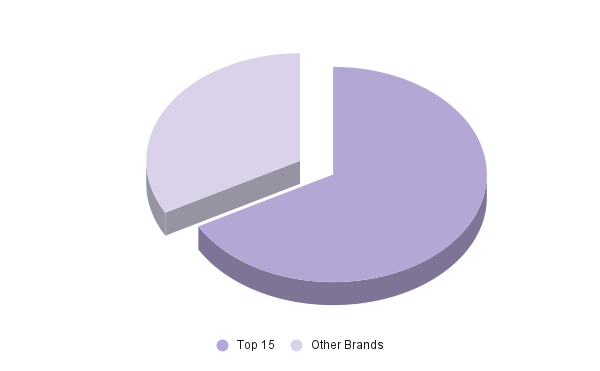
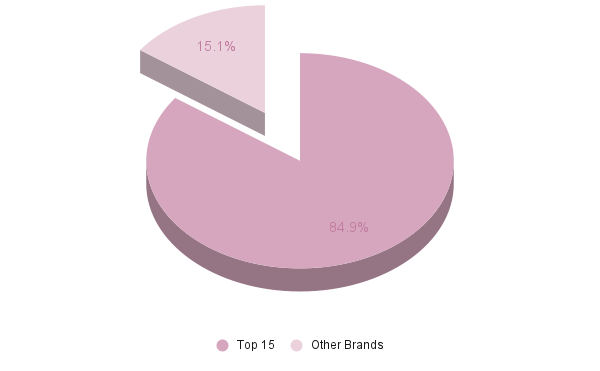
    An important insight from this report is that well-known Canadian brands accounted for approximately 67% of the total denim purchased from Bangladesh, highlighting the concentration of purchasing power among a limited number of brands. [private_special]

    Note: This report only reflects the shipments that were made to Canada. If any shipments were made by these brands to other destinations, they would not be covered here.

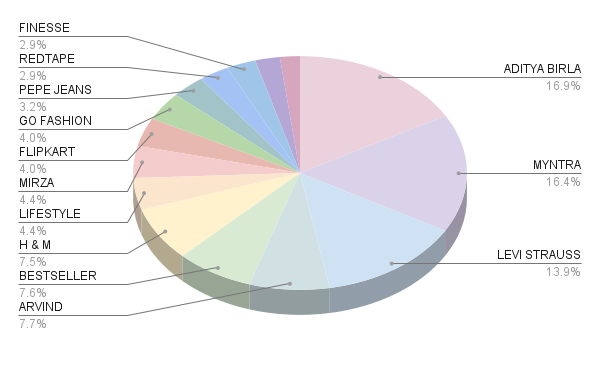
    Share of Each of Top 15 Brands

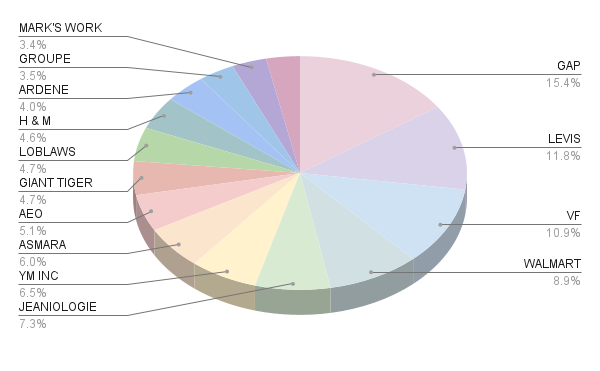
    Gap has established itself as the dominant player in the Bangladesh market for denim garment purchases from Canada. This is evident from the accompanying pie chart, which indicates that Gap has acquired 15.4% of denim garments from Bangladesh, making it the largest player in the market. Following closely behind is Levi’s, with a purchase of 11.8% of denims, and VF Sourcing, with a purchase of 10.9% of denim garments.

    We will be focusing on this data to further analyze in details in the ensuing sections.

    TOP 15 COMPANIES BUYING DENIMS

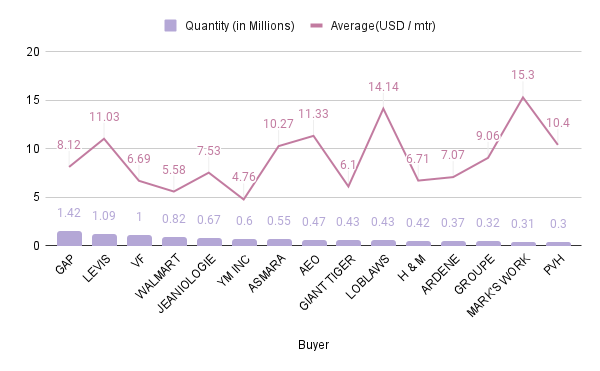
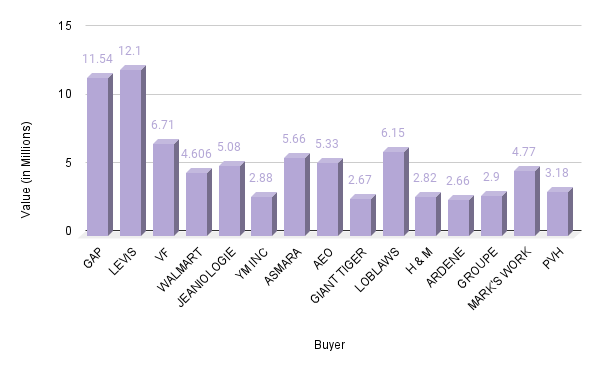
    This section offers an overview of the denim garment purchases made by Canadian brands from suppliers in Bangladesh. Gap has emerged as the foremost buyer, acquiring an impressive 1.42 million units at an average price of 8.12 USD/meter. In comparison, Levis purchased a lesser quantity of 1.09 million units but at a higher average price of 11.03 USD/meter.

    Despite Mark’s Work Wearhouse acquiring the lowest quantity of denim garments, which is approximately 0.31 million quantities, they have paid the highest average price of 15.3 USD/meter. Similarly, Loblaws, with a purchase of around 0.43 million quantities of denim garments, has also paid a commendable average price of 14.14 USD/meter.

    One more point that needs to be considered is that the details in this report show only the shipments made to Canada. So if Gap has ordered for shipments to be made to other countries, it will not reflect in this report.

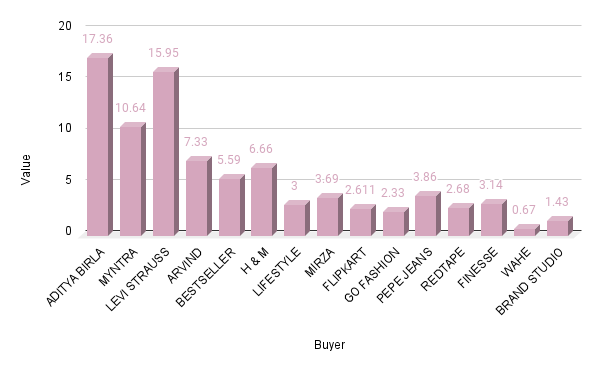
    The above show the value in USD million that different brands purchased from Bangladesh during this period.

    TOP 3  GARMENT SUPPLIERS OF THESE BRANDS

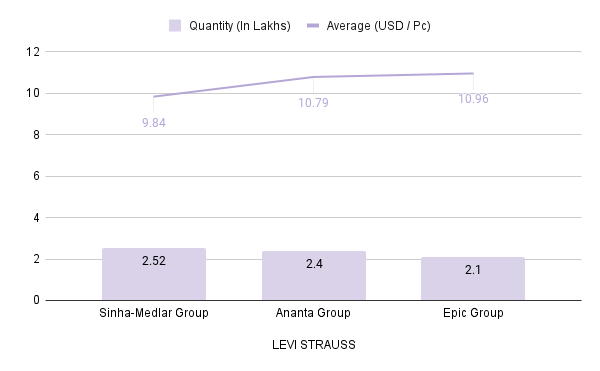
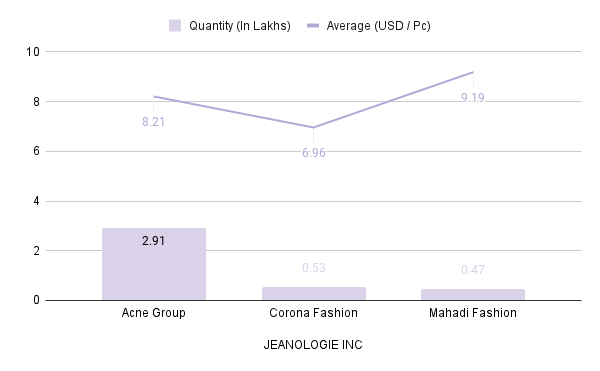
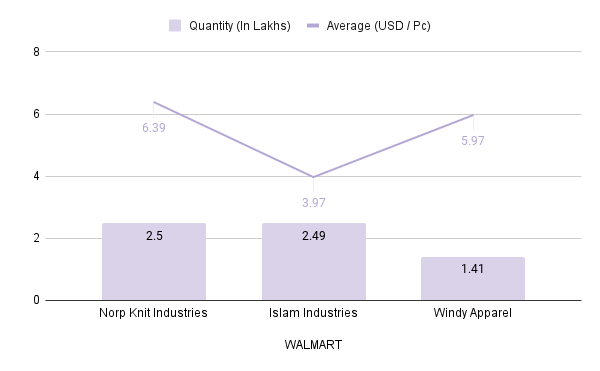
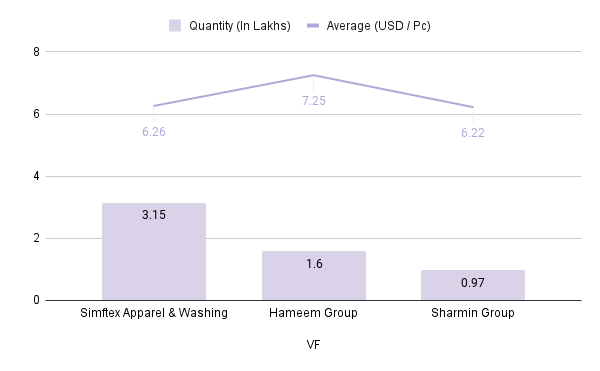
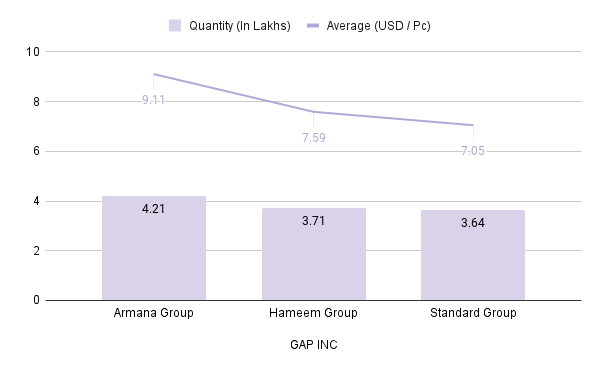
    In this section, we will explore the primary suppliers of the leading retail brands, namely Gap, Levis, VF, Walmart INC, and Jeaniologie. We will provide an overview of their three largest suppliers to offer a comprehensive perspective. Additionally, we have included details on the quantities and average prices at which they have purchased denim garments.

    Based on estimates, Canadian brands procured approximately 13.76 million units of denim apparel from Bangladesh during the period of 2022-2023. The actual quantities could be higher than this. [/private_special]

  • Exports Of Denim Apparel From Bangladesh In Last One Year

    Exports Of Denim Apparel From Bangladesh In Last One Year

    This report provides an insight into the purchasing patterns of major Indian brands in the denim industry from Bangladesh from March 2022 – 2023. The report also delves deeper into the specifics of the trade, including data on Bangladeshi companies that export garments to India, as well as quantities supplied.

    One of the key takeaways from this report is that a few top Indian brands bought about 84% of total denim from Bangladesh, indicating a concentration of buying power in the hands of a select few. The report also presents information on other Indian companies that engage in substantial buying from Bangladesh. [private_special]

    Note: This report only reflects the shipments that were made to India .

    Share of Each of Top 15 Brands

    The denim industry in Bangladesh has seen a significant growth in recent years, with several global players vying for a share of the market. Among them, Aditya Birla has emerged as the biggest market player in Bangladesh when it comes to buying denim garments, accounting for 16.9% of the total purchases. It is followed closely by Myntra, which purchased 16.4% of its denim from Bangladesh, while Levi Strauss bought 13.9%.

    We will be focusing on this data to further analyze in details in the ensuing sections.

    TOP 15 COMPANIES BUYING DENIMS

    This section provides a snapshot into how much these Indian brands purchase denim garments from Bangladesh suppliers.

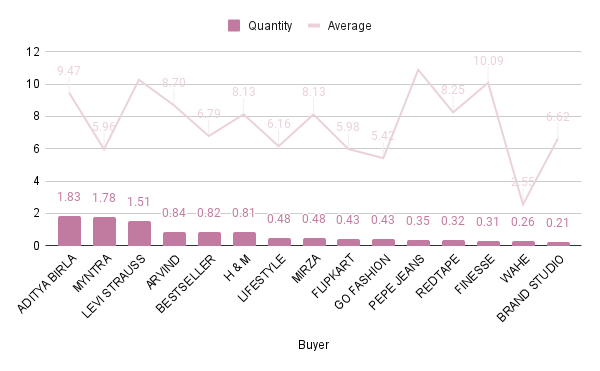
    Aditya Birla, has emerged as the leading purchaser of denim garments from Bangladeshi manufacturers. They have purchased a staggering 1.83 million units valued at 17.36 million USD.

    Recently, Aditya Birla has emerged as the leading purchaser of denim garments from Bangladeshi manufacturers, purchasing an impressive 1.83 million units valued at 17.36 million USD. Not far behind is Myntra, with their purchase of 1.78 million units of denim garments at a value of 5.96 million USD.

    Interestingly, Levis has also jumped on the bandwagon by purchasing almost the same quantity of denim garments – 1.51 million units valued at a whopping 15.95 million USD!

    One more point that needs to be considered is that the details in this report show only the shipments made to India. So if Aditya Birla has ordered for shipments to be made to other countries, it will not reflect in this report.

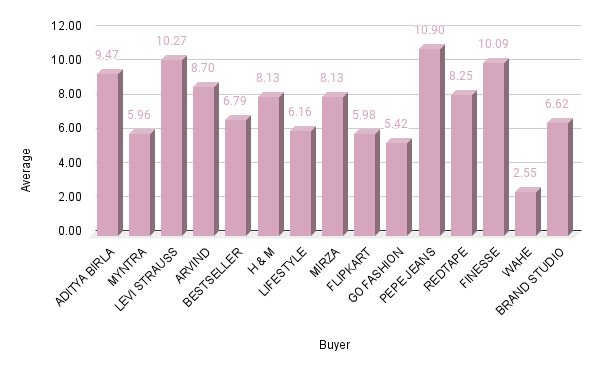
    Average Buying Price (USD/Pc)

    It is evident from the graph that Levi Strauss has purchased a significantly larger quantity of 1.51 million units at average price of 10.27 USD / mtr. It is notable that Pepe Jeans has paid a competitive average price of 10.09 (USD / piece) for their smaller purchase of 0.35 million units.

    TOP 3  GARMENT SUPPLIERS OF THESE BRANDS

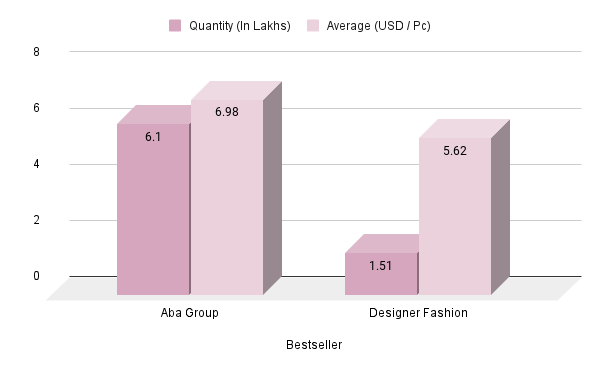
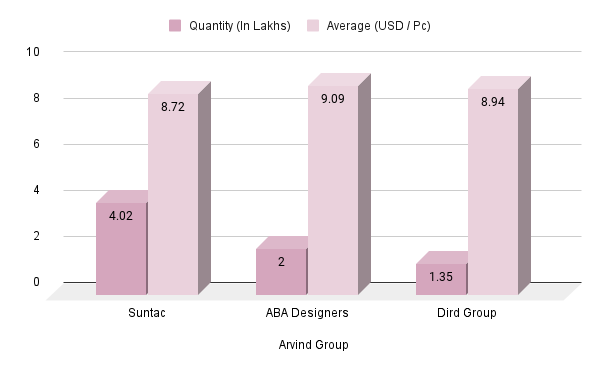
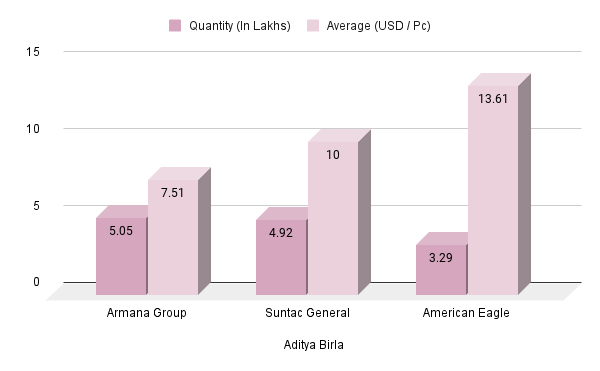
    In this section, we will look into who are the major suppliers of these top Indian retail brands. We will also list out their top 3 largest suppliers to provide a comprehensive view.

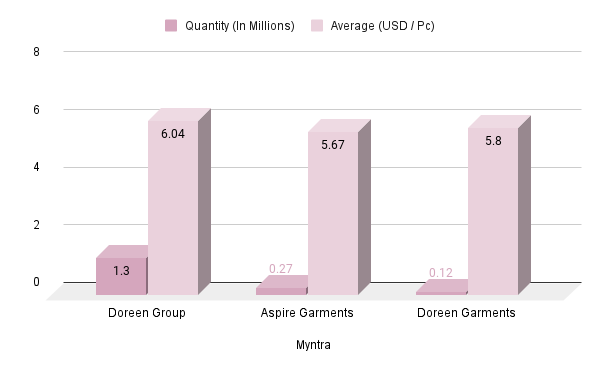
    It is clear that Doreen Group is an essential supplier for Myntra.

    According to our records, Doreen Group supplied over 1.3 million pieces at an average price of 6.04 USD/pc in the last year which is a very good price

    In recent years, Indian brands have been sourcing their denim apparel from Bangladesh. According to estimates, in 2022-2023 alone, approximately 12.93 million pieces of denim apparel were purchased by Indian brands from Bangladesh. It’s important to note that this number only reflects shipments made directly to India and doesn’t account for orders that are shipped to other destinations. [/private_special]

  • Top 15 Japanese Brands Buying Denim From Bangladesh In 2022

    Top 15 Japanese Brands Buying Denim From Bangladesh In 2022

    In this report, we are providing information about what major Japanese brands purchased denim from Bangladesh in 2022 .

    This report offers in-depth analysis on the purchasing patterns of Japanese companies, highlighting those that engage in substantial buying . Furthermore, the report presents data on Bangladeshi companies that export garments to Japan, including the quantities supplied and a deeper delve into other specifics of the trade . [private_special]

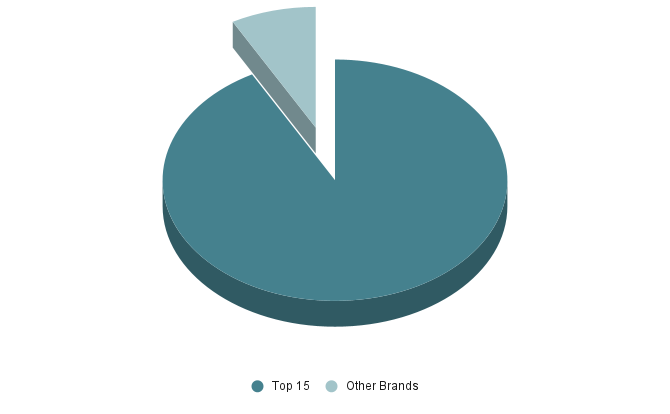
    As we can see from the pie chart below, the top Japanese brands (15) bought about 92% of the total denim apparel purchased by global denim brands from Bangladesh in 2022 which is a large part of the business!

    Note: This report only reflects the shipments that were made to Japan .

    Share of Each of Top 15 Brands

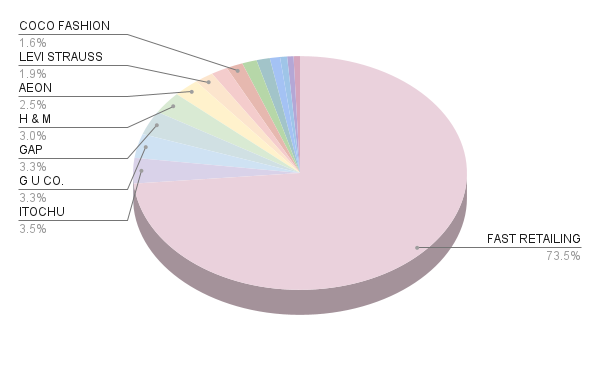
    Fast Retailing has emerged as the biggest market player in Bangladesh when it comes to buying denim garments. This is evident from the below pie chart which shows that 73.5% of the total market share of denim garment buying from Bangladesh goes to Fast Retailing.

    We will be focusing on this data to further analyze in details in the ensuing sections.

    TOP 15 COMPANIES BUYING DENIMS

    This section provides a snapshot into how much these Japanese brands purchase denim garments from Bangladesh suppliers.

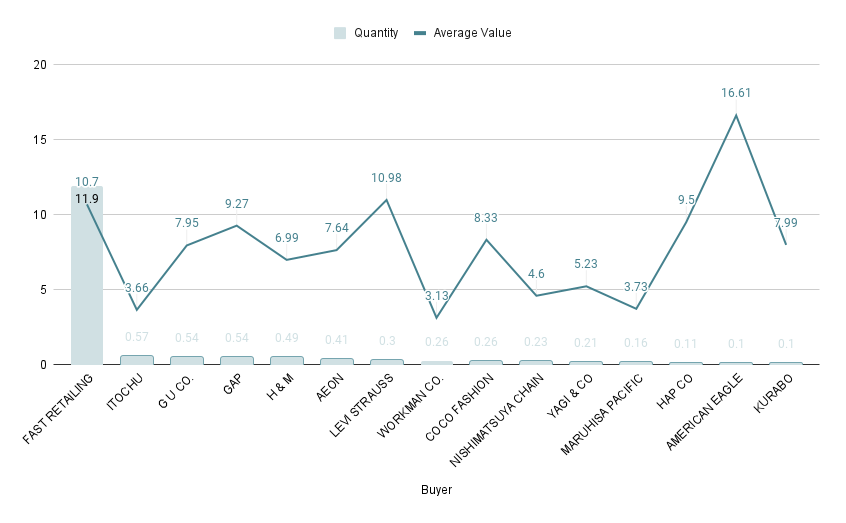
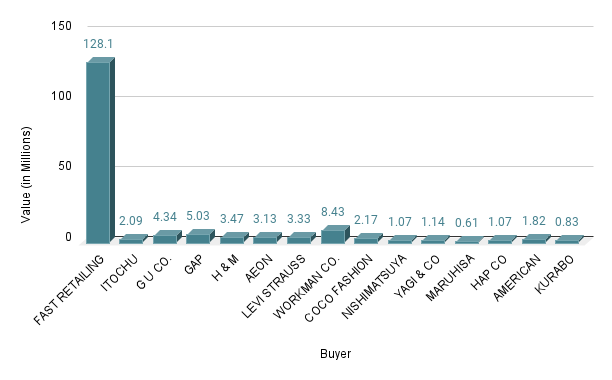
    Fast Retailing, the Japanese clothing giant with Uniqlo and other brands, has emerged as the leading purchaser of denim garments from Bangladeshi manufacturers. They have purchased a staggering 11.9 million units valued at 128.1 million USD, comprising more than half of Bangladesh’s total exports in this sector.

    This is notable for a number of reasons, namely the amount of industry competition they face and the fact that other major brands such as Itochu, Gu, Gap and H&M have made purchases totaling 0.57 million, 0.54 million, 0.54 million and 0.49 million respectively at similar prices in the same period of time. Of course, we cannot forget that Uniqlo is a leading global retailer and dominates the denim space when it comes to Japanese market . One more point that needs to be considered is that the details in this report show only the shipments made to Japan. So if Uniqlo has ordered for shipments to be made to other countries, it will not reflect in this report.

    While brands such as Workman & co. and Gap purchased denim garments with a value of nearly USD 8.43 million and 5.03 million, other brands chose to purchase far lesser quantities at a fraction of this cost. Specifically, purchases between 0.83 – 4.34 million USD were made by various buyers.

    Average Buying Price (USD/Pc)

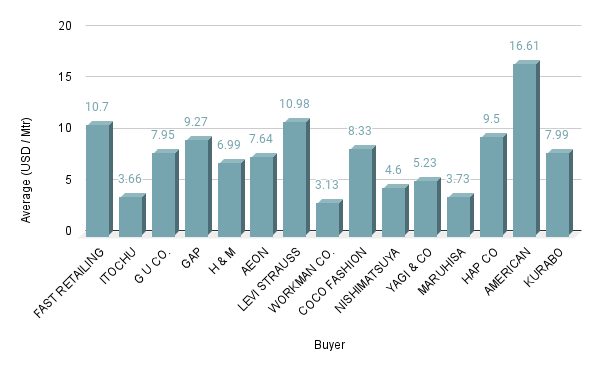
    American Eagle, one of the leading international fashion companies, purchased the least quantity of 0.1 millions, they still managed to pay a record-breaking average price of 16.61 USD/mtr per unit making them the highest paying buyers in Bangladesh thus far. However, the quantity is negligible.

    TOP 3  GARMENT SUPPLIERS OF THESE BRANDS

    In this section, we will look into who are the major suppliers of these top Japanese retail brands. We will also list out their top 3 largest suppliers to provide a comprehensive view.

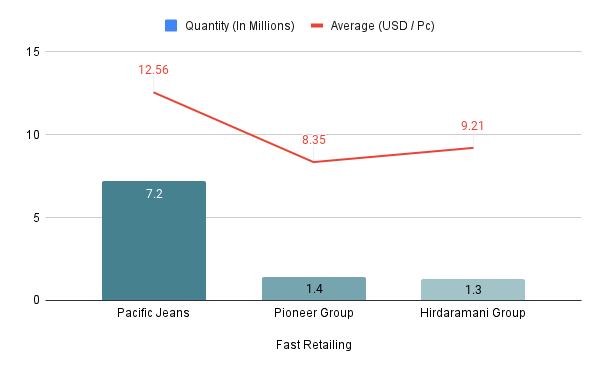
    It is clear that Pacific Jeans is an essential supplier for Fast Retailing company.

    According to our records, Pacific Jeans supplied over 7.2 million pieces at an average price of 12.56 USD/pc in 2022 which is a very good price and most of their products go to Uniqlo only. They are the main nominated supplier to Uniqlo from Japan.

    In 2022, an estimated of 17.70 million pieces of denim apparel [/private_special] were bought by Japanese brands from Bangladesh. The quantities of Japanese orders would, however, be much higher if we consider that the shipments also go to other destinations. This figure reflects the shipments that were made to Japan. Japanese buyers are shifting slowly from China to Bangladesh and we will find an increase in volume in the coming times.

  • AiMAT Software For Laundries By Arief Labu

    AiMAT Software For Laundries By Arief Labu

    Arief Labu has been working in the denim industry in Bangladesh for over 15 years since 2006. He started in product development, moved on to wash R&D, and then to wash production and product management. He has worked with well-known companies and brands like G-star, Bestseller etc and his work experience encompasses countries such as India, Vietnam, Pakistan, Cambodia, UAE, Sri Lanka, and Bangladesh. He has literally been a witness and a part of the booming denim industry in Bangladesh and has had the opportunity to see it from different angles. He also saw the various problems that came with the growth and were always keen to work out ways to resolve them. One of the issues he found in the industry was the lack of measurability of the resources used in laundry and the inability of the companies to create concrete data of resource usage. This set him thinking to try to find a solution to this problem and with a team; he developed a software cum hardware solution called AiMAT.
    We spoke to him about the product and what it means and how it can be used and we bring this Q&A that we had with him.

    Hi Arief, you have come out with a new software called AiMAT. Can you let us know more about it?

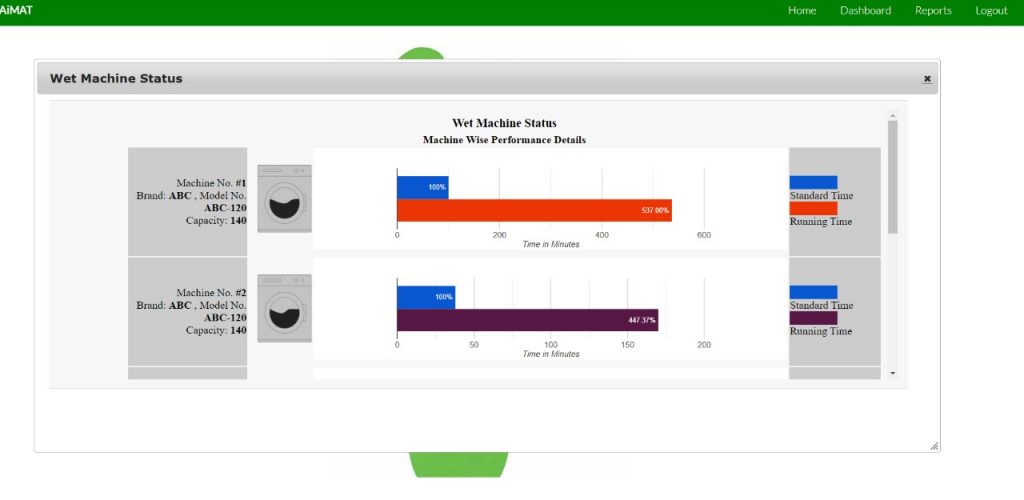
    Thanks for asking, yes, we did, it is just like its name, Automated Industrial Measurement and Analysis Tool. It is not only software but a combination of hardware and software. The purpose of the same is to help the washing/laundries to come out with real-time data on usage of water, chemicals, fuel, etc, inputs in their factory. It also enables the calculation of this data based on buyer, order, period, and other parameters, making it easy for the supplier to generate reports as he wishes. It can also help the buyer to monitor resource usage on his order in real-time and this I believe is the biggest advantage. Other positives are:

    •  Having data automatically 
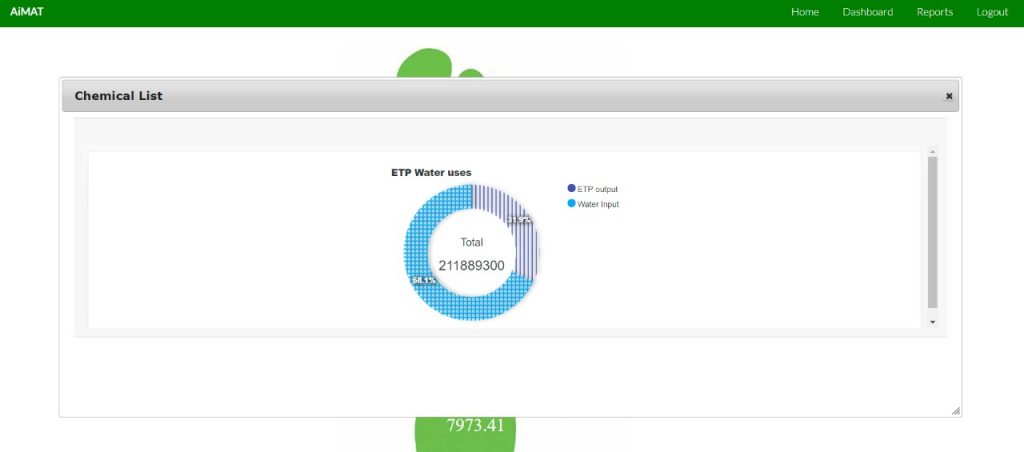
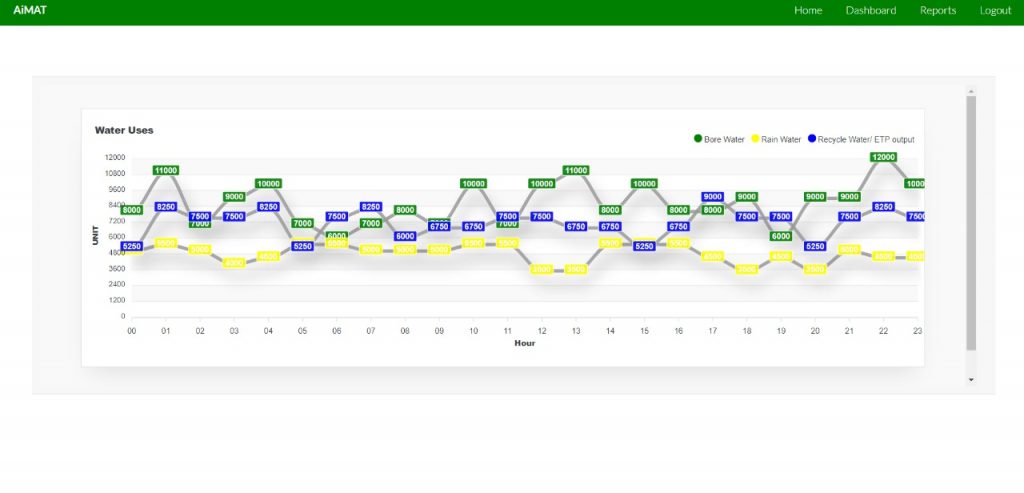
    •  Knowing the real uses of chemicals, water, electricity, fuel, and ETP. 
    •  Knowing the real data of carbon generation.
    •  Analyzing data and automatic report system, accessible from any internet destination.
    •  Transparency at the highest level. The base for any kind of sustainability.
    •  Digitalization of chemical uses.
    •  Knowing the uses of Brand wise, order-wise, style-wise, or pcs-wise. Also, yearly, monthly, weekly, and day-wise.

    What is the applicability of this tool? Who would really benefit by implementing this and how?

    This tool is basically to be used by the washing/laundries where the most of the resources are used. The laundries can easily control and monitor their consumptions of water, chemicals, electricity, Gas etc. The most important aspect of this solution is that it is Not dependent on any kind of machine, chemical etc. It can be applied in ANY LAUNDRY. The One Click reporting system also is very helpful to know order wise, style wise, period wise details of resources and it greatly helps in Management control and improving sustainability credentials.

    With this system, everyone would be benefitted.

    • Factory
      • By knowing the exact consumptions.
      • By knowing the exact cost of the production.
      • By knowing the real chemical consumption
      • By knowing the exact rewash/rework amount.
      • By knowing the real productivity.
      • By knowing the real time production status.
      • By knowing if the production is really getting sustainable or not.
      • By having more specific control over the production.
    • Brand
      • All these factory benefits are really a benefit for the real product owners.
      • By knowing if the production same as the development.
      • By knowing if the ETP is performing properly or not.
      • By knowing exactly what is the consumption for their own products.
      • Does not have to be dependent on a third party company to know if the product is sustainable or not.
      • Having transparency on the laundry.
      • Be able to have confident sustainable marketing strategy.

    So you mean that the hardware and software will be connected and bring live data from machines in the laundry without needing for manual input?       

    This tool is more a hardware then and a software. Avoiding any manual input requires mechanical support and in this case, it is quite big. All hardware’s are connected with the software to generate and analyses data. 

    How do you ensure the authenticity of data?

    •  All support tools are ECC certified and authenticated for accurate data.
    •  All the tools are calibrated from one standard accurate value.
    •  The periodic audit will be performed on all hardware, to make sure, data are real.
    •  Any difference and tools will be checked physically.
    •  We also welcome any third-party company to come and check.
    Arief Labu

    Do you think that this kind of software can help companies in sustainability monitoring?

    Yes, Over here no % is used, valuations are no created, nor it is based on any previous record. It gives you information, based on what is happening now. If you know the exact use it is simple to say it is sustainable or not. Data is refreshed every 5 minutes, to know the exact results or the productions.  It also helps you to see if the wash machines are using the same recipe and time.  It also helps in monitoring ETP performance.  The biggest plus is that it enables monitoring real-time data transparently.

    How can fashion brands make use of AiMAT for their monitoring purpose? Can it be done in real-time by them?

    The brands can use this tool for various objectives of theirs. E.g. they can

    •  Monitor if the product consumption is the same as it is declared or not. 
    •  Monitor factory’s growth as sustainable production.
    •  Monitor if the ETP is working or not.
    •  Monitor factory’s wash production status.

    In addition, since Data is updated every 5mins, so, it is real-time. With extra investments, we can also provide a Cell phone app for both monitoring and reporting.

    Arief Labu

    How much time it takes to setup such a system in a typical laundry

    3 to 6 months minimum. Most of the time is taken for getting the imported hardware in-house and its installation.

    What are your plans looking ahead to ensure that this system is installed and recognized as a tool for monitoring in the industry?

    With-in the company ownership, we are building a model factory for denim, with sewing and washing facility. Our plan is to install the solution there as a showcase. However, due to corona situation, we got late.

    The initial plan is to inform Global companies, who initiate sustainable projects.  Besides, we want to take this to the denim community, to brands and factories so that all can fulfill various objectives that they want to achieve from this solution.

    We are also looking for investors who want to associate with us, take this tool to the next level, and serve a bigger part of the global denim industry.

    Arief Labu

    To connect with Arief for more info, contact him on this email Mohammad@tds-bd.com

  • 30% Fall In Jeans EU Imports  From Bangladesh  In 2020

    30% Fall In Jeans EU Imports From Bangladesh In 2020

    In this report, we have done a detailed analysis of the imports of denim jeans over a period of 10 years from 2010 to 2020 . The detailed report shows the imports by EU over this period. Particularly interesting is the imports in 2020 compared to 2019. The same fell by over 30% – more or less as expected . . The details of the report are as below :

    PARTICULARS
    Table And Graphs showing total jeans imports from Bangladesh
    Table And Graphs showing men’s jeans imports from Bangladesh
    Table And Graphs showing women’s jeans imports from Bangladesh

    [private_special]

    1.TOTAL JEANS IMPORTED FROM BANGLADESH DURING 2010-2020

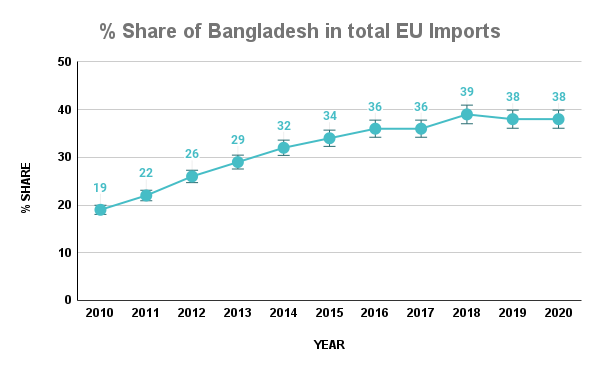
    As we can see from the table below, Bangladesh has increased its share of EU imports significantly over the last 10 years. From a 19% share in 2010, it has doubled to 38% in 2020 and becoming the largest supplier of jeans to Europe.

    YEARPRICE IN EURO / PIECEVALUE IN MILLION EUROSQUANTITY IN MILLION PCSTOTAL EU IMPORTS(QTY)% SHARE
    20104.56444.5497.44505.9719
    20115.33591.73111.07507.2422
    20125.77725.38125.72477.6626
    20135.46808.42147.99505.5629
    20145.48939.21171.52533.0232
    20156.371188.59186.6545.0934
    20166.191297.35209.58586.7936
    20176.11307.67214.52587.8336
    20185.711377.74241.39619.9739
    20196.061316.11217.13569.1438
    20205.99905.81151.22399.638

    2.MEN’S JEANS IMPORTED TO EU

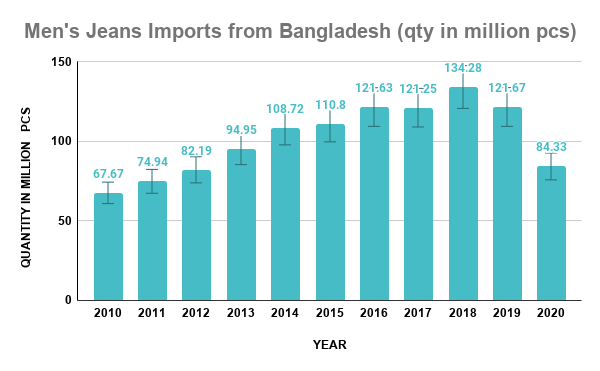
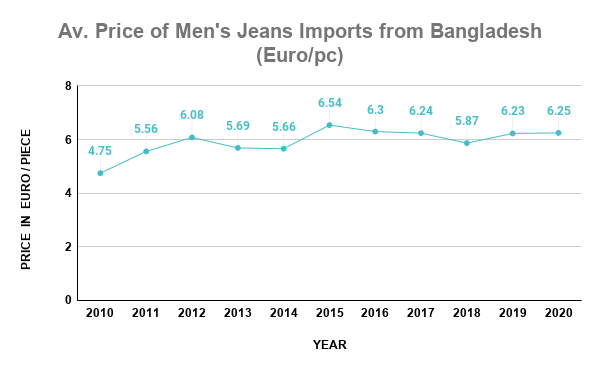
    In 2018 Bangladesh exported the highest number of men’s jeans with a total volume of about 134.28 million pieces at an average price of EURO 5.87. Compared to 2018, 2019 exported fewer jeans, and due to pandemic in 2020, it fell drastically around 30% since 2019.

    YEARVALUE IN MILLION EUROSQUANTITY IN MILLION PCSPRICE IN EURO / PIECE
    2010321.2167.674.75
    2011416.374.945.56
    2012499.6482.196.08
    2013539.7894.955.69
    2014614.92108.725.66
    2015725.14110.86.54
    2016766.43121.636.30
    2017756.36121.256.24
    2018787.6134.285.87
    2019757.97121.676.23
    2020526.6984.336.25

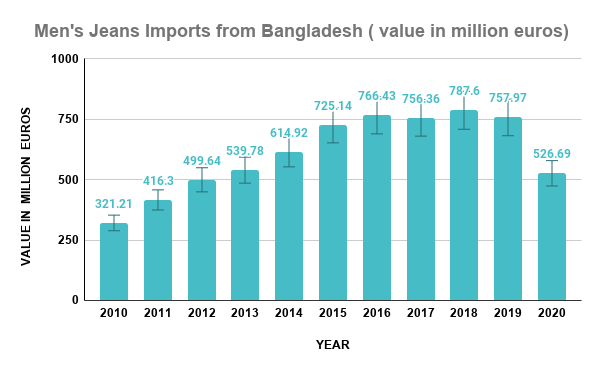
    1. The below graph shows how much value of men’s jeans was exported during 2010-2020

    2. The graphs below shows the Men’s Jeans imported to Europe during 2010-2020. It is clear that there was a clear and continuous growth till 2018 and we see some slump coming in 2019 and 2020 was clearly affected by the pandemic.

    3. In the following graph , its visible that the price peaked in 2015 and after that it more or less hovered between Euro 6- 6.50 . It is likely that we might see a rise in price in 2021.

    2. WOMEN’S JEANS IMPORTED TO EU

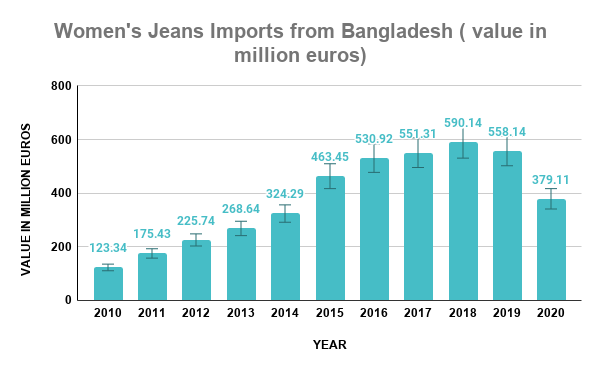
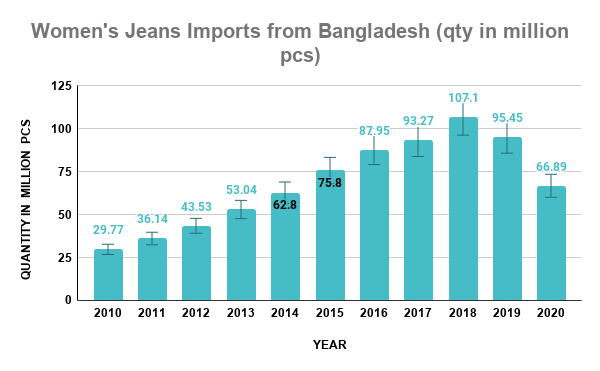
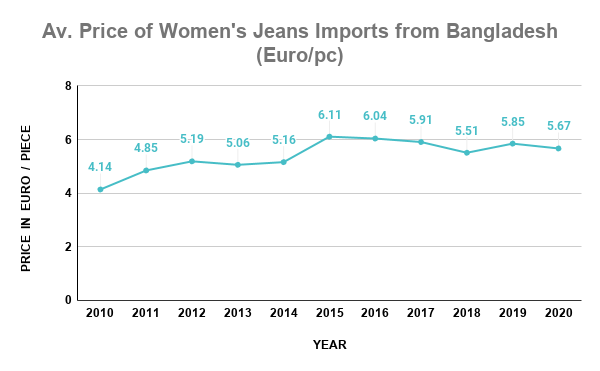
    In 2018 Bangladesh imported the highest number of women’s jeans with a total volume of about 107.1 million pieces at an average price of EURO 5.51. Compared to 2018, 2019 imported fewer jeans, and due to pandemic in 2020, it fell drastically around 30% since 2019 – almost same fall that Men’s jeans also experienced. It is quite likely that the imports will pick up very strongly in 2021 and we might even see the figures exceeding that of 2018.

    YEARVALUE IN MILLION EUROSQUANTITY IN MILLION PCSPRICE IN EURO / PIECE
    2010123.3429.774.14
    2011175.4336.144.85
    2012225.7443.535.19
    2013268.6453.045.06
    2014324.2962.85.16
    2015463.4575.86.11
    2016530.9287.956.04
    2017551.3193.275.91
    2018590.14107.15.51
    2019558.1495.455.85
    2020379.1166.895.67

    3. We can see that strangely that even the women’s jeans price peaked in 2015 and have seen a decline since. Even in 2020 , the price fell whereas the men’s jeans price had risen.

    From all the figures above , we can say that Bangladesh is now the most important exporter of jeans to EU and has been continuously increasing its exports to EU. Even with the setback of 2019, it continues to grow and is expected to show great figures for 2021.

    [/private_special]

  • Jobs Of Millions Of Bangladeshi Garment Workers At Stake

    Jobs Of Millions Of Bangladeshi Garment Workers At Stake

    Bangladesh, one of the fastest growing economies of South East Asia, is now under serious threat due to ongoing COVID19 which has hit its economy very hard and jeopardised the country’s growth saga.

    The country has over 95,000 cases of COVID 19 and on average country has been witnessing over 3500 cases daily. On April 5, Bangladesh was at 117th position in the list of countries with the highest cases in the world. Today, within two and a half months, the country is in the 18th position.

    The cases are expected to rise at faster rates in coming weeks and considering the health infrastructure and dense population, experts are anticipating Bangladesh as the new hotspot.

    One of the crucial contributors to the The Bangladeshi economy is its Garment and Textile Industry which accounts for 12% of the country’s gross domestic product and 84% of its merchandise exports is suddenly in the crisis due to this pandemic. More than 1,000 factories have been closed or are under process of closing (as per reports) and 2.19 million workers have their jobs at stake.

    Bangladesh’s ready-made garments sector accounts for around 80% of the country’s total export earnings. At least 4 million workers depend on the textile industry for their livelihood.

    HOW BADLY IS BANGLADESH AFFECTED

    In the month of May, Bloomberg reported that garment orders worth $1.5 billion were cancelled and export dipped by 84% in the first half of April. In April, the garment exports amounted to just $380 million, against $2.26 billion a year earlier. In March, the export earning were mere $520 million, down from $3.03 billion in the same month of last year. (Source- EPB)

    The country imposed lockdown for few weeks but considering the economic compulsion, lockdown was eased and factories were re-opened. According to BGMEA, currently the garment factories are running at only 55% capacity.

    Many reports suggest that over 1,000 brands/retailers have either canceled or put on hold on the orders which may cause the complete shutdown to 1,150 factories leaving 2.28 million workers unemployed.

    BGMEA is expecting the situation to be worsened if the western retailers do not come to rescue. The association has even anticipated that up to half of million workers could lose their jobs in June if commitments to pay for ordered stock that was in production when the epidemic struck are not honoured.

    Bangladesh was one of those countries which was and was expected to be benefited from the ongoing US-China Trade war along with Vietnam and India however COVID-19 changed the fates.

    The country was expected to grow at 8% in 2020 which has been now revised down to less than 2% which may also be revised later. Such abrupt fall has hit the development aspiration and have created serious problems for the country.

    The government has recently come with a rescue plan of amounting nearly $12 billion(3.5% of GDP), however another worrying thing before the government is that they need an additional $ 928.48 billion to achieve the Sustainable Development Goals (SDG) by 2030. IMF has recently approved $732 Million Disbursement to Bangladesh to Address the COVID-19 Pandemic.

    RECENT CANCELLATIONS FROM BRANDS

    Post the US-EU lockdown, Bangladesh has started to receive the cancelation threats from all the major retailers and brands, however in later months, when the manufacturers and the associations started to build pressure , a lot of brands assured that they are going to pay for the shipped items.

    But recently, The U.K.’s Edinburgh Woolen Mills Group, the brand owners of Peacocks, Jaeger, Bonmarche, and Austin Reed, has canceled orders valued $30 million.

    Apart from that, the parent company of Sears Holding has also refused to pay over $40 million of outstanding debt with its garment suppliers in Bangladesh. Over $21 million worth of products have been already shipped and the same has been store in the USA ports.

    One of the USA’s largest retailers – Kohl’s, one of the US’s largest clothing retailers, cancelled orders worth $50m and refused to even renegotiate payments. The company paid $109 million as dividends to the shareholder just weeks before the cancelation.

    VOCAL FOR LOCAL

    At this point of time, when everyone is looking to support the local manufacturers, in Bangladesh also, supporting local yarn manufacturers is being discussed, nothing is yet confirmed, however the local newspaper reported that Bangladesh Textile Mills Association (BTMA) sent a letter to Finance, Commerce and Jute Minister for taking necessary measures to curb the entry of Indian yarn to the country.

    In the letter, the president of BTMA said

    Bangladesh exported $566 million worth of garment items to India in the fiscal years 2017-18 and 2018-19, but imported $7.74 billion worth of textile related items including raw cotton, cotton yarn, cotton fabrics and textiles during the same period this year.

    Bangladesh produces yarn worth $12 billion on an annual basis and due to the COVID19 yarn worth $1.4 billion has remained unsold at the factory level over the last two months.

    BTMA believes that the Indian Yarn is highly subsidised and is being sold from $2.60 to $2.70 per kg in Bangladesh however the same quality of yarn is locally available at the price range of $2.80-$2.90 per kg.

    There has been vocal need for localization not only in Bangladesh but in most countries which feel that the local industry and communities need to be supported . This call will strengthen over time if we see this pandemic still causing distress over long period of time. Globalization is sure to take a retreat in a big way even if recovery from Covid situation is achieved to a large extent because the consumption levels are not expected to reach the pre-covid ones anytime soon and the biggest impact will come on supply chain which is the farthest.

  • COVID 19 Emerges As The Biggest Threat To BANGLADESH

    COVID 19 Emerges As The Biggest Threat To BANGLADESH

    Bangladesh, the 2nd largest garment exporter in the world and one of the fastest-growing economies in Southeast Asia, seemed to be in a very serious problem due to Covid 19 which caused lockdowns in the USA and Europe.

    The government has sanctioned a bailout package of Tk 50 billion($600 million) for the RMG sector to ensure the timely payment of wages to the workers, however, an industry which earns $34 billion annually, contributes more than 13% in the country’s GDP and also employs over four millions of workers, have its own apprehensions regarding its survival in the long run. 

    Last week, Ms. Rubana Huq, BGMEA president, confirmed that due to the lockdown in the USA and Europe, orders of 864.17 million pcs valued at $3bn have been canceled which added panic to over 1000 garment factories which were exposed to this loss. The majority of canceling orders are from C&A, Inditex, Primark, Marks & Spencer, Tesco, Walmart, and Target.

    Ms. Rubana Haq Urging Brands not to cancel the orders

    Amid all such hustle and bustle, H&M came to the rescue and assured its garment suppliers of taking shipment of goods that have already been manufactured, however, the brand has categorically stated that they are not going to place any new orders and also going to review the potential changes on recently placed orders as the COVID-19 outbreak impacted their business supply chain.

    During March 21-25, a survey was conducted by the Center for Global Workers’ Rights and the Worker Rights Consortium, a Washington, D.C.-based labor rights organization, findings of which are very worrying. 


    The Survey included approx 200 large suppliers that mainly manufacture garments for EU brands and retailers and employ over 750 workers.

    The finding suggested that nearly all buyers refused to contribute to wages for those workers, and more than 70% of those furloughed were sent home without pay. Of the workers who were fired, less than 20% were given severance pay.

    The 1st case of Covid 19 was reported on March 8 and as of now the country has reported only 49 confirmed cases and 5 deaths, the government has asked people to stay at their homes and practice social distancing, however considering the population density of Bangladesh, social distancing will not be easy.

    Bangladesh is one of the most densely populated countries in the world and is packed into 147629 square kilometers and it accommodates approx. 164 million people out of which 21 million lives in Dhaka, the capital of Bangladesh.  

    “In other countries, people can isolate. Our people don’t have that possibility. Workers live in houses that are a 10 x 10 room where 5 or 6 people live. If one person gets infected in a community, everyone will be infected.” said Kalpona Akter, Executive Director, Bangladesh Centre for Worker Solidarity

    In current times , even the most developed countries are finding it difficult to handle the COVID situation. Every country has its own challenges and so Bangladesh has its own. The govt . seems to be taking all measures to control the disease and resultant damage. The brands and retailers need to extend their help to this country as well other important garment exporting countries like India, Pakistan, Sri Lanka etc which have been seamlessly delivering to the brands over decades. We all need to stand in solidarity to fight this battle collectively.

    Read all the latest industry updates on Covid19 at https://www.denimsandjeans.com/corona-denim-fashion-industry-updates

  • Bangladesh Vs Pakistan – Denim Exports To EU From 2016 To 2018

    Bangladesh Vs Pakistan – Denim Exports To EU From 2016 To 2018

    In this report, we’ve analyzed the trend of Denim Jeans from Bangladesh and Pakistan to the EU for the years 2016 to 2018 to understand how these both important countries are performing when it comes to their most important market ie the EU.

    Pakistan and Bangladesh both enjoy GSP benefit to EU and this has helped them to take a major share of market away from China which was the previous holder of major share in this market. We try to understand how these countries have developed their exports to the EU during these 3 years

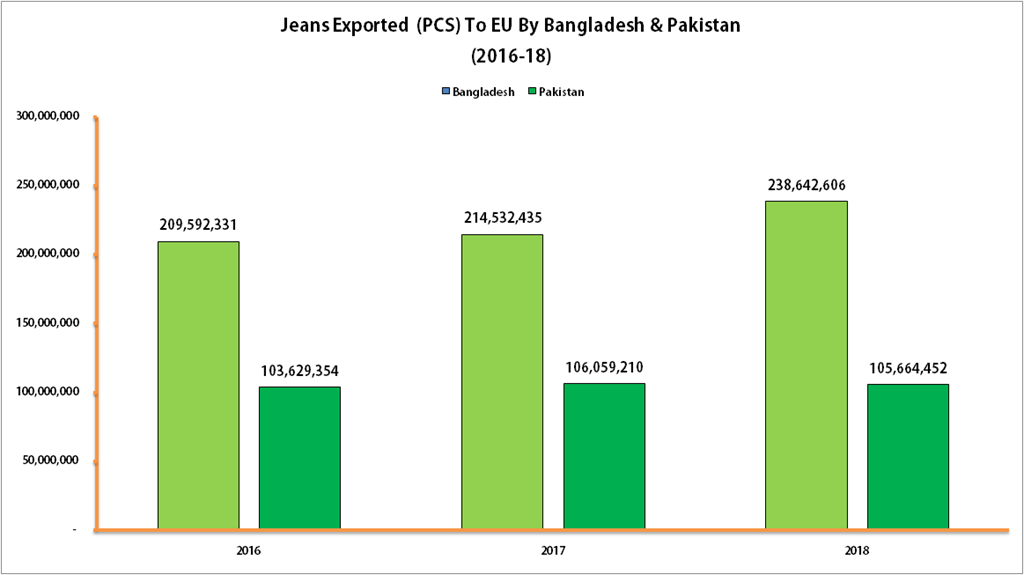
    Jeans Exported To EU By Bangladesh (BD) And Pakistan (PK) During 2016-18

    By the end of the year 2018, the total denim exports by Bangladesh to the EU stood at 238.66 million pcs, which is 14% more than the export of 2016 and 11% more than 2017. Pakistan, on the other hand, exported 105.6 million pcs of denim to the EU by the end of 2019 which is only 2% higher than the export of 2016. The year 2018 also witnessed a marginal decline of 3.94 lacs pcs in the export from 2017.

    Particulars

    2016

    2017

    2018

    % Change ( 2016-18)

    Bangladesh (BD)

    209,592,331

    214,532,435

    238,642,606

    14%

    Pakistan (PK)

    103,629,354

    106,059,210

    105,664,452

    2%

    14% Rise In Bangladeshi Denim Exports To EU, May Achieve Export Of 25 Million Pcs By The End Of 2019

    Average Price (Euro/Pc) Of Jeans Exported

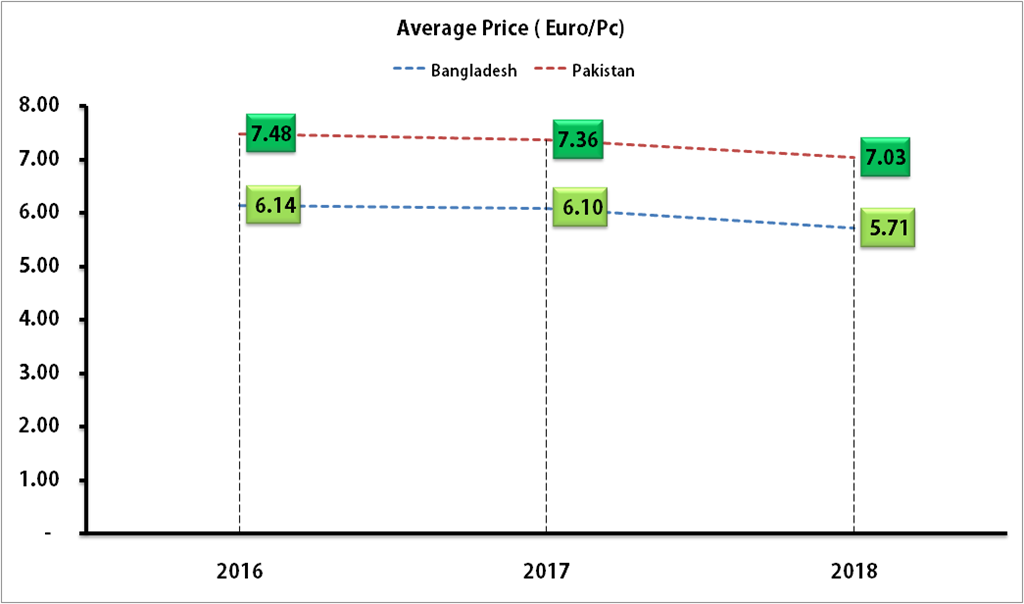
    Bangladesh is one of the cost-competitive countries and due to various factors like lower costs, efficiencies and large capacities, the country has been exporting denim at very competitive prices. Bangladesh exported its Jeans at an  average price of Euro 5.71/pc in 2018 whereas Pakistan exported at Euro 7.03/Pc. Though the prices cannot strictly be compared unless there is a comparison of types of products exported, their complexities, volumes,  qualities, types of buyers etc but on broader terms, Bangladesh’s prices were lower than that of Pakistan.

    Another interesting fact to note is that both countries have become more competitive in terms of price over a period of three years and we can see the changes in the below table and graphs.Increased competition among themselves and with countries like Vietnam and Ethiopia with a better geographical dividend and huge FDIs in past years made the trade little more intense. It is a reflection of a sad fact of our industry that with each passing year we are actually reducing the prices whereas the costs of production are going up ! .This also reflects that our industry is oversaturated with supply far exceeding the demand.

    Particulars 2016 2017 2018
    Bangladesh (BD) 6.14 6.10 5.71
    Pakistan (PK) 7.48 7.36 7.03

    14% Rise In Bangladeshi Denim Exports To EU, May Achieve Export Of 25 Million Pcs By The End Of 2019

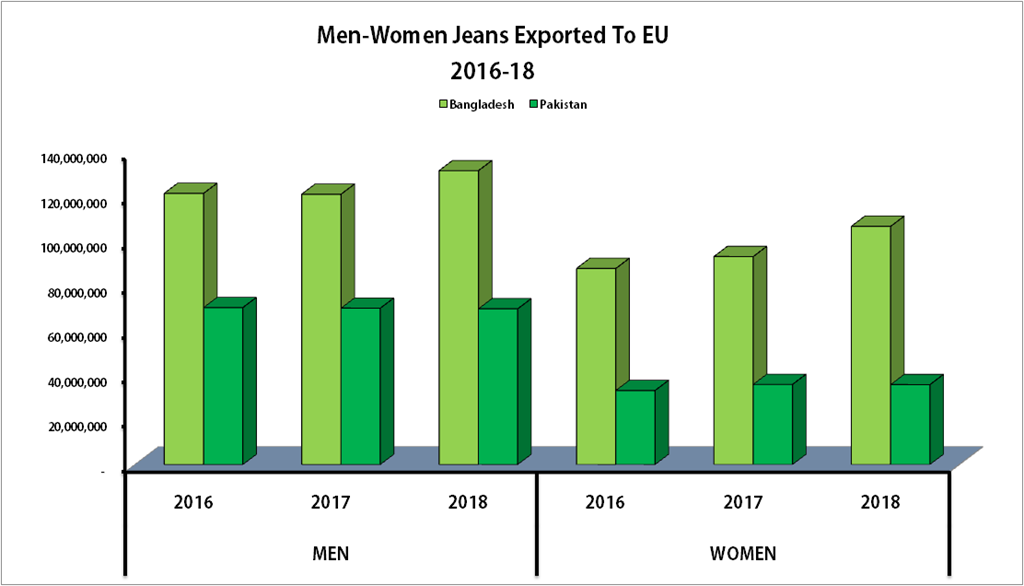
    Jeans – Women & Men, Exported To EU By Bangladesh (BD) And Pakistan (PK) During 2016-18

    Interesting to note that Pakistan is more focused on Men’s jeans with its Men jeans volume being almost double than that of women. However, in the period of 2016-28, the %age of women jeans is slowly increasing but its exports are still majorly dominated by Men’s Jeans.

    Bangladesh also exports more Men’s jeans but their gap between the two is not so much. The exports of Men’s jeans was about 50% more than that of Women’s in 2016 whereas in 2018 it is about 30% more. So Bangladesh has probably better adapted to women jeans production over the years taking a major share away from China which was the major exporter of Women jeans.

    Men

    Women

    Particulars

    2016

    2017

    2018

    2016

    2017

    2018

    Bangladesh(BD)

    121,649,779

    121,252,198

    131,813,909

    87,942,552

    93,280,237

    106,828,697

    Pakistan(PK)

    70,415,364

    70,132,699

    69,834,067

    33,213,990

    35,926,511

    35,830,385

    14% Rise In Bangladeshi Denim Exports To EU, May Achieve Export Of 25 Million Pcs By The End Of 2019

    Average Price (Euro/Pc) Of Jeans ( Men & Women) Exported

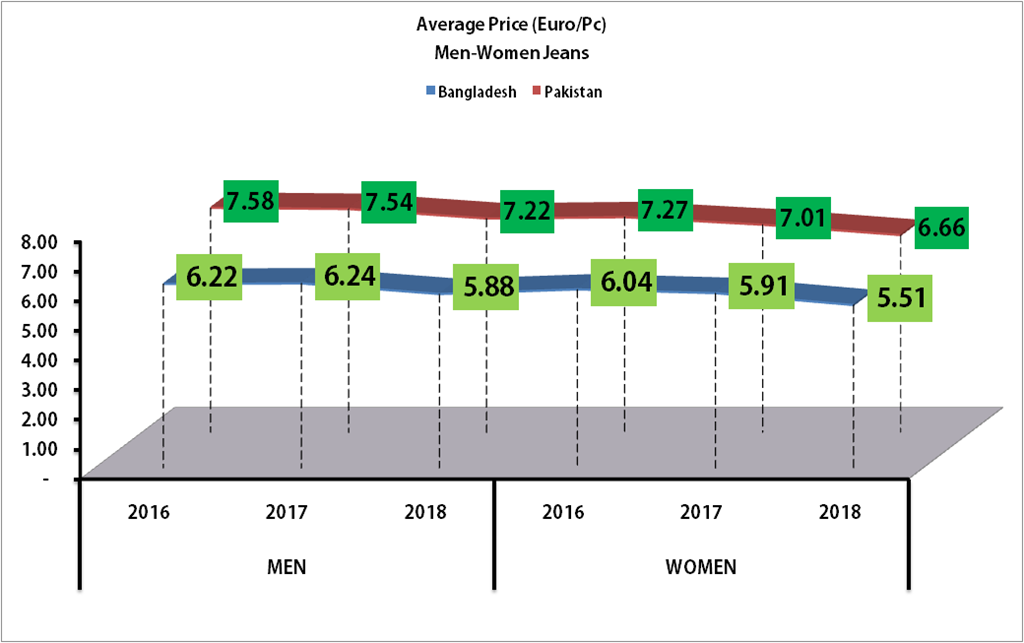
    The average price of Women Denim is  lower side as compared to the average price of Men’s Denim for both the countries. In 2018, Bangladesh exported Men’s denim at an average price of Euro 5.88/Pc and Women’s denim at an average price of Euro 5.51/Pc, Pakistan exported the same at Euro 7.22/Pc and Euro 6.66/Pc respectively. But the drop in prices of women denim is more sharp for both the countries over a 3 year period. Bangladesh reduced its Men’s denim prices by about 6% from 2016 to 2018 whereas Pakistan reduced the prices of the same by about 5%. In Women’s denim , the reduction by BD is about 8.5% whereas that of PK is about 9% .

    Men

    Women

    Particulars

    2016

    2017

    2018

    2016

    2017

    2018

    Bangladesh(BD)

    6.22

    6.24

    5.88

    6.04

    5.91

    5.51

    Pakistan(PK)

    7.58

    7.54

    7.22

    7.27

    7.01

    6.66

    14% Rise In Bangladeshi Denim Exports To EU, May Achieve Export Of 25 Million Pcs By The End Of 2019

    The total volume of both countries stands at about 330 million pieces of jeans to EU. This is more than 50% of total exports to EU which stands at about 600 million pcs. The share of these countries is expected to grow over the next few years and China would be one of the biggest loser of its share in this market.