Cambodia is one important garment manufacturing location and it was important to understand how the current #covidtimes situation has affected this country and its working. Sandeep Agarwal spoke live to Karthikeyan V – ex country manager of C&A – (on our Instagram ) to understand how the change in global sourcing dynamics after covid is affecting Cambodia. Here are some excerpts from the talk .
Sandeep
Hi Karthikeyan. Hope you are fine ! I heard that Cambodia has been doing quite well in terms of managing this crisis much better than many other countries .
Karthikeyan
I am fine Sandeep and hope the same for you .
In Cambodia I would say from the day one till now there have been 122 cases and out of which 119 cases have been treated and only three cases are still being treated. The government had implemented certain restrictions during the celebration of Cambodian New Year which was in the middle of April.
Today being the Labor Day May 1st, the government has asked no more public gathering and requested public celebrate it at home, so the government has been very cautious and moreover that the surrounding countries have also implemented the travel bans and not many travellers are coming in, so it’s a combination of both together and we have to be careful and the government is also warning is about the second wave. So we look forward and we hope everything goes in the right direction and the world recovers very fast.
Sandeep
Absolutely ! Cambodia has been in kind of a turmoil since last year when European Countries started to put pressure on the government and for various issues and I think they have also partially revoked EBA to Cambodia, so can you tell a little more about that all things.
Karthikeyan
Cambodia had its own challenges in a global sourcing market , it had the EBA- Everything But Arms, where European Union was offering duty-free benefits to all the products except for arms. However based on various studies / Investigation and so on by the middle of February 2020, European Union made a Conclusion / Judgment that part of the products like menswear will lose its benefit in terms of duty and the rest of the products ladies and children will still have the duty-free benefits. This will be effective from September 01, 2020.
Sandeep
So all men’s wear will no longer have duty benefits however the rest of the products including Kids and Women wear will still be able to avail the duty benefits.
Karthikeyan
Yes.
Sandeep
Can you tell us more about Apparel Export Business Loss due to this from Cambodia?
Karthikeyan
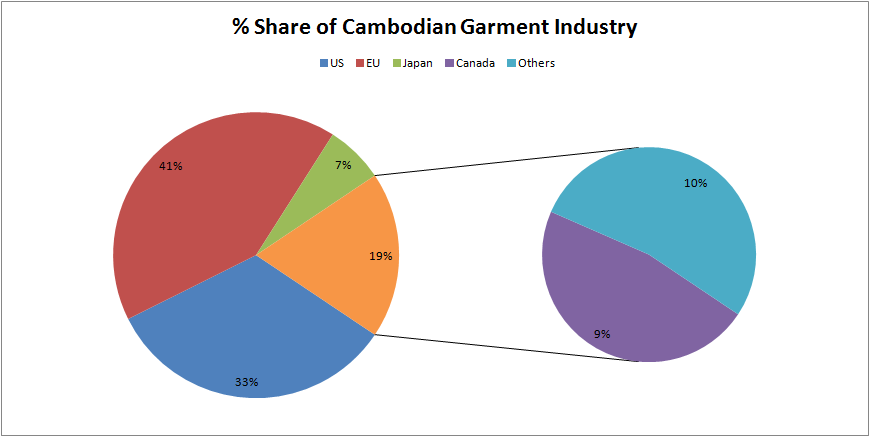
When we look at the business in Cambodia, 18bn dollar is the total export revenue which was earned in 2018-19 out of which 64% is mainly out of the apparel sector (ie about $12 billion) and out of this 46% came from Europe and from the USA ,24% of export revenue generated and the rest is scattered across Japan, Canada and other countries. So out of this 46%,15% comes from Menswear straight away, that’s the expected numbers.
Sandeep
All right, so I mean that business of around 7% of total apparel revenue is already gone now.
Karthikeyan
Yes, there were requests made to the European Union / Commission by the Garment exporters to reconsider; however the decision arrived on February 12th that they are partially revoking EBA benefits.
Sandeep
Coming to Corona Crisis, after this issue of EBA which already created a crisis like situation and now this Corona is also here ,now what is the situation after this crisis how it is affected industry, how is this going to affect the workers out there and what other steps are being taken to
manage the crisis?
Karthikeyan
So as I said Cambodia had its own challenges in the past and one of them was EBA and the second part was increasing wages. When you position Cambodia against the neighbouring countries or manufacturing countries like Bangladesh, Myanmar, when the wages are compared still Cambodia is on the higher side, so the manufacturing cost per se has been the highest between these three countries.
Why I pick these three countries is due to GSP benefits . Europe is dependent on GSP plus benefits so when you see that Bangladesh is one number, two is Myanmar and third is Cambodia in terms of pricing . So then with the EBA, the situation was not very certain whether only a partial will be there or the complete withdrawal. So because of these problems part of the high summer 2020 and winter 2020 orders which were to be produced between March September.
Further the orders for this year are getting affected due to covid situation.The raw materials are coming from outside Cambodia and because of the Covid, the raw material movement was affected and finally now we are talking about the store closures in Europe and US so on. So that by its permutation and combinations due to all Cambodia lost its share considerably for the time being.
Sandeep
So far as the raw materials are concerned, does it mainly come from China?
Karthikeyan
Yes, Major part from China but there are other countries as well including Pakistan, Korea and Vietnam.Organic Materials from India too.
Sandeep
I heard that a lot of workers have lost their jobs due to the Covid and now the government is paying some compensation, can you tell a little more about that?
Karthikeyan
Yes, in this crisis situation the government is stepping forward to support the garment workers and the manufacturers, the manufacturers will pay about $30 and the government will pay about $40 per worker, so that means per worker will get $70 and this will be paid until the work is suspended. If the factory is normally functioning then there is no aid from the government however if the factory cannot run or if it has to be suspended then the government steps in and supports it.
They are getting $70 now, however currently the wage is about $190 dollars and the average take-home of a worker can be anything between $250 plus, so now because of the suspension, the worker will get about $70.
Sandeep
So let’s say if we compared the regions which include Cambodia, Myanmar, Laos and Vietnam, so what are the changing dynamics now after this crisis?
Karthikeyan
It is too early to arrive at any conclusion at this point of time, the reason being that the Asian countries are predominantly dependent on European market and the US market. So where the stores have not opened completely but there are a few stores opened starting this week or end of last week in Germany and France is expecting to open from May 11th . So there are many changes happening now and hence at this point of time it is very difficult to arrive at a clear picture as to which country is going to be benefited.
Sandeep
But some countries have better Vertical Integration creation like Vietnam has a better vertical integration
Karthikeyan
Yes, going forward if you look at how the industry is going to change in terms of supply chain then there comes the speed, vertical integration and price so these three will be the main criteria because globally if you see the prediction is such that around 50% of the labor force including staff or the workforce will be jobless, that’s a very hard number to believe. However, that is a prediction according to which unemployment is going on now from various countries. So in that sense the spending power of the people will go down drastically and when the spending power goes down drastically, then if you are pricing your product at the same price level nobody’s going to walk in and buy it.
The Customers want a better product and quality. Those use and throw culture is gone so they’ll be buying for the basic very important ones ,all the kids grow every now and then so they have to buy the new clothes for the kids so these are the two main areas where the products are needed in stores really often.
So when people buy they will not be looking at high brands or luxurious brands to buy ; even the people who are buying from the luxurious brands they’ll be thinking twice at this time- should I spend so much to buy? why should I not think of something which gives a better quality and better price at a better price? Why don’t I look at options? they will be going to cheaper brands, they’ll be looking at discounts and so on so. If that is the mentality of the customers, what about buyers? and they will not be able to survive at the lower prices and discounts and so on. They also need to look at better products at a cheaper price thereby there will be a demand for a cheaper price which again if you are talking about Europe they will be looking at GSP markets where there will be a direct benefit with the duty benefits.
So Bangladesh, Myanmar and Cambodia these three countries have the GSP plus benefits. Price will be the one of the main points to consider going forward besides sustainability. Sustainability a few years back was a point to discussion but now this becomes the base, sustainable social compliance all these becomes a base how do we put the price in a sustainable way so that’s going to be the way forward.
Sandeep
But when we are talking about better quality and price – that is what that has been there even before also, people have been always wanting a cheaper product and at a better quality so the fight has been there always . So now with this COVID, the supply chain actually is in a much weaker position .Would they be able to really offer cheaper prices and better quality? Do you think that will work out?
Karthikeyan
That’s the challenge way forward. What are the options ? so we need to look at all the possibilities to make it happen if there is no spending power nobody is going to spend because the customer will not spend more or the same amount for the same quality of product. If a person is going to buy a product he will be looking at a longer lifespan for the same amount of money this is the challenge lying in front of us .How do we solve this . You need to put hands together – from the brands to the manufacturers to the raw material side to everybody make it happen.
Sandeep
Who are the main retailers who are working in Cambodia and are they still there or they have exited the country in crisis?
Karthikeyan
Okay for the time being, I would say as the stores are not completely operational. If the stores are completely operational then deriving a strategy for a slightly long term is possible and that’s where the sourcing footprints come in ,which country has to be positioned where and all that . But now we are having a COVID crisis where the stores are not opening ; in that sense the plans based on the situation will be short term not long term, so based on the short term the geographical shifts might happen from one product to another product in different countries.
For example Cambodia has got its own strengths of circular knits and flat knits . It might retain these two products over . Bangladesh and Myanmar. there are strong supply partners under development in other countries as well so in the sense at this point of time today or
In the next few weeks there will be no strategy from any brands, that’s what I believe .All the brands would ask for suspension or postponement or partly cancellation . So this will continue until the situation revives a little bit , when the situation in Europe or the US rest of the countries is little positive . Then there comes a slightly longer short term plan – it is not still a long term plan.
Sandeep
And what are the main brands working there?
Karthikeyan
Adidas, H&M, Carrefour, M&S, Lidl, PVH ,Ralph Lauren and Uniqlo and so on. There are many other big global retailers ,players here at this point of time and there is no clear sign of exit strategy from any of the buyers that I have come across.
As the stores open, they will have to see how the consumers are going to behave in terms of buying power and basket size and what kind of mentality they are having or are they going for quality ? So there are so many permutations combinations and this is too early to decide because the stores have not been completely opened in all the locations.
Sandeep
Do you see any changes in the demand for these kinds of products post COVID? You’ve already mentioned the surge in Kids clothing, I would like to ask if there are other changes you’re anticipating
Karthikeyan
First we spoke about quality and at the same time what I also see we are going to be looking at is the workwear and children wear. Even in workwear there is a possibility that there is a need for antibacterial and bacteria resistant finished garments going forward and more sustainable fibres.
These are the fiber related and finish related and already brands in India and some of the brands across globe also have started importing masks- tailor-made masks to fit in the shirts or the work wear .So it goes as a combination now and in industry many people are working around to put some embroidery or Prints on the mask which was also displayed on your page Denimandjeans So I see so that’s the direction . I feel for now it is a short-term direction until the vaccination is found and all the people have taken the vaccination across globe so until then this mentality towards the products will be more towards health .And how do we be safe and healthy as well, so we spend very wisely this is where I see the future is going to be.
Sandeep
So Cambodian Garment Industries are also getting orders for manufacturing these health gears and protective garments?
Karthikeyan
Not many of them, very little because not many countries are open for import and export so thereby the requirements as of now there globally. I have been hearing a lot of requirements but at the end export is a question how do we make it happen? Raw materials and so on so there are questions and there are difficulties and it is going to take some more time to streamline all this to get into those interesting lines .
Sandeep
And there’s a lot of investment coming into Cambodia from different countries including China now so after this crisis those investments will be affected?
Karthikeyan
Well, as I said the way forward will be something like vertical integration I believe. The reason being the stores are not open for quite some time and when the customers come in to be proactive so they can get time to supply.
The countries which have vertical integration like China or India or Bangladesh or Vietnam would be able to supply faster . Cambodia is very close to Vietnam and if the fabric raw materials are sourced from Vietnam there is a high possibility Cambodia garment industry gains but a lot more to do in terms of vertical integration within the country, that’s the way forward, that’s the future I believe in .
Sandeep
What about Chinese Investment in Cambodian Industry?
Karthikeyan
Vertical integration is one way to think of at the moment. The investments were coming in ; there were at least seventy eight projects signed off between Jan 2019 till Jan 2020. So post this crisis we need to really see because the whole world was suffering from COVID19 and we will see it in a couple of months if there will be more investments and in which direction it is going.
Sandeep
As you already mentioned, the countries which are vertically integrated will be a better place?
Karthikeyan
Absolutely, so it is not necessarily for woven’s alone, we are strong in knits, summer inner garments we are pretty strong in summer garments and one advantage for Cambodia is also licensed articles.
Sandeep
Okay and coming towards the end what positives do you see coming out of this crisis?
Karthikeyan
The positives as of now what I see what I hear from different brands and their seminars all over I see the people have been utilizing this situation to a greater extent and conducting their business online . We’re already focusing on online the sense and we’re going forward also would be online and speed the positive will be speed so if you want to be in the race then it is going to be survival of the quickest. If you think out-of-the-box innovative and simplify the overall operations and see how we can reduce the lead time so we need to keep on thinking innovatively to come out of this situation as fast as possible.
Sandeep
Let’s hope for the best, and I really thank you for joining us and sharing so much information and wish you all the best.
Karthikeyan
Thank you. It’s my pleasure to be a part of this talk ,thank you again.
Video Link