Tag: denim manufacturing

  • Cone Gemini Fx Color Weft System

    Cone denim (ITG – Burlington Apparel Solutions)  is always on the forefront of innovations providing apparel solutions to brands and retailers worldwide on various fashion and lifestyle products. In their latest effort , they have tried to find a solution to address the demand for achieving color weft looks on the denim and non-denim fabrics. Colored wefts have been a strong denim trend for the last few seasons. The garment manufacturers faced some problems in this kind of product :

    • The minimums required by mills to produce these fabrics are usually not very small.
    • The color in the weft is created by the mill and the garment manufacturer cannot make any changes in the color if he wants.
    • There is a limitation on the number of colors a manufacturer can buy or a mill can supply.

    To overcome these shortcomings of traditional way of  coloring the weft –Colored weft denim fabrics from Cone whether its by way of using colored weft yarn or performing a color coat on the reverse of the fabric , Burlington developed chemicals and its application process which, the company claims, overcomes the above mentioned drawbacks..
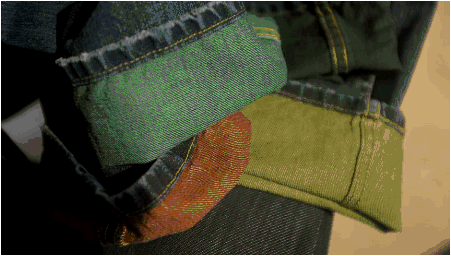
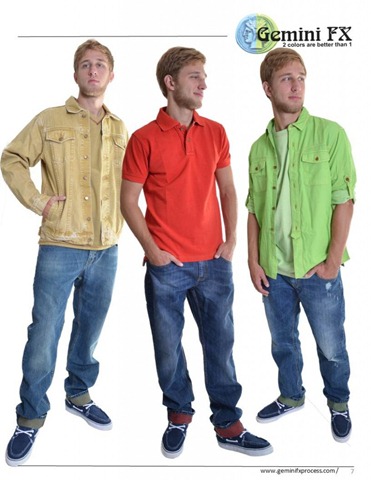
    Cone denim Gemini Fx Men


    The Process

    • The fabric to be given different color wefts in the laundry are first coated with an invisible chemical on the reverse side (weft area). At this stage the denim (or non-denim) does not look any different than what it was before.
    • The fabrics are cut and sewn by manufacturer and the garments are either washed or kept raw.
    • The jeans/garments are finally taken through an overdyeing  process where special chemicals – the Hi White chemicals are used in the dyeing. The property of these chemcials (from Garmon) is such that they will show color only on the reverse side of fabric where the coat of chemical was applied.  Thus the front part , in case of denim , will still show as Indigo color and the reverse would be dyed in the color the buyer choses.
    • And the color weft fabric is created !

    I asked Gary Kernagham from Burlington whether these chemicals to used during the overdyeing process would also be supplied by them.
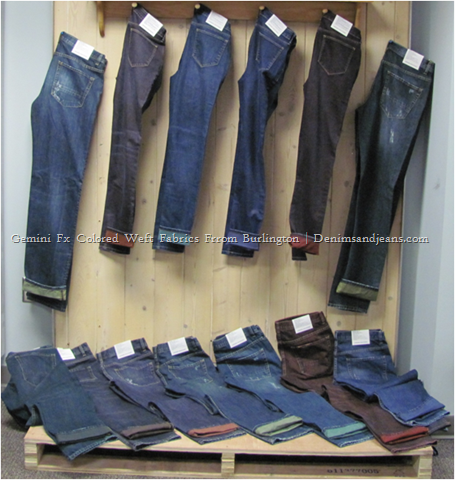
     

    colored weft fabrics in denim

    He said

    “..We do not Supply the Dye and other Chemicals used in the garment dye recipes provided on our website. These chemicals come from Garmon. We worked with Garmon  to  develop a range of Dyes they call HI White Dyes that work with our Gemini FX  textile Pretreatment . They have Global  distribution & technical services that our customers can utilize They have screened & tested the 10 dyes noted on our website for Color fastness & light fastness. HI Whites also have an advantage over other dyes in that they have very little staining on non pretreated fibers yarns or in the case of Gemini FX  the front of the fabric. The other chemicals found on the Recipes provided Such as Geopower PFD, Hydros TED , ECO2, Elam ECO-c , & Elam RP are also available from Garmon.  Of course  the obvious reason for  including these Garmon chemicals in our recommended procedures was to  control the usual  variables of other suppliers cemisties. By using a consistent supplier to take developments from the lab to a broad global we feel we have a much better chance to replicate these looks in laundries ranging from China to  Bangladesh to Cambodia to Vietnam  Etc.  which is consistent with our customers sourcing plans. These desizing Enzymes softeners and Ant back stain chemistry   were also  chosen due to their Enviromental friendly Low Temperature capabilities which we felt were consistent with the Low temperature and Salt free environmental advantages of HI White Dyeing of Gemini FX Fabrics .We realize that  a mill such as ours publishing garment dye recipes with such detail is not the norm but it the Objective of our Cone apparel solutions to make it as easy as possible for our customers  to implement new innovations like Gemini Fx into their global sourcing instruction no matter how globally challenging that might appear to be.

    I asked further whether these whether these colors bonded strong enough to sustain heavy washes on denim . Gary Kernagham  replied “

    “ For Both the Denim & Natural ready to dye Gemini FX fabrics The HI Whites dyes are bonded to the back side using a Cationic chemistry similar to the one used in our Affinity process fabrics thus the Bond is extremely strong and thus have great wash fastness Crocking etc .

    He further suggested that

    “ …we would recommend that  these denim garment are garment dyed first  as the recipe procedure provided  outlines and then stonewashing  & dry process is done in order to avoid the rear shade from tinting in Scraped and Stoned areas.

    The technology is new and interesting and looks quite promising for addressing a fashion related backend problem. It now needs to be seen whether it can pass the tests in bulk productions.

  • Common Defects In Denim Jeans Sewing

    denim-seam-inequalitiesAmerican and Efird – has listed out some of the most common seam inequalities in the manufacturing of denim jeans . The company lists out the defects and suggests solutions for removing these defects. We are summarizing the results from A & E  below :
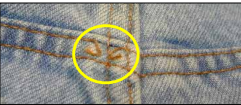
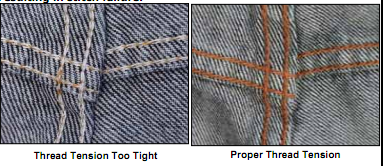
     

    1.BROKEN STITCHES – NEEDLE CUTTING

    Description : Where the thread is being broken where one seam crosses another seam (ex: bartacks on top of waistband stitching, seatseam on top of riser seam ) resulting in stitch failure.

    denim stiching

    jeans sewing

    Recommended solution by A & E :

    • Use a larger diameter thread on operations
      where the thread is being cut.
    • Make sure the proper stitch balance is being used. On a chainstitch seam on denim, you normally would like to maintain a 60%/40%
      relationship of Needle thread to Looper thread in the
      Seam.
    • Use needles with the correct needle point.
    • Change the needles at regular intervals on operations
      where the Needle Cuts are occurring frequently.
    • Use a higher performance  Perma Core or D-Core thread.

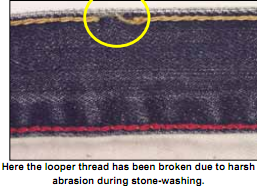
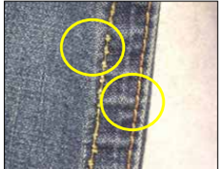
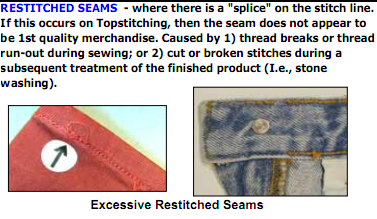
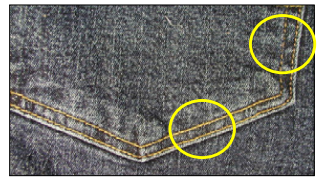
    2.Broken Stitch – Abrasion :

    Description : where the thread is broken during stone-washing, sand blasting, hand sanding, etc.  Broken stitches must be repaired by restitching over the top of the stitch-line.

    denim defects denim sewing

    Recommended Solution :

    • Use a larger diameter thread on operations where
      excessive abrasion is occuring  (ex: use T-120 on
      Waistband
      );
    • Make sure stitches are balanced properly.
    • Use a Magic air entangled thread in the looper due to its lower
      seam profile making it susceptible to abrasion
      (ex: use T-90 or T-135 Magic in loopers of the Yoke, Seat
      and Waistband seam);
    • Monitor the Finishing Cycle for compliance to specs.

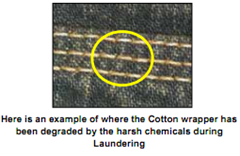
    3. Broken Stitches : Chemical Degradation :

    image

    Description : where thread is  being compromised by the chemicals used during laundering resulting in loss or change of color and seam failure.

    • It is recommended to go to larger thread sizes when the
      Denim Garments will be subject to Harsh Chemical
      washes.
    • To achieve the best laundering results make
      sure that the water temperatures and PH Levels are
      correct and that the proper amounts and sequence of
      chemical dispersion are within guidelines.
    • Make sure the garments are being rinsed properly to neutralize the
      chemicals in the fabric.
    • Monitor the drying process, cycle times, and temperatures to make sure they are correct so that the best possible garment quality can be
      achieved.

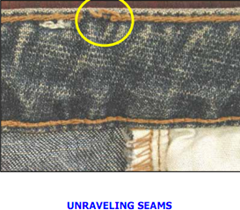
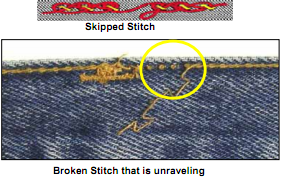
    4. Unravelling Seams :

    denim sewing denim stitching

    Description : where either the stitch has been broken or a skipped stitch has
    occurred. This will cause seam failure unless the seam is Restitched.

    Recommended Solution :

    • This may include going to a higher
      performance thread designed to minimize sewing
      interruptions.
    • Observe sewing operators for correct
      material handling techniques.

    6. Sagging or Rolling Pockets :

    Description :  where the pocket does not lay  SAGGING OR ROLLING POCKETS  flat and rolls over after laundering.

    denim stitching

    Recommended Solution :

    • Make sure the sewing operators are not holding POCKETS
      back
      excessively when setting the front pocket.
    • Make sure the hem is formed properly and that excessive
      fabric is not being being put into the folder
      that will cause
      the hem to roll over.
    • Check to make sure pocket is cut properly and that pocket curve is not too deep.
    • Use a reinforcement tape on the inside of the pocket that may
      help prevent the front panel from stretching along the bias
      where the front pocket is set.
    • The type and weight of denim, along with the fabric construction, may contribute to this problem. Contact your fabric supplier for assistance.


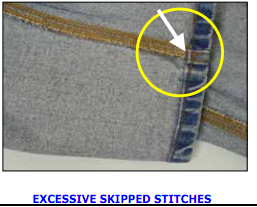
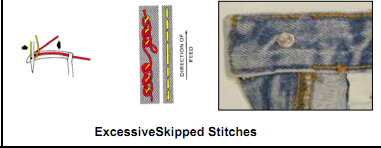
    5.Skipped Stitches

    Description: where the stitch forming device misses the
    needle loop or the needle misses the looper loop. Skips are usually
    found where one seam crosses another seam and most of the time
    occurs right before or right after the heavy thickness.

    denim stiching jeans stiching

    Recommended Solution :-

    • Use corespun thread.
    • Use minimum thread tension to get a balanced stitch.
    • Use the ideal foot, feed and plate that helps to minimize
      flagging.
    • Training sewing operators NOT to stop on the
      thickness.
    • Make sure the machine is feeding properly
      without stalling.
    • Make sure the machine is not back-feeding.

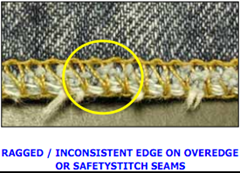
    6. Ragged – Inconsistent Edge

    Description : where the edge of the seam is
    either extremely “ragged” or “rolls” inside the stitch.

    jeans edge

    Recommended Solution :

    • Make  sure the sewing machine knives are sharpened and
      changed often.
    • The knives should be adjusted properly in relationship to the “stitch tongue” on the needle plate to obtain the proper seam width or width bite.

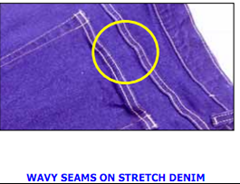
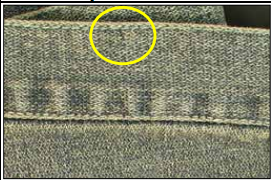
    7. Wavy Seams On Stretch Denim

    Description : where the seam does not lay  flat and is wavy due to the fabric stretching as it was sewn or during subsequent laundering and handling operation.

    image

    Recommended Solution : 

    • Use minimum presser foot pressure.
    • Instruct sewing operators to use proper handling techniques and not
      stretch the fabric as they are making the seam.
    • Where available, use differential feed to compensate for the
      stretch of the fabric.

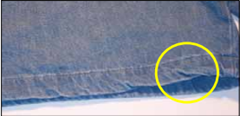
    8. Ropy Hem

    Description: is where hem is not laying flat and is skewed in  ROPY HEM
    appearance .

    image

    Recommended Solutions :

    • Instruct the sewing operator to make sure they get the hem started correctly in the folder before they start sewing.
    • Also, make sure the don’t hold back
      excessively as the seam is being sewn.
    • Use minimum roller or presser foot pressure.

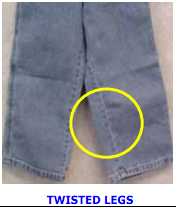
    9. Twisted Legs :

    Description : is where the sideseam twists around to the front   of the pant and distorts the appearance of the jeans .

    twisted legs jeans

    Recommended Solution :

    • Instruct the sewing operator to
      match the front and back properly so they come out the
      same length. Sometimes notches are used to insure proper
      alignment. They should NOT trim off the front or back with
      scissors to make them come out the same length.
    • Make sure the cut parts are of equal length coming to the
      assembly operation.
    • Check fabric quality and cutting for proper skew.
    • Make sure the sewing machine is adjusted
      properly for uniform feeding of the top and bottom plies

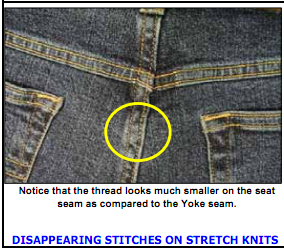
    8. Disappearing Stitches in Stretch Denim

    Description :  is where the  thread looks much smaller on seams sewn in the warp direction than in the weft direction of the fabric

    jeans stitching

    denim jeans stitching

    Recommended Solution :

    • Use a heavier thread size (T-120,  ON STRETCH DENIM
      T-135, T-150) on topstitching.
    • Go to a longer stitch length  (from 8 to 6 spi). 3) Make sure the thread tensions are as loose as possible so the thread sits on top of the
      fabric rather than burying in the fabric on seams sewn in
      the warp.

    10. Thread Discoloration after Laundry

    Description : is where the thread  pics up the indigo dyes from the fabric giving the thread a ‘dirty’ appearance. A common discoloration would be the pick-up of a greenish or turquoise tint.

    denim stitching

    Recommended Solution :

    • Use thread  with proper color fastness characteristics.
    • Correct PH level (too low) and Water Temperature (too low) during
      laundry.
    • Use the proper chemicals & laundry cycles.
    • Use Denimcol PCC in wash or similar additive.
    • Do Not overload washers with too many garments at one time

    Need further  info on denim stitching , visit A&E website or contact them.

  • Cone Denim opens manufacturing plant in Nicaragua

    Cone Denim of the ITG Group has formally opened its Nicaragua plant for the manufacturing of 28 million metres of denim. Employing about 850 people, it is their first venture in the Central Americas.
    Cone denim already has manufacturing facilities in the US,Mexico and China and partnerships in India(recently with LNJ Denim) and Turkey.
    At a time when Denim is going through a downturn, it is surprising to see the confidence with which Cone Denim is not only expanding operations but entering into various partnerships around the world. The previous record of Cone, however, related to partnerships has not been very good .Its previous partnership with the Indian company Ashima Denims (which was entered into late 1990s) did not proceed very well and broke early.