Tag: denim prices

  • $300 Jeans! – How Do They Cost So Much?

    An interesting article on Wall Street Journal explores how the premium denim labels cost $300 or more. For those who buy $50 jeans from Levi’s , it is at many times unpalatable to see that the jeans are priced at $300 +.

    true religion brand jeans The market had started moving  in a direction since early 2000’s when a  good amount of manufacturing started happening in the US. A True Religion jeans which costs $50 in US can end up being wholesaled at $150 and retailed at $335!! 
    The margins in the chain are very high to cover the huge marketing budgets and other costs of working the line  in the US and with retail markups touching 2.6 to 3 times.. But there are also benefits for the manufacturers to produce in the US – keeping a close tab on fashion and reacting quickly. When Jeff Rudes, founder and chief executive of J Brand, saw designer Jil Sander’s electric colors in New York’s Jeffrey boutique earlier this year, he asked his designers to come up with a hot pink and an emerald green color for jeans. Five days later, the first, small run of jeans were shipping into Barneys New York. It would have taken months to get the same product out of a manufacturing unit in China. This kind of quick turnaround is a major factor for the premium brands to survive despite high prices.

    But it is not that the prices of premium denim have not taken a hit due to the ongoing recession. Most of the brands have reduced their average prices below $200 and $150 is claimed to be about the minimum level to be qualified as a premium label – though we still have companies like Gap selling their 1969 jeans at around $70 or even Uniqlo selling at lower prices with fabrics still being from Japanese mills ! .  It is anybody’s guess at what can be termed as premium jeans. If only very high priced labels are termed as premium jeans, we would have a very small % of jeans in US qualifying for the same – maybe around 1% – though their sales value at over $1 billion would not be insignificant.

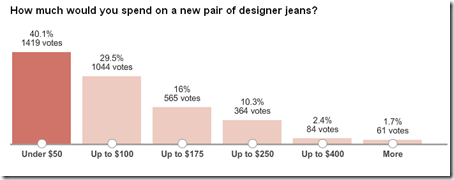
    It is also interesting to see the results from the WSJ poll on what average price the consumers are ready to pay for their jeans. Interestingly , about 15% consumers in the poll are still ready to pay over $250 for their jeans.. So the craze for premium denim continues !!

    denim poll

  • Retailers Cutting Costs To Make Up For Increased Prices

    cost cutting The retailers worldwide are resorting to increases in prices to make up for the increased costs – most of which have been attributed to the increase in cotton prices. Though the cotton prices have started to ease, the impact on the supply chain will be visible for some time to come.  As previously mentioned , GAP announced its forecast of reduced earnings leading to the largest fall of share price in over a decade . Businessweek now reports that the apparel brands are finding that they do not have much pricing power over budget conscious consumers and the only way to fight the increased prices is to cut costs .

    Companies are resorting to “Deconstruction Experts” – companies who help to reduce the cost of the garment . These companies , eg Kurt Salmon – are helping a number of their clients to find the ways to cut costs without making the change felt to the consumers.

    Various suggestions being given by these experts to cut costs. Fabric comprises as much as 50 percent of a garment’s costs. Cutting it more carefully to reduce waste can reduce by a few cents, Zippers that come in a big roll are cheaper than ones custom-made for specific garments .Brown – Vice Chairman , Kurt and Salmons ,  recently examined a pair of men’s khakis that sell for $29.50 and spotted a coin pocket. Eliminating it zaps a nickel, he says. Watch pockets are an easy cut, since few men use them anymore. So are logos and decorative stitching inside the waistband—visible to men only when they put on their pants.

    However, this cost cutting cannot be taken beyond a point . The customers can easily switch over to another brand if they find cheaper plastic buttons, smaller pockets  or reduced quality of waistband or other visible changes.

    However, i feel  that the brands/retailers which have been able to absorb these increased costs and have not made significant changes to their prices or product quality will be able to get the benefits in the next one year. The impact of increased prices of cotton is  going to go away as we are seeing the prices of cotton falling and the retailers will not have to work too much on cost reductions. We might see GAP’s share price rising in the next 6 months again !!!! 

  • Denim Mills In India :Facing Some Tough Time

    The denim players have seen some tough times in the last 1 and half years. With the cotton prices going through the roof (having almost doubled), the mills were  previously hard pressed to make their buyers understand the increase in costs and tried to get the prices increased. The process was slow as getting sharp increases in prices from buyers is never too easy. However, the awareness of the cotton price increase was there among buyers and many of them , reluctantly , agreed to increase the prices . Now, with cotton prices crashing, the strike by garment manufacturers against govt. duties , reduced demand etc has suddenly led to a situation of oversupply of denim fabric with prices falling . According to reports, most of the mills have large stocks   and the next 2 months look tough for the denim market. The players who were specializing mainly in the polyester denims and with no exports have been hit more hardly. The prices of polyester denim seem to have fallen about Rs 15-20 per mtr (35-45 cents/mtr)  and those of cotton in the range of Rs 10 (2o cents approx). However, with festive season sale starting from July, it is expected that the demand would stabilize during this period.

    Cotton Prices

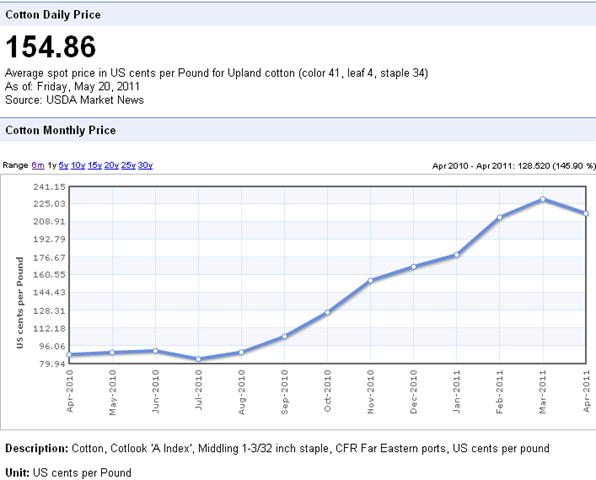
    Cotton price increase in the last one year  have actually played a spoilsport and have not helped anyone – neither the mills, nor the retailers and of course not the consumers. It has created a lot of uncertainty in the market and is still doing so. The cotton prices  had increased dramatically last year and peaked during Feb this year. However, suddenly the prices have started crashing with a better forecast of cotton production.  In India, the prices have come down from almost Rs 65000 a candy (35 to Rs 42000 a candy – about 33% fall  in 2 months !! Internationally , also prices have been reducing on a similar note :

    Month Price Per Candy Price Per Kilo in Rs Price per kilo in USD(@Rs45/USD) Difference
    Feb 2011 63000 Rs 177 3.93  
    May 2011 42000 Rs 118 2.62 -33%

    The movement of international cotton prices over the last year can also be seen here.

    image

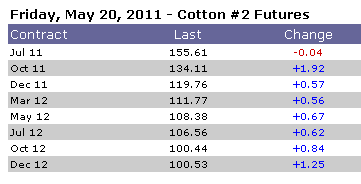
    The outlook of future prices of cotton also do not look that good. The crop for 2011-12 is expected to be very good at about  127 million bales with cotton planting around the world projected to rise by 7% in 2011/12 to 36m hectares– the largest in 17 years.. The cotton futures market in US is projecting prices much lower than current levels . See below :

    cotton future prices 

    The international retailers too had to bear the brunt of the cotton price increases. Many of them could not pass on the price increases in the denim and other fabrics to their consumers.  Eg GAP management said late thursday

    “….second-half product costs per-unit, factoring rising cotton and other costs, are now expected to rise about 20%, more than it anticipated, as it began to purchase goods for the holiday season. Its lower-priced channels such as Old Navy and the outlet stores that compete on price would be hit the hardest and would have the least room to pass on any cost increases…..”

    As a result the share price of Gap plunged 18% – its biggest fall in a decade -on hearing this news of increased costs.  Chief Executive Glenn Murphy said

      Gap has been testing the depth, frequency and length of discounts to help offset margin pressure. It plans to be less promotional and experiment with marketing ideas to drive traffic that do not involve discounting.For instance, at the company’s struggling Gap brand in the U.S., instead of having a 40% off the entire chain, the company plans to have promotions such as 40% off women’s products excluding denim, he said.

    Similarly , many other retailers have not been able to pass on the increase in sourcing costs to their consumers and are feeling the heat of increased costs.

    Now, with falling prices of cotton, the mills will be faced with the prospect of reducing prices for the retailers and other customers when already many of them have a stock of 3-4 months of cotton at higher prices. It would be a double whammy for the mills as they try to deal with their customers again and try to hold on their prices as costs have not gone down.

    Another problem related to exports for denim mills in India would be the DEPB – a scheme under which they got incentive of about 7.5% on exports is coming to an end and being replaced by Duty drawback scheme where they would get almost 4% less. This would further shave off another 4% from the margin of exporters and will not give any help .

    As mentioned before, the strike by garment manufacturers in India – which lasted about a month , left a huge impact for both fabric and spinning mills. The companies are reeling under the impact of the reduced production for this time which can hardly be covered up . Most of the spinning mills are running under capacity and holding huge stocks with prices of yarns falling on a daily basis.
    It is hoped that the market would get some sanity after end of June when demand starts to pick up for festive season .

    Follow us on   FACEBOOK   or   TWITTER to get more reports on denim industry directly.

  • Why Are Cotton Prices Increasing And Affecting Prices Of Denim Jeans And Other Apparel ?

    This is a guest article by Robert Antoshak – Managing Director , Olah Inc.

    clip_image002[4]This week, cotton futures prices topped $2.00 per pound. A year or so ago, the big debate in the cotton world was whether cotton could reach the history-setting level of a $1.00 per pound. How things can change!

    For jeans and denim companies, the recent run up in cotton prices has significantly impacted costs and at a time when consumer demand remains uncertain in the U.S. and elsewhere.

    So how did this shortage sneak up on us?

    Simply stated, there is a shortage of the stuff. Causing the shortage were a number of factors that came together to create a supply imbalance not seen in cotton since World War I.

    1. First, global stocks of cotton were drawn down sharply as less cotton was grown and shipped through the global supply chain due to competition from other crops. Many farmers switched to different crops when cotton was below 80 cents per pound. In particular, the ethanol boom of a few years ago convinced many farmers it was time to switch into corn production as corn paid better than cotton. Previously, cotton had been stuck in an anemic price range of about 40 cents to 70 cent per pound. Corn, on the other hand, soared when government support of ethanol production pushed that commodity up to unheard of price levels with corn now worth more as a fuel additive for our cars than as fuel for our stomachs!
    2. Next, there was bad weather. Flooding in Pakistan, a poor crop in China and a bad Monsoon in India combined to seriously undermine global cotton production in the season leading up to the recent surge in cotton prices. As much as one quarter of the global cotton crop was somehow affected by this bad weather and at a time when there was less cotton grown because it was more profitable for farmers to grow other crops.
    3. Finally, government actions further aggravated the situation. India, one of the world’s largest cotton producers, slapped export quotas on raw cotton and yarn in an attempt to maintain a good supply of moderately priced cotton for its textile industry. But cotton prices in India did not moderate and all this policy did was to cause an acute shortage of cotton and yarn in China, the major export market for these products. What a way to treat you customer! As a result, stocks of cotton in Chinese government warehouses began to run low. Without the ability to freely import cotton and yarn from India, and faced with a poor domestic crop and low country-wide inventories Chinese mills have had little choice but to enter the world markets and buy everything in site.
    4. And there’s more. When the grip of the global recession began to ease on economies everywhere, demand for textiles and apparel rose. Over the past 50 years or so, the U.S. and Europe often led global recoveries. But this time something was different. China played a major role as an end consumer of products. The Chinese government pumped huge amounts of money into their economy in an effort to ward off recession. It largely succeeded. Domestic demand soared, a recession was avoided in China, but demand for cotton jumped to levels not seen in years as local mills struggled to produce enough product to not only meet restored demand in the U.S. and Europe — but the demand of local consumers as well. Chinese textile producers are no longer solely reliant upon the global markets for their livelihood. Domestic sales have now become a new standard for the world’s largest textile industry and have placed even further demands on the cotton supply chain.

    There are also other factors that have contributed to the run up in cotton prices, some more obvious than others. Higher energy costs have played a role not only terms of shipping cotton but also to physically grow the crop. There’s another factor too – speculators in the cotton market. A weak U.S. dollar has helped to inflate commodity prices. It is often said that the wherever gold goes so does cotton. During this run up, a safe haven for investors has been gold and other commodities. When the stock markets were shaky during the recession, there was a lot of money to be made betting on higher commodity prices. In terms of cotton, sensing a quick buck, hedge funds swooped into the market just as the run up in prices began and the sheer size of their positions elevated prices well beyond what has normally been the case in the cotton markets.

    And, yes, there is one other factor: psychology. Panic is driving the market these days. Fear of not being able to secure a supply of cotton has left many clothing companies scrambling and even more mills wondering if they can stay in business if the price continues to rise and if there will be a consistent supply of cotton to be had at any price. It is this panic in the marketplace that has helped to elevate cotton prices even more. For many years, the retail and apparel side of the textile supply chain set the rules for what it was willing to pay for its raw materials be it fabrics or raw cotton. But the panic in the market has weakened the grip of these companies. Raw material suppliers appear to have at least temporarily gained some ability to push higher costs on their customers and, indirectly at least, to the customers of those customers.

    Needless to say, all of these factors have put the cotton industry in the precarious position of meeting soaring demand from a reduced production base.

    The bottom line: There’s simply not enough cotton to go around.

    Of course not all textiles are made of cotton and the fabric is only one component of the final price of the item. Unfortunately, polyester and other synthetic fabric prices trend to track with cotton and have risen significantly as well. Labor has become more expensive as has electricity, and pretty much all of the input costs of producing a final product. Sounds like an end of the world scenario…

    But there’s hope on the horizon. Production will return. $2.00 cotton will move many farmers back into the game. A few years ago, many in the cotton trade forecast a reduction of U.S. cotton acreage from about 10 million acres to just six million. Funny how things change: Today, most analysts feel the US market will actual grow to about 13 million acres this year. As the U.S. is the world’s largest exporter of cotton, that’s a good thing.So all is not lost. Production will return and prices should moderate over time.

    Will we go back to 40-cent cotton anytime soon?

    No. Cotton prices will remain high for next couple of years — certainly above $1.00 per pound and it is possible that the record run-up in cotton prices will continue. But eventually prices will moderate as more supply comes on line. It just takes time. It takes almost 200 days to grow a cotton crop. Because of this long lead-time it will take time to bring production to a level that meets world demand.

    But, then again, there’s only so much acreage to grow cotton. Perhaps that’s best left for another discussion on another day!

    About: As Managing Director of Olah, Inc., Mr. Antoshak supervises the firm’s global cotton marketing and consulting services. Olah Inc runs the famous Kingpins Denim  Shows besides other activities. Mr. Antoshak has more than 30 years of experience in the fiber and textile industries. He has held analyst positions with the Fiber Economics Bureau as Editor of the Fiber Organon, American Fiber Manufacturers Association as Director of International Trade, American Textile Manufacturers as Associate Director of International Trade,  as President, Werner International as Vice President of Information Services, . Most recently, Mr. Antoshak was Managing Director of the Fibers & Textiles Division of FCStone, LLC.  Mr. Antoshak has strong experience in trade negotiations and worked as a FBI-cleared industry advisor to the U.S. government on numerous bilateral quota trade agreements, NAFTA, the MFA and the WTO.

    Contact him on this email address.

  • Bangladesh Export Of Denim Jeans To EU : 2005-2009

    Bangladesh is a major exporter of denim jeans to EU27. Being low priced and with special and indefinite duty free and quota free access under ‘Everything but arms’  initiative to EU , Bangladesh continues to dominate the EU denim import business.  Currently, it has about 19% share of the denim jeans import market in EU27 countries.

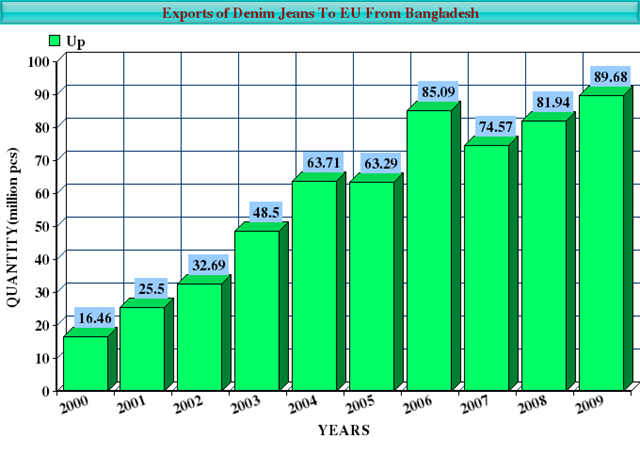
    Lets have a look at the figures of imports of denim jeans from Bangladesh for the last 10 years .

    Year Total Denim Jeans (million pcs) Value (million Euros) Average Price
    (Euro/pc CIF)
    2000 16.46 87.92 5.34
    2001 25.50 120.26 4.72
    2002 32.69 144.69 4.43
    2003 48.50 190.87 3.94
    2004 63.71 247.52 3.88
    2005 63.29 245.42 3.88
    2006 85.07 341.78 4.02
    2007 74.57 289.98 3.89
    2008 81.94 317.23 3.87
    2009 89.68 373.93 4.17


    denim prices bangladesh

    Thus we can see that the exports of denim jeans have increased by almost 400%  from 2000 to 2009 . There have been some years in which the exports increased by a large % as compared to the previous year . These years have been :
    2001    : Increase  54%
    2002   : Increase 28%
    2003   : Increase 48%
    2004  : Increase 31%
    2006 :  Increase 34%
    2009 : Increase 10%

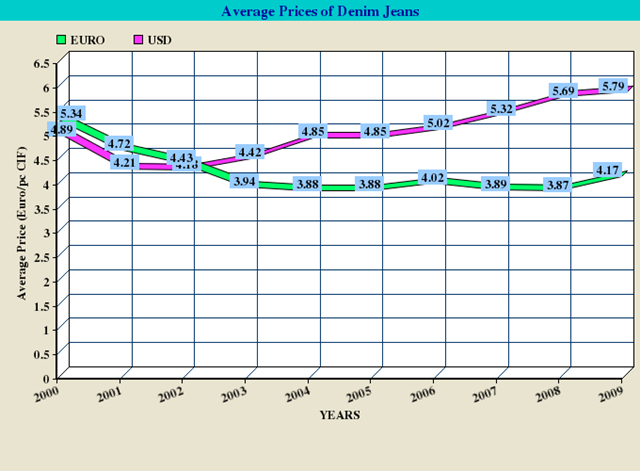
    The prices from Bangladesh have been more or less moving in a narrow range of Euro 3.8  to 4.20 since 2003. Though in earlier years, the prices were much higher, but recent years have seen the prices move around in this range. There is no clear trend in the prices from Bangladesh if we consider these figures. However,  would it be the similar situation if the Euro prices were converted to dollar prices . In the table below, we have taken the average conversion factor (from Euro to USD) for each year from 2000 to 2009 and applied the factor to the average prices for that year. This gives us the average dollar prices for export of denim jeans from  Bangladesh to Eu . With this table we will come to know whether there is really no trend for prices from Bangladesh:

    Year Euro To USD
    average factor
    Av Price  (Euro) Av. Price (USD)
    2000 1.09 5.34 4.89
    2001 1.12 4.72 4.21
    2002 1.06 4.43 4.18
    2003 0.89 3.94 4.42
    2004 0.80 3.88 4.85
    2005 0.80 3.88 4.85
    2006 0.80 4.02 5.02
    2007 0.73 3.89 5.32
    2008 0.68 3.87 5.69
    2009 0.72 4.17 5.79

    av prices of denim jeans

    In the table and chart above, we can see that actually the prices from Bangladesh are quite different than what Euro prices show. We can see that since 2002 the average prices  in Euro terms (from 2002 to 2009) have declined by more than 5% whereas there is an  uptrend in dollar terms  and the prices have increased from $4.43 per piece in  2002  to $ 5.79 in 2009 – actually showing an increase of  about 30%

    Dollar being the ruling currency worldwide, gives  a better picture of the prevailing price situation and it clearly reflects that the prices from Bangladesh are continuously and steadily rising over the years. This is despite the fact that the volumes have increased manifold during this period. The Bangaldesh denim export industry is only expected to grow stronger in the coming times . We have seen a number of denim mills also come up in Bangladesh and this strengthens the supply chain making it easier for Bangaldesh to go deeper into these markets.

    Also check : Exports of Jeans from Bangladesh to USA

  • Difference Between $20 and $240 Jeans – An Evaluation

     what-jeans-to-buy1 What really is the difference between a $20 and a $240 jeans? There is a world of difference in the prices but how much should be the difference in quality to warrant this price difference. Normally it should be a lot and it could be on many  inputs that go into a jeans  :

    The difference could be related to  :

    • fabric quality
    • stitching quality
    • attention to details
    • washing effects
    • accessories used
    • fit
    • brand name
    • life of a jeans

    or a combination of a number of these or more  factors.

    ConsumerReports – a non-profit consumer welfare organisation -  evaluated evaluated seven women’s cotton/spandex boot-cut jeans in that price range, looking for sewing and fabric flaws, washing one pair of each five times, opening stitching at the waist to examine construction, and checking zippers . They produced a report with their findings and excerpts from this report are shared in this article.The seven jeans selected were  :

    1. Signature by Levi’s – Totally Slimming : $20
    2. Old Navy – The flirt curving dark balboa :$30
    3. Gap 1969 – Perfect boot :$70
    4. Levi’s – Skinny Dusk :$70
    5. Lucky Brand – Stockton Lola : $80
    6. 7 for all Mankind – Flynt : $155
    7. True Religion – Becky Silver Chainball : $240

    Their findings were :

    • Some cheaper jeans have better construction features such as interfacing under the waistband .
    • Levi’s Signature jeans shrunk maximum in the width at 2.5% while 7 for all Mankind shrunk maximum in length at 3% .
    • Lucky brand was the only jeans which did not shrink at all. It was , however, a highly distressed jeans . Zipper locks only in ‘down’ position.
    • Levi’s and Old Navy  jeans had stitching under waistband which limits stretching.
    • 7 for all Mankind had some features to justify their high price eg the  silver bling (on back pockets and  hiding inside a front pocket), a nice print fabric for the pocket bags (where it can’t be seen), big white stitches as an accent, and a zipper that won’t stay up unless it’s locked down.

    If we look at their findings above,  we will find that even the less expensive jeans can have features which may be better than  those of the more expensive premium denim jeans. An expensive jeans does not necessarily translate into a better jeans.
    (Note: However, since the sample size of this experiment has been small, we  do not say that a particular brand of jeans is better than the other.)

    However, having said that , we also need to understand that denim jeans are not bought for their technical features alone. In fact, most of the consumers are not even aware of technicalities of denim fabrics . They are , mostly, looking for a jeans which has a good hand feel, a great looking wash, a reasonably good fit ( this sometimes is the deciding factor for buying jeans)  etc. Brand name , celebrity endorsements and company name are also big factors in deciding regarding the jeans purchase as they provide the necessary ego massage to the buyer !.

    Normally , luxury products have a high proportion of brand value input and it combines with other factors to make them worth the money. But it is also to be ensured that the quality of  such high priced products needs to constantly outshine the quality of that of lower priced products . A $150+ premium denim  jeans may sell well during a boom time and on the strength of its brand name, but it will not keep on doing so if it does not provide quality that is much much better than the cheaper jeans available in the market. The owner of such high priced products need to feel proud of their purchase for a long period of time to sustain the high brand value that has been charged.

    About : ConsumerReports.Org is run by Consumers Union (CU) – an expert, independent, nonprofit organization whose mission is to work for a fair, just, and safe marketplace for all consumers and to empower consumers to protect themselves. The organization was founded in 1936 when advertising first flooded the mass media.

  • Retail Price Structure Of Denim Jeans Imported Into EU

     denim jeans imported in eu CBI provides a detailed table for analysing the price structure of the  imported jeans in the EU. Basically, this table helps to find how the retail prices of the jeans can be approximately derived from the CIF prices of the jeans at which they arrive in EU. The jeans , after they arrive , add various kinds of costs which are reflected in their final retail price. However,  due to market segmentation, the table is divided into three categories under which jeans might be sold. These are the Low, Medium and High segments of the market. The wholesaler and retail margins vary significantly under these different segments – thus causing a different ratio of retail price to the CIF cost . The starting index is taken as 100 and different costs are added as % to this base index.

    Price Structure Of Jeans In EU

    Details Low Medium High
    CIF Rotterdam/Amsterdam 100 100 100
    Import Duties * * *
    -handling charges, transport,Insurance, banking services 8 8 8
    Sub-total 108 108 108
    Wholesaler’s Margin(25/33/50%) 27 36 54
    Sub-total 135 144 162
    Retailer’s Margin (40/60/75%) 54 86 122
    – net selling price 189 230 284
    VAT (19%  of net selling price) 36 44 54
    Gross selling or consumer price 225 274 338
    Ratio CIF/Consumer Price 2.2 2.7 3.4
    • Import tariffs( 0-12%) are not included in this calculation. The ratios will change a little when the tariffs are incorporated for individual countries.
    • VAT is taken for Netherland and will be different for different countries.

    Thus we can see that the ratio of  retail prices varies from 2.2 times to over 3.4 times the CIF value of the jeans into EU. This could vary a little when we consider the additional factors of duty and different VAT structures.  However, it helps us to have an approximate idea of how the price structure of denim jeans is done in EU. For more details, visit the CBI Market Info and download the report from there.

  • The Highest And Lowest Priced Exporters Of Denim To USA In 2009

     denim prices About 580 million pieces of denim apparel were imported into US from various countries around the world in 2009. This apparel included mainly jeans and some small quantities of  denim skirts, denim jackets, denim blazers etc. The average price of all this apparel was USD7.15/ piece CIF US .

    It would be interesting to know which were the countries whose exports of denim apparel  to the US were very high priced and which were the ones which were priced low and we can see the marked difference between the two as also compared with the average prices .Lets have a look

    Countries Exporting High Priced Denim Apparel

    Italy , Japan and and Tunisia were the countries from where the denim jeans and apparel were the costliest for imports into US.  Naturally the volume for the same was also much lower as compared to low priced exporters.

    Japan – $46.47/piece   CIF US Ports
    Tunisia -$32.75/piece    –do–
    Italy -     $31.21/piece    –do–

    As expected Japan had to get the distinction of the highest priced exporting country . However, it was surprising to see that apparel from Tunisia were more expensive that from Italy. It is however to be noted that Tunisia exported much lesser volume to US than Italy.

    Countries Exporting Cheap Denim Apparel

    This is the category of countries most of the buyers of denim jeans/apparel from US are interested in knowing.  Bangladesh, Pakistan and Vietnam were the countries from where these exports were really very cheap.

    Bangladesh : $ 5.19/piece  CIF US Ports
    Vietnam      : $5.92/piece   —-do——–
    Pakistan      : $5.97/piece   —-do——-

    So we have an interesting matrix where ,against the average price of denim apparel at $7.15/piece, we can see the prices to be as high as $46.50 and as low as $5.20. This also shows the difference in prices  at which jeans and other denim apparel retail in the US – from $9.99(or lower) a jeans to $500 for a pair jeans.

  • Av. Price Of Denim Apparel Imports In US Goes Down 7% in 2009

    denim apparel The average price of imports of denim apparels into US has gone down significantly in the year 2009 as compared to the year 2008 .The year 2008 had actually seen an increase of 1% in the average price of imports of denim apparels as compared to the year 2007. But when we come to the year 2009 , the average price has actually gone down by almost 7%.This was inspite of an increase of over 1.5% in volumes. It  reflects  the spillover affect of the recessionary period that hit the world and specially the US.

    Denim Apparel Imports -Value and Average Price

    Year Quantity(million pcs) Value(US$ million) Average Price (per pc)
    2007 549.09 4.172 $7.59
    2008 577.52 4.434 $7.67
    2009 584.74 4.180 $7.14

    source:us dept of commerce
    We can hope that the year 2010 would show an improvement in prices and the volumes as well as the reports trickling in are positive.

  • Levi’s India adjust pricing strategy


    Levi’s India plans to vacate the middle price segment and concentrate on the lower and the higher ends.Its Signature brand – which is the value offering – will see a further fall in price and start at Rs 900 instead of Rs 1000(USD 22 instead of USD 24 approx.). On the other hand, the premium segment will see an increase of about 15% in average pricing and increase to about Rs 2400(about USD 58). The report by Economic Times also mentions that in the next six months, the company will roll out its high-fashion, high-end brand Levi Rivet nationally.
    The company is also planning to increase its adspend significantly during the next few months as it sees a slowdown and counts on its advertising to perk up the sales and take an increasing share in the 10 million value jeans and about 3 million premium jeans market in India.
    Levi’s has been continously moving in the direction of vacating the mid-priced segement – as I mentioned in a previous post also and probably this is a sign of times to come for many large denim labels. The mid-priced segment of the Jeans is experiencing the miniumum growth and its share is being taken up by local brands who are more adaptable to local conditions (in India brands like Spykar,Killer etc)

    Related articles : Levi’s ipod Jeans in India
    Levi’s Footwear range in India
    Levi’s new model for India – actor Akshay Kumar