Based in Turkey, Kaiser is a well-known supplier of colorants and laundry auxiliary products, providing environmentally friendly solutions to clients worldwide. Offering the best products and technology for laundries and garment dyes, Kaiser has almost a century of experience in product research and innovation for the textile industry, building on its DyStar heritage.
In order to promote their innovations, they exhibited garments that explained their concepts at the Denimsandjeans Vietnam 2024 show. Serdar Demircioglu talked with Denimsandjeans on his exclusive products showcased during the show.
Water-Free Stone Wash Look
Lava Cell NSY works as a stonewashed effect auxiliary as well as an accelerator for denim stone washing. At room temperature, the substance speeds up mechanical abrasion of Indigo. Without using pumice stones, it gives certain denim qualities a stonewashed look.
The product offers waterless stone washing processes. It can be used on wet clothes following the pre-wash. Water in the drum is not necessary for application.
The Lava® Cell NSY, a water-free stone washing enzyme and the Lava Con KKT Powder, a water-free enzyme activator make up the Stone-Free & Water-Free concept. With an environmentally responsible application method, Lava® Cell NSY & Lava Con KKT Powder offers the appearance most similar to pumice stones.
Ozone Bleaching
A specifically prepared substance called Lava Con OZN is intended to cause denim substrates to undergo ozone bleaching. The product is an environmentally friendly substitute for hypochlorite and permanganate. It gives denim clothing a more pronounced and brilliant bleaching appearance and enhances the marble impression.
Dry Ozone Application
Lava Con OZN can be applied via dipping, spraying, routine machine applications, or injection in closed machinery systems. The garments must be completely dry before applying ozone.
Lava Con OZN is an excellent bleach for fabrics with sulfur and indigo.There is no need for a specific neutralization with this product. All that’s needed for neutralization after the ozone application is a simple detergent wash.
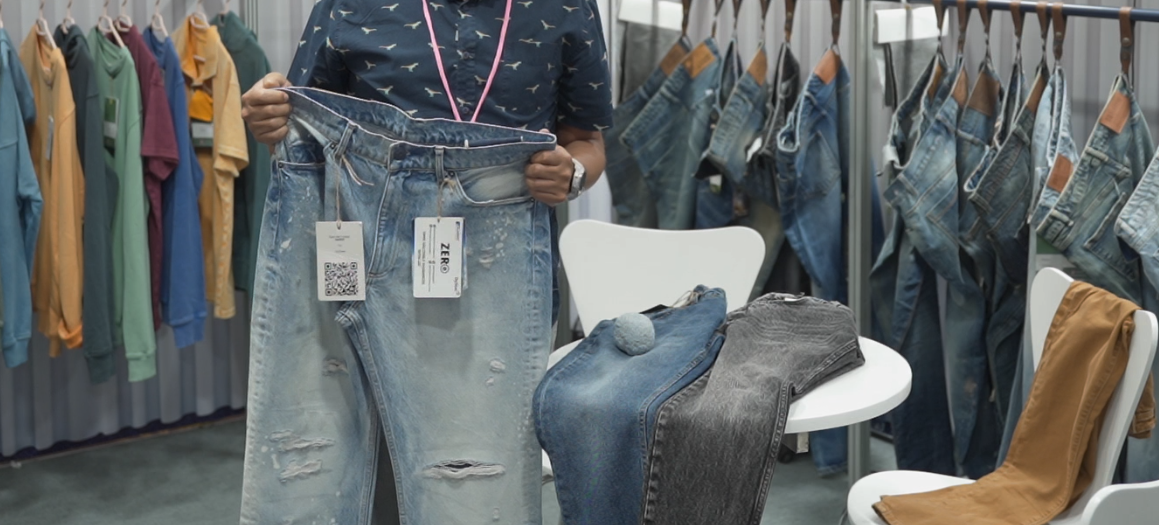
The clothing produced with this method is referred to as “Zero” because hypochlorite and permanganate are not present in the process.
Advanced Used Look
Advance used look effect is achieved on garments treated with reactive dye to make sustainable fashion colorful. It is used to create fashionable washed-down effects.
Advantages of the concept;
Applicable for both garment and fabric dyeing
No cationization is needed in the dyeing process
Excellent color fastnesses can be achieved
Provides a fashionable used-look after the garment treatment without additional bleaching process
Provides very good reproducibility and levelness
Garment treatment process is conducted without water and without hazardous chemicals such as potassium permanganate
Energy and time saving
To connect with them , please contact @ serdard@kaisertekstil.com
Haelixa is a multi-award winning spinoff of ETH ZURICH founded in 2016. The two founders Michela Puddu and Gediminas Mikutis worked during their PhD at the ETH Zurich on the development of DNA markers for product traceability, the technology that they have then further advanced and commercialized setting up Haelixa. With a sophisticated technology as a base, the Haelixa traceability solution is easy to use and can be applied to the raw material (or intermediate product) to address challenges related to proof of product origin, authenticity and sustainability claims.
Having grown from strength to strength, the company now has a wide global reach helping out brands and companies to physically trace input materials. Haelixa has particularly made its mark in the Denim Industry by helping trace , among other things, the cotton fiber used – a subject of great concern to the large brands .
Soorty Denim from Pakistan is one large denim conglomerate using their technology and providing the physical tracing of recycled cotton fibers that they use in their fabrics to their large base of customers globally. We spoke to Mr. Mansoor Bilal – VP Marketing, Research & Innovation and Holly Berger , Marketing Director , Haelixa AG about their collaboration .
Briefly summarize the partnership between Haelixa and Soorty.
Haelixa and Soorty began their partnership in 2019, over a need to have a reliable means of tracing the denim Soorty is recycling. Haelixa provides a liquid solution containing specific DNA for Soorty to spray on post-consumer waste. Once the post-consumer waste is mechanically recycled into fibers and further processed into a finished garment, samples are sent to Haelixa labs to be tested for the DNA. Once verified, Soorty can responsibly stand by their recycling claim.
What advantages do marking and tracing recycled denim have for customers? Why is this important?
HB : Denim manufacturers and producers are being pushed to increase the percentage of recycled products. As denim brands are setting more aggressive sustainability goals, this means the demand for recycled fibers increases. In order to substantiate recycling claims, Haelixa offers forensic proof as to whether marked recycled fibers are used.
MB : With an increase in demand for circularity in textiles, many brands are focusing on the transparency and traceability of the fibers and their sourcing background. The major advantage for the customers is having confidence and total reliability in the product because it’s been sourced from a credible and authentic supplier who understands circularity and its dynamics.
This also provides them with the satisfaction of being conscious consumers since traceability offers supply chain transparency that makes you feel like a partner in environmental support and that you are giving back to nature
What has been the overall response of marking recycled denim?
HB : The response has been positive. Traceability is not only a trend but an important standard that is being adopted by the textile industry. Haelixa offers credible testing (through PCR) to verify DNA in the fibers marked. Soorty offers brands the option of labelling their products with a tag, “Marked and Traced by Haelixa.†All fact-based information on sustainability efforts are important for the industry and consumers.
MB : Many brands are realizing the effects of ongoing climate changes and the consequences of growing landfills. Over the past few years, many of our buyers have been asking us to add PCW (recycled cotton) into our fabrics. But since the last 2 to 3 years, the demand has been getting higher and higher with every passing day. Now most of the brands we are working for demand a mandatory percentage of PCW blend in their collections.
How does the process work and what are the steps involved in execution
HB: Haelixa ships the liquid formulation to Soorty, where it is applied in a standard production step by spraying. Denim garments are then produced as usual. What we have also done with one of Soorty’s clients, is to prepare a unique DNA to identify their collection. Haelixa then verifies marked garments and issue test certificates.
MB : After sorting and shredding our PCW denim fibers, we apply DNA markers to the fibers, which are then mixed with virgin cotton in the desired percentage requested by the buyers to make the yarn.
What is the most common reason brands want to mark recycled denim?
HB: Marking fibers is important to maintain the credibility of the product in the supply chain. In a world of greenwashing and misinformation, brands are looking for fact-based evidence to back the claims about the fibers used in their textiles.
What does the consumer gain from purchasing marked and traced recycled denim? How has the DNA solution evolved since working with recycled denim?
HB: Haelixa marking fibers initially was used mostly as a tool for supply chain players to verify their claims of traced textiles. Since the product was first launched, Haelixa now offers customer-facing communication. This includes the optional hang tag, stating “Marked and Traced by Haelixa†or a QR code printed within the finished garment which directs the consumer to a website sharing supply chain data.
With respect to this partnership, what is possible for the future? Are you planning on scaling the recycled cotton traceability? What will you mark besides recycled?
HB : The range of textiles that Haelixa can reliably trace is vast, beyond denim. The traceability solutions portfolio includes organic cotton, recycled cotton, hemp, nettle, and synthetic fibers. With Soorty, the next scale will be in recycled and organic cotton.
MB : Soorty has always kept a sharp focus on its customers’ expectations while ensuring a sustainable impact on our Earth. We do it through research, innovation, and continuous improvement of infrastructure. Recently, we have doubled our recycling capabilities, keeping in mind the flow of demand for recycled denim. And we are thinking of coming up with something interesting like traceable organic cotton under SOCI, Soorty’s Organic Cotton Initiative.
Why is marking organic cotton important? Which advantage will it give you?
HB : The feedback has been very strong after collaborations with brands in marking organic cotton. It adds credibility as traceability is the only way to ensure that a product is indeed made of the specific lot of organic cotton that is stated on the transaction certificate or other documentation. The fact that Haelixa markers are approved as chemical inputs by GOTS is a major advantage here and allows us to ensure that safety and GOTS requirements are maintained.
MB : It seems like the new business approach will be based on the transparency of the full supply chain and not limited to one part.
What is the risk of not using a traceability solution?
HB: There are two major risks of not having a traceable solution in place : 1. Future: With regulations and communication mediums changing faster than the seasons, businesses need to keep up with the trends. Without a solution in place, their efforts to create consistent products that meet standards will fall short. 2. Transparency: To keep stakeholders informed about the fibers used, traceability is necessary to state the facts about the production processes in the supply chain.
MB : It is unavoidable in today’s world to provide a tangible with no traceability. To be in the league of dependable supply chains, a significant number of businesses would have to rely on an authentic and consistent traceability partner sooner or later.
Mr. Mansoor Bilal - VP Marketing, Research & Innovation says :
Going forward, companies will be judged on their overall footprint of traceability and reliability. As a first step, we have onboarded Haelixa for the beginning of process control to encourage track and trace. And we see great potential to further push the initiative in our cotton fields under the flagship project of SOCI to create a circular benchmark.
Mr. Abdelkader Amouche – Global Sales Director , Haelixa says :
Greater transparency is a must. Business owners now know that their companies will be asked about their sustainability goals and efforts. Our work in cases, like Soorty, demonstrates that transparency is possible.
For more information , please contact Holly Berger , Marketing Director , Haelixa AG @ h.berger@haelixa.com
(Cleveland, OH) RevoLaze, LLC, a laser technology firm headquartered in Westlake, OH, announced today that it has reached a new licensing agreement with Levi Strauss & Co. regarding additional denim laser patents in their Intellectual Property portfolio. This new agreement provides Levi Strauss & Co. access to additional opportunities outside of the licensed patents from their previous agreement signed in January 2015. One of the new technologies RevoLaze will be introducing is LightLaze, an automated software tool to reduce laser cycle time. The online software works on ANY laser system. Trials from multiple laundries showed a decrease of up to 40% in laser cycle time, without losing any details.
By adopting this software and modifying the wash technique, it can also lead to the elimination of PP spray. It is an eco-friendly and low cost alternative to PP spray with significant savings in water, chemicals and time. No new equipment, software or chemicals are needed.
About RevoLaze LLC
RevoLaze (formally TechnoLines) is a US based technology firm dedicated to create and implement their patented laser processes. With over 30 patents granted, some of the biggest denim brands and manufacturers in the world license RevoLaze technology. For over 20 years, they have provided economic and environmental solutions to the textile industry through innovation. Their technologies help mills, laundries, manufacturers and denim brands lower overall cost, while increasing volume and design capabilities. These processes also reduce or eliminate various health hazards, such as hand sanding and PP spray. Several of the leading denim brands and manufacturers work with RevoLaze to maximize their use of lasers from development through production. Visit their US based design center where companies can see the future of laser technology – the only 2,500 watt laser that etches designs in seconds with ultra fine detail.
For more information on testing LightLaze, contact Ryan Ripley at ryan@revolaze.com
Whiskering inconsistency is a regular problem in denim jeans production . It requires highly skilled workers to create the right kind of whiskers consistently. However, even with the highest levels of consistency, the element of uncertainty remains and whiskers may not be uniform across the entire production .
Modul SRL of Italy has devised moulds for jeans which it claims can provide a very high level of consistency by providing inbuilt whiskers on its moulds. This enables the worker to just scrape normally on the jeans and the whiskers appear uniformly without the effort on the part of the worker to create the same and the whole whiskering and hand sanding process is complete within 4 minutes.The company claims to be the only producer in the world of a technology to replicate the vintage look that they sell to contractors around the world and big denim producers .
How do these whisker moulds work ?
Take a look at this video first to understand how this mould system works
As you can see from the video above, the worker scrapes normally on the jeans put on the Modus Moulds and whiskering appears itself in a predetermined pattern. Thus the whiskering can be done by a relatively inexperienced worker also.
These moulds look quite interesting if they perform consistently. However, the cost of these moulds may be an issue as they are not cheap .
How Can A Jeans Factory Use These Moulds
A factory needs to buy at least 5 moulds to start using this system and since each mould costs around Euro 700, an investment of about 3,500 Euros is required to make a beginning.
All moulds are expandable to three sizes – small ,medium and large.
Each mould lasts 5000-7000 inflations – though it depends on the skill of the operator.
Each mould can produce only one whisker pattern. If the client needs to recreate any whisker pattern (from any jeans eg) , Modus can recreate the mould for the same and ship to the client within 1-2 weeks.
The company also provides protos moulds prized at Euro 370 which can be used for sampling purposes.
Note:Modus has also designed a denim brand Onvis using this concept. ONVIS is a project which tells true stories . They are offering raw denim jeans – BLUEVIRGINS– and asking consumers to live them everyday by (ab)using them as much as possible. Once daily life has left it’s traces on the denim (ususally within 6months – 1 year without washing !) Onvis encourages consumers to send used pair of BLUEVIRGINs back to be evaluated and to be chosen and replicated for one of our next ‘TRUESTORIES’ limited edition (up tp 5.000 pieces). The respective life storyteller will get paid a royalty of 1,00 Euro per piece on the collection’s effectives sales (max. 5,000,- Euro) and will be portrayed on their website.
Cone Denim (in Jiaxing,China),Central Textiles(Hong kong) and Lanyan Group(China) have installed the Electronic Fibre Selection System from Cotton Incorporated. This computer software technology driven system aims to optimize the quality and consistency of the cotton fibre – meant to help in producing high quality yarns .
Also, this helps the American Cotton Exporters as more American Cotton is expected to be used by mills using the EFS system.
Well its a good move by the Cotton Inc. to increase its Cotton exports.
Let’s wait and see how profitable wwill it be for the companies who have installed it ..