Tag: eco sustainability

  • Recycling Blended Textiles – A Technological Breakthrough By H&M And HKRITA

    Recycling Blended Textiles – A Technological Breakthrough By H&M And HKRITA

    The innovative partnership between the non-profit H&M Foundation and The Hong Kong Research Institute of Textiles and Apparel (HKRITA) finds groundbreaking solutions to recycle blend textiles into new fabrics and yarns – without any quality loss – through a hydrothermal (chemical) process. The technology will be scaled up and made available to the global fashion industry. The finding is a major breakthrough in the journey towards a closed loop for textiles.

    “For too long the fashion industry has not been able to properly recycle its products, since there’s no commercially viable separation, sorting, and recycling technology available for the most popular materials such as cotton and polyester blends. This very encouraging finding has the potential to change that. We are very excited to develop this technology and scale it beyond the laboratory, which will benefit the global environment, people and communities,” says Erik Bang, Innovation Lead at H&M Foundation.

    Edwin Keh (HKRITA) Erik Bang (HM Founation) in HKRITA lab

    How Does This Technology Work ?

    While talking with Denimsandjeans.com ,  Erik Bang, Innovation Lead at H&M Foundation said

    We’re working on two different separation and recycling technologies, both targeting blended textiles. In this process of Hydrothermal ,  the cotton comes out at a cellulose powder which is possible to upcycle back into yarn and fabric through existing and emerging technologies. Through our second method, the biological one, the cotton is processed to glucose. Glucose is a widely used chemical building block in several industries including textiles. The polyester is in fiber form and without quality loss from both methods, which of course is fantastic. The water used in the process is recovered and can be reused over and over again in a closed system. So there is very little water consumption. We are very mindful not to create another problem through these new technologies so it is top of mind in designing both methods. The partnership works towards the goal of providing at least one separation and recycling technology to the industry by 2020. We’re currently scaling up the lab breakthrough in a pilot plant in Hong Kong, operational within 12 months. We are very excited to see what the future holds.

    Biological Treatment at HKRITABiological Treatment in HKRITA lab

    The hydrothermal process uses only heat, water and less than 5% biodegradable green chemical, to self-separate cotton and polyester blends. This fibre-to-fibre recycling method is cost effective, and there’s no secondary pollution to the environment, ensuring the life of the recycled material is prolonged in a sustainable way. The technology will be licensed widely to ensure broad market access and maximum impact.

    “By being able to upcycle used textiles into new high value textiles, we no longer need to solely rely on virgin materials to dress a growing world population. This is a major breakthrough in the pursuit of a fashion industry operating within the planetary boundaries,” says Edwin Keh, Chief Executive Officer of The Hong Kong Research Institute of Textiles and Apparel (HKRITA).

    The H&M Foundation initiated the partnership with HKRITA in September 2016. It is backed by an estimated 5.8 million euros of funding, with HKRITA conducting the research and work to commercialise the outcomes. The Innovation and Technology Fund of the Hong Kong SAR Government also provides additional substantial funding and support. The total project investment is estimated to around 30 million euros during the four-year collaboration (2016-2020), which makes it one of the biggest and most comprehensive efforts ever for textile recycling.

    It is H&M’s customers’ engagement that have enabled this important research, as the exact financial contribution is determined by the annual surplus from H&M’s global in-store garment collecting program, which is donated to H&M Foundation. To date the H&M Foundation has donated 2.4 million euros to HKRITA.
    H&M has been very consciously moving in the direction of sustainability as an important corporate objective. We can see its developments in terms of usage of organic materials, efforts to implement sustainable practices with its partners , collection of used garments and many other sincere efforts in environmental protection. This again is a huge step and if the efforts pay off, it will make huge impact on the global fashion industry with vast amounts of recyclable materials available taking off big part of  ‘FASHION BURDEN’ from mother earth. It also looks that this technology, once developed , will be freely available for common good. If the project is successful, we may find PCW getting a new meaning and fashion industry may loose some of its guilt ! We all look forward to and hope for success of this project.

    ABOUT

    H&M Foundation is a non-profit global foundation, privately funded by the Stefan Persson family, founders and main owners of H&M group. Its mission is to drive long lasting positive change and improve living conditions by investing in people, communities and innovative ideas. Through partnerships with organizations around the globe, the H&M Foundation drives change within four focus areas; Education, Water, Equality and Planet. In addition to this, the Foundation can also provide emergency relief. Since 2013, the Stefan Persson family has donated 1.3 billion Swedish krona ($177 million/€144 million) to the Foundation. Learn more at hmfoundation.com.

    The Hong Kong Research Institute of Textiles and Apparel was established in 2006 and is a publicly funded applied research center. It is one of five applied research centers sponsored by the Innovation and Technology Fund (ITF) of the Hong Kong Special Administrative Region Government. HKRITA engages in applied mid- and down-stream research to support the textile and apparel industries, to drive sustainable improvements, and to drive improvements for society.

    The Innovation and Technology Fund (ITF), administered by the Innovation and Technology Commission, aims to increase the added value, productivity and competitiveness of our economic activities. The Government hopes that, through the ITF, Hong Kong companies could be encouraged and assisted to upgrade their technological level and introduce innovative ideas to their businesses.

     

  • Levis Makes Jeans From Old Fishing Nets With Aquafill

    Levis Makes Jeans From Old Fishing Nets With Aquafill


    Levi’s is Making Jeans From Old Fishing Nets

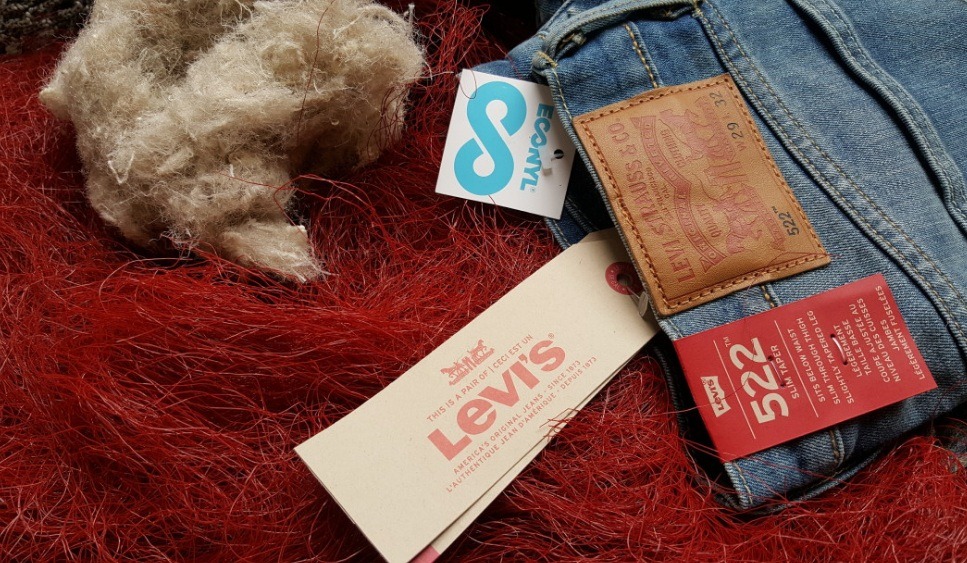
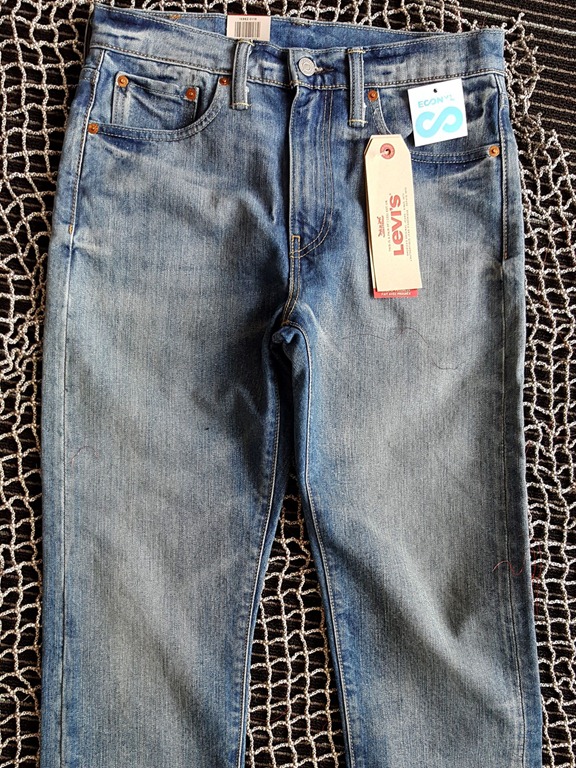
    ECONYL® brand and Levi Strauss & Co. have come together to create a new men’s collection made from regenerated nylon from waste materials such as fishing nets and spent carpets.Levi Strauss & Co. has a long history of working on environmental protection through advanced technologies . The collection, the Levi’s brand’s first made with ECONYL®, provides further proof of Levi’s commitment to a sustainable supply chain.

    This development  involves a partnership with Italian nylon manufacturer Aquafil. One of the products that Aquafil makes is a synthetic material called Econyl, which is made from 100 percent regenerated nylon waste materials. The collaboration goes in line with Levi’s longstanding interest in promoting eco sustainability on our resource-strapped planet. “We envision a world where everyday items don’t have to come at the expense of the environment,” Giulio Bonazzi, chairman and CEO of Aquafil, said in a statement. “This new partnership is further proof that sustainable materials can be used to reinvigorate products that have been traditionally made. Levi’s is redefining the denim industry.”

    Levi’s is Making Jeans From Old Fishing Nets

    About Aquafil :

    Aquafil Since 50 years, Aquafil has been one of the leading players, both in Italy and globally, in the production of Polyamide 6: a landmark in terms of quality and product innovation. Additionally, the Group is a leader in the research of new production models for sustainable development.Aquafil Group has a presence in eight countries on three continents, employing more than 2700 staff at 15 plants located in Italy, Germany, Scotland, Slovenia, Croatia, the USA, Thailand and China.

    About ECONYL® :

    ECONYLThe ECONYL® brand was inspired by Giulio Bonazzi, President and CEO of the Aquafil Group. He firmly believes in maximizing sustainability through closed-loop manufacturing systems. Aquafil’s ECONYL® fiber helps divert global waste streams from landfills and oceans and is used to produce a wide range of textile products such as sportswear, swimwear, and carpets. Today the ECONYL® Regeneration System is known as the most advanced and sustainable recycling process within the synthetic fibers industry.


  • Google and Levi’s Present The First Smart Jeans For Urban Cyclists : Project Jacquard

    Google and Levi’s Present The First Smart Jeans For Urban Cyclists : Project Jacquard

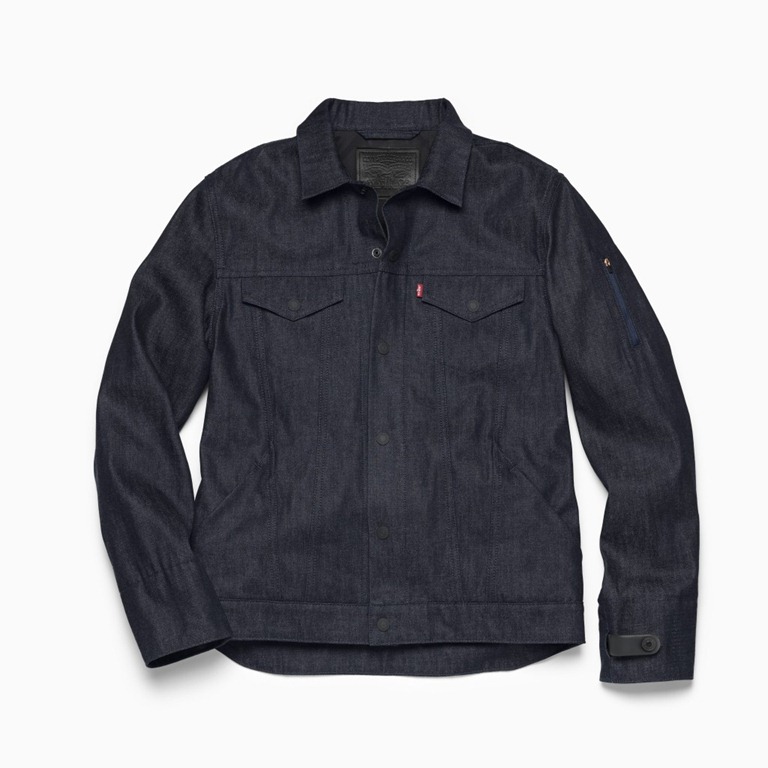
    Levi's® Commuter™ x Jacquard by Google Trucker Jacket

    Continuing our previous report on Project Jacquard by Google and Levis , its heartening to know that Levi’s is taking its collaboration with Google ATAP to the next level by introducing a commuter denim jacket. The collaboration, which comes under Project Jacquard, works toward establishing a new, scalable system which weaves technology components into standard fabrics and textiles.

    The jacket was announced on 20th May, 2016 at Google I/O, the result of a year-long effort between the Levi’s® Innovation team and Google’s Advanced Technology and Projects (ATAP) group under the banner of Project Jacquard.

    The discreetly placed Jacquard technology is literally woven into the jacket, allowing for simple gestures like tapping or swiping on a sleeve to activate functionality. Of course you can wash it, just like you do with any other jacket. This perfect pairing showcases the knowledge and know-how of Google ATAP’s Jacquard team with the performance power of the Levi’s® Commuter line, which is designed to perform as great as it looks. The Jacquard team then adds a smart tag — which looks like a normal jean jacket button — to provide feedback to the user. The smart tag would be the equivalent to a smart watch; it’s packed with LEDs and haptic sensors to alert of phone notifications and such. Levi’s mainly advertised the jacket for urban bike commuters, but it seems ideal for anyone, since it looks like any other Levi’s Commuter jacket.

    Levi's® Commuter™ x Jacquard by Google Trucker Jacket

    “Anyone on a bike knows that navigating your screen while navigating busy city streets isn’t easy – or a particularly good idea,” said Paul Dillinger, head of global product innovation for Levi Strauss & Co. “This jacket helps to resolve that real-world challenge by becoming the co-pilot for your life, on and off your bike.”

    During last year’s Google I/O conference, the Levi’s brand became Google ATAP’s first partner on Project Jacquard, which credited the brand for being authentic, innovative and fashionable.

    Our innovation story began with the invention of the blue jean, which turns 143 years old today, but that was merely the first chapter. From the debut of the first jeans for women in 1934 to the revolutionary work that goes on in our Eureka Innovation Lab today, Levi Strauss & Co. brands are constantly innovating to solve the needs of our consumers.

    The Levi’s® Commuter™ Trucker jacket is expected to be available beginning spring 2017 in select Levi’s® stores and on Levi.com.

  • H&M Green And Conscious Exclusive collection

    H&M Green And Conscious Exclusive collection

    The Eco Sustainability is the need of hour which has been well understood by the Denim Industry. Consequently , everyday new efforts are being made to ensure the sustainability and the very recent development is that the Swedish clothing company ,H&M, is moving into sustainable fashion . This Retail powerhouse H&M has taken this very innovative initiative on a much larger scale than expected .

    Eco Sustainability has been a focus for H&M for some time now. A few years back H&M started the initiative to recycle used garments .The company had rolled out a global garment recycling program in which anyone can donate their clothing and in return of that the company will give a token discount of 15% in a form of voucher which can be used by the donor on the next purchase. To collect the cloths, the bins are placed near the cash registers to prevent any ambiguity. Stores accept any clothing irrespective of brands.

    H&M has been collecting more than fourteen thousand tons of clothing since 2013. Once the cloths are collected , they are sent for further processing and classifications. Clothing which found to be very much worn are reused as cleaning cloths and otherwise. Sometimes they are also recycled into raw materials for new products. Those clothing which can be possibly worn again are sold at second hand stores. New collections are being designed with these old clothes .

    Sixteen new denim styles for men, women and children made from recycled cotton collected in H&M’s Garment Collecting initiative were recently introduced at stores. The items include jeans, jackets, joggers, zip-up hoodies, joggers and jumpsuits.

    H&M Conscious Exclusive collection

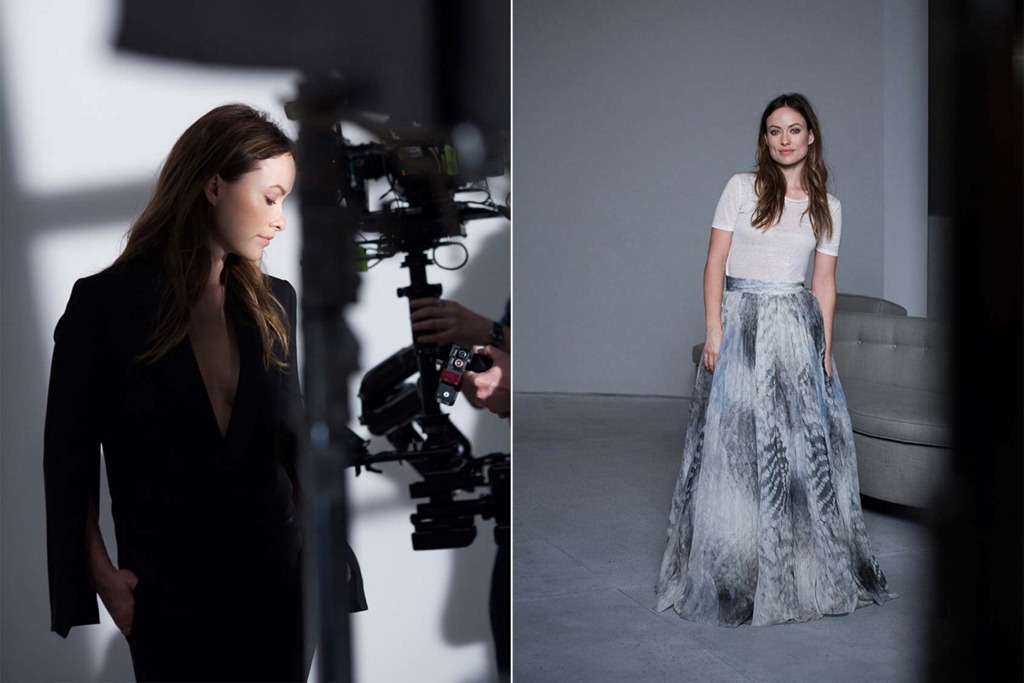
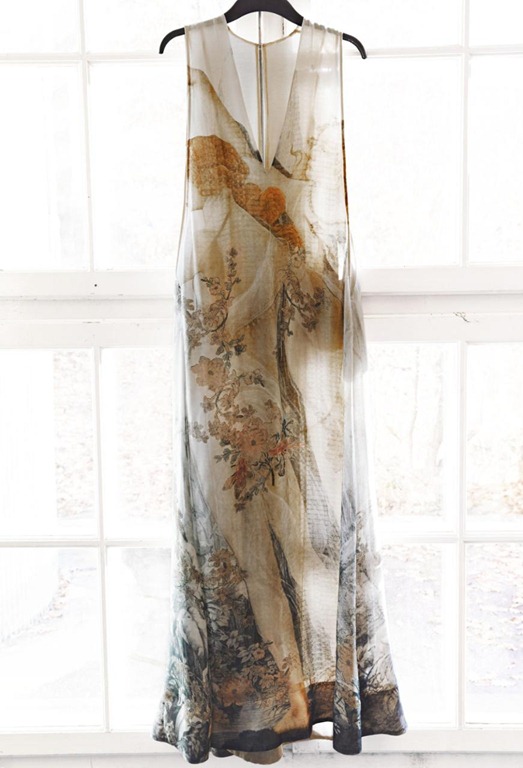
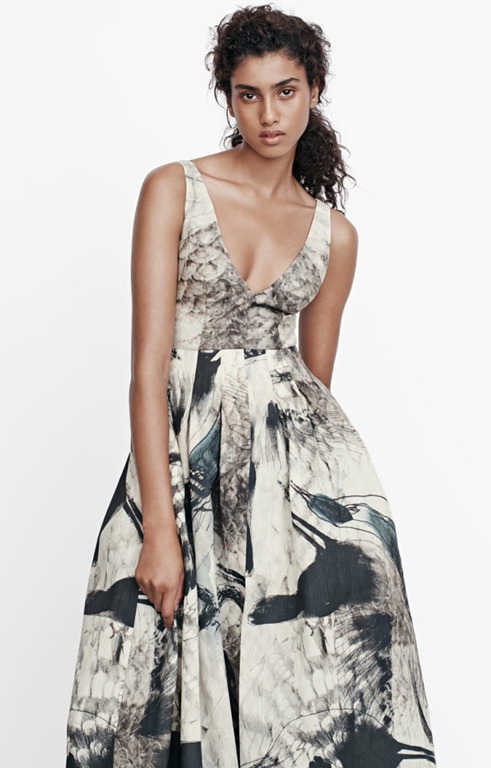
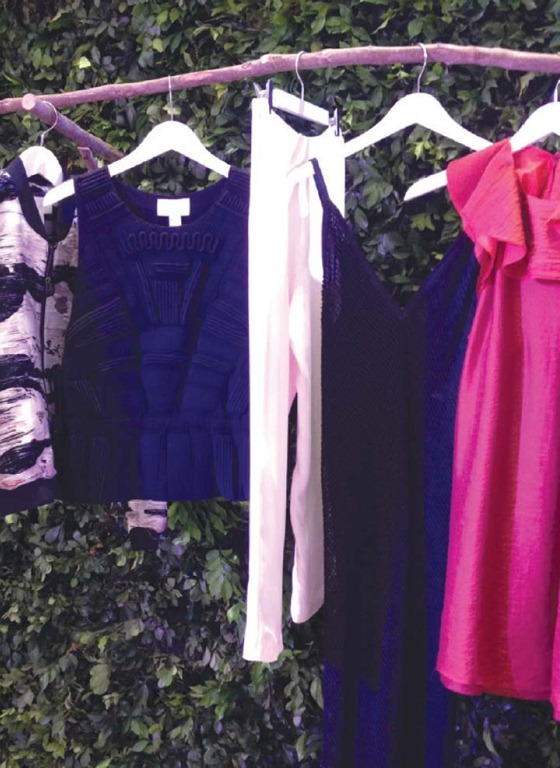
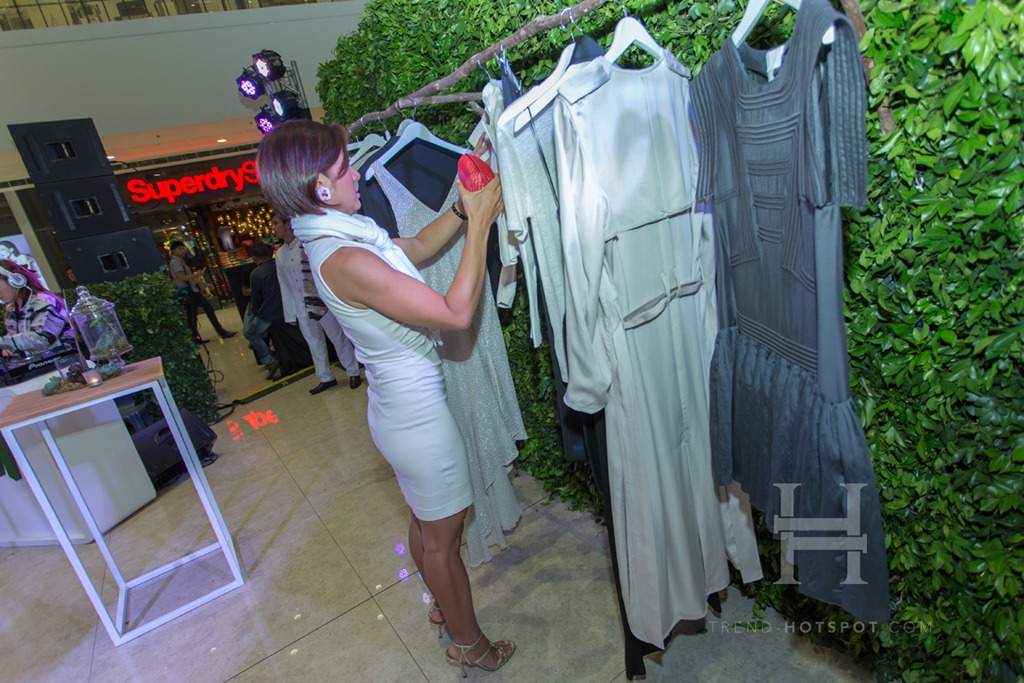
    After collaborating with the Musée des Arts Décoratifs, located in the Palais du Louvre in Paris,the chain is set to celebrate the new H&M Conscious Exclusive collection.The new H&M Conscious Exclusive Collection features organic materials,recycled wool, Tencel, and recycled sequins.The whole collection is dreamy and showcases gorgeous prints, elegant dresses and versatile separates. The natural color palette ties perfectly with the environmental theme of the range.Some of its apparel is created from recycled worn clothes – many coming through its collection of customers’ unwanted garments. For its Close The Loop collection, recycled fibers from shredded unwanted clothes are blended with organic yarns to produce durable denim.Continuing the sustainability is fashionable theme, H&M have created sustainable glamour via their Ambassador, Actress Olivia Wilde who is known for her efforts for a sustainable environment.

    H&M Conscious Collection | Denimsandjeans.com

    H&M Conscious Collection | Denimsandjeans.com

    H&M Conscious Collection | Denimsandjeans.com

    H&M Conscious Collection | Denimsandjeans.com

    H&M Conscious Collection | Denimsandjeans.com

    H&M Conscious Collection | Denimsandjeans.com

    H&M Conscious Collection | Denimsandjeans.com

    H&M Conscious Collection | Denimsandjeans.comH&M Conscious Collection | Denimsandjeans.comH&M Conscious Collection | Denimsandjeans.com

    H&M Conscious Collection | Denimsandjeans.com

    H&M Conscious Collection | Denimsandjeans.comH&M Conscious Collection | Denimsandjeans.com

    H&M Conscious Collection | Denimsandjeans.com

    The range shall be launched at Musée des Arts Décoratifs located in the Palais du Louvre in Paris  on  Thursday 7th April to coincide with the opening of the hotly anticipated exhibition, Fashion forward.

  • ITMA 2015 – Sustainable Innovations

    ITMA 2015 – Sustainable Innovations

    ITMA is the world’s largest textile and garment machinery exhibition ,which is held every four years in a different country and has been always a focal point for a large number of highly qualified international visitors and top decision makers. Held in Milan this year after a 20 year gap, the show was welcomed not only by the city but by the industry as well.

    In the last few years there has been an increased , sustained and market pushed focus on sustainable technologies which could help in saving of energy, chemicals, water and other resources. In this article, we bring out information on some of the companies who showcased their sustainable technologies and products.

    Jeanologia , Spain

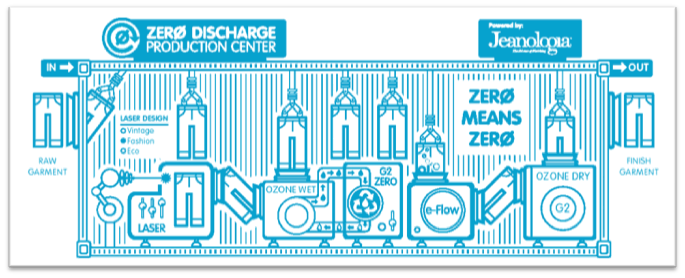
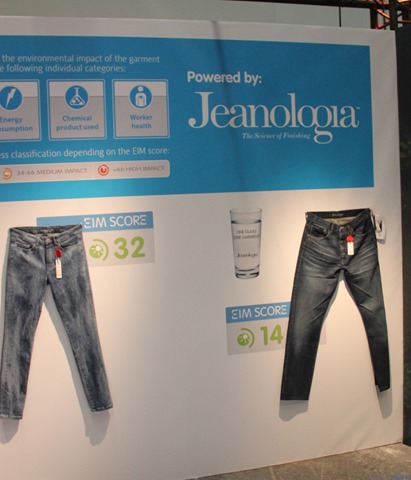
    Jeanologia presented a complete combination of machines which can enable the jeans manufacturer, as the company claims, to have ZERO contamination. The process involves usage of different machineries from the company to eliminate different environment harming steps. It involves-

    • Combination of  three main technologies – laser, wet and dry ozone G2, e-Flow nano bubbles – to reduce use of water and chemicals by 90% and energy by 50%.
    • Doing away with the usage of pumice stone , manual scraping and potassium permanganate by usage of advanced features of  laser which can be attached to existing laser machines.
    • The complete system to create a high level of eco-sustainability bringing ZERO contamination benefits to the producers.

    ITMA MILAN 2015 : Denimsandjeans.com

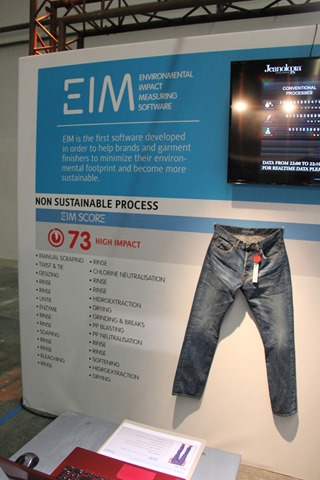
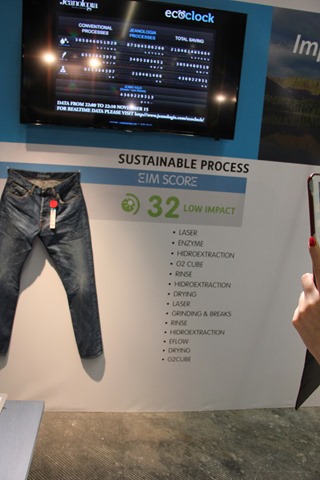
    The company calculates EIM – Environmental Impact Measure to arrive show how usage of different processes can make an impact on sustainable production.

    IMG_8988

    IMG_8989

    IMG_8996

    Tonello , Italy :  NoStone® And Water Brush

    In a collaboration with Levi Strauss & Co. ,Tonello announced the latest award winning technology – the NoStone®.  The new process is designed to overcome economic, mechanical and environmental limitations of existing stone-wash processes. The thrust of the innovation is to eliminate the use of pumice stone ,replacing it with a stainless –steel abraders ,attached to the washing machine. The process is entirely mechanical and not chemical in nature  and the company claims the following advantages of the process.
    The Advantages of NoStone are as under :

    • Eliminates usage of pumice stones
    • The effect is similar to that of of stone-wash
    • All logistics, transport, mining and storing activities related to stones can be done away with
    • Doing away with the costly cleaning and maintenance operations
    • No need to dispose the sludge, stones and to purify waste water.

    ITMA MILAN 2015 : Denimsandjeans.com

    ITMA MILAN 2015 : Denimsandjeans.com

    Water Brush By Tonello

    The second denim finishing technology announced by Tonello is the WATER BRUSH. The water brush helps whitening and abrasion process for jeans as it uses jets of water to bring out the abraded look on the jeans.   Unlike permanganate and manual brushing , which cause irritation and also harmful for the eyes ,skin as well as for the respiratory system , this Water Brush from Tonello is claimed to be totally ecological as it runs on water but consumes none. The water brush requires only one operator for its operation while the Permanganate and manual brushing needs considerable labour .

    In essence, the technology of Water Brush  consists of:

    • A robot that whitens and abrades the garment by spraying water under high pressure;

    • A central column to alternate two mannequins, one in the loading/unloading position and the other in the working position;

    • A tank for collecting the water, with a filtration and recirculation system.

    The system offers much reduced environmental impact and no health risk for the end user as the company claims.

    Officiana+39, Italy

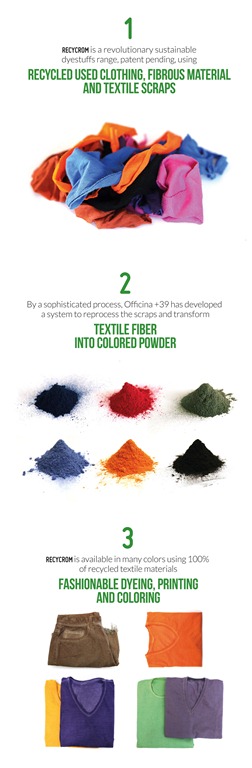
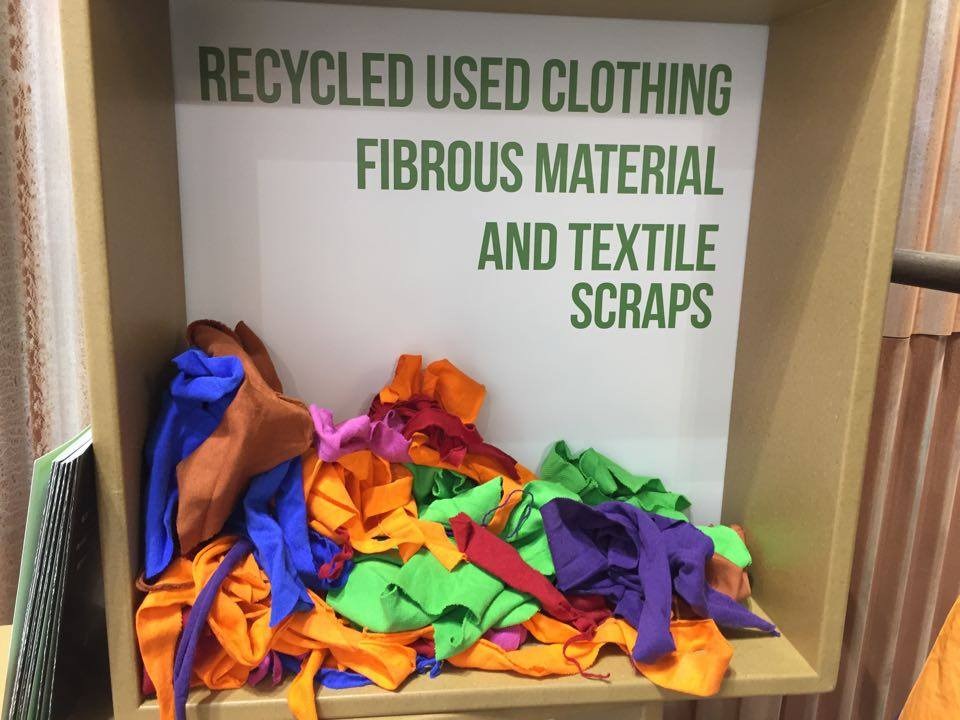
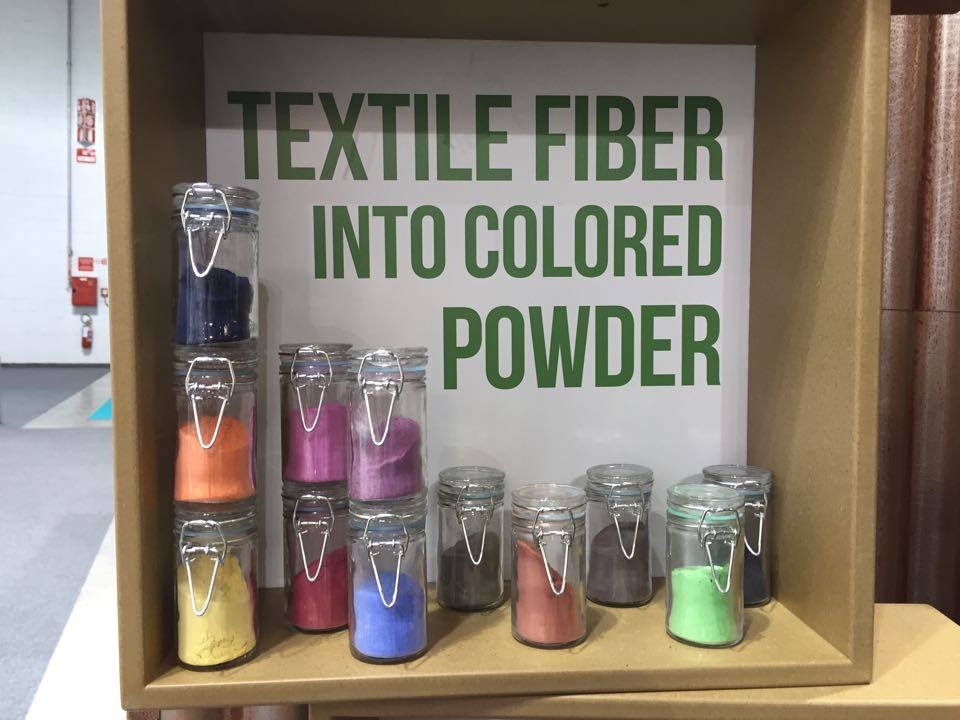
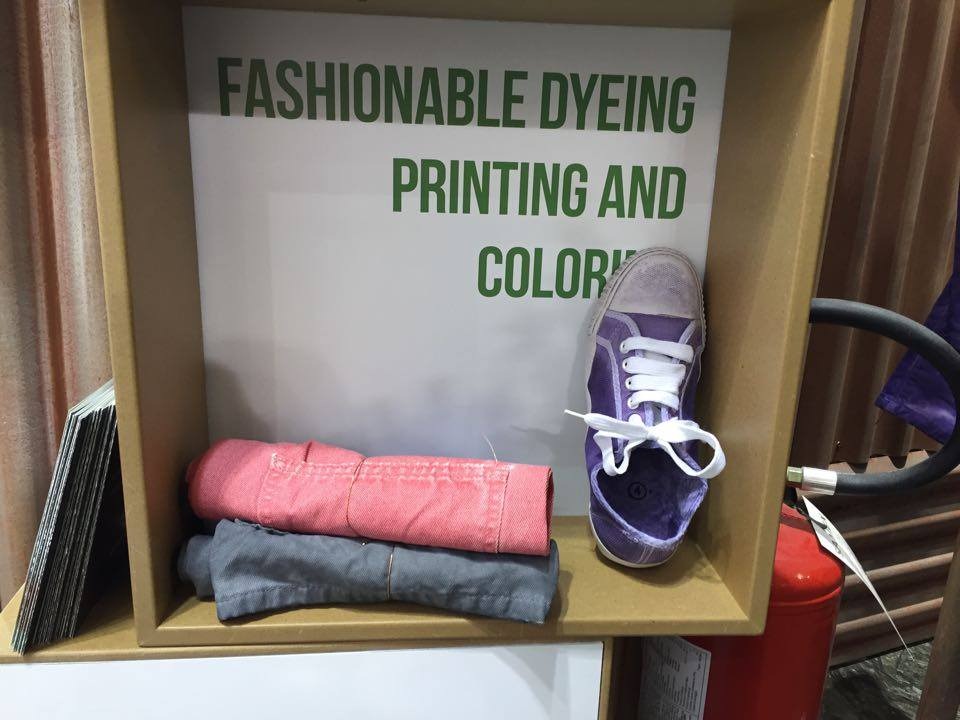
    The company brings out RECYCROM – the dye made with 100% recycled textile powder. Basically the process involves recycling used clothing material into colored powder and dyes . These dyes can then be used for dyeing various textile items with eco-sustainable inputs and not environment harming chemical dyes.
    ITMA MILAN 2015 : Denimsandjeans.com

    ITMA MILAN 2015 : Denimsandjeans.com

    ITMA MILAN 2015 : Denimsandjeans.com

    ITMA MILAN 2015 : Denimsandjeans.com

  • H&M Sustainability Report 2014

    H&M Sustainability Report 2014

    Recently H&M released its annual sustainability report for 2014. The document mentions in detail how the company is implementing more eco-friendly practices in its supply chain and stores to reduce the harm it causes the environment, as well as its efforts on a variety of social welfare issues such as gender equality and poverty alleviation.

    H&M manufactures at least 600 million items each year and operates more than 3,200 stores in 55 countries. If you include its subsidiary brands, such as COS, that number jumps above 3,500 stores, and the company is expanding its locations by 10% to 15% each year. To operate those stores—besides manufacturing and shiping the clothes —requires a staggering amount of resources, from energy-hungry cotton to electricity, oil, and water . Even if H&M manages to mitigate its environmental footprint slightly from one year to the next, its business continues to grow, and that footprint remains enormous—and far from sustainable.
    CEO Karl Johan Persson emphatically reiterates the integration of sustainability mantra in the DNA of H&M  as

    “Our business idea is to offer fashion and quality at the best price. It’s about the best value, not the cheapest price. Sustainability is an important part of this. We know that our customers, just as our colleagues, care more and more about it. And while we must be realistic about the fact that most customers are not prepared to pay more for added sustainability value, I am convinced that it will become an important differentiator in the future.”

    H&M Conscious

    H&M Conscious is the name of their work for a more sustainable fashion future. It’s consisting of seven commitments and is built on passion, long-term thinking and teamwork.

    “We want to make fashion sustainable and sustainability fashionable.”

    Seven Commitments

    H&M seeks to make seven commitments towards sustainability and measures its performance towards those commitments.

    1.Provide fashion for conscious customers:

    “Our goal is to increase the share of more sustainable fabrics and materials every year. We are constantly on the lookout for innovative materials and processes that can make our products more sustainable. “

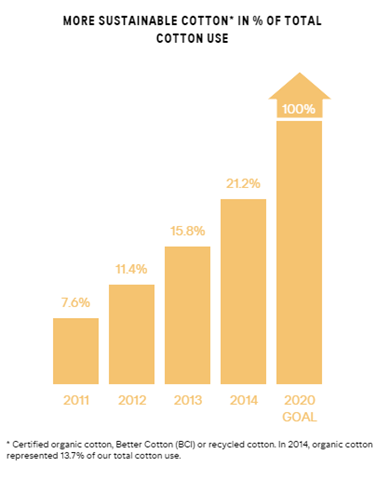
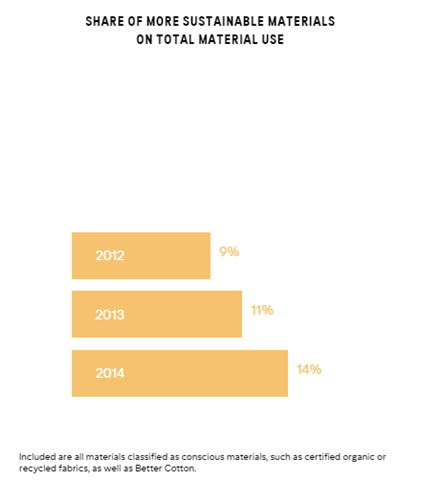
    H&M uses about 21% of total cotton consumed in the form of Organic Cotton, BCI or recycled cotton and is supposed to be No. 1 user of organic cotton according to textile exchange report of 2013. About 13.7% of all its materials consumed are in the form classified as conscious materials.

    sustainable cotton usage h&m

    sustainable material usage h&m

    2.Choose and reward responsible partners

    “We need to be a good partner ourselves. Our standards are high and we reward sustainability performance with better business. We work hard to ensure better livelihood and positive development in the communities where we operate.”

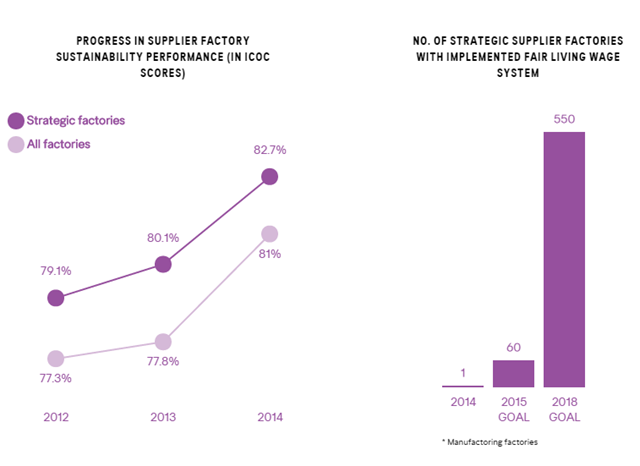
    H&M seeks to reward its responsible partners and seeks to make them more committed towards their workers and encourage role model factories. It seeks to have about 550 suppliers with fair living wage system by 2018.

    Supplier factories living wage

    3.Be ethical

    “We see diversity as an asset that makes us better and we want to set a good example wherever we operate. To us this means respecting human rights, taking a clear stand against corruption and embracing diversity and inclusion.”

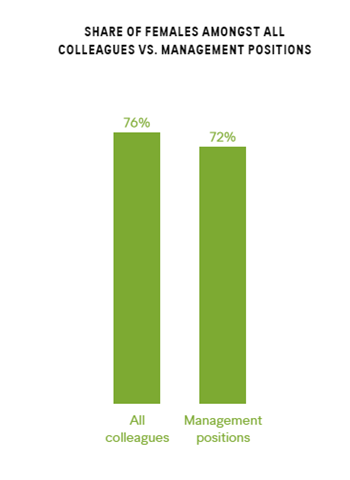
    One of the criteria that H&M takes for measuring being ethical is to employ more of female employees – though not a very right measure for the same. About 76% of their workforce is female and 72% of management positions are being held by them.

    Female employees in H&M


    4.Be climate smart

    “Tackling climate change is one of the major challenges of our time. Its consequences are as likely to affect us as everyone else on our planet, including our suppliers, colleagues and customers. So it is essential that we do everything we can to reduce climate impact – for example by only using renewable energy wherever possible.”

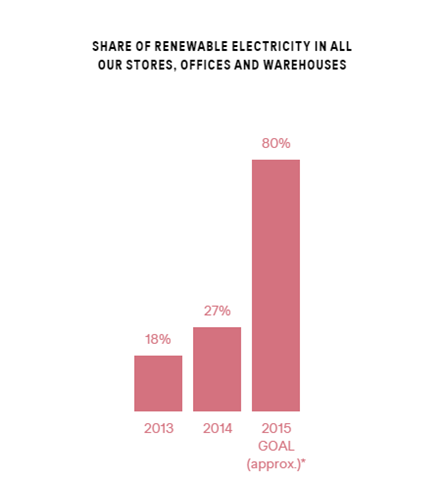
    Renewable energy is sought to be used in all stores, offices, warehouses of H&M (*100% in all markets, where this is feasible and renewable electricity is credibly available. This is currently not the case ,for example, in China or Peru).

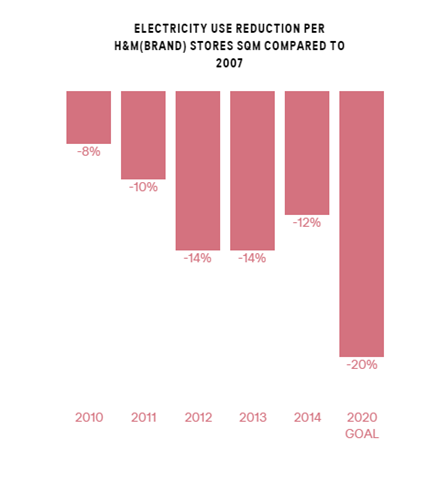
    Electricity use per sq. mtr of H&M brand store is sought to be reduced by 20% in 2015 compared to 2007 levels.


    Renewable Energy usage

    image


    5.Reduce, reuse, recycle :

    “We strive to reduce, reuse and recycle wherever we can. Our biggest concerns is that too much fashion ends up in landfill. That’s why we teamed up with I:Collect and created a the first global garment take back system.”


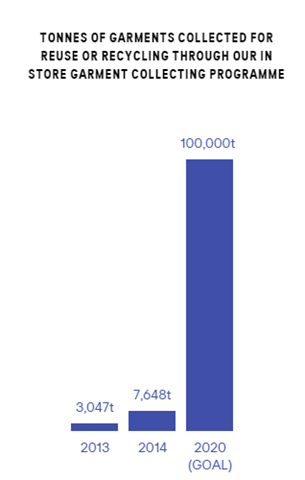
    Anyone can drop unwanted clothes at H&M and they will try to give it a new life. The goal is to create a closed loop where unwanted garments are recycled into new creations. Currently they claim to  blend in about 20% recycled fibres without any loss of quality or longevity. About 7600 tons of garments were collected for reuse or recycling through their in store garment collection programme. The target for 2020 is 100,000 tons – a very ambitious one indeed.

    Recycled garments collected by H&M


    6.Use natural resources responsibly

    “Making great fashion can require a lot of resources. Growing cotton, dyeing fabrics and washing our clothes all require significant water use. But natural resources aren’t endless.”

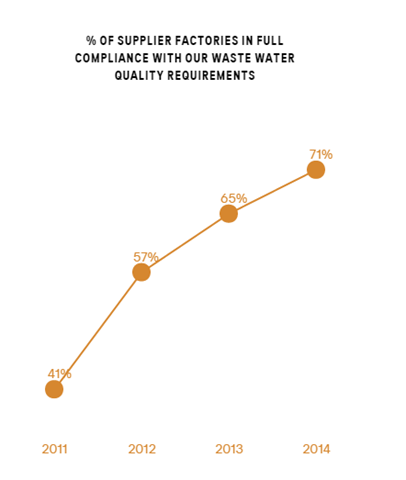
    H&M seeks to educate its suppliers on water conservation and compliance with waste water quality requirements.  Their internal guidelines on waster water quality are met by about 71% of total suppliers in 2014.

    Waste water quality requirments compliance


    7.Strengthen communities

    “Strengthening the communities around us is part of our responsibility. Prosperous and stable markets where human rights are respected, skills training are readily available and the eco-systems are healthy benefit our business.”

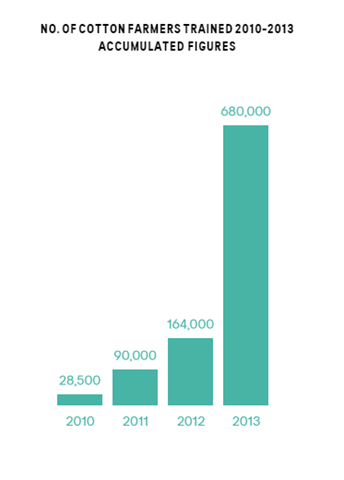
    Besides other activities of community involvement, H&M trains cotton farmers to do better crops. The numbers claimed are quite high !

    Cotton farmers trained by H&M

    While the report makes it clear that H&M is doing a good deal to lessen its impact, it is also a fact that the goal and fast fashion are inherently at odds. By its nature, fast fashion is a volume business, which is exactly what makes it a big strain on the planet. The proponents of fast fashion will try to always sell more and there is inherently the conflict with sustainability. H&M acknowledges that the sheer quantity of resources it consumes is a serious problem. In US alone about 10.5 million tons of clothes end up in landfills each year. Even if H&M ensures a large part of its clothing is organic or BCI cotton , still the landfills will be filled unless the garment recycling process becomes much more widespread and is taken up by a larger number of brands and retailers. H&M’s target of getting 100,000 tons of garments for reuse in 2020 will be still less than 1% of garments going to landfills in US alone. Currently it is about 0.2% of its own garments that are being recycled. The problem is endemic and needs industry wide awareness. However, still it is commendable that H&M has taken a lead which can offer example to other larger entities in this business.

    Sponsored link:


  • Leeds Gold Certificate For Artistic Milliners’ Latest Garment Factory

    Leeds Gold Certificate For Artistic Milliners’ Latest Garment Factory

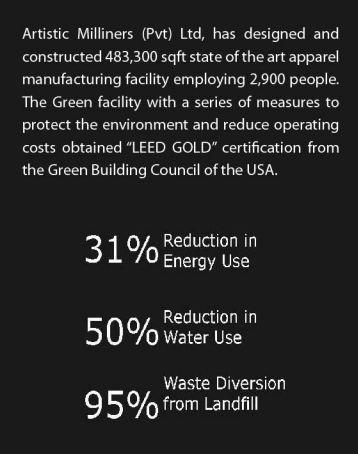
    Artistic Milliners , the denim producer from Pakistan, gets Leeds Gold Certificate for its latest garment factory in Pakistan.

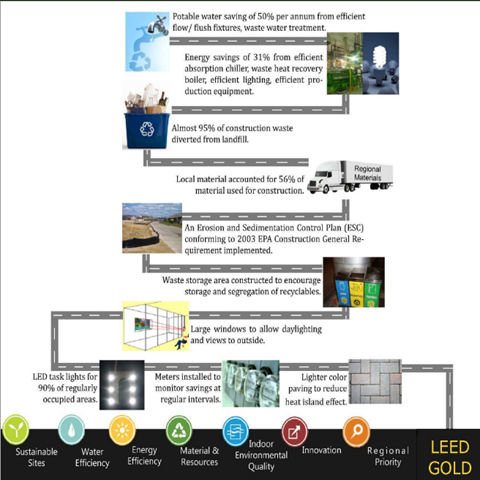
    Developed by the US Green Building Council , the LEED is intended to help building owners and operators be environmentally responsible and use resources efficiently.It  is a green building certification program that recognizes best-in-class building strategies and practices. To receive LEED certification, building projects satisfy prerequisites and earn points to achieve different levels of certification.

    The company mentions that they are highly focused on sustainability and  in 2013 they produced over 2 million mtrs of denim with recycled polyester and over 2 million waterless jeans..

    We spoke to Murtaza Ahmed, Director Artistic Milliners , about this latest project and he mentioned that this is Pakistan’s first Leeds Certified Factory. He further says

    “We are very excited as a group and a company. We have done many initiatives in this unit. All our dry processes are solar powered. We shall be recycling 100% of our water. Our daily consumption is 500,000 gallons. 70% of this will go back to laundry and 30% will go for sanitation and irrigation even though LEEDS does not require us to recycle 100% water. Even the sludge is being used  for making bricks.  We are using technology and automation to make the processes more sustainable including using automated spray booths, laser machines, ozone machines etc….”

    Here is the video on our talk with him where he explains about the latest project and the thought behind it..


    Artistic Milliners


    Leeds Certified Factory by Artistic Milliners

    image