Tag: marks and spencer

  • #DENIMLOVEAFFAIR’M&S Tries To Woo The Millenials

    #DENIMLOVEAFFAIR’M&S Tries To Woo The Millenials

    denimsandjeans

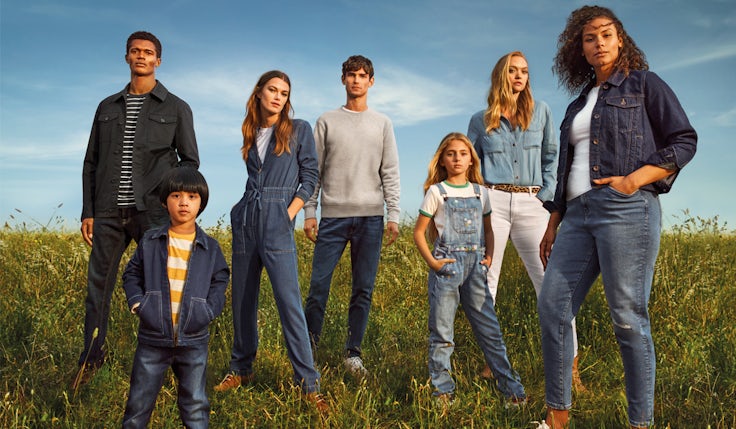
    In an effort to reposition its denim offering and make it more appealing to the millenials, Marks & Spencer featured “Go jumpers” and “Go pyjamas” of House of Pain’s Jump Around  during Christmas . For the Spring Marks & Spencer  have launched their  new campaign, “Start a denim love affair“. This is the third marketing campaign for M&S Denim in less than a year but with double the marketing investment and double the buy of product to support the addition of a TV ad. To synchronize the ad with Valentine’s Day and to reinforce the message around encouraging people to fall in love with denim, M&S will display the TV ad in love-themed shows including Love it or List it, Love Island and First Dates. Its clear that M&S wants to be perceived as a more younger brand that it is now !

    The TV ad, created by ODD, features 15 dancers showing off M&S’s best denim products to Donna Summers’s ‘I Feel Love’. M&S says it follows strong customer feedback that the dancing in its ‘Go Jumpers‘ Christmas campaign helped customers engage with the brand.
    denimsandjeans

    “Denim is a real killer category for us and that means it should be backed with a killer marketing campaign,” says M&S’s clothing and home marketing director, Nathan Ansell. He also added  that the choice of track was influenced by the campaign’s release shortly before Valentine’s Day.

    Start a denim love affair”  – aims to communicate a range of factors, because it was also a matter of fact that the consumers often get stuck with a single retailer for jeans, due to the difficulty of finding a fit they like. Ansell said they have also taken care of the major factors in their collections including the retailer’s competitive prices, its sustainability credentials, which include the majority of its cotton being certified by the Better Cotton Initiative, and the product range, including its “magic jean”, made with bi-stretch denim that has a sculpting effect.

    It is designed to spotlight the progress and strength of M&S’s denim business focusing on style, fit and value. While currently the retailer sells 15 pairs of jeans every minute and is the market leader for womenswear denim , M&S is not the top of the recall brand for denim even in UK. . When a consumer is asked to name the denim brand, M&S comes at only 4th position out of top 21 brands. M&S Denim is a multi-million-pound operation serving 1 in 10 denim shoppers in the UK and growing it is central to M&S’s transformation.M&S is  focusing on its brand popularity related to Denim first and scale of its business.This campaign will use all major customer channels including TV advertisement, billboards, print advertisements and social media.

    denimsandjeans

    denimsandjeans

    denimsandjeans

    denimsandjeans

    denimsandjeans

    denimsandjeans

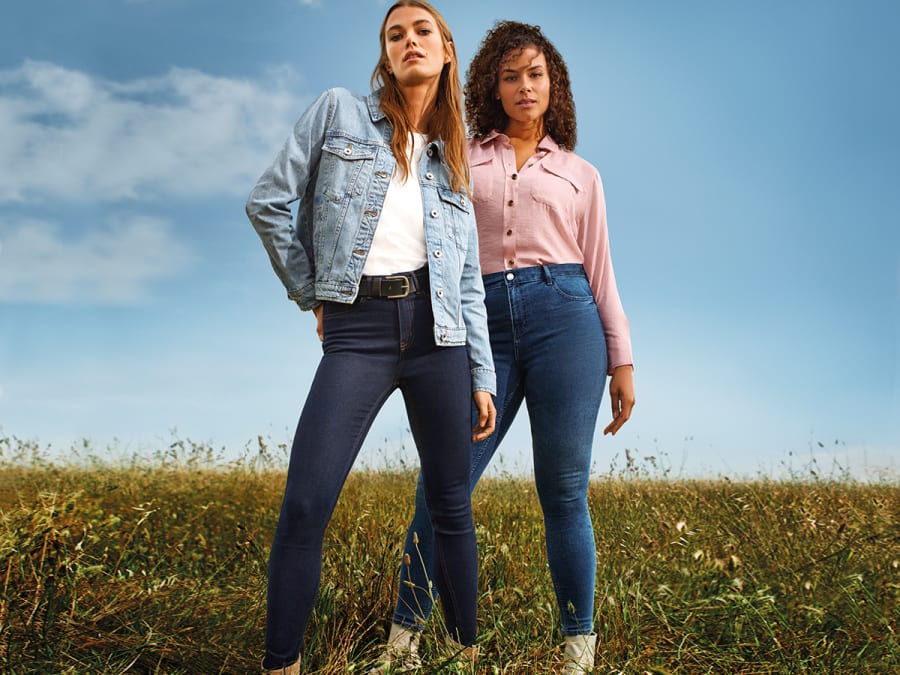
    As part of its Spring denim campaign M&S will also launch its ‘Magic Jeans’ in womenswear – high waisted skinny’s that feature flattering tummy technology, bi-stretch denim for superior comfort and a gap-proof waist band. They’ll be one of several pairs of jeans highlighted by the campaign which will put a strong focus on the still most popular cut – skinny jeans.

  • Marks And Spencer Introducing Major Changes In Supply Chain

    Marks And Spencer Introducing Major Changes In Supply Chain

    Marks & Spencer has been going through a wide range of changes to adjust to changing demands of its, mainly middle aged, customers. After hiring new designers, overhauling its online offering and giving a facelift to stores, M&S is working hard  to push home its most ambitious project: overturning more than a century of retail history by taking full control of its supply chain.

    The company , founded in 1884, has always relied on third party suppliers to drive to create, manufacture and ship most of its garments. Taking control of the supply chain means a radical departure to create more flexibility in its quest to source faster . Long-term relationships with those mostly British-based firms, based on big orders and long lead times, helped M&S keep prices down and build a reputation for quality.

    But as its most loyal customers – women aged 50-plus – have become more fashion-conscious, the middlemen have hampered M&S’s ability to quickly refresh supplies of fast-selling items before shopper interest tails off.

    “There’s a killing to be made if they can serve older women better,” said Patsy Perry, a lecturer in fashion marketing at the University of Manchester. “Unless you have money to buy designer clothes, it’s hard to find what you want on the high street unless you want to look like your daughter.”

    Even as new M&S womenswear collections won praise from the fashion press, shoppers often found the clothes were sold out in their size or were not appropriate for the weather.In contrast, nimble retailers like Zara-owner Inditex , H&M and Next, which have more direct control over factories, replenish their stores faster and offer a more frequent turnover of styles.

    Pressure mounted on M&S Chief Executive Marc Bolland after a mild winter and delivery problems at the new online distribution centre hit Christmas trading, leading to a 14th consecutive quarterly sales decline in the clothing side of the business.

    But investors seem prepared to give Bolland more time after his revamp of the supply chain started to bear fruit.

    M&S’s gross margin – gross profit as a percentage of sales – rose 150 basis points to 53.7 percent in the first half of 2014, helped by sourcing gains, but still lags an estimated 64 percent at Next and 59 percent at Inditex.

    While taking tighter control of the company’s supply chain started several years ago, the final push is being given by Hong Kong-based brothers Neal and Mark Lindsey, whom Bolland appointed as joint sourcing directors last year.The pair previously worked at Next, where they pioneered “virtual manufacturing”, a process that enables designers to produce patterns and layout plans for cutting fabric so they can give precise instructions to distant factories.

    Adopting the Next model is a big shift for M&S, which until recently ordered most of its stock through so-called full service vendors — companies that designed, made, shipped and warehoused products before sending them to M&S for sale.

    Relationships with those suppliers often went back decades, and with one, Dewhirst, to the founding of the company: Michael Marks borrowed five pounds from wholesaler Isaac Dewhirst to launch a chain of penny bazaars in the northern city of Leeds. Dewhirst also introduced Mr Marks to Tom Spencer.

    As competition mounted in recent decades, M&S pushed partners like Dewhirst to move production overseas: 78 percent of its general merchandise now comes from Asia compared to just 22 percent from Europe, including Turkey, Italy and Britain.

    M&S has already taken control in the last few years of most logistics for the 40,000-odd shipping containers it fills a year, leaving detailed product design and factory liaison as the last jobs to come in-house.

    “All of us had to learn how to manage the supply chain, how to manage third-party logistics providers, how to manage freight, how to manage working capital on a much earlier purchase than previously,” said Zen Yaworsky, head of supply chain operations at M&S until 2010.

    “M&S now have to develop negotiation capability to go into a factory and negotiate from a position of intelligence,” said Yaworsky, who runs his own consultancy.

    That is easier said than done, according to experts who used to help M&S do just that.

    “At a board level, it makes a lot of sense. At the operational level, it is a lot more difficult,” said Bill Mills, a textile industry consultant who used to manage factories for M&S suppliers Courtaulds and Coats Viyella.

    “On the one level there are some cost savings, but on the other hand M&S will have to place resource in their buying offices, whether that be UK or local, to manage the factories. It is not a panacea.”

    M&S says it is already making big progress. It has halved the number of fabric suppliers in the last couple of years, so it can secure better prices at higher volumes from preferred mills.

    Bolland, in the job since 2010, wants to increase the proportion of products designed in-house to 60 percent by 2017 from 25 percent last year.

    The first garments sourced by the Lindsey brothers are coming into stores for the spring/summer season: “Spring/summer is bought at the moment with at least a lot more flexibility than it was done last year,” Bolland told analysts in January.

    A bigger proportion of orders will be left “open to buy” depending on demand and M&S is moving to deliver new products in 12 phases a year, up from six to eight, with some coming on a three-weekly basis – closer to Zara-style “fast fashion”. This is going to be a major change for M&S and its garment and fabric suppliers. It also means that they have to be more dynamically connected to the retailer to understand its changing requirements and need for quick fashion. On the whole, a major change is in offing . Whether it helps M&S to regain its role as Britain’s omnipotent retailer, needs to be seen.

    Source:Reuters.com