Germany is the largest market for denim jeans and apparel in Europe . It has a strong affiliation for jeans , specially men’s jeans , and is importing them from not only around the world but also from within EU27. No exporter , whether outside or inside EU , can ignore the German market due to its sheer size.
We will look in this report the following :
a) Imports of denim jeans made into Germany from EU27 , 2010-2014
b) Imports of denim jeans made into Germany from out of EU27 , 2010-2014
c) Total quantities of jeans coming into Germany during this time.
d) Average prices coming from these regions during 2010-2014 period.
e) Trends in quantity and prices from these two origins and their comparison. Which of them gets an increasing share of the market now?
f) Tables , graphs and explanations.
[private_special]
If we look at the table below, we will find that Germany has imported more jeans in 2010 – 169 million pcs – than it imported in 2013 – 158 million pcs. This shows a fall in total imports of jeans coming into Germany , which is not a very good sign for denim exporters. But more interesting is to note that the jeans coming from out of EU have declined while those coming from EU27 have increased during the same period. In 2010 , about 135 million pcs came from out of EU27. However, in 2013 we find only 114 million pcs of jeans coming from out of EU27 .
| Year | Out of EU27 (mill pcs.) |
From EU27 (mill. Pcs) |
Total Qty. (mill. Pcs) |
% from Out of EU27 | % from EU27 |
| 2010 | 135 | 34 | 169 | 79.9 | 20.1 |
| 2011 | 134 | 38 | 172 | 77.9 | 22.1 |
| 2012 | 115 | 39 | 154 | 74.7 | 25.3 |
| 2013 | 114 | 44 | 158 | 72.2 | 27.8 |
| 2014(upto june) | 52 | 21 | 73 | 71.3 | 28.7 |
The imports from EU27 have, on the other side, increased from 34 million pcs to 44 million pcs. The market share of EU27 in German jeans market has increased from 20% in 2010 to about 29% in 2014. This shows an increasing tendency of Germans to import jeans from within EU. But we need to also remember that all of these jeans coming from within EU may not be actually made in EU and some of them may have been imported into those countries and re exported to Germany. But when we look at the price comparison, we will have a better idea . The following graph shows the increasing trend of imports from within EU27 as compared to rest of the world.
% Imports from EU27 and out of EU 27

Prices of Imports
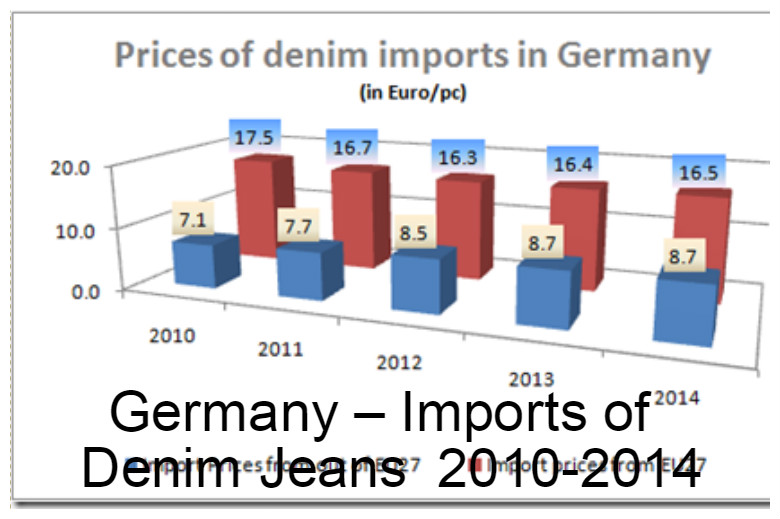
Now let us look at the prices of imports of denim jeans into Germany from EU and from rest of the world. Lets have a look at the table below :
| Year | Import Prices from out of EU27 | Import prices from EU27 |
| 2010 | 7.1 | 17.5 |
| 2011 | 7.7 | 16.7 |
| 2012 | 8.5 | 16.3 |
| 2013 | 8.7 | 16.4 |
| 2014 | 8.7 | 16.5 |

The prices of jeans coming into Germany is , surprisingly, showing a reverse trend. The prices of jeans coming from EU27 has fallen from Euro 17.5/pc in 2010 to Euro 16.5/pc in 2014. On the other hand the prices coming from rest of the world has increased from Euro 7.1 to Euro 8.7 / pc. So on the one hand the price of jeans from EU27 has fallen by about 6% , that from the rest of the world has increased by over 20% . This is a significant increase and we can see that the trend of price increase is continuous through all years . This also signifies that EU27 imports into Germany are now more competitive and hence getting a higher share into German market , whereas the rest of the world is getting expensive (relatively) and not able to retain as much share of the market.
This is good news for EU27 and shows that even with higher prices they are able to get an increasing share of the market . Also shows that near sourcing for quick fashion is very important for German market as well and enables them to buy at double the prices of imports , which have a much higher lead times involved.
[/private_special]
Leave a Reply