Tag: denim production

  • Production of Jeans in East EU Countries

    east eu copy Many of East European  countries, and erstwhile members of former Soviet Republic, had been integrated into EU in the last decade and have been climbing up the development ladder. Many of these countries had low costs of production due to reasonable wage structures . But over the years , as they integrated into EU , their economies no longer remained as competitive as before . Apparel production, which was there is some of these countries in some numbers could not be carried forward in the same way and they lost the productions to Asian countries. However, in spite of these losses , some of these countries still have some apparel productions and we will check out about jeans production in a few of these countries in 2011 and 2012.
    We shall cover these countries in this report (also given their years of integration into EU).

    Country Year Of Integration in EU
    Lithuania 2004
    Hungary 2004
    Romania 2007
    Bulgaria 2007
    Poland 2004

    We will look at the production of jeans in these countries in the year 2012. These numbers will be given for men’s and women’s jeans separately. Also we will have a look at the production values for men’s and women’s jeans and see how they compare with the average value of import of jeans into EU.

    [private_special]

    Jeans production in five east EU countries in 2012

    Country

    Men’s Jeans

    Women’s Jeans

    Total

    Lituania

    7,762

    45,657

    53,419

    Hungary

    4,735

    46,524

    51,259

    Romania

    2,427,471

    3,720,639

    6,14,8110

    Bulgaria

    9,06,766

    1,27,699

    1,034,465

    Poland

    44,932

    3,79,459

    4,24,391

    Total

    3,391,666

    4,319,978

    7,711,644

    From the above table , we can see that the highest production of jeans remains in Romania . It is almost 80% of the total jeans produced in these above mentioned five countries. However, Romania produced about 14 million jeans in 2007 , hence we have come down to less than half in just 5 years.    Other countries like Lithuania , Hungary, Poland etc have hardly any jeans production left. Bulgaria , at about 1 million jeans, is the next highest , but again not something that they can be really proud of .  However, it would be important to mention here that in these countries sometimes entire production quantities may not be fully reflected due to some productions escaping govt. records – as the records maintained in these countries are not as perfect as those of developed countries like Germany, France  etc. Hence these figures need to be taken with a pinch of salt.
    Also to be noted is that the production of women’s jeans is higher than that of men’s jeans. Women’s jeans are about 60% of the total jeans production in these countries – again indicating production for fast fashion items for women. We will see another reason too.

    We will also see how these countries value the production of these jeans in their countries. We will see the different valuations for men’s and women’s jeans.

    Production value of Men’s Jeans Produced

    Country

    Men’s Jeans
    (No. of pcs)

    Prod. Value per unit of Jeans ( In Euros)

    Lituania

    7,762

    10.9

    Hungary

    4,735

    16.9

    Romania

    2,427,471

    14.6

    Bulgaria

    9,06,766

    14.3

    Poland

    44,932

    9.3

    Total

    3,391,666

    14.4

    Production value of  Women’s Jeans Produced

    Country

    Women’s Jeans
    (No. of pcs)

    Prod. Value per unit of Jeans ( In Euros)

    Lituania

    45,657

    N.A

    Hungary

    46,524

    12.8

    Romania

    3,720,639

    10.3

    Bulgaria

    1,27,699

    7.9

    Poland

    3,79,459

    6.3

    Total

    4,319.978

    9.9

    As we can see from the figures above, it is more costly to produce a men’s jeans in these countries with average production values coming to about  Euro 14.4 and those for women’s jeans nearing about 10 Euros.  This is also probably a reason for higher production of women’s jeans in these countries when compared to men’s. We must , however, remember that these are production valuations and not necessarily the prices at which the retailer might be able to get the jeans to retail.

    In this context, it would be interesting to see what are the average prices of jeans being imported into EU from around the world. Are those prices significantly different from figures seen above  ? We can have a look at the following figures of import of jeans into EU with their average prices( sans duties) .

    image 

    If we make a comparison with the of jeans production in these countries in 2011 vs 2012 , we will find that the falling trend of production continues.

    image

    [/private_special]

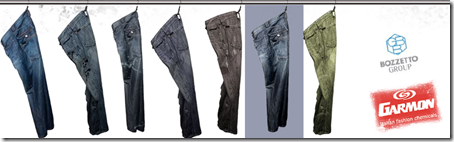
  • Sustainable Development Through Denim Chemicals From Garmon and Bozzetto

    “Sustainable development is development that meets the needs of the present without compromising the ability of future generations to meet their own needs”

    says Brundtland Politician and sustainable development leader.

    image

    This concept has been imbibed by Garmon and Bozetto – who are a chemical manufacturing company from Italy and firmly believe in innovation with sustainability.   According to them , world still lacks the know-how and technologies to be 100% sustainable; but they are doing their bit and  moving forward by :

    • Reducing the water consumption required for treating garments
    • Reducing the temperatures required, required energy and Co2 emissions.
    • By using chemicals with lower environmental impact.

    They mention that they can reduce water consumption by combining a range of production processes:

    • WaterSTONE WASH + BIO-BLEACH Savesat least24 lt. per garment(2rinsesr.b. 1/10 + bleachr.b. 1/10)
    • NEUTRALIZATION + DESIZINGSavesat least16 lt. per garment(neutralizationr.b. 1/10 + rinser.b. 1/10)
    • NEUTRALIZATION + STONE WASHSavesat least16 lt. per garment(neutralizationr.b. 1/10 + rinser.b. 1/10)
    • SOFTENER+ BIO-POLISHINGSavesat least16 lt. per garment(bio-polishingr.b. 1/10 + rinser.b. 1/10)
    • SOFTENERSPRAYSavesat least4lt. ofwater per garment
    • DIRECT DYEING + BIO-POLISHINGSavesat least16 lt. per garment(bio-polishingr.b. 1/10 + rinser.b. 1/10)
    • REACTIVE DYEING + BIO-POLISHINGSavesat least16 lt. per garment(bio-polishingr.b. 1/10 + rinser.b. 1/10)
    • PIGMENTS DYEING + BIO-POLISHINGSavesat least16 lt. per garment(bio-polishingr.b. 1/10 + rinser.b. 1/10)

    Garmon & Bozzetto’s ECO-SUSTAINABLE process allows all production phases to be carried out “cold” or at the lowest possible temperature.

    • COLD DESIZIN GA saving of 35°C equal to 3.5 m3of methane and 6.65 Kg C02
    • STONE WASH AT 40°CA saving of 15°C equal to 1.5 m3of methane and 2.85 Kg C02
    • BIO-POLISHING AT 40°CA saving of 10°C equal to 1 m3of methane and 1.9 Kg C02
    • COLD BIO-BLEACH A saving of 40°C equal to 4 m3of methane and 7.6 Kg C02

    Some more details on their eco sustainable denim products can be had from this presentation below

    ABOUT THE COMPANY
    Garmon & Bozzetto Italian Fashion Chemicals is a JV, result of a successful cooperation between two Italian companies leaders in the textile market worldwide:

    • Garmon, present on the market for over 30 years, pioneers, since the 80’s, in the research and development of formulas and chemicals for garment wet processing.
    • Bozzetto Group, a chemical company, with a tradition behind it: almost one hundred years of ongoing improvements, with a constant evolution in technology, products and territorial expansion with a wide range of chemical auxiliaries, which cover the complete textile chain, from spinning to finishing.

    The strong reliable and innovative know-how of GARMON & BOZZETTO is the result of a combination of experiences and of the presence, in the Denim market, since the beginning of the’80s: the boom of the use of this fabric has, in fact, lead the company to sign relationships with the major national and international manufacturers.

    GARMON & BOZZETTO owes its success to a highly motivated team inspired by a genuine passion for casual fashion: it is a group of young, dynamic and highly specialized technicians continuously engaged in finding innovative, surprising solutions and in constant contact with designers of the most important brand.

    To add value to their customers, they also organise training classes based on both theory lectures on the know-how of the chemical formulas
    ITALIAN STYLE: A COSTANT INNOVATION.
    THE ITALIAN JOB  is  a structure entirely dedicated to the activities of R&D.

    THE ITALIAN JOB’s team is working daily on new applications and new formulas offering to the customers the possibility to create samples and prototypes with innovative treatments and by using performing chemicals.
    Behind the concept of “Finishing” there is a process that embraces all the know-how and creativity of the Made in Italy, in fact, “Italian style finishing” is the benchmark for fashion worldwide and represents the added value for those customers.

  • New Jeans From Levi’s To Save 16 Million Ltrs Of Water In 2011 Spring

    levis water less denim jeans

    Levi’s has started offering a new collection of jeans which consumes less water .

    The logic behind this ?

    Levi’s did a ‘Cradle to grave’ study for its 501 jeans and found that about 3480 ltrs of water in its entire lifetime !! . This is a phenomenol amount of water to be spent on a single pair of jeans . The majority of this water is spent by consumers during the washing process of jeans at their homes . Though Levi’s could not control the water that consumers use at their homes, it decided to use the ozone technology to wash its new collection so that it could save 28% of the water that is spent in finishing process.

    The Result : A new collection of Jeans from Levi’s which

    a)Will save about 10 ltrs of water per jeans .
    b)Levi’s expects to sell about 1.5 million such pairs ie about 15-16 million ltrs of water saved.

    Here is a very interesting video from Levi’s to explain their concept of water saved in this new collection.


    However, though the intention of Levi’s is quite noble, the effort on its part will only save 0.3% of the water that is used in the life cycle of  the jeans.  The jeans manufacturing causes a lot of damage to the environment in terms of its entire production cycle from Cotton growing , to dyeing and weaving and finishing .There is a need to reduce the consumption of not only water but also energy, pesticides and to ensure that wastes are recycled .  There needs to be developed a concerted campaign to draw attention to the damage that is being done and alternative technologies need to be developed for the same.  Eg a number of companies are producing ozone washing machineries – which should be encouraged , lazer washing is another technology which saves a lot of ecological damage .

    At consumer level , we need to make the people aware of the need to wash their clothes only when necessary and this applies to all clothes including denim jeans.  Then only it might make some REAL impact on the environment.

  • Super Stretch , Comfort , Recovery and Other Denim Selections From Invista

    Invista sponsored the recently held Kingins show and  will be sponsoring the upcoming next few shows in LA  , Hong Kong and Shanghai . They also displayed some of their cool denim products at the NY show .
    Lycra name being synonymous with stretch , most of the products were stretch related though some of them were also non- stretch and were broadly divided into four fabric themes . I spoke to Kristin Altimari and she explained all the denim themes that Invista is focusing on .

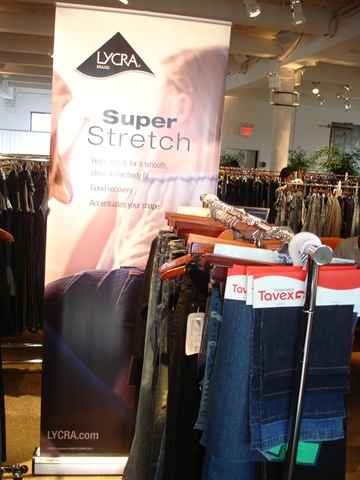
    Super stretch denim Theme

    DSC05584 Super stretch are those fabrics with more than 30 percent stretch –are called super stretch . These  are easily one of the hottest trends on today’s denim landscape. The consumer’s desire for comfort and fit, paired with a fashion trend that favors slim, body curving silhouettes, have helped give birth to this whole new category of denim. Super stretch fabrics can range from very lightweight “jegging” styles, to more traditional 10 to 12 oz denims. But making high quality super stretch fabrics and garments poses unique design challenges for mills and brands alike.
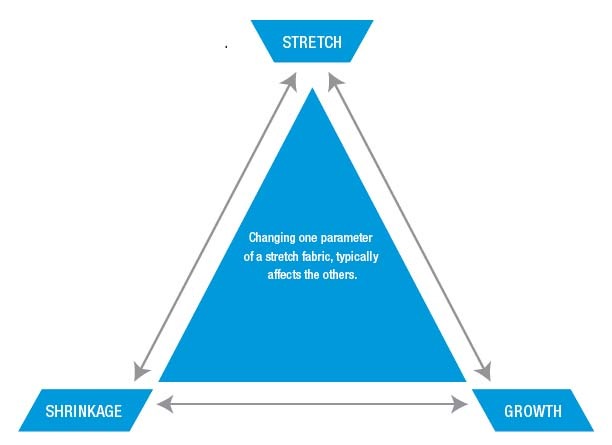
    Typically, as the level of stretch in a fabric is increased , you also increase the potential for higher shrinkage and/or higher growth. Think of the three parameters—stretch, shrinkage, and growth—as the three points of a triangle, with stretch at the top. As you move stretch to a higher point, the base of the triangle (shrinkage and growth) tends to change as well.

    diagram copy
    The end result can be a fabric with poor dimensional stability.
    INVISTA has developed quality guidelines and best practices for creating super stretch fabrics. The use of LYCRA® fiber and LYCRA® T400® fiber together and in recommended proportions can result in  achieving the optimum balance of stretch, recovery and shrinkage.

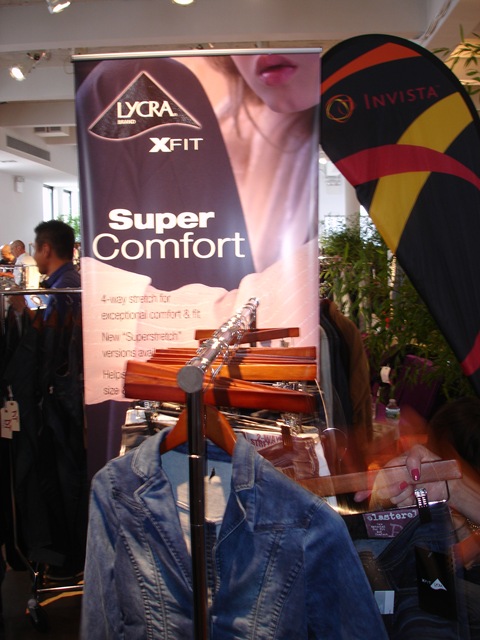
    Super Comfort Denim Theme

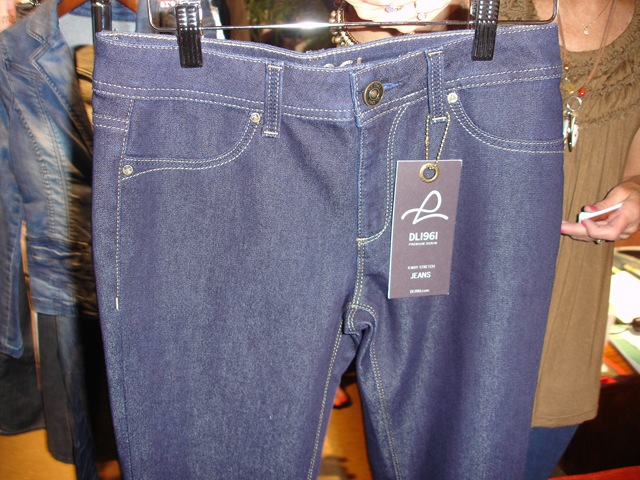
    DSC05592 The super comfort category takes comfort and fit to the next dimension. Though introduced in 2006, INVISTA’s XFIT LYCRA® fabric technology has been advanced further to present a  new super stretch versions of XFIT LYCRA® fabrics take that concept even further, bringing comfort and all around movement to even the sleekest of silhouettes . These fabrics combine the best attributes of Lycra fiber and Lycra T400 fiber – providing super comfort and freedom of movement in all directions.


    lycra T 400

    Super Recovery Denim Theme

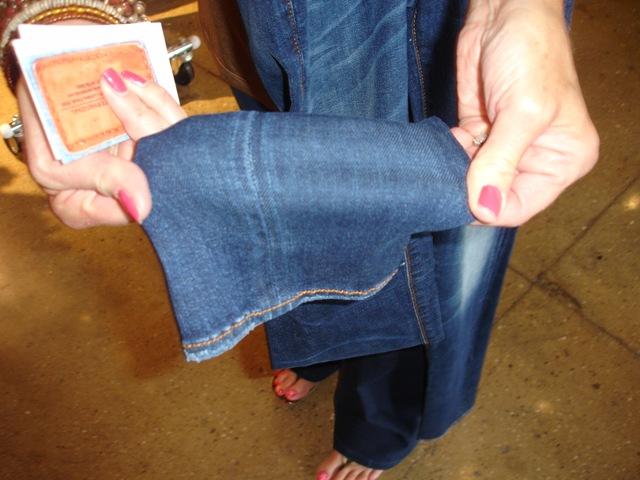
    DSC05585 Another hot category is fabrics with super recovery. These fabrics often appear similar to super stretch fabrics because of their significant “snapback.” Although stretch levels are more consistent with those of standard stretch fabrics (e.g. 20 to 25 percent stretch), these fabrics seem “more stretchy” because they have more powerful recovery. The enhanced power comes from LYCRA® T400® fiber which has a permanent, coil-like structure, so it always wants to return to its original shape. New yarns such as the textured LYCRA® T400® fiber provide excellent recovery, as well as a soft hand . I stretched some of these fabrics to see the recovery and they just snapped back to their original shape in a jiffy.

    Super Durability Theme – Cordura Denim

    DSC05593 The CORDURA Denim fabric collection combines the authentic look and feel of 100% cotton denim with long lasting durability. According to Cindy McNaull, CORDURA brand marketing director,


    "These fabrics have up to four times the abrasion resistance of comparable 100% cotton fabrics, making them ideal candidates for rugged applications such as skateboarding and workwear…”

    These fabrics have a nylon mix and use a technology that has been used in the military clothes for decades . The result is a super lasting denim fabric for “Rough and  Tough Wear”


    Invista has paired the T 400 brand name with the Lycra fiber brand name to make it easier for the customers downstream to easily associate the T 400 brand with the Lycra brand.  Though Lycra and its properties are well known, T 400 is sometimes not so completely understood. Here are some typical questions which will help understand T 400 better :

    What is Lycra T 400 fiber ?

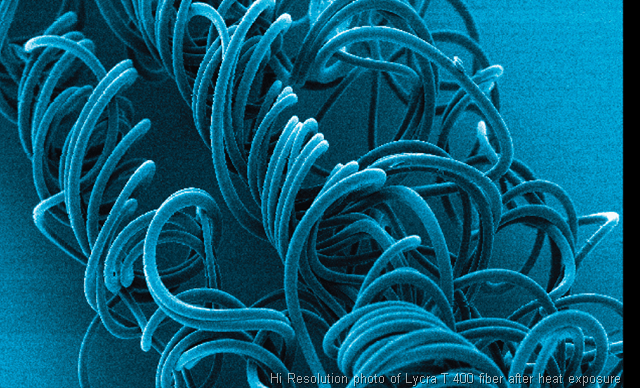
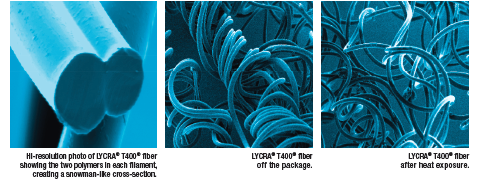
    LYCRA® T400® fiber is a special type of bicomponent fiber in which two different polymers are joined together within each filament. The differential shrinkage between these two polymers provides a smooth, helical crimp.
    Additional crimp is developed during the dyeing and finishing process when the fiber is exposed to heat. The result is fabrics and garments with  great stretch and recovery properties .

    image

    How is Lycra T 400 fiber used ?

    LYCRA T400 fiber can be knit or woven in its bare state into garments. For certain applications where cotton is used, core-spun LYCRA T400 yarns may be preferred.

    What is the content of T 400 as compared to Lycra elastane fiber ?

    Weight for weight, LYCRA  T400 fiber provides stretch and recovery to textured yarns but less than LYCRA elastane. Thus, to achieve a given level of stretch and recovery in fabrics, LYCRA® T400 fiber content will normally be greater than LYCRA® elastane content .The following table shows typical fiber contents of garments with LYCRA  elastane and garments with LYCRA T400 fiber.


    Garment Typical Lycra Elastane content Typical Lycra T 400 fiber content
    Jeans / Pants 2 to 4% 10-25%
    Woven shirts 2 to 6% 10- 25%
    Knit Shirts 5 to 10% 15- 25 %
    Swimwear 18 to 22% 45 – 50 %
    Underwear 2 to 5 % 15 – 20%

    For any further information contact Kristin at this email address ..

  • Indigo Rope Dyeing : Operation , Duties, Inspections & Responsibilities


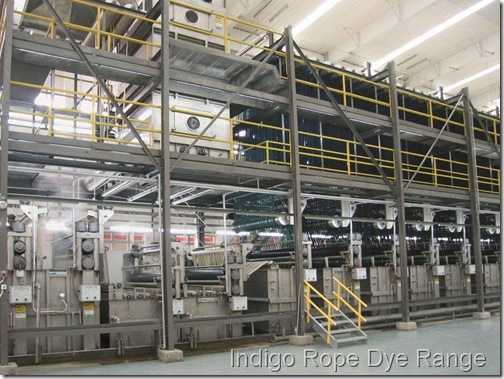
    Morrison Spectrum Indigo Range

    Morrison Textile Machinery is a global leader in textile processing machinery. They are particularly famous for its Rope Dyeing Machines for denim  fabrics and have installed over 200 machines worldwide. They have shared with us some information on the ‘Duties and Responsbilities of the Indigo Dye operators’ and this info would be useful for many of our readers(with technical background)  who come from various denim mills around the world. Here is the summary of the information provided by Morrison.

    “Based on our experience in the start-ups and operations of over 200 indigo rope and dye ranges, we have prepared a listing of the basic duties which must be included for the maintaining of a proficient operation of the indigo rope range.

    These  duties and functions are broken down into into three parts :

    1. Duties  to be performed before starting the range
    2. Duties to be performed while the range is in operation  and
    3. When it undergoes a normal shutdown.

    Normally, 3 operators would run this operation. However, in the beginning, we certainly suggest more during the training period.During this time, the most qualified personnel may be selected to become the head operator or unit supervisor — whatever the title might be.

    Assignment of these various duties and responsibilities will be left up to the dyeing manager, but all the operators should become aware of the many and various duties which must be performed.
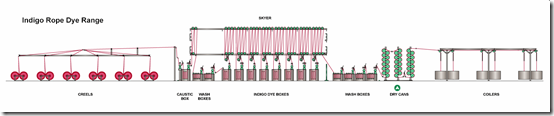
    indigo rope dye range

    I. Before Starting The Range

    1. Turn on steam — Check supply.

    a. Dry Cans

    b. Prescour Box

    c. Rinse boxes – Softener box (if applicable)

    2. Check all valves for proper position for "RUN".

    Indigo Boxes and Circulation System

    a. Discharge Lines – Indigo Boxes – Open

    b. Leveling Lines – Open

    c. Indigo Feed Lines – Open

    d. Restriction Valve – Feed Header – Partially Closed – To be run 12 – 15 PSI on 6 – Dip. Run wide open on 8 – Dip.

    e. Pump – out line to Holding Tank – Closed

    f. Return Line from Holding Tank – Closed

    3. Make sure prepared box mixes are transferred to the boxes and the box volumes are correct. Fill to the overflow.

    a. Prescour

    b. Indigo boxes (if charging or replenishing)

    Softener box (if used)

    4. Recheck and Set Steam Controls

    a. Prescour Box

    b. Softener Box

    c. Dry Cans

    5. Check circulation filter to make sure it is clean.

    6. Check indigo and chemical metering pump filters.

    7. Turn on main power to range.

    8. Turn on circulation pump (manual). Run 10 minutes then turn off.

    9. Recheck for proper valve positions are correct for flow through desired filters and pumps.

    10. Make sure all feed mixes are prepared and adequate volume is available for startup and beginning of run.

    a. Indigo Stock Mix

    b. Indigo feed mix. If not running supplemental chemical feed or hydro boost, do not add hydro until just before the range is started.

    c. Chemical feed mix (if running chemical feed). Have pre-cooled caustic and water prepared and hydro weighed. Do not add hydro to the chemical feed tank until just before the range starts.

    d. Prescour Feed Mix

    e. Softener Mix (if used)

    11. Check for proper position of valves on all feed tanks.

    a. Drain valves – closed

    b. Valves to feed pumps – Open

    c. Valves to other auxiliary feed tanks -closed

    d. Valves to indigo stock transfer – closed

    12. Following tank valves are OPEN

    a. Indigo feed to metering pump – open

    b. Prescour feed mix to box level control or transfer pump – open

    c. Softener feed tank to metering pump or flowmeter – open

    d. Chemical feed tank to metering pump – open

    13. Make sure valves to metering pumps (at pump area) are in proper position.

    14. Check Indigo Box Conditions

    pH: 11.8 – 12.0

    ORP: 780 – 800

    Hydro Tit: Single vatometer reading:

    1.8 – 2.0

    Caustic Tit: 1.8 – 2.0 G/L

    If necessary, adjust the box conditions upwards with an addition of hydro and/or caustic.

    Make up in solution and add to the boxes or use the metering pump if desired.

    If addition is necessary, circulate 10 minutes and recheck conditions after turning off circulation pump.

    15. Wind lead-line slack onto the ball warps.

    16. Open tension bar (if closed).

    17. Recheck all feed line valves to metering pumps.

    18. Check indigo feed and chemical feed (if used) pumps for specified delivery. Recheck and adjust if necessary.

    19. Lower all nip rolls and check for proper nip pressure.

    20. Set switches on circulating and feed pumps to "automatic" position. Pumps will now start and stop with range.

    21. Turn on and adjust water nip sprays at rinse boxes.

    22. Recheck temperature and level in the prescour box.

    23. Check temperature in the softener box.

    24. Turn on softener feed (if used) at box flow indicator and control or metering pump.

    II. Dutiea and Responsibilities while the range in running

    1. START RANGE

    a. Observe compensator positions and watch for slack warps.

    b. Observe tracking and watch for problems with lead line.

    c. Recheck metering pump – only to see that they are pumping.

    d. Prepare to change lead line tubs to yarn tubs at coilers.

    e. Observe for any abnormal behavior of coiler operation.

    f. Recheck dry cans and condition of moisture in running yarn at coiler.

    g. Lay out end of rope at coiler position designated for "lay-out" inspection.

    2. During 1st 20 minutes of running

    a. Check water sprays at nip rolls on rinse boxes.

    b. Check roll nip pressures.

    c. Check compensator arm positions. Trim vernier rheostats if necessary.

    d. Make sure tension bar at front of range (draw roll) is open o- no drag.

    e. Recheck for desired drying conditions – 5 to 7% moisture left in the yarn.

    f. Observe running warps at each box – especially for laps on sky rolls.

    g. Check dosification of metering pumps. Record.

    h. Check flow and level in prescour (or sulfur bottom) box.

    3. 1st 20 minutes of operation

    a. Check flow and temperature of softener box.

    b. Recheck range speed.

    c. Check circulation pump operation.

    d. Observe coiler operation.

    e. Check indigo box conditions – record. Determine if conditions are satisfactory. Record data in log book or control monitor sheet.

    4. Specific Duties While Range is Running.

    Perform duties and record in Log Book

    a. Check flow to softener box (if used) – also temperature.

    b. Check range speed.

    c. Check circulation pump operation. Observe pressure on discharge restriction valve (if applicable).

    d. Clean circulation filters every 3 hours.

    e. Check indigo box conditions hourly and record.

    f. Check indigo and chemical feed metering pump delivery hourly and record.

    g. Constantly patrol range. Look for any abnormalities. Patrol and observe.

    – lap-ups – sky rolls and other areas

    – bearing noise – unusual metering pump noise

    – interruption of metering pump delivery

    – reduction problems (indigo squeeze nips)

    – abnormal tension – compensators unbalanced

    – incorrect water spray at nips

    – high or low level in indigo boxes

    – drying conditions – too damp or too dry

    – incorrect air pressure at nips

    – motor overload

    h. If machine stops, insure that circulation and metering pumps stop with range.

    i. If range is necessarily slowed down, make sure metering pumps are adjusted.

    j. Prepare new feed mixes prior to need. Keep chemical stock near preparation area.

    k. Turn in new feed mixes just after old mix is exhausted. Rinse dye tanks before new indigo preparation.

    l. Check "wet out" of yarn in sample from prescour mix.

    m. Observe warps for problems or lost ends.

    III. When Dyeing Range Stops- End of Set

    1. Adjust the tension bar at the stock draw roll to induce tension on the incoming lead lines. Do this before "pulling off" and plaiting leads.

    2. Turn off metering pumps and circulation pump.

    3. Turn off water and steam at nip sprays and boxes.

    4. Close valves from feed tanks.

    5. Raise all nip rolls.

    6. Drain wash boxes and prescour box. Remove any lapped up ends from rolls.

    7. Flush out lines and metering pumps. Left over chemical feed may be used if pump piping is appropriate.

    NOTE: Never leave indigo in the metering

    pumps for an extended period of time.

    8. Clean metering pump and circulation pump filters.

    9. Turn off power to range.

    10. Tie "bow ties" in lead lines at all accessible areas. This prevents fraying of lead lines, prevents laps.

    11. Check and clean metering pump back pressure valves. Replace diaphragms if questionable. This should be practiced weekly.

    12. Clean feed tanks that are empty.

    13. If low volume is in the indigo feed tank, transfer back to the indigo stock tank

    14. Small volumes of chemical feed mix may be pumped through the metering pumps into the range. This in many cases will avoid hydro addition to the boxes when the range is restarted.

    15. Check and remove any yarn lapped on sky rolls.

    16. Clean range area – floor, etc.

    17. Dispose of any empty drums, bags, etc.

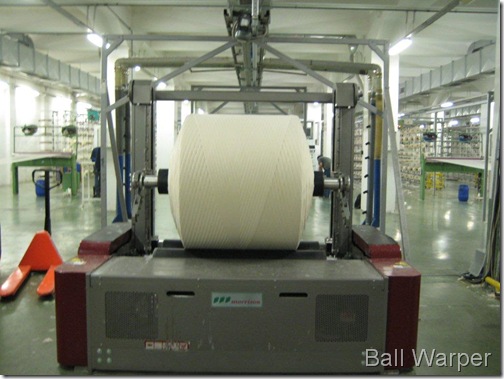
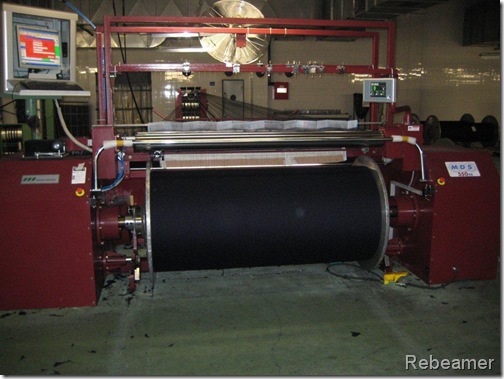
    About  : Morrison Textile Machinery is a global leader in textile processing machinery.Since its founding nearly fifty years ago, Morrison Textile Machinery has been designing and producing the  textile dyeing and finishing machinery for fabric producers worldwide. Known the world over for their Rope Dyeing Machines, Morrison has also started producing denim preparation machines like Ball Warpers and Rebeamers – and as a result becoming a single source of machines for Indigo Rope dye and denim finishing.


    Orta Taper

    rebeamer indigo yarn