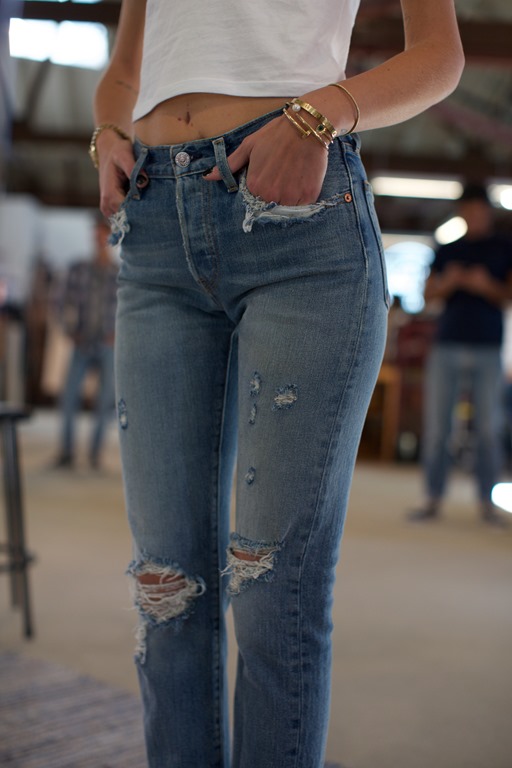
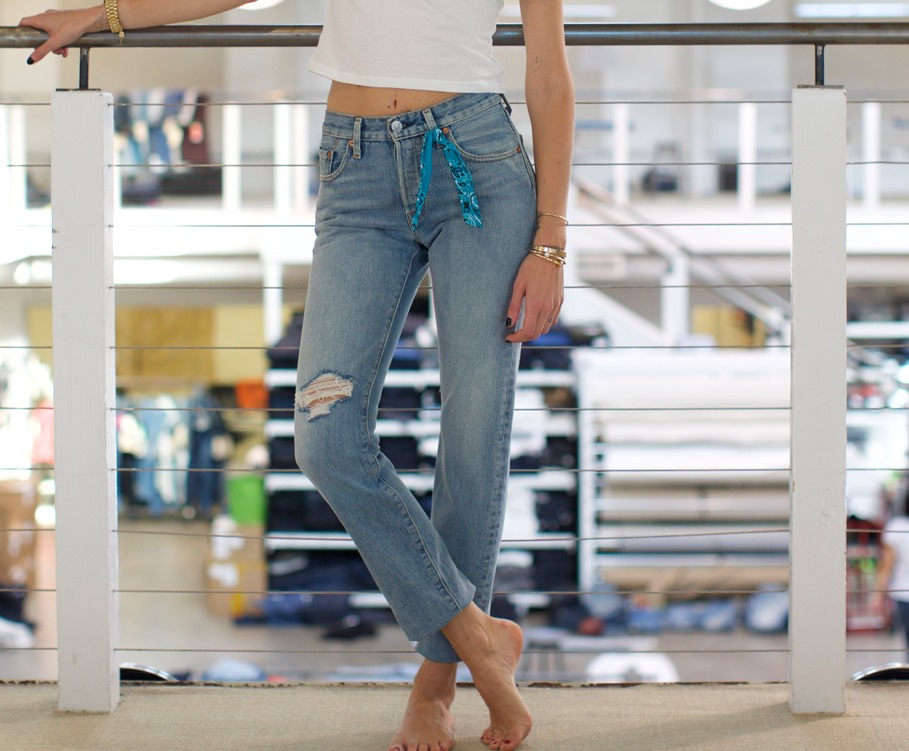
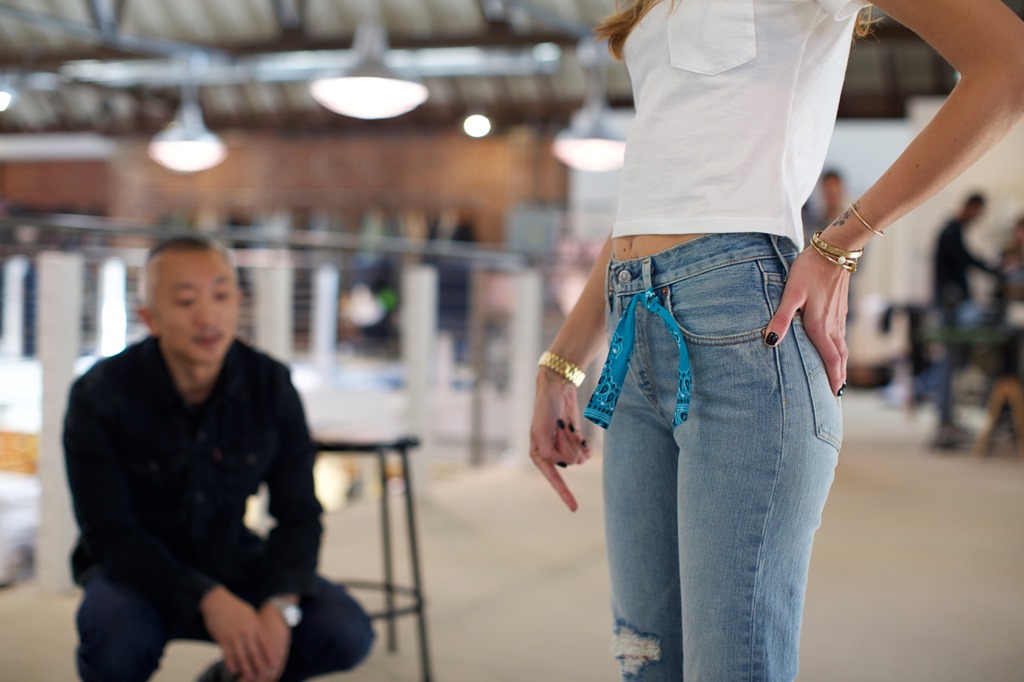
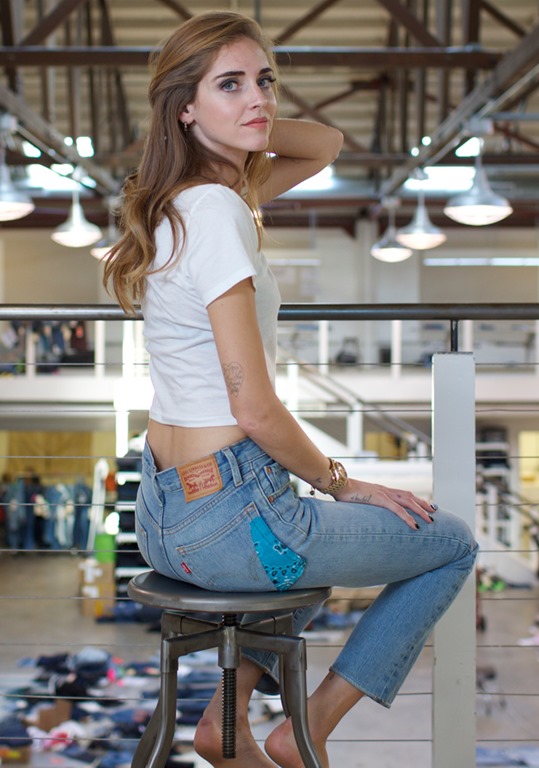
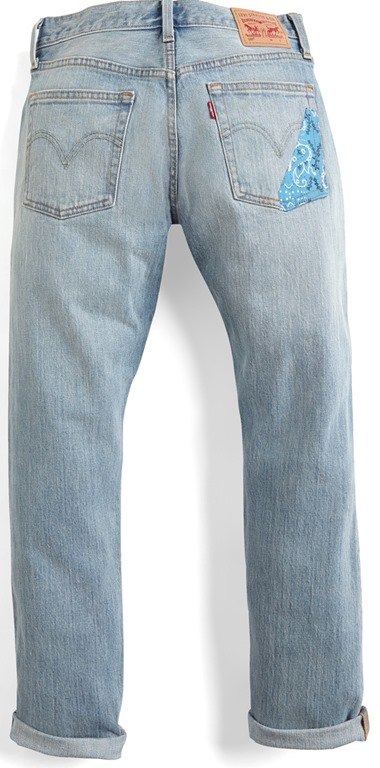
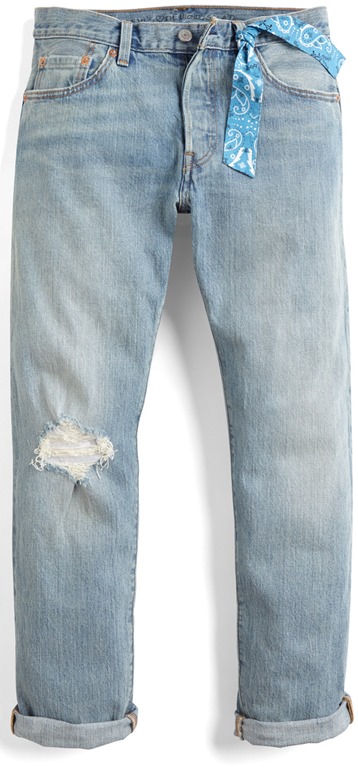
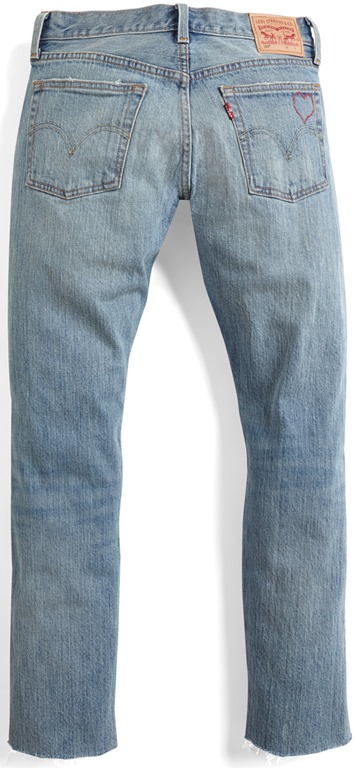
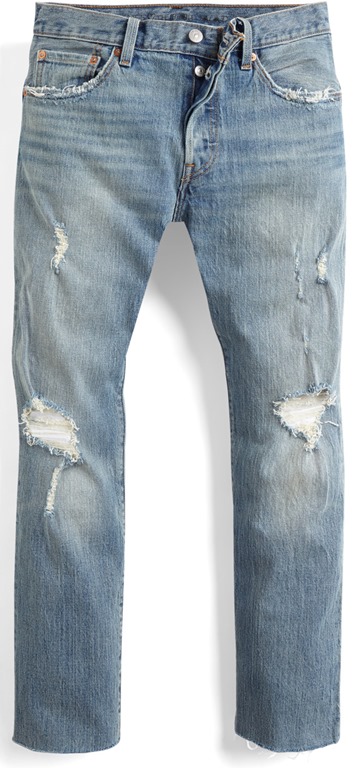
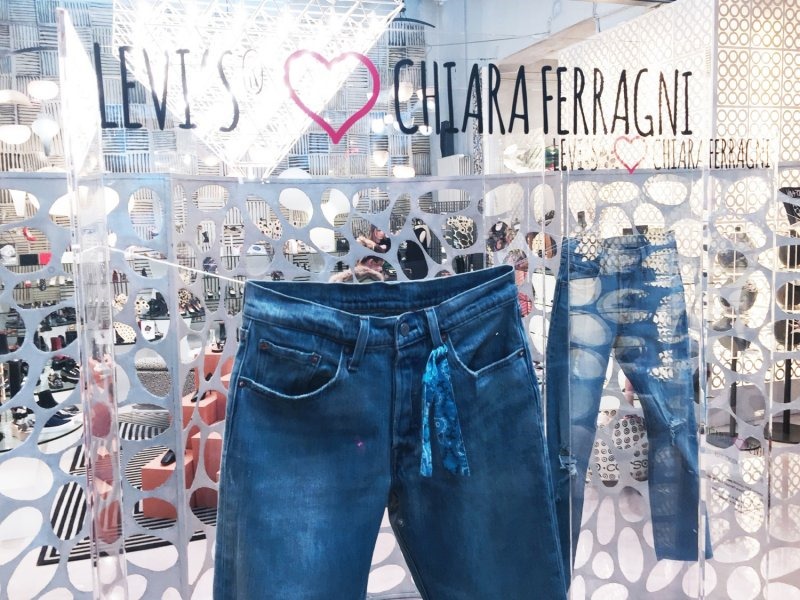
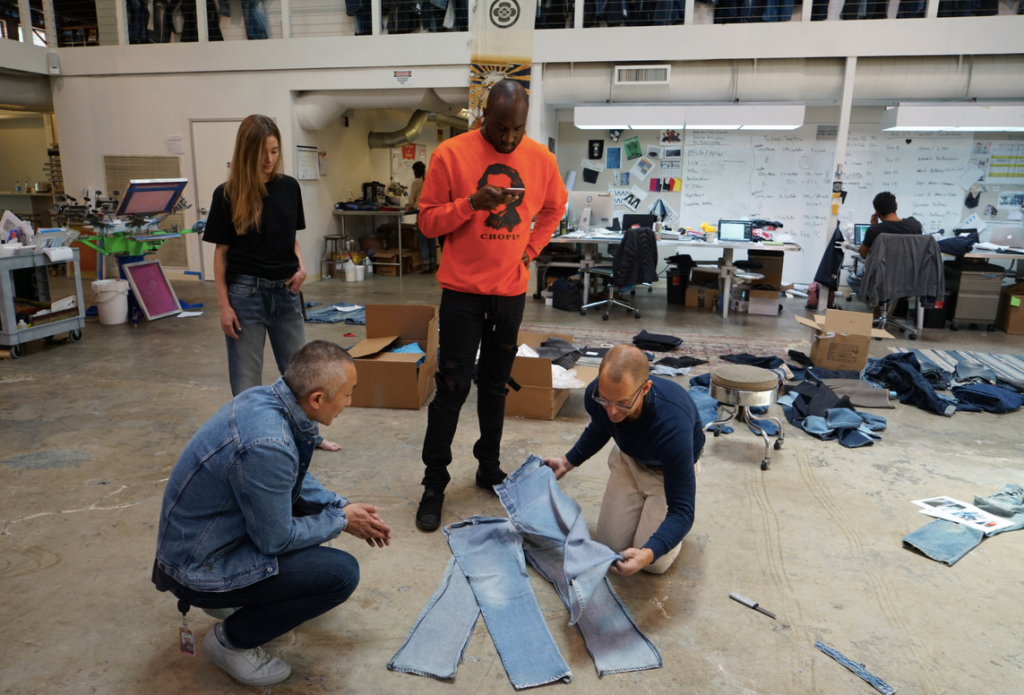
The limited edition of Ferragni Jeans by Levis in collaboration with Chiara Ferragni has been announced recently . Chiara Ferragni,a style icon , is the founder of the fashion lifestyle platform and e-shop The Blonde Salad and in partnership with Levi’s design team, created two 501 jeans at Levi’s Eureka Innovation Lab and denim atelier in San Francisco.
The two original designs include hand stitched embroidery and matching faded emerald blue bandana, and a embroidered heart, both on authentic, washed-out, vintage-feel indigo finishes . The collaboration with the Italian fashion icon and world-renowned blogger Chiara Ferragni to create these limited-edition 501® Jeans seems to be very exciting for Levi’s. They feel it is ‘True to the original, feature the iconic straight fit and signature button fly, and are cut from durable denim with a substantial feel ‘’. This special pair is infused with a hint of stretch for comfort, do-it-all functionality and the perfect amount of give (and recovery). Chiara has personalized them with fun, ‘lived-in’ style — a heavily faded wash of indigo (blue), subtle elements of wear throughout and bandana cut-out adornments.’
“Chiara reflects a cool style that has become a daily source of style inspiration for many,†commented Karyn Hillman, chief product officer, Levi’s.
“We love how she mixes authentic denim pieces into her looks. Working with Chiara on the creative design process was fun as she is incredibly passionate about denim. We were excited to partner with her to reimagine our most iconic product – the 501. We love the results!â€
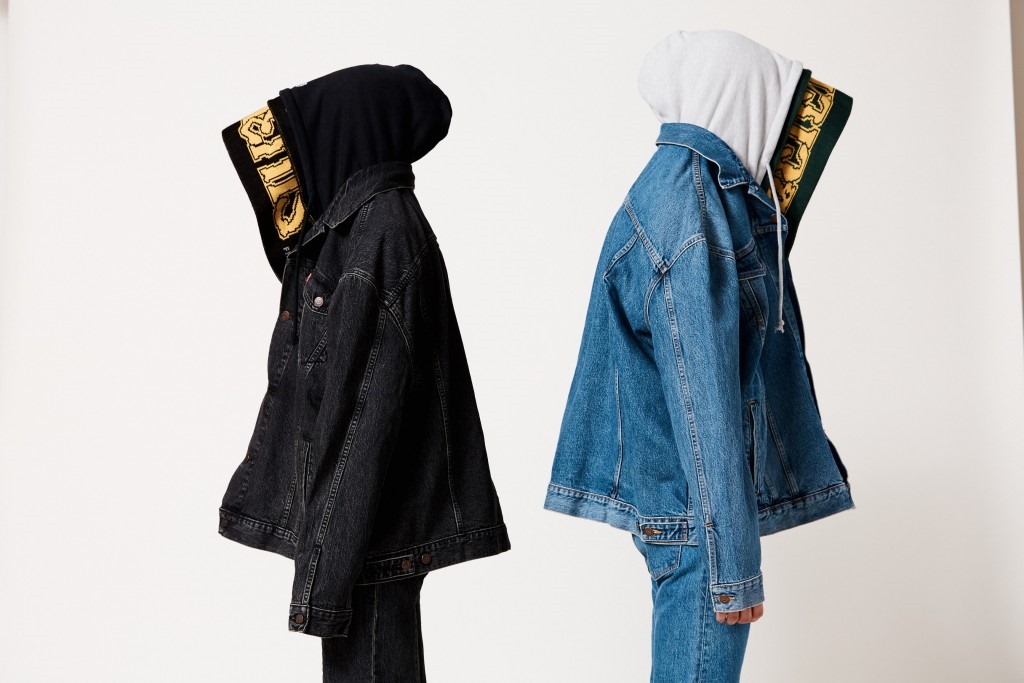
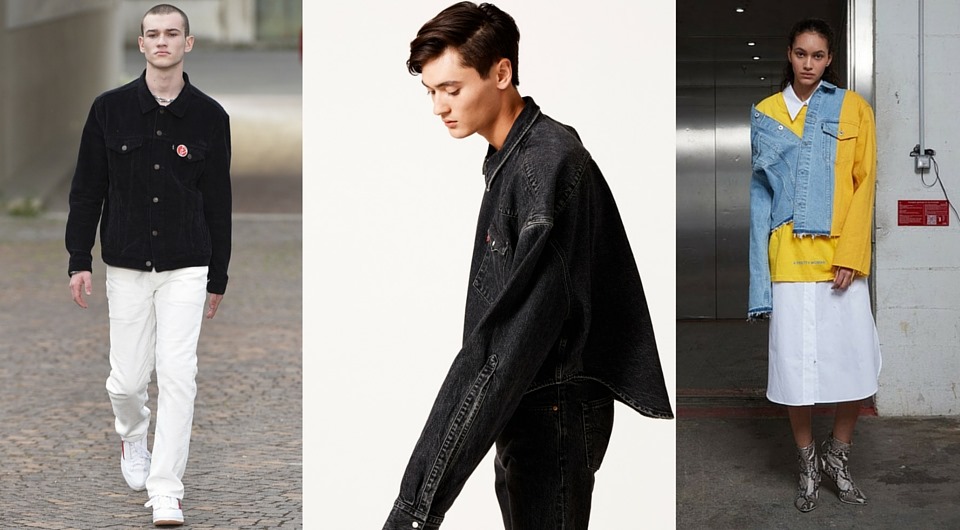
Levi’s , the pioneer of blue jeans , is now pairing up with some of the most creative designers for a chic take on quintessential American staples.Vetements, Gosha Rubchinskiy and Off-White are some of them who are re-inventing the cultural and classical designs on a global level for Levi’s.
Vetements
Demna Gvasalia , the designer who lead The avant-garde French fashion label ,showcased spring 2017 collection to the catwalks of Paris for Haute Couture fashion week which was the classic example of collaboration of seventeen other unconventional heritage brands and Levi’s itself.The idea was to take the most attractive product from their bucket and put in to a Vetements frame,both either in size or in shape. Demna Gvasalia is a Georgian fashion designer. He studied at Royal Academy of Fine Arts. He led design teams at Maison Martin Margiela and Louis Vuitton.
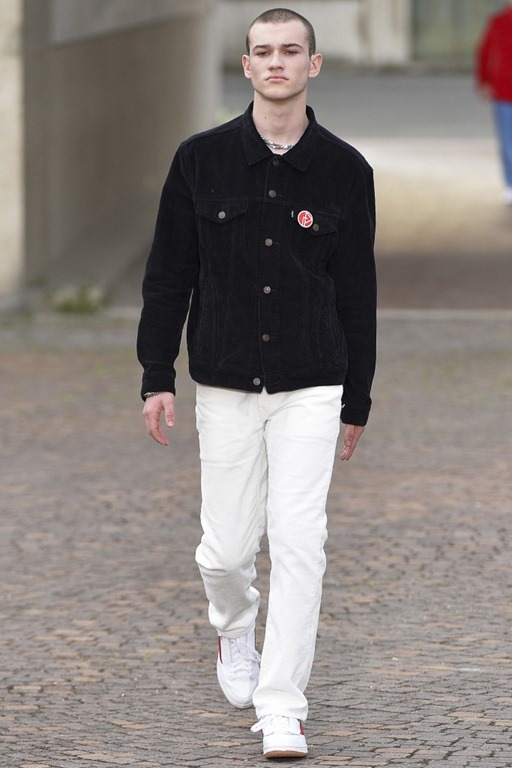
Gosha Rubchinskiy, one of the most prominent fashion personalities in today’s time , his approach to style is subverting basics into unique statements imprinted with his signature aesthetics.Gosha collaborated with Levi’s for his spring/summer 2017 collection where he utilized pairs of corduroy jeans and trucker jackets to underscore his broader story,which some are calling his most accessible collection till now.There were two classical pieces created by Gosha while working Levi’s – Type III Trucker Jacket and the 505 Jeans having exclusive black Gosha x Levi’s labels and tonal Cyrillic embroidery , both of which will be celebrating their 50th anniversary when the Gosha collection launches in 2017
Off-White
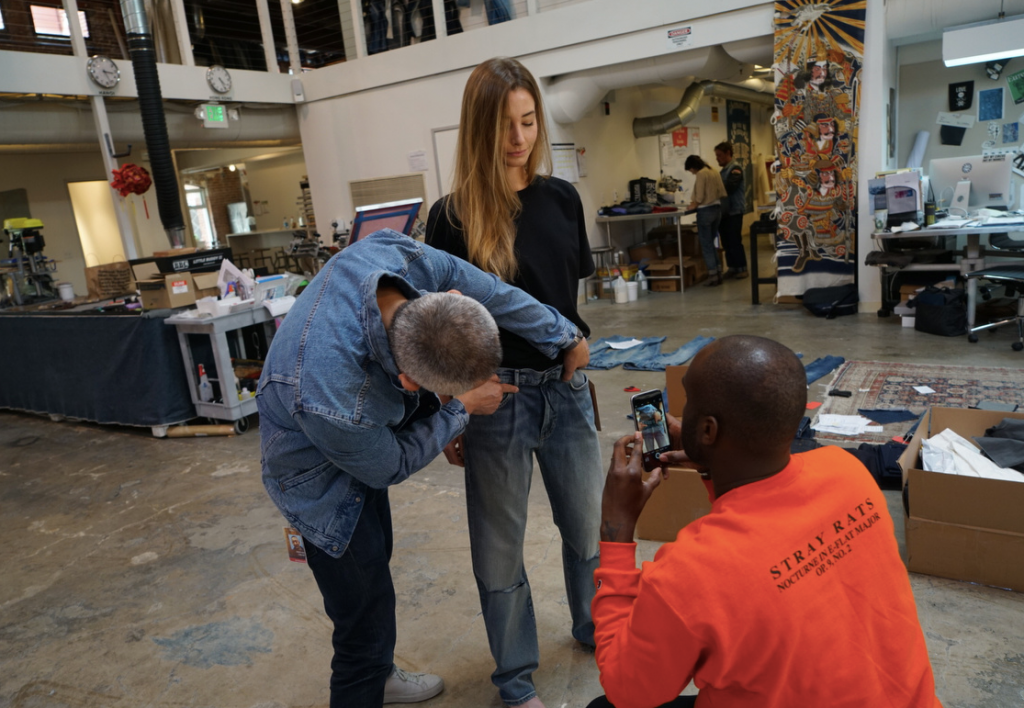
The design team at Levi’s Made & Crafted™ has collaborated with Abloh for Off-White’s Fall/Winter 2016 collection, which debuted on the Paris catwalks earlier this year, and again for his 2017 Resort collection this June. It went so well that Virgil came back to our Eureka Innovation Lab and our Made & Crafted team, to design a special 100-piece limited edition “Made-in-Eureka Levi’s Made & Crafted x Off-White†collection. It’s set to ship later this summer.
The Fall/Winter 2016 collection features 12 unique silhouettes, half of which are unisex. The baseline of the aesthetic is heartland Levi’s® with an emphasis on the vintage 501® look. Virgil then added his architectural-DJ take on Levi’s® classic jeans and trucker jackets by remixing them, splicing them up and adding clean, modern and contrasting colors.
“The decision to work together with Virgil on Levi’s Made & Crafted came pretty naturally,†said Jonathan Cheung , Head of Levi’s . “He gets it. He knows the significance of Levi’s. It’s culture. And it’s in that intersection with culture, particularly youth culture, where Virgil and Levi’s excel. We see this as Levi’s® Made & Crafted standing on the shoulders of Levi’s® heritage and looking into the future.â€
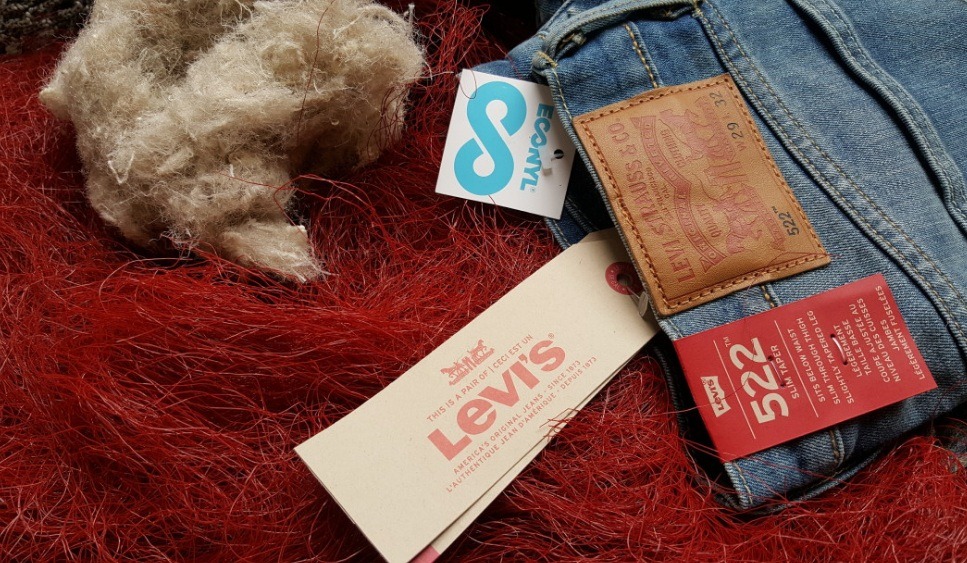
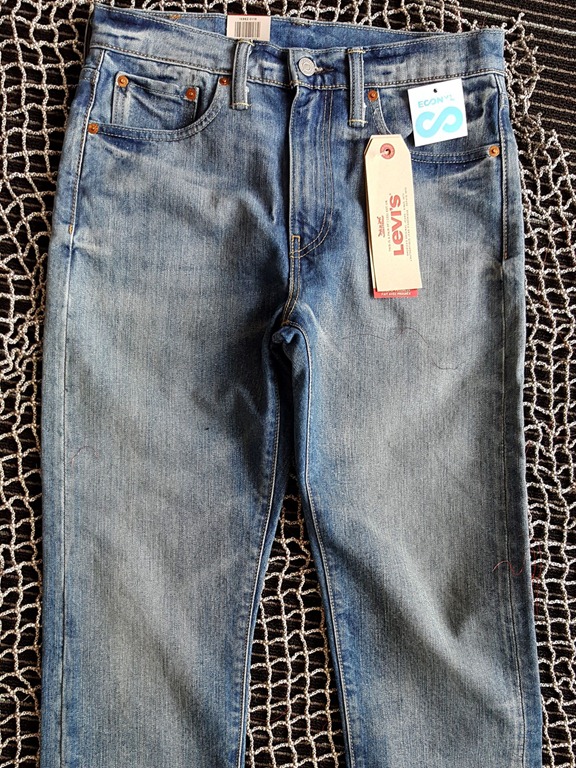
ECONYL® brand and Levi Strauss & Co. have come together to create a new men’s collection made from regenerated nylon from waste materials such as fishing nets and spent carpets.Levi Strauss & Co. has a long history of working on environmental protection through advanced technologies . The collection, the Levi’s brand’s first made with ECONYL®, provides further proof of Levi’s commitment to a sustainable supply chain.
This development involves a partnership with Italian nylon manufacturer Aquafil. One of the products that Aquafil makes is a synthetic material called Econyl, which is made from 100 percent regenerated nylon waste materials. The collaboration goes in line with Levi’s longstanding interest in promoting eco sustainability on our resource-strapped planet. “We envision a world where everyday items don’t have to come at the expense of the environment,†Giulio Bonazzi, chairman and CEO of Aquafil, said in a statement. “This new partnership is further proof that sustainable materials can be used to reinvigorate products that have been traditionally made. Levi’s is redefining the denim industry.â€
About Aquafil :
Since 50 years, Aquafil has been one of the leading players, both in Italy and globally, in the production of Polyamide 6: a landmark in terms of quality and product innovation. Additionally, the Group is a leader in the research of new production models for sustainable development.Aquafil Group has a presence in eight countries on three continents, employing more than 2700 staff at 15 plants located in Italy, Germany, Scotland, Slovenia, Croatia, the USA, Thailand and China.
About ECONYL® :
The ECONYL® brand was inspired by Giulio Bonazzi, President and CEO of the Aquafil Group. He firmly believes in maximizing sustainability through closed-loop manufacturing systems. Aquafil’s ECONYL® fiber helps divert global waste streams from landfills and oceans and is used to produce a wide range of textile products such as sportswear, swimwear, and carpets. Today the ECONYL® Regeneration System is known as the most advanced and sustainable recycling process within the synthetic fibers industry.
Moving a step ahead in the field of sustainability, Global Jeanswear leader Levi Strauss & Co. has recently announced that they have created the world’s first jean made from regenerated post-consumer cotton waste . This innovation has been made possible with the help of textile technology startup EVRNU.
Evrnuâ„¢ is a social purpose corporation registered in the State of Washington, USA and founded in 2014 for the purpose of addressing the problem of the resource-intensive, environmentally negative impact of the textile & apparel industries. The Evrnu technology safely converts post-consumer cotton garment waste by breaking down to the molecular level and converting in to a high quality, premium textile fiber.
Levi Strauss & Co.partnered this year to create the first pair of jeans made entirely from post-consumer cotton waste. Discarded consumer waste is converted into renewable fiber after using a new ,patent-pending recycling technology . The first prototype, in the form of a pair of iconic Levi’s® 511® jeans, represents a future where textile waste is reduced considerably and cotton garments are continually regenerated to create a more sustainable world.
Believing the figures, United States alone creates an average of 13.1 million tons of textile wastes and out of which 11 million tons ends up in landfills. According to the Council for Textile Recycling, the U.S. generates an average of 25 billion pounds of textiles per year, or 82 pounds per person. Eighty-five percent (21 billion pounds), or 70 pounds per person, ends up in landfills — accounting for 5 percent of all landfill space.Till now , there is no effective technology which could transform old apparels into new without telling upon the quality or strength. However with EVRNU technology, discarded cotton clothing can be turned into a new cotton-like fiber, creating new possibilities. This emerging technology doesn’t only act as a game changer for the Textile Industry but also help the industry to meet the increasing need for textiles and reduce both waste and water consumption.
Approximately five discarded cotton T-shirts have been used to develop the first prototype Levi’s jean and surprisingly 98 percent less water has been used than virgin cotton products while developing this innovation. Both companies are associated with a vision to create a circular economy that enhances the life of cotton and eliminates waste by infusing new life into used clothing. The partnership could help this technology scale up quickly and begin to make a significant impact.
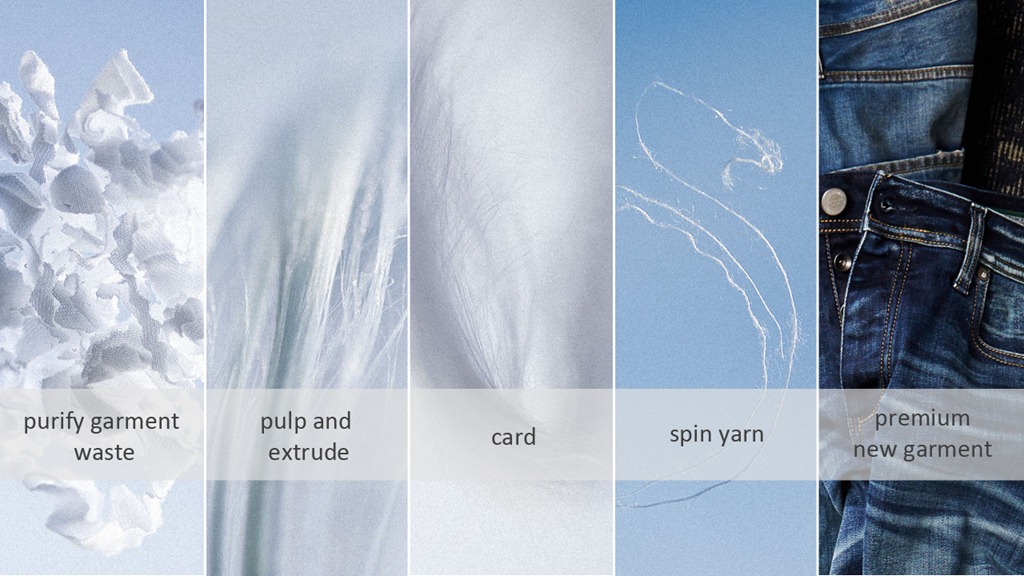
 Evrnu takes cotton garment waste, purifies it and breaks it down into a pulp. The organization then extrudes this pulp into a pristine new fiber that is finer than silk and stronger than cotton — made entirely of garment waste. Each tone of fabric (Jeans and T-shirts) consumes approximately 200 tons of water , however only two percent of water will used in the original garment process.
“We can take your old jeans, break them down to the molecular level, and build them back up into beautiful sweaters that feel good and hold color beautifully and When you are done with that sweater and it’s been reused and recycled, we can break it down again and convert it back into premium jeans.†quoted the officials of company.
 By the end of 2025 , the experts predicted the volume of apparel industry to be doubled and the current rate of resource extraction can’t meet this demand. Considering it , there is an enormous opportunity for emerging technology that efficiently as well as effectively manages resources. The process as given by the company can be seen in the image below :
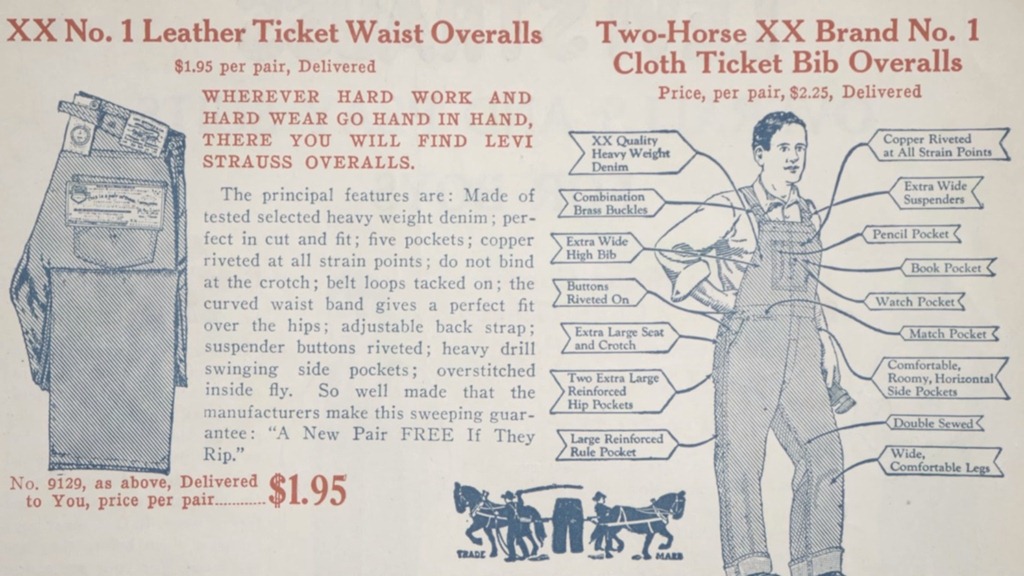
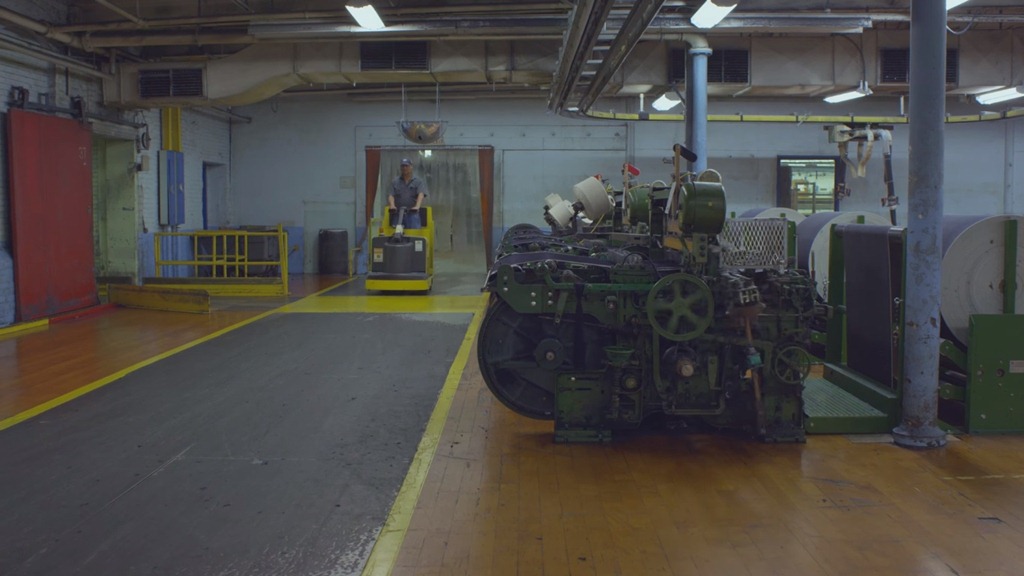
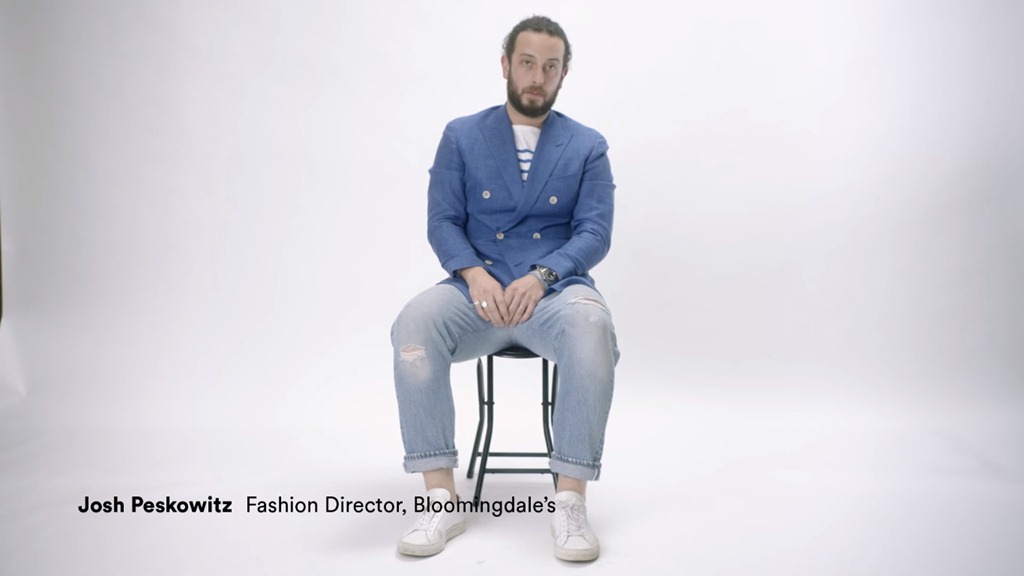
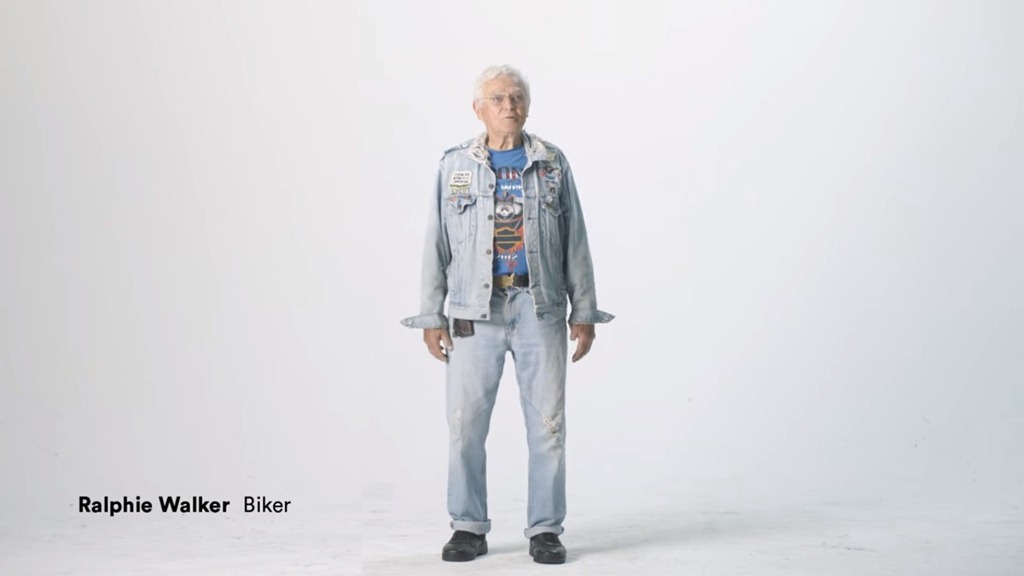
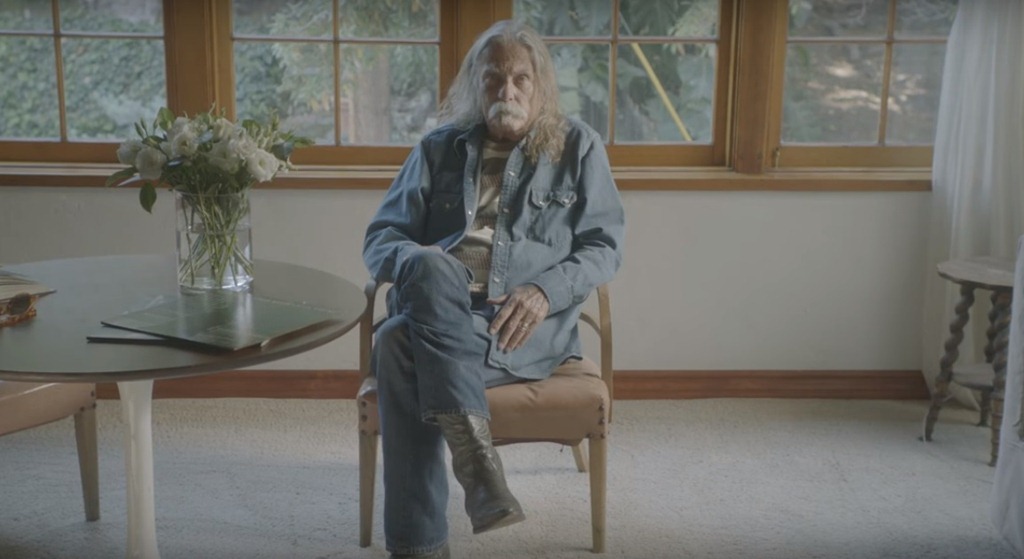
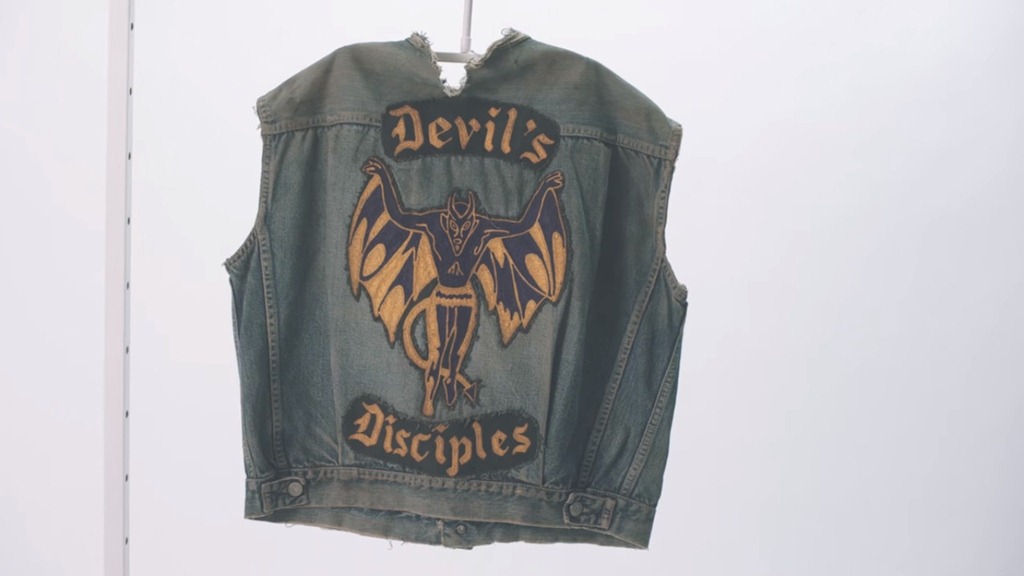
Celebrating 100 years of partnership with Cone Mills Denim in North Carolina, the Levi’s brand presents a short documentary film, The 501® Jean: Stories of an Original. The film explores the lasting impact the Original 501® jean has had on cultural history.The story began in 1873 with the original button fly jeans and after more than a century it has been continuing with the same pace and innovations.From humble beginnings of being granted the patent to place rivets on trousers to a universal staple providing youth with their virgin denim experience, the name Levi’s has long been synonymous with blue jeans.
Levi’s has decided to pay tribute to its denim masterpiece with a three-part documentary series, titled The 501 Jean: Stories of an Original.
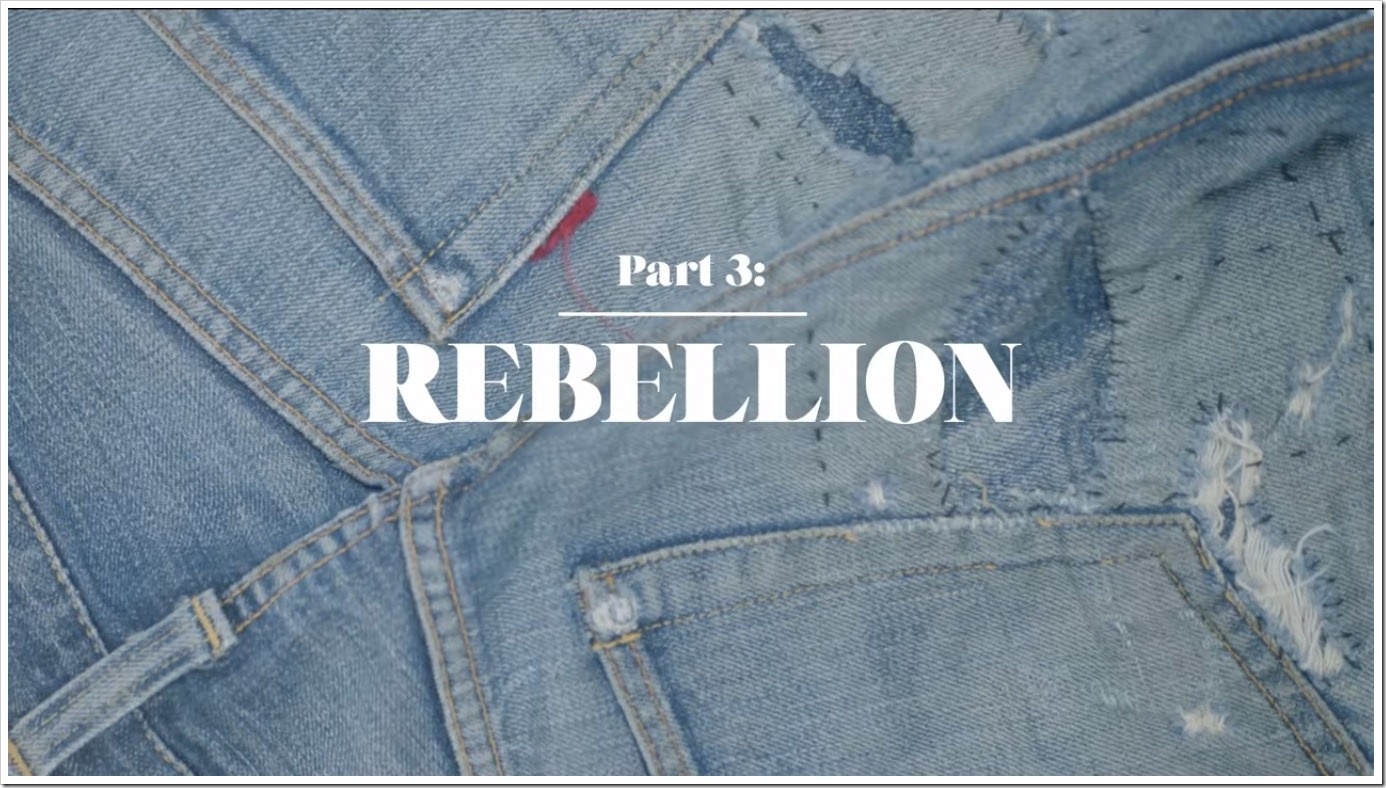
The three parts are titled “Work,†“Style,†and “Rebellion,†and explore the 501’s influence on various aspects of popular culture since its creation in 1873 (which made it the very first blue jean, might we add). It’s a fitting tribute to such an influential piece of clothing.
FEATURING INTERVIEWS WITH:
Henry Rollins, John Baldessari, Erin Wasson, Gary Burden, Andy Spade, Mark McNairy, Eddie Huang, Steven Alan, Jim Walrod, Kim Hastreiter, Mel Ottenberg, Scott Schuman, Lee Ranaldo, Darren Romanelli, Greg Chapman, Hal Fischer, Rachel Wang, and many many more.
Having already screened in NYC, London, Buenos Aires and Caracas, the documentary is live on Levi’s official site and on YouTube.
WORK :
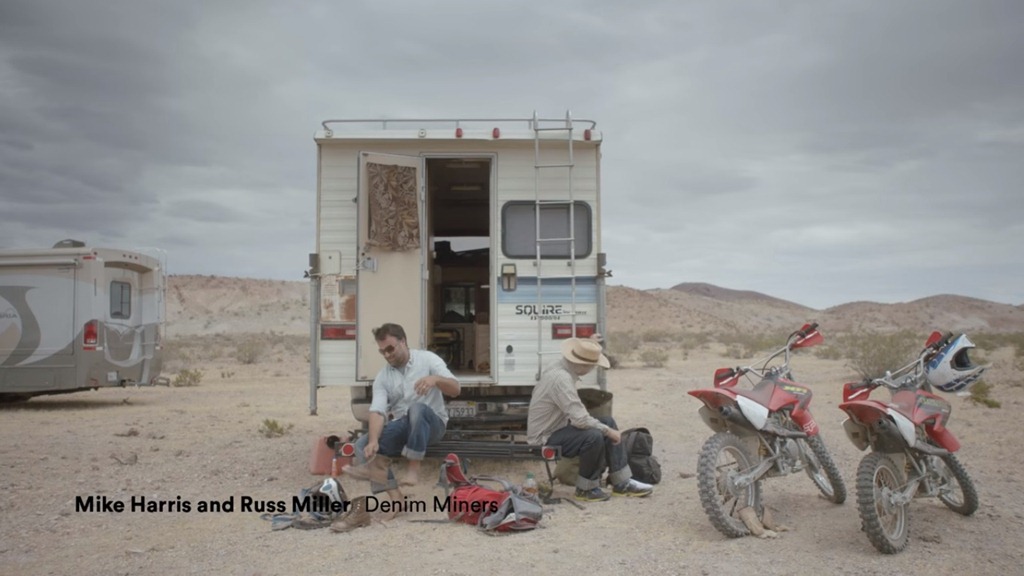
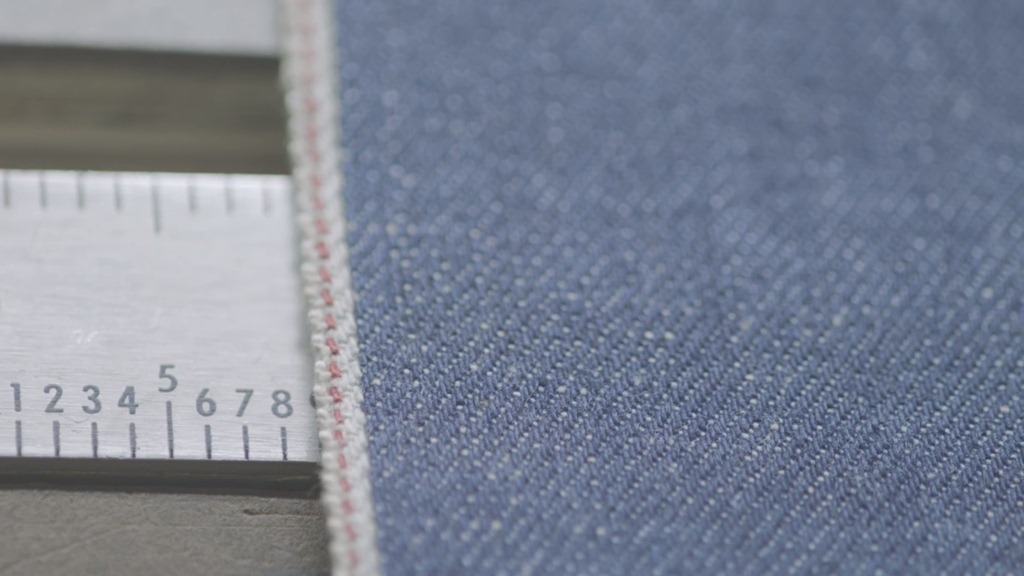
In 1915 Levi partnered with Cone denim- Fabric Mill in USA and since 1927, LEVI and CONE denim put red thread on the edges in their selvedge jeans which signifies Levis quality which is now known as red line selvedge . In the video it has been featured thatMike Harris and Russ Miller went to west in search of Denim mines and after travelling miles they traced the 501® Jean’s roots as a utilitarian garment for coal miners, cowboys, industrial workers, all the way to the creative workers who continue to wear it today. They also managed to find the denim mines where they got some worn out jeans which were happened to be of between 1893 and 1896. From Miners to farmers, now the denim serves for all sorts of workers.
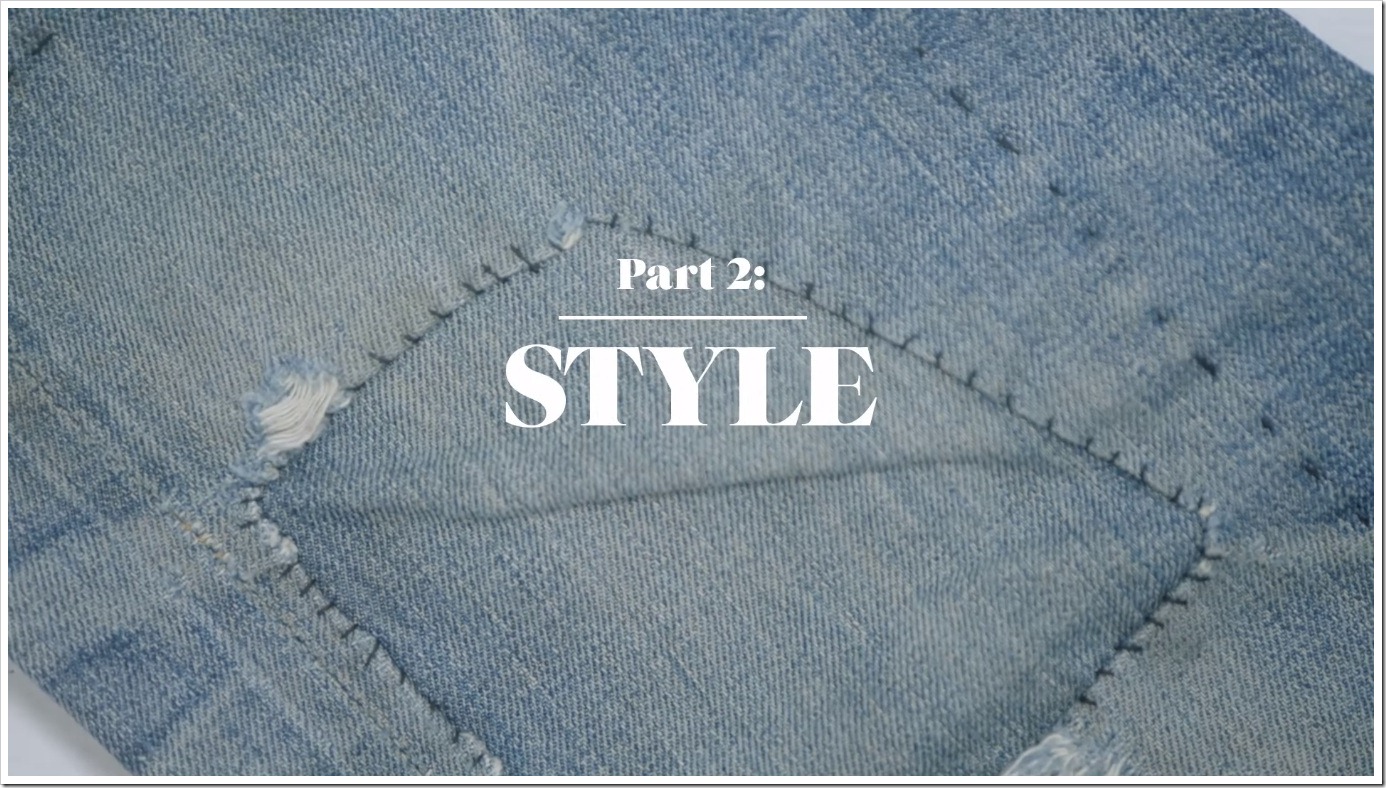
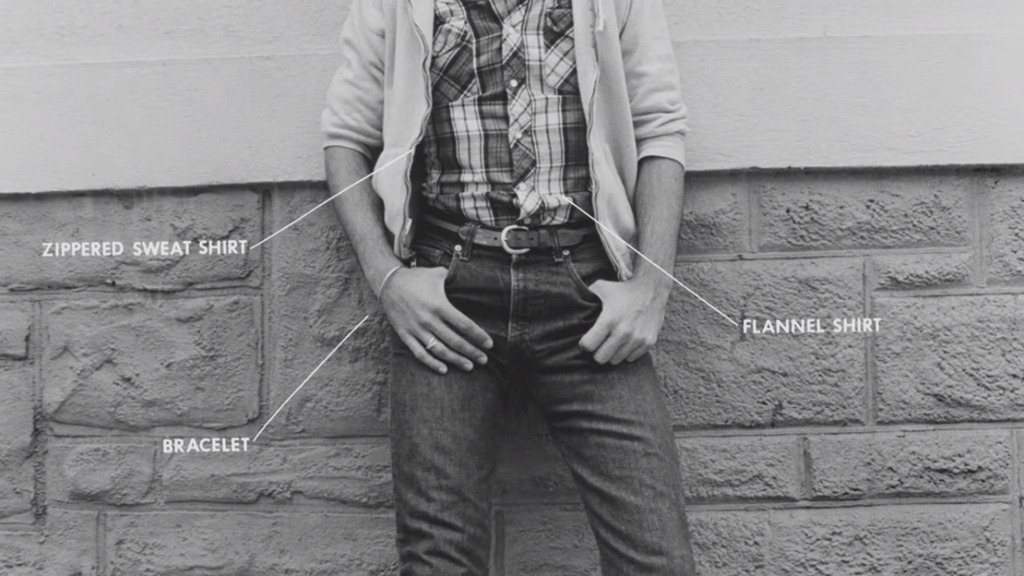
STYLE : For the first time Levi’s are worn for their look, rather than function. Hollywood stars adopted it for decades and the 501 Jean becomes a style icon: continuing to inspire contemporary designers and style leaders. The western films made the cowboy look very popular which was later well adapted by common man also.In 1934 , Levi lady jean was showcased for the first time in the Vogue Fashion Magazine and later on became as the catalyst in the glamour quotient once it has been wore by movie actresses and eventually became the fashion icon.
REBELLION : In some schools , Jeans were banned because of the outright which came due to wearing a jeans which is itself a surprising fact and gradually The 501 Jean became a symbol for countercultures as broad as biker clubs, punk, rap, skateboarding, and art movements. It can be seen on crowds through decades of activism: from beats to hippies, LGBTQ rights protests, to the fall of the Berlin Wall.
China has been ruling the manufacturing industry for the last more than 2 decades on the basis of its economies of efficiency, lower labor costs and huge supply of manpower and of course right policies of the govt. However, much of this is likely to change in the coming future as demographic change take place in China . A recent WSJ report shows how the demographic dividend might turn into a drag on the economy and actually make it difficult for many international companies to remain cost effective in their productions.
Looking at the history of Chinese Denim Market ,Thirty years ago , denim giant Levi Strauss & Co. began producing its iconic jeans in China , eager to tap a evidently endless lot of workers willing to work for few cents an hour which now apparently is starting to vanish. Believing on the economic statistics and market research , over the coming decades , a labor crisis like situation may evolve which will force Levi and other global brands to reconsider their operation in China or even lead to a situation of pack and leave.
Recent developments in the Chinese labor market apparently pointing towards a much bigger crisis for which proactive measures needed to be taken and that too within reasonable time frame. The report mentions about manufacturing units have already started using alternatives and the recent example is an apparel factory in Zhongshan , where lasers are replacing dozens of workers who scrub Levi’s blue jeans with sandpaper to give them the worn look that American consumers find stylish. New Digital printers are being introduced to make intricate patterns on jeans , earlier the workers used to do the same with a mesh screen.
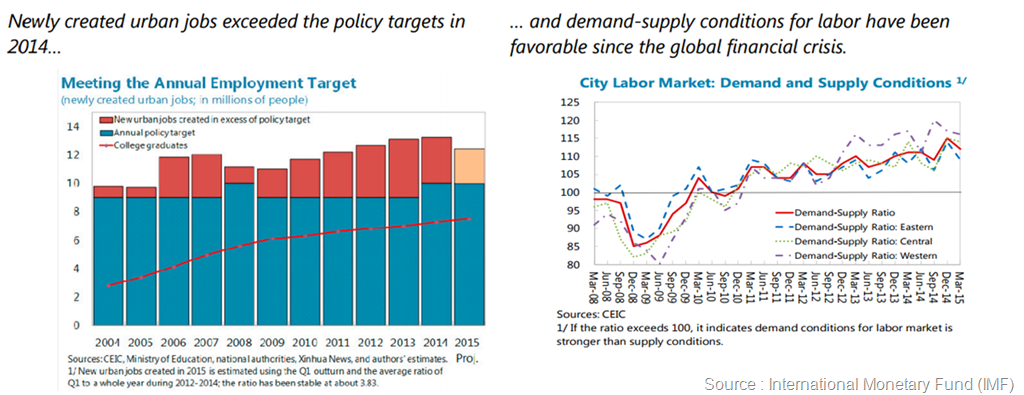
China is also trying its bit to ensure the adequate supply of workforce for the future and therefore announced the abolishment of its one of the old policy which restrict most couples to one child. However , it won’t be able to change much as very few Chinese prefer to have more than one child.
The end of very cheap labor in China is giving a push to many advances in technology resulting of which it will put more emphasis on capital intensive rather than labor intensive techniques of manufacturing but this will make China apparently less central to global manufacturing. But changing consumer tastes—enabled by the same technological change—are diminishing China’s role too.Logistics, taxes and marketing may become more expensive compared to labor costs which could make China less attractive.
Levis began production overseas in Hong Kong in 1966 and later on expanded its production also in Mexico ,Europe and Asia. During the early 1980s, demand for jeans declined, and the San Francisco company laid off a third of its global workforce, according to a Harvard Business School study, and moved more aggressively overseas to cut costs.
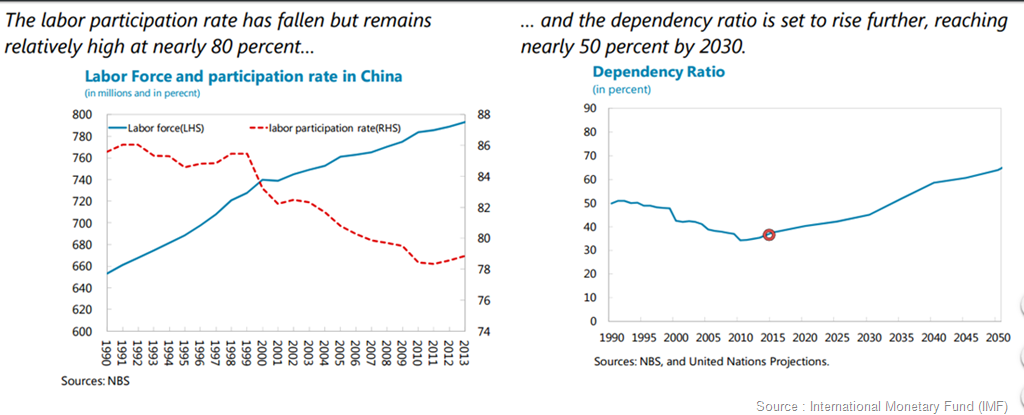
In 1986, Levi started to shift its production to China. China’s rise to the world’s No. 2 economy relied on a huge increase in the country’s working-age population, which expanded by 380 million people between 1980 and 2015. In one of history’s greatest migrations, hundreds of millions of rural Chinese headed for cities for manufacturing jobs that were a step up from peasant labor, even though the work paid poorly by global standards.
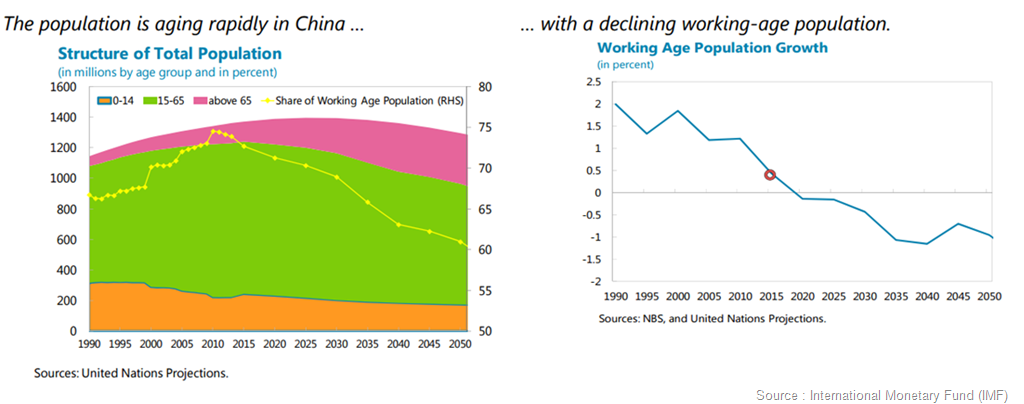
But China’s working-age population recently peaked, and its so-called demographic dividend has started to turn into a demographic drag. By 2050, the working-age population will decline by 212 million, estimates the United Nations—roughly as many people as live in Brazil, the world’s fifth most-populous nation.
Wages and benefits have already been rising in double-digit percentages for the past decade as workers can command higher rates. Although wage growth may ease this year because of the economic slowdown, the pressure is bound to increase in coming decades as the number of workers plunges.Adding to the shortage, many factory workers will be drawn back to their hometowns to take care of the growing ranks of Chinese older than 60, whose share of the population is forecast to double by 2050 from 2015, to 36.5%. Already, China’s rising labor costs—now $14.60 an hour on China’s coast, adjusted for productivity, compared with $22.68 an hour in the U.S., according to the Boston Consulting Group—have diminished China’s competitiveness. Adding energy costs, China is now a more expensive place to manufacture than Indonesia, Thailand, Mexico and India .
None of this means brands like Levi is going to abruptly pull up stakes. Levi still lists about 200 Chinese factories where it does business, five times as many as any other country. Levi is adapting its laser technology so it can etch different patterns to create the right wash look , avoiding usage of too many workers. Levis is however, using this and many other techniques to bring down its costs . These also include reducing the number of fabrics used in a line and cutting the number of suppliers. It is said to have reduced number of fabrics by 40% in last 3 years and number of suppliers by 50%. But automation is the key which China is going to target. It is already expected to be the largest automation market in the coming years.
China’s loss is becoming gain for many countries including Mexico, Bangladesh, Vietnam and others where the Chinese cake is now spreading out. Factories in Mexico seem to be upgrading productions to take the advantage of new situation and are modernizing and investing.
Still , we need to wait and see how the Chinese govt. aims to handle the demographic changes. However, its unlikely that sectors like apparel will remain lucrative for long as the govt. focuses on hi-tech sectors to get better growth with existing population.
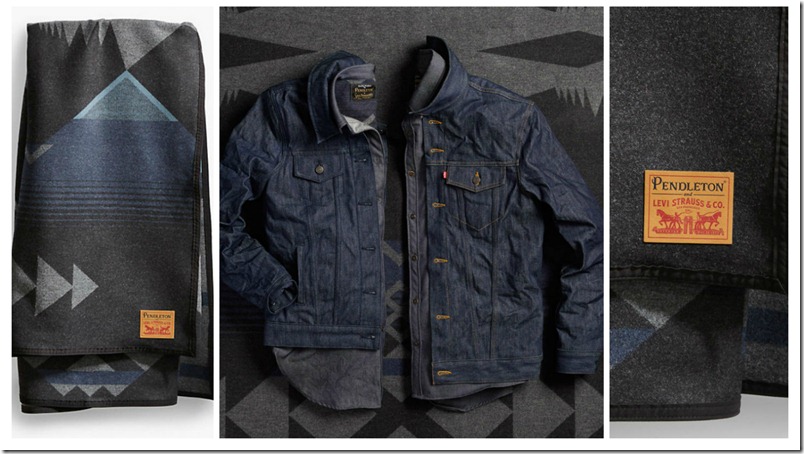
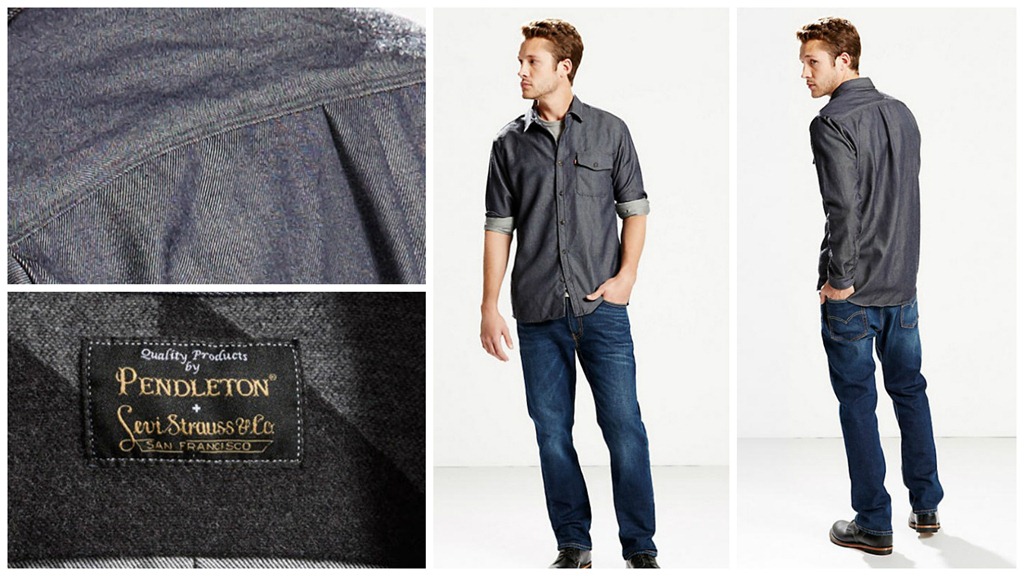
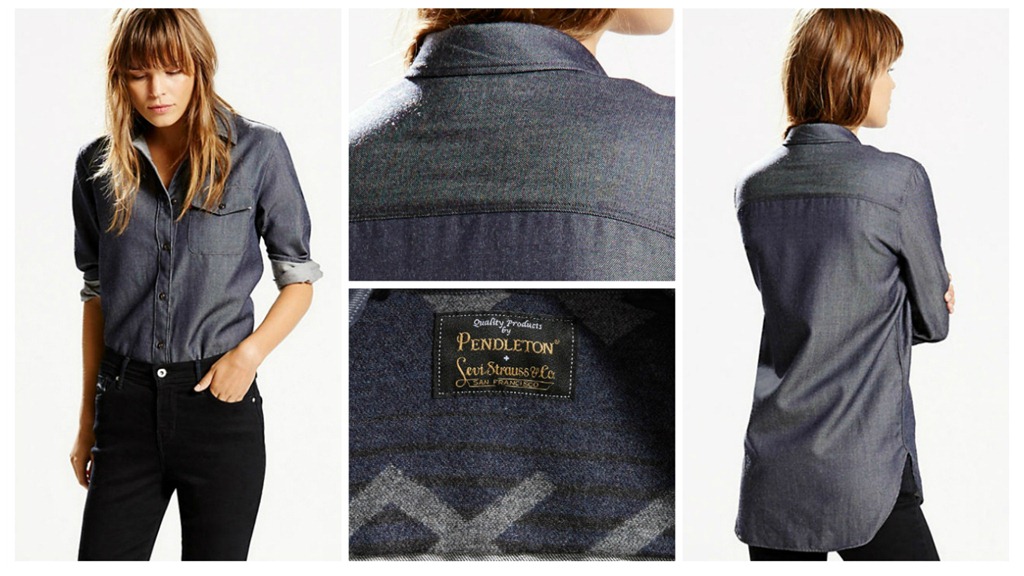
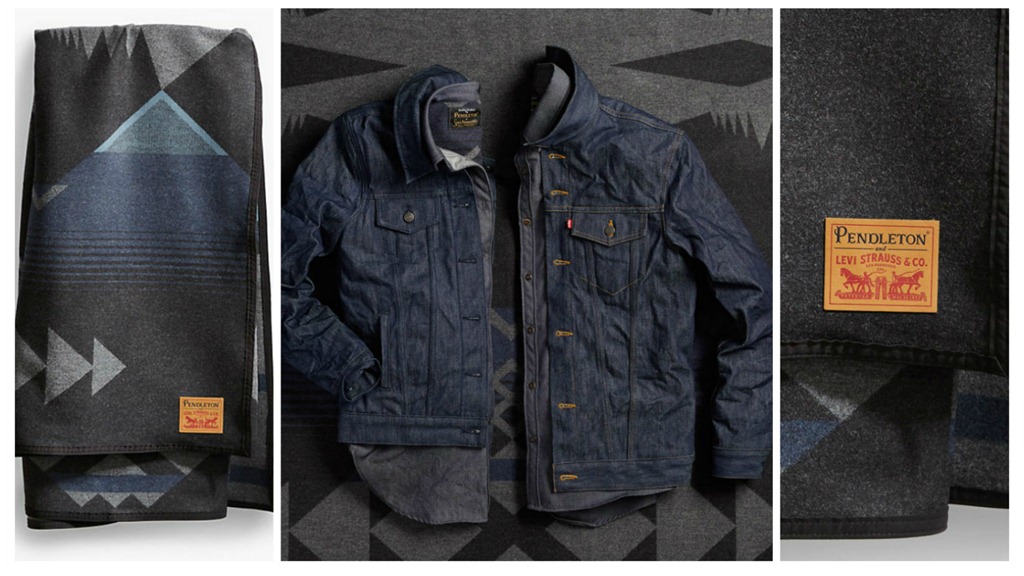
Levi’s and Pendleton – two iconic brands come up for another colloboration to create a new collection of winter staples for a second time. Premium Levi’s® denim and Pendleton® Wool use an exclusive print inspired by Native American designs and some deep indigos. The collection is entirely made in USA and pays tribute to workwear history of both companies. The collection includes a Levi’s trucker jacket and traditional work shirt lined with Pendleton’s classic Native American fabrics, done in a rich indigo palette, as well as a signature Pendleton blanket, lined in Levi’s denim.
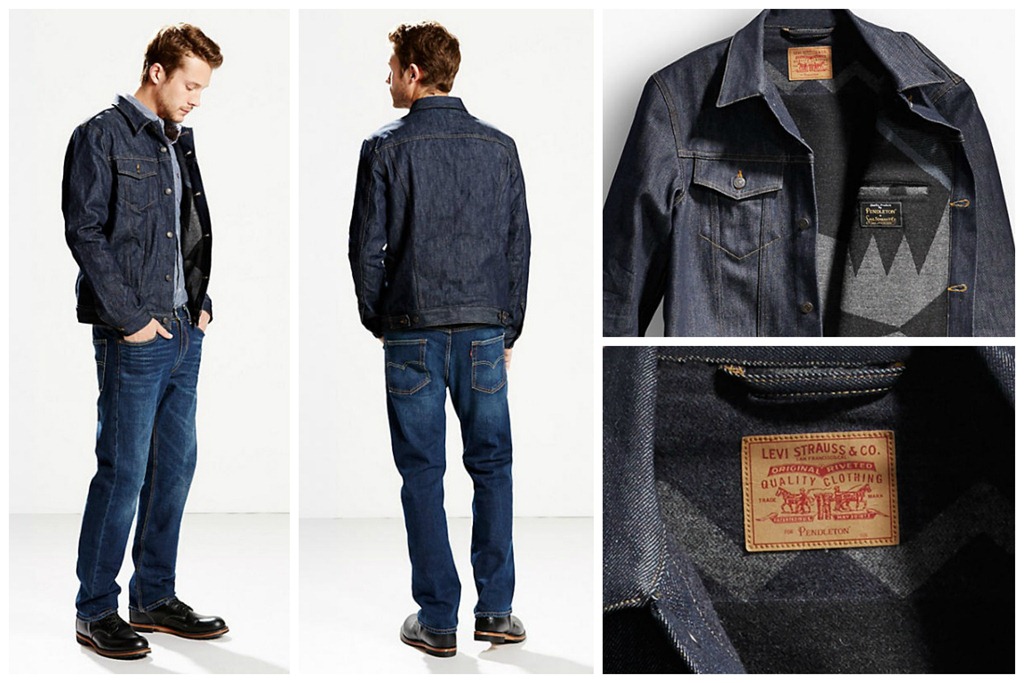
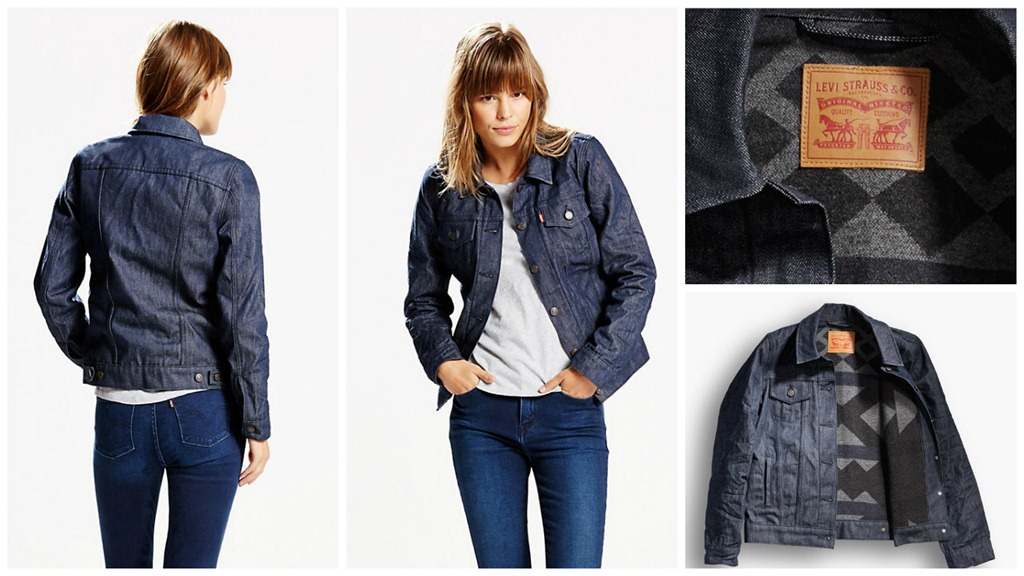
LEVIS® X PENDLETON® TRUCKER JACKET :
This classic trucker is lined with Pendleton® wool in a black, navy and gray design through the torso.
MATERIALS & FEATURES :
100% Cotton
Heavyweight Denim
Torso lined with Pendleton® wool
LEVIS® X PENDLETON® WOOL WORKSHIRT :
This standard work shirt features an indigo wool fabrication with a patterned lining across the shoulders.This collaboration uses a special year-round weave, with yokes lined in the collaboration’s unique patterned wool. The work shirts feature a blanket-lined upper panel and are crafted from a wool-denim blend unique to this collaboration.
MATERIALS & FEATURES :
100% Wool
Midweight Plain Weave Wool
Soft drape that will get better with age
Chest pocket
Patterned wool lining through shoulders
LEVIS® X PENDLETON® WOOL BLANKET :
Exclusive collaboration print inspired by Native American designs, but scaled up to create a unique take on a classic Pendleton® style. This blanket is made from 22oz. wool in a standard queen size (60×80 in.). The limited-edition blankets feature a rugged denim backing and an exclusive Pendleton pattern.
MATERIALS & FEATURES :
100% Wool
22oz. Wool
Print inspired by Native American designs but scaled up to create a unique take on a classic Pendleton® style
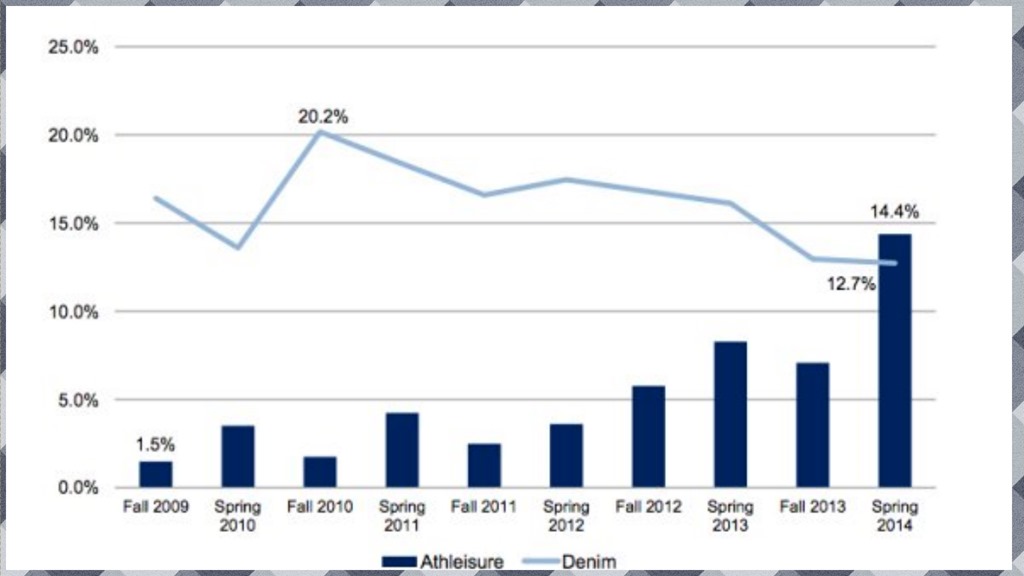
The athleisure trend has been very strong for last few years and is confounding pundits who were considering it to be just a fad . Yoga has been one of the main components of the increasing affinity to activewear and is affecting clothing lines tremendously. The denim industry is definitely influenced by this trend as sales of jeans –particularly women- were strongly affected specially in US where they fell about 8% last year as per NPD group figures. Companies like Levi’s have been particularly affected as their sales of women’s jeans went down by 10%. By mid 2014, with sales of athletic pants had risen 62 per cent from 2010—and athleisure apparel started looking less like a fad and more like a permanent addition to women’s closets. Eva Mendes, the actress and style icon, spoke for many women when she told a fashion blog that if she was seen wearing jeans, it could only mean that her softer pants were dirty.
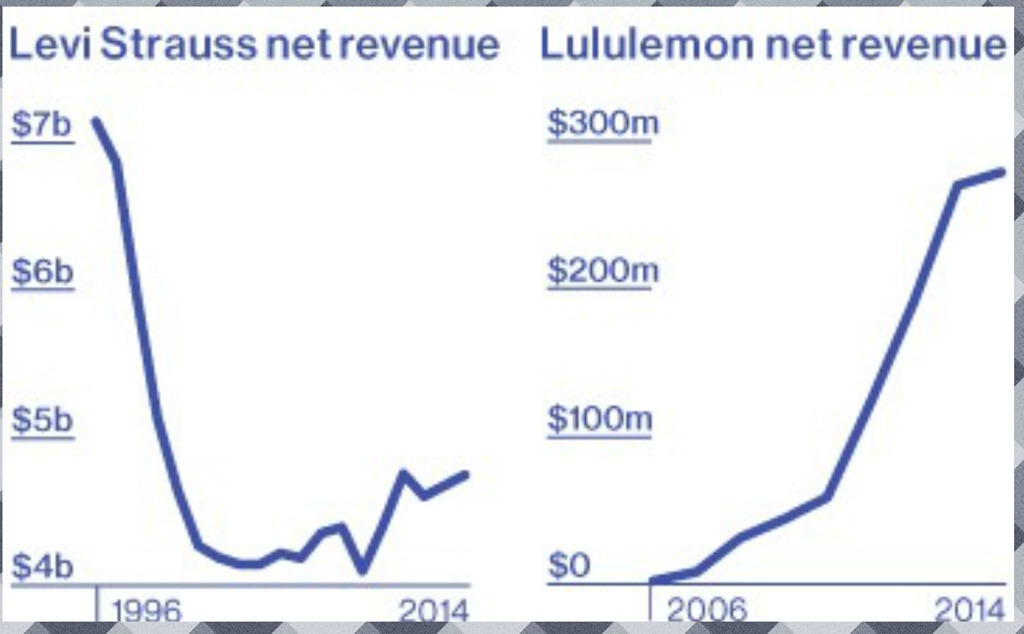
Activewear has grown faster than the overall apparel market during the past two years as more people wear exercise clothing casually. Analysts at Barclays estimate it may grow by almost 50% in U.S. to more than $100 billion at retail by 2020. A small comparison below in a report on Bloomberg shows how a small company Lulemon has grown over last few years selling yoga clothes and has actually a market capitalization of over $9 billion.
2 decades ago, Levi’s was bigger than Nike at over $ 7 billion , but now Nike crosses $30 billion in revenues and Levi’s fell to $4 billion.
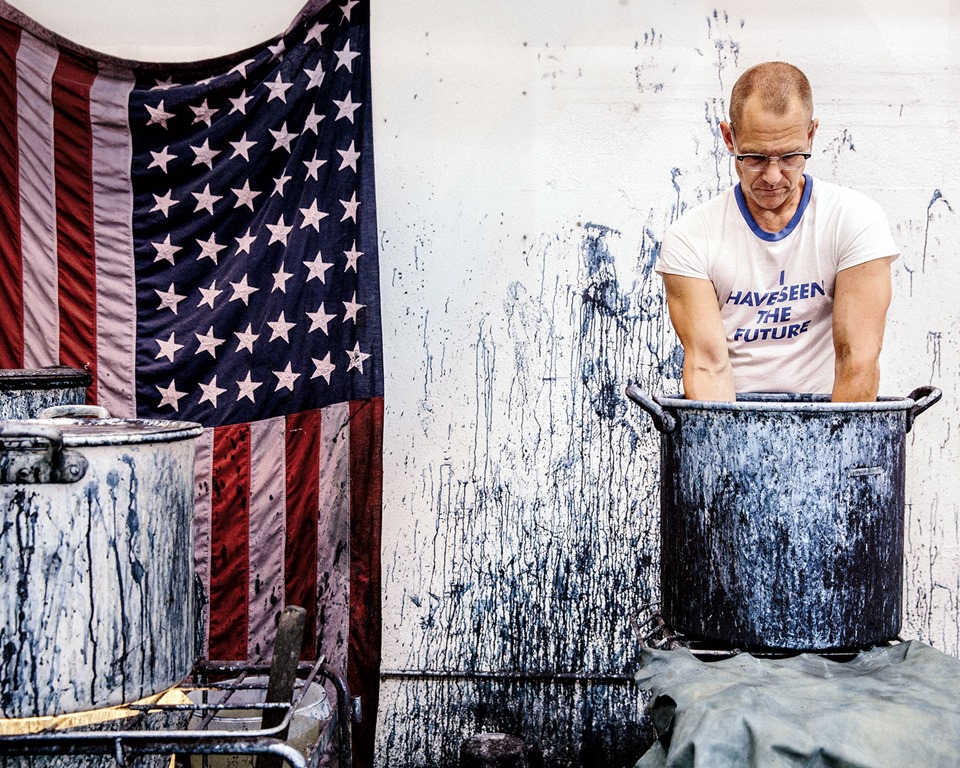
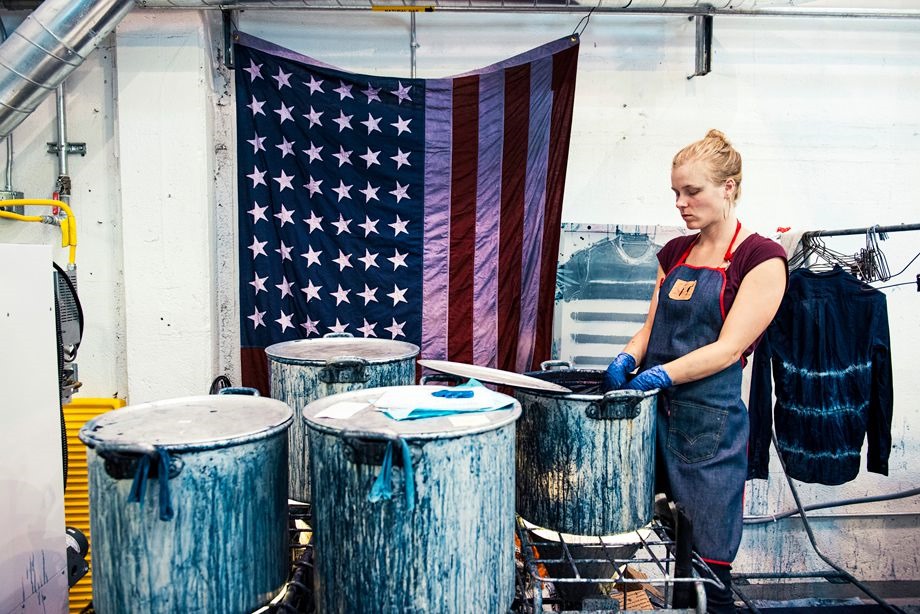
At Levi’s, the yoga pants scourge is especially vexing, disrupting a turnaround plan by a new chief executive officer that had been showing signs of success. Levi’s is , however, not sleeping . It has focused its efforts on R&D to tackle the athleisure onslaught. At the foot of Telegraph Hill in San Francisco, in a renovated grain mill with soaring ceilings and wooden beams, Bart Sights , senior Director for technical innovation is refining his recipes for denim. In his hands, stained dark blue from day after day of plunging fabric into buckets of indigo dye, he tries to work out the correct look and feel for a new skinny jeans for women using different combinations of fibers, weaves and finishes. He tries to replicate a second hand women’s jeans bought in Thailand which after years of wear has developed unique patterns all over. Artificially reproducing the wear is easy, done with sandpaper, oxygen baths, and rocks. “The trick,” Sights says, “is to get a look like this on a very modern fabric—a fabric with a lot of stretch in it.”
Source : Bloomberg.com
Sights’s team began tearing apart wet suits and other unconventional garments. “Neoprene is supercomfortable in the water because it allows movement, but it’s also superforgiving, it recovers well,†he says. “And there are some fibers in lingerie that bring these really valuable comfort attributes.â€. Levi’s is trying to use such fibers in their jeans.
Bloomberg in their report makes a mention of shoppers such as Kate Slattery, 25, a data scientist in San Francisco, one of dozens of women interviewed for this story, says she hasn’t bought a new pair of jeans in more than a year but did splurge on Lululemons. She loves their clever pockets. Asked for her take on Levi’s, Slattery draws a blank. “My view of Levi’s is probably 15 years old,” she says, “because I just haven’t even considered shopping there since my mom shopped with me.”
Source:Bloomberg.com
Levi’s developed a new line called Lot 700.-a nod to the original women’s jean, Lady Levi’s Lot 701, introduced in 1934. The new one features the retro “Two Horse” leather logo patch on the rear waistband and adds larger back pockets to accentuate the seat. Another style, Lot 300, uses a more girdle-like design for a different shaping effect. The 501ct can be worn in a looser fit.To blunt its sales decline, Levi’s rushed some of the new materials that Sights was working on to market in the summer of last year, infusing skinny and midrise jeans with additional soft and stretchy material.
Levi’s finally introduced the new women’s line earlier this month, at an event in Manhattan’s clubby Meatpacking District. Large photographs displayed up-and-coming female artists wearing Levi’s, and six models stood like mannequins wearing the Lot 700 line. Holding court near the door, James Curleigh, Levi’s president, said he expected the women’s reboot to help the company increase wholesale prices over the next three years. Macy’s is doubling the amount of space for the brand in its flagship store in Manhattan and adding floor space at stores across the U.S., according to Louis Mastrogiacomo, who manages the women’s ready-to-wear category for Macy’s. Feedbacks from customers seem to be good , though whether these jeans will make them abandon yoga pants is doubtful and remains to be seen.
Levi’s is the world’s oldest and largest denim brand. The family-owned blue jeans pioneer — founded in 1853 and adopted by everyone from miners, cowboys and railroad workers to greasers, rockers and hippies — has long been linked to a potent blend of democratic, rebel-infused Americana. Bruce Springsteen wore a pair of classic Levi’s 501s on the cover of his album “Born in the USA.â€
Levi’s is the world’s oldest and largest denim brand. But despite its powerful story, Levi’s hit its commercial peak back in the 1990s. In 1996, annual sales at parent company Levi Strauss & Co.reached $7.1 billion. By 2003, however, revenues had fallen to $4.2 billion and, over the last decade it faced competition from a number of retailers, high street brands , fast fashion retailers and hardly experienced any growth in this period. Fast-fashion retailers and other value players, offering very low prices, took the bottom off the business, while new premium denim specialists targeted the top. Speaking to Business of Fashion (excerpts taken from there)James Curleigh , global President for Levi’s says
“There are more denim brands born this century than in the previous 104 years.All of a sudden, we get attacked by premium. All of a sudden, value and own-label and fast fashion come and try to take a piece of the business. Traditional competitors, like Wrangler and Lee, also wake up to a moment of denim growth,†he continued. “So, you’re getting attacked by premium, value, traditional and fast fashion..
“Because you’re the leader, I think it’s natural, at first, to not be reactive and say, ‘We’re the original. We’re just going to stick with what we’re doing.’ Whereas everybody else is going, ‘Ok, I’m going to do these funky new washes, I’m gonna try use super-stretch fabrics, I’m going to offer different cuts of denim,’†said Jonathan Cheung, senior vice president of design, who joined the brand in 2009. “It’s been a big challenge for Levi’s.â€
The company has regained some lost sales . In 2014, revenues touched $4.7 billion, growing for the second consecutive year. But Levi’s needs to address host of other issues in the denim market , including softening demand.In August 2014, American market research company NPD Group reported a drop of 6 percent, year-on-year, in overall denim sales in the US.
The company recently launched a tapered version of the jeans, called Levi’s 501 CT (which stands for customized and tapered). “501 CT started off as a conversation between myself and Karyn Hillman [Levi’s chief product officer] and how we wore our 501s. We’d go to the store, bump into people and discover popular alterations,†explained Cheung. “For years, people have taken the iconic 501 and customized them by getting on a sewing machine and giving the legs a little taper. With the 501 CT, we’ve done that work for you.â€
Levi’s A Lifestyle Brand
Levi’s is aiming to be not just a jeans maker but a true lifestyle brand. Currently about 80% of Levi’s revenue comes from sales of denim pants. However, they realize that only 7-8% of a consumer closet is filled with jeans. More than 90% of the products are not denim. Hence the need to focus on the range of product categories which connect to its brand heritage. Eg Trucker jackets, T-shirts , belts etc. Levi’s mentions that it is hardly known that they are the worldwide leader in branded belts and these kind of products they would like to focus on to increase their revenues.
Increasing Share Of Women’s Denim
For Levi’s Men’s is about 75 percent to women’s 25 percent of the total business and is highly skewed in favor of Men’s . “There’s opportunity in our gender balance and we’re going to give a big surge on women’s in the second half of the year†say Cureigh. Women’s jeans is an underexploited opportunity for for Levi’s and this is where they are going to focus on during this and the coming years . Their Curve ID and Revel had some great responses and the brand wants to extend that and take a complete relook at their women’s business.
“One route could be through further targeted products, moving beyond figure-flattering styles. For example, VF Corp’s Wrangler brand launched its Denim Spa collection in 2012, which incorporates moisturizing and cellulite-reducing treatments,†she continued. “Alternatively, Levi’s could align its ranges to fashion trends. Capitalizing on the on-going demand for colored, printed and textured denim could keep consumers engaged.â€
Strong focus on innovation
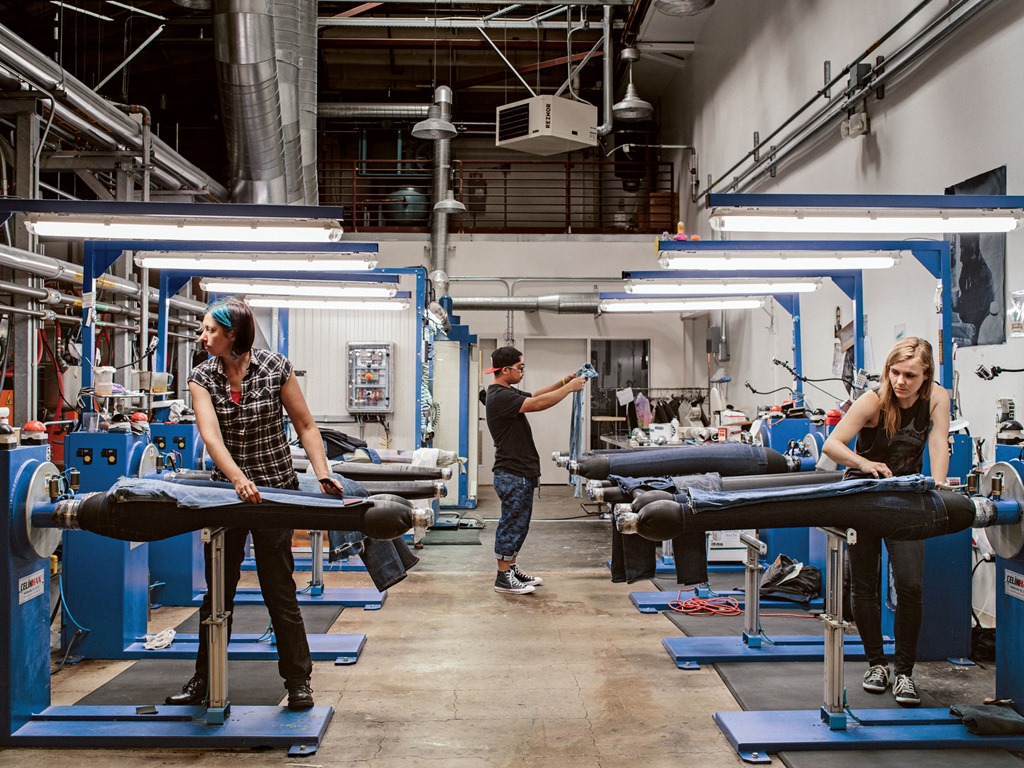
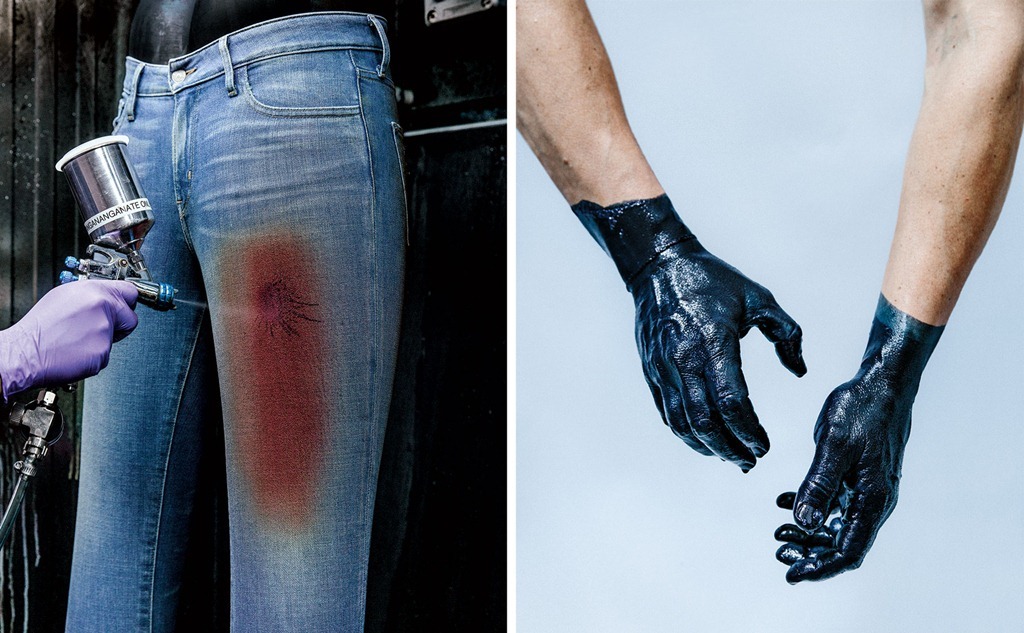
Company has opened a Eureka Innovation Lab, which opened at the base of Telegraph Hill, a few blocks from the company’s main office, in 2013 and houses about 30 technicians, some of whose arms have turned blue from working with the indigo used to dye blue jeans. Levi’s previous innovation center was located in Corlu, Turkey, thousands of miles away from the company’s headquarters, making it slow and costly for the design team to develop prototypes. The Eureka lab is developing over 30 prototypes a week and include the successful Revel Jeans using the liquid shaping technology as well as the Commuter series with a metallic finish that looks normal during the day but lights up during the night enabling the biker to be easily seen at night. The new 501 CT was also a product of Eureka.
Levi’s is looking ahead to continuous growth with the 2014 fourth quarter results growing 10% (however a large part of this was due to Black Friday sales week which was an additional week in the year). The brand is hopeful and looking for some great growth figures in the coming times as it expects the denim brand space to clean and creating more space for growth.
Levi Strauss & Co. announced that they’ve developed both the technology and a 3rd party certified standard to produce clothing using 100% recycled water—a landmark development for an industry heavily reliant on water for textile finishing.
LS&Co. has implemented the 100% recycled water standard in a factory in China and soon they’re going to expand to a factory in Nicaragua, with the end goal of taking this technology to their supply chain and publicly sharing their 3rd party standards for other retailers to use.
This appears to be an industry first and is verifiable by third parties and aims to reduce the impact of garment production on water resources.
The process is being used in one of the brand’s key Chinese factories, which bleaches, dyes and stone washes garments to achieve specific looks or feels.The factory, located in southern China, worked with Levi Strauss produce over 100,000 pairs of jeans with the new technology.
The process is still in the testing phases, but the goal is to eventually use 100% recycled water to finish a broader range of Levi Strauss products at factories in other parts of the world.
Michael Kobori, VP of Sustainability at Levi’s replied to questions from Denimsandjeans.com about the various aspects of this process
What % of waste water is recycled in this process?
In our test program we focused on showing it was possible to finish high quality products using 100% recycled water. Only a portion of the water used within a factory was recycled and treated for re-use. Since we do not know the total volume of wastewater produced in the factory for other brands, we cannot calculate the percentage of wastewater that is recycled.
Do you think the cost of such recycling is economically feasible for your products ?
As with Levi Strauss’ Water<less program, there is an investment in equipment, however, factories using our 100% recycled water standard will see cost savings over time because they will use less water and energy. There are also many social and environmental benefits that are harder to quantify, such as reducing the use of shared resources in neighboring communities in an era of increasing water scarcity. The cost of water still artificially cheap in many parts of the world, and Levi Strauss & Co., along with its suppliers, is focusing on the sustainability benefits of this program.
Does this process require some high end technological equipment not normally used in garment factories?
Our standard will require some new equipment to be installed but these advanced wastewater treatment technologies are available to all suppliers. Participating factories have the flexibility to install whatever is the most cost-effective combination of equipment to meet our stringent Recycle & Reuse water quality standard. Depending on their particular existing wastewater quality, some factories will find that only a relatively modest investment is required to qualify for the program.
Do you see this technology being used for a larger portion of your productions worldwide ?
We don’t want to stop at one laundry with 100,000 units. The goal is to scale it across many of our factories and collections, depending on the economic feasibility among individual factories. We are currently working with suppliers in Central America, Pakistan, and China to evaluate their potential in the program.
This is a unique initiative from Levi’s and, if successful , can change the way the industry makes apparel worldwide with a huge positive impact on water resources.
Download the Levis Water Recyle / Reuse Standard here.
Levi’s is trying to touch new heights on the ladder of corporate social responsibility by ensuring in various ways that its suppliers adhere to practices which are good for the workers and for the society as a whole. Since , Levi’s hardly has its own manufacturing left now, it is dependent on factories around the world in Asian , South American and African countries to make products for them . On the one hand, it increases the need to monitor and control these factories , but on the other hand , it also gives Levi’s the power to affect the lives of people connected with these factories and of the apparel industry as a whole .
While Levi’s recently announced its decision to ban Sandblasting in its factories to prevent harmful effects on its workers, it has now gone a step ahead and announced the new terms of engagement for its suppliers. The main idea behind this announcement is to move beyond compliance to help improve the lives of workers in factories around the world. Under the new approach, the company will require contract factories to help make employees’ lives better by supporting programs for their workers that align with the UN Millennium Development goals.
Levi’s President and CEO – John Anderson – announced at the recently held CERES conference these new terms in his speech. Here is the complete speech – its quite long . I tried to cut it short – but was difficult to do so without his address losing some of the meaning and intent . The speech is quite an honest one and shows that the company is strongly focused to make these terms work . However, the challenge for the company would be to balance the demand for getting products at the right price vs that of getting
“ John Anderson :
I’m honored to be invited to speak to you here today. For years, CERES has helped advance the debate about what it means to be a responsible company. All of us at Levi Strauss & Co. have felt the impact of your work, and we have been honored to partner with you. We’ve been particularly proud to be a founding member of BICEP – Business for Innovative Climate and Energy Policy – the CERES-led business coalition providing the business case for innovative climate and energy policy to ensure U.S. leadership and competitiveness. CERES has furthered that leadership with the Investor Business Roundtable announced this morning. We know the success of this Roundtable will depend on the pledges from companies in this room. Levi Strauss & Co. is proud to heed this call with a commitment to action in our supply chain. My remarks today will outline this approach.
I want to look ahead – ahead at what I propose ought to become the new apparel industry standard of social, economic, and environmental sustainability. As I will explain, this new standard isn’t just for apparel companies like ours. It establishes a new, higher set of expectations that investors, activists, and governments should all promote. It applies to all of us in this room – whether you work for an auto manufacturer or a technology company – or you have vendors that employ workers around the world.
Twenty Years Ago: We Pioneered A New Standard
For us at Levi Strauss & Co., this is a good time to think about raising the bar. Twenty years ago, we established a set of labor standards for our suppliers around the world. We called them our Terms of Engagement. We believed – and we still do – that a successful global company must set a high standard for ourselves and the factories we do business with around the world. So we took the labor, health, safety, and environmental standards we used in our owned and operated factories and effectively told our partners: “this is now your standard – regardless of where you operate.†To put it mildly, we didn’t win much applause initially. Some of our competitors snickered. They thought that it was just the “do gooder†Levi Strauss & Co. being impractical and idealistic. Many predicted we would go out of business because we were asking global suppliers to do what critics considered was beyond the scope of companies: To demand their supply chain treat their workers with dignity, respect, and fairness and to run safe, clean factories. And, of course, there was also a real dollar cost to this decision. Both to us and to our suppliers. Our competitors weren’t the only skeptics. Many investors and business leaders scoffed… asking: “why should a company take on a burden that was the government’s responsibility?†But, two decades ago, the leaders of our company, in particular our then-CEO Bob Haas, wouldn’t be swayed. They wouldn’t be pressured by the critics. And they were heartened by the support they received from labor and human rights leaders – including some of you here today –who believed that a responsible and successful global company was obligated to take this step. In the broadest sense, our Terms of Engagement worked in ways bigger than we ever imagined. Not only did more than 90 percent of our suppliers accept them, we discovered that we’d set a new standard. Before long, our Terms of Engagement became the new normal. Almost every apparel company with a global supply chain established their own version. Compliance became the new yardstick for measuring how responsible companies performed. Before we knew it, independent watchdog groups were monitoring us, keeping check lists, and holding us accountable. In fact, many in this room help keep us honest by asking the right questions on the ground every day. Five years ago, we disclosed our list of suppliers around the world. That enabled labor and advocacy groups, the media, and other companies to help us identify 3 and address problems when they develop. In this area, above all, transparency works. It makes a difference when groups like Ceres demand it.
The Limits of Compliance
There is, of course, still much to do. With factories in developing countries around the world, there were – and always will be – problems on the ground. From the tragic factory fires in Bangladesh to abuses against migrant workers, we still see setbacks. In fact, I think most of us would have to agree that any honest assessment of global compliance programs in our industry would give only a middling grade. While we’ve made progress in a number of areas over twenty years, the hard truth is: we haven’t made nearly enough progress on improving the everyday lives of the people who make our products. In fact, the reports we continue to receive about problems in factories should challenge us to update our Terms of Engagement for the next twenty years; to re-examine our current compliance approach. Compliance has us focused – perhaps obsessively so – on two things: a standard of
“do no harm†and
factory-level monitoring and reporting.
We measure very well what our factory suppliers are doing – or not doing – to meet these global standards. But we pay less attention and devote fewer resources to the real, everyday outcomes for human beings. Many of us in the apparel industry are too familiar with the fire extinguisher story.
One of our compliance monitors noticed that a fire extinguisher was hung awkwardly on a factory wall with a slide that allowed it to move to different heights. What was going on with the fire extinguisher, she asked. “Well, one company says the fire extinguisher must be hung 2 feet off the floor. nother brand requires it to be 4 feet off, and you want it 3 feet off the floor.â€
As you know, stories like this can be found all through supply chains in the developing world. In some cases, good intentions have gotten smothered by compliance regimes. A couple of years ago we surveyed our suppliers around the world. We discovered that some of them were monitored an average of 25 times each year. Every two weeks, a monitor from another brand would come and check records, do a walk through, interview workers, and talk to management.And that was just the average!
Can you imagine – in your own organization – if an inspector came every two weeks to demand senior management do an audit? And, during the audit, demanded slightly different corrective actions than those required two weeks earlier?
You wouldn’t have time to make many of the requested corrections, much less do your work. I don’t want to minimize or trivialize the importance of monitoring, compliance, or reporting. I don’t think global companies or their suppliers should be let off the hook. Absolutely not. But if our ultimate goal is to improve not just factory conditions, but to make a material difference to the people and communities in our supply chain, then we need a more holistic approach…a more human perspective. I want to be very clear on this point, because I don’t want to be misunderstood about the commitment at Levi Strauss & Co. to enforce fundamental standards of worker rights, health, safety, and environmental protection. Our record, our history, and the recognition you have given us should leave no doubt on that front. We will continue monitoring and working with our suppliers and others to improve compliance with our Terms of Engagement. Our New VisionBut we need to do more.
Today I want to share our vision for the next stage in the evolution of our Terms of Engagement.
Going forward, Levi Strauss & Co. intends to propose a new approach in this arena. In our view it is a higher standard and tougher standard. But we also think it is a better standard. Better for the employees who work throughout our supply chain. Better for their communities. And – I say this without apology –better for our business. Our new Terms of Engagement, to be spelled out in detail over the next year, will ask our suppliers and partners to do more. Us to do more. But it will also give all of us a new and more productive focus. Our intention is to build new requirements for our key suppliers that align with the United Nations Millennium Development Goals. These goals – not merely compliance – ought to be the new standard of engagement, and the common objective for every company in our industry. These goals are known to everyone who has been active in global development. They have been endorsed by every nation in the world. And they should be the philosophic underpinning of how we support the people who make our products. We intend to work with our suppliers to focus on several of the eight MDGs, because we believe the apparel industry is best positioned to help drive results on these. Among them are:
eradicating extreme poverty and hunger
improving maternal and child health
combating HIV/AIDs, and other diseases
promoting gender equality and empowering women
ensuring environmental sustainability
Following the rules and conditions of labor rights and workplace safety and health will continue to be an embedded part of the way we operate. We have no intention of stepping back from our compliance requirements. But in setting our sights on alignment with the Millennium Development Goals, we are actually asking our suppliers to do more: We are going to find new ways to measure success by focusing on improving the actual living conditions of workers whose lives we touch. I know this all sounds a bit abstract – so let me give you an example of the kind of program we believe should be adopted in factories around the world.
The Levi Strauss Foundation has been supporting a pilot program to increase financial literacy among apparel workers, developed by an NGO called Give to Colombia. This groundbreaking partnership provides financial training, matched with savings accounts and microenterprise development programs for workers in the apparel industry in Medellin, Colombia. Workers receive education about family budgeting, assessing credit worthiness and understanding the importance of savings as a way to ensure their family’s future.Those who start a savings account receive access to government programs such as credit for low income housing, with preferential interest rates. It may seem counterintuitive that a company would work to require its suppliers to provide savings accounts for workers. But these programs generate real results in improving the lives of workers. This in turn creates stronger, more effective factories.
Other programs we’d like to implement with our suppliers include access to HIV/AIDS education, and access to maternal and infant health services. When it comes to the environment, we’re focused on setting targets for measurable reductions in material, energy, and water use by our suppliers. Programs like this are happening on various scales with companies around the world – but we’d like to be the first company to build them into our business model and contracts with factories around the world. And while we may be the first on this front, we don’t expect to be alone on this journey for long. We know the world of global sourcing and manufacturing. We know our industry colleagues want to find solutions that are good for their people and good for their business. I am absolutely confident that they will see this integrated, forward-looking approach as a better solution. This vision – working with our suppliers to help make employees’ lives better by supporting programs for their workers that align with the UN Millennium Development goals – is admittedly, quite ambitious. And like the Terms of Engagement we established twenty years ago, we do not believe this will be achieved overnight. How we will implement this vision We are clear about our vision. But we would not be so arrogant to suggest we have all the answers about the best way to create the metrics we need to drive change. Making it work and persuading others to join us won’t be easy. But we are determined to make it work. We have to make it work. That’s why we aren’t simply issuing a new rule book from San Francisco. We’re proposing working with the experts in this room – as well as those outside it – to develop a public white paper with recommendations for action. And we’re making a commitment to start implementing these programs in our supply chain by this time next year. We’re going to begin with the CERES stakeholder engagement model and invite a group of interested NGOs, brands and labor leaders to advise us. We’re also going to work very closely with our suppliers on the ground to make sure we’re creating local solutions that can be scaled up in order to really address the apparel industry’s most pressing social issues. And we’ll continue to seek advice from the Levi Strauss Foundation and other leading global organizations that have been doing work in the apparel industry for years. What we ask of you In addition to your advice and expertise, to make this work, we also need you to help raise awareness about this new standard. We can’t do it alone. Progress will be incremental. And we will surely continue to have occasional problems that might be embarrassing. Undoubtedly, with thousands of factories around the world, there will always be short-term supply chain issues. But true to our history, we want to make our long-term commitment clear – and we want to honor our history of staking out new ground as pioneers. With your help, we hope it will trigger a sea change in the way Terms of Engagement evolve across industries. The next twenty years are going to be very different for both our economy and the world. We want to help shape that future. To achieve it, we are convinced that a new approach to corporate responsibility is needed. We are sure that if companies focus not just on the legal requirements, but on a broader vision of social, economic, and environmental sustainability, they will be rewarded. Ultimately, we strongly believe that higher standards will drive better performance and results in our suppliers’ factories. Five years ago, the Levi Strauss Foundation partnered with Business for Social Responsibility to launch HER-Project, a woman’s health education program in factories in Bangladesh, China, Egypt, and Pakistan. The program is touching more than 90,000 women in 65 facilities. The focus is on women’s health outcomes, helping factory workers connect to existing health care services nearby. A study found that for every dollar invested in building the capacity of factory health clinics, health education, and training, three dollars of return are realized in the form of increased productivity on the factory floor. Let me repeat that – one dollar invested provides three dollars in return:
Greater concentration on the shop floor.
Less absenteeism.
More production targets met.
These are exactly the kinds of results socially responsible investors have told us we could achieve. The workplaces of the 21st century will be stronger when workers have the tools to improve their lives. When they are given healthy and safe workplaces, they become more productive, dependable, and efficient. We can demonstrate that investing in workers is what you do because, one: it’s the right thing; and two: it yields profitable returns. We see this as an indispensable component of a true sustainable growth story. It is a business plan and an investment plan that will work. As investors and close observers of business, you know what we mean.
So my message to you is: please join us.
Help convince our industry and other industries that improving the quality of life ought to be the real touchstones for the next stage of activism and engagement. We need your help. It will create better companies. It will create a better world……â€
Here is a small video which gives more insight into these new proposed terms of engagement:
Levi’s has started offering a new collection of jeans which consumes less water .
The logic behind this ?
Levi’s did a ‘Cradle to grave’ study for its 501 jeans and found that about 3480 ltrs of water in its entire lifetime !! . This is a phenomenol amount of water to be spent on a single pair of jeans . The majority of this water is spent by consumers during the washing process of jeans at their homes . Though Levi’s could not control the water that consumers use at their homes, it decided to use the ozone technology to wash its new collection so that it could save 28% of the water that is spent in finishing process.
The Result : A new collection of Jeans from Levi’s which
a)Will save about 10 ltrs of water per jeans .
b)Levi’s expects to sell about 1.5 million such pairs ie about 15-16 million ltrs of water saved.
Here is a very interesting video from Levi’s to explain their concept of water saved in this new collection.
However, though the intention of Levi’s is quite noble, the effort on its part will only save 0.3% of the water that is used in the life cycle of the jeans. The jeans manufacturing causes a lot of damage to the environment in terms of its entire production cycle from Cotton growing , to dyeing and weaving and finishing .There is a need to reduce the consumption of not only water but also energy, pesticides and to ensure that wastes are recycled . There needs to be developed a concerted campaign to draw attention to the damage that is being done and alternative technologies need to be developed for the same. Eg a number of companies are producing ozone washing machineries – which should be encouraged , lazer washing is another technology which saves a lot of ecological damage .
At consumer level , we need to make the people aware of the need to wash their clothes only when necessary and this applies to all clothes including denim jeans. Then only it might make some REAL impact on the environment.