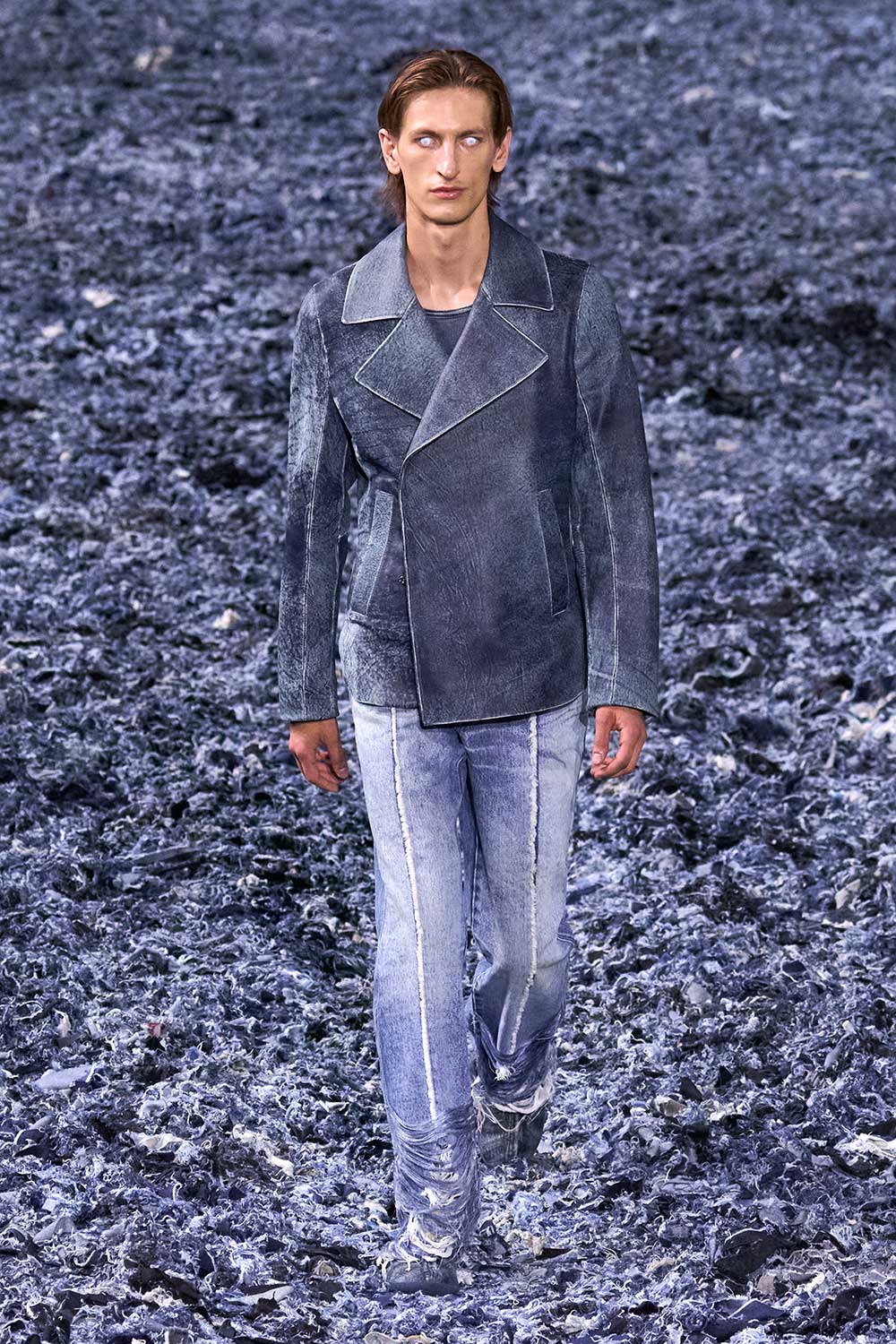
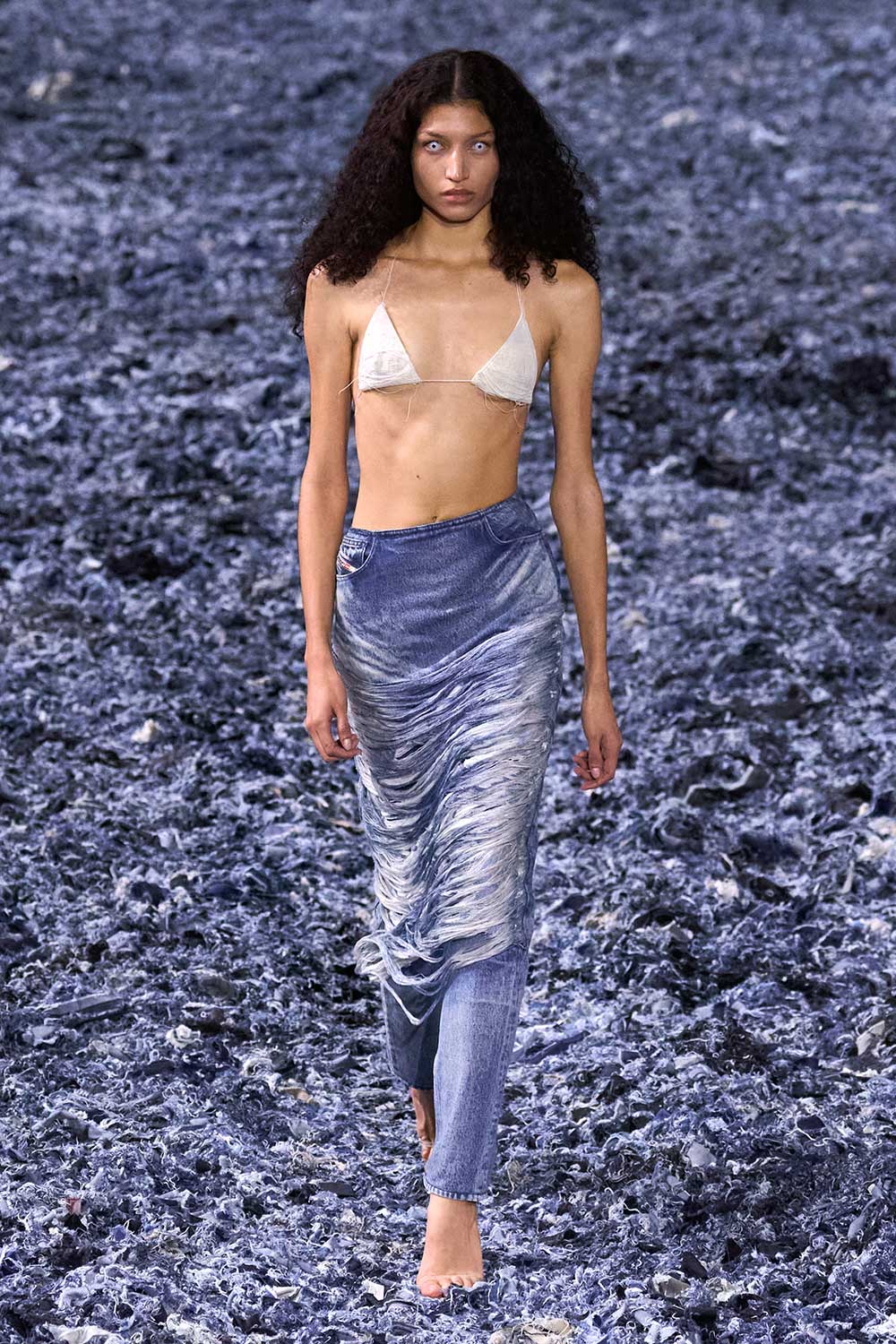
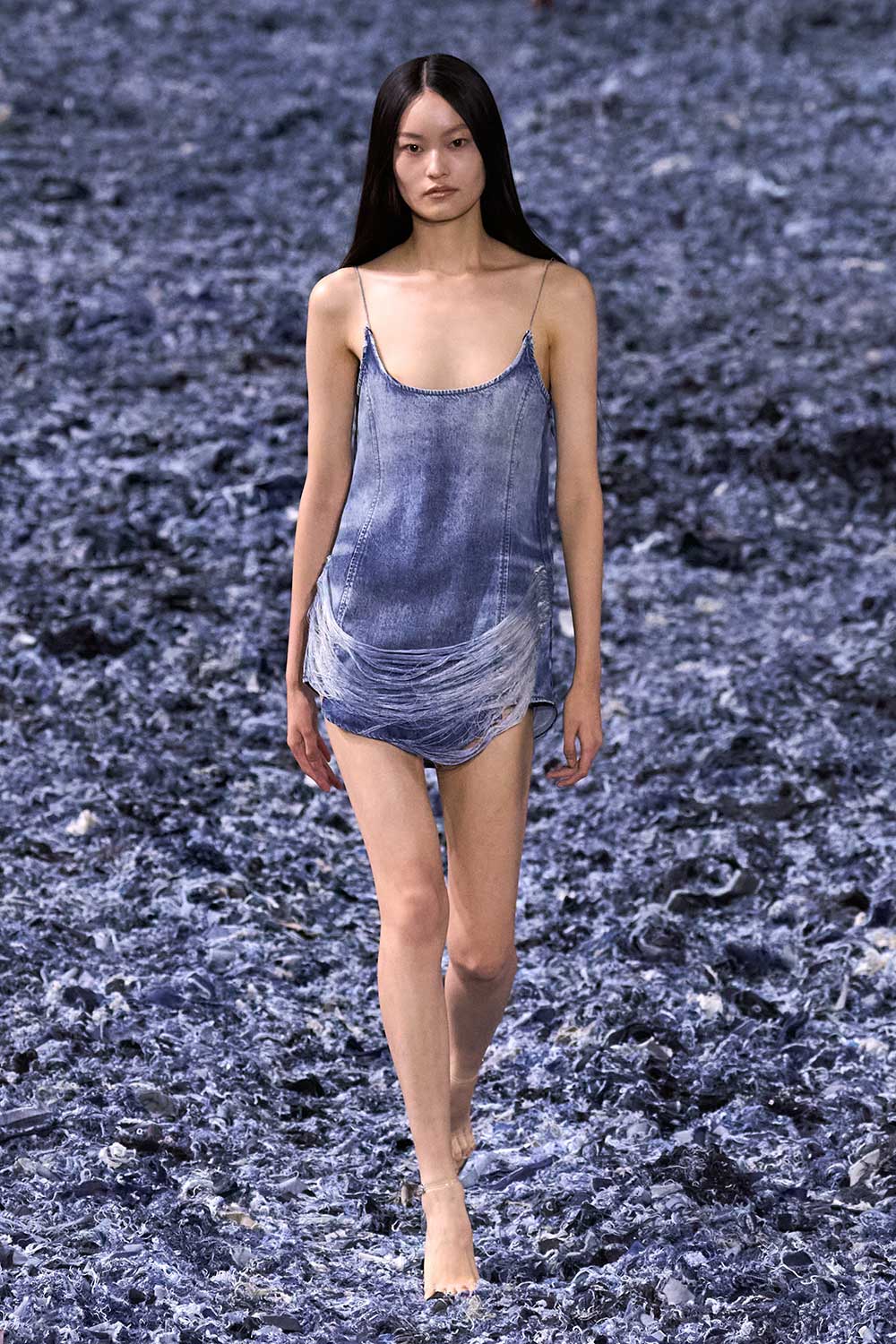
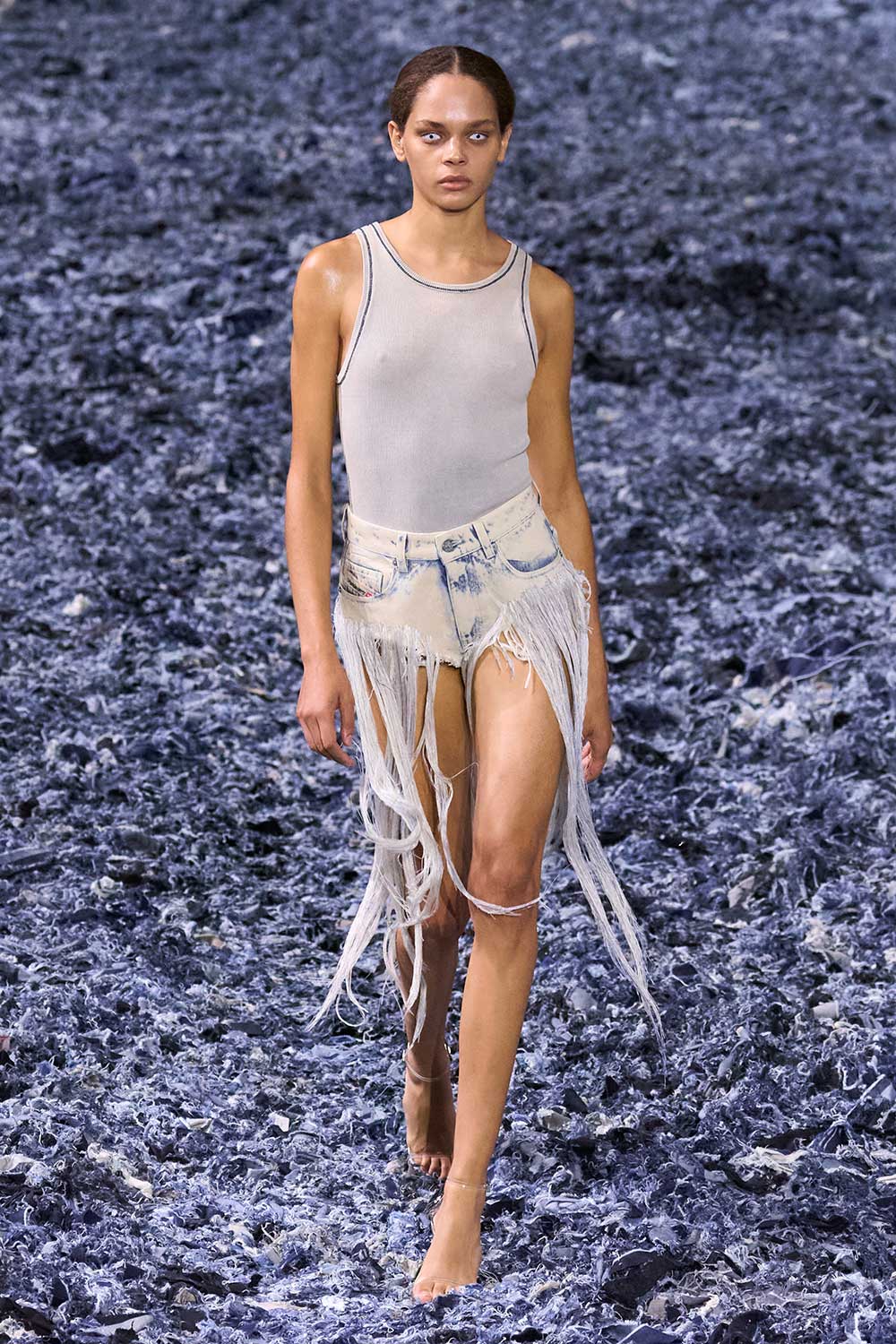
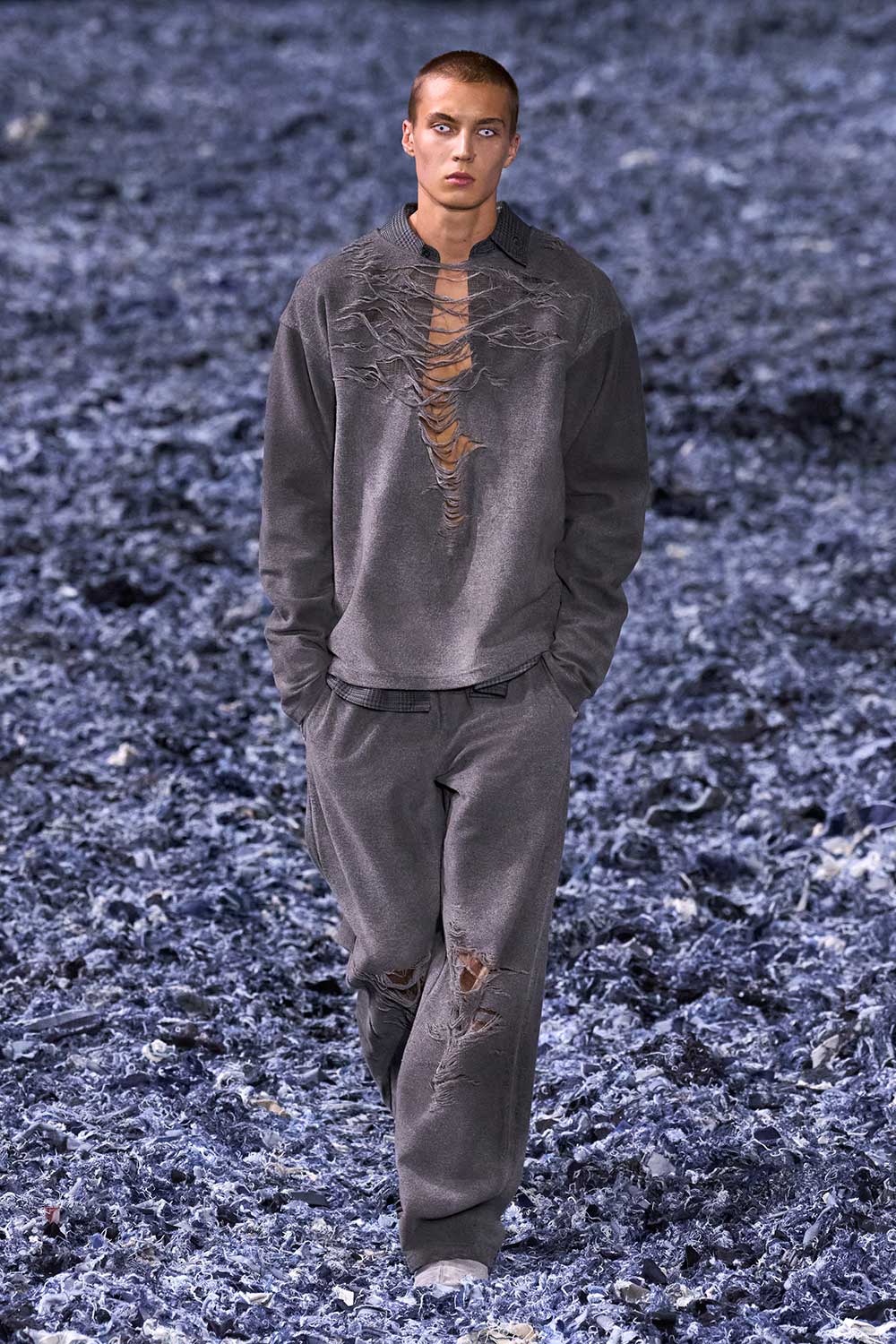
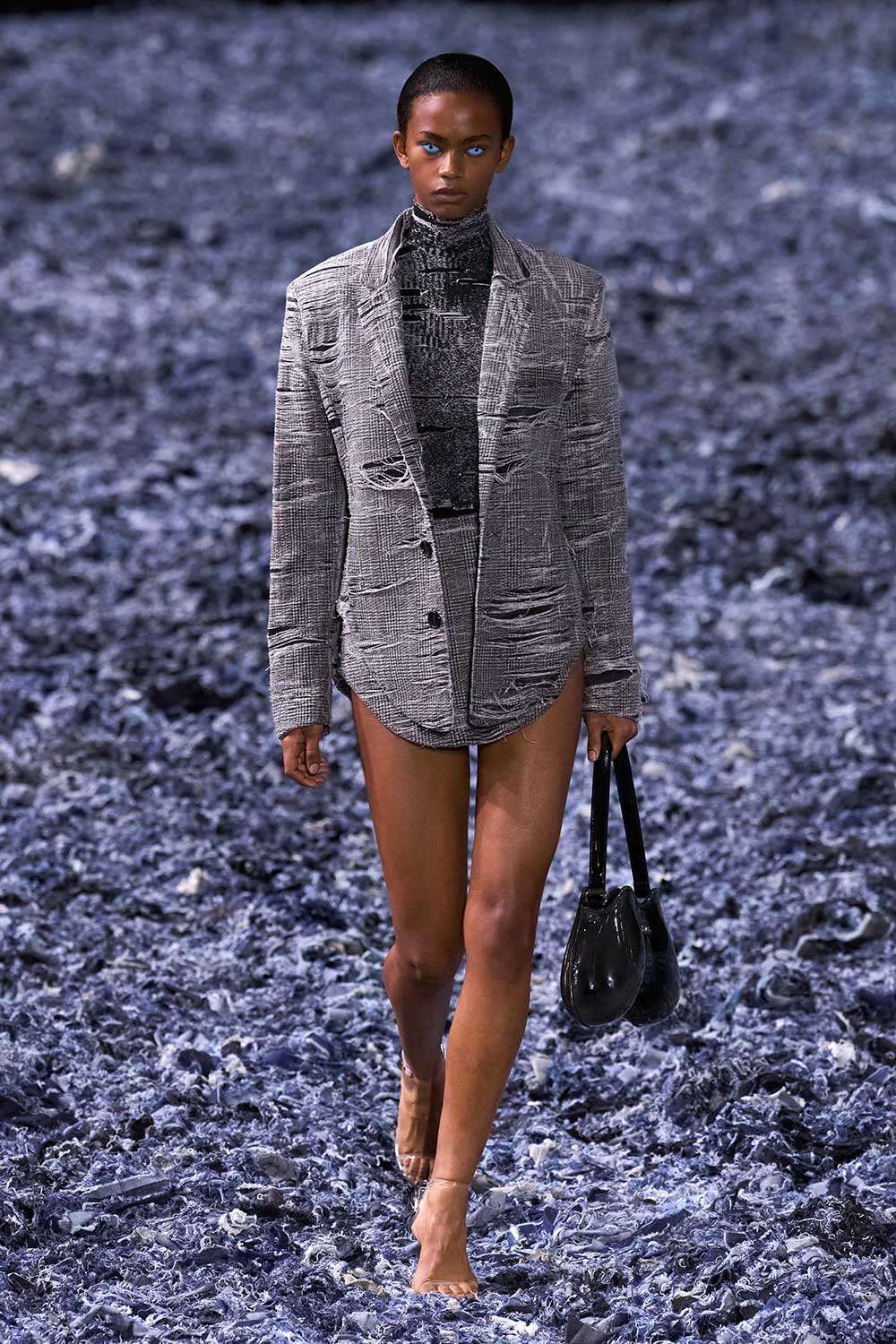
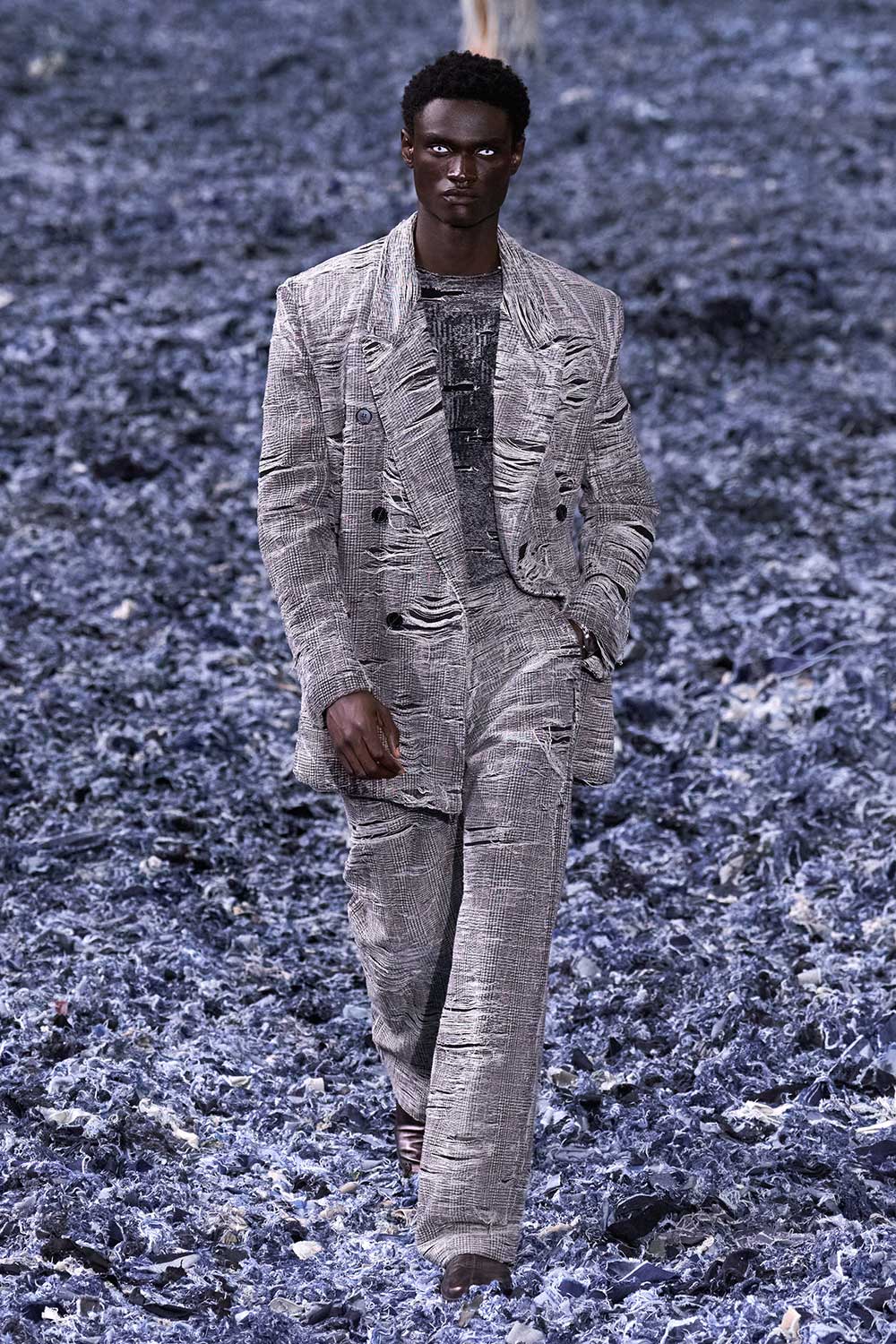
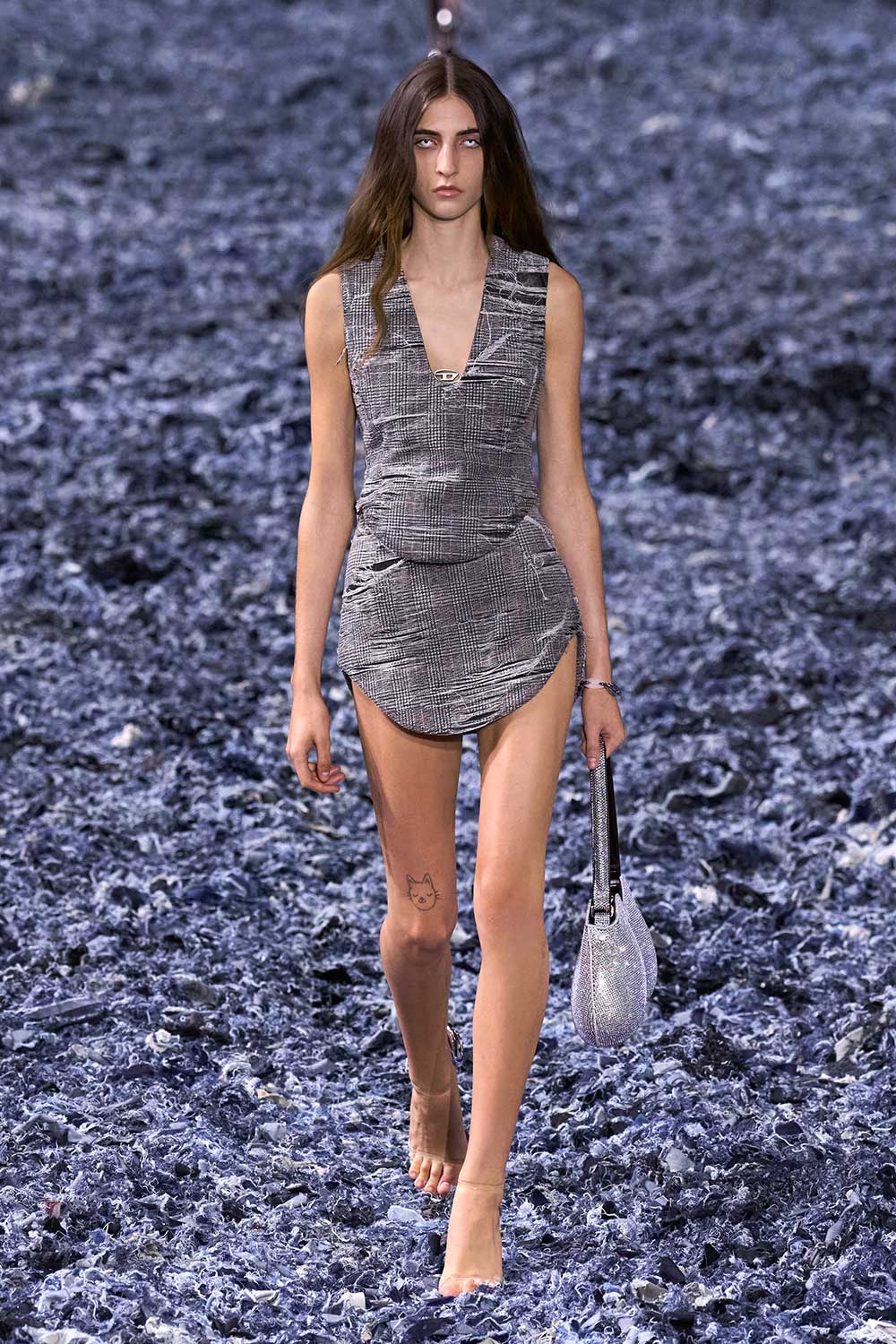
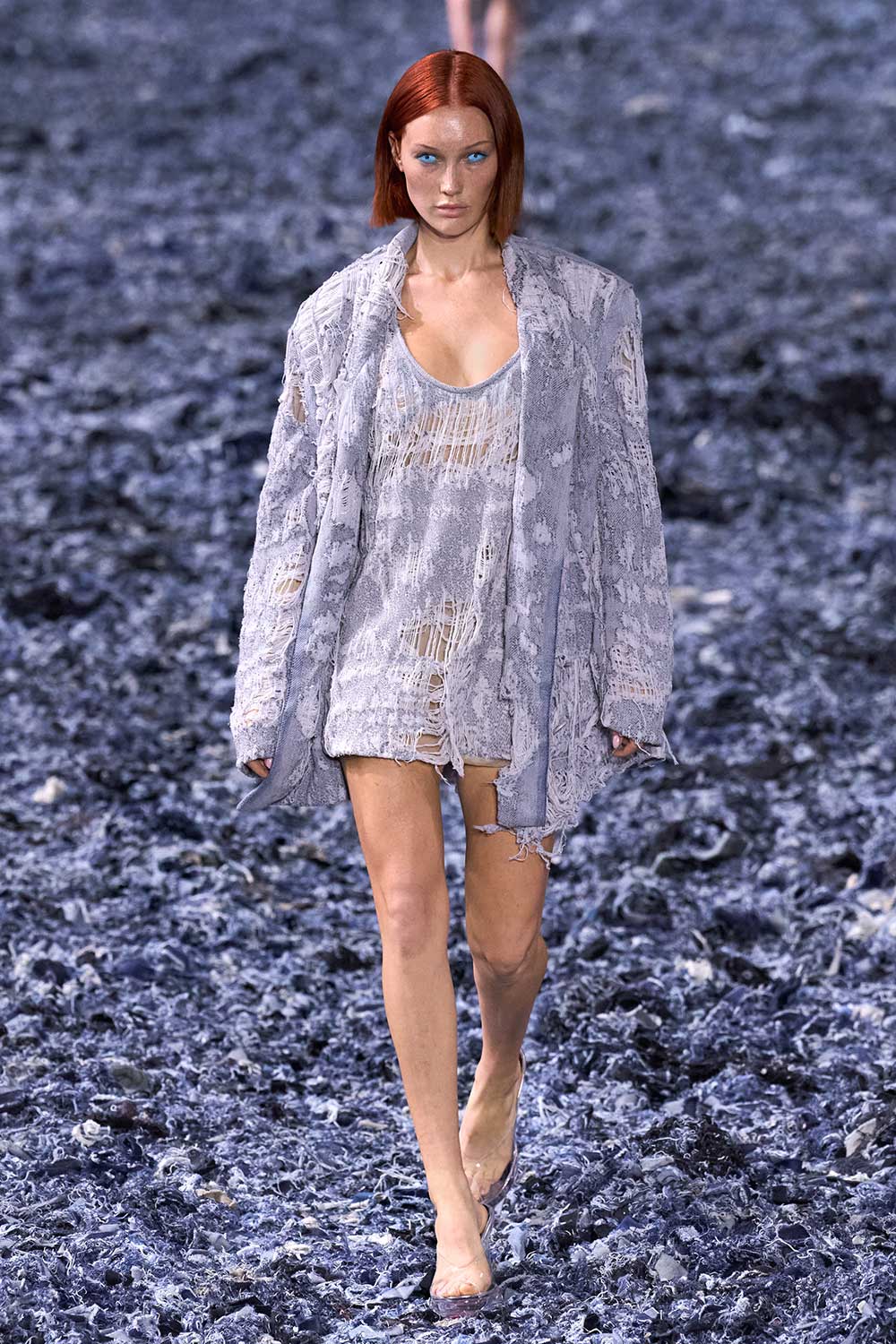
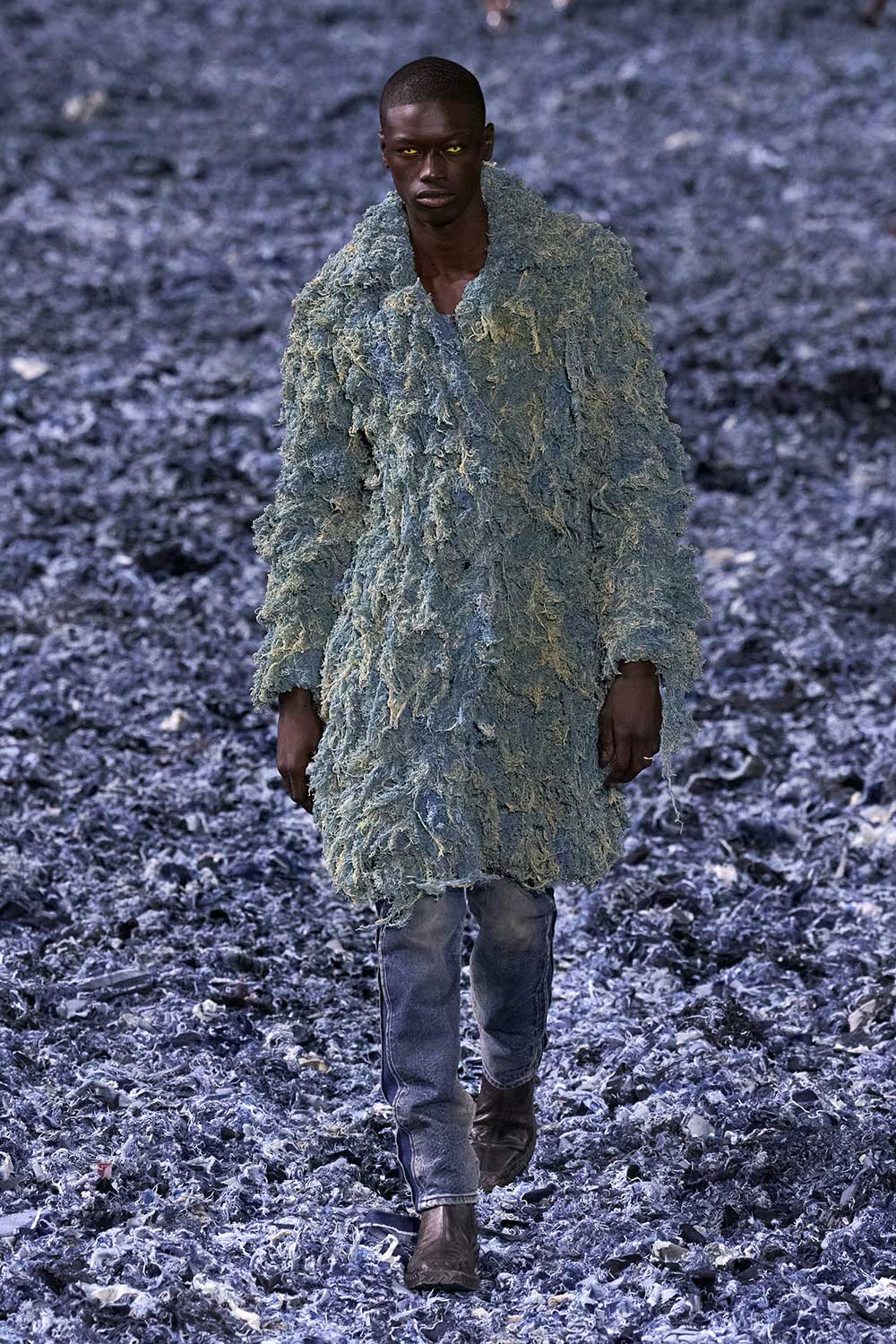
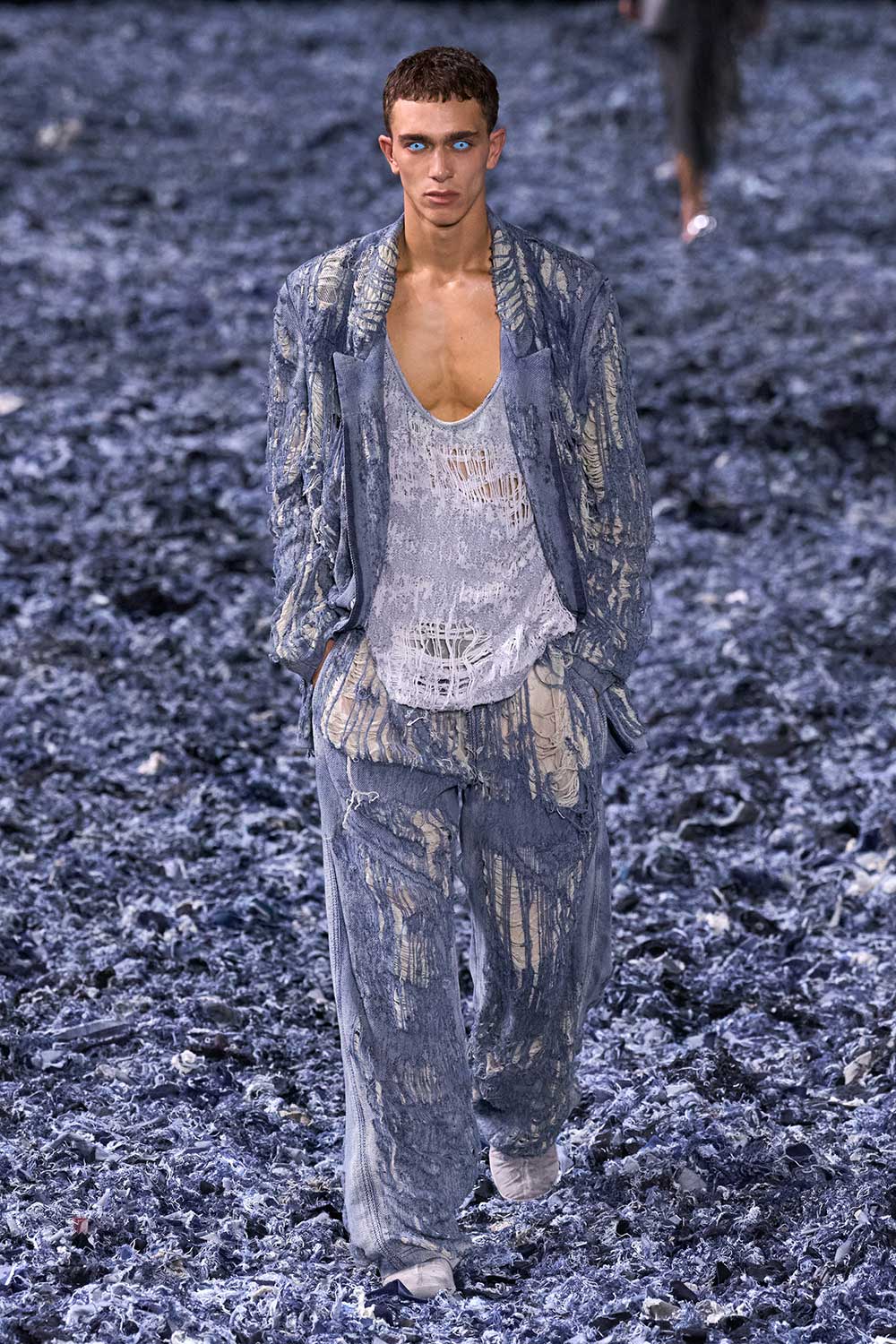
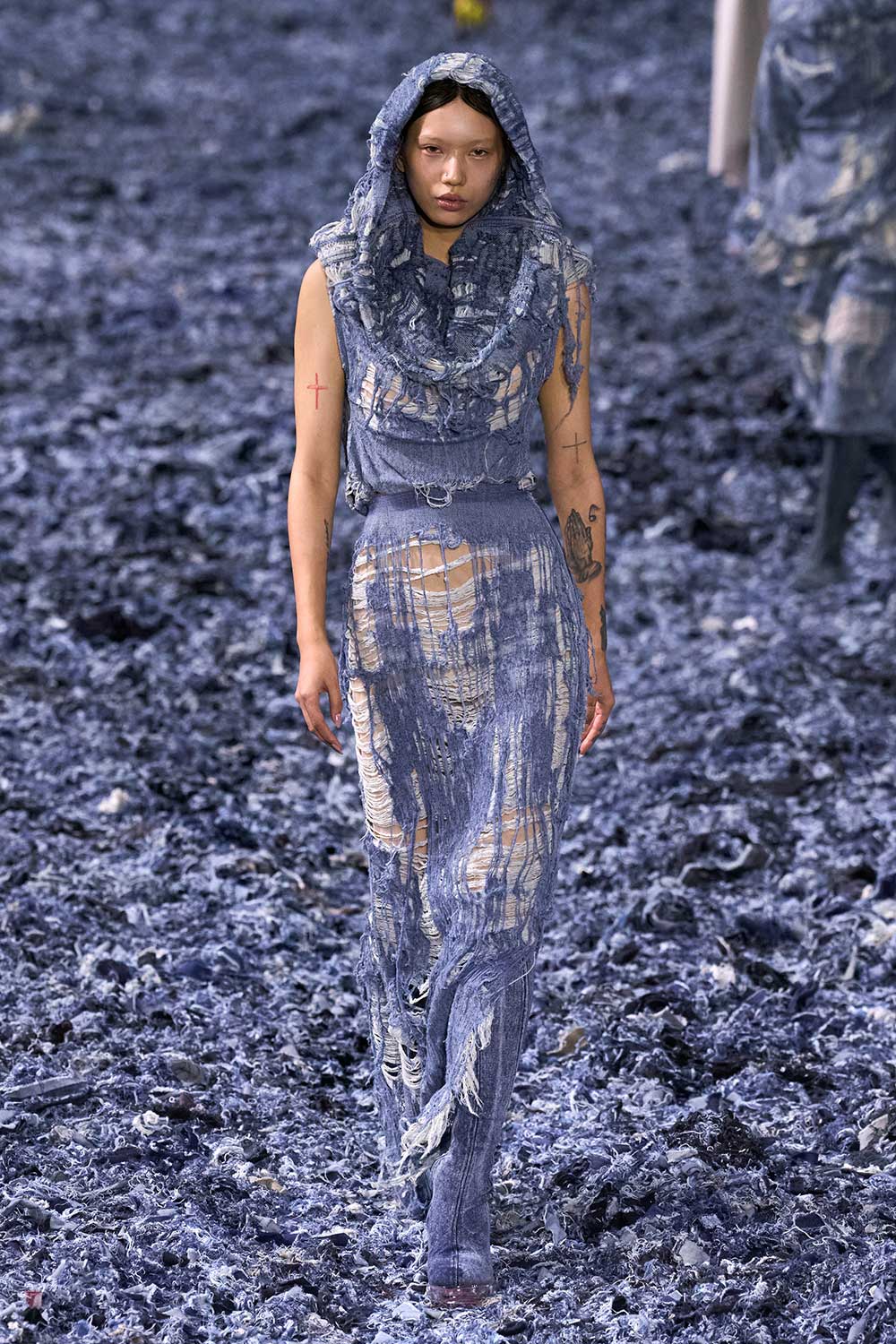
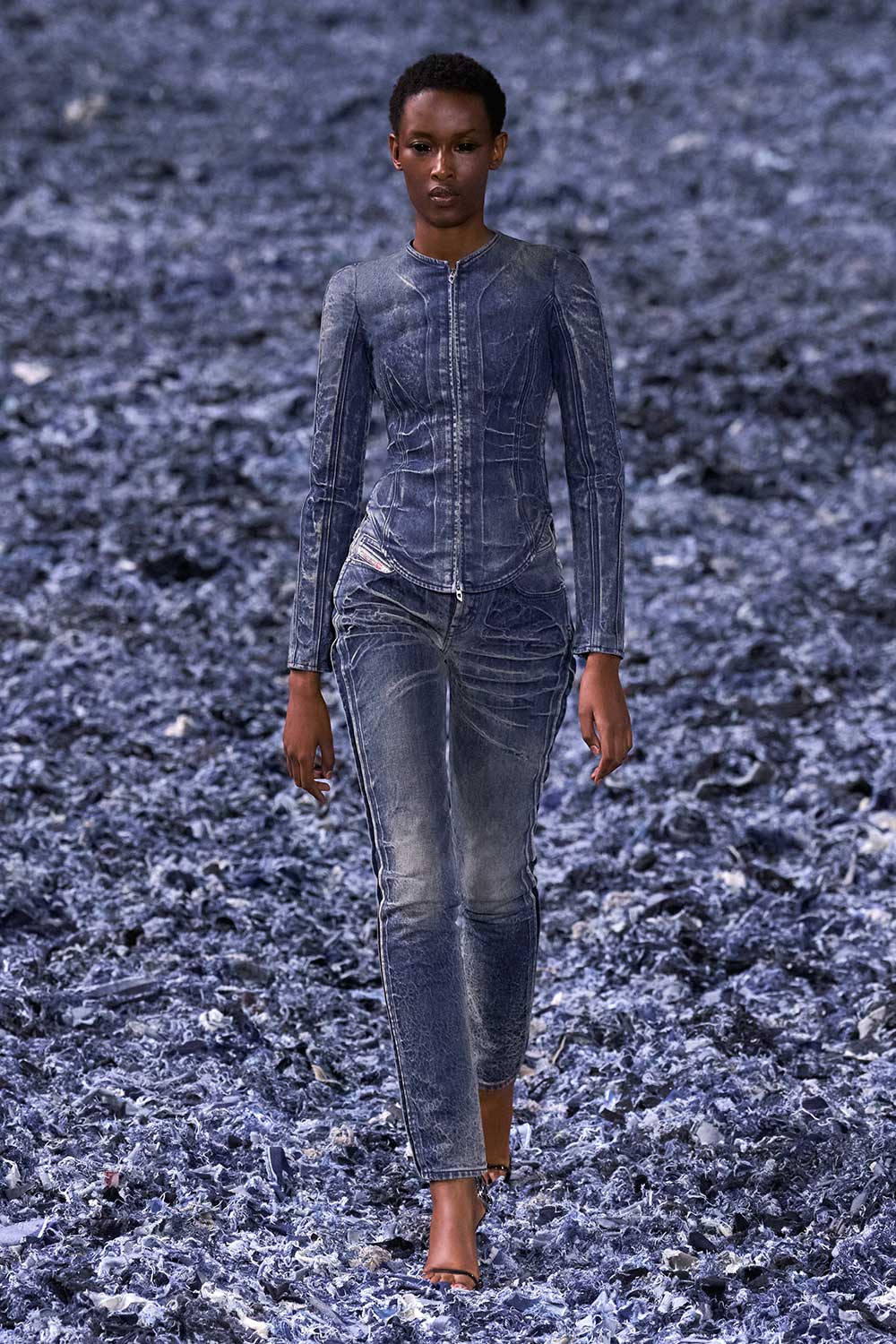
Diesel’s creative director, Glenn Martens, continues to revolutionize the fashion industry with unprecedented transparency. For the second consecutive season, Martens invites the public into the brand’s inner workings, live-streaming the show preparation process. This bold approach democratizes high fashion, providing uncensored access to the typically exclusive world of fashion design. By breaking down barriers, Martens engages a broader audience, redefining the relationship between fashion brands and their followers.
Experience their collection’s revolutionary approach to denim, where innovation meets sustainability. They’ve reimagined iconic fabrics, transforming archival bandanas into pleated, cracked textures. Double loom weaving reduces waste, while laser distressing creates unique effects. Timeless designs, such as the Play bag and Scrunch D, are reinterpreted. Their debut eyewear collaboration with Luxottica completes the story, showcasing a fresh perspective on fashion’s future.
image source : diesel.com
Diesel’s circular approach tackles fashion’s environmental challenges. Their show set, made from 14,800 kg of recycled denim, highlights the potential of waste reduction. By reusing and repurposing materials, they minimize their ecological footprint. This commitment extends beyond the show, as the entire set will be repurposed, inspiring a more sustainable fashion industry.
“There is beauty in waste, in what is distressed and destroyed. It’s in the circularity of denim waste, and into the distressing that we build into the collection. This is the disruption of Diesel: we are pushing for circularity in our production as hard as we push the elevation of design.†– Glenn Martens, creative director of Diesel
Kaiser is a leading laundry auxiliaries and colorants provider, offering sustainable solutions for customers across the world. With a Dystar heritage of more than a century in product development and innovation for the textile industry, Kaiser offers the best available products and technologies for laundries. Kaiser is also a long term partner for Denimsandjeans Shows . We welcomed them back at our Denimsandjeans Show in Vietnam ( June 26-27) and talked with We talked with Serdar Demircioglu – Sales and Marketing Director from Kaiser on what latest developments they will bring on the table !
How have you seen the apparel world change in the past covid scenario and how do you see the changes affecting garment washing in the near future.
In the post-COVID scenario, the apparel world has experienced significant shifts, particularly in consumer behavior, supply chain dynamics, and manufacturing practices. There are some changings likely to impact garment washing in some ways:
Shift to Casual and Comfortable Clothing: With more people working from home and socializing in relaxed settings, there has been a notable increase in demand for casual and comfortable clothing, including denim. This trend towards casualization could influence the types of denim garments being produced and subsequently washed in industrial facilities, with a focus on softer finishes and comfortable fits.
Sustainability Considerations:Environmental sustainability has become a key priority for many consumers and brands in the post-COVID era. Garment washing processes typically involve significant water, chemical, and energy usage, which can have negative environmental impacts. As a result, there may be growing pressure on manufacturers to adopt more sustainable washing practices, such as water-saving techniques, eco-friendly chemicals, and alternative application methods.
Supply Chain Disruptions: The pandemic exposed vulnerabilities in global supply chains, prompting many apparel brands to reassess their sourcing and manufacturing strategies. This could lead to changes in where denim garments are produced and washed, with a potential shift towards more regionalized or localized manufacturing to mitigate supply chain risks and reduce transportation emissions.
We thank you for again joining the Denimsandjeans Vietnam show in 2024. What would be your focus during this show and what kind of customers do you want to reach out to ?
At DenimsandJeans Vietnam 2024, our focus would be on showcasing the latest trends, innovations, and sustainable practices in the garment washing industry. We would showcase cutting-edge technologies and innovations that are driving positive change in the laundry industry. This could include advancements in laser and ozone finishing techniques, new coating looks, special dyeing processes with less water usage and different application methods for laundry processes.
We would aim to engage with garment manufacturers, fabric mills, and suppliers looking to adopt sustainable practices and integrate innovative chemical technologies into their operations. This could involve showcasing solutions for improving resource efficiency, reducing environmental impact, and enhancing product quality throughout the garment and fabric supply chain.
Overall, our goal at DenimsandJean Vietnam 2024 would be to inspire and educate garment industry stakeholders about the importance of sustainability, innovation, and responsible practices in shaping the future of denim. By targeting a diverse range of customers and addressing key themes and trends, we aim to facilitate meaningful discussions and collaborations that contribute to a more sustainable and ethical denim&garment industry.
What would you rank you most innovative and sustainable solutions which are also widely accepted.
Our water-free and stone free enzyme concept widely accepted in the laundry sector since last 2 years. By this way we are able to eliminate pumice stone usage in laundry application by using less water. Our Laser and ozone products are also running in the market and additionally we are working on new application methods for laundry market.
How do you see Vietnam evolving over the next few years in terms of fabric and garment productions. Do you think it could perhaps evolve in a more sustainable manner than the other major centers of garment production.
Vietnam has emerged as a significant player in the global fabric and garment production industry over the past few years, and its evolution in the coming years is likely to be influenced by several factors, including sustainability considerations, technological advancements, and shifting market dynamics. There is growing recognition of the importance of sustainability in the textile and garment industry, driven by environmental concerns and changing consumer preferences. Vietnam has the opportunity to position itself as a leader in sustainable fabric and garment production by adopting eco-friendly materials, implementing resource-efficient manufacturing processes, and promoting transparency and accountability throughout the supply chain. Vietnam has the potential to evolve in a more sustainable manner than other major centers of garment production by leveraging its strengths in technology, innovation, and collaboration. By embracing sustainability as a core principle and adopting responsible practices throughout the value chain, Vietnam can contribute to the global transition towards a more sustainable and equitable textile and garment industry.
What do you see as the furutre of denim?
The future of denim is likely to be shaped by several trends and factors, including sustainability, technology, and shifting consumer preferences. As environmental concerns become increasingly important to consumers, the denim industry is likely to see a continued focus on sustainability. This could involve the use of eco-friendly materials such as organic cotton, recycled denim, and alternative fibers like hemp and Tencel. Additionally, denim manufacturers may adopt more sustainable production processes, such as water-saving techniques, reduced chemical usage, and improved waste management. With advancements in technology such as 3D printing and digital design tools, consumers may have greater opportunities to customize and personalize their denim garments. This could involve choosing specific fits, finishes, and embellishments, allowing individuals to create unique pieces that reflect their personal style and preferences. Denim has always been influenced by cultural and fashion trends, and this is likely to continue in the future. Emerging trends in streetwear, vintage revival, and sustainability-conscious fashion may influence the styles, washes, and silhouettes of denim garments.
Overall, the future of denim is expected to be characterized by innovation, sustainability, and adaptability to changing consumer needs and preferences. Whether it’s through eco-friendly chemicals, technological advancements, or personalized experiences, denim is likely to remain a versatile and enduring staple in the fashion landscape.
LYCRA® is one of the most well known fiber brand globally and an important partner for our various Denimsandjeans Shows . Recently the company participated as our associate partner in the 5th edition of Denimsandjeans event in Bangalore. This time our theme was Denim Repurposed and LYCRA® showcased special products at the show. With the theme being ‘Denim Repurposed’ – we had a special focus on the material inputs that go into denim . With LYCRA® being an important supplier to the industry, we spoke Fabrizio Maggi , Commercial Director South Asia & EMEA Distribution @ The LYCRA Company on their latest developments to support the sustainability aspect of the industry .
LYCRA®is one of the most well known brand of fiber producers for global fashion brands. What do you think helps LYCRA®create this distinct identity.
The LYCRA Company is recognized worldwide for its innovative products, technical expertise, sustainable solutions and marketing support. Our focus is on adding value to our customers’ products by developing unique innovations designed to meet the consumer’s need for comfort and lasting performance. The LYCRA Company innovates and produces fiber and technology solutions for apparel and owns leading consumer and trade brands like LYCRA®, LYCRA® T400®, COOLMAX®, THERMOLITE®.
Denim is one of the key segments for LYCRA®. How do you think denim has evolved post covid and how has LYCRA®adapted to it
Pandemic followed by cost of living has dramatically changed the consumer behavior and shopping habits. They have become more selective and conscious about their apparel purchase. Shrinking budgets made them to consider the value of the apparel products and they want to invest more in timeless, versatile, and high-quality garments which have longer wear-life. Circular economy approach has put a bold focus on responsible design. Brands and retailers now better understand designing clothes that last longer and are more durable as a key to reducing environmental impacts. The latest launched technologies like LYCRA®lastingFIT and LYCRA® ADAPTIV fiber were developed to address these new trends.
3. Sustainability is now the core of global fashion. With various governments creating rules for transparency and circularity, how LYCRA®has evolved to keep ahead of these requirements.
4. You had created a ‘Green Wall’ at Denimsandjeans India show held recently at Bangalore . What concepts were you showing there and why do you think they are they important for Indian brands and retailers.
Taking in consideration that durability is the new sustainability, we showcased our latest fiber innovation LYCRA® ADAPTIV fiber and LYCRA® Anti-Slip fiber. Those fibers are part of our LYCRA® XTRA LIFE™ offering, as helps garments to last longer, in terms of body adaptivity in the case of LYCRA® ADAPTIV fiber which provides wider fit windows and size inclusivity and long-lasting by adopting LYCRA® Anti-Slip fiber which reduces the risk of seam slippage. In addition these technologies will have a positive environmental and costs impact due to less returns in particular for brands and retailers selling online.
5. What does the near future of denim industry look to you. Do you think we are looking at big changes in terms of demand, production systems , technologies etc ?
The denim industry will develop in order to address the increased consumers concerns about reducing their environmental footprint. There will be a significant investment in higher quality garments, designed to last longer because they are made with durable fibers.
Nearchimica is a well known Italian chemical company which has been serving the industry for over 40 years and is well respected for its various initiatives and contributions to the industry specially in the sustainability arena. We spoke to the Managing Director – Roberto Camera – to understand how they are have been moving over these years and what are their plans for Vietnam.
Nearchimica is over 4 decades old company dealing in auxiliaries for textiles. How has the company grown over the years
The company has grown step by step, implementing his activity cooperating with Customers on market need satisfaction, focusing on continuous innovation, offering deep technical support
What change have you seen in last 10years with focus of the industry changing towards more environment friendly products and how have you kept pace with it
In the last 10 years many things happened ,with continuous and pressing requirements for eco sustainability together with some reluctance from brands to fully adopt related technical innovation for their standard production.
Starting from 2019, with growing ZDHC compliance demands and its deadlines, this commitment has become more defined and important. Today we can say that most major companies are involved in eco sustainable process developments.
What do you think are the 3 key concern areas in denim fabric and garment production which need to be addressed to reduce our impact on the mother earth
Our philosophy is that “ less is better†: less water consumption, less energy consumption, and less hazardous chemicals.
We call this project Eco dress code which means continuity in our denim tradition, paying attention to people, workers and environment.Today technology is available to produce attractive garments with sustainable approach, it’s just a matter of deciding when and how. We’re available for supporting our customers in this transition.
Your main products which you think can help in the above-mentioned areas.
As usual our model is based on an offer of Application knowhow and Chemical product innovation to our partners. Main subjects are:
Laser technology ,combining new generation laser booster and smoothers in order to improve laser engraving performance …the object is to come to a No Touch process.
Selected Enzymes high performing at low temperature and suitable for easy biodegradable bleaching and cleanings
Eco friendly bleaching agents and Ozone activators.
Concentrated performing auxiliaries to improve, along the whole textile field, logistic cost and energy cost and pollution related to the transport.
Major changes you see coming in the auxiliaries in the next few years. How will that impact our industry.
One of the fundament futures will be recycling. At any level, it will be successful if we’ll be able to transform the waste into a resource. Our company is sharing with our customers projects that are going in that direction. This means that all the life cycle, for garments & fabrics, must be consciously planned starting from the real beginning.
SONY DSC
You are participating in the Denimsandjeans Show in Vietnam in 2023. What are your expectations from the event as it is happening after 3 years
Our expectation is to overcome problems arising from this long pandemic lockdown and happy to meet by person again re starting relationships.
It is clear that after the pandemic nothing is same as before, and we need to adapt ourself to new needs and situation, considering these transformation as a part of a natural evolution.
Every year, approximately 300 million metric tonnes of plastic garbage are generated throughout the world. Each year, India produces roughly 9.46 million metric tonnes of plastic garbage. From 1950 to the present, researchers estimate that 8.3 billion tonnes of plastic have been produced. 60 percent of the plastic has ended up in landfills or the global ecosystems as plastic garbage. Despite different attempts, just 9% of plastic garbage has been recycled so far, and only 12% has been burnt. The remaining 79% has been collected in our surroundings.
In 2016, France produced a significant quantity of the trash, averaging 4 to 6 tonnes per person. Large amounts of post-consumer trash are hardly recycled back into circulation, escape through the waste management system’s seams, and end up creating environmental harm and posing a threat to biodiversity. France created around 4.5 million tonnes of plastic garbage in 2016, with 80,000 tonnes harming the environment and 10,000 tonnes entering the Mediterranean Sea. As a result, France was responsible for the most environmental degradation in the Mediterranean area that year.
Furthermore, large amounts of post-consumer waste are mishandled, and goods and products are thrown away before even being utilized once. Unsold goods worth EUR 630 million are discarded in France every year. When perfectly excellent things are thrown away unnecessarily, the energy and materials utilized to make them are also squandered. Unsold items are destroyed, resulting in 5 to 20 times higher GHG (greenhouse gas) emissions than if they were reused.
Plastic waste has now become a major issue for governments all over the world. To address this issue, the French government has taken a bold step by passing Law no. 2020-105, often known as the “Anti-Waste Law,” which sets a target of recycling 100% of plastics by 2025.
THE ANTI – WASTE LAW
Since 2015, the European Commission has been focusing on an implementation plan to help Europe transition to a circular economy. The French government approved “The Anti-waste Law” on February 10, 2020, to combat waste and encourage a circular economy. The law intends to minimize waste and pollution at the design stage and shift from a linear to a circular economic model of production, distribution, and consumption. It uplifts businesses in a variety of sectors, as well as municipalities and citizens, to reduce waste and enact more circular practices.
Full oversight in environmental and health attributes of goods, surveillance on the recycling program, restriction on the use of plastic, assistance to fight pollution and waste of both food and non-food commodities, rigid punishment for environmental violations, provision to support companies in their eco-friendly initiatives, and so on are among the fifty measures included in the law. To sum up, the law aims to-
To scrap out single-use plastic packaging by 2040
Eradicating waste by revitalizing reuse and aiding charitable organizations
Handling planned obsolescence
Endorsing a better resource management system from design stage to material recovery
Present improves, stronger and more seamless information to the consumers
How the government of France aims to achieve this anti-waste law? By 2025, the French government plans to recycle 100 percent of plastic. By 2030, they plan to reduce home garbage and waste from business activities by 15% and 5%, respectively. To accomplish this, the government intends to establish a five-year strategy focusing on plastic reduction, reuse, and recycling. It will be phased in over four years, from 2020 to 2025, 2025 to 2030, 2030 to 2035, and 2035 to 2040.
PRESENT DATE SCENARIO
Source: Twisted Sifter
When France prohibited the disposal of unsold food goods in 2016, it made international news. This restriction will be expanded to other unsold commodities, such as electronics and hygiene products, beginning this year, 2022. From January 1st, it is unlawful in France to burn a variety of unsold items, as part of the government’s goal of establishing a “circular economy” and minimizing waste.
From this year, 2022 onwards, it is illegal in France to destroy the following unsold goods- electronic products, textiles, clothes and shoes, furniture, ink cartridges, hygiene products, food preservation and cooking equipment, leisure products, books, and school equipment.
Affect Of Anti- Waste Law on Fashion Industry
What is the actual amount of trash produced by the fashion industry? Every year, the average consumer discards 70 pounds (31.75 kilograms) of apparel. Every year, we generate 13 million tonnes of textile waste, 95% of which might be repurposed or recycled. For the past five years, post-consumer trash has been at the forefront of the circular economy debate in the fashion sector. “The 2020 Preferred Fiber and Materials Market Report reveals that the global fiber production has doubled in the last 20 years, reaching an all-time high of 111 million metric tons in 2019 and pre-COVID-19 results indicated potential growth to 146 million metric tons by 2030.â€
As per French Lawmakers, the fashion sector is a viable target of the new laws as apparel merchants, in particular, will have to refresh their items more regularly (than those of other industries) as they often have unsold overstock. The industry, as a result of its long-standing procedure of destroying unsold merchandise to avoid selling it at a reduced rate and/or paying to store it, is one of the major causes in terms of more than €650 million (nearly $710 million) worth of new consumer goods destroyed or disposed of annually in France, and $900 million worth is unsold items that end up in landfills.
How exactly is France recycling the wasted clothes? More demand for recycling choices arose as a result of increased interest in the environment and a desire to live a safe life. There is no denying that over 60% of the garments wind up in the garbage. So, what happens after that? Garments that are dumped in the trash are collected by ECO TLC organizations or businesses. The collected clothing is then processed by hand and resold to second–hand retailers or delivered to textile recycling organizations, which is the labor portion.
After that, all of the textiles that can no longer be worn are transported to be recycled, where they are chopped, shredded, frayed, or crushed, and then turned into rags, insulating products, new garments, or secondary raw material. . Few firms in France, such as Hopaal, Maison Izard, and others, are already providing precedents for other large brands, demonstrating what is possible.
The Policy Measures
Source: Ministry of the Ecological Transition
The law includes plenty of measures, to help shape the adaptation to a circular economy. The demolition of unsold non-food items is prohibited in France for the first time. Instead of dumping or incinerating unwanted items, businesses will be required to repurpose, donate, or recycle them.
It is also the first country to require that electronic and electric items, including cellphones, computers, washing machines, and televisions, have a mandated modifiability index. This strategy attempts to enhance the proportion of devices that are fixed by requiring manufacturers to consider modifiability throughout the design stage and educating customers about repair alternatives when purchasing a gadget.
By establishing new employment and promoting the solidarity economy, the law also hopes to inspire societal reform. France is also supporting circular solutions to help those living in difficult situations by setting aside funding to encourage the development of 70,000 employment in reuse networks and encouraging the donating of unsold items to charitable organizations.
Stella McCartney is the first designer to endorse New York’s Fashion Sustainability and Social Accountability Act.
With the new year 2022, comes fresh focus on sustainability from authorities in USA. Fashion Sustainability and Social Accountability Act was proposed on January 7 and which , if passed, would make NY to become the first state in the US to pass a bill, holding the largest fashion labels accountable for their involvement in climate change.
The Fashion Sustainability and Social Accountability Act, sponsored by State Senator Alessandra Biaggi and Assemblywoman Anna R. Kelles, was also backed by a number of sustainable fashion nonprofits including the New Standard Institute, the Natural Resources Defense Council, and the New York City Environmental Justice Alliance, as well as designer Stella McCartney. The law applies to global apparel and footwear companies with revenues of more than $100 million.
WHAT EXACTLY DOES THE BILL SAY?
Prada, Nike, Armani, Gucci, Chanel, and all other global high-end fashion brands with more than $100 million revenues are liable to map out at least half of their supply chain from raw material farming ,through transportation, and to reveal the social and environmental implications along the way. Fair labour pay, greenhouse gas emissions, and water waste and management are all examples of topics that must be made public. Under the Act, fashion firms must set goals in line with the Paris Agreement, which is limiting global warming to 1.5 degrees Celsius over pre-industrial levels – and present a strategy to achieve them.
FASHION SUSTAINIBILITY ACT INTO EXISTENCE
“As a global fashion and business capital of the world, New York State has a moral responsibility to serve as a leader in mitigating the environmental and social impact of the fashion industry†quoted by Senator Biaggi in a press release. She also added, “a groundbreaking piece of legislation that will make New York the global leader†in holding the fashion industry “accountable†ensuring, “labour, human rights, and environmental protections are prioritized.â€
Companies would have 12 months to comply with the mapping rule (18 months for impact declarations), and if found in violation, they might face fines of up to 2% of their annual revenues. The fines would be directed to a new Community Fund run by the Department of Environmental Conservation, which would be used for environmental justice programmes. A list of companies determined to be non-compliant would be published annually by the New York attorney general.
THE CURRENT SCENARIO
Though many brands have become more vocal in admitting their role in climate change and human rights violations, efforts to correct the situation have been left to the companies and a variety of nongovernmental watchdog organizations such as the Fair Labor Association, which focuses on wage issues, and Higg, which focuses on supply chain reporting. They can be rather diverse.
According to the UN Environment Programme, the worldwide fashion industry today accounts for 10% of global carbon emissions, which is more than the aviation and shipping sectors combined, as well as roughly 20% of global wastewater. Every year, the textiles sector produces an estimated 92 million tonnes of trash, which is expected to increase to 134 million tonnes by 2030. This deteriorating trend may mostly be linked to the rise of fast fashion, in which firms make and distribute low-cost, low-quality apparel that buyers discard after only a few wears.
Though a step in right direction, it remains to be seen if the Act can bring some very objective standards to be complied with – rather than giving subjective directions leaving scope for misinterpretations and hence non-compliance. The fashion industry needs the governments large consuming regions of US / Europe and later even China and India. Till the time we have thoughtful intervention by the governments, sustainability and circularity is likely to remain dependent on subjective interpretations preventing its universal application.
Denim brands are increasingly looking for ways to decrease the environmental impact of their products. As part of their business strategies to protect the environment, many denim brands are focusing to adopt greener practices and techniques of producing jeans. They are conscious of the importance and need of building a sustainable future for the denim industry.
One such brand that has come quite far in its sustainability journey is Closed – a German iconic denim retailer that has been around since 1978.
About The Brand
Marie and François Girbaud, two French fashion designers, created the renowned denim brand Closed in 1978. In the ’90s and 2000s, the duo had a big effect on hip-hop style with their distinctive take on denim silhouettes. The brand has been featured in songs and famous videos, like Kris Kross’ ‘Jump’, for its casual, stonewashed ensembles. It gained global popularity for its baggy denim designs thanks to endorsements from the hip-hop community.
The brand believes that sustainability is their key value to whatever they do. The brand has been progressively focusing on the environmental impacts of its products and has taken a number of steps to move ahead towards lowering the ramifications.
CLOSED Sustainable Journey So Far
Some of their latest steps towards the big goal included in their 2020 sustainability report :
The denim giant has just joined the Fair Wear Foundation, which will inspect the manufacturing facilities at regular intervals in the future — formally demonstrating to their consumers the great working conditions in which its production partners operate.
In collaboration with its denim mill Candiani, the company has expanded its eco-denim line A BETTER BLUE by launching the world’s first degradable stretch denim clothing made with the natural rubber yarn CorevaTM. A BETTER BLUE jeans are made using eco-friendly materials, low-impact dyeing techniques, and washing methods for resource conservation in Italy. So far, the company has manufactured 223,950 units of A BETTER BLUE things and claim that it has saved 6,882,870 litres of water, 649,455 kWh of electricity, and 77,262 kg of solid waste of chemicals (based on average savings compared to a pair of conventional Closed jeans).
To reduce its use of water, electricity, and chemicals even further, it has included eco-friendly innovations into its designs, such as outerwear made from 100% recycled materials coloured with plant dyes. The retailer is increasing the proportion of eco-materials.
Another important aspect in ensuring seamless manufacturing was the company’s short supply chains. This is a feature that has always been essential for the brand, as well as for environmental and quality concerns. An astounding 80% of our products are manufactured in Europe, near our key consumers. To reduce its environmental impact, the company has avoided flying materials or semi-finished clothes throughout the world. Its producers in Italy, Portugal, Romania, and Turkey typically work with European materials, whilst its Chinese partners primarily obtain materials from Asia, such as silk or technological textiles. To reduce emissions to a minimal, its clothes, footwear, and accessories are exclusively carried to warehouses by land or sea.
The company donates to climate protection projects to compensate for a part of unavoidable emissions. Its corporate offices and warehouses are already carbon-neutral. While they’re on the issue, they have some exciting news: beginning with the autumn 2021 collection, they will offset the CO2 emissions for all A BETTER BLUE jeans. They will progressively focus on eco-friendly measures and CO2 offsetting in the next years, with the goal of creating a totally climate-neutral supply chain.
Closed’s Code of Conduct, which is followed by all of its manufacturing partners, allows it to rely on an official letter that assures: no child labour, fair and statutory pay, compensated overtime, safe and sanitary working conditions, set working hours, and a maximum 48-hour work week. Every partner must sign the Code of Conduct twice a year.
The Road Ahead
The denim retailer is looking forward to bigger and better sustainability goals. The brand will provide PETA-approved vegan labeling for its items that do not include any animal-derived substances. They will be employing a new outerwear fabric composed of recycled nylon beginning with autumn 2021 collection. It is dyed with a plant-based dye that is environmentally friendly. ONIBEGIE is an eco-friendly dyeing method developed by its Japanese partners Komatsu Matere that upcycles onion peels, olives, and bamboo. By donating to eco-initiatives and offsetting its carbon emissions, its A BETTER BLUE jeans will bring climate-neutral items beginning with the winter 2021 collection. Additional certifications, declarations of purchase, and the provenance of the raw material, as well as animal welfare standards, are required for all yarns containing animal fibers beginning with the brand’s winter 2021 collection. In this collection, they will also include organic cashmere. It is also integrating a greater proportion of organic cotton and other natural fibers in its collections. As per the brand, 35% of its women’s and 47% of its men’s winter 2021 collections are eco-friendly, 41% of the women’s and 50% of the men’s denim are part of the eco-denim line A BETTER BLUE. The brand will also use recyclable paper for its hangtags.
WHAT THE BRAND BELIEVES
Since its inception, sustainability has played a critical part in Closed’s purpose. In the 1970s, the notion of “sustainable” was far from pervasive or widespread as it is now, and it was open to several interpretations. Closed has always represented respect for and a fair perspective of not just the environment, but also of everyone and everything with whom it works. Its declared goal was and continues to be long-term partnerships with all business colleagues, which is why the brand seeks for partners that share similar values and whom it can lay trust. Simply put, sustainability entails far more than this, it also entails using the planet’s resources as responsibly as possible.
Timeless, the brand pays homage to its legendary past while also looking ahead, producing sustainable jeans for the coming years.
H&M Group had a lot going on this week with its CEO and sustainability ambassador attending the Fashion Future Conference, its Monki Brand becoming a part of Zalora, and the launch of the world’s largest recycled denim collection ever, altogether.
Monki, the company’s youth-oriented brand, is expanding its online presence throughout Southeast Asia. The brand currently has six storefronts in Malaysia and two in the Philippines, and the move onto a platform that is a major participant in online fashion retail in the area demonstrates that the company regards the market as vital. The launch also marks the brand’s first move to Singapore.
“We have a strong following in south-east Asia, which makes us excited about expanding our online offer in this area together with Zalora. We can’t wait to welcome our new customers into the Monki world.†Says Jennie Dahlin Hansson, Managing Director, Monki
Monki’s ranges on Zalora will showcase on-trend ensembles with conscious materials, inspired by Asian street style and Scandi fashion. New jeans styles in vibrant prints, all made from organic cotton, will be included.
Monki will be available on Zalora in the Philippines up in late September, with Malaysia and Singapore following later this autumn.
H&M’S FALL RECYCLED DENIM COLLECTION
The brand also announced its recycled denim collection for the fall season (which was worn by sustainability ambassador Maisie Williams for her virtual participation in a fashion future event). Baggy jeans, loose straight leg jeans, trucker jackets, oversized overshirts, bucket hats, and shoppers make up H&M’s “Most Recycled Collection Ever.”
Each apparel gets inspired by the laidback aesthetic seen in the 1990s. It’s crafted mainly from recycled metal zippers and trims and 100 % recycled fabrics, threads, labels, and pockets. Its washing technique has a minimal impact on the environment and is free of harmful chemicals.
The H&M Recycled Denim collection launches on 9 September 2021 with selected pieces in stores and the whole range online.
INCORPORATING SUSTAINABILITY
One of H&M’s greatest goals is to move to a circular production system, which entails reusing both production waste and collected clothes.
Patchwork details and 90s denim washes ranging from vintage light blue, normcore mid-blues, dark vintage blues, vintage blacks, and cool grey, are featured in the new collection. It aims to highlight the possibilities of recycled materials and provide denim fans around the world with even more sustainable options. Each clothing is created entirely of recycled materials, including pre-consumer recycled cotton from industrial waste cuttings and post-consumer recycled cotton from collected garments, some with recycled polyester, and accessories made entirely of fabrics cut and re-used from production rejections.
FASHION’S NEW NORMAL
During the Fashion Future Conference 2021, H&M CEO Helena Helmersson and sustainability ambassador Maisie Williams met virtually to discuss the future of fashion, specifically the post-pandemic road for the business. The talk focused on the fashion industry’s post-pandemic path forward, a future that will require imagination, creativity, technological innovation, and new business models to connect customers in innovative ways.
Helmersson and Williams provided a glimpse into the future of sustainable fashion. They left on a positive and empowering note, focusing on practical solutions and reminding us that while there are physical limitations to what the planet can support, fashion can find a way to work within them.
The duo also stated that sustainability is an ongoing challenge that requires influencers, companies, and governments to unite around a singular purpose. “Creating a truly sustainable business isn’t a one-off job. But, when we — influencers, companies, governments — come together around a common goal, we can do almost anything.†Said Helmersson.
They also feel that “creativity and technology are key.” H&M’s new technology has provided the brand, whole different methods to interact with customers. A personal avatar that helps clients try on items in virtual fitting rooms is one excellent example that H&M Group developed in its internal innovation lab. Virtual fits could help enhance accessibility and reduce product returns, to bring another dimension to the shopping experience. Helmersson cited the company’s 3D body scanner and the Loop machine in Stockholm as examples of its innovation. Customers could transform unwanted garments into new fashion favorites, enabling them to see the textile-to-textile recycling process, which is generally kept behind the scenes.
Earlier, the brand also launched its sustainability-linked bond which aims at sustainability-driven initiatives. The bond is linked to H&M Group meeting several sustainability targets, such as by 2025 reducing emissions from its operations by 20 percent. The brand is also committed to reducing absolute Scope 3 emissions from garment manufacturing, fabric production, upstream transport, and raw materials by 10 percent.
Helmersson stated that the notion of sustainability is evolving. According to her expanding definitions of sustainability beyond materials, to include the people and relationships that go into creating the fashion we wear is an important part of the agenda that needs to be followed for fashion’s new normal.
H&M believes that by going backward and reusing leftover fabrics, we can move forwards and create denim that’s kinder to the planet. It quotes, “Remember, waste isn’t waste until you actually waste it.†The brand grails to achieve sustainable growth that makes a positive difference to people and the planet.
Recognizing the urgent need for Transparency across the denim supply chain , backed by a credible Traceability mechanism, Arvind denim recently joined hands with TEXTILE GENESIS™Â – a pioneering start up in “Digital track & trace†space. Arvind is probably the most well known textile group and most diversified as well. Its denim division , which is one of the largest globally and caters to most of the top retailers and brands , has always been ahead of the curve while adopting new technologies and solutions which can add value to their and their partners’ businesses. Sustainability has been a mission for the company and it has undertaken various initiatives for water, energy and chemical conservations, including tieups with global brands like Gap for making them more effective.
Arvind X Textile Genesis
The new tie-up with Textile Genesis will enable the company to create digital “Fibercoins™â€ for their sustainable collections and which allow brand and retailers full value chain traceability and visibility along with ESG (environmental, social and governance) credentials of the Supply Chain Partners from fiber-origin to retail. The Textile Genesis platform has won innovation awards & recognition in the industry from H&M Foundation, Accenture and Fashion for Good.
Aamir Akhtar , CEO of Arvind Denim mentions about the push from customers :
“There is a clear feedback from consumers that they are looking for transparency in supply chains. They are wary of buying products made from raw materials that originate in conflict zones. This is the reason we have decided to partner with Textile Genesis to offer block chain based traceability in our denims.”
Why Textile Genesis
Textile Genesis is an award winning startup which creates traceability for all sustainable fibers – natural, man-made and recycled .
Cotton fibres – 15-20% of global cotton supply is covered by them with leading recycled cotton producers on board.
Cellulosic fibres – 50% of viscose and 80% of lyocell tracked by TG. Long term commitments with Lenzing.
Top 10 recycled polyester players on TG platform
Long term partnership with #1 wool & cashmere producer – Schneider group
How it works
The fibercoins issued at various stages of manufacturing will be visible to the brands and retails across the value chain, enabling them to trace how and from where the materials are being used.
“As this is a block chain based solution , Fibrecoins will be issued at the origin – for eg ginneries for cotton; production plants for MMF etc. these Fiber coins will get transferred right thru the supply chain and will be visible virtually to all brands as well their customers “ – says Aamir Akhtar
End to end traceability of Arvind’s product offerings will be visible on TG platform including all stages
Addition of any sustainability , transparency and traceability solutions , the costs are bound to increase . On being asked if they would be able to pass on the same to the buyers, Aamir Akhtar mentioned that if the buyers find value in the new initiative, they will surely be open to pay for it.
We were also wondering if Arvind would limit this traceability to only their sustainable denims or extend it to other products . Aamir was sure that it is going to be taken forward :
“This initiative would be expanded to the products from other divisions of Arvind Limited. Even in its current form, this traceability is not limited to raw materials. It includes traceability of other inputs like recycled water, green energy, Higg Score etcâ€
On the whole, a great initiative and a need of the times. As we get more and more transparent and allow easy traceability , the brands will be able to give better information to their customers enabling them to take informed purchase decisions , giving a great boost to sustainability.
Sponsored article – This article has been written by Coats team and is reproduced here at D&Jon their behalf.
“With over 4.5 billion pairs of jeans produced worldwide every year, denim is one of the planet’s most popular clothing choices. But it has a serious image problem when it comes to the environment. Here at Coats, we’re working with innovators, manufacturers and brands to change all that.
Denim may look good, but it’s not great for the planet. Take water consumption. On average, 10,000 litres of this precious resource goes into making one pair of jeans – firstly, in growing the cotton, and secondly in the seriously labour-intensive processes required for dyeing, stonewashing, and distressing.
They say meat’s bad for you. Well, it takes up to 10,000 litres of water to make a single pair of jeans, compared with 2,400 litres for a burger.
(Talking of ‘distressing’, did you know that 16% of insecticides & 6.8% of herbicides used worldwide are for cotton? That harmful chemicals are used for dyeing? Or that processes like sandblasting can cause breathing problems if you don’t take protective measures?)
Real action, not greenwash
So that’s the problem – and it’s not just an environmental one. If consumers don’t see that brands are making efforts to embrace sustainability, they’ll choose ones that do. The buck really does stop here.
That’s why Coats is working with our customers to champion sustainability and the circular economy. We help find ways to waste less, while reusing and recycling more. We also look for alternatives to chemical and synthetic dyeing and bleaching – like foam dyeing, natural bio indigo dye, and water-efficient fabric dyeing machinery.
Coats has invested in a revolutionary waterless digital dyeing start-up called Twine. While It’s not yet suitable for bulk production, we need to give initiatives like this all the support we can.
Naturally, a way to save even more water is in washing. Lasering, ozone, eflow and using bio-based enzymes are all excellent alternatives – and, as thread makers, we need to make sure our products can withstand these new processes.
Sustainable solutions for the circular economy
As the industry starts looking for alternatives to cotton, we at Coats have begun experimenting with yarns that use more sustainable hemp and soybean.
Going one step further, our 100% recycled EcoVerde range of threads is made up of old PET plastic bottles – which rescues them from the rubbish tip and cuts CO2 emissions too. So that really is a win-win.
By 2024, we aim to offer EcoVerde versions of all our premium threads. But we’re far from finished. May 2021 saw the launch of biodegradable and compostable EcoRegen. This brand-new thread is made from 100% lyocell, a renewable fibre derived from wood pulp sourced from sustainably managed forests. Also in the pipeline is EcoCycle, a water-dissolvable thread that makes reusing and recycling end-of-life garments even easier.
There’s been a lot of progress, but we still have a long way to go. Coats is supporting the drive to sustainability and circularity through investment in research and development. Our Innovation Hubs are home to some truly astonishing developments. So, we won’t just look good. We’ll be doing good – and feeling good about it too.
Join us on the 4th August, for a dedicated CoatsCast session on the future of denim- features guest speaker Danielle Elsener (Founder of Decode) Click now to register: https://bit.ly/3yTgxe7
In this closely knit world brought closer by the pandemic, ‘collaboration’ has become the buzzword. Companies and people who are already good in their fields can do something excellent together. This approach is even more important in the denim industry where innovations are happening at a rapid pace across various segments and there is a great need for talent to come together and synergize to achieve bigger goals.
Recently such a collaboration took place between various companies :
Naveena Denim – NDL, Pakistan
Lenzing Corp, Austria
Endrime Studio, UK
Jeanologia, Spain
Officina+39, Italy
Warp-Face, UK
Crafil, Portugal
It was coming together of some important players who have been very active in the industry’s sustainability space. Their collaboration was, as expected, focused on creating some environment-friendly denim. However, there is much more to the BAST RECAST collection than being a sustainable one. It was a completely designed collection that brought out the marriage of vintage denim aesthetics with modern technology and some great mix of sustainable fibers like Lenzing’s Tencel, Refibra, and Modal along with Hemp. In all 9 fabrics were produced under this collection at NDL and 18 garments were designed by Endrime Studio during the lockdown period at their UK studio. Jeanologia made a great value addition by giving some very authentic vintage washed looks using their eco-technologies.
We spoke to Rashid Iqbal from Naveena Denim besides Michael Kininmonth from Lenzing and Mohsin from Endrime Studio to delve deeper and find out what made this collection tick!
1. Bast Recast looks like a very good combination of technology, sustainability, and vintage aesthetics. What made you think of such a project?
Rashid Iqbal:
Yes, bast recast is an exclusive collection that we are proud of, it took around one year for all the thought process before launching this unique collection that adds a modern soft hand feel to the old-school vintage denim. Bast Recast is a sustainable denim line that has been developed using a mix of Tencel, Lyocell, Wet Spun, and Cottonized hemp.
Mohsin
My company ENDRIME® was brought on at the start of the project together with Naveena Denim LTD. Michael Kininmonth (from Lenzing) wanted to design a capsule collection of 4 to 5 styles using the latest Hemp and TENCEL™ Lyocell technologies. I had been telling many denim mills to start using hemp and have been personally educating myself and others about hemp – I did many denim webinars on the history of hemp before this project started, so I was excited to do this collection.
The trust we were given, to not only design and manage the collection, but also to design the fabrics alongside NDL , was very encouraging. I and Sadia Rafique who co-designed the collection knew it was a special project from the beginning.
2. You all are some great partners who came together for the development of this collection. It must have made a big difference to the whole project.
Rashid:
It feels great when you have like-minded partners on board who share the same vision and cares for nature as we do. This project has garnered a lot of attention due to its sustainability aspect and added maximum value to redefine the way we look at denim.
Michael:
Even with the best ideas, best technology, or best product you are still reliant on supply chain partners. No company has all the skills required. The biggest potential partner might not be the best one. Many companies aim to collaborate with their largest suppliers or customers because they assume that the greatest value is to be found there. In many cases, however, this turns out not to be true. Collaboration may be of more interest to a smaller partner, which might invest more time and effort in the project than a very large one that is already juggling dozens of similar initiatives.
3. Hemp has been Naveena’s favorite fiber for some time. But blending this bast fiber (which is a bit rough) with other sustainable fibers like Refibra and Tencel (which are much softer) must have been a challenge. How has your overall experience been in this journey for the same?
Rashid :
It was quite a challenging experience while blending during the spinning stage, as it was not so easy to have homogenous blending of HEMP, COTTON & TENCEL. We all know that HEMP is known as the oldest fiber so our aim from the beginning was to develop fabrics that had both the authentic hemp look complimented by a modern hand-feel, so we blended HEMP with Tencel, Refibra & Modal to make a low impact/ environmentally-safe denim.
Michael:
The entrance of TENCEL into the market in the early 1990s was accompanied by a strong environmental story, superior fiber properties, and lots of marketing hype.
In hemp, I saw a parallel to what TENCEL faced almost 30 years ago versus where hemp is today in the textile apparel industry. There is no economy of scale, a lack of established supply chains, some agricultural challenges, some technological barriers, and many urban myths to dispel.
Traditional wet-spun hemp still provides many challenges and requires specialist yarn spinners whereas cottonized hemp as its name implies can be spun and blended on traditional short-staple systems. In reality, the specifications of TENCEL™ fibers, length, and thickness can be adjusted to be compatible with all kinds of fibers.
4. Bast Recast has been inspired by 1840s aesthetics and the constructions, styling, and designing reflect the same with duck canvases, workwear silhouettes, etc. Tell us more about it.
Mohsin :
This Project has certainly been a huge career highlight for ENDRIME®️ – I’ve been researching the old tailoring pre-dating 1870s jeans… so yes I was looking at the 1840s period.
I ended up designing 7 garments that were period correct to the 1870s-90s period – in construction and fit – In fact, most of the collection does not even have belt loops and no overlocking… each garment is super clean in construction – in some ways made even better than the period. I added a continuous one-piece fly in all styles and even added it in the pullover jumper style – making it better than the original.
In total every garment had 2 or 3 versions of each garment – I’m most proud of the indigo duck canvas and the 2/1 fabrics. In this period duck and lightweight fabrics were everywhere, so I pushed NDL to make these types of fabrics 1st, especially as you don’t see many lightweight hemp fabrics, so I knew it was challenging for NDL . I made a wish list of fabrics they made every variant I asked for plus more. But every single fabric NDL made was breathtaking.
5. Eco-friendly fibers, washes, and processes must have added greatly to the sustainability credentials of this collection. How do you think can a brand compare its relative impact and strength vs other products of yours or competitors’?
Rashid:
Our bast recast collection is a sustainable wardrobe capsule series. I can proudly say that all the articles in this collection right from the fiber to the finished garment are sustainable to call it a real sustainable. We have achieved a low EIM Score with the help of Jeanologia™, made hangtags from the offcuts of the Tencel™ Lyocell and hemp denim fabrics by WARPFACE™, used sustainable dye stuff from Officina+39™ and used 100% biodegradable threads by CRAFIL™.
Mohsin
I think going forward, we all might be designing in this way. I don’t think designing sustainability is a trend, I know many would look at this collection, so wanted to go all out. From the fabric construction to the garments, and of course sustainability washing and finishing the collection. when it came to branding, trims, and hang tags we just followed the same philosophy . I was most proud giving Duncan from warp face all my leftover cuttings then a few weeks later seeing the denim TENCEL™️ X HEMP paper from all my waste. Of course, we could have gone a step further and made zero-waste patterns, but I guess that for another project, small steps.
6. Have you documented all the processes from patterns to washing in case a brand loves your collection (which I believe many would) and wants to replicate the same?
Rashid :
Absolutely! We have all the details and recipes that a customer needs. Every detail in this development has been locked during the thought process.
Michael:
We would be more than happy to share our knowledge and know-how if a brand was serious about creating a collection. Such collections aim to stimulate such activity in the industry.
Mohsin :
Yes for my entire 20-year career I have never been precious of my work. I love giving away knowledge, I hate it when others don’t share, it was important we did the project in this way and yes the collection was designed to inspire others and most brands don’t lead or take risks, so at least the way, we have already developed the fabrics and done the washes and shown how circular a collection can be, it’s certainly harder but far more rewarding.
7. One of the dilemmas the mills face is that the development of fundamentally strong sustainable products entails higher costs. Do you find retailers and brands more receptive and understanding of the same recently?
Rashid :
Yes definitely! We got a massive response since this capsule collection launched. Many customers and brands have reached out to us from all over the world and want to know more about Bast Recast. Since the pandemic hit us, we all are looking out for ways to be more sustainable and transparent in our developments and the brands are showing a keen interest in it.
Michael:
I sense that the pandemic has finally changed attitudes. Supply chain industry partners such as chemicals and machinery are also reporting the same. Greenwashing has been a blight on our industry and it reflects badly on all of us, regardless of the progress we have made. It has allowed brands and retailers to gain kudos on the back of marketing, not merit.
Mohsin:
Most brands I have spoken to want to use hemp and overall develop more sustainably especially in the fabrics and washes they select. But there are drawbacks, we used TENCEL™️ thread made by Crafil – it was perfect no issues, and an amazing achievement, but it’s made and designed to be used on sustainable washing like laser and ozone. The moment you use pp spray and other harsh chemicals it becomes weak. So many designers and product developers think sustainable options can work for everything. They can’t when you design with sustainable ways you need to follow through everything else. It means washing less also. If more people select sustainable options like TENCEL™️ X HEMP and ask to use green chemicals and treatments costs will reduce.
8. Can we expect to see more sustainable collections and initiatives from Naveena in the near future?
Rashid:
Yes, absolutely! We have already started working on SS-23 developments and many interesting projects are on the way. STAY TUNED!
Note: 3D Animations, Designed and Created by ENDRIME®️ / Mohsin Sajid + Paras Gupta for TENCEL™️ / CARVED IN BLUE®️ – BAST RECAST PROJECT
Sustainable fashion is intended towards better and bigger ecological integrity. The rise of popular sustainable clothing brands is strong evidence that there is greater awareness of environmental degradations, their reasons, and possible solutions by apparel makers.
To acknowledge this effort, fashion brands were awarded in the first-ever Marie Claire UK Sustainability Awards 2021. Judged by a panel of over 40 of the world’s leading experts in sustainability, the awards beamed limelight on the achievements of a diverse range of industries to show the positive impact that different types of brands and businesses can have on the environment.
These fashion innovators rightly affirm to the world that fashion can be incorporated without causing harm to our planet.
Here’s a glance at all the Sustainability fashion winners.
1.BEST SUSTAINABLE JEANS
Winner: unspun
The brand preludes the next generation denim by providing first of its kind custom-fitted denim collection with the use of AI and 3D modeling.
The made-to-measure concept of the jeans helps the brand cut out excess waste thus reducing the industry’s emissions by 30 %. The brand hopes to reduce these emissions further to 20% through long-term committed circularity.
Unspun jeans are made from 100 % organic cotton and are easily recyclable. The ‘out of the box ’ operating scenario of the brand makes it the future of sustainable denim fashion.
“unspun jeans are custom-made to order, meaning that not only are they hugely inclusive – they use a 3D body scan to ensure jeans fit your body – but they cut waste, as no pair is created without a home.†Says MC‘s Digital Fashion Editor Penny Goldstone.
2.Best for Carbon Footprint
Winner: Allbirds
Allbirds believes that the environmental crisis can’t be tackled by a single brand alone rather it requires the consolidated efforts of everyone in the fashion industry. In 2019, the brand achieved complete carbon neutrality. This was made possible by following a three-step agenda: measuring carbon impact, reducing and replacing it with natural alternative material and at last spurring out whatever is left through verified emission reduction projects.
Allbirds became the first fashion brand to have labeled carbon footprints for its products. The brand also open-sourced its carbon footprints tech via FreeTheFootprint.com which is freely accessible by other fashion brands too.
“The integrity of this work is clear and exemplary, and the sharing of methodology to encourage others is a great practice too,†says Dilys Williams, Director of the Centre for Sustainable Fashion.
3.Best Ethical Brand
Winner: Birdsong
The UK-based fashion brand, Birdsong operates on the ideology of empowering women and creating fashion that is inclusive, dignified, and transformative for local economies. 80% of the garment workers employed by the brand are women who are talented migrants, refugees, and survivors of domestic abuse. It is the only brand in the UK that nurtures local communities and marginalized women. Despite incurring constant loss in sales due to pandemic, the brand’s sustainable impact was consistent and unchangeable. To manage their ecological impact, the brand produces clothes only after the client’s order.
“Instead of outsourcing work to sweatshops, the brand works with migrant and refugee women, and survivors of domestic abuse in a notoriously poor area. All orders are packed by adults with learning disabilities in Camden, providing vital employment to those in need.†Says Penny Goldstone, Digital Fashion Editor at Marie Claire.
4.Best Progress Towards Circularity
Winner: Baukjen
The main aim of the brand is to disrupt the fast fashion industry. Baukjen’s 92 percent of products are made from fibre sources that are both natural and biodegradable. Organic cotton is widely used and synthetic fibres are curtailed to the usage of about 10 percent only. The brand also works on a zero-waste approach and recycles 90 percent of its textile waste. Recycled garments are also sent for charitable purposes. Currently, it is working on digital traceability of garments, enabling customers to trace their product’s journey from design to material.
5.Best Re-commerce
Winner: Thrift+
Thrift+ is a second-hand clothing platform that ensures clothes are not discarded but resold. The brand processes more than 300,000 clothing items each month and displays around 100,000 items on its site at any time. The platform makes reselling clothes a trouble-free process by three major steps- sellers have to order an eco-friendly bio-plastic thrift bag, fill it up and return it for free. Since its launch in 2017, the brand has diverted more than 150,000 clothes from ending up in landfills.
5.Best Rental Brand – Womenswear
Winner: Rotaro
Rotaro is a cult label fashion rental company that disrupts the UK fashion landscape by making fashion more circular to the consumers. The brand focuses on extending the lifespan of garments, mobilizing unsold stock, gaining revenue, and reaching a new audience. Sustainability is foundational to everything that the brand delivers. To lower its impact on the environment, it works with a carbon-neutral delivery partner, uses zero-waste reusable garment bags, and promises to plant a tree for every rental supplied.
 “Rotaro’s offering has great potential to invoke behavior change, given its focus on culturally relevant fashion and its eye for brands. I see the brand attracting fashion enthusiasts who are not already subscribed to a ‘responsible fashion mindset’.†Says Sustainability Awards judge Emma Slade Edmondson.
6.Best Rental Brand – Kids wear
Winner: thelittleloop
thelittleloop is the UK’s first rental marketplace for kids’ clothing that encourages parents to adopt clothing as an everyday lifestyle choice. The brand has revolutionized the conventional shopping experience by starting its business with reusable mailing bags and then turning them into a full-fledged re-sale platform. Altogether, it accomplishes sustainability, convenience, style, and value to help both parents and the planet.
 The Sustainability Awards judges were highly impressed with thelittleloop’s innovative and easy solution to the often-overlooked problem of fast-fashion kidswear.
7.Best Sustainable Fabric
Winner: SPINNOVA
SPINNOVA incorporates a ground-breaking way of making textile fibre without using harmful chemicals. SPINNOVA takes cellulose, “nature’s most brilliant building material†and aligns it in an impeccable way to make a soft textile fibre that can be as warm as wool. This ideology of the brand is inspired by how spiders weave their webs. This biodegradable fibre does not emit any microplastics and can be recycled repeatedly without losing its strength. The brand aims at compostability and biodegradability, thus optimizing the maximum usage of plant-based inputs in its fabric.
8.Best Sustainable High Street Brand
Winner: [R E S E T]
[R E S E T] emphasizes inclusive clothing culture and opposes mainstream fashion notoriety. It helps people with disabilities gain confidence and independence by making clothes with features, designs, prints, and colors to feel comfortably fashioned. Directed towards the convergence between style and accessibility, the brand seeks to become a voice for the differently-abled on the high street.
“[R E S E T] is doing the important work of bringing accessibility and inclusivity into the fashion industry. Its innovative design thinking shows how clothing can actively improve lives by providing differently-abled people with clothes that best support their needs, as well as with an avenue for self-expression.†Says Sustainability Awards judges Noëlla Coursaris Musunka.
These fashion winners not only surpass the expectations of the Sustainability awards but also hold a victory at establishing a better tomorrow in the fashion industry. The brands give us a glance at a fashion that is guilt-free and ecologically thoughtful. Fashion brands and evenConsumers need to think about how their purchase affects the environment, the lifecycle of their garment, and how to invest in clothes that last longer. Sustainability is a long shot and thus demands collaborative efforts of both brands and conscious consumers.