Author: Sandeep Agarwal

  • Turkish Denim Demand

    Cotton Inc regularly comes out with lifestyle monitor surveys across various countries around the world. In this survey in Turkey(2012) , they come out with interesting facts on denim purchase by Turkish customers. Turkey is already a large denim producing country with both fabric and garment production. Famous denim brands from the country include Mavi, LTB, Cross etc and world  famous fabric producing mills like Orta, Isko etc have their base in Turkey. So how does the consumers in Turkey buy denim … Lets have a look at the highlights from the report.

    • The Global Lifestyle Monitor survey found that Turkish consumers shop more often for clothes than their European counterparts and agree about the value of durable apparel and good prices.
    • 65% of  Turkish shoppers say they love or enjoy wearing denim.
    • Younger consumers are more likely than older consumers to say they love or enjoy wearing denim (76% versus 49%).
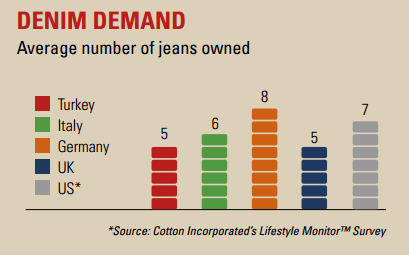
    • Turkish consumers own an average of eight denim garments,  five of which are denim jeans. When compared to the U.S. and Europe, denim ownership is lower among consumers in Turkey.
    • However,  younger Turkish consumers’ denim ownership is more in line with their European counterparts, as they own more denim garments (10 versus 7) and jeans (6 versus 4) than older Turks.
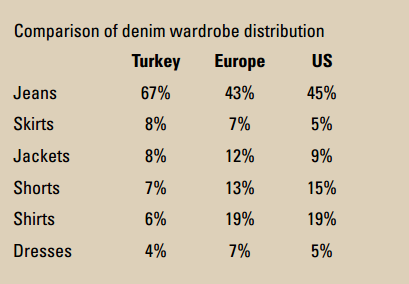
    • Overall, Turkish consumers’ denim wardrobes are less fragmented than the denim wardrobes of consumers in the U.S. and Europe; two-thirds of Turkish consumers’ denim wardrobes are dedicated to jeans, compared to 45% in the U.S. and 43% in Europe.

    denim demand turkeydenim wardrobe turkey

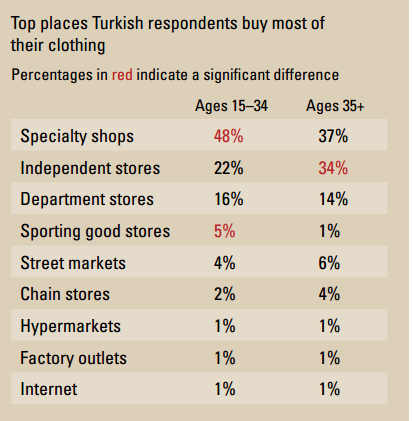
    The Turkish consumers reduced their purchase from unorganized retail – as happens in most economies which are growing fast. In 2012, 32% of Turkish consumers shopped at unorganized retail channels, down significantly from 41% in 2008. Specialty stores, where 43% of Turkish consumers purchase most of their clothing, are the most popular shopping destinations.

    turkish purchase of denim from stores

    However, internet shopping is still nascent and at a miniscule 1%..

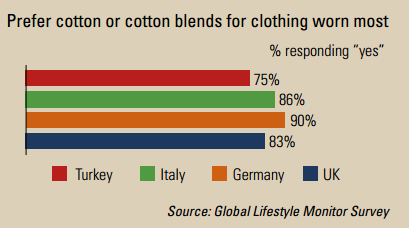
    The consumers also showed their preference for cotton clothes but at 75% of consumers saying so, it was significantly lower than those from countries like Germany and UK where almost 85-90% consumers want Cotton…!!

    cotton clothes turkey

    Turkish Exports of Denim Fabric / Mens and Women’s Jeans to US and EU

  • 18 Chinese Denim Brands

    China has become one of the most important markets for denim . Almost all the major denim brands from around the world are present there. While international brands like Levi’s and other brands play an important role in the market, there are a number of local denim brands which have carved out their own niches and are getting good share of the market. We have listed out 18 denim brands which are Chinese denim brands and are growing at a good pace. This is the first report in this series and we will be listing the second set of brands shortly – including international brands in China and their details/contacts etc.

    We are giving the short details on these brands/companies and their contacts in this report. It is interesting to see that some brands have a large number of stores – even in thousands . This shows the potential of this market !!

    image

    [private_special]

    Brand Name:

    Semir

    Company Name:

    Zhejiang Semir Garments Co., Ltd.

    Address:

    Shanghai, Lianhua South Road 2689

    Website:

    http://semirbiz.com/

    Email:

    315@vip.semir.com

    Phone/ Fax:

    86-21-67288111 / 86-21-67288112

    Description:

    The Semir Group was founded in 1996 and currently includes two brands – Semir and Balabala. Semir was created in 1998 and has since become a leading brand for casual clothing. It has also been named a listed Well-Known Brand, a Chinese brand name . Balabala first appeared in 2002 and is well known among China’s urbanites for children’s clothing and was among the first brands to be named a “Chinese Children’s Brand Name.” Currently, Semir has 4,300 sales locations throughout China.


    image

    Brand Name:

    Black Peony

    Company Name:

    Black Peony Group Co., Ltd.

    Address:

    Changzhou City, Jiangsu Province, Qingyang Road No. 47

    Website:

    http://www.blackpeony.com/index.shtml

    Email:

    bangongshi@chinadenim.com

    Phone/ Fax:

    86-519-68868300/ 86-519-68868110

    Description:

    It was founded in 1940, and then engaged on jean manufacturing since 1980s, which has been one of the earliest manufacturers nationwide. The company not only makes jeans (ERQ Jeans) but also denim fabrics . It has a production capacity of 60 million mtrs of denim and 8 million garments (most of them jeans). The ERQ brand was launched 2 years back and over 200 line experience stores were opened nationwide. The company is listed on the Shanghai Stock Exchange.


    image

    Brand Name:

    TOUGH

    Company Name:

    TOUGH cowboy

    Address:

    Chungshan North Road, Putuo District, Shanghai Building, east of the mid-2000, 24th Floor

    Website:

    http://www.toughjeans.com

    Email:

    sales@bauhaus.com.hk

    Phone/Fax:

    852-35131800 / 852-27967625

    Description:

    Launched in 1994, TOUGH Jeansmith is the first private bauhaus label. As one of Hong Kong leading fashion creators and retailers, their activities range from designing, to merchandising and sales networking.

    image

    Brand Name:

    Biaoqi Jeans

    Company Name:

    Shunde Biaoqi Garment Co., Ltd.

    Address:

    Shunde District Jun’an the ADLO industrial city

    Website:

    http://www.biaoqi.com/ 

    Phone/ Fax:

    86-757-25583388 / 86-757-25583399

    Email:

    Ceo@biaoqi.com , biaoqifac@msn.com

    Description:

    Denim garment manufacturers, founded in 1998, and  with an  annual production capacity of more than 3.8 million, it is an important jeans brand .

    image

    Brand Name:

    JUNTWO

    Company Name:

    The Enping Li Brothers Garments Co., Ltd.

    Address:

    Guangzhou City, Guangdong Province, Zengcheng way on the 13th

    Website:

    http://www.juntwo.com 

    Phone/ Fax:

    86-20-82792595 /86-20-82792595

    Email:

    juntwo@qq.com

    Description:

    The company is based in the Jeans Province – Guandong (New Town).. The company has over 200 workers and their brand sells in various provinces in China.


    image

    Brand Name:

    Lee Lang (Eng Name :LILANZ )

    Company Name:

    Lee Lang (China) Co., Ltd.

    Address:

    No. 200 Changxing Road, Jinjiang, China

    Website:

    http://www.lilanz.com/

    Email:

    lilanz@lilanz.com

    Phone/ Fax:

    86-4008879888 / 86-595-85622555

    Description:

    Lilang Group, by Wong’s three brothers – Wang Dong Xing, Wang Xing, Wang Cong Star was founded in 1987 .In 2007 and 2008 for two consecutive years it was listed  by Forbes as one of the most potential SMEs in China. The company now owns the brand: Lilang LILANZ, sub-brand L2. Lilanz started its globalization strategy in 2008 by changing its trademark LILANG to LILANZ .As top Chinese  men’s clothing manufacturer, Lilanz succeeded in going public in Hong Kong and entered the international capital market in 2009. After that, Lilanz enhanced its multi-brand operation and fostered new growth points by promptly exploring the huge market of medium-grade men’s business and leisure clothing with brand L2. It has currently more than 3000 outlets in China.


    ABC Kids

    Brand Name:

    Kids of ABC

    Company Name:

    Zhejiang start Children’s Products Co., Ltd.

    Address:

    Qingtian County, Zhejiang Province, hometown Development Zone

    Website:

    http://www.twabc.com.cn

    Phone/ Fax:

    400-6929-777 /86-578-400-6929-777

    Description:

    Zhejiang start Children’s Products Co., Ltd. is a a large group focused on children products including clothing.At present, Zhejiang start Children’s Products Co., Ltd. owns Fujian started Children’s Products Co., Ltd. and other companies. In addition, the company is still in mainland China with more than 20 sales branches, with nearly 2400 sales outlets across the country.


    image

    Brand Name:

    Baoxiniao

    Company Name:

    Baoxiniao

    Address:

    Wenzhou, Zhejiang Yongjia the Baoxiniao Industrial Park

    Website:

    http://www.baoxiniao.com.cn/about/

    Email:

    david@baoxiniao.com

    Description:

    Baoxiniao Garments Group Co., Ltd. was established in 1996, Group under a clothing listed companies,  with six original apparel brand, four international agency brand, three garment production base and more than 2,000 sales outlets. At present there are , more than 10,000 employees of the Group total assets of 3 billion yuan, annual sales income of 5 billion yuan.


    image

    Brand Name:

    Samuel & Kevin

    Company Name:

    Guangzhou Friendship Baleno Garments Co., Ltd.

    Address:

    Block-C Bei ke Qiao tang tang xia Zhone shan ave.,Guangzhou

    Website:

    http://www.samuel-kevin.com/

    Email:

    info@baleno.com.cn

    Phone / Fax:

    86-20-85107888 /86-20-85107888

    Description:

    The brand Samuel and Kevin was established in 1997 in Hong Kong. With a clear brand positioning strategy, the brand has positioned itself as “ The Trousers Expert”. It has established over 610 stores in China , Hong Kong, Taiwan, Singapore, Malaysia , Thailand, Vietnam etc.

    image

    Brand Name:

    Fanse

    Company Name:

    Where the color of denim under the Garments Co., Ltd.

    Address:

    Tianhe District, Guangzhou, Zhongshan Avenue, Tianhe Business Building, on the 8th of 22

    Website:

    http://www.fanse.com

    Phone/Fax:

    86-20-87570767 /86-20-87570767

    Description:

    The company has a number of well-known cowboy fashion designers, professional brand marketing team and product development team, and to set up a number of garment manufacturing plant in mainland China .


    image

    Brand Name:

    LAFEI NIER

    Company Name:

    Shantou S.E.Z.Yesheng Garment Co., Ltd.

    Address:

    2nd Floor, No.10 Changjiang Road, Shantou

    Website:

    http://www.lafeinier.com

    Email:

    yesheng@lafeinier.com

    Phone / Fax:

    86-754-88260250 / 86-754-88265993

    Description:

    Shantou S.E.Z.Yesheng Garment Co., Ltd. located in Guangdong province of China, was established in the year of 1992. It started from 100 odd employees, workshop area 1,000 square meters to the present scope: more than 3,000 employees, nearly workshop area 60,000 square meters,  and producing capacity reaches more than 30,000 pieces of garment per day. They are  also equipped with over 200 sets of computerized embroidery machines, owning a dye works factory as large as 14,000 square meters.


    image

    Brand Name:

    Maijia cowboy

    Company Name:

    Guangzhou Maijia clothing Co., Ltd.

    Address:

    402, Block A, No. 90 East Long River Business Center, Tianhe District, Guangzhou City, a Yokomichi

    Website:

    http://www.miccan.net

    Phone/ Fax:

    400-000-8368 / 86-020-82028181

    Description:

    The company has a large number of stores around China and specializes in Denim. It has a Business college called MBC where dealers are trained in latest industry research on denim and marketing related activities.


    image

    Brand Name:

    LWD

    Company Name:

    Hunan little witch-commerce Co., Ltd.

    Address:

    Yuhua District, Changsha in Hunan Province People’s East Road, Ming-Cheng International 24 Floor

    Website:

    http://www.lwd.net.cn/index.asp

    Phone / Fax:

    86-731-88866324 /86-731-88860645

    Description:

    The Hunan little witch-commerce Co., Ltd. is a denim brand in the Chinese mainland market, the core operation of the domestic production base located in the fashion capital – Guangzhou. "LWD" is the abbreviation of "Little Witch Denim" in  English. The little witch clothing brands into  has become a well-known brand of domestic and foreign, Hong Kong, Macao and Taiwan regions besides mainland China.


    image

    Brand Name:

    N6

    Company Name:

    Shunde, Foshan, light en Garment Co., Ltd.

    Address:

    2 Ronggui, Shunde District, Foshan City, Guangdong Province, the Kau together wins Road, on the second floor

    Website:

    http://www.N6-niuzai.com

    Email:

    1158567988@qq.com

    Phone/ Fax:

    86-757-28385365/ 86-757-28385364

    Description:

    Light ex Garment Co., Ltd., Shunde District, Foshan City, formerly known as Guangdong Austin Adams Garments Co., Ltd.,  was established in 1999. With the extension and expansion of the company’s business, in 2007, the light ex-Garment Co., Ltd., was established with  the sole operation of the company’s own brand N-6 JEANS    Up to now, the jeans  is now available throughout the 16 provinces and municipalities of Guangdong, Guangxi, Hunan, Hubei, Guizhou, Fujian, Sichuan, Hebei, Henan, Chongqing, Jiangsu, Zhejiang, Shaanxi, Shandong, Gansu, Liaoning,  etc.


    image

    Brand Name:

    JASONWOOD

    Company Name:

    Hung Garment Industry Co., Ltd.

    Address:

    Business Plaza, Hangzhou, sea 238 Senhe Building B, 10-12F

    Website:

    http://www.jasonwood.com.cn/

    Phone/ Fax:

    86-571-88115885 / 86-571-81995777

    Description:

    The company  designs and markets denim casual family apparel, shoes, bags and  accessories.Company’s JASONWOOD brand was born in 2000.The characteristics of their clothing consumption: the pursuit of individuality, but not an alternative.


    image

    Brand Name:

    Bso

    Company Name:

    Hopson Industrial Co., Ltd.

    Address:

    Guangdong Province by the new Town

    Website:

    http://www.bsojeans.com/

    Email:

    bso@bsojeans.com

    Phone/Fax:

    86-20-82693698 /86-20-82693111

    Description:

    Hopson Industrial Co., Ltd. was established in the year 1996 , is a collection of costume design, development, marketing, brand management, after-sales service as one of the major clothing brand entity. The company is headquartered in the famous cowboy town of China —— Guangdong Province, covering 80 acres, with a production base for denim garments, denim washing etc.The company is set up in over 20 provinces, municipalities and more than a dozen branches, the country has nearly a thousand denim brand stores.


    image

    Brand Name:

    Touchblue

    Company Name:

    Guangdong constant rain Garment Co., Ltd.

    Address:

    Guangzhou City, Guangdong Province, the village committee under the new Town Stone (set of states near the logistics park). Post Code: 511340

    Website:

    http://touchblue.nzw.cn/

    Email:

    sales@touchblue-gmt.com
    Phone/ Fax:

    86-20-82882676 / 86-20-82882671

    Description:

    The company employs more than 1,000 modern professionals in a denim apparel production factory in Guangdong Xintang.


    image

    Brand Name:

    Wanchun

    Company Name:

    Guangzhou City Pure Garment Co., Ltd.

    Address:

    Guangzhou Xintang Tong Mei Industrial Park, A1 Building

    Website:

    http://www.wanchun.com/cn/

    Email:

    wanchunjeans@126.com

    Phone / Fax:

    400-889-9041

    Description:

    Founded in 1998, after ten years of rapid development and has introduced new products, the brand has been around in more than 20 provinces nationwide.

    [/private_special]

  • Urban Outfitters Fall Winter ‘12 Denim

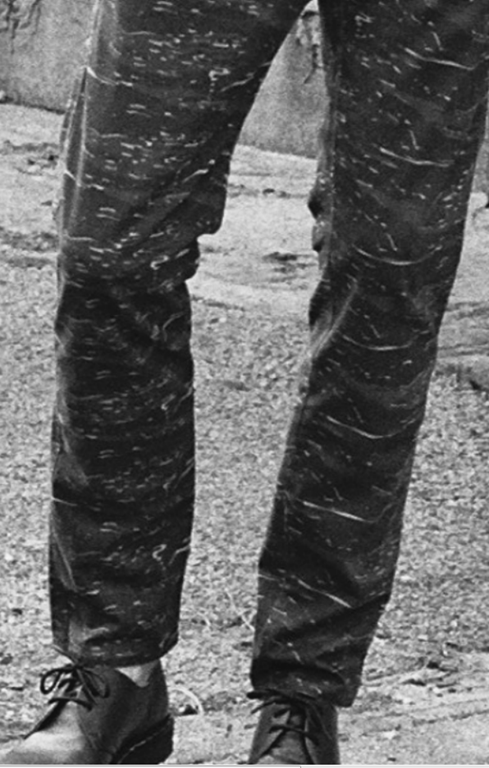
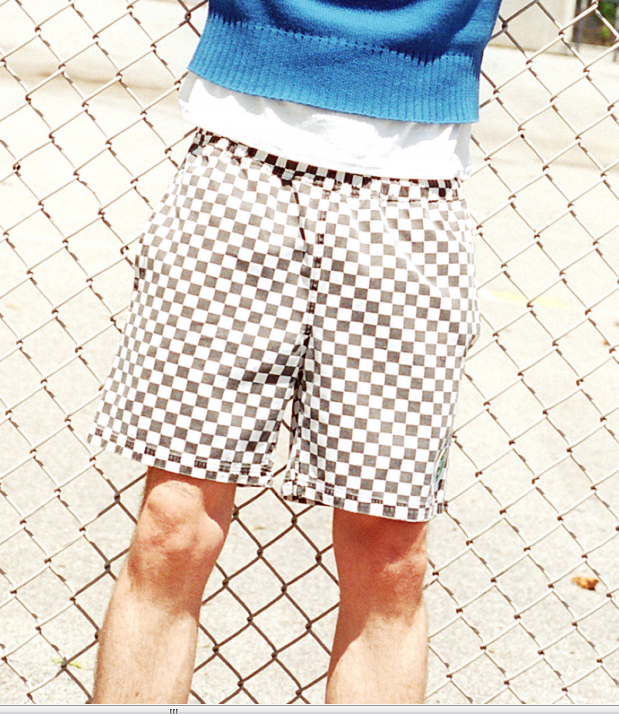
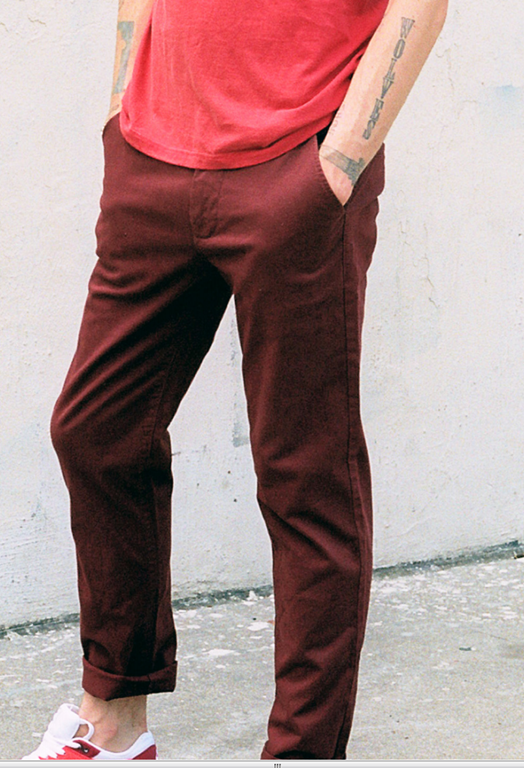
    Bold colors and innovative prints are center of Urban Outfitters  latest denim offerings for men’s. Over 77 new printed and colored denim styles are offered.Along with the core blue and black washes, Urban’s new range of denim focuses on moving color forward, with a broad array of Autumnal colors (eggplant, pine, wine, and ocean blue). Beyond color there are a plethora of fresh-out-of-the-box prints, including geometric ikats and florals, with unique detailing like embroidery and studs. The collection also explores its animalistic side, with feather, snake, horse and cheetah prints in multiple shades.

    The new collection is available in one of two signature fits — the Twig and the Cigarette.

    • The Twig fit comes in both mid-rise and high-rise inseams, and features an ultra-skinny leg.
    • The Cigarette fit has a slim leg opening, and is also available in mid- and high-rise inseams.


    Urban Outfitters Fall Winter 2012 Denim Collection

    Urban Outfitters Fall Winter 2012 Denim Collection

    Urban Outfitters Fall Winter 2012 Denim Prints

    Urban Outfitters Fall Winter 2012 Denim Colors

    Urban Outfitters Fall Winter 2012 Denim Prints

    Urban Outfitters Fall Winter 2012 Denim Prints


    Urban Outfitters, Inc.  is a publicly traded American company that owns and operates over 400 retail locations across five retail brands: Urban Outfitters, Anthropologie, Free People, Terrain, and BHLDN.Urban Outfitters originated as “The Free People’s Store” in 1970 in Philadelphia, Pennsylvania, focusing on “funky” fashion and household products. Shortly thereafter the owner and now Chairman, Richard Hayne, changed the name to Urban Outfitters. The product line has evolved from vintage, bohemian, retro, hipster, ironically humorous, kitschy apparel and furniture to include luxury brands and several designer collaborations.Headquartered at the Philadelphia Navy Yard, Urban Outfitters operates more than 170 locations in the United States, Canada, the Republic of Ireland, Denmark, Sweden, Germany, Belgium, and the United Kingdom.

    Sponsored Link:
    orta-button

  • Nudie Jeans–Fall /Winter 2012 Collection

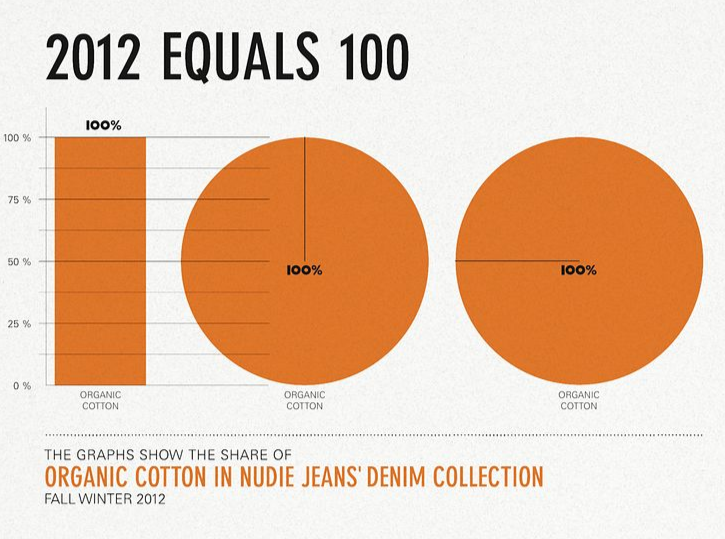
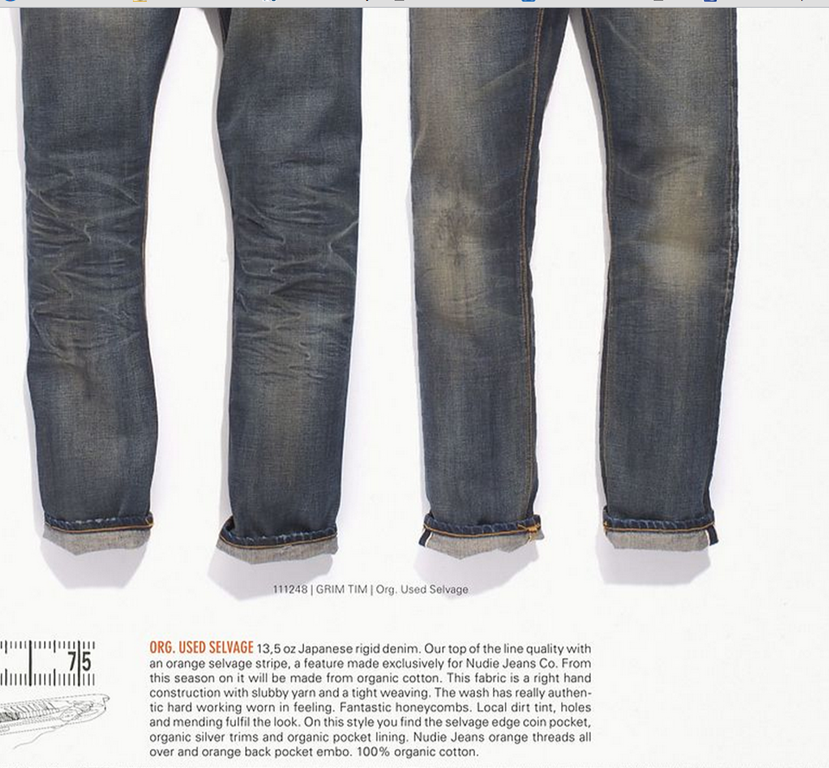
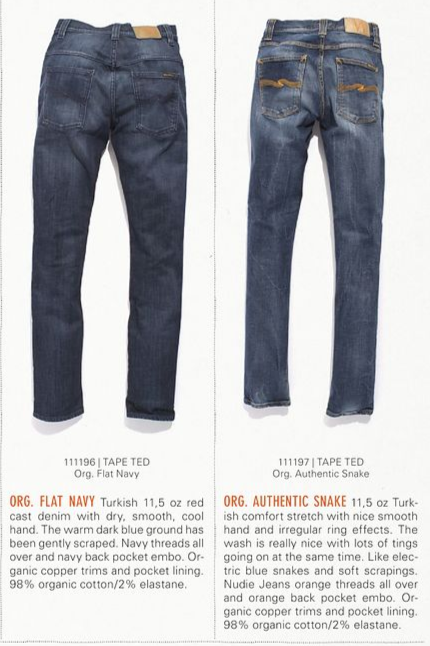
    Nudie Jeans, the famous denim brand from Sweden , does it again with a unique denim collection for the Fall Winter 2012 with complete collection made of Organic Denim.

    organic cotton denim collection

    Here is what Nudie Jeans guys have to say about their focus on social responsibility in respect to manufacturing of their products:

    We do not envisage a trade off between profit and people , or between manufacture and environmental reponsibility . These issues are major factors in our choice of suppliers. As with most other clothing brands, we do not own the factories in which our clothing is made. However, together with our garment factories, we bear the responsibility to provide a safe , fair and ethical work environment for all the people who are involved in the manufacturing of our clothes. We work together with only a handful of partners, all of whom are required to comply with our code of conduct. Our membership of Fair Wear Foundation is a key element ensuring that everyone across the production chain works  under fair conditions.

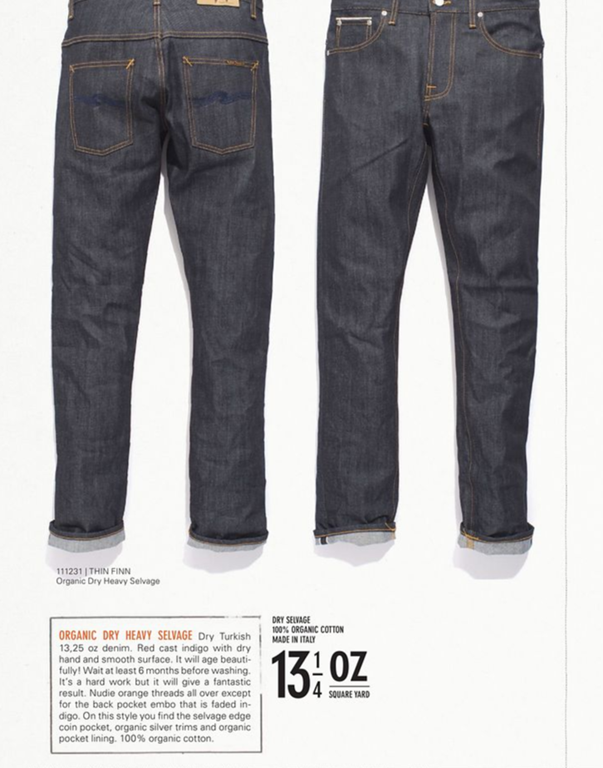
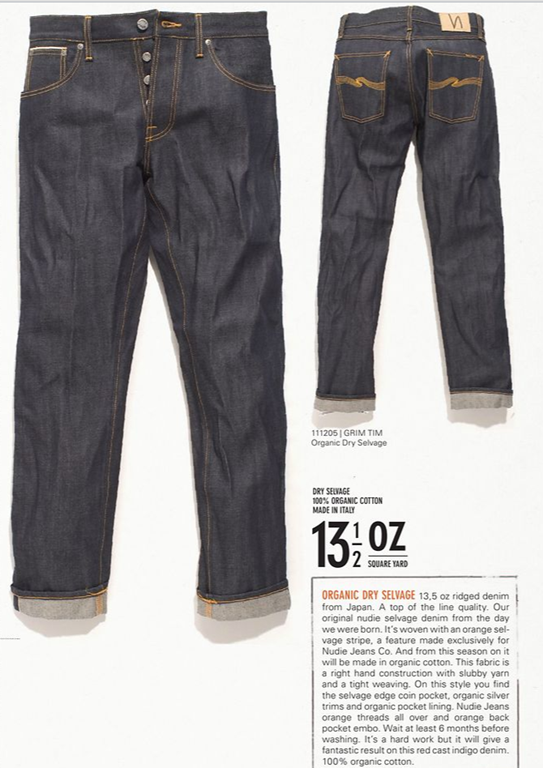
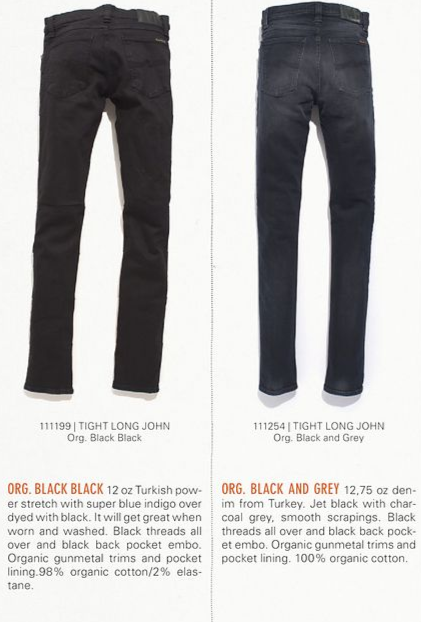
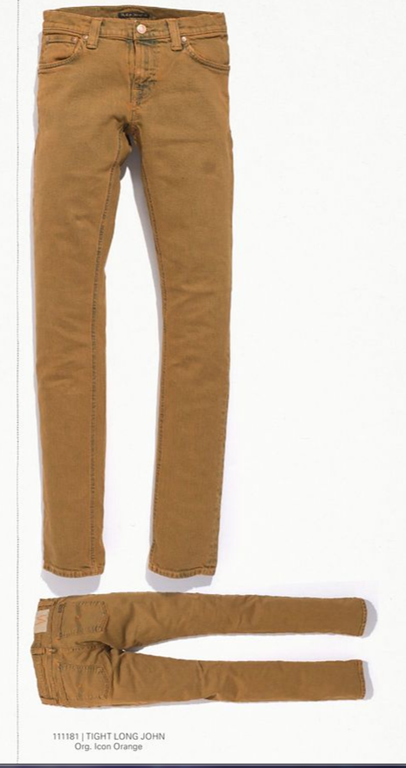
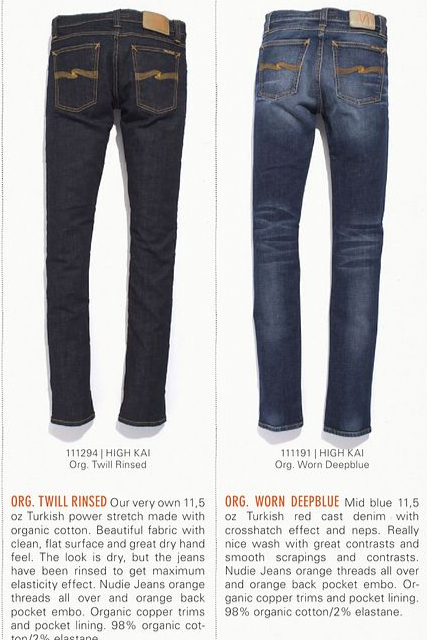
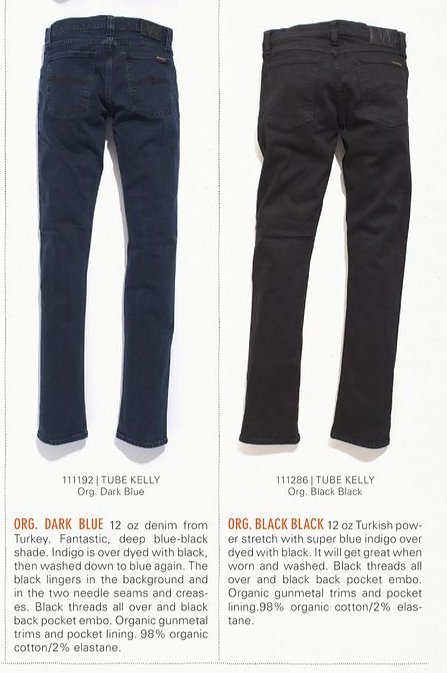
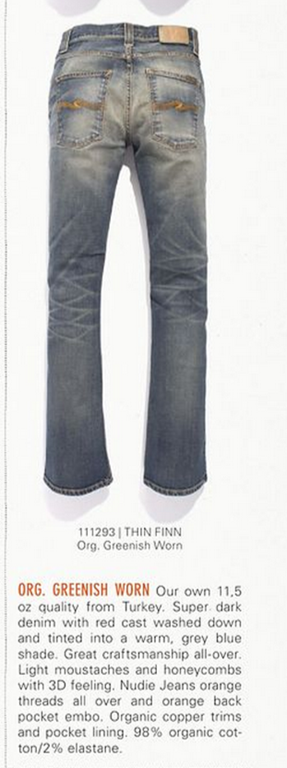
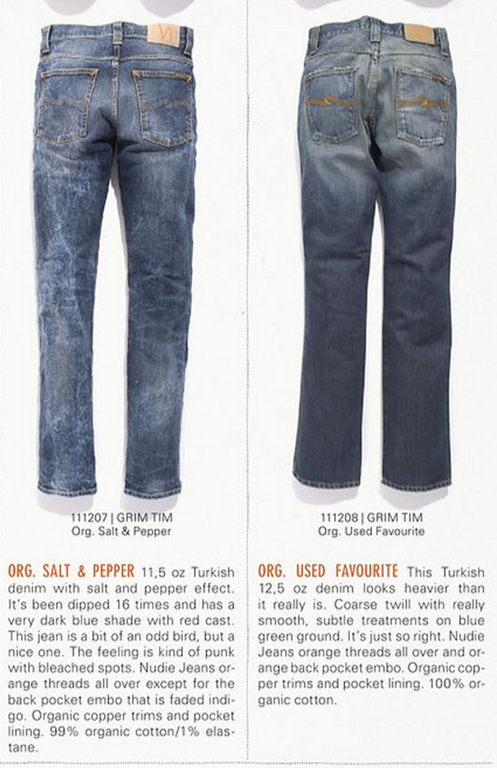
    Here are some styles and pieces from this Organic Denim Collection. Most of the fabrics used by Nudie Jeans are from Turkey and some from Japan and Italy.. The weights range from 9 oz to 13.5 oz.


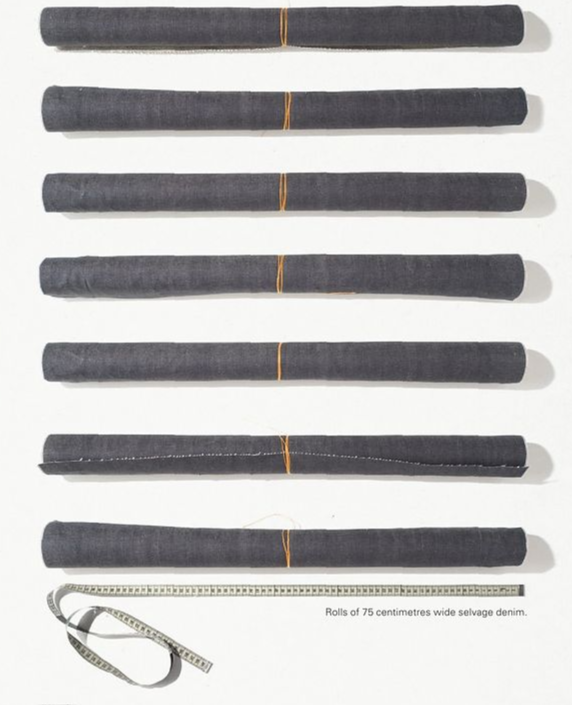
    Dry Selvedge

    selvedge denim rolls

    Nudie Jeans - Fall Winter 2012 - Dry Selvedge

    Nudie Jeans - Fall Winter 2012 - Dry Selvedge

    Tight Long John

    Nudie Jeans - Fall Winter 2012 - Tight Long John

    Nudie Jeans - Fall Winter 2012 - Tight Long John

    High Kai

    Nudie Jeans - Fall Winter 2012 - Hai Kai

    Tube Kelly

    Nudie Jeans - Fall Winter 2012 - Tube Kelly

    Tape Ted

    Nudie Jeans - Fall Winter 2012 - Tape Ted

    Thin Finn

    Nudie Jeans - Fall Winter 2012 - Thin Finn

    Grim Trim

    Nudie Jeans - Fall Winter 2012 - Grim Trim

    Nudie Jeans - Fall Winter 2012 - Grim Trim

  • Japan–Denim Fabric Exports & Imports : 2011-2012

    Japanese DenimThe importance of Japan in the denim industry can never be underestimated. Though Japan never had huge productions , it always played an important role in giving directions and leading denim industry creatively. Though Japan has only a few mills like Kaihara, Kuroki etc doing real production in Japan, all other production units having shifted overseas, the fabrics of these mills are still highly sought after the world over. Besides, Japan has some local denim jeans manufacturing – again not in huge quantities but – small quantities and niche products. These jeans use the fabric made in Japan and also import some fabric.

    In this special report we will see :

    Regarding Exports of Denim Fabrics from Japan

    • What were Japan’s exports of denim fabrics in 2011 and to which countries did Japan export these fabrics ..The % share of the top markets (table)..
    • What were the average prices of such exports (table)
    • What were the aggregate exports made by Japan in the first six months of 2012 and the prices thereof  . This will be compared with the average exports made in the first six months of 2011. (table)
    • The change in quantities exported and prices changes of denim fabrics during these similar periods of 2011 and 2012.
    • Imports of Denim fabrics into Japan in 2011 .

    Regarding Imports of Denim Fabrics into Japan

    • The countries from where such imported fabrics came and the prices and quantities of the same during 2011.
    • The share of top markets in exporting denim fabrics to Japan etc ……
    • Imports during Jan – June 2012 as compared to same period in 2011 (table)  . Understanding how big is the import market of Japan for denim fabrics.
    • The countries from where highest priced fabrics are coming to Japan.
      [private_special]

    Note: HS codes covered are 520942 and 521142
    :The conversion rate of USD to Yen is taken as 1 usd =78 Yen

    Exports of Denim Fabrics from Japan – Worldwide : Jan- June 2012 vs 2011


    Year Quantity in million sq mtrs Value in million USD Average Price (USD/ Sq mtr)
    2012 14 75.13 5.31
    2011 14 70.65 5.04
    Change   0%   +5.9% +5.08%

    Imports of Denim Fabrics into Japan from around the world : Jan- June 2012 vs 2011

    Year Quantity in million sq mtrs Value in million USD Average Price (USD/ Sq mtr)
    2012 1.1 3.42 2.98
    2011 2.1 6.07 2.87
    Change -47% -43.65% +3.8%

    Exports of Denim Fabrics in 2011 from Japan to the world


    Country Sq mtrs Value in USD Av Price (US$ /sq mtr) Share (%)
    China 10,302,202.0 5,09,67,538.5 4.9 37.9%
    Vietnam 48,59,414.0 2,63,01,705.1 5.4 17.9%
    Bangladesh 32,77,890.0 1,21,09,371.8 3.7 12.1%
    Hong Kong 27,66,364.0 1,60,40,923.1 5.8 10.2%
    USA 21,39,812.0 1,34,47,423.1 6.3 7.9%
    Thailand 8,78,312.0 14,29,423.1 1.6 3.2%
    Italy 6,08,230.0 56,75,782.1 9.3 2.2%
    Taiwan 4,06,618.0 22,57,859.0 5.6 1.5%
    Srilanka 3,78,946.0 17,39,217.9 4.6 1.4%
    Cambodia 2,88,260.0 15,61,910.3 5.4 1.1%
    Turkey 2,67,248.0 20,00,833.3 7.5 1.0%
    Malaysia 1,87,016.0 4,97,692.3 2.7 0.7%
    Tunisia 1,72,470.0 13,09,217.9 7.6 0.6%
    India 1,36,757.0 5,06,782.1 3.7 0.5%
    ————- ———– ———— ———– ——
    Total 27.1 million mtrs US$ 139.75 million US$5.14/ sq mtr


    Imports from around the world in 2011 – Top Few Countries

    Country Sq Mtrs Value US $ per sq.mtr share %

    Taiwan

    1,132,407

    4,976,282

    4.39

    32.22%

    China

    1,128,908

    2,889,026

    2.56

    32.12%

    Indonesia

    9,44,043

    2,001,577

    2.12

    26.86%

    Hong Kong

    1,38,232

    4,16,948.7

    3.02

    3.93%

    Turkey

    88,686

    5,88,576.9

    6.64

    2.52%

    Thailand

    50,955

    1,68,679.5

    3.31

    1.45%

    Philippines

    21,514

    87,333.33

    4.06

    0.61%

    —- —— ——– ——– ——–
    Total 3.51 million sq mtrs $ 11.21 million $3.19

    Source:Japan customs and various.

    Exports:

    Almost 40% of fabric from Japan goes to China. The rest goes to important markets like Vietnam, Bangladesh , Hong Kong , USA etc. The average price of export seems to be about $5 per sq mtr though there are wide variations from country to country. Exports are almost constant in the first six months in 2012 compared to the last year , but the prices have increased by about 5% .

    Imports:

    As we can see from import figures in 2012 over that of 2012 in Jan to June , we see that there is a drastic fall of about 47%  in the quantity of denim imported into Japan. These figures , if continued in the later part of this year , would result in imports of denim fabrics falling to about 2 million sq mtrs only…. The average import prices of $2.98 in 2012 are higher than in 2011 but significantly lower than those of exports .. This clearly shows that while exports high value fabrics, it does low priced fabrics from various countries . However, it is to be noted that countries like Turkey are shipping into Japan (though very small quantities) high priced fabrics of over $6 per sq mtr. Even Italy is exporting to Japan but very miniscule quantities.
    It is also surprising to see that Taiwan and China take up the lion’s share of about 64% Japanese import market though price from China is very low. Indonesia is also exporting some good quantities into Japan.

    [/private_special]

  • What Are Consumers Looking For When Buying Denim?

    What are the factors that influence the purchase decision of a consumer when he/she is buying denim jeans?  Is it the quality or the fit or the  color, wash, fabric, price, feel etc which influence  the decision of a man or woman when he is in a store selecting jeans..
    While we know that all of these factors in some measure affect the purchase decision , but which factors are more important compared to other factors?

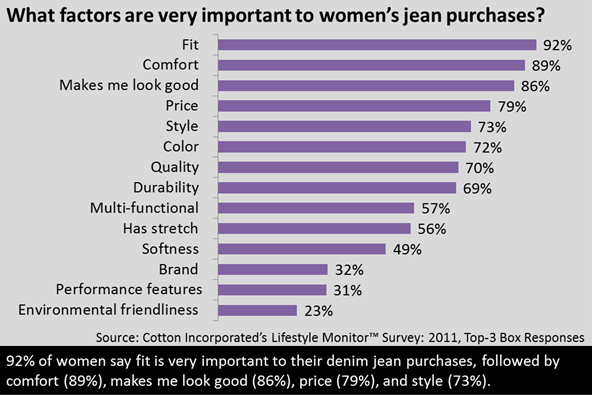
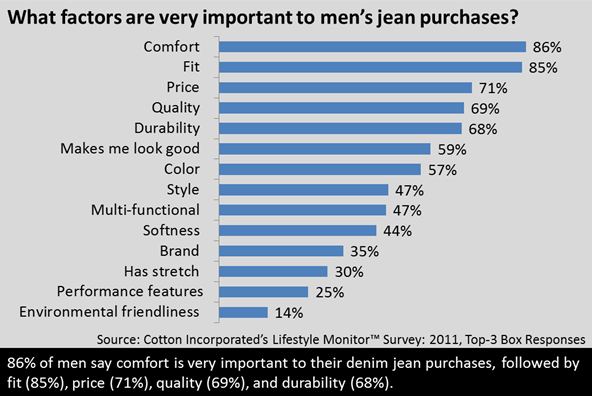
    Cotton Inc USA did an annual survey  of US consumers in 2011 to work out a report on the factors affecting the purchase of denim by Men and Women. Here

    What factors are important for women to purchase denim jeans in USA?

    Denim Jeans Purchase Factors Women

    As we can see from the results of   Cotton Inc survey in US ,for women FIT IS THE MOST IMP. Attribute.  Over 92% feel that fit is very important to their jeans purchase decision. Comfort comes second  and -though very important – falls behind the fit . Other important factors are ‘Makes me look good’ (of course ! ) , price , style etc..
    Stretchability as a factor which is showing low in the rankings seems strange because women jeans are almost 80%+ stretch. However, the biggest loser is the ENVIRONMENTAL FRIENDLINESS factor – which comes in the last and does not seem to be very  important for the women in US while purchasing denim.. Environmental consciousness is actually conspicuous by its absence in most of the markets around the world where the buyers are not really aware of the actual damage that jeans production is causing. However, I am sure the importance of this factor is increasing slowly everyday and in the near future this factor coming up . Already initiatives like Organic Cotton, BCI and others are gaining in strength and harmful production processes like sandblasting are being controlled to some extent and water saving in jeans manufacturing encouraged. However, at consumer level, the awareness is still very low.

    What factors are important for men to purchase denim jeans in USA?

    Denim Jeans Purchase Factors Men

    Men are most concerned with comfort with FIT coming close second. And of course they are more concerned about price than women !!  For them multi functionality of denim is not as important (compared to women) – seem happy if the jeans performs its normal function of feeling comfortable. Brand consciousness is more than women while stretchability is not really very important. Last , but not least , their environmental consciousness is much below that of women (kudos to women !! )…

    Finally , the message for the denim brands – if you have great FITS , the consumers may ignore other factors to some extent. !!!

    Denimsandjeans Resource Snippets
    J Brand Jeans- Designer Denim Fit Guide
    All Denim Apparels Into USA From China:2000-2012
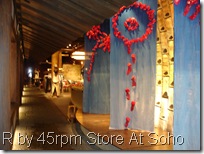
    R By 45rpm Denim Jeans – A Chat With Ehren At NY Store
    Levi’s? Master Denim Tailor-Union Square job
    Current/Elliott – Denim Brand From U.S
  • ITG– Financials 1st Quarter 2012


    imageITG Group is one of the most important textile group related to denim industry. Cone Denim is a part of the ITG group and Cone needs no introduction having being serving denim industry for over a 100 years.. In this report which is a partial reproduction from company’s own report for the 1st quarter of 2012 , it is reflected that the company has been badly affected by the economic downturn and the increase in raw material prices in 2010/11. The company is trying , through various cost reduction and marketing initiatives to reduce the impact of these macro economic factors.

    ITG Financial Report For Jan-March ‘12

    International Textile Group, Inc.is a global, diversified textile manufacturer headquartered in Greensboro, North Carolina, with operations principally in the United States, China, and Mexico. ITG’s long-term focus includes realizing the benefits of its global expansion, including reaching full production at ITG facilities in China, as described below, and continuing to seek other strategic growth opportunities.

    The Company believes it is one of the world’s largest and most diversified producers of denim fabrics and the largest producer of better denim fabrics for products distributed through department stores and specialty retailers. In addition, the Company believes it is one of the largest worsted wool manufacturers and commission printers and finishers in North America, and is a leading developer, marketer and manufacturer of other fabrics and textile products.

    The Company is organized and managed primarily according to product categories and manufacturing processes rather than by markets or end-use customers. The Company currently has five operating segments that are reported to the chief operating decision maker (“CODM”) and four reportable segments that are presented herein.

    • The bottom-weight woven fabrics segment includes heavy weight woven fabrics with a high number of ounces of material per square yard, including woven denim fabrics, synthetic fabrics, worsted and worsted wool blend fabrics used for government uniform fabrics for dress U.S. military uniforms, airbag fabrics used in the automotive industry, and technical and value added fabrics used in a variety of niche industrial and commercial applications, including highly engineered materials used in numerous applications and a broad range of industries, such as for fire service apparel, ballistics materials, filtration, military fabrics and outdoor awnings and covers.
    • The commission finishing segment consists of textile printing and finishing services for customers primarily focusing on decorative fabrics and specialty prints as well as government uniform fabrics primarily for battle fatigue U.S. military uniforms.
    • The narrow fabrics segment consists of narrow webbing products for safety restraint products such as seat belts and military and technical uses.
    • The all other segment consists of expenses related to the idled Cone Denim de Nicaragua and ITG-PP joint venture plant facilities, transportation services and other miscellaneous items.

    International Greenfields

    The Company’s facilities in China experienced increasing capacity utilization during 2011 as the economy improved from the significant downturn starting in 2008. As previously disclosed, in April 2009, the Company idled its Cone Denim de Nicaragua facility until further strategic alternatives are finalized. In addition, as previously disclosed the Company idled its Vietnam facility while in arbitration with its joint venture partner.

    Business and Industry Trends

    The global economic environment continues to be uncertain and volatile. Concerns related to continued high unemployment, government and municipal budgetary issues and the prospects for sustained economic recovery continue to impact consumer, military and municipal spending and our businesses, which could continue to have adverse effects in the significant markets in which we operate. The Company has taken, and expects to continue to take, steps to counter this continued economic uncertainty. These actions include, among other things, negotiating higher sales prices for certain products, negotiating new working capital financing arrangements, focusing on new product development projects and implementing cost saving initiatives.

    During the latter part of 2010, cotton prices began increasing dramatically and reached historical highs in the first half of 2011 due to weather-related and other supply disruptions, which, when combined with increasing demand for cotton, particularly in Asia, created concerns about continued short-term availability in addition to increased costs for the Company’s products. While cotton prices have recently declined from the historical highs, cotton and wool prices continue to fluctuate and remain high as compared to historical levels. The Company’s bottom-weight woven fabrics segment has historically entered into firm purchase commitments for cotton and wool commodity raw materials used in the manufacture of apparel fabrics. Such non-cancellable firm purchase commitments are secured to provide the Company with a consistent supply of a commercially acceptable grade of raw materials necessary to meet its operating requirements as well as to meet the product specifications and sourcing requirements with respect to anticipated future customer orders. Because of the Company’s commitments related to raw materials, declines in selling prices below the committed price have had, and could continue to have, a negative impact on the Company’s results.

    While we have been able to pass on some of these increased raw material costs through to our customers, the Company’s margins were negatively impacted in 2011 and in the three months ended March 31, 2012 by higher raw material prices. In response to the cost increases in raw materials, we have increased sales prices and we expect to continue to attempt to increase sales prices as necessary in response to higher costs or committed purchase contracts in order to provide sufficient margins. However, the Company has had difficulty maintaining higher sales prices as certain raw material market prices have fallen despite the higher raw material costs that remained in the Company’s inventories through the three months ended March 31, 2012. If the Company incurs increased raw material or other costs that it is unable to recoup through price increases, or experiences interruptions in its raw materials supply, our business, results of operations, financial condition and cash flows may be adversely affected.

    Restructuring Charges and Asset Impairments

    As a result of the macro-economic conditions discussed above and the continued financial challenges facing the Company, the Company initiated a restructuring plan in late 2011 that focused on reducing overall operating expenses by including manufacturing and other cost reduction initiatives, such as

    • workforce reductions at the bottom-weight woven fabric segment’s White Oak denim facility
    • and administrative functions to improve efficiencies.

    As described above, the Company announced in December 2011 that the ITG-PP joint venture facility(at Vietnam)  would be idled for an unknown period of time beginning in January 2012 and ITG-PP incurred direct costs related to the decision to idle the facility . The 2012 restructuring charges are primarily related to the idling of the Company’s ITG-PP joint venture facility in the amount of $2.5 million and workforce reductions at the Company’s White Oak denim facility in the amount of $0.1 million. The 2011 provision for restructuring charges of less than $0.1 million was primarily related to the Company’s multi-segment selling and administrative cost reduction plan.

    Results of Operations

    Net sales and income (loss) from continuing operations before income taxes for the Company’s reportable segments are presented below (in thousand US Dollars). The Company evaluates performance and allocates resources based on profit or loss before interest, income taxes, expenses associated with refinancing activities, restructuring and impairment charges, certain unallocated corporate expenses, and other income (expense) – net. Intersegment sales and transfers are recorded at cost or at arms’ length when required by certain transfer pricing rules. Intersegment net sales for the three months ended March 31, 2012 and 2011 were primarily attributable to commission finishing sales of $4.9 million and $5.0 million, respectively.

                                                                Three Months Ended
                                                           March 31,           March 31,
                                                             2012                2011
    
    Net Sales:
    Bottom-weight Woven Fabrics                         $       140,970     $       135,766
    Commission Finishing                                         11,839              10,690
    Narrow Fabrics                                                7,530               6,665
    All Other                                                     6,393               9,905
                                                                166,732             163,026
    Intersegment sales                                           (4,870 )            (5,040 )
                                                        $       161,862     $       157,986
    
    Income (Loss) From Continuing Operations Before
    Income Taxes:
    Bottom-weight Woven Fabrics                         $         1,459     $         8,525
    Commission Finishing                                            407                 136
    Narrow Fabrics                                                 (361 )              (327 )
    All Other                                                    (1,393 )            (5,334 )
    Total reportable segments                                       112               3,000
    Corporate expenses                                           (3,001 )            (3,844 )
    Other operating income - net                                      3                 403
    Restructuring charges                                        (2,033 )               (14 )
    Interest expense                                            (13,791 )           (11,557 )
    Other income (expense) - net                                 (2,501 )              (972 )
                                                                (21,211 )           (12,984 )
    Income tax expense                                             (890 )            (1,014 )
    Equity in loss of unconsolidated affiliates                    (378 )               (24 )
    Loss from continuing operations                             (22,479 )           (14,022 )
    Discontinued operations:
    Loss from discontinued operations, net of taxes                   -                 (29 )
    Gain on disposal, net of taxes                                    -               2,110
    Income from discontinued operations                               -               2,081
    Net loss                                                    (22,479 )           (11,941 )
    Less: net loss attributable to non controlling
    interests                                                    (1,874 )            (2,019 )
    Net loss attributable to International Textile
    Group, Inc.                                         $       (20,605 )   $        (9,922 )

    ($ in ‘000s)


    Comparison of Three Months Ended March 31, 2012 to Three Months Ended March 31, 2011

    Consolidated: Consolidated net sales in the three months ended March 31, 2012 and 2011 were $161.9 million and $158.0 million, respectively, an increase of $3.9 million, or 2.5%, in the three months ended March 31, 2012 compared to the three months ended March 31, 2011. This increase was primarily due to an improved product mix in the Company’s technical fabrics business and higher selling prices charged to recover higher raw material costs at most of the Company’s other businesses. Net sales also increased due to sales volume increases primarily in the airbag and selected synthetic fabrics businesses due to improved economic conditions in the automotive industry and selected synthetic fabrics retail apparel markets. These increases were partially offset by volume declines in most of the Company’s other product lines primarily due to continued general unfavorable economic conditions affecting those markets as well as increased pricing pressures and municipal government budget cuts affecting demand at certain businesses. The Company also experienced reduced sales of $2.9 million at its cotton fabric and garment manufacturing complex in Vietnam due to the idling of that facility in January 2012 as described above.

    Gross profit in the three months ended March 31, 2012 was $9.2 million, or 5.7% of net sales in the three months ended March 31, 2012, compared to $12.6 million in the three months ended March 31, 2011, or 8.0% of net sales. Gross profit margins were negatively impacted primarily by higher raw material costs that were not fully offset by higher selling prices as well as manufacturing inefficiencies at certain locations due to volume declines, partially offset by reduced losses at the idled ITG-PP facility of $3.2 million. Operating loss in the three months ended March 31, 2012 was $4.9 million compared to $0.5 million in the three months ended March 31, 2011 with such reduction primarily due to the lower gross profit margins described above and higher restructuring charges of $2.6 million mainly related to the idling of the ITG-PP joint venture facility, partially offset by lower selling and administrative expenses described below.

    Bottom-weight Woven Fabrics: Net sales in the bottom-weight woven fabrics segment in the three months ended March 31, 2012 increased $5.2 million to $141.0 million as compared to the $135.8 million recorded in the three months ended March 31, 2011. The increase in sales primarily resulted from $14.9 million of higher selling prices charged to recover higher raw material costs and improved product mix primarily as the result of the development of new higher margin products, as well as higher sales volumes of $5.0 million primarily in the airbag and synthetic fabrics businesses due to improved economic conditions in the automotive industry and selected synthetic fabrics retail apparel markets. Improvements in this segment were partially offset by lower sales volumes of $14.7 million primarily in the denim business due to general unfavourable economic conditions affecting demand in that market, as well as increased pricing pressures, and, to a lesser extent, in certain of the technical fabrics businesses due to municipal government budget cuts.

    Income in the bottom-weight woven fabrics segment was $1.5 million in the three months ended March 31, 2012 compared to $8.5 million in the three months ended March 31, 2011. The decrease in income was primarily due to higher raw material costs of $9.5 million primarily in the denim business, lower selling prices of $0.6 million and higher energy costs of 0.3 million. These reductions were partially offset by an improved product mix of $1.7 million primarily in the technical fabrics business, lower labor costs of $0.9 million due to reduced production volumes and favourable impacts from changes in foreign currency exchange rates of $0.9 million.

    Commission Finishing: Net sales in the commission finishing segment were $11.8 million in the three months ended March 31, 2012 compared to $10.7 million in the three months ended March 31, 2011. The increase from the prior year period was primarily due to sales volume increases of $1.3 million due to increased sales to certain U.S. and foreign militaries. Commission finishing markets in the 2012 and 2011periods were also negatively affected by diminished discretionary income and consumer spending in the U.S. as well as increased competition. Income in the commission finishing segment was $0.4 million in the three months ended March 31, 2012 compared to $0.1 million in the three months ended March 31, 2011. The increase in operating results was primarily due to higher sales volumes in the government sector and lower raw material, energy and labor costs, partially offset by manufacturing inefficiencies.

    Narrow Fabrics: Net sales in the narrow fabrics segment were $7.5 million and $6.7 million in the three months ended March 31, 2012 and 2011, respectively. The increase from the prior year was primarily due to higher sales volumes of $0.3 million primarily related to the segment’s seat belt business due to improved economic conditions in the automotive industry, and $0.6 million related to higher selling prices to recover higher raw material costs and a more favourable product mix related to certain government contracts. Loss in the narrow fabrics segment was $0.4 million in the three months ended March 31, 2012, compared to $0.3 million in the three months ended March 31, 2011. The decrease in operating results was primarily due to higher raw material and energy costs and manufacturing inefficiencies, partially offset by higher selling prices and a more favourable product mix of $0.6 million.

    All Other: Net sales in the all other segment in the three months ended March 31, 2012 and 2011 were $6.4 million and $9.9 million, respectively. The decrease from the prior year period was primarily due to lower sales at the ITG-PP facility in Vietnam which was idled in January 2012. Loss in the all other segment was $1.4 million in the three months ended March 31, 2012 as compared to $5.3 million in the three months ended March 31, 2011. Operating losses in this segment were primarily due to depreciation and other carrying costs related to the idled ITG-PP facility and, to a lesser extent, the idled Cone Denim de Nicaragua facility. Operating losses at the ITG-PP facility were lower in the 2012 period as compared to the 2011 period as a result of the idling of the Vietnam facility in January 2012 as described above.

    Sponsored Link:

    image

  • Bangladesh Denim Market

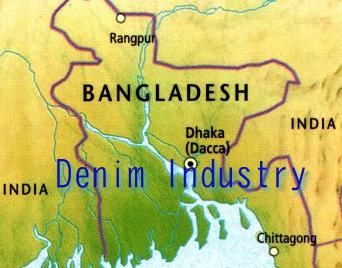
    bangladesh denim industryBangladesh is one of the most important centre for denim apparel production and export around the world. In fact, it has come up as the third most important exporter of denim apparel to US after Mexico and China and second highest to EU after China.  With thousands of small and big garment units in Bangladesh, it is also one of the cheapest production centre for apparel around the world . Also , it is the world’s most concentrated cluster of apparel production with most of the units centered in and around the city of Dhaka and some around Chittagaong.
    While most of the aforesaid is known , what is not well known is that Bangladesh is also coming up as large textile industry centre . A number of new spinning and weaving mills have come up in the country and these include denim weaving mills also. While Bangladesh has traditionally been a fabric importer, the emergence of these mills is changing the equation for the exporters of fabrics to this country.

    In this report , lets see :
    a) What is the total market size for denim fabrics in Bangladesh ?
    b) What is the production of denim fabrics in Bangladesh – total and mill wise – giving capacities of mills and approx utilization.
    c) What is the total import market for Denim fabrics in BD?
    d) What are the major export destination markets for these products and what are the actual exports to US (till May 2012) and for EU (till April 2012) . How does it compare with the same period last year ? EU exports seem to be increasing while US exports are falling (see figures)
    e) An (public) report from a denim mill in Bangladesh (which can be downloaded)  and  will give an idea on

    • Financials of operating denim mill in Bangladesh.
    • SWOT analysis of denim industry in Bangladesh
    • Some idea on prices received by denim mills for their fabrics in BD.
    • Balance sheet and statement of income.
    • And many other useful aspects of denim operations in BD.
    • An idea on the buyers who buy from local mills and approx prices .

    (the report is in about 1000 words)

    The share of imported fabrics is decreasing by the day as the capacities of Bangladesh Denim mills keeps on increasing every year.
    [private_special]
    Bangladesh has  a total market size of about 270 million mtrs of denim (2011). Almost the entire quantity is used for manufacturing of apparel for export. Though , of course, the actual quantity of denim consumed will vary from year to year , depending on orders from overseas markets, this is the approximate quantity that has been consumed in the country in the year 2011. In 2012, this quantity is expected to be lower as we find that the orders from US and EU both have reduced and the figures of exports from Bangladesh are lower.

    Domestic Production

    The installed capacity of  domestic production of denim fabric in Bangladesh is about 233 million mtrs. This is the installed capacity. The capacity utilization of denim mills in Bangladesh is between 80-85% and hence the actual production estimate for denim in BD is about 191 million mtrs.  The breakup of the production capacities mill wise is given below :
    Mill Name Capacity (mmpa)
    Partex Denim 22
    Envoy Textiles 22
    Yogotex Fabrics Co. Ltd. 20
    Shasha Denim 18
    Ha Meem Denims Ltd. 18
    Pacific Denims Ltd. 16.5
    Nassa Taipei Denims Ltd 14.5
    Chittagong Denim Ltd 10
    Royal Denims Ltd 10
    Jamuna Denims Ltd 9.2
    Deep Textiles Mills 8
    Salek Textiles 7.5
    Argon Denim 7.5
    Bengal Indigo 7.2
    Sinha Denim Limited. 7
    Desh Denim Mills 7
    Dhaka Denim Mill 6.5
    Beximco Denim Ltd 6
    Mahmud Denims Limited 6
    Mab Denim Limited. 6
    Titas Spinning & Denim Company Ltd. 5
    Total 233.9

    Imported Fabrics

    So what is the approx imported fabrics that are coming into Bangladesh. The approximate figures for these fabrics coming into Bangladesh are about 90 million mtrs. This is still a huge quantity . However, if we consider that about 7-8 years back almost the entire quantity of denim was being imported, the market share of imported fabric is going down steeply. Also, there are planned expansions of more than 50 million mtrs in the coming year in Bangladesh and this will further push out the imported fabrics – unless there is a huge increase in order position (which does not seem likely in 2012).  This cake of about 100 million mtrs is divided principally between the following countries exporting denim fabrics .

    India
    Pakistan
    China
    Indonesia
    Thailand

    Some quantities of fabrics comes from countries like Turkey, US and even Japan – but these are mainly against nominated orders only.

    The mills likely to be hit most by the increased capacities in Bangladesh are the ones that cater to the lower end of the market  as Bangladesh mills are slowly becoming as competitive as those from India, Pakistan and other countries. Besides there are costs associated with importing fabrics(l/c opening , importing , custom clearance, port costs etc)  which the domestic fabrics do not have  Also, the orders which are highly time sensitive may slowly be replaced by domestic mills as they will be in a position to supply faster. The BD mills, however, face some drawbacks when compared with overseas mills in that they are still behind in terms of R & D and quality of products. Hence the orders which are meant for high quality conscious buyers are being served by the overseas mills and BD mills cater more to the lower end . However, with companies like Partex , Envoy , Sasha coming up very well , using India, Turkish and European technicians, the days are nor far ahead when these mills will be able to have the qualities made by top mills in India, Pakistan etc.

    Where is the  denim apparel going from Bangladesh  ?

    Lets look at some figures of exports of denim apparel from Bangladesh

    Desination 2011 (million pcs) 2011 (YTD) 2012
    USA( all denim apparel) 66 21.6 (Jan – May) 16.8 (Jan- May)
    EU (jeans only) 106 31.02 33.5 (Jan- April)
    EU (Other products – estimated) 6 2 2
           

    Apart from the above two destinations, the BD ships to Latin America, African countries, Australia etc. With India having given a duty free access to BD , now India has become an important destination for BD exporters.
    Also , it can be seen from the above chart that while exports to US in the first five months of the year are very dismal and are already short by about 22%. However the exports to EU have increased by about 7% – which is a great achievement given the situation of EU . The imports into EU are actually not increasing and the increasing exports from Bangladesh is an indication that it is cannabalizing on the exports from other countries like China.

    Here is a link to a report from Envoy Textiles – one of the most imp denim mill from Bangladesh. This report ,which is an IPO filing gives various details about the operation of the company , the financials, the product prices and many other info in its 146 page report. Download here – Envoy-Textiles-Limited

    [/private_special]

  • Mavi Fall ‘12/13 Denim Collection

    Mavi is one of the fastest growing brands in denim . Originating from Turkey, the brand has made its mark in the competitive markets of US and EUROPE . The company is growing at a fast rate – about 40%  last year in Europe  – a blistering pace compared to the economic  scenario. The company sold close to 3 million pairs of jeans in 2011 – a figure almost 3 times that in 2009.

    The new collections of Mavi invite interested views from the industry as it seeks to bring out new concepts and directions. Lets have a look at their Fall / Winter 2012 denim – men’s and women’s. Both collections make liberal use of T400 yarn fabrics and of course regular elastanes. Coated denims seem to be a preference in both the collections as well as suedes .

    Women’s Denim Fall Winter ‘12/13

    New coated denims in metallic and sueded looks have been introduced .Supersoft  feel has been emphasized with more sateen fabrics besides black gold tencel . Color denims further evolve into suedes with deep but soft colors like rust .

    10670 Serena / Finish 11180 Indigo Gold  Mavi Denim

    10670 Serena / Finish 11180 Indigo Gold

    10672 Alexa / Finish 14390 mid Gold Sateen Mavi Denim

    10672 Alexa / Finish 14390 mid Gold Sateen

    10136 Molly / Finish 14391 Dark Gold Sateen Mavi denim

    10136 Molly / Finish 14391 Dark Gold Sateen

    Mavi jeans - 12011  Autumn / Finish 14474 Black Gold Tencel

    12011  Autumn / Finish 14474 Black Gold Tencel

    Mavi Jeans - 12011 Autumn / Finish 14478 Dark Denim

    12011 Autumn / Finish 14478 Dark Denim

    Mavi Jeans - 10670 Serena / Finish 14509 Sueded Amethyst

    10670 Serena / Finish 14509 Sueded Amethyst

    mavi jeans - 10670 Serena / Finish 14895 Bronze Brushed

    10670 Serena / Finish 14895 Bronze Brushed

    Mavi jeans - 10197 Lindy / Finish 14243 Cayenne

    10197 Lindy / Finish 14243 Cayenne

    Men’s Denim Fall Winter ‘12/13

    Men’s denim also see new variations in Indigo cords, suedes , coated denims  and of course, the  rust colors .

    mavi jeans 00453 Zach / Finish 14353 Dark White Edge

    00453 Zach / Finish 14353 Dark White Edge

    Mavi Jeans 00453 Zach / Finish 14353 Dark White Edge

    Black coated Jameson

    Mavi Jeans 00453 Zach / Finish 14353 Dark White Edge

    00453 Zach / Finish 14299 Japanese Selvedge

    Mavi Jeans 00453 Zach / Finish 14353 Dark White Edge

    00422 JAKE / Finish 14040 Sand

    Mavi Jeans 14363 Indigo Cord

    14363 Indigo Cord

    Mavi Jeans 00422 Jake / Finish  14344 Rinse White Edge Denim

    00422 Jake / Finish  14344 Rinse White Edge Denim

    Check out the collection in a slideshow here

    Denim Data Sections by Denimsandjeans.com

  • From Denim To Strawberries !!

    Nisshinbo Denim Textile

    What is the relation between Denim and Strawberries ?
    Well if Strawberries are grown on the ex-denim plant, then a relation develops !!!

    Nisshinbo Holdings Inc. of Japan  has started growing strawberries in large volume at its idled denim plant in Tokushima, western Japan . The facility is the first in Japan to grow strawberries on a large scale using only artificial light as the light source, according to the company. The denim plant was shut down in 2009. Nisshinbo is shifting its textile production business to such countries as Indonesia and China , and the strawberry growing is part of the company’s efforts to make effective use of idled facilities. Nisshinbo spent some 100 million yen to convert the denim plant into a facility that can grow about 70,000 strawberry plants .

    Nisshinbo has in fact moved most of its textile manufacturing divisions overseas . It would be interesting to see how Japanese groups are spreading out their operations in various markets to achieve economies in costs and operations. Mentioned below are the overseas units of Nisshinbo around the world ..

    Pt Malakasari Nisshinbo Denim Industry  (Indonesia) : Nisshinbo established this rope dyed unit in 2010 with a capital of $6.5 million. The unit is vertically integrated from yarn manufacturing to processing and uses some of the older machineries from Japan.

    Pt. Nisshinbo Indonesia – Again around 2010 , Nisshinbo invested in this plant for manufacutring of shirt fabric and the total capacity of this plant is about 24 million yards p.a

    Pt. Nagai Shirts – Again in Indonesia , this unit manufactures about 1.6 million shirts p.a out of which about half are APOLLOCOT or non-iron shirts.
    Nisshinbo Textile  Changzhou Co.  Ltd (China) : Another company to manufacture shirt fabrics in China with a capacity of 6 million mtrs.

    Vardhman Nisshinbo Garments Co. Ltd (India)  – This company ,a joint venture with Vardhman group of India is going to make about 2 million shirts .

    Nisshinbo Do Brazil Industrial Textile LDA (Brazil) – This is a yarn manufacturing unit of Nisshinbo  in Brazil   to manufacture yarns.

    Like many other manufacturers in Japan, Nisshinbo has slowly shifted its textile production facilities overseas to be able to overcome the increased costs of manufacturing in Japan and to still retain its Japanese name to be able to get the desired premium in the market.  Nisshinbo seems , for some reasons , to favour Indonesia as a destination of its overseas expansion. However, there are still denim mills like Kaihara, Kuroki etc, which still prefer to stay in Japan and sell the fabric  ‘ Made in Japan’.

    Note : For the Denim Seminar (Mexico) in Nov ‘12 – Registrations can be done at this page …

  • Bread And Butter Denim Trends for S/S 13

    Here is a report from Stylesight regarding Bread and Butter denim trends in the show held in Berlin on July 4th-6th.  A number of previous trends like color denim, tailored looks ,light weights   continue with modifications while the ones like Pattern denim looks evolve with micro looks .

    Cheat sheet :

    • Performance Denim
    • Premium Indigo
    • Indigo Pattern


    Performance Denim

    A key story for S/S 13, brands look to peak performance technology to increase sale-ability and appeal.
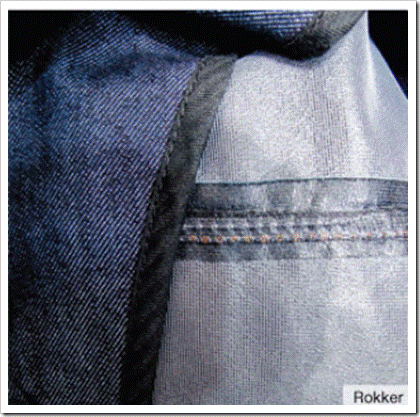
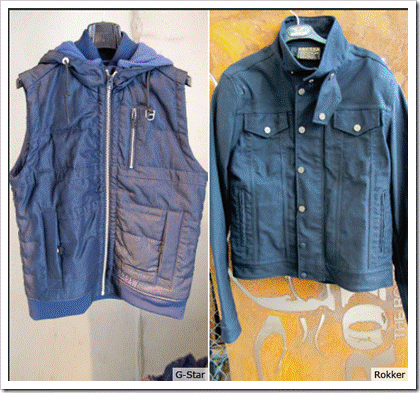
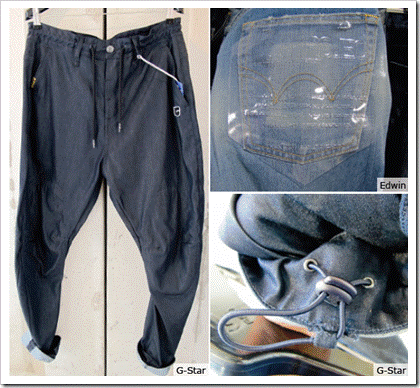
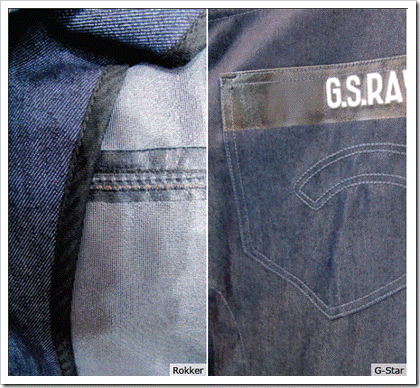
    Swiss brand Rokker make denim garments for extreme biker performance / Shock absorption membranes and Schoeller Dynatec technology / Edwin continue last season’s FuseProject jeans with Teflon bonded jeans / G-Star’s “Sports Originals” taps into activewear styling for the denim market

    Brands increase their product’s appeal byinfusing technological advances to denim. Extreme biker denim garments with protective membrane fabrics. Sportswear ranges and active-ready denim.

    Rokker Performance Denim

    Rokker Performance Denim

    G Star Edwin  Performance Denim

    Premium Indigo

    Brand’s key focus for Summer 13 is with premium, saturated and deep indigo tones.

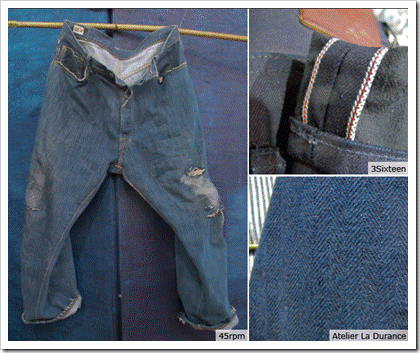
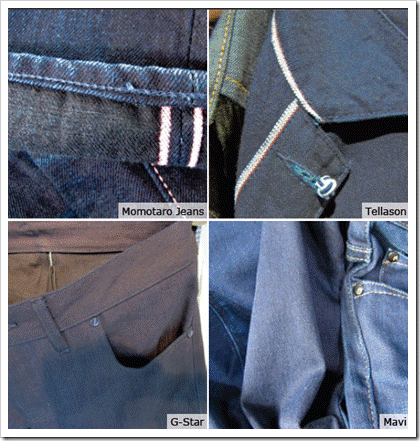
    Men’s indigos come in saturated selvedge with indigo warp and weft / Natural Japanese indigo dyes trend / Overdyed vintage herringbones offer rich texture / Black wefts create a deep indigo cast / Women’s brands look to sateen weaves to create a rich luster

    A strong focus for S/S 13, brands embrace the artisanal roots of denim. Natural indigo dips, deep and rich casts and blackened wefts create a deep palette.

    Premium weaves appeal to both the Men’s and Women’s markets.

    45rpm Premium Indigo

    Momotaro  , Gstar  Premium Indigo

    Indigo Pattern

    One of the biggest trends to feature at Bread & Butter this season, micro indigo pattern dominated both Men’s and Women’s denim.

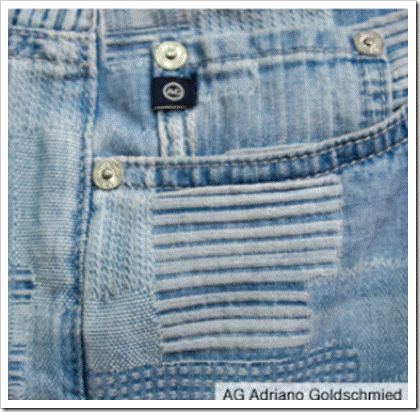
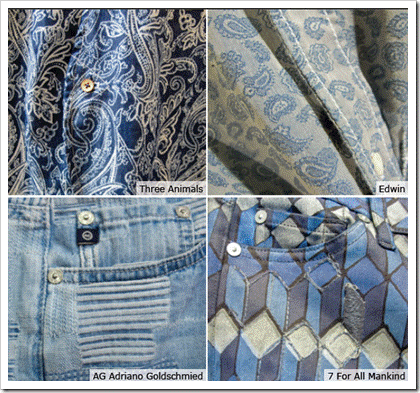
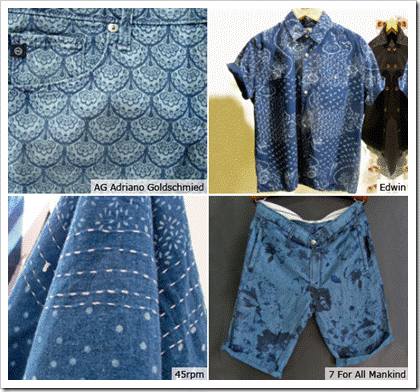
    A trend originally Japan-based, indigo pattern emerges for the western denim world / Micro paisleys emerge for both guys and girls / Jacquard denims look set to be key for 2013 / AG present innovative jacquard patchwork looks /Painterly indigo laundries and graphic geo prints .Indigo ditsy prints are a key surface innovation for S/S 13. Plaids, micro florals and paisleys create surface interest.

    Jacquard weaves hit product after their success at fabric trade shows.

    Adriano Goldschmied  ,Indigo Pattern

    Adriano Goldschmied  ,Indigo Pattern

    Adriano Goldschmied  ,Indigo Pattern

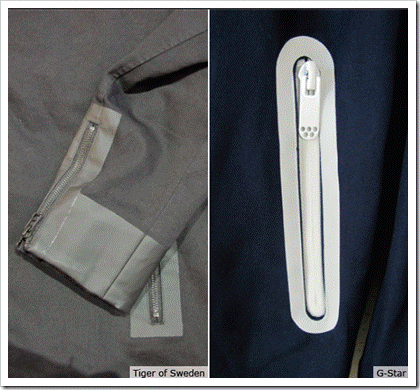
    Plastic Accent

    Cementing the performance denim story, technical finishes and glossy sign-off update denim.

    Creates a clean and future-forward aesthetic / Taped seams and watertight function / Clean plastersol prints add a graphic highlight to denim detailing / Rubberized finishes on zips and pocket openings / Raw indigo and black accentuate city-smart attitude

    Rokker Plastic Accent

    Rokker Plastic Accent

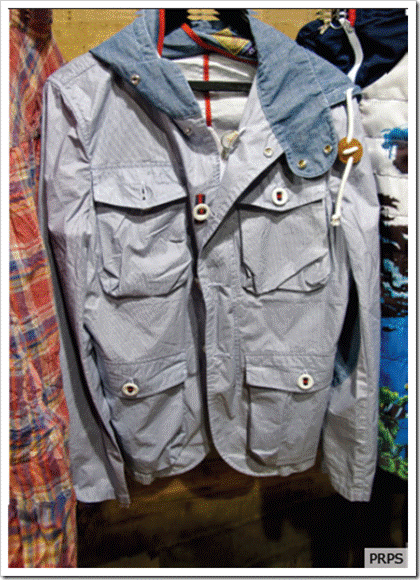
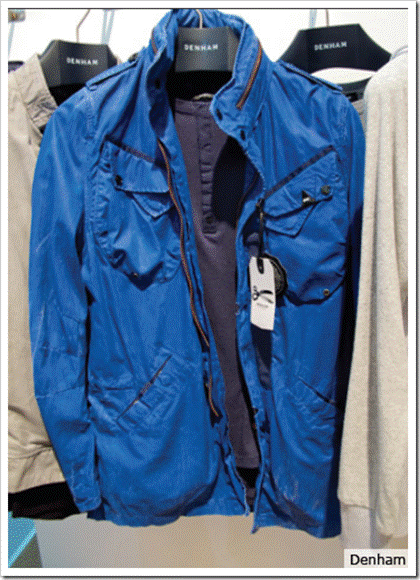
    Summer Parker

    Technical function melds with treated lightweight denims to create a functional Summer basic.

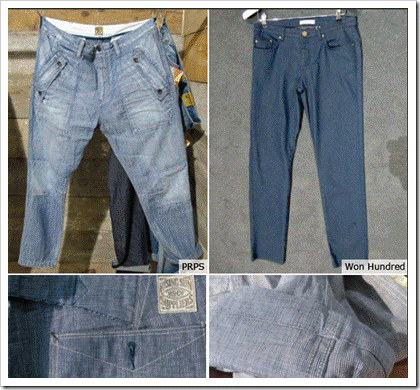
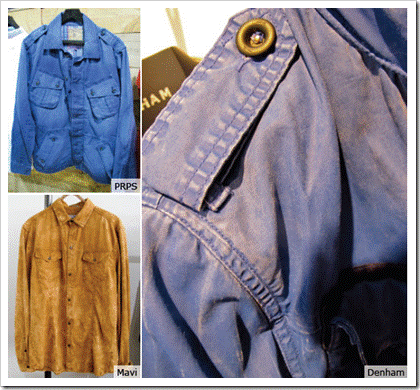
    Active and military themes drive new jacket shapes for Summer 13 / Lightweight fabrications re-work the parker for summer wear / Mavi uses tactile tencel to give this outdoors shape feminine appeal / Denham takes tencel and gives it masculine attitude with a resin finish / Drawstrings, functional zips and hooded silhouettes.PRPS Jeans - Summer Parker

    PRPS Jeans - Summer Parker

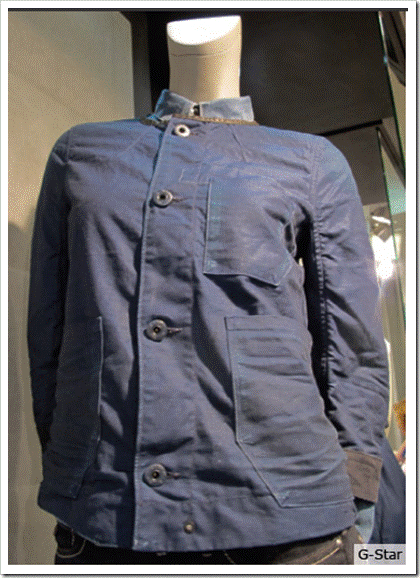
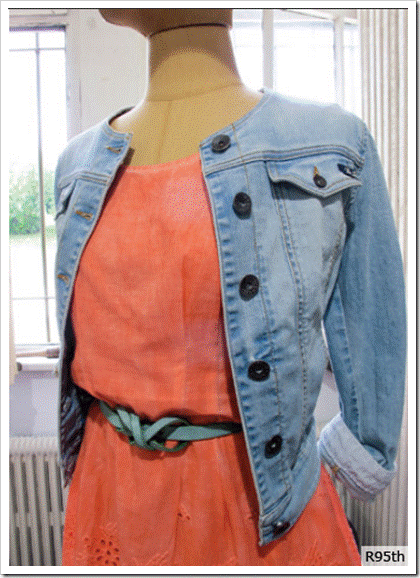
    Mandarin Jacket

    Oriental themes update girlʼs blouson and collarless jackets for Summer 13.

    The Coco Trucker is reworked with a more Chinese feel for S/S 13 / Mao jacket micro-stand collars / Neat and fitted body shape / Modernized railroad detailing updates from trucker looks

    Gstar Denim Mandarin Jacket

    R95th Denim Mandarin Jacket

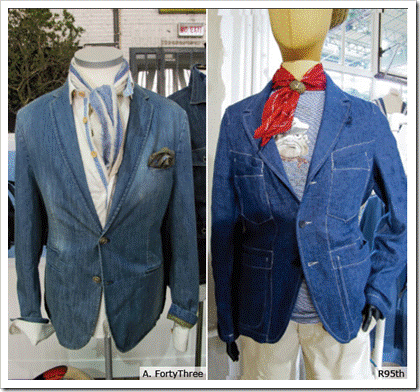
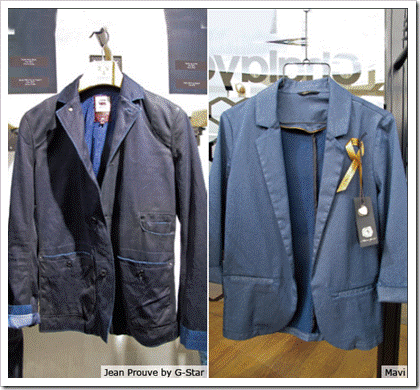
    Denim Tailor

    As sartorial and tailored influences continue to trend, the unisex blazer emerges.

    Fitted and neat silhouettes for both men and women / Premium denims such as Tencels and sateens / Glossy finishes are resin coated for a premium look / Railroad styling is modernized and added for a more denim attitude /Contrast top stitching adds authenticity.

    Denim Tailor - R95th

    G Star Mavi - Denim Tailor

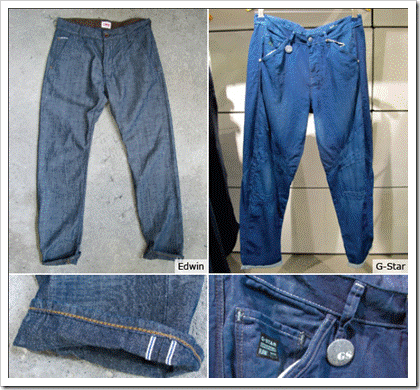
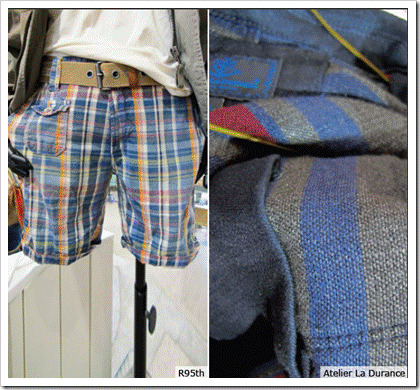
    Summer weight Jean

    Chambray and lightweight denim is tapped to update Summer 2013ʼs denim jeans.

    The classic summer jean becomes a key item / Lightweight denims in 8-11 oz weights / Tencel denims and chambrays / Modernized styling explores trouser pockets and tailored details / Loose and baggy silhouettes create a relaxed summertime look / Laundered chambray or raw and rigid looks.

    Summer Weight Jeans - Gstar , Edwin

    Summer Weight Jeans - Gstar , Edwin

    Shifting Perspective

    The classic shift dress gets a makeover for S/S 13.

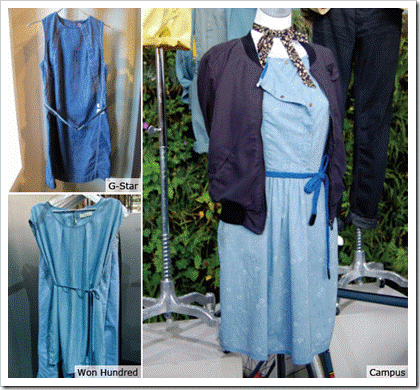
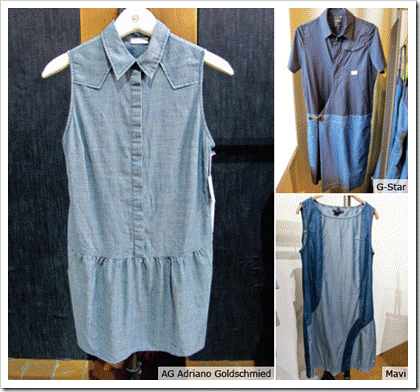
    Womenʼs shift dress shapes are reworked into new modern looks / Minimal tee-dresses with simple tie belts offer summertime simplicity / Directional seam detailing and asymmetric openings create interest / Shirtdress styling fuses with shift silhouettes / Tencels chambrays and lightweight denims offer drape / Color-blocking continues.

    Summer Time Women Denim Dresses

    Summer Time Women Denim Dresses

    Jersey Indigo

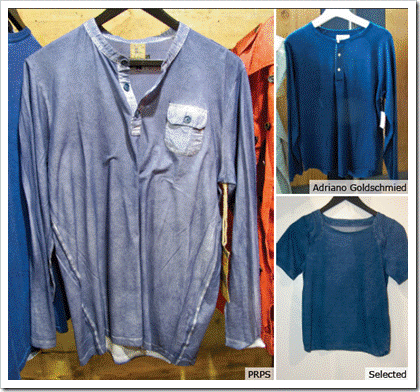
    A key unisex story, casualwear tops are re-worked in indigo jersey.

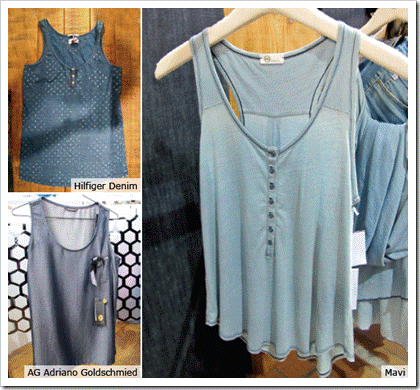
    Resin dyed blue jersey gives tops a laundered denim look / Clean vest top shapes are key for Womenʼs Summer 13/ Drape tencels are key for the premium Womenʼs market / Laundered and faded indigo shades / Rich and saturated overdyes.

    Indigo Jersey - Tommy , AG,

    Indigo Jersey - PRPS

    Fabric-Blocked Shirt

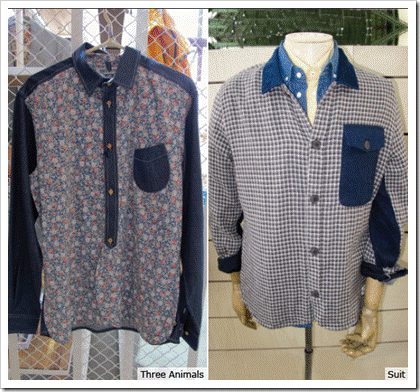
    Menʼs shirts continue to be a big seller and updates draw on a multitude of fabric blocking for S/S 13.

    Ditsy floral shirtings with denim collar, cuffs, sleeves and pocket / Gingham checks, plaids and stripes / Denim shirts with contrast front yokes / Laundered denim pockets on contrast fabric shirts.

    Fabric Blocked Denim Shirt

    Fabric Blocked Denim Shirt

    Summer Blanket

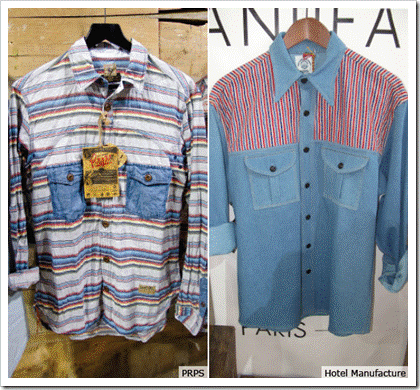
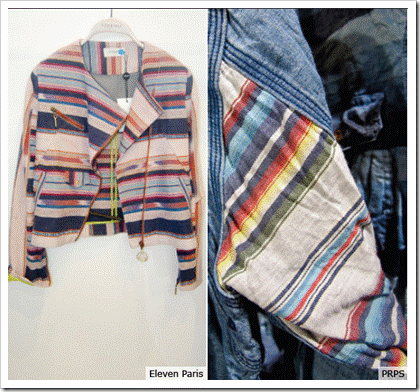
    With the influence of winter blanket looks, brands look to continuing the look for lighter, summer styling.

    Colorful blanket stripes and checks nod to archival 60s lined truckers / Mexican blanket weaves in muted tones / Indigo teams with lively brights / Traditional blanket linings are re-worked in lighter-weight denims / total garments, linings and inserts.

    Summer Blanket Denim Jeans

    Summer Blanket Denim Jeans


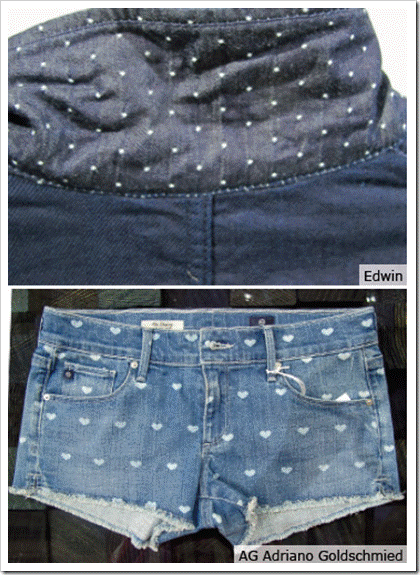
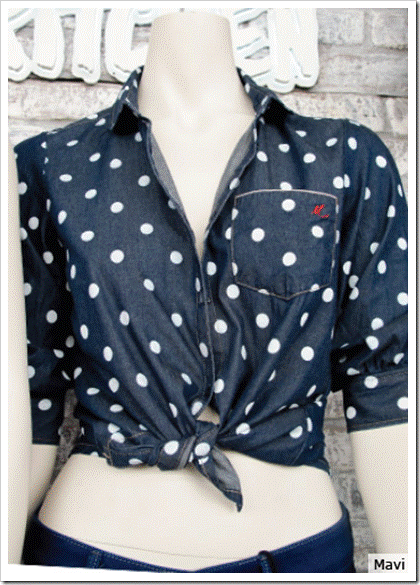
    Playful Repeats

    Following the indigo print story, micro spots, dots and hearts emerge for S/S 13.

    Repeat spot prints update the classic chambray summer short / Japanese Wabash micro spots adorn collar reverse/ Repeat hearts appeal to the Womenʼs and Juniorʼs market / Retro spots update daisy duke tie-waist shirts / Clean and graphic white and indigo story.

    Playful Repeats Patterns - Denim Jeans

    Playful Repeats Patterns - Denim Jeans

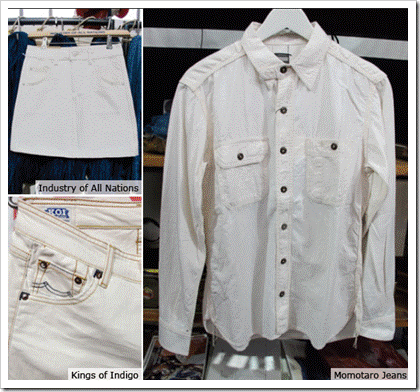
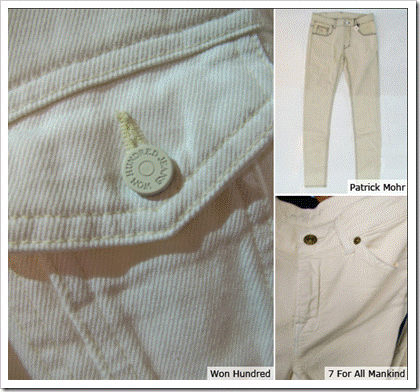
    Ecru

    Unbleached cotton looks have emerged for Summer in previous seasons, but S/S 13 looks set to be a key year.

    Unbleached, un-dyed and untreated cottons / Strong eco story with little or no chemical treatments / Ecru takes prominence as the Summer shade of choice for denim/ Unrefined and unbleached cottons / New Summer white alternative / Once a menswear story, Ecru emerges across markets for S/S 13.

    Ecru Denim Jeans

    Ecru Denim Jeans

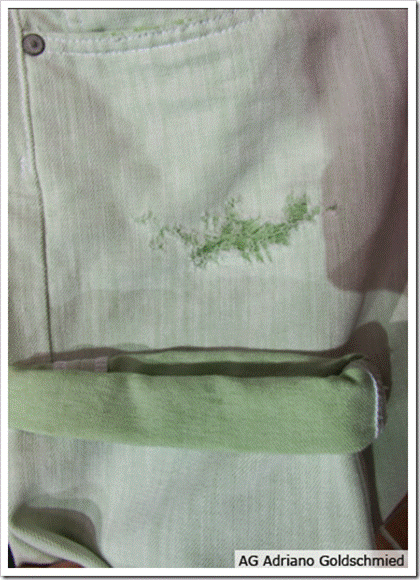
    Pastel Weft

    With white and ecru warp yarns trending, fashion denim brands look to colored wefts for a summer update.

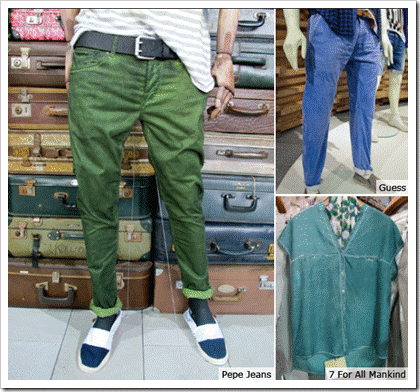
    Pushing the colored weft trend into a pastel-toned, summer-ready story / Green emerges a prominent shade for 2013 / Intentional destruction reveals weft color beneath / Key update for the loose boyfriend jean / Gives clean white denim a subtle 2013 update.

    Pastel Weft Colored Denim Jeans

    clip_image064

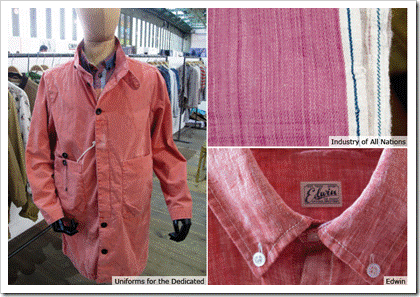
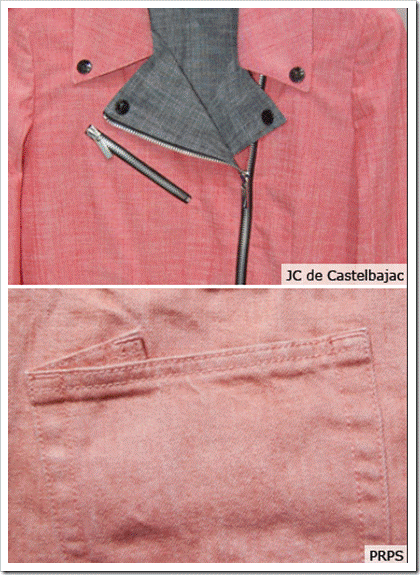
    Vegetal Pink

    A strong color particularly for menswear, natural and vegetal pinks emerge on chambrays and denims.

    Industry of All Nations use natural dyes to create their pink denim shade / Lightweight denims are coated with colored resin for a laundered feel / Red chambray is a key fabric for both Men’s and Women’s markets.

    Vegetal Pink Denim Jeans

    Vegetal Pink Denim Jeans

    Colored Resin

    A new surface dye technique to emerge for S/S 13; colored resins create laundered imperfection.

    Lightweight denims are coated with matte colored resins / Laundered and tumbled treatments create an uneven,mottled effect / Updates all product categories, including shirts and jackets / Rich royal blue offers a modern alternative to natural indigo / Creates strong contrast and seam pooling with a soft-focus look.

    Colored Resins - Denim Jeans

    Colored Resins - Denim Jeans

    Dramatic Dip

    A wash treatment Stylesight has been following for a few seasons, dip dye looks are updated for Summer 13.

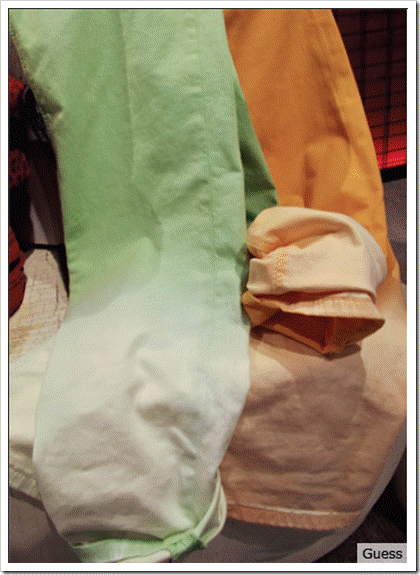
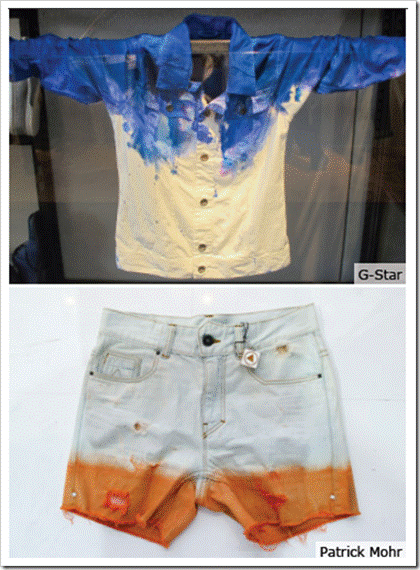
    White denim pairs with bright contrast shades for S/S 13 / Soft gradients are achieved with graduated dips / More dramatic dips are sponged and painted, with a strong DIY attitude / Indigo is synthetic and bright, to appeal to a fashion-conscious market.

    Dip Denim Jeans

    clip_image076

    Statement Surface

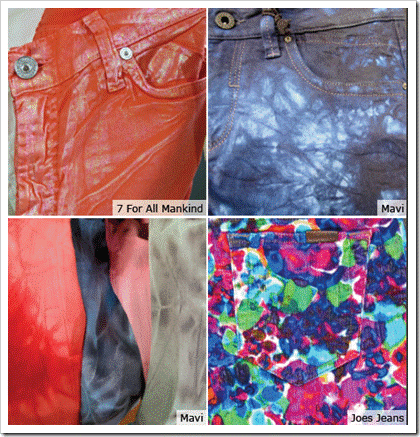
    As items become more core for Summer 13, surface treatments, prints and laundries take center stage.

    Classic slim and skinny silhouettes are updated with allover high-color prints / Digital printing replicates watercolor laundries / New holographic and pearlescent looks emerge / Dramatic allover batik and tie-dyes.

    Prints and Surface Treatments - Denim Jeans

    Prints and Surface Treatments - Denim Jeans

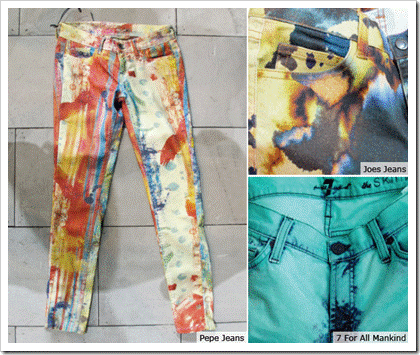
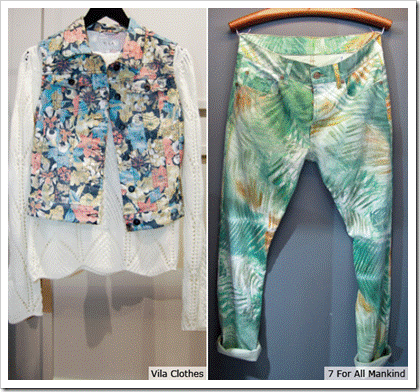
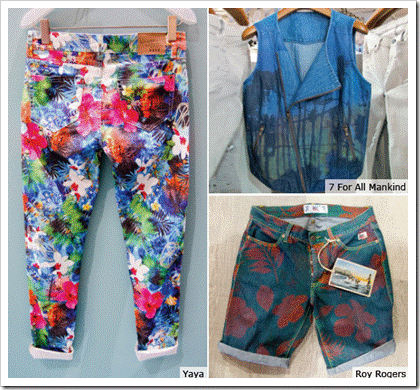
    Tropical

    Allover florals are replaced with a unisex tropical trend for Summer 13.

    A trend that has taken hold in retail the story looks set to continue into S/S 13 / Both menʼs and womenʼs styling is key for this vacation surface story / Allover photo prints in retro brights / Items emerge for the menswear market from 7 For All Mankind and Roy Rogers / Painterly and diffused looks offer a new take on the trend.

    Tropical Florals Denim Jeans

    Tropical Florals Denim Jeans

    Watch the musical presentation of these trends  below and you can see the presentation in 3D here…

    About Stylesight:  Stylesight  is a leading provider of trend content, tools and technology for creative professionals in the fashion and style industries.

  • US Fabric Imports Up , Apparel Imports Down in 2012 !

    fabric up apparel downThe first five months of 2012 have seen an interesting trend in the US market. Whereas , the imports of denim apparel have been down 10.4% , the imports of denim fabric has been up 25% !!

    The imports of denim apparel into US are not showing any signs of recovery. There is a continuous fall in imports since late 2011 and it continues well into May 2012. There has been a fall in the volumes , though the prices continue to rise – showing the continued effect of rising costs of production in exporting countries.  The fall in Jan-May is depicted below :

    Jan-May Million pcs Value (US$ billion) Average Price (US$/pc)
    2011 176 1.379 $7.83
    2012 157.8 1.314 $8.33
    Change -10.4% -4.7% +6.37%

    On the other hand, we see that the denim fabric imports into US have increased in the same period by a significant number of  about 23% .

    Jan-May Million sq mtrs Value ($ million)  Avg. Price (US$/ sq mtr)
    2011 11.37 36.82 3.23
    2012 14 42.93 3.06
    Change +23.4% +16.6% -5.25%

    It feel strange looking at such figures since fabric imports have been on a general decline for a  long time and the jeans imports had been strong for about 7-8 years.  The prices of jeans have been rising ever since the cotton prices rose and they still keep on rising . The major suppliers including China, Bangladesh have experienced increase in prices (source data section at Denimsandjeans.com )

    The increase in denim fabric imports could be temporary , but it is still interesting to see that there is an effort to do more manufacturing in US or nearby countries (near sourcing). Another indication of this trend (as shown in tables below) is that one of the countries near US has gained significantly in terms of denim apparel exports to US even as others experienced serious falls.

    It would be interesting to see where do which countries are losing in terms of jeans exports or which countries are gaining in terms of fabric imports into US. Lets see the analysis below in tables for :21.62

    • Table showing the top  10 exporting countries  in denim apparel and their respective loss or gains in volumes and values during the Jan – May 2011/2012 period.
    • Table showing top gainers in fabric exports.
    • Table showing Men’s vs  women’s denim apparel  – a comparison to understand which category contributed more to the fall.

    Our online Denim Show

    [private_special]

    Denim Apparel Imports into US from various countries Jan-May 2011 vs 2012

    Country 2011
    (qty in mill. pcs)
    2012
    (qty in mill. pcs)
    2011(value in US$ million) 2012(value in US$ million) Change % qty Change % value
    China 48.39 42.98 385 346 -11% -10%
    Mexico 43.75 42.46 367 378 -2.9% 3%
    Bangladesh 21.62 16.85 121 113 -22% -6.6%
    Nicaragua 8.07 9.74 46 55 20% 18.4%
    Egypt 8.12 6.72 67 62 -17% -7.8%
    Cambodia 7.17 6.90 57 58 -3.7% 2.3%
    Vietnam 5.11 5.70 40 46 11.5% 15.2%
    Pakistan 6.59 5.26 50 41 -20% -17.4%
    Lesotho 5.50 4.05 35 32 -26% -10%
    Indonesia 3.46 2.71 25 23 -21% -8%

    It is interesting to see that countries near  to US have not experienced the kind of reduced exports that other countries have experienced. Nicaragua, for example, has experienced a 18%+ increase in exports whereas , Mexico has suffered a marginal fall. Mexico has also reduced its difference in terms of volumes vis-a-vis China . These figures are an indication that nearsourcing is getting popular with US importers.

    Lets have a look at which category – men’s or women’s is responsible for this fall that we are looking at. The results are surprising, it is women’s denim imports which have fallen at a rapid pace and lost over 13% in volumes. While  men’s denim apparel imports have mostly been higher than women’s , the difference seems to have increased much more this year.

    Men’s and Women’s Denim Exports Jan-May 2011/2012

    Year Men’s qty Women’s Qty Men’s Av. Price Women’s Average price
    2011 88.56 82.68 $8.03 $7.72
    2012 82.32 71.16 $8.74 $7.96
    change% -7% -13.92% +8.8% +3.1%

    Denim Fabric Imports

    Denim Fabric Imports Into US Jan-May 2011 vs 2012 (Top Exporters)

    Country 2011
    (qty in mill. sq mtrs)
    2012
    (qty in mill. sq mtrs)
    2011(value in US$ million) 2012(value in US$ million) Change % qty Change % value
    China 4.11 5.68 9.48 11.73 +38% +23.8%
    Mexico 2.15 2.44 4.85 6.08 +13.5% +25.2%
    Taiwan 1.81 2.08 3.54 4.36 +14.8% +23.3%
    Italy 1.25 1.43 6.65 7.61 +13.8% +14.5%
    Turkey 0.96 0.90 5.56 5.60 -6% +1.5%
    Japan 0.80 0.83 5.31 6.16 4% +14.9%

    The denim fabric imports  in US , though not a huge quantity , rose significantly from some countries including China and Mexico. While the Chinese denim is  , at many times, meant for reexport , still it is surprising to see such an increase – indication some action in the garment production in US. The only loser among the top exporters was Turkey – which lost about 6% in this period.. Otherwise, an overall increase of about 23% is quite positive figure for the garment manufacturing industry in US.

    [/private_special]