Category: Denim Data & Figures

  • Skinny Jeans Going Out Of Style | Google Fashion Report

    Skinny Jeans Going Out Of Style | Google Fashion Report

    Google is not only an ocean of knowledge but it is also the largest reservoir of information (database) on human wants and desires as it systematically maps the searches by keywords, location, time etc. So , if you were to know what the people of ,say, New York primarily look for or what kind of food they most desire, or the sport they are most interested in , Google can tell exactly . And this information would be time sensitive ie it would be easy to find how the preferences have been changing over a time period.

    Can this strength of Google be applied to Fashion industry as well ?? Of course- they can also mine important information on any industry and find about consumer likes , changing needs etc ! .

    Google has recently released a Fashion trends report for US based on the searches that take place on the behemoth. Their team, Yarden Horwitz (fashion brand strategist) and Olivier Zimmer (Fashion data scientist)  analyzed 6 billion queries related to apparel category from 2012 to 2015 and applied Time Series Clustering to group together the queries based on time series of similar trends or seasonality. The directions are quite interesting and worth noting for the fashion industry  –specially those who are interested in the US market.

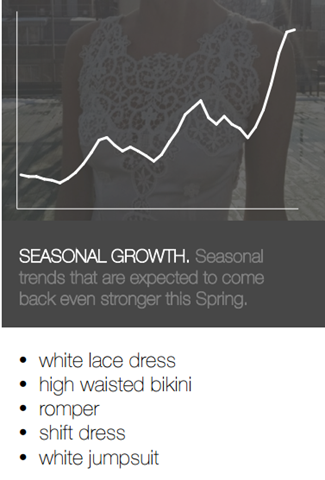
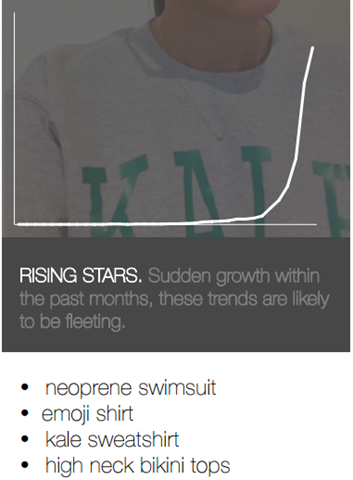
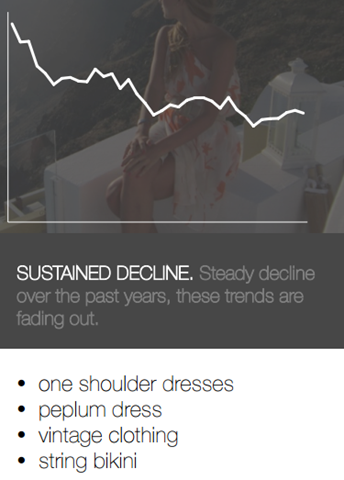
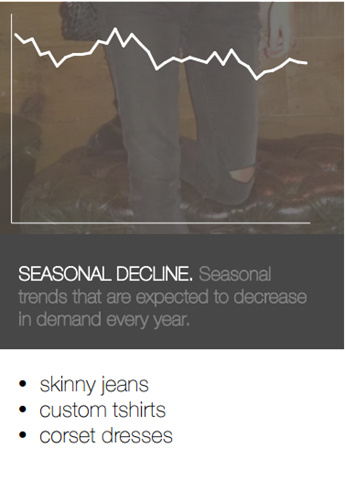
    The trends from the report have been categorized into following main groups.


    RISING
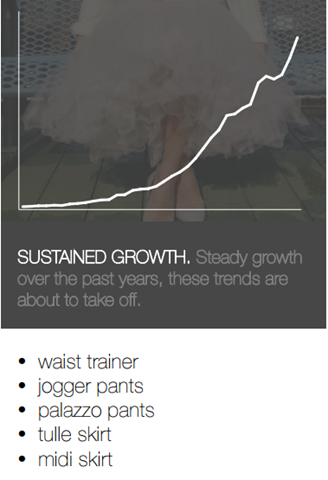
    Google Fashion Trends 2015- Sustained growth

    Google Fashion Trends 2015- Seasonal Growth

    Google Fashion Trends 2015- Rising Stars

    DECLINING

    Google Fashion Trends 2015- Declining

    Google Fashion Trends 2015- Seasonal Decline

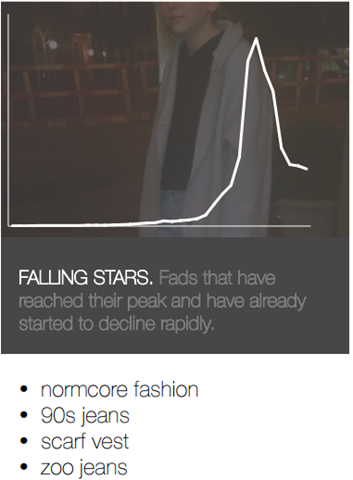
    Google Fashion Trends 2015- Falling Stars


    Now we look deep into important product categories that have seen the major changes in getting focus of consumers from the US.

    Jogger Pants
    image

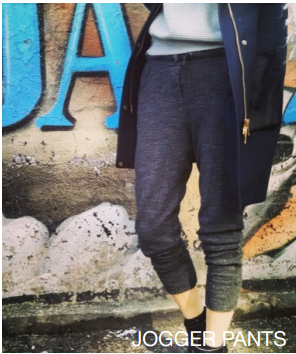
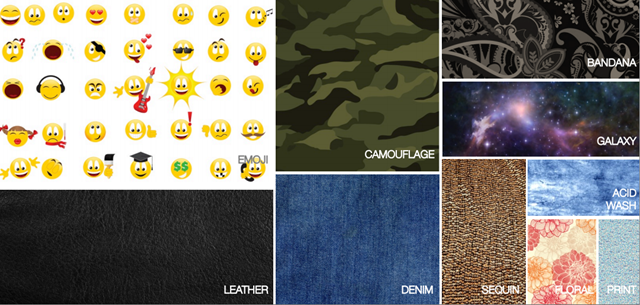
    Jogger pants have been growing in popularity for sometime as comfort factor gets more important for the consumers . The searches for Jogger Pants have grown 165% during the last year. The top styles of Jogger pants can be understood from the following image. Each rectangle size indicates the size of the search.
    image

    Google says

    “Top searches for jogger pants span men, women, boys, girls, and even toddlers, indicating mass appeal for this apparel item. Looking at the terms often searched in conjunction with jogger pants, it seems that consumers are already well-versed in jogger pants and are turning to Google Search to learn more about which brands offer the best selection and deals. Consumers are stepping out of their comfort zone on this trend. The top most-searched style? Emoji jogger pants.”

    Denim also generates a reasonable size of interest though Emoji, Camouflage and leather look more appealing to consumers. Google analysis says that while Jogger Pants started on the East Coast, the trend is quickly becoming a big hit in the Southern areas of the US as can be seen from the images below.
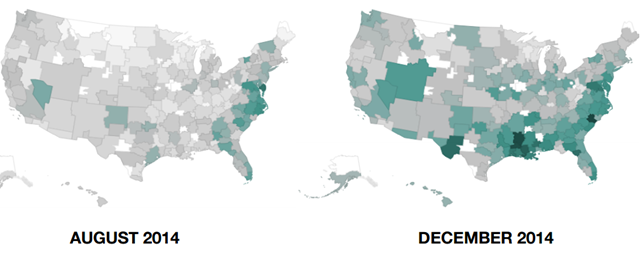
    Jogger Pants Denimand - Google Trends

    Tulle Skirts

    Tulle Skirt - Google Fashion Trends

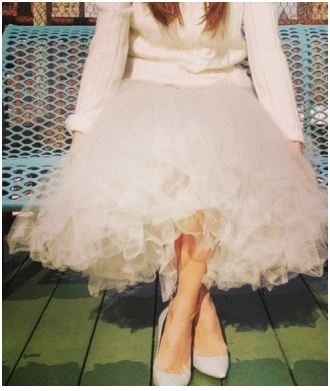
    According to trending Google apparel searches, tulle skirts are growing in popularity just in time for spring fashion, up 34% from January 2014 to January 2015.

    “Originating on the West Coast, the tulle skirt trend is making its way across the U.S. Consumers are seeking this skirt in all colors of the rainbow (and even in rainbow), but the most popular colors are the classics: black and white. Consumers aren’t interested only in buying tulle skirts. Top searches indicate that a majority are feeling inspired to get crafty and make their own. Who says you need to be a ballerina to wear a tulle skirt? said a blog post on the report by Google brand strategist Yarden Horwitz and fashion data scientist Olivier Zimmer.Originating on the West Coast, the tulle skirt trend is making its way across the US, according to Google searches. Consumers are seeking this skirt in all colours of the rainbow (and even in rainbow stripes), but the most popular colours are the classics: black and white.”

    Midi Skirts

    Midi Skirts - Google Fashion Trends

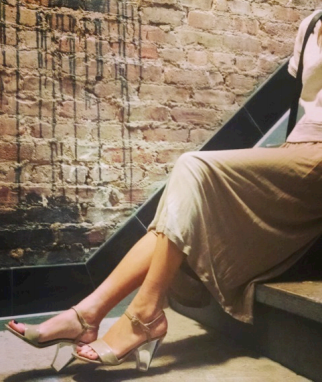
    Recently brought back in the U.K. in 2013, the midi skirt is making its way back to the U.S. While lower in search volume than tulle skirts or jogger pants, the midi skirt has seen 9X growth in searches over the past three years—and is still in its early stages of growth within the U.S. market. Top searches for midi skirts, such as “how to wear” and “outfits,” demonstrate a lack of education on how to incorporate the trend. Consumers are turning to Google Search for advice and inspiration on styling a midi skirt as part of their daily outfit. Because the trend has been growing in the U.K. over the past couple of years, there are already so many variations of silhouettes and styles displayed on the internet. Top silhouettes include pleated, pencil, A-line, high waisted, skater, circle, and flared, to name a few. With such an overwhelming list of styles, it’s no wonder consumers are seeking tips on how best to pull them off.

    Below are the top styles searched for Midi  Skirts. Size of the rectangle represents the volume of search.
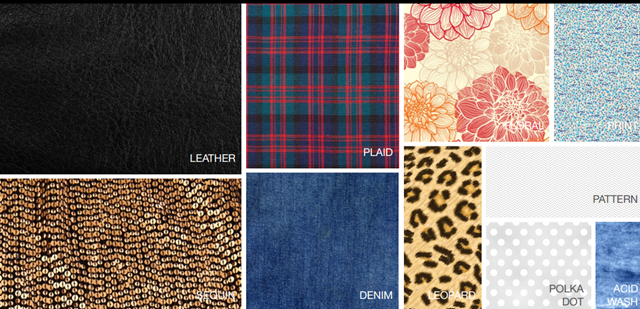
    Midi Skirt Demand Trend - Google Fashion Report

    Specific Denim Trends

    skinnyjeans

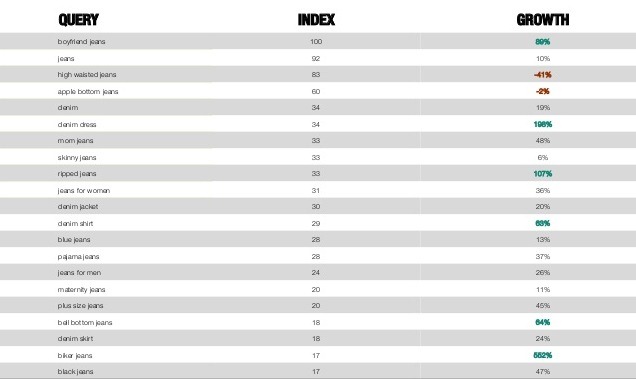
    When we look at the specific denim trends, we find that biggest gainers are :

    Boyfriend Jeans : +80%

    Denim Dress : +198%

    Ripped Jeans: +107%

    Biker Jeans :+ 552%

    Bell Bottom Jeans : +64%

    Biggest losers

    High Waisted Jeans : –41%

    Skinny Jeans :+6% – though in positive , skinny jeans has seen a very dormant kind of response on the Google and fades in comparison to other competing searches like Boyfriend Jeans, Ripped jeans or Bell bottom jeans !


    It is not only Google report which is pointing in the direction of reduction of skinny style but a host of other indicators which show that skinny is not the current favourite of the consumers in US. A number of celebrities have been seen in either flares or increasingly in boyfriend jeans indicating that they seem to be switching the sides !. This trend also makes sense from the point of view of brands / retailers and others in supply chain. Skinny jeans have been long in trend and most consumers – mainly females – have a horde of them in their closet. It makes sense to encourage the shifting of the trend to non-skinny styles so that they would open up their purses and again revive the sagging market.

    Sponsored link:

    Rajby Denim - Your apparel connection in Pakistan

  • Denim Imports In Germany : 2010-2014

    Denim Imports In Germany : 2010-2014

    germany denim imports Germany is the biggest market of jeans in Europe constituting about 30% of the total imports of jeans. It consumes a large quantity of value jeans and a decent quantity of premium jeans as well.

    The German economy is powered by exports. Its current-account balance (the difference between the money it receives from the outside world and what it spends abroad) is one of the world’s largest, at 7% of GDP. It is an open economy: its ratio of exports to GDP is double China’s. About 6% of German exports go to China, especially what are  "capital" goods such as heavy machinery. Germany has also been hit by slow growth in the 17 other euro-zone countries, where it sends 40% of its exports. Also issues with Russia are affecting its capital goods export to that country . Though the unemployment level is still low at about 5% , the country needs to worry about its other aspects as its costs of manufacturing are increasing. The Fukushima nuclear disaster in 2011 resulted in focus being shifted away from the nuclear energy – due to which its energy prices are increasing – and causing shifting of some manufacturing away from Germany.

    But still Germany is the country that powers the Eurozone. Its performance is an indicator of how the zone performs. We will , in this report, see how the country is performing in terms of imports of jeans over the last 5 years from 2010 to 2014. We will see:


    1. The quantity of jeans imported from the world during this period .

    2. The value and prices of such jeans imported.

    3. Breakup of these imports in terms of men’s and women’s jeans. Import market size in terms of men’s and women’s jeans component.

    3. The imports compared from within and outside EU in terms of quantities , prices , shares etc.

    4. The main gainers and losers from 2010 to  2014 for exports of jeans to Germany. Top exporting countries and their share

    5. Eight tables showing the supporting  figures and their analysis.

    [private_special]

    1.Import of Jeans into Germany from outside EU since 2010

      2010 2011 2012 2013 2014
    Men’s Jeans 92 94 84 82 82
    Women’s Jeans 43 40 31 32 32
    Total 135 134 115 114 114

    (all figures in million pcs)

    2.Share of Men’s and Women’s Jeans in total imports into Germany from outside EU

      2010 2011 2012 2013 2014
    Men’s Jeans 68% 70% 73% 72% 72%
    Women’s Jeans 32% 30% 27% 28% 28%

    3.Imports from within EU28 into Germany : 2010-2014

      2010 2011 2012 2013 2014
    Men’s Jeans 18 20 18 21 23
    Women’s Jeans 16 18 21 24 24
    Total 34 38 39 45 47

    (all figures in million pcs)

    4.Share of Men’s and Women’s Jeans in total imports into Germany from within EU28

      2010 2011 2012 2013 2014
    Men’s Jeans 53% 53% 46% 47% 49%
    Women’s Jeans 47% 47% 54% 53% 51%


    5. Share of imports of jeans from outside and within EU : 2010 and 2014

      2010 % share 2014 % share
    Total Jeans from outside EU 135 80% 114 70%
    Total Jeans from within EU 34 20% 47 30%
    Total imports 169   161  

    The above 4 tables are quite interesting. Table 1 shows the imports of jeans into Germany from outside EU since 2010. We will notice that the year 2010 was the year with highest imports into Germany from outside EU. With about 135 million pcs imported into Germany in 2010 , the imports in 2014 were 15% lesser at about 114 million pcs. The major fall in imports happened in 2012 when the European economies suffered a setback and since then the recovery has been poor or hardly any. We also note that the ratio of imports of jeans is highly in favor of Men’s jeans with about 70% of jeans being men’s . It clearly shows that Germany is male dominated market when it comes to jeans imports.

    But Germany does not only import jeans coming from outside EU. A good quantity is also imported into Germany from within the EU countries. Some of these countries like Italy, Portugal , Spain, Bulgaria and others are also manufacturers of jeans while other countries are importers themselves. We see from tables 3 and 4 that the imports from within EU countries has been increasing for Germany. From about 34 million pcs imported in 2010 , the imports are about 47 million pcs in 2014. This is quite a jump of about 33% . This is also indicative of influence of fast fashion and near sourcing getting more important. Also this is corroborated by the fact that about 50% of such jeans imported are women’s as against 30% in case of those imported from outside EU.

    The total imports of jeans , when we consider both outside and within EU imports, we find that the figures of 2010 and 2014 and not quite apart besides a small decrease. In 2010 about 169 million pcs were imported and in 2014 about 161 million pcs were imported. But the major change has been in the % of share of within EU imports which have gone up from 20% of total imports to 30% of total imports. This is a significant direction from the country with the largest consumption in Europe. And it looks that this direction may continue for some time .

    Now lets look at the prices of imports below:

    6.Prices of imports from outside EU (euro/pc)

      2010 2011 2012 2013 2014
    Men’s Jeans 7.56 8.12 8.73 8.93 8.84
    Women’s Jeans 6.61 6.56 7.79 8.03 7.97

    7.Prices of imports from within EU (euro/pc)

      2010 2011 2012 2013 2014
    Men’s Jeans 18.2 17.7 18.2 18.3 17.7
    Women’s Jeans 16.7 15.7 14.6 14.9 14.8

    The prices of imports of jeans from outside EU is hovering around Euro 8.5-9.0 per pc for men’s jeans and about 8 Euro for women’s jeans. While the prices from within EU are significantly higher at about 18 Euro and 15 Euro respectively. The prices from within EU are almost double that of the imports from outside. And the fact that still the imports are increasing from EU is again and indication of changing consumer preferences .


    8.Countrywise share in Outside EU Imports


      2010
    (mill. pcs)
    2014
    (mill.pcs)
    % share in 2010 % share in 2014
    Bangladesh 29 36 21% 32%
    China 68 26 50% 23%
    Pakistan 11 20 8% 18%
    Turkey 11 12 8% 11%
    Tunisia 4 4 3% 4%
    Indonesia 2 2 1% 2%
    Others 9 14 7% 12%
    Total ( in million pcs) 135 114    

    Now we come to the major exporters of denim jeans to Germany since 2010 . When we look at 2010 we find that China had almost 50% share of the entire market and it was a huge number with about 68 million pcs. However, year 2014 saw its share drop to 23% and that too at reduced import quantities. Thus its quantities of exports fell to about 26 million pcs which is a significant drop of over 60% !!. The loss in China’s share was the gain for other major exporting countries like Bangladesh and Pakistan. Bangladesh increased its volume by about 25% to 36 million pcs and Pakistan almost doubled its volume to 20 million pcs. Other countries like Turkey , Tunisia, Indonesia etc were almost at similar levels of absolute exports but increased their relative shares of a reduced market. Thus it is clear that China’s loss has been the benefit for most other exporting countries.

    [/private_special]

  • Levi`s Looks At Growth From Multiple Channels

    Levi`s Looks At Growth From Multiple Channels

    levis Levi’s is the world’s oldest and largest denim brand. The family-owned blue jeans pioneer — founded in 1853 and adopted by everyone from miners, cowboys and railroad workers to greasers, rockers and hippies — has long been linked to a potent blend of democratic, rebel-infused Americana. Bruce Springsteen wore a pair of classic Levi’s 501s on the cover of his album “Born in the USA.”

    Levi’s is the world’s oldest and largest denim brand. But despite its powerful story, Levi’s hit its commercial peak back in the 1990s. In 1996, annual sales at parent company Levi Strauss & Co.reached $7.1 billion. By 2003, however, revenues had fallen to $4.2 billion and, over the last decade it faced competition from a number of retailers, high street brands , fast fashion retailers and hardly experienced any growth in this period. Fast-fashion retailers and other value players, offering very low prices, took the bottom off the business, while new premium denim specialists targeted the top. Speaking to Business of Fashion  (excerpts taken from there)James Curleigh , global President for Levi’s says

    “There are more denim brands born this century than in the previous 104 years.All of a sudden, we get attacked by premium. All of a sudden, value and own-label and fast fashion come and try to take a piece of the business. Traditional competitors, like Wrangler and Lee, also wake up to a moment of denim growth,” he continued. “So, you’re getting attacked by premium, value, traditional and fast fashion..

    “Because you’re the leader, I think it’s natural, at first, to not be reactive and say, ‘We’re the original. We’re just going to stick with what we’re doing.’ Whereas everybody else is going, ‘Ok, I’m going to do these funky new washes, I’m gonna try use super-stretch fabrics, I’m going to offer different cuts of denim,’” said Jonathan Cheung, senior vice president of design, who joined the brand in 2009. “It’s been a big challenge for Levi’s.”

    The company has regained some lost sales . In 2014, revenues touched $4.7 billion, growing for the second consecutive year. But Levi’s needs to address host of other issues in the denim market , including softening demand.In August 2014, American market research company NPD Group reported a drop of 6 percent, year-on-year, in overall denim sales in the US.

    The company recently launched a tapered version of the jeans, called Levi’s 501 CT (which stands for customized and tapered). “501 CT started off as a conversation between myself and Karyn Hillman [Levi’s chief product officer] and how we wore our 501s. We’d go to the store, bump into people and discover popular alterations,” explained Cheung. “For years, people have taken the iconic 501 and customized them by getting on a sewing machine and giving the legs a little taper. With the 501 CT, we’ve done that work for you.”

    Levi’s A Lifestyle Brand

    Levi’s is aiming to be not just a jeans maker but a true lifestyle brand. Currently about 80% of Levi’s revenue comes from sales of denim pants. However, they realize that only 7-8% of a consumer closet is filled with jeans. More than 90% of the products are not denim. Hence the need to focus on the range of product categories which connect to its brand heritage. Eg Trucker jackets, T-shirts , belts etc. Levi’s mentions that it is hardly known that they are the worldwide leader in branded belts and these kind of products they would like to focus on to increase their revenues.

    Increasing Share Of Women’s Denim

    For Levi’s Men’s is about 75 percent to women’s 25 percent of the total business and is highly skewed in favor of Men’s . “There’s opportunity in our gender balance and we’re going to give a big surge on women’s in the second half of the year” say Cureigh. Women’s jeans is an underexploited opportunity for for Levi’s and this is where they are going to focus on during this and the coming years . Their Curve ID and Revel had some great responses and the brand wants to extend that and take a complete relook at their women’s business.

    “One route could be through further targeted products, moving beyond figure-flattering styles. For example, VF Corp’s Wrangler brand launched its Denim Spa collection in 2012, which incorporates moisturizing and cellulite-reducing treatments,” she continued. “Alternatively, Levi’s could align its ranges to fashion trends. Capitalizing on the on-going demand for colored, printed and textured denim could keep consumers engaged.”

    Strong focus on innovation

    Company has opened a Eureka Innovation Lab, which opened at the base of Telegraph Hill, a few blocks from the company’s main office, in 2013 and houses about 30 technicians, some of whose arms have turned blue from working with the indigo used to dye blue jeans. Levi’s previous innovation center was located in Corlu, Turkey, thousands of miles away from the company’s headquarters, making it slow and costly for the design team to develop prototypes. The Eureka lab is developing over 30 prototypes a week and include the successful Revel Jeans using the liquid shaping technology as well as the Commuter series with a metallic finish that looks normal during the day but lights up during the night enabling the biker to be easily seen at night. The new 501 CT was also a product of Eureka.

    Levi’s is looking ahead to continuous growth with the 2014 fourth quarter results growing 10% (however a large part of this was due to Black Friday sales week which was an additional week in the year). The brand is hopeful and looking for some great growth figures in the coming times as it expects the denim brand space to clean and creating more space for growth.


  • Denim Fabric Imports Into US Fall 20% In 2014

    Denim Fabric Imports Into US Fall 20% In 2014

    It is no secret that the imports of denim fabrics into US has been constantly falling over the last 2 decades. There was a fillip to imports when the premium denim boom came up in mid 2000s . But that also peaked out in 2005-07 period. Now there is hardly any strong reason for the imports to pick up for US , unless the production of local denim fabrics falls further.

    Details 2013 (Jan-Nov) 2014 (Jan-Nov) Difference %
    Quantities (million sq mtrs) 26.4 21.03 -20.4%
    Av. Price $3.21 $3.46 +8%


    The imported quantities decreased by about 20% from 26.4 million sq mtrs to about 21 million sq mtrs. This is a sizeable decrease in a year and does not portend well for the local jeans manufacturing at US. However, we also see an increase in average price of the imported fabrics at about 8% despite decreased quantities. This is also indicative that the imports of premium denim fabrics seem to be sustaining better over lower priced denims.


  • Bangladesh Targets $50 Billion RMG Exports by 2021

    Bangladesh Targets $50 Billion RMG Exports by 2021

    bangladesh के लिए चित्र परिणामA 3 day apparel summit was recently organized by  BGMEA (Bangladesh Garment Manufacturers and Exporters Association)  –‘Bangladesh RMG 2021- 50 billion USD in 50 years’- with Alliance, American Apparel & Footwear Association (AAFA), German Development Council and others to chalk out a sustainable road map for the ready made garment industry to reach this ambitious target by 2021 when Bangladesh would be celebrating its 50th anniversary . Garment exports have been the mainstay of Bangladesh’s exports for last many years and have been rapidly growing and forming the major part of the exports from the country. The following table brings out figures of exports of apparel from Bangladesh in the last over 2 decades. From a 32% share in exports from Bangladesh in 1989, the RMG exports now constitutes over 80% of all exports . All the figures have been taken from the data published in an article by the BGMEA President – Mr Md Atiqul Islam- during the apparel summit.
    RMG Exports from Bangladesh 1989 to 2014

    Year Export of RMG Total Export from BD % of RMG Export to Total Number of Garment factories Employment in Millions
    1989-90 624 1,923 32.45 759 0.34
    1994-95 2,228 3,472 64.17 2182 1.20
    1999-00 4,349 5,752 75.61 3200 1.60
    2004-05 6,417 8,654 74.15 4107 2.00
    2009-11 12,496 16,204 77.12 5063 3.60
    2010-11 17,914 22,924 78.15 5150 3.60
    2011-12 19,089 24,287 78.60 5400 4.00
    2012-13 21,515 27,018 79.63 5400 4.00
    2013-14 24,492 30,186 81.13 4536* 4.00**

    All figures in US$ millions
    * A number of least compliant factories have closed down after the incidents in last 2 years.
    ** Latest figures to be updated

    During its growth over last 2 decade and more, the RMG exports from the country has grown well over 15% and has overcome (and is overcoming) many of the challenges that are coming in the way including child labour, MFA phase-out , social compliance etc. The tragic incidents in the last 2 years has further provided the impetus to overcome major challenges that come up as a part of growth in most developing economies. Despite adverse publicity after the Rana Plaza incident, the RMG exports growth during 2013 was about 13.8%.
    The report published by BGMEA sites a number of important reports published by  international organizations bringing out the positive sentiment on sourcing from  Bangladesh.

    MckinseyForecast , Summer 2014
    McKinsey & Co. surveyed 29 chief procurement officers in 2013 at leading apparel companies responsible for a combined purchase of Euro 29 billion. They found that Bangladesh remains at top of the list of apparel –sourcing markets expected to grow in importance in the next few years.

    US Fashion Industry Association Forecast, June 2014
    The ‘Benchmarking Study’ published by the US fashion industry in June 2014 mentions that 60% of the respondents say they expect to somewhat increase sourcing from Bangladesh in the next two years .

    HSBC Trade Confidence Index , Sept 2014

    The trade confidence index rose sharply from 103 in 2013 to 141 in H1 2014 as per HSBC . This index is second highest in a sample of 23 countries. The authorities are introducing more safety regulations to the garments sector and this appears to have provided an additional boost to confidence.

    The China Factor

    Gradual reduction of bulk apparel production by China as rising costs, socio-economic and livelihood uplifts, shift to high tech industries has made large apparel buyers concerned to shift their sourcing from China to other countries . Bangladesh has become the biggest beneficiary of this outcome. China occupied (as per WTO) a 37.35% share in global clothing exports in 2011 whereas Bangladesh occupied about 4.83% (which has increased slightly now). This huge gap is also reflecting on a huge opportunity for Bangladesh as it strengthens its position as second largest exporter and positions itself to take a large part of the ‘ China apparel export cake’.

    New Markets

    It is interesting to note that Bangladesh is also exploring new markets and diversifying its exports and going beyond the traditional exports to EU and US. The share of apparel exports to markets other than EU and North America was 6.88% in 2008-09 and increased to 14.71% in 2013-14. The new markets include Japan, China, India, South Korea, South Africa, Russia, Brazil, Mexico and Chile. The duty free access and preferential market access by countries like India, China, Korea and Malaysia have helped this process.

    Export Components

    The product wise  exports from Bangladesh given below – indicating that the highest share is occupied by  Trousers , followed by T-shirts and Jackets while sweaters and shirts follow. Over the last 5 years , however, the highest growth has been in the exports of shirts and jackets. In the period of about 4 years from 2009-10 to 2013-14 , jacket exports increased by over 120% whereas exports of shirts increased by about 118%. Trouser exports increased by about 87% .

    Product-wise Exports from Bangladesh

    Year Shirts Trousers Jackets T-Shirt Sweater
    2009-10 993.41 3035.35 1350.43 3145.52 1795.39
    2010-11 1566.42 4164.16 1887.50 4696.57 2488.19
    2011-12 1733.54 4686.39 2231.16 4713.11 2340.34
    2012-13 1972.89 5185.48 2634.28 5143.22 2620.73
    2013-14 2173.73 5690.78 2973.16 5863.81 2932.94

    Note:Figures in US$ million

    Challenges

    To achieve the target of $50 billion, there will be significant challenges which Bangladesh will have to overcome , specially related to infrastructure. Lets see how it stands among other Asian countries in Global Competitiveness . The ‘Global Competitiveness Report 2014-15 (World Economic Forum) evaluates important apparel exporting countries on their Infrastructure quality.

    Comparison of Infrastructure Quality : 2014-15

    Country
    /Region
    Country Ranking Overall Infrastructure Score Electricity Roads Railroads Port
    Bangladesh 109 2.8 2.5 2.9 2.4 3.7
    India 71 3.7 3.4 3.8 4.2 4.0
    China 28 4.4 5.2 4.6 4.8 4.6
    Cambodia 95 3.4 3.0 3.4 1.6 3.6
    Myanmar 134 2.3 2.8 2.4 1.8 2.6
    Pakistan 129 3.3 2.1 3.8 2.5 4.4
    Sri Lanka 73 5.0 4.8 5.1 3.7 4.2
    Thailand 31 4.1 5.1 4.5 2.4 4.5

    The above table shows the areas where Bangladesh still needs to work in relation to infrastructure improvements especially Roads and Electricity . Besides, availability of skilled work force would be another important aspect which would be very important for growth. Investment in education and training would be paramount to raise a large and skilled work force.

    The target of $50 billion is very  ambitious but still not entirely unachievable if one sees the growth achieved in last 5 years as exports doubled from $12 billion to $24 billion. However, the country needs to work really hard in improving its infrastructure and ensure a larger supply of a skilled workforce to reach the magic milestone.

    Denim Exports From Bangladesh

    Denim apparel is becoming an important part of exports from Bangladesh . In 2013 , the combined exports of denim jeans and related apparel to US and EU were over $ 1.2 billion with about 65% going to EU and balance to US. If we consider exports to other nations, the value would be still higher. The exports are set to increase further as Bangladesh overshadows Chinese exports to these regions in next 2 years and becomes the number 1 exporter of denim apparel. Already its exports of men’s jeans to EU is greater than that of China.

  • Denim Apparel Import Into US Falls 7.5% in 2014

    Denim Apparel Import Into US Falls 7.5% in 2014

    Imports of denim apparel into US has fallen by about 7.5% in the period Jan-Oct’14 compared to the same period in 2013.  The imports fell by about 33 million pieces from 437 million pcs to about 404 million pcs during this period. The average price has also seen pressure with the same falling by about 8.6% from $8.12 per piece to about $8.03 per piece.

    Imports of Denim Apparel | 2013-2014 (Jan-Oct)

    Details 2013 2014 Difference (%)

    Quantity (mn .pcs)

    437 404 -7.5%

    Price

    $8.12 $8.03 -8.6%

    It is worth noting that the imports of denim in US had increased in 2013 by over 4% compared to the year 2012 . However, the imports never touched the peak of over 600 million pcs that US achieved in 2005.

    Denim sales in US have been under pressure as there has been strong competition from Yoga and Athletic wear with female consumers strongly moving in favor of the latter due to their versatility and comfort . Pioneers of form fitting garments like Spanx have been working to create stretchy pants that look like denim and steal consumers away from denim . On the other hand denim companies are fighting back and coming out with products to compete with Yoga wear. High stretch abilities going upto 100% with strong recoveries and low growths with high comfort quotient are being brought out by innovative companies. But it will take time before denim can recover lost ground. As per NPD group , US, the sale of active wear climbed 7% while denim sales fell leading top retailers to increase their offering of athletic and leisure apparel.

  • 2nd Denimsandjeans Bangladesh Show On 15-16th Oct’14

    2nd Denimsandjeans Bangladesh Show On 15-16th Oct’14

    lofofinal5 The second edition of the Denimsandjeans.com Bangladesh show is to be held at Dhaka on 15-16th Oct at Hotel Radisson, Dhaka.  The first show had received a great response with exhibitors from a number of countries and with visitors from over 300 companies joining the show. As per last edition, the show would be an invite only event .

    The second show shall have a mix of cool eclectic companies making possible the sourcing of denims, non-denims, related apparel and technologies from some of the best companies around the world. Here is a list of the companies joining the show


    Company Country Products
    Artistic Fabric Mills Pakistan Denim Fabrics + Jeans
    Artistic Milliners Pakistan Denim Fabrics + Jeans
    Arvind Limited India Denim Fabrics + Jeans
    Bhaskar Industries (P) Limited India Denim Fabrics
    CHT Chemicals Germany Chemicals For Denim
    Envoy Textiles Limited Bangladesh Denim Fabrics + Jeans
    Ginni International India Denim Fabrics
    Hameem Bangladesh Denim Fabrics + Jeans
    Indigo Pakistan Denim Fabrics
    KG Denim India Denim And Non-Denim(Solid Dyed) Fabrics
    Kassim Denim Pakistan Denim Fabrics
    LNJ Denim India Denim Fabrics
    Mafatlal Industries Limited India Denim Fabrics
    Oswal/Nahar Group India Denim + Non-Denim Solid Dyed
    Pacific Denims Ltd. Bangladesh Denim Fabrics
    Prosperity Textile (H.K.)Ltd. China Denim Fabrics
    Siddiqsons Limited Pakistan Denim Fabrics + Jeans
    S. M. Denim Mills Pakistan Denim Fabrics
    Soorty Pakistan / Bangladesh Denim Fabrics + Jeans
    Vav Technology Germany Laser Machines
    Vicunha Textil S.A. Brazil Denim Fabrics
    Wintex Trims China Acessories And Trims


    The show shall also have some denim seminars and denim info modules for the benefit of the visitors and the exhibitors.denimified  The seminar “ European Denim Washes – SS’16” by Vasco Pizarro of Pizarro Laundries, Portugal – shall throw light of latest in denim washes from Europe . Pizarro laundries is one of the most reputed laundry in the whole of Europe and worldwide.  Also on the  evening of 15th October and morning of 16th October , there shall be modules of denim information covering various aspects of denim – from production to final retailing and consumption. With all things denim (non-denim), get ready to be denimified !

    denim trends ss16Do not miss out the trend area at our show which brings out the latest SS’16 trends – the latest denim / non-denim  constructions, designs, looks, washes, finishes . The theme for the show remains eco sustainable , like in our last show and enhanced with natural elements !

    Bangladesh has become the favorite destination of the retailers and brands worldwide . While , a few years back, the country was known more as a origin for sourcing cheap garments, it has quickly scaled up the value chain and is also producing value added jeans and apparel using skills and technology from around the world. The country is not only able to import fabrics and accessories from factories around the world, but its textile industry base is increasingly supporting its garment export sector. Its current denim fabric production covers about 40% of its requirements.

    Some figures related to denim exports from Bangladesh from our data section  . ” While Bangladesh exported about 74 million pieces of denim apparel to US in 2013, it shipped around 140  million pieces of jeans to Europe. It was actually the largest exporter of men’s jeans to Europe in 2013  with   89 million pcs compared to 65 million pcs from China. Also notable is the growth achieved in exporting these products in 2013 despite a lot of disturbances. The denim apparel exports  from Bangladesh surged by 11.48% to US in 2013 over 2012 and to EU by over 19.65% in the same period . This is not a mean achievement and speaks volumes about the efforts put in by the garment and textile industry of Bangladesh and the continued trust reposed by the buyers”.

  • Madagascar Reinstated Into AGOA For Duty Free Imports Into US

    agoa AGOA is a U.S. preferential trade program established in May 2000 that provides duty-free access to the $3 trillion U.S. market for thousands of products from eligible sub-Saharan African countries.   One goal of AGOA is to support sub-Saharan African economic development through trade and investment.  The program offers tangible incentives to sub-Saharan African countries for undertaking difficult political and economic reforms that promote long-term growth and development.  Madagascar was removed from AGOA on January 1, 2010 following a 2009 coup d’état by which the democratic govt. was overthrown.  Swaziland , has however, been removed from the beneficiary list of AGOA countries.

    Successful elections in late 2013 led to the formation of Madagascar’s first democratic government since the 2009 coup.  The United States has taken steps to normalize relations with Madagascar, lifted all coup-related restrictions on direct assistance to the Malagasy government, and invited President Rajaonarimampianina to attend the U.S.-Africa Leaders Summit in Washington in August.

    Swaziland

    The decision to withdraw Swaziland’s AGOA eligibility comes after years of engaging with the Government of the Kingdom of Swaziland on concerns about its implementation of the AGOA eligibility criteria related to worker rights.  After an extensive review it was decided by the US govt. that the country no longer should be included in the list of beneficiary countries.
    The latest updated list of AGOA countries includes the following names :

    Angola,Benin,Botswana,Burkina Faso,Burundi,Cameroon, Cape Verde, Chad, Comoros,Congo (DROC),Congo (ROC), Djibouti , Ethiopia,Gabon, Gambia ,Ghana ,Guinea ,Guinea-Bissau , Kenya , Lesotho,Liberia ,Madagascar ,Malawi,Mali ,Mauritius ,Mozambique , Namibia,Niger ,Nigeria ,Rwanda ,Sao Tome & Prin ,Senegal,Seychelles , Sierra Leone, South Africa ,Tanzania ,Togo ,Uganda and Zambia

    The inclusion of Madagascar in the list of AGOA countries will enable it to import fabrics from outside AGOA and use it for manufacturing garments for duty free exports to US. This should enable the country to regain its exports to US which had been stalled for last 3-4 years and could push up the exports of all apparel (including denim) from AGOA to US since Madagascar had been an important constituent of this region.  Exports of denim apparel from AGOA had peaked in 2005 when the country used to export sizeable qty of about 40 million pieces and thence it has only declined its volumes of exports to less than half with increasing competition from Asian countries.

    Exports of Denim Apparel From AGOA to US from : 2000 to 2006

    Exporting
    Country

    Year of
    Import

    All Denim Apparel
    (million pcs)

    Total Value
    (million US$)

    Average Price
    (US$/pc)

    Agoa

    2000

    13.2

    86.58

    6.56

    Agoa

    2001

    21.1

    141.47

    6.71

    Agoa

    2002

    21.71

    141.16

    6.5

    Agoa

    2003

    32.22

    203.21

    6.31

    Agoa

    2004

    33.49

    235.65

    7.04

    Agoa

    2005

    40.16

    256.23

    6.38

    Agoa

    2006

    37.9

    235.43

    6.21

    But really, would this change make an immediate impact for Madagascar. We spoke to few people in the AGOA region to understand whether it would really help the country to work up  its exports to US.  Denim Specialist Vinay Narisimlu from Mauritius says :

    “With the withdrawal of AGOA benefits, many export units in Madagascar had closed down. Those which did not , started exploring the European markets and  in the last 3-4 years have completely oriented their productions and systems towards these higher margin but low volume region. The companies to again focus towards the US markets may not be easy and the US markets may be better served by reopening of some of the units which closed down before….”

    It remains to be seen if Madagascar really gets any benefit from the decision of the US govt. But surely , it will be helpful for the buyers from US to again relook at this country with interest.


  • 18% Fall in US Imports Of Denim Fabrics in 2014

    denim imports Reflecting a continuous slide in production of jeans in US, the denim fabric imports fell by about 18% in the first four months of 2014 (Jan-April) compared to similar period in 2013. The quantities of denim fabrics imported from around the world reduced from almost all major exporting countries including China, Mexico, Japan , Taiwan etc.  The quantity of about 9.7 million sq mtrs was imported in 2013 and this fell to about 8 million sq mtrs.  The table below shows the quantities both in sq. mtrs and in linear mtrs (at a standard width of 150cm) imported from different countries in 2014 vs 2013

    Denim Fabric Imports Jan- April 2014 vs Jan- April 2013

    Country

    2013
    in ‘000 sq mtrs

    2014 in ‘000 sq mtrs

    2013
    in ‘000 linear mtrs at 150cm width

    2014 mtrs in ‘000 linear mtrs at 150cm width

    China

    3,679

    3,057

    2452.67

    2038.0

    Mexico

    2,019

    1,711

    1346.00

    1140.7

    Japan

    915

    841

    610.00

    560.7

    Taiwan

    896

    849

    597.33

    566.0

    Italy

    722

    754

    481.33

    502.7

    Turkey

    817

    573

    544.67

    382.0

    India

    590

    89

    393.33

    59.3

    Hong Kong

    38

    15

    25.33

    10.0

    As seen in the table above, China remains the highest exporter to US for its fabrics – though it is estimated that much of this fabric goes for re-export to Latin American countries. Mexico , Japan, Taiwan and Italy come next in the rankings and export some quantities (not large) to US. These fabrics are mainly used for premium denim products made in US. But as we can see that the imports have been falling continuously for a few years and this is reflective of the fact that the usage of imported fabrics for jeans mfg. is falling in US.

    The prices from different destinations to US are given in the following chart. As expected, Japanese prices are the highest . Turkish prices are very good and surprisingly higher than Italy. Indian prices are unexpectedly the lowest .

    Prices of denim fabrics imported into US :
    2013 & 2014 Jan-April

    Country

    2013 price in USD/sq. mtr

    2014 price in USD/sq. mtr

    2013 price in $/linear mtr. At 150cm

    2014 price in $/linear mtr. At 150 cm

    China

    2.21

    2.15

    3.31

    3.22

    Mexico

    2.09

    2.13

    3.13

    3.20

    Japan

    6.71

    6.64

    10.06

    9.95

    Taiwan

    2.25

    2.09

    3.37

    3.13

    Italy

    4.91

    5.57

    7.36

    8.35

    Turkey

    6.01

    6.16

    9.01

    9.24

    India

    1.18

    1.65

    1.77

    2.48

    Germany

    3.43

    3.67

    5.14

    5.50

    Pakistan

    3.83

    4.00

    5.75

    6.00

    It is clear from above data that the imports of denim fabrics to US are under a continuous fall reflecting a falling usage of imported denim for production and , if we may generalize, a falling US production of jeans as fabric produced in US is not on an increase.

  • Imports of Denim Apparel In US : Improves in 2013

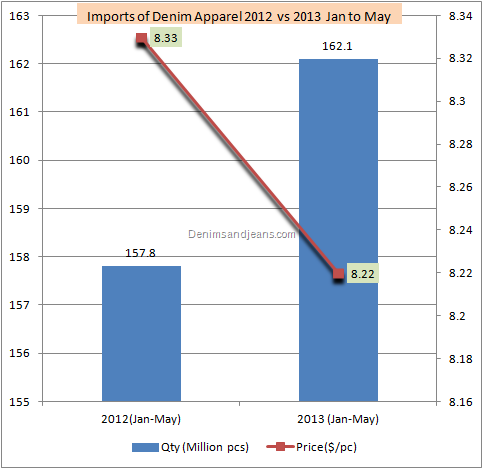
    The US imports of denim apparel show some improvement in 2013. While we had been happy to note a  fall of 3.5% only!  in 2012 over 2011 figures, the first 5 months of 2013 show an increase of about 2.7% over the last year . Lets have a look at the table and chart below :

    Period Qty (Million pcs) Price ($/pc)
    2012 (Jan-May) 157.8 8.33
    2013(Jan-May) 162.1 8.22
      +2.7% -1.3%

    The quantity of imports has increased marginally by 2.7% but it has an important psychological impact given the fact that the figures were negative for the last two years. Also to be noted that the imports generally improve further in the second half of the year and we can expect better performance during this period. Price is almost at similar levels with a minor fall.

    Denim Imports in 2013 in US

    The constant improvement of imports in the first year would add to the positive sentiment for the denim retail in US which has been reeling with falling sales and resultant imports since 2010 and has lost almost 15% ground since then. If the US recovers this lost sales, it would have a tremendous effect on the exporting countries.

  • US Imports of Denim Apparel Recovers a Little

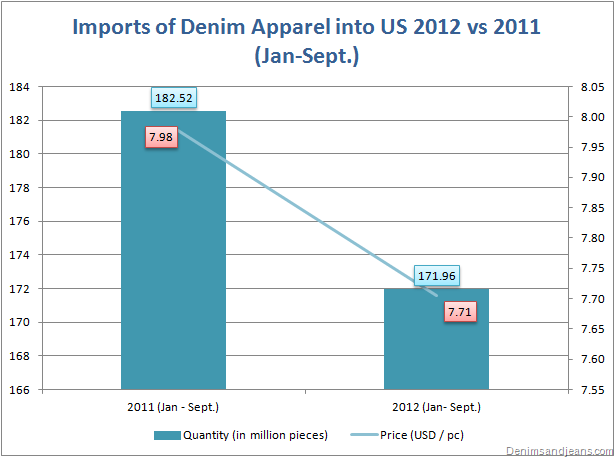
    The US Imports of denim apparel , which was showing a decline of over 10% till May this year  compared to 2011, seem to have recovered a little . The latest figures show that the US imports of denim apparel for the period Jan- Sept. 2012 is down only by 5.8% as compared to similar period in 2011.
    Though the imports are still lower than that in 2011, the reduced difference reflects a positive sentiment and an indication of better times to come in 2013.  On the ground too, the retailers are reflecting optimism and their orders too have firmed up  . On the whole, we can look forward to a better year ahead.

    However, there is one downside. The average price of denim apparel, which had , till mid of this year ,  been higher than 2011, has fallen and is now about 3.45% lower than that in 2011  reducing from $7.98 to $7.71 a piece.
    This is also a reflection of falling cotton prices and stronger dollar ,  but on the whole industry should not be very unhappy.

    US denim imports 2011-2012 (Jan-Sept)

    world denim market

  • Sri Lanka Exports of Denim Apparel to US : 2006-2012

    Sri lanka is an important apparel producing center with important apparel groups like Brandix and Hirdaramani and others who are world renowned .Sri Lanka’s apparel industry has grown to be one of the largest contributors to the export revenue of the country. The country having established itself as a reliable supplier of quality garments at competitive prices, also upholds ethical practices backed by legislation, thus being identified as a producer of “garments with no guilt” .Being the single largest employer in the manufacturing sector the apparel industry provides close to 75% of Sri Lanka’s employment either directly or indirectly. The industry has been positioned as a socially responsible and preferred destination for apparel sourcing.  Sri Lanka is also the only outsourced apparel manufacturing country in Asia having signed up to 30 of the ILO conventions. It stands out as a reliable source that pays fair wages to its workers while discouraging sweat shops and child labor in its businesses.

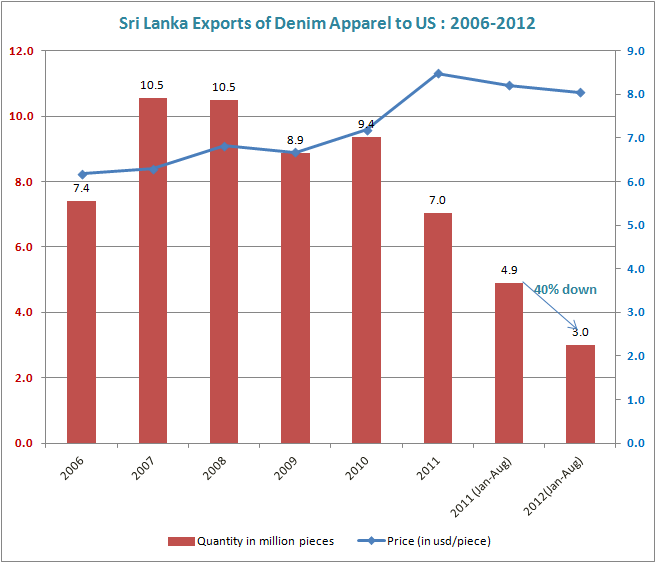
    Apparel exports from Sri Lanka is over $6 billion . But the share of denim apparel exports is a small part of this total . Though exports to EU are still higher, exports to US are limited. Lets look at the figures of exports of  all denim apparel to US for the period 2006-12.

    Sri Lanka denim exports

    The exports to US have hardly crossed 10 million pieces in a year since 2006 and have been continously falling since 2010. The year 2012 is no better either . For the period 2011 (Jan-August) the exports have been about 5 million pieces while those in the same period in 2012 have been about 3 million pieces. This shows a sharp fall of 40% ! .
    Sri Lanka is in no position to compete with other Asian countries like Bangladesh , China and Indonesia and it is able to serve the higher end of the market only. The average prices for the last 2-3 years have been over US $ 8 /piece.

    Check out – Buyers of denim apparel in Sri Lanka