Tag: Indigo Dyeing

  • Indigo People | Natural Indigos For Fall 2016

    Indigo People | Natural Indigos For Fall 2016

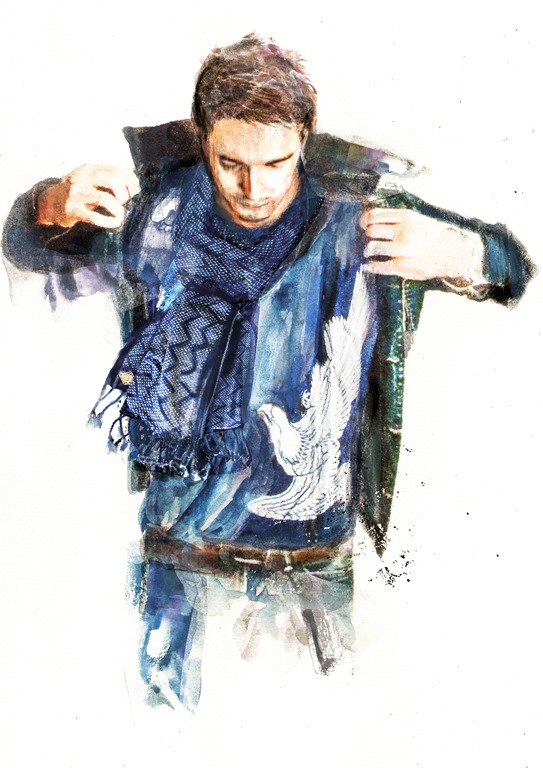
    Natural indigo – though costlier and more difficult to dye than the synthetic indigo  – brings out different aesthetics (better for many)  than the synthetic indigo. And when it is applied on hand spun yarn and then handwoven , the products become completely natural and bring out the cultural heritage to the fore. This is what the  Indigo People duo Kiat and Johan do with their enterprise which was established in 2013. Combining contemporary design with authentic techniques, every product is unique. Each product is hand woven and customized with integrity by a master artisan, who hand picks the base materials an dyes them in indigo main

    The main weaving techniques used are ‘ikat’, ‘open weave’, ‘batik’, and ‘4-grill’. These production methods can result in little imperfections, giving each product a unique appearance. The main material is based on unbleached and unprocessed cotton. The raw cotton is manually spun, which results in unevenness in the yarns. These little nubs in the weaving yarns give the product a natural and rugged look.

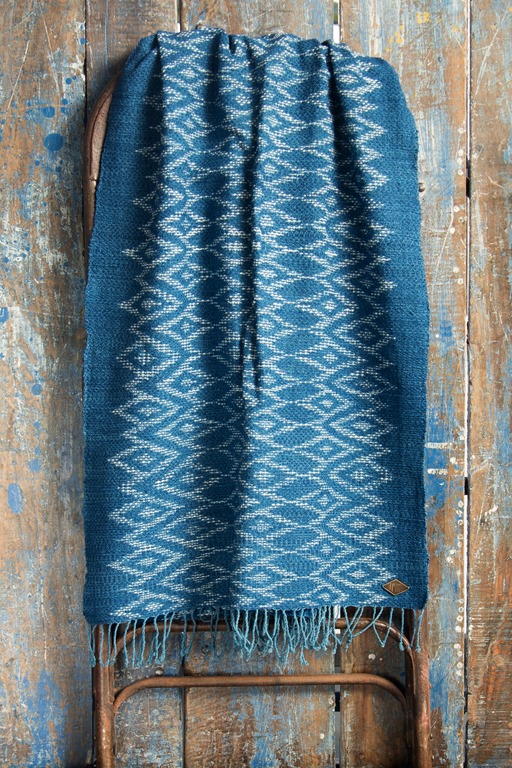
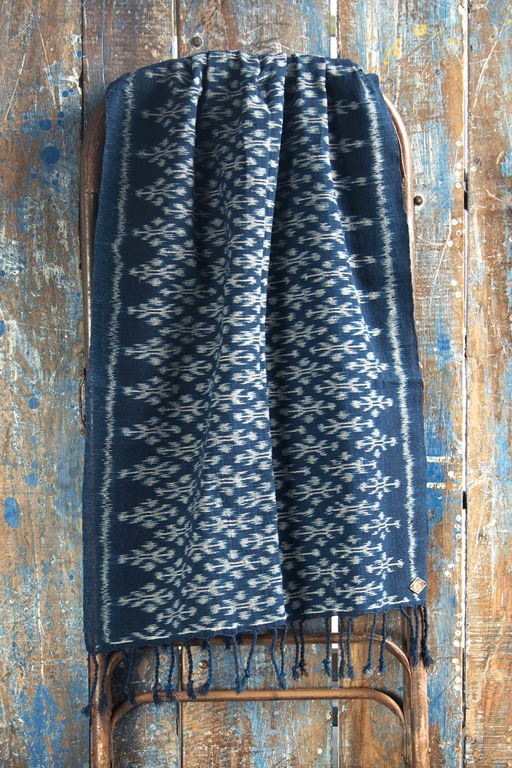
    The scarves are traditionally hand loomed and manually dyed in natural indigo following the ikat technique. The patterns are manually tied on the weaving yarns to resist dye. The designs are inspired by vintage ikat patterns and given a contemporary twist. New is the composition of 70% cotton and 30% rayon. The blend of cotton and rayon results in a very soft hand feel and increase the wear comfort of the scarves.

    Indigo_People_AW16_1Indigo_People_AW16_Mazaki_ScarfIndigo_People_AW16_Jimmu_Scarf

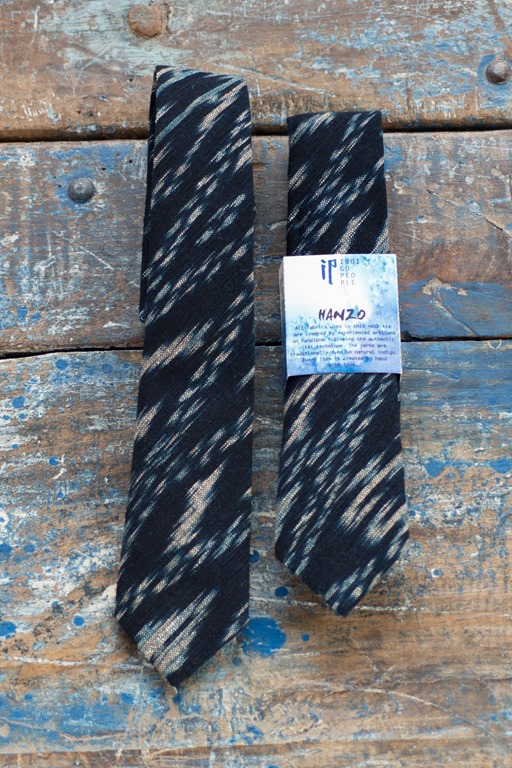
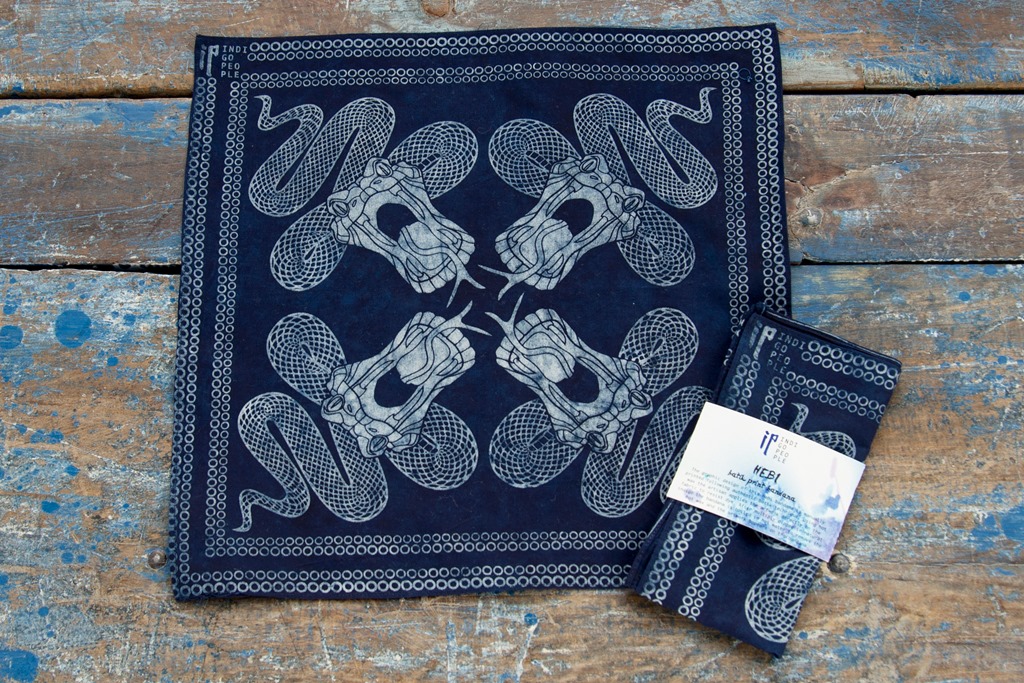
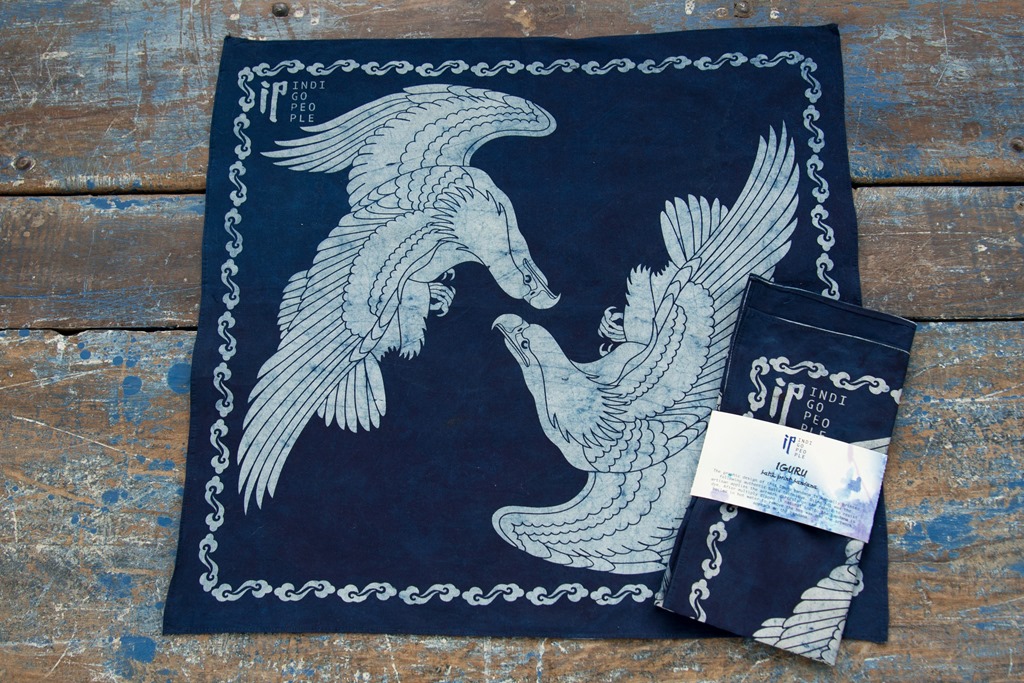
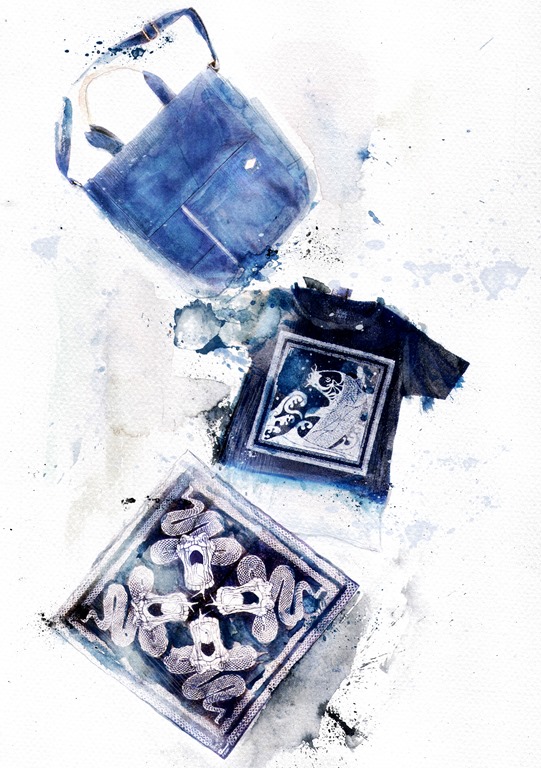
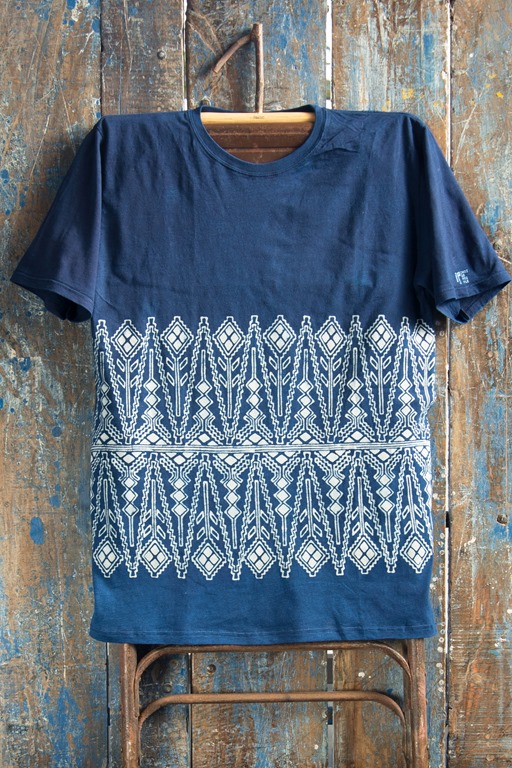
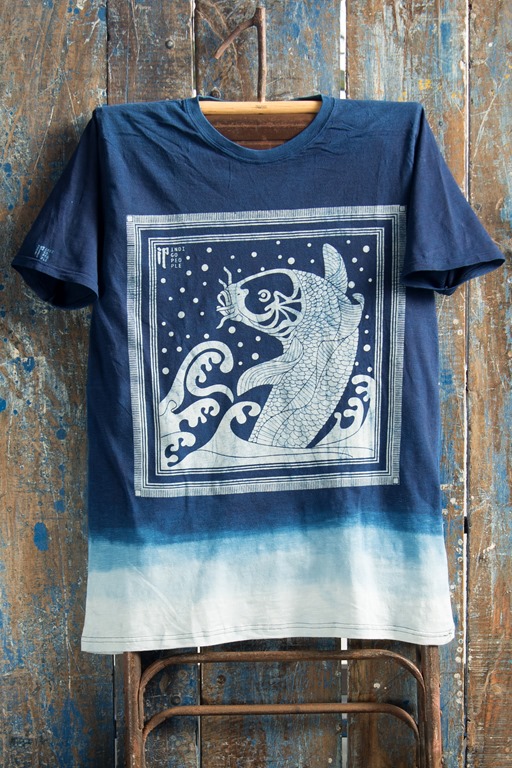
    Next to the well known handcrafted indigo scarves and ties, Indigo People is bringing 3 new product groups in this new collection: T-shirts, Bandanas , Ties and Bags. All ties are made from fabrics that are natural indigo dyed and hand woven following the traditional ikat technique. The inspirations for the sophisticated ikat designs come from the old Japanese Shibori Textiles.The t-shirts and bandanas are produced following the authentic batik technique. The artworks are stamped or printed with hot wax to resist dye during the indigo dyeing process. The artworks are then cracked and the garments are manually dyed, piece by piece, in natural indigo. To reach the dark indigo color, the dye master has to dip the garments up to 16 times in indigo. After dyeing, the garments are boiled in hot water to remove the wax. The printed artworks and the cracked lines remain their raw color and appear on the garments.

    Indigo_People_AW16_Hanzo_TieIndigo_People_AW16_Hebi_BandanaIndigo_People_AW16_Kingyo_Bandana

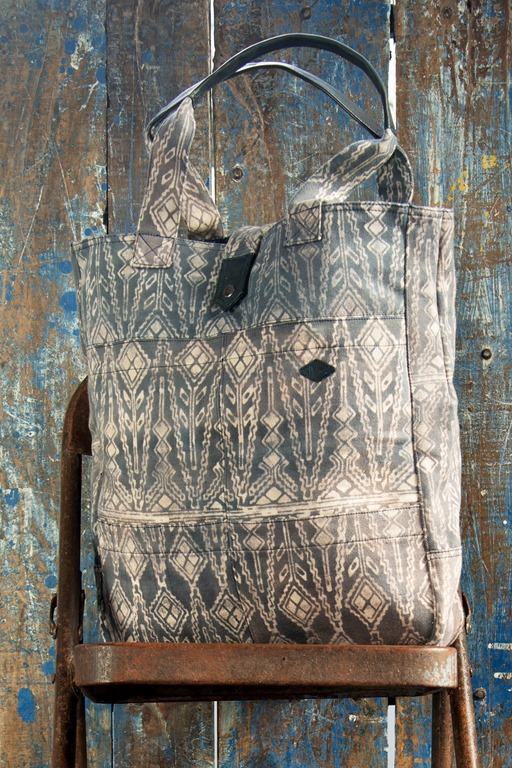
    The bags are offered in 2 different fabrics:

    • 17-ounce hand woven selvedge denim in natural indigo .
    • 17-ounce hand woven batik denim.

    The 17-ounce selvedge denim is hand woven and hand dyed in natural indigo. Because of the manual dye process, a color difference occurs in the finished fabric, there is no way to avoid this. This is considered as the uniqueness and charm of hand woven and hand dyed denim. The base twill fabric of the 17-ounce batik denim is hand woven like the selvedge denim. The pattern is printed following the traditional batik printing technique by stamping with hot wax. Removing the wax in hot water causes big color shading in the fabric because of its heavy weight and thickness; this color shading gives the fabric a vintage look.

    Indigo_People_AW16_3Indigo_People_AW16_Batik_Denim_ToteIndigo_People_AW16_Akio_TeeIndigo_People_AW16_Kingyo_Tee


  • Shade Control In Indigo Dyeing | Part 3

    This is a technical article by Harry Mercer on the process of Shade control in Indigo dyeing. This is the  third in the series. The first  and second part of this article were published before .

    Standard Illuminants
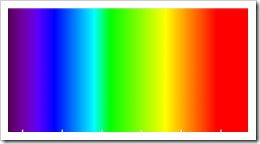
    standard light illuminantsAs stated earlier in this series, colour starts with a light source or illuminant. Illuminants have been standardized since 1931 by the Commission Internationale d’Eclairage (CIE). Illuminants are specified by a reference colour temperature such as 6500 degrees Kelvin., which is commonly referred to as D6500, (D identifying as a “daylight source). D6500 is a standard daylight illuminant in the United States and Northern Europe, originally to replicate light on the north side of a building in Chicago at noon. This specification of a light source by a colour temperature was originally established with a device known as a blackbody radiator. This is a small metal sphere with an opening which emits this specific illuminant when heated to a temperature of 6500 degrees Kelvin. Another example is Illuminant A, basically the colour of a tungsten filament lamp, which has a heavy red influence and a correlated colour temperature of 2856 degrees Kelvin.

    Specular Component

    “Specular” refers to the mirror-like quality of a fabric surface-the manner and directions in which light is scattered, which is a separate consideration from the colour itself. Appearance of a fabric is a combination of color and surface effects. The specular reflection of a sample differs depending on fiber characteristics, yarn count, yarn twist, fabric construction and finishing. These surface effects are neutralised during visual colour evaluation by using specific viewing geometries which relate the angle of the light source to the fabric and the angle between the human observer and the sample. For example, the 45˚/0˚viewing geometry, which neutralises the specular component, allowing a clear view of the colour only, means that the angle between the light source and the sample is 45˚ and the angle between the observer and sample is 0˚ or perpendicular to the sample. Colour measuring instruments offer this and other special viewing geometries to eliminate the specular or surface factors in measurement. If it is desired to include the specular component, then the option known as Specular Excluded (SEX) can be selected. The other option is include the specular component known as Specular Included (SIN). The Specular Excluded is superior for focusing on dyeing variation and prediction of washed colours, while Specular Included measurements are useful for rating the combined colour and physical differences of denim.

    Tolerances

    A tolerance, in regard to colour measurement, is a numerical difference between the standard color approved by the customer and the colour measurement of the fabric that was provided to the customer. In order to be indicative of a true visually noticeable colour difference, the tolerances should be established based on what a human being would recognize as a visual difference between 2 colours. As a general rule, if there is a total colour difference of ΔE equal to 0.2 between 2 samples, these samples can be considered visually different. With Indigo-dyed denim, this is also true if the colour difference between 2 samples has a value of ΔL = 0.2 in light-dark difference or Δb = 0.2 in yellow-blue difference. However, shades of Indigo are more sensitive in the Δa, red-green difference. In the U.S., it was standard to use a tolerance of only 0.08 for Δ a, meaning that if 2 samples differed by that much, they were considered different shades. This is not only because of the greater visual contrast in red-green differences, but also because of Indigo colour after washing. As Indigo develops a redder or less green shade, it loses colour in washing more quickly. For that reason, the Δa is a good general indicator of how easily Indigo will fade. Δh (hue difference) provides the same indication and is a more precise predictor.

    Many denim operations, as well as other textile operations use larger tolerances to specify shade differences from standard. These can be as high as 1.0ΔE to distinguish a slight shade difference, but this tolerance size allows up to 5 different shades to be shipped to the customer as the same colour.

    By the numbers

    Only by intelligent use of available colour data can the extensive problems with managing shade variation in Indigo dyed denims be systematically brought under the control needed to conform to the customer’s expectations. Colour measuring instrument programs provide massive amounts of direct information that is objective, but the data must be studied and analyzed in order to effectively manage colour, which is the most critical factor in denim success. Factors such as Standard Deviation are the most useful in determining progress, or the lack of it, in reducing Indigo shade variation. The Standard Deviation will demonstrate the relative degree of variation in Indigo dyeing between companies, products, machines, procedures, workers etc. and is the best tool for setting objectives for managers. In far too many denim companies, little concern is demonstrated within the production areas for identifying the sources of colour variation. The standard approach is to resort to shade-sorting or tapering programs that only establish the degree of failure in colour management.

    Recommendations

    1) ILLUMINANT- Illuminant A has long been recognized as a better light source for distinguishing true colour differences in denim, because of the greater sensitivity of Indigo to red-green colour difference. This will increase the number of to allow the laundry to sort the fabric more reliably in terms of wash-fastness.

    2) SPECULAR COMPONENT-While the Specular Included is normally used for fabric shipments, the Specular Excluded is more useful for evaluating the effects of dyeing directly, avoiding the influences of weaving and finishing on denim which is significant.

    3) TOLERANCES-Review the colour tolerance used in shade sorting or tapering to determine if it is realistic and allows conformance to the customer’s expectation.

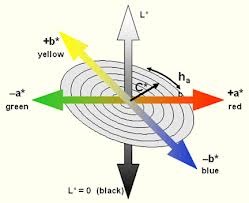
    4) COLOUR ORDER SYSTEM- While the L*a*b* colour arrangement is in common use, the L*c*h*(chroma and hue) arrangement allows better communication between denim producers and customers. While the L*a*b* arrangement orders colour in a way that approximates how garment buyers see colour, the L*c*h* arrangement relates more directly to how colour managers, as in dyeing perceive colour.

    5) EDUCATION-In order to raise the level of professionalism of those responsible for colour management, detailed, scientifically-based training is badly needed in the denim business in every sector in order to minimize dissatisfaction on the part of customers. There are training resources available from colour instrument vendors on line or colour experts for in-factory training. Selection of staff for colour nmanagement is critical since less than 5% of people are able to grasp the concepts involved, so objective evaluation of colour staff is necessary to maintain an image of professionalism.



    image
    This is a guest post by Harry Mercer. Mr. Mercer has 30 years experience in the denim business including 3 prominent U.S. denim companies.He is an expert colorist for measurement and color matching as well as textile testing. He can be contacted here


    Denimsandjeans.com   Bangladesh – The first denim show in Bangladesh on 1st and 2nd March 2014. Don’t miss it !!  Want to visit ? Get an invite here

  • Shade Control In Indigo Dyeing | Part 2

    This is a technical article by Harry Mercer on the process of Shade control in Indigo dyeing. The first part of this article can be found here

    While it cannot be disputed that, ultimately, how the individual consumer values color with their human subjectivity is the true test of coloration, in large-scale manufacturing of fabric and garments, the resort to evaluation of color visually is extremely unreliable. Color vision is denim eyedifferent among human observers and varies with the same observer depending on factors like fatigue, age, emotional state and even race Color blindness related to difficulty in distinguishing red-green color differences is most common among Caucasians, affecting 8% of males, but only 0.6% of females, 5% of Asian males and 0.25% of females and 4% of African males, 0.16% of females. The Ishihara test is used to quickly identify colorblindness problems. Many fashion houses require colorists to pass the Farnsworth-Munsell 100 Hue test for employment. This test provides a rating of ability to distinguish colors and demonstrates how different individuals are in this regard. When I had the test, it showed that I have excellent color vision in terms of distinguishing violet and Indigo, but hopeless with shades of red. These differences in individual color perception result in endless disputes regarding conformance-to-standard expectations. For final determination of whether a sample and a standard are identical, the eye is still the best instrument, it fails in describing the exact quantity and quality of the differences in a submitted sample to the approved standard. Color measuring instruments, on the other hand, will objectively and precisely measure the exact differences in multiple dimensions, how the standard and sample are related to each other and will determine if the sample is acceptable within a given tolerance through thousands of tests with extreme accuracy and repeatability which nearly impossible with visual measurements.

    How Color Measuring Instruments Work

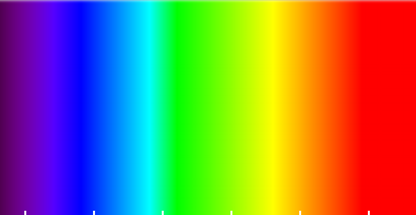
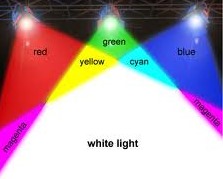
    Without engaging in the complex physics and mathematics of color science and measurement, the basic principles of determining color involve a standard light source, an object to bounce the light off of and an observer (human or color measuring instrument). Color starts with light. In a color white light color measurement in denim measuring instrument, a standard white light source illuminates the sample to be measured. This white light can be thought of as containing equal amounts of all visible light colors at a high level-100 units of red, orange, yellow, greens, blues, Indigo, violets etc. Dyes and pigments absorb these colors of light in different amounts and allow the rest to escape, which the instrument measures. With a light shade of Indigo, of 100 units of each light color illuminating the sample, perhaps reflected are 50 of violet, 70 of Indigo, 60 of blue, 50 of blue-green, 30 of green, 20 of yellow-green, 10 of yellow and 25 of red. The instrument collects these quantities and converts that into various numerical values. A curve is produced from this data that serves as a “fingerprint” of a color that distinguishes it from all other colors. The data collected by measuring the escaping light colors is mathematically converted into basically 3 numbers that are coordinates in a 3-dimensional color space. This color space is roughly like a sphere in which all colors thatcolor measurement in denim hunter scale can be perceived by the human mind are contained. The distance and direction in 3-dimensions precisely relate each color to all other colors. From these mathematically precise locations the differences are calculated. These values are then mathematically transformed into a color coordinate system, most often L*a*b*.

    Color Descriptors

    The starting point of these color spaces is the L-scale which is a vertical axis around which all colors are organized. The L-scale establishes the differences in lightness between samples-how dark or light a sample is. The L-scale starts at the top of the sphere with a value of 100, for a perfect white and ends at the bottom with 0 for a perfect black. In between are degrees of grayness. This axis is neutral with regard to color, having no color or hue, meaning without red, green, blue etc. A dark shade of Indigo may have an L-value of 30 while a light shade may have an L-value of 60. If a color difference were calculated between the dark and light values it would be a minus 30, reported as a DL -30 (delta L, or ΔL, Δ being the scientific symbol for “difference”). Starting from this neutral central axis of this sphere where are colors are mathematically located, moving outward hue is added, hue being the scientific name for color.

    From the central, neutral axis, color is added gradually so that when the outer edge of the sphere is reached a saturation limit is reached at which the human eye perceives that the color is too dark to be at the same level of lightness. For example, at a lightness (L*) level of 85, which is very white, as you move outwards at first there is a small amount of red added and you have a color that would be identified as pink. If you add the maximum amount of red, then the color becomes a dark, but bright red. When the maximum amount of red has been added, more than the human eye can recognize at the L* level of 85, the lightness level will drop to 80 because the color had increased to a darker level.

    If this color sphere is bisected into a series of planes that go from top to bottom of the sphere, these planes are initially divided into 4 quadrants. In the most commonly used color space (L*a*b*), there is one line labeled a* that represents red-green differences and a line labeled b* that represents yellow-blue differences. Red and green are considered to be opposing colors as are yellow and blue, just as east and west, north and south are opposites.

    On the a* line a positive number like +3.5 indicates a red color and a negative number like -3.5 indicates a green. If a standard has an a* value of +3.5 and a sample has a value of +0.5, then the difference between standard and sample is expressed as Δ a*-3.0, simple subtraction. However if the standard has a value of +2.0 and the sample has a value of -1.0, then the total red-green difference is Δa*-3.0 because these are Cartesian coordinates. The total color difference is the same, but the overall visualcolor measurement in indigo denim color chart difference is much greater because crossing the boundary between the red and green sides of color space results in much greater contrast. Red-green differences are the most significant with Indigo, not only because of the visual contrast, but also red-green differences are good predictors of wash-fastness of Indigo and even small differences in the a*values means higher variation in the laundry.

    The b* line is similar for yellow-blue differences. The –b* values should be monitored as a way to evaluate changes in the original dyed color of Indigo on yarn.

    The third part of the article Shade control in Indigo Dyeing follows shortly..


    image
    This is a guest post by Harry Mercer. Mr. Mercer has 30 years experience in the denim business including 3 prominent U.S. denim companies.He is an expert colorist for measurement and color matching as well as textile testing.

  • Indigo Dyeing : Problems And Potential–Part 4

    This is a technical article by Harry Mercer on Indigo dyeing. It is the fourth and the last part of the article in series. The first part can be seen by clicking here and the second one here and the third one here

    Part 4 of 4: Denim Dyeing Done Right

    Indigo Dye BathIndigo dye is unique among textile dyes with the unusual color and appearance that it imparts to any fabric, and is along with the extreme comfort of 100% cotton denim is the source of denim’s enduring appeal. Attempts to replicate the Indigo color with other dyes ,like sulfurs, only results in a poor imitation.The process of dyeing Indigo is also unique because of the necessity for repeated applications in multiple dye baths. Indigo is actually a better wool and silk dye and has been used to dye those fibers for centuries.
    All other cotton dye types- reactives, directs, sulfurs, naphthols and vats- have simple application methods usually only requiring only a single bath application and simple machinery arrangements.

    Indigo dyeing on the other hand presents complexities with regard to machinery design that includes multiple dye baths and a circulation system that is needed to keep the Indigo dye in motion with pipes through which the dye flows into and out of each box and in a circuit around the dyeing section which can have a total dye volume of from 1000 to 30000 liters while ordinary dyes need only a few hundred liters for application. This is necessary because Indigo dye, exists not in a true solution like acid or basic dyes, but are in colloidial state- clusters of dye molecules in a reduced condition that will sink to the bottom of the dye bath due to gravity if not stirred constantly. The degree of circulation pressure must be balanced so that there is a uniform concentration of Indigo from top-to-bottom and from side-to-side for consistent dyeing. If the circulation pressure is too high there will be excessive turbulence in the dye baths which will result in the reduced Indigo and the reducing agent breaking down. In engineering terms (Reynold’s Number), the flow should be greater than laminar, but in the low transitional range and never approaching turbulent conditions. Unfortunately, a number of Indigo dyeing machines offered in the last 20 years, are badly designed for maintaining uniform bath circulation, especially sheet ranges which usually have entry- and exit pipes that are too small to achieve even dye distribution in the boxes, which results in serious problems like Cross-Shade Variation. These problems have been complicated in many denim companies by the feeding of sodium hydrosulfite as a dry powder which is highly unstable when mixed into the dye, most of it being wasted through unnecessary decomposition. Hydrosulfite should never be added to the dye unless in a stable liquid mixed with alkali, which was the method used by all U.S. denim companies.

    More importantly for achieving the desired tone(red versus green), consistency of color and color-fastness (to rubbing , washing and staining) is understanding the complicated chemistry of Indigo. Other dyes are mixed and applied in basically the same chemical state. When Indigo is mixed with sodium hydroxide and sodium dithionite (hydrosulfite) a series of reactions occurs in which the Indigo is combined with hydrogen and sodium to form the reduced indigo form. Additionally, approximately half of the sodium hydroxide is converted into sodium carbonate and other alkalies while the sodium dithionite reducer decomposes into an acid and simpler reducing agents like sodium sulfite. Three ingredients are mixed and between 9 and 12 new chemicals are created. Because of this phenomenon and the special design of the circulation system, Indigo dyeing can only be correctly understood with a basic knowledge of chemical engineering. I have found in training programs in many denim companies, that only trained chemical or mechanical engineers are readily capable of understanding the Indigo dyeing problem well enough to have perfect results

    In order to measure the chemical concentrations for Indigo dyeing there are only certain methods that have proven to correlate with the yarn color, which is after all, the measure of effectiveness for any test method. If test results are plotted comparing the measures of dye and chemical concentrations vesus the yarn color and colorfast-ness and changes in concentration measurements do not reflect similar changes in the color, then the wrong test method is being used.

    Extensive research has demonstrated that for testing the strength of the Indigo mix, the glass plate method and the 2-endpoint titration for caustic/carbonate have always proven reliable. For testing the concentrations of reduced Indigo and hydrosulfite in the dye bath, the vat-ometer , mentioned in a previous article will correlate well with the color produced and can also be used to control color-fastness.

    Unfortunately, the most commonly used methods, will not correlate with color and therefore are not useful for solving Indigo dyeing problems. These include:

    pH and millivolt meters which are incapable of quantitatively measuring concentrations of sodium hydroxide and sodium hydrosulfite. They provide only a general qualitative measure of the number of particles in a liquid indirectly by measuring electrical currents. The only difference between a pH meter and a millivolt meter, other than the electrode used is that one converts electrical measurements into a logarithmic scale(pH) and the other to a linear scale(ORP) which reflects a buffered condition and not concentrations-only concentrations matter in chemistry.

    Automatic titrators for use with the 2-endpoint ORP titration are not useful in monitoring Indigo dyeing for production. The sample size is too small for accurate results and there is a persistent problem with the titrator trying to identify the correct endpoints. 20 years ago, I introduced the potassium ferricyanide method to the public in an article. It had been in use by a small group of denim experts in the U.S. for many years, but only worked with manual titration with a large sample size. As a denim consultant for the last 18 years, I have never observed results from automatic titrators that correlated with the Indigo color.

    Dye strength measurement by colorimetric transmission measurement is false sophistication. In order to measure the strength of a dye by transmission and converting it to absorbance requires application of the Beer-Lambert Law. The basic principle is that light absorbance is directly proportional to the concentration of a dye is correct, however there are limitations which include the need for a true solution at very specific concentrations (<0.01 M) that avoid light scattering. Indigo dye, as mentioned earlier, exists as a colloidial dispersion which produces turbidity, which, in turn, causes light-scattering and defeating attempts to measure absorbance.

    Indigo dyeing can, in fact, be conducted at nearly perfect levels with a properly designed training program that illustrates the chemistry, mechanics and management methods required to get the dyeing right which I have provided for many years.

    This is a guest post by Harry Mercer. Mr. Mercer has 30 years experience in the denim business including 3 prominent U.S. denim companies.He is an expert colorist for measurement and color matching as well as textile testing and is considered to be a leading authority for denim dyeing, finishing and fashion denim development.

  • Indigo Dyeing : Problems And Potential–Part 3

    This is a technical post by Harry Mercer on Indigo dyeing. It is the third part of the article in series. The first part can be seen by clicking here and the second one here

    Part 3 of 4: Monitoring of the Indigo Dye baths

    As discussed in Part 2 of this series, most of the control of indigo dye bathIndigo dyeing must be managed before the dye and chemicals reach the dye boxes in the machine. In order to measure the effectiveness of control measures of the dye and chemical mixes, it is necessary to measure concentrations of Indigo, reducing agent and alkali in the Indigo dye boxes. If the methods of measuring these concentrations in the dye boxes are accurate and reliable, then those measurements will be able to predict the Indigo color of the yarn and the colorfastness of the denim in the garment laundry as well as providing a benchmark of dyeing management capability. By analyzing the data for each dyeing method with simple statistical tools such as Standard Deviation, the level of control for each color, for each dye lot and each group of workers can be measured and improved. In this way, continual progress can be made towards perfect denim color which has been achieved in a few companies. This wins business with jeans producers that pay the highest prices.

    In 1992, I published an article, “Quality Assurance Methods for the Continuous Dyeing of Cotton Yarn with Indigo” that was the most advanced treatment of the subject. After years of research into test methods for Indigo dyeing, several conclusions could be made:

    • 1) the most commonly-used methods of measurement, pH and millivolts were unreliable and could not be correlated with the dyeing results. They gained popularity because of simplicity and because that the results were consistent- the color changed, but the pH and millivolts were consistent. Dye managers used these numbers to claim that they had good dyeing control when customers complained about color variation.
    • 2) Statistical Analysis comparing test results with the actual fabric color and wash-down demonstrated that the glass plate, vat-ometer and a special alkali titration correlated perfectly with instrumental color measurements of denim(L*a*b* or L*c*h*) and were the only reliable test methods for correcting Indigo dyeing problems.

    The primary cause of Indigo variation is changes in the reduction potential of the dyebath which consists of a combination of reduced Indigo and free sodium hydrosulfite. The total hydrosulfite in the Indigo bath is divided between the hydrosulfite that is consumed for reduction of the indigo dye molecule and free hydrosulfite that is not consumed in dye reduction. Where the dye circulation is adequate and the dye feeding concentrations are consistent, the grams per liter of reduced Indigo and the alkali levels are consistent. The free hydrosulfite is unstable and requires the most effort in control for Indigo dyeing. As the concentration of free hydrosulfite increases, the Indigo shade becomes greener and more wash-fast; as the free hydrosulfite decreases, the indigo appears less green or redder and loses color faster after washing. If the free hydrosulfite changes by 0.3 grams per liter in the indigo bath, a different indigo shade results. Many denim companies have 10-15 shades per dye lot where a true color difference of 0.2 Delta is used as a measure.

    In the above-mentioned article that I published, I mentioned a number of possibilities for measuring reduced Indigo and free hydrosulfite in Indigo dye boxes. One was the permanganate method that uses a 2-endpoint, potentiometric reduction-oxidation titration.This method has come into common use in many companies, but is not reliable for measuring the Indigo dye. The method has been in use for over a hundred years and I found it useful in conducting research into Indigo dyeing in order to develop Indigo formulations in the laboratory. This method was occasionally useful at the Indigo machine when developing new Indigo colors, but only with manual titration. Automatic titrators usually proceed too quickly and produce erroneous endpoint identifications. Also, the sample sizes used are too small to be representative of the average Indigo and hydrosulfite concentrations for all of the dye boxes. In addition, the test is too slow for quick response in dyeing and laboratory personnel often are not aware of maintenance and calibration requirements.

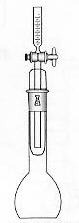
    The vat-ometer, on the other hand, offers simplicity, speed and reliability. This device was invented about 150 years ago and research into Indigo dyeing has demonstrated that the vat-ometer results are consistent and are predictive of actual color variations in Indigo dyeing. The vat-ometer consists of a rounded glass flask and a measuring tube. Water is added to the vat-omter, then dyebath is entered, the vat-ometer is sealed to prevent entry of additional air and then the mixture is shaken for about 1Vatometer minute. The principle involved is to titrate the hydrosulfite with oxygen from the air. This causes oxygen trapped in the flask to be consumed by the hydrosulfite,which creates a partial vacuum in the flask. Then water is added to the measuring tube, the stopcock on the measuring tube is opened and a quantity of water is pulled into the flask that equals the number of cc’s of oxygen consumed. The number of cc’s of oxygen consumed multiplied by 1.1 yields an accurate and reliable measure of total hydrosulfite in the dye. Repeating the test after adding some formaldehyde to the water will provide the grams per liter of reduced Indigo. By subtracting the reduced indigo number from the total hydrosulfite number, the grams of free hydrosulfite is provided- this number determines the color and wash-fastness of the Indigo.

    As mentioned previously, the practical number is the average hydrosulfite for all of the dye boxes. As a rule the hydrosulfite concentrations in indigo dye boxes will vary from box-to-box, from top-to-bottom and from side-to-side. In order to know the machine average, at least 2 dye boxes should be sampled. For example, on a 6-box Indigo machine, normally an average of the 2nd and 5th box will equal the machine average.

    The vat-ometer offers the advantages of larger sample sizes for better accuracy faster results. The vat-ometer can be constructed in the laboratory to use dye samples as large as 100 cc’s, however the portable vat-ometer which yuses a 10 cc sample has long been proven to be accurate enough for Indigo dyeing production eg the one from Tudorscientific here.

    This is a guest post by Harry Mercer. Mr. Mercer has 30 years experience in the denim business including 3 prominent U.S. denim companies. He is an expert colorist for measurement and color matching as well as textile testing and is considered to be a leading authority  for denim dyeing, finishing and fashion denim development.

  • Indigo Dyeing : Problems And Potential–Part 2

    This is a guest post by Harry Mercer on Indigo dyeing. It is second part of the article in series. The first part can be seen by clicking here

    Preparation For Dyeing

    In the previous article, the basic machine factors in Indigindigo dyeingo dyeing were discussed. There are many other details required to achieve the highest quality Indigo dyeings , but ultimately the most important factors involve the preparation of Indigo and chemical feeds to the machine. Approximately 80% of Indigo dyeing control depends on the stability and consistency of the dye and chemicals being sent to the machine.

    1) Raw materials: The basic ingredients for Indigo dyeing are the Indigo dye, sodium hydroxide and the hydrosulfiteindigo dye (sodium dithionite). Indigo is an insoluble vat dye which means that it cannot enter the cotton fiber until it is made soluble by the process of reduction .Reduction is basically a process where hydrogen is produced which opens up the Indigo dye molecule allowing it to attach to a water molecule which carries the vat dye into the fiber. The most commonly-used

    2) The reducing chemical is known as “sodium hydrosulfite”, but this nomenclature is incorrect becausesodium hydrosulphite the molecule does not contain hydrogen. The “hydrosulfite acts on the sodium hydroxide to split it into NaO and hydrogen, both of which attach to the dye molecule in the reduction process.

    3) The reduction of Indigo with sodium hydroxide and sodium dithionite is known as vatting and has been used for thousands of years. Vatting refers to mixing the dye and chemicals into a tank or “vat” with some stirring and then waiting from 1-4 hours usually for the complete reduction of the dye to occur which is noted when the solution color is a clear, yellow-brown.. The solution then is referred to as “leuco” Indigo, a Greek word meaning “without color”. The concentrated Indigo mix is then ready to pump into the dye machine for dyeing.

    4) Most of the variation in Indigo dyeing is a result of instability in this concentrated mix. Sodium dithionite can be extremely unstable, with the concentrations in this feeding mixture becoming smaller with the passage of time. For example, the initial recipe may specify 100 grams per liter of sodium dithionite, but by the time the last liter goes into the machine, the concentration often drops to 20 to 30 grams per liter and each 5 gram per liter loss in dithionite concentration produces a small Indigo color variation. This is evidenced in many denim operations that suffer 10-15 colors after fabric washing per dye lot.

    5) There are several causes for the decomposition and strength losses of the reducing agent in the feeding mix: Oxidation at the surface of the tank, unnecessary stirring and high concentrations of ingredients. The stirring should be only enough to maintain consistent concentrations of dye and chemicals from the top of the feeding tank to the bottom. Stirring beyond that will result in more reducing agent being oxidized. Also, in many Indigo operations the stirring units are badly designed with small propellers that turn at high speeds. The Indigo feeding mix is of very high viscosity and in order to stir the entire mix out to the edge of the tank, large propellers that cover the tank diameter are needed. Theseindigo dye box stirrers should turn at only 10-15 RPM in order to avoid turbulence that would lower the strength of the mix. With regard to concentrations, if the viscosity of the dye mix is too high, the reduced Indigo will not disperse uniformly resulting in areas of varying concentration in the tank that will cause color change as the mix is fed to the machine. Concentrations above 23% solid have a tendency to settle, so that there are very high concentrations of reducer in the bottom of the tank, making a greener Indigo tone when pumped to the dye boxes, and lower concentrations of reducer at the top of the tank, making a redder Indigo tone later in the dyeing. No more than 80 grams per liter of indigo should be added to a feeding mix as this is the maximum amount that has long been proven that can be completely reduced. The amount of reducing agent should also be limited to 80 grams per liter since greater amounts will cause more rapid decomposition due to aerobic and anerobic decay.

    6) The concentrations of indigo and reducing agent must be actively managed so that the same concentrations of dye and reducer are feeding to the machine every minute,otherwise the color will change. Management of the feeding mix requires an understanding of the chemistry of reduced dye solutions, measurement of concentrations and skill in correcting strength losses of ingredients in the feeding mix especially of reducing agent and alkali. There are 2 simple , but special test methods to measure the concentration of alkali and sodium dithionite in the feeding mix: a 2-endpoint titration for alkali and the glass plate test which have been in use by the best denim companies for over a century and will be covered in a future article.

    Conclusion:

    The problem of Indigo color variations is principally a result of inconsistent dye and chemical concentrations going to the machine. A glance at the design of flow of dye and chemicals into Indigo dye machines should make this obvious. The multiple dye box arrangement and circulation in the dyeing section of indigo machines allow the blending of indigo and reducing agents, so the problem of variation obviously starts at the mixing tank.

    Sponsored Link:

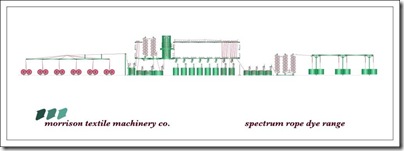
    spectrum_rope_dye_thumb

    This is a guest post by Harry Mercer. Mr. Mercer has 30 years experience in the denim business including 3 prominent U.S. denim companies. He is an expert colorist for measurement and color matching as well as textile testing and is considered to be a leading authority  for denim dyeing, finishing and fashion denim development.

  • Sulphur Dyeing In Denim

    This is a guest post by Harry Mercer. It tells about the  best practices in Sulphur dyeing for fashion denim and was  a part of the presentation made at Dhaka  by him on a seminar on Sulphur Dyes by Fenazol

    The Nature of Sulfur Dyes

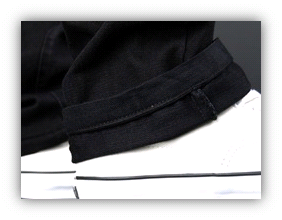
    • Sulfur dyes are a form of vat dyes – they are water-insoluble and in order to apply to fibers must be made water-soluble through the process of reduction.  sulphur denim jacket
    • Reduction is a chemical process in which hydrogen is liberated. The hydrogen reacts with the dye and permits a water molecule to attach to the dye. The dye is transported into cotton fiber by the water.
    • This reduced dye must then be oxidized. Oxygen reacts with the hydrogen producing water. Removing the hydrogen makes the dye insoluble, which results in the dye becoming physically trapped inside the fiber.

    The Uses of Sulfur Dyes

    • Sulfur dyes are commonly used for black, blue, brown, khaki and green colors.
    • Sulfur dyes are applied to cellulosic fibers and blends of cellulosics with polyester, nylon and acrylics.
    • Sulfur dyes can be applied with little difficulty and with excellent results at a relatively low cost.
    • With good application methods, sulfur dyes are extremely wash-fast, however, they are usually not fast to chlorine bleaching.

    Dark and medium colors are the most common with sulfur dyeing. Light colors can be produced by special procedures involving blended reducing agents, blends of surfactants, controlled oxidation and preparation methods like Mercerizing and bleaching.

    Dark, dull sulfur dyeing

    •Sulfur blacks are commonly applied in the 1st box on Indigo machines.

    •The sulfur black dye molecule exists as very large polymers which require high temperatures for penetration into fibers (90-95 degrees).

    •The maximum amount of sulfur black dye that can be efficiently applied is 4%on weight of cotton of a pure sulfur powder or 20% of a standard liquid (20% dye strenght). Darker sulfur blacks can be achieved by adding a sulfur blue.

    •Sulfur blacks are best oxidized with an air passage like Indigo.

    indigo dyeing sulphur

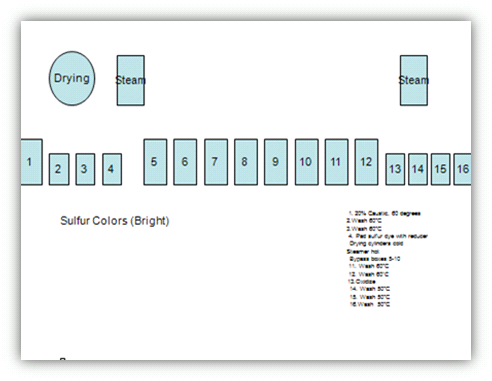
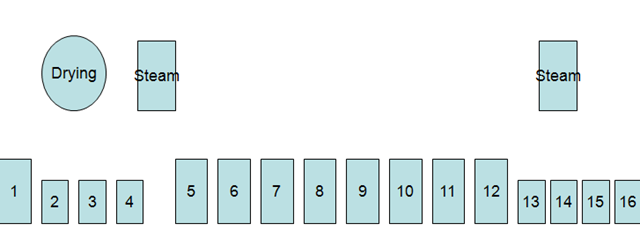
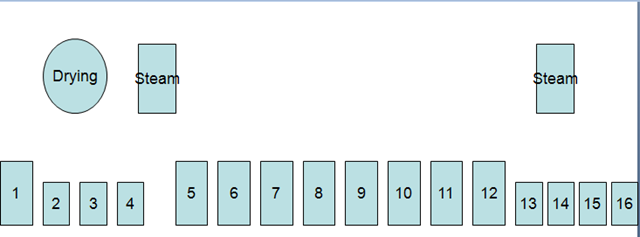
    Boxes :
    1. 20% Caustic, 60 degrees
    2.Wash 60°C
    3.Wash 60°C
    4. Pad sulfur dye with reducer
    Drying cylinders cold
    Steamer hot
    Bypass boxes 5-10
    11. Wash 60°C
    12. Wash 60ËšC
    13.Oxidize
    14. Wash 50°C
    15. Wash 50°C
    16.Wash 50°C

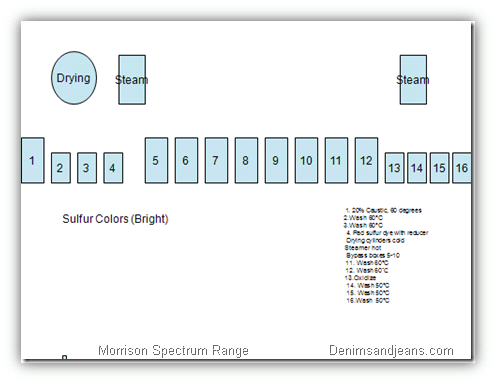
    Light Sulphur Colors

    color denim sulphur

    • Sulfur dyeing procedures have been used to create a full range of colors including browns, yellows, greens, violets, reds, orange and neutrals  (light/medium greys)
    • Producing special colors with these processes involves the use of true sulfur dyes alone or in combination with sulfurized vats or special direct dyes that  can be applied with special sulfur dyeing procedures.
    • For success in fashion markets with these colors, marketing is focused on color “themes” such as “earth tones”, “urban”, sport or university colors.

    Control Of Light Sulphurs

    • In order to match specific colors, dyes with greatly different affinity factors are mixed.
    • Different affinity factors result in these dyes being picked up at different rates, so special methods are necessary to avoid color variation.
    • Sulfur colors should be applied from 30 to 60 degrees to avoid color variation and must be chemically oxidized.


      image
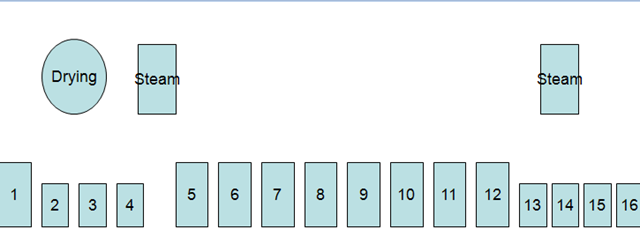
    Boxes:

    1. 20% Caustic, 60 degrees
    2.Wash 60°C
    3.Wash 60°C
    4. Pad sulfur dye with reducer
    Drying cylinders cold
    Steamer hot
    Bypass boxes 5-10
    11. Wash 60°C
    12. Wash 60ËšC
    13.Oxidize
    14. Wash 50°C
    15. Wash 50°C
    16.Wash 50°C

    Sulphur Bottoming

    • Bottoming of Indigo dyed yarns produces a darker, brighter effect with Indigo.
    • The purpose of bottoming originally was to produce a darker color with less Indigo.
    • While large amounts of sulfur dye can be applied in the 1st box, most of the sulfur is removed by hydrosulfite in the Indigo dye.
    • Unlike other sulfur dye applications, a pH of 12 with sodium hydroxide is helpful to retard the dyeing for color consistency.
    • A temperature of 60 degrees or less should be used to lower the affinity factor for consistent color.

    Problems With Sulphur Bottoming sulphur bottom denim

    • Sulfur bottoming can provide lighter shades because most of the dye applied in the 1st box is removed by the hydrosulfite in the Indigo boxes.  
    • The affinity factor (rate of dyeing) at high temperatures of sulfur dyes results in shade variation.
    • If sulfur black is applied as a bottom, the Indigo boxes are contaminated with a yellow compound which causes discoloration of pure Indigo shades. Sulfur blacks are typically produced by polymerizing 2,4 –dinitrophenol(reddish-yellow) with sulfur. Hydrosulfite in the Indigo boxes-reduces the sulfur black to this yellowish compound.
    • Sulfur bottoming should be conducted at temperatures of 30-60 degrees for consistency. Unlike other sulfur dyeing which should be conducted at pH 11, sulfur bottoming can be conducted better at pH 12 with sodium hydroxide which acts as a retarder to slow the rate of dyeing.

    indigo dyeing range sulphur morrison

    Boxes

    1. Pre-wet 2% caustic 90°C
    2.Wash 60°C
    3.Wash 60°C
    4. Wash cold
    By pass drying cylinders
    Bypass steamer
    Boxes 5-10 Indigo
    11. Wash 60°C
    12. Pad sulfur topping
    Steamer hot
    13. Wash cold
    14. Wash 50°C
    15. Wash 50°C
    16.Wash 50°C/Softener

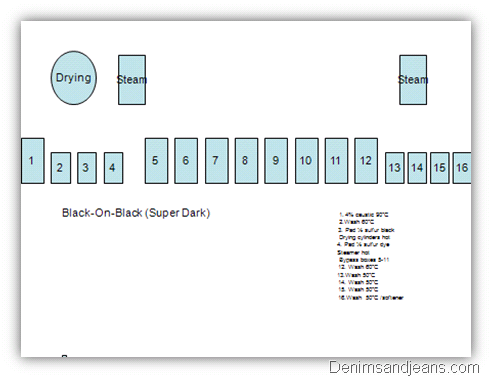
    Black-on-Black Dyeing black over black denim

    • Sulfur black dyes are low-intensity dyes that require large amounts for dark shades.
    • The amount of sulfur black that will produce the darkest shade when applied properly is 4% of a 100% powder or 18% of a 20% liquid.
    • It is difficult for cotton to easily absorb that quantity of dye in a way that produces a very dark shade. 
    • One method that has been used to produce darker, more colorfast sulfur blacks on yarn is to apply 50% of the dye, then dry the cotton, air oxidize and without washing, proceed to a second dye-box where the dye is applied again, dried oxidized with air again and washed.

    indigo dyeing sulphur

    Boxes:

    1. 4% caustic 90°C
    2.Wash 60°C
    3. Pad ½ sulfur black
    Drying cylinders hot
    4. Pad ½ sulfur dye
    Steamer hot
    Bypass boxes 5-11
    12. Wash 60°C
    13.Wash 50°C
    14. Wash 50°C
    15. Wash 50°C
    16.Wash 50°C /softener

    Reducing Agents For Sulphur Dyes

    • Because sulfur dyes cannot be dissolved in water directly, reducing agents must be utilized to produce hydrogen which allows the dye to attach to water.
    • Any standard reducing agent can be used to dye sulfurs including reducing sugars (dextrins), sodium hydrosulfite, sodium bisulfite, sodium sulfide, sodium polysulfide and sodium hydrosulfide.

    Selection of reducing agents

    • Reducing agents for sulfur dyes should be selected according to the type of dyeing (batch or continuous), temperature of dyeing (cold or hot) and depth of color (light or dark).
    • The reduction potential measured in millivolts for continuous sulfur dyeing as on Indigo machines should be at least -600 for dark, dull shades and at least -700 for bright, colorfast shades.
    • The best sulfur dyeing for bright, consistent and colorfast shades requires blends of reducing agents.

    Advances in sulfur dyeing

    • Cold dyeing of sulfurs is possible on Indigo machinery in a full range of colors.
    • This procedure has long been utilized by craft dyers in Asia.
    • Cold dyeing of sulfurs have the advantage of requiring only 50% as much sulfur dye,
    • Energy savings, excellent colorfastness, no polluting dye waste and less cotton damage for a soft touch and higher weaving efficiency.

    Special Notes

    • Dyeing with 100% sulfur blacks on yarn results in lower weaving efficiency. Normal yarn break levels with black can be achieved with improved washing and the use of buffers in dyeing.
    • Sulfur blacks can be dyed with special procedures that provide wet rub-fastness of 4 and good washfastness even after 20 launderings.

    Caution And Care

    • The recommendations of many sulfur dye suppliers result in dye waste of 50% or more, which increases dyeing costs by twice that is necessary. Also, most of the additional chemicals used in sulfur dyeing, especially for blacks, are unnecessary.
    • The use of fixatives after sulfur bottoming are often recommended to increase dye shades, but these are destroyed by the hydrosulfite in the Indigo boxes.

    For more details on sulphur dyeing , check the site of FENAZOL

    imageThis is a guest post by Harry Mercer. Mr. Mercer has 30 years experience in the denim business including 3 prominent U.S. denim companies. He is an expert colorist for measurement and color matching as well as textile testing. 


    Sponsored Link :

    Denim Threads From A & E

  • History , Chemistry And Application Of Indigo Dyes

    Bluconnection – an innovative indigo dye manufacturing company from Singapore has compiled a comprehensive compendium about the history , chemistry and application of Indigo dyes. We are producing some extracts from this compendium . Also show is the complete presentation in a slideshow under the article and it can also be obtained in  PDF form Free by email from Paul Cowell of Bluconnection.

    Indigo History

    The roots of indigo go back into the stone age when our ancestors used indigo in cave art and for painting their bodies. for at least 6,000 years indigo has been used as a dye, for example the colouration of textiles. the oldest evidence for this was found during excavations in the indus valley between bricks forming a small vat in the ground. it is suggested that this is why we call it indigo, a greek word meaning “coming from India.”
    There are many plants containing the precursor of indigo, before indigo was
    synthesized, it was extracted from these plants – in the beginning probably just by chewing them. historically, indigo maintained it’s place since it was the only blue dye available and still today, after more than 150 years of organic chemistry and quite a few competitive dyes of blue colour, it is still the most efficient blue dye or pigment. in fact there is no other substance that creates such intensive blue colour with such few carbon atoms in its molecule.
    In the high and late middle ages – about 500 to 1000 years ago – the most
    important dye for black, blue and brown shades was gained from a plant called “dyer’s woad” (isatis tinctoria). woad was grown in England and Germany and the areas and towns involved in growing and trading woad became extremely wealthy. many rules and regulations gave privileges to those communities in order to maximize and maintain their earnings from woad.
    This dye was not called indigo. Indigo only came to Europe later during the modern age. Although today we know that both dyes had the same chemical  structure. In the course of increasing overseas trade, colonialism and slavery, indigo was produced on large plantations in subtropical regions, e.g. in India and along America’s Atlantic coast. this indigo was extracted from a plant named “indigo fera tinctoria”. It was purer and gave a more brilliant shade. despite the ongoing privileges protecting the woad industry, this indigo gained more and more market
    share. in Nurenberg it was written that even the death penalty was imposed on those found guilty of having used indigo. nevertheless, woad had nearly disappeared by the second half of the 19th century. by that time the global annual consumption of natural indigo had reached 5,000 metric tons.
    Indigo had largely contributed to the wealth of the companies and patrician
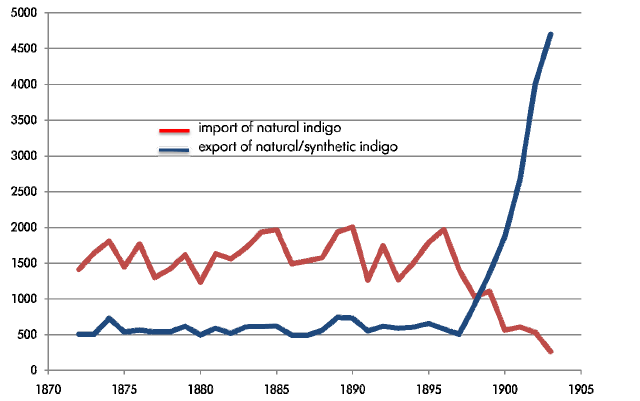
    families involved in overseas trading. due to this, the pioneers of organic chemistry were challenged to find a way to synthesize indigo. In 1883 Adolf von Baeyer, a German professor and winner of the 1905 nobel prize in chemistry, discovered the chemical structure of indigo. based on this work, synthetic indigo production was developed at Badische Anilin & Soda Fabric (BASF) and started in an industrial scale. within only a few years synthetic indigo almost completely replaced the natural indigo imported from overseas.

     image
    imports and exports of indigo in the German Empire

    The production and sales of synthetic indigo followed the graph of a typical
    product cycle. It grew during the first years and declined later because the
    chemists had developed other dyes with better yield and superior fastness
    properties. having understood chemically the principle way of applying indigo, reduction to a dye and oxidation to a pigment on the fiber, a number of other vat dyes were synthesized. however, indigo never has been defeated and after decades as a niche product it came back as the dye for denim in the late 50’s of the last century.
    Production of synthetic indigo had it’s revival during the second half of the last century and indigo has become the most important textile dye.

    • Jeans fashion has reflected the change towards a more liberal attitude.
    • Work wear. originally gold seekers, later cowboys, craftsmen etc.
    • Less formal clothes required and appreciated
    • James Dean Effect

    In the 50s BASF was prepared quite well for this hype. Nevertheless BASF’s indigo capacity could not meet the huge global indigo demand during the 60s and 70s. The increasing prices encouraged quite a few competitors to invest in indigo production, particularly in China. it is said that in Hong Kong an indigo drum could be sold for a lot of money. Former sales managers tell about customers who issued blank cheques hoping to get hold of some extra kilograms of indigo.Huge indigo production capacities had been built up in China by the middle of the 90s. with a total capacity around 100,000 tons for a global indigo market of ~30,000 tons. Today we estimate a global indigo market consumption of ~60,000 tons. Due to excess capacity for synthetic indigo this market became an oligopoly during the 1990s. lower and lower prices made the smaller producers disappear.
    Indigo by nature has a number of unique features making it successful:

    • it supplies favored shades from black to navy to sky blue.
    • these shades are balanced – not too brilliant or artificial and not too dull.
    • as a pigment it would not participate in metabolism making it very safe for human contact, in fact indigo is used as food dye and as medical indicator applied intravenously.
    • it is “designed” to exist as reduced soluble form during dyeing and as oxidized form as blue pigment.
    • it’s soluble form is not sensitive to water hardness and this allows the dyeing of greige or minimum pretreated cotton.

    Shown below is the complete presentation and as mentioned above you can also get a Free PDF file by sending an email to Paul Cowell

  • Rope Dyeing Vs Slasher (Sheet) Dyeing

    This is a guest post by Harry Mercer

    Until 1915, most Indigo dyeing was conducted in skein machines for cotton or loose fiber dyeing for wool. Skein dyeing of Indigo is still the best method for dyeing Indigo on very fine yarns for the delicate high-fashion fabrics. In 1915, the first rope dyeing machine appeared and only in the 1970’s was sheet dyeing introduced. The relative advantages of rope as opposed to sheet Indigo machines is a common subject of debate. Based on my 30 years of experience in this area, including as a consultant in about 40 denim operations worldwide, here are some basic observations that I have made in companies that had only sheet or rope dyeing, but also in many denim companies that employed both. These evaluations included mass-balance studies, benchmarking, weaving efficiency and overall fabric quality.

    A. Lower consumption of reducing agent per kilogram of yarn.

    The primary reducing agent utilized in Indigo dyeing is sodium dithionite, commercially known as sodium hydrosulfite. The amounts of this reducer that are consumed in Indigo dyeing are greatly in excess of what is necessary for the Indigo dyeing itself. In explanation, in order to reduce 100 kilograms of pure Indigo so that dyeing can proceed, only about 66 kilograms of 100% hydrosulfite are required for the basic reaction. The amount of hydrosulfite actually consumed in Indigo dyeing is often3 or 4 times this amount. There is often hydrosulfite wasted incurred in the initial mixing of the stock mix, due to excessive stirring or concentrations of hydrosulfite greater than 80 grams per liter which promotes anerobic decomposition.

    A great deal of hydrosulfite is lost because of contact with atmospheric oxygen at the surface of Indigo dye boxes as a result of aerobic decomposition. The surface losses of hydrosulfite are related to the volume and surface area of the dye boxes, with approximately 15% loss in larger Indigo boxes found on rope ranges and 50% or more in the smaller dye boxes found on sheet ranges.

    The scientific explanation for this phenomenon is related to what is known as Specific Surface Area (SSA). The greater the SSA (the quotient of the surface area and volume), the more rapidly the sodium hydrosulfite is oxidized. The time for half-oxidation (50% loss) is inversely proportional to the SSA, which means that decomposition is slowest in a large dye tank with a relatively small surface area. There are other factors involved such as the initial concentration of hydrosulfite in the dye boxes – a higher initial concentration decomposes more slowly. However the most significant source of loss is through surface contact and air brought into the dye tank by yarn.

    The instability of hydrosulfite in smaller Indigo boxes is also the primary cause of color variation in Indigo dyeing, which on rope ranges is much better controlled. It should also be noted that rope ranges have the advantage in regards to Cross Shade Variation(CSV), which refers to differences in color from side-to-side in the fabric. CSV is basically a result of dye circulation system design where the Indigo enters the dye box from the side instead of the front. In rope ranges that are designed with that style of circulation there is also some difference in the yarn color from to side-to-side, but unlike sheet ranges where the yarns are fixed in their final fabric position, the yarn ropes can be blended to remove the side to side effects. There have been some newer designs of Loop indigo machines which have greatly improved CSV.

    B. VERSATILITY IN DENIM PRODUCT DEVELOPMENT

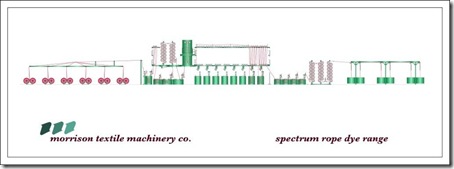
    Rope ranges have been designed to apply the widest range of dyeing techniques. For example, the Spectrum Dye Machine available from Morrison contains features like additional steamers and drying sections that allow not only the standard dyeing techniques of sulfur bottoming and topping, but also consistent application of all other cotton dyes such as vats, reactives and directs in combination with Indigo or dyeing yarns with these dye classes only.

    Spectrum_single_thread rope dyeing

    Also available are specially designed dye boxes that allow the simultaneous dyeing of 2 different sulfur applications, such as one set of yarn with a sulfur topping and the other set without topping, or with only a sulfur color, which allows flexibility in production. Rope ranges are also easily adaptable for random effects such as space dyeing of yarn. With the rope design, yarns from different dyeings such as Indigo only and sulfur only, can be blended for producing stripe patterns.

    2-1_indigo_washer

    C. HIGHER PRODUCTION AND FABRIC QUALITY

    Common methods of operating Indigo machines have a damaging effect on yarn quality which results in very high warp breaks in weaving, lowering efficiency and increasing off quality. Yarn on the machines is made weaker as yarn tension increases. Sheet Indigo machines, because they are attached to size machines, have very high levels of yarn tension and therefore higher weaving breaks than yarn dyed on rope ranges. A yarn quality that would result in 10 warp breaks per million weft insertions without Indigo dyeing often will have around a break level of 200 with sheet dyeing, but as low as 15 if processed on rope machines. This is because tension on rope machines is much lower and can be easily controlled at very low levels.

    Another important cause of high weaving breaks in denim is dirty yarn – the cleaner the yarn the higher the weaving efficiency. This is because chemicals not washed from the yarn after Indigo dyeing result in bad sizing and lower protection of warp yarns. Wash boxes on rope ranges are typically more efficient than the smaller wash boxes on sheet ranges that use overflow washing methods. The importance of washing the yarn dictates that it is better not to apply softeners in the final box for rebeaming efficiency which is optimal though improved washing and moisture control after drying.

    The need for a separate rebeaming step in rope dyeing is often considered objectionable in rope dyeing, but this is actually an important advantage, since yarn breaks can be repaired at rebeaming resulting in higher weaving efficiencies. Yarn breaks from warping and dyeing cannot be repaired in sheet machines because they are passed directly from dyeing to sizing.

    D. FLEXIBILITY IN PRODUCTION

    Sheet ranges are usually limited to producing yarn for only 1 weaving set at a time. In a rope range, normally 12 ropes will produce enough yarn for a weaving set and because rope ranges do not pass the yarn directly to the size machine, from 1 to 50 ropes can be dyed at one time. Any combination of yarns can be processed for completely different fabric constructions at the same time and dyed with the same Indigo color. Also, rope ranges can be operated continuously without stopping, which avoids the waste of yarn which occurs when sheet ranges must stop in order to change yarn lots. Because the yarn is sized separately.higher priority fabric orders can be processed without delays resulting from the need to complete a dye set as with sheet dyeing.

    Rope Dyeing – Morrison

    imageThis is a guest post by Harry Mercer. Mr. Mercer has 30 years experience in the denim business including 3 prominent U.S. denim companies. He is an expert colorist for measurement and color matching as well as textile testing.

  • Indigo Dyeing Methods – Engineering Color, Wash Fastness And Fashion Effects

    This is a guest post by Harry Mercer. This is a very technical description – read on if you are technically oriented..

    Here are given some important dyeing processes related to indigo dyeing – specially on Rope Dyeing .

    Pre Treatment

    Pre-treatment is conducted in the 1st tank. The most common pre-treatments are :

    1.  Sulfur bottoming

    2.  Scouring with sodium hydroxide

    3.  Causticizing or Mercerizing

    Pre- Treatment : Sulphur Bottoming

    •The purpose of sulfur bottoming was to:

    • Originally to produce a dark shade on denim using less Indigo for lower costs
    • In the U.S. sulfur bottoms were dyed using a combination of blue and black dyes
    • In denim operations outside the U.S. the bottom is normally dyed with sulfur black

    Pre – Treatment : Cotton Scouring

    Cotton fibers contain impurities like waxes, pectins and minerals that will interfere with Indigo dyeing and result in streaks.-Sodium hydroxide at low concentrations (<5%) are applied at high temperatures (>85 C) in order to remove impurities and melt natural cotton waxes.

    Pre – Treatment : Causticizing

    • Causticizing generally refers to using sodium hydroxide at below Mercerizing concentrations (<18%).
    • Cold causticizing of cotton yarn results infaster Indigo dye fading from laundryabrasion, darker Indigo color with the same % of Indigo and unique washdowns.
    • Hot causticizing improves colorfastness

    Pre – Treatment : Mercerizing

    Mercerizing is the use of strong sodium hydroxide (18-30%) to swell surface fibers.

    Caution:

    • When using strong sodium hydroxide it is important to remove all of it.
    • If sodium hydroxide is on the yarn as it enters the Indigo tanks, the yarn color will change.
    • Concentrations of sodium hydroxide more than 18% are not a solution, but a gel and are difficult to remove.
    • Mercerized yarns are more ring-dyed and dye more darkly than non-Mercerized.
    • Mercerizing is normally conducted at low temperatures, but hot Mercerizing can be employed for a more abraded appearance after garment laundering.

    Indigo Dyeing

    • Indigo dyeing is unique and because of the complex chemical reactions should be correctly viewed a a form of chemical engineering.
    • Only Indigo dyeing requires multiple dye applications for a dark shade.
    • Color consistency of Indigo in recent decades has been unsatisfactory as a result of machine designs that do not apply basic principles of fluid mechanics properly and unstable dye mixes.
    • Commonly, a single dye lot will have between 8 and 15 visually different shades from beginning to end and also have shade differences from one side to the other.

    Indigo Dyeing Methods

    Spectrum_single_thread

    • Indigo dyeing follows the same basic steps regardless of machine design.
    • Scour or dye bottoming in a heated tank,
    • washing tanks, dyeing(1-20),a heated tank for topping (optional) and wash tanks.
    • In different areas of the world,the same color is produced using 1.8, 2.0 or 4% Indigo depending on dyeing method.


    indigo dyeing methods


    Dark Indigo(1.8%)

    1. 15% caustic cold
    2.Wash 60°C
    3.Wash 60°C
    4. Wash cold
    Drying cylinders hot
    Steamer cold
    Boxes 5-12 Indigo
    Steamer cold
    13.Wash 50°C
    14. Wash 50°C
    15. Wash 50°C
    16.Wash 50°C /Softener

    Stock Mix 80 g/l Indigo Pure 100 g/l 50% Caustic 70 g/l Hydro powder.

    Chemical Feed 120 g/l 50% caustic 60g/l Hydro powder Feed 1.4 liters per minute

    Dark Indigo Color

    • This was an example of a typical method used in the U.S. for a very dark shade.
    • In order to produce the same depth of color as 1.2% in the U.S., in Latin America 2.0% is used and in Asia from 2.4 to 2.8%.
    • The U.S. method results in more surface (ring dyeing), which loses color faster.

    Darkest Indigo Shades

    • Very dark shades of Indigo are in demand currently around the world.
    • Many companies use 4% or more Indigo on weight of yarn, which is expensive.
    • 2% Indigo will produce the same depth if low levels of caustic are used(0-0.4%)
    • For dark Indigo that does not lose color 2% applied normally, with an Indigo bottom.

    Light Indigo Shades

    • Dyeing Indigo in light shades results in a sky-blue impossible with any other dye.
    • This is useful for shirting fabrics that are  not strong enough for stonewashing,  bleaching or cellulase treaments.
    • Special procedures are necessary in order to avoid colorfastness problems.

    indigo dye baths


    Light Indigo 0.4%

    1. 4% caustic 90°C
    2.Wash 60°C
    3.Wash 60°C
    4. Wash 60°C
    Bypass drying cylinders
    Bypass steamer
    Close off boxes 5-8
    Boxes 9-12 Indigo
    13. Wash 50°C
    14. Wash 50°C
    15. Wash 50°C
    16.Wash 50°C/softener

    Control Of Sulphur Bottoming

    • The typical methods used for dyeing sulfur bottoms result in denim shade differences.
    • When applied as light colors, sulfur dyes should be dyed at temperatures <60 C,
    • If dextrin reducing agents are used, which require 85 C, there will be variation.
    • Sulfur bottoms are an exception to the normal pH for sulfurs(11), requiring 12.

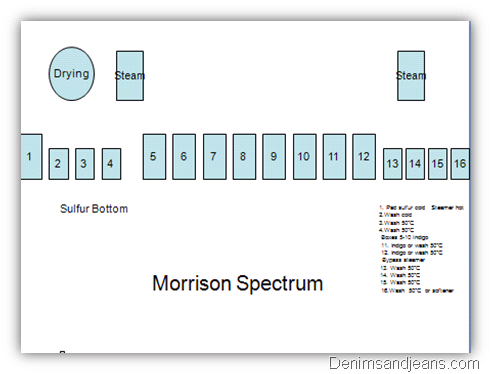
    indigo machine

    Sulfur Bottom

    1. Pad sulfur(cold)
    Steamer hot
    2.Wash cold
    3.Wash 50°C
    4.Wash 50°C
    Boxes 5-10 Indigo
    11. Indigo or wash 50°C
    12. Indigo or wash 50°C
    Bypass steamer
    13. Wash 50°C
    14. Wash 50°C
    15. Wash 50°C
    16.Wash 50°C or softener

    Sulphur Topping

    • In topping the sulfur dye is applied after the Indigo dyeing.
    • Sulfur topping permits much darker color than a sulfur bottom, but is duller.
    • Sulfur topping colors include black, blue-black, yellow brown and green.
    • Sulfur toppings are used to produce slub appearances in normal yarn.

    indigo dyeing machine

    Sulfur Top

    1. Pre-wet 2% caustic 90°C
    2.Wash 60°C
    3.Wash 60°C
    4. Wash cold
    By pass drying cylinders
    Bypass steamer
    Boxes 5-10 Indigo
    11. Wash 60°C
    12. Pad sulfur topping
    Steamer hot
    13. Wash cold
    14. Wash 50°C
    15. Wash 50°C
    16.Wash 50°C/Softener

    Reactive Dyes in Indigo Dyeing

    • Reactive dyes can be applied on specially-Designed Indigo machines.
    • Small 150 liter boxes are inserted inside the larger dye tanks for Indigo and sulfur.
    • Steamers, drying units near the front of the machine and high-quality dye padders are required for quality dyeing.

    image 


    Pad-Dry Chempad- Steam Reactives

    1. Pre-scour wetter plus chelate 90°C
    2.Wash 50°C
    3. Pad monochlortriazine dye cold, neutral pH
    Drying cylinders hot
    Pad caustic in salt brine
    Steamer hot
    Bypass boxes 5-10
    11. Soap 90°C
    12. Soap 90°C
    Steamer hot
    13. Wash 60°C
    14. Wash 60°C
    15. Wash cold
    16.Wash cold/softener


    Pad Steam Reactive Topping

    1. Pre-wet 10% caustic 90°C
    2.Wash 60°C
    3.Wash 60°C
    4. Wash cold
    By pass drying cylinders
    Bypass steamer
    Boxes 5-10 Indigo
    11. Wash 60°C
    12. Pad Dichorotriazinyl cold with bicarbonate
    Steamer hot
    13. Wash cold
    14. Wash 50°C
    15. Wash 50°C
    16. Wash 50°C / softener

    Vat Dyeing

    • Indigo and sulfurs are types of vat dyes.
    • In non-denim cotton dyeing, another class of vats, anthaquinoids are used to produce a full range of colors that are colorfast.
    • Some of these vat dyes can be blended with Indigo or applied using standard procedures on specially designed machines.

     indigo dyeing machine

    Pad-Dry Chempad Vats

    1. Pre-wet 4% caustic 90°C
    2.Wash 60°C
    3. Pad vat dye cold
    Drying cylinders hot
    4. Chempad caustic/hydro cold
    Steamer hot
    Bypass boxes 5-10
    11. Wash 60°C
    12. Oxidize
    13. Soap with anti-oxidant
    Steamer hot
    14. Wash 50°C
    15. Wash 50°C
    16. Wash 50°C / softener


    <><><><></> </></></>

    Pad-Dry Chempad Steam Vat Bottom

    1. Pre-wet 4% caustic 90°C
    2. Wash 60°
    3. Pad vat dye cold
    Drying cylinders hot
    4. Chem-pad caustic/hydro cold
    Steamer hot
    Boxes 5-10 Indigo
    11. Wash 60°C
    12. Soap 90°C
    Steamer hot
    13. Wash cold
    14. Wash 50°C
    15. Wash 50°C
    16. Wash 50°C

     2-1_indigo_washer

    Control Of Indigo Dyeing

    The Indigo dyeing process begins with a concentrated mixture of Indigo, sodium hydroxide and reducing agent.  This concentrated mixture (70-90 g/L Indigo) is delivered by pipes to the Indigo dye tanks where the dye concentration is reduced to 1-4 g/L for dyeing the cotton.

    Dye Mixing Procedures

    • Many denim companies find it difficult to control original and washed Indigo shades.
    • The primary source of color differences is the instability and inconsistency of Indigo mixtures.
    • As the concentration of reducing agent going to the dye machine changes, the color changes.

    Uniform Indigo Mixtures

    • For consistent Indigo dyeing, the mixture must have consistent concentrations of Indigo, sodium hydroxide and reducer from the top of the mixture to the bottom.
    • The main cause of inconsistent Indigo mixtures relates to concentration levels.
    • Instability of Indigo mixtures results from the decomposition of sodium hydrosulfite.

    Consistency of Concentration

    • There is a limit to the amount of any chemical that can be dissolved in water.
    • When the limit of solubility of any chemical •In water is exceeded, precipitation occurs.
    • Indigo mixes should not have more than 20% solids. At higher levels, chemicals and dye sink to the bottom of the tank.

    Improving Dyeing Consistency

    • When reducing agent sinks to the bottom of the tank, there is a higher concentration  than in the top of the tank. As the dye enters the machine, the higher concentration results in a lighter, greenercolor and as the dye from the top of the tank enters the machine, the color is darker and redder.

    Dye Control In Feeding  Tank

    • Stirring the tank for 2 minutes will improve dye uniformity between top and bottom.
    • To avoid settling of dye and chemicals the total solids should not exceed 20%.
    • The “glass plate” test can be used to test concentrations of hydrosulfite in the top and bottom. If dye requires 50 seconds to oxidize, there is about 50 g/L of reducer.

    Buffers In Indigo Dyeing

    • Alkaline buffers have been used to make very dark shades of Indigo with as little as 1% dye, more ring-dyed, faster fading.
    • Reductive buffers can eliminate color differences in Indigo-dyed denims and can reduce hydrosulfite use by 30-50%.

    Cold Dyeing Methods

    • Sulfur colors can be dyed at low temperatures with specific buffers which produce more colorfast dyeings with no color variation.
    • Cold dyeing methods have been used to blend Indigo and sulfurs, eliminating the need for separate bottoming and topping, while eliminating shade changes in both.

    Special Dyeing Techniques

    • On rope ranges, space dyeing techniques can be simple and produce a wide range of special effects in denim.
    • By dyeing part of the yarns with a sulfur top and leaving the rest un-dyed, many companies produce a slub appearance with regular yarns.
    • Blending ring yarns of different sizes also produces a slub appearance.

    imageThis is a guest post by Harry Mercer. Mr. Mercer has 30 years experience in the denim business including 3 prominent U.S. denim companies. He is an expert colorist for measurement and color matching as well as textile testing.

  • Indigo Dyeing With Loop Dyeing Machinery

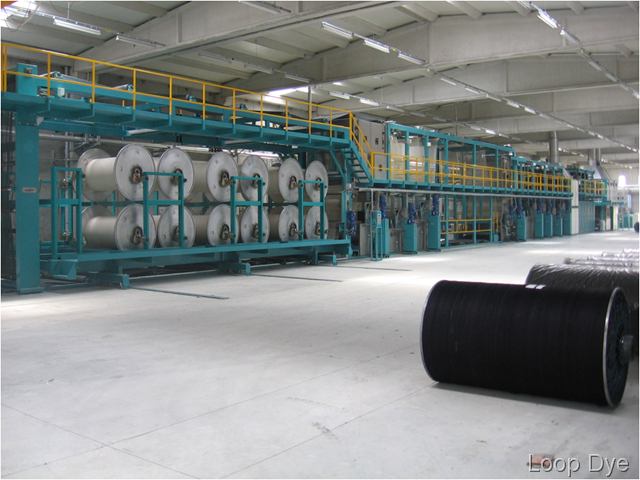
    loop dyeing for denim

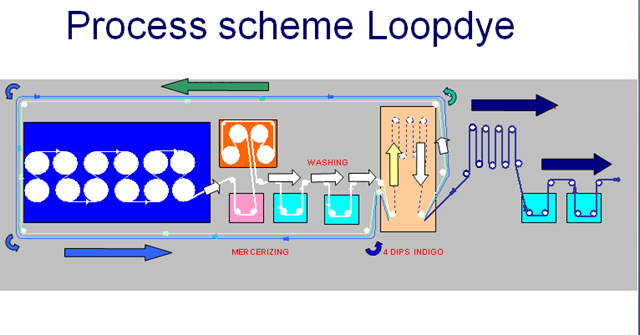
    The name “Loopdye” results from the method of skying or air passage for oxidizing the Indigo-dyed yarn and the method of passing through the Indigo dye. On the other 2 important Indigo machine types, the dyed yarn is passed through from 6-8 Indigo boxes on rope machines or 6-20 Indigo boxes on slasher (sheet) Indigo machines, multiple dye boxes being necessary for dark shades because only a small amount of Indigo can be applied in each immersion. After immersion in each Indigo dye box, the yarn is conducted through the air after each box, where the reduced Indigo (yellow-green) is oxidized or “fixed” by oxygen in the air returning to the original blue, then the yarn enters the next dye box, passes into the air and so forth until the required depth of shade is developed.

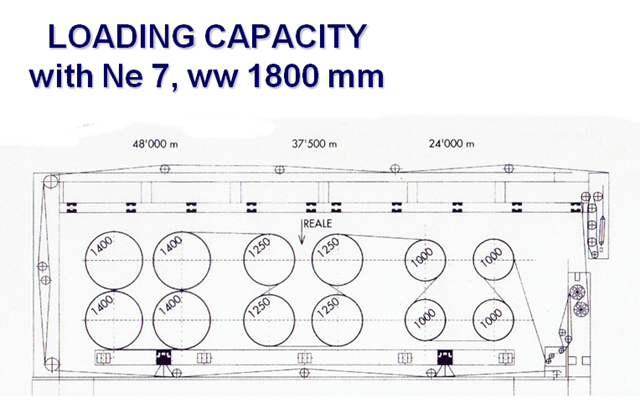
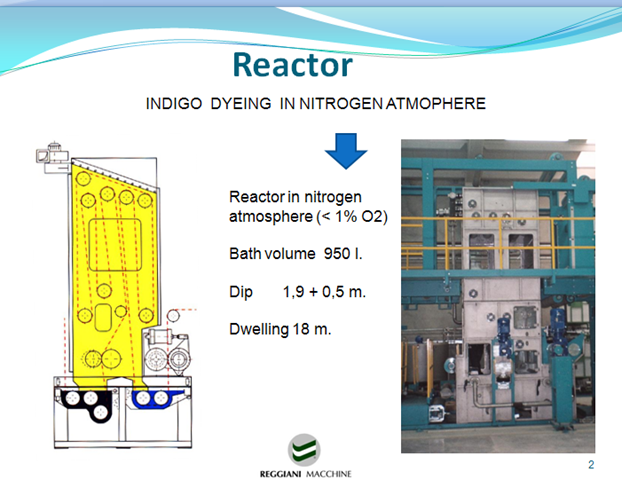
    In the case of rope and sheet ranges, this oxidation takes place above each dye box. In the Loopdye process, there is only a single Indigo box through which the yarn passes 4-5 times. The white cotton is pulled into the front of the machine and passes first through the pre-treatment boxes, then moves through a reactor which can be used for steaming or additional reaction time for sulfur- bottoming or Mercerization, followed by washing. The wet yarn then enters the Indigo dye box. When the yarn exits the dye box, instead of moving forward, the yarn is carried to the rear of the machine, around the top and rear of the yarn creel from where it started, passes under the yarn creel where it is returned to the Indigo box for another dye passage. This continuous passage of yarn between the yarn creel and the dye box is in the form of a “loop” which is almost circular. After making multiple loops through the Indigo dye box the yarn is conducted through wash boxes and on to drying cylinders. The Loopdye machine is a simplified version of a “sheet” or “slasher” Indigo machine. After drying the Indigo-dyed yarn, the yarn passes directly to sizing where the yarn is prepared for weaving. Because the sizing part of the machine must stop in order to remove a completed weaving beam, in order to prevent the dyeing unit from stopping as well, there is a yarn accumulator between the drying cylinders at dyeing and the wet-size boxes. When the yarn stops moving on the sizing unit, a series of parallel cylinders begin to move apart allowing the yarn from the dye unit to continue through dyeing and allows the size machine approximately 2 minutes of time to install an empty weaving beam and re-start the sizing machine.

    Loopdye Machines in the Denim Industry

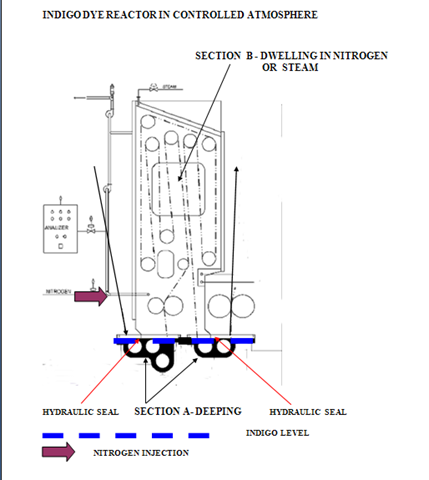
    In the early 1990’s, thee were approximately 30 Loopdye machines in use. Currently, the number is reported to be 60 or so. The biggest concentration of these machines is in Brazil. Vicunha employs 11 of these machines, Canatiba, Santana and Cedro have 2 units each, while Tavex, Tear, Textil Kafi, Santista have 1 each. There are 9 of these machines that have been equipped with nitrogen units which use nitrogen gas as protective blanket over the surface of the Indigo dye. The nitrogen gas prevents oxygen in the air from attacking sodium hydrosulfite resulting in more consistent dyeing and reducing consumption of hydrosulfite, lowering costs and pollution. There are other claimed advantages such as higher speeds and darker Indigo color.

    Advantages and Disadvantages

    1.  Productivity – When compared to a multi-box slasher machine, productivity is essentially equivalent since the yarn loading, start-up times and speeds are similar. Rope dyeing machines can produce up to 4 times as much dyed yarn.
    2. Capital Investment – The Loopdye machine has the lowest initial costs of continuous Indigo dyeing machinery, currently reported to be approximately 25% less than  8 dyebox slasher machine.
    3. Operating Costs – Maintenance and energy costs are reported to be approximately 20% lower with Loopdye when compared with slasher dyeing and even lower than with rope dyeing.
    4. Space requirements – The Loop machine with a single dye box requires less floor space than either sheet dyeing or rope dyeing. Rope machines also require higher ceilings because of the design of the airing arrangement.
    5. Indigo Dyeing Quality – The newer designs of Loopdye are reported to have little of the problems with Cross-Shade (side-to-side) shading than with slasher dyeing equipment. Indigo consistency from the start-to-finish of dyeing can be expected to be better with the inclusion of nitrogen units. Rope machines still have an overall advantage in terms of Indigo dyeing quality, but this may be overcome by employing improved chemical blending.
    6. Sulfur dyeing – The Loopdye machine can be equipped with a steamer for cold-pad sulfur bottoming which will provide greater consistency than a hot application in the 1st box. The Loop machine is not provided with enough boxes after Indigo dyeing for sulfur topping as the slasher dyeing is. With the newer methods for cold-sulfur dyeing, the Loop machine is ideal for sulfur colors since it the dye can be applied in only one box, which allows for faster color changes and less dye discarded after the dye lot is finished. Rope machines still have the greatest flexibility with regard to producing a full range of denim colors.
    7. Weaving Efficiency – The methods of dyeing, especially of sulfurs, has a direct effect on warp yarn breakage in weaving, which lowers operating efficiency as well as fabric and garment quality. Experience with the older design of Loopdye machines demonstrated higher levels of warp breaks in weaving than other Indigo machines. Rope dyeing results in the lowest-level of weaving stops, largely because yarn breaks in dyeing can be repaired at long-chain re-beaming.
    8. Versatility – In the higher denim fashion market, some companies like Vicunha have had success using a combination of Loopdye and slasher dyeing. Overall, the slasher dyeing with its greater number of application boxes offers more flexibility in product development, while rope dyeing provides the greatest flexibility for denim product development.

    loop dyeing

    loop dyeing indigo

    loop dyeing

    image

    nitrogen reactor loop dyeing

    For more information on the Loopdye process, contact Mr. Attilio Frescura and for informartion on advances in sulfur dyeing on Loopmachines  contact  Harry Mercer

    imageThis is a guest post by Harry Mercer. Mr. Mercer has 30 years experience in the denim business including 3 prominent U.S. denim companies. He is an expert colorist for measurement and color matching as well as textile testing.

  • Cross-Shade Variation (CSV) In Indigo Dyeing : Causes and Solutions


    indigo yarn shadeCSV is a serious problem that occurs on the great majority of Indigo dyeing equipment in which yarns dyed on one side of the machine are a different shade from the yarns on the opposite side. This problem is so common that it is generally accepted as unavoidable, especially in sheet ranges.

    Basically, the problem arises as a result of the uneven distribution of Indigo within the dye box: 

    • The Indigo dye is initially mixed in a feed tank at concentrations of from 70-100 g/l. This concentrated mix is then pumped into a recirculation line in which the dye flows in a pipe that passes around the outside of the dyeing section of the machine.
    • The recirculation line normally has smaller pipes  that carry fresh dye directly  into the dye boxes on one side of the boxes and pipes on the other side of the boxes that pull the partially exhausted dye back into the recirculation line.
    • In the recirculation line, concentrated dye mix from the feed tank is blended with the diluted dye mix removed from the dye boxes which creates an equilibrium between the 70-100g/l Indigo feed mix and the dye box concentrations which range from 1-5 g/l.
    • The CSV problem results because as the more concentrated dye and chemical mix enters the dye boxes, there is a sudden increase of dye and chemicals on the entry side of the dye boxes and as the dye/chemical mix spreads across the yarn sheets, the concentrations are gradually reduced as they are pulled toward the exit side of the dye box.

    Problem of Solubility:

    • Vat dyes, which include Indigos and sulfurs, exist as colloidal particles when subjected to reduction.
    • While reduction renders these dyes soluble enough to penetrate cellulose, they do not exist as a true solution as do acid or cationic dyes, which will immediately and uniformly distribute in water.

    • The colloidal particles, which exist as clusters involving varying numbers of dye particles are affected by gravity and will exhibit settling behavior. This means that once the initial acceleration of being forced into the dye box losses force, the larger clusters slow down and begin to sink, while lighter particles travel to the other side of the box.
    • Mathematically: V = 2r² (s-s’)g/ 9n, where V = rate of settling, r = particle radius, s =density of the particle, s’ = density of fluid, g = 980 (gravity constant) and n = viscosity of fluid.

    Improving Solubility of Indigo Dye

    • Some additives can improve the solubility of the dye which will reduce the CSV and also  shade variation from beginning to end of the dyeing.
    • Dispersing agents are commonly used in Indigo dyeing, however only very few are effective in the dye box. Insist that chemical suppliers demonstrate the dispersing action of reduced Indigo.
    • Since potassium hydroxide possesses vastly greater solubility than sodium hydroxide, an effective practice is to replace about 30% of the sodium hydroxide with the potassium form.
    • Include methanol or isopropyl alcohol in the dye, about 40 g/l in the feed mix and 10 g/l to start in the dye boxes.
    • Reduce concentrations in the feed mix. The typical practice in the U.S. for many years was to keep Indigo concentrations at 80 g/l, sodium hydroxide at 140 g/l (50%) and hydrosulfite at 70 g/l. Reducing the Indigo to 50 g/l is a proven way to improve shade consistency. The objection to this is that more liquor must be pumped into the machine, causing an overflow in the dye boxes, however this can be controlled by having low wet pickup on yarn entering the 1st dye box and increasing the wet pickup on yarn leaving the last dye box (75-80%).

    Machinery Considerations

    • CSV occurs on most types of Indigo dye machines, but is particularly a problem on sheet  Ranges.
    • In a sheet range the yarn is dyed, then sized immediately and carried to weaving with the yarns arrayed on the loom in the same order as they passed through the dye machine. Therefore, if there is a difference in shade from side-to-side in dyeing, the same variation will be present in the woven fabric.
    • Rope ranges have side-to-side variation in most machine designs, however the effects of  CSV can be easily corrected, by blending the ropes of yarn which instead of being arrayed as a single, flat-sheet are separated into bundles of 300-400 yarns each. For example, in a 24-rope range, the 1st 12 ropes on the left side may be, on average, darker than the 12 ropes on the right side. By utilizing a blending scheme such as combining the odd- numbered ropes (1,3,5…) into one fabric set and the even-number (2,4,6…), the variation will be averaged-out.
    • On sheet ranges, the optimal solution is to improve distribution of dye in the box.
    • The traditional recommendation for avoiding problems like CSV was to gently keep the dye in the box stirred in order to prevent settling which results in differing dye and chemical concentrations from side-to-side, top-to-bottom and from front-to-rear in the dye box. The practice was to “turn-over” the dye in the box at least 3 times per hour. In other words, with a 2000 liter dye box, the circulation system should pump 6000 liters into the box and pull out 6000 liters per hour. Unfortunately, circulation systems on Indigo machines have been downsized over many years, making this impossible. About 20 years ago, in collaboration with Morrison Textile Machinery, we were able to modify the recirculation system on a U.S. machine to correct this problem. By calculating a mass balance for the specific machine and dyeing objective and explaining it to the machinery engineer, a relatively simple modification solved the problem. An understanding of the complex dye chemistry along with fluid mechanics will solve any dyeing problem. Chemical engineers are the best qualified for significant improvements and collaboration with the machinery supplier can reap great rewards.
    • A final possibility is to use suitable submersible pumps inside the dye box for uniform distribution of dye and chemicals. The design of dye boxes on many machines present obstacles to insertion of such units into the box, but there is the possibility of mounting the pumps outside the box and submersing only the tubes, with one pump per dye box.
    • The CSV problem in the past has resulted from uneven wet pick up in the dye boxes. Check the wet pickup on each side of the squeeze roller by soaking a 10 gram sample of yarn and passing it through right and left sides and weigh again. If unequal, the roll pressure needs adjusting.
    • Another possible source of CSV is uneven yarn tension which can be caused by a guide roll that is not aligned. Higher yarn tension on one side of the dye box results in less dye penetration.

    A number of years ago, the U.S. company BJM Pumps developed a submersible pump that is not affected by alkalis or reducing agents and appears to be a good solution to CSV.

    imageThis is a guest post by Harry Mercer. Mr. Mercer has 30 years experience in the denim business including 3 prominent U.S. denim companies. He is an expert colorist for measurement and color matching as well as textile testing.