The denim trade between Pakistan and the United States is a significant aspect of the textile industry, shaping fashion trends and retail markets. This report provides an overview of the market shares of top brands importing denim from Pakistan to the US for the period of September 2022 to September 2023.
One of the key highlights is that major US brands that we are studying accounted for an impressive 82% of the overall denim purchased from Pakistan. Get ready to explore the ins and outs of this dynamic denim industry!
Market Share Breakdown Among Top 15
[private_special]
Levi’s: Dominates the import market with a significant 32.4% share, highlighting its stronghold in the US denim sector.
Gap: Commands a notable 22.3% of the imports, reinforcing its position as a major player in the market.
Target: Follows with an 11% market share, emphasizing its competitive procurement strategy.
JC Penney and 5 Star Apparel: These brands secure considerable portions of the market with 10.8% and 3.6% respectively, showcasing their relevance in the denim import market.
Smaller but notable contributions come from brands such as H&M, Kontoor, and AL USA, each holding shares ranging from 2.8% to 3.6%, reflecting a diverse market with several active participants. Of course, H&M , Kontoor etc
We will be focusing on this data to further analyze in details in the ensuing sections.
TOP 15 COMPANIES BUYING DENIMS
This section illuminates the purchasing habits of top US companies sourcing denim from Pakistan, offering a clear view of the quantities bought and the average prices paid.
Leading Buyers
LEVIS: Evidently leading the pack, LEVIS has purchased a staggering 16.86 million units, indicating a strong demand for denim garments. However, the average price paid stands at USD 8.45 per unit, which is not the highest among the competitors, suggesting a balance between quality and cost-effectiveness.
GAP: Another major player, GAP, has secured 11.6 million units at an average price of USD 9.31 per unit. This higher price point could be indicative of GAP’s positioning towards quality or a specific product range in the denim segment.
Market Trends
TARGET & JC PENNEY: Both of these retailers showcase a similar purchasing volume with TARGET buying 5.74 million units and JC PENNEY close behind at 5.61 million units. Their average prices are USD 8.91 and USD 9, respectively, again reflecting the industry’s trend towards a mid-range pricing strategy.
Value-Focused Buyers
5 STAR APPAREL & AL USA: With a more conservative quantity of 1.855 and 1.853 million units respectively, these buyers are spending less on average (USD 4.23 and USD 4.45), which may suggest a strategy targeting the value segment of the market.
Premium Pricing Strategy
KONTOOR: At a lower volume of 1.69 million units but a higher average price of USD 9.96, KONTOOR appears to be pursuing a premium pricing strategy, likely focusing on higher-end denim garments.
Consistent Buyers
H & M and MAMIYE BROTHERS: These two companies have procured lesser quantities of 1.43 and 1.31 million units but at healthy average prices of USD 8.12 and USD 5.55, signaling consistent market activity.
Niche Market Participants
KAMDAR INDUSTRIES to EXPRESS: This group ranges from KAMDAR INDUSTRIES purchasing 0.97 million units to EXPRESS with 0.48 million units. However, it’s notable that the average prices here vary significantly, with EXPRESS paying a premium of USD 11.88 per unit, possibly indicating a specialized product demand or niche market strategy.
TOP 3 GARMENT SUPPLIERS OF THESE BRANDS
In this detailed analysis, we explore the principal Top 3 garment suppliers for notable Top 5 US retail brands. Leveraging the data provided on volumes and average prices, this section aims to paint a clearer picture of the procurement strategies and partnerships that define the denim garment supply chain from Pakistan to the United States.
Artistic Milliners
Serves as a key supplier to multiple US brands, notable for providing large quantities of denim garments with varied pricing:
For LEVIS, they supplied 3.82 million units at an average of USD 8.87 per piece.
For GAP, they supplied 5.4 million units, with an average price of USD 10.19 per piece, indicating a premium product offering.
For TARGET, they are the leading supplier, delivering 3.81 million units at USD 9.2 per piece, highlighting a strong position in TARGET’s premium segment.
Artistic Fabric
Another significant player, Artistic Fabric’s presence is felt across the spectrum of US retailers:
They have provided GAP with 6.01 million units at USD 8.57 per piece.
JC PENNEY sourced 1.69 million units from them at USD 9.7 per piece, showcasing their ability to cater to different market needs.
US Apparel
This supplier has demonstrated versatility in serving both mass-market and niche segments:
Supplied LEVIS with 2.77 million units at the highest average price point of USD 10.05 per piece.
For TARGET, they delivered 1.12 million units at USD 9.99 per piece, reaffirming TARGET’s preference for higher-quality denim.
The procurement of over 52 million units of denim by the top US companies from Pakistan represents a considerable majority of the nearly 63 million units acquired in total, underscoring the depth of trust and the quality of the textiles sourced. To conclude, the data indicates that the US denim market is driven by a combination of high-volume purchases and targeted, cost-effective sourcing methods. The diversity in purchasing volumes and average price points suggests a market that caters to a wide range of consumer needs and preferences.
Continuing with the sustainable progress of denim brands, we provide you with some more brands that design jeans with eco-wise and sustainable efforts to aid you with the best possible buy this year.
1. BOYISH
LA brand Boyish is a member of The Jeans Redesign project from the Ellen MacArthur Foundation, which outlines circular economy guidelines including making durable products. It also uses an ozone wash instead of chlorine bleach, a natural enzyme instead of polluting potassium permanganate, and REFIBRA, a fabric made using upcycled clothing and fabric scraps with Tencel. The brand also uses organic cotton certified by the Organic Content Standard (OCS Certified) and recycled cotton, which is the most sustainable cotton fiber source according to the Sustainable Apparel Coalition’s Higg Index. Its denim is cruelty-free and PETA approved. By 2023, 100% of the brand’s products will be made from plant-based fibers. It also plans to expand brand’s core collection to be more size inclusive and exceed living wage by 2023.
2. OUTERKNOWN
A brand established from an understated approach to design and an overstated approach to quality, material and consciousness, Outerknown launched its New Denim Project with Madewell on a capsule collection that featured coats, skirts and tops. Brought in WellThread X Outerknown collection made with single fiber polyester and cotton is fully recyclable down to the labels and snaps. The brand also launched Women’s stretch jeans with Coreva Stretch Technology from Milan’s Candiani mill. Ninety percent of the fibers the brand sources are organic, recycled or regenerated, and 100% of its trunks are made with recycled or renewable fibers. It also opened FutureShop, a planet-friendly online marketplace. Its goals comprise of: Making 75% of fabrics and 50% of products circular by 2030. To serve as a key catalyst and leader for circular innovation industry initiatives by 2025 and advocate to protect worker rights, safety, and livelihoods.
3. UNSPUN
Unspun won Marie Claire UK Sustainability Award for Best Sustainable Jeans 2021. It used AI and 3D modelling to create custom and on-demand jeans that are unique to every customer. This first-of-its-kind custom-fit denim collection was a big leap in the fashion industry as each pair of jeans is made-to-measure, cutting out excess waste. The brand is reducing the industry’s emissions by 30%. It also launched PanHemp, a new denim fabric in collaboration with Pangaia.
It also launched its Genesis Jeans which comprises of the fabric made with 99 percent GOTS certified organic cotton denim and 1 percent Lycra, and is washed using 100 percent recycled water and Greenscreen-approved chemicals. Unspun also ensures transparency element to its Genesis Jeans collection by including fashion tech firm Eon Group’s scannable CircularIDs to the jeans. Unspun’s 2021 sustainability goals include phasing out all cotton that is not recycled, organic or BCI and to eliminate all virgin poly from its fabrics. Other goals are reduce Co2 impact by 53% in near future and reduce global carbon emissions by 1%. The brand aims to 100 percent biodegradable and compostable packaging and use low-impact transportation to ship fabrics.
4. CLOSED
Closed’s sustainable gains include the launch of the world’s first 100 percent degradable stretch denim made with the biodegradable stretch yarn Coreva. The innovative jeans are part of Closed’s “A Better Blue†denim line, which is manufactured with sustainable materials, low-impact dyeing processes and environmentally friendly washing techniques in Italy to save resources. Closed also introduced Jacron back patches for its jeans as a sustainable vegan-alternative to leather.
Half of the men’s jeans, and 41 percent of the women’s denim in Closed’s Winter ’21 collection are a part of the A Better Blue line. The company followed the addition of organic cashmere in the F/W 21-22 range. It claims that it has saved 6,882,870 litres of water, 649,455 kWh of electricity, and 77,262 kg of solid waste of chemicals. Its future plans include: to provide PETA-approved vegan labeling, focus on making carbon-neutral supply chain and increasing the volume of A BETTER BLUE products to limit water, electricity and chemical consumption.
5. WARP+WEFT
The brand is on a mission to create the best sustainable denim in the world. Since the brand’s launch in 2017, they’ve sold more than 477,000 pairs of jeans and saved more than 572.4 million gallons of water. 98% of the water that goes into its denim is treated and recycled for additional use. To be completely transparent about its manufacturing process, Warp + Weft highlights elements like responsibly sourced cotton, eco-friendly dye from Dystar, water-saving techniques, and solar power. The brand also employs Ultra-absorbent Tencel fibers and waterless Dry Ozone technology, replacing bleach. It aims to launch a partnership with NGOs to provide clean drinking water in developing countries. For this it partnered with Charity: Water to provide a lifetime supply of water for 3,300 people for each pair of jeans sold.
6. PRIMARK
Leading retailer Primark has pledged to make clothes that can be “recyclable by design†by 2027. In addition, it plans to work with suppliers to halve carbon emissions throughout its supply chain while eliminating single-use plastics from its operations by 2027. Primark has also committed to pursuing a living wage for workers in its global supply chain by 2030 and has partnered with material innovators Unifi, Inc to bring their REPREVE Our Ocean fibre to its newest denim style.
The brand also partnered with Yellow Octopus, for a textile takeback service to divert garments from landfills in reusable pieces. It uses Sustainable Cotton Programme to trace the source of its sustainable cotton and is committed to training and educating 160,000 cotton farmers on more environmentally friendly farming practices by 2022. The brand launched its C2C Certified Gold Jeans which comes in a mom-fit and is made using a minimum of 50% renewable energy and 100% organic cotton. It has become a participant in the Circular Fashion Partnership, led by the Global Fashion Agenda that supports the development of the textile recycling industry in Bangladesh. The brand plans to provide living wage for its global supply chain workers by 2030.
7. KINGS OF INDIGO
Since 2012, Kings of Indigo has curated sustainable denim collections, making itself known as a leader in sustainable fashion. Fully PETA (vegan) approved since 2020, the brand uses 100% certified organic cotton; GOTS or OCS and EIM scored denim washes. It launched 100% Recycled jeans 40 pieces collection that contain 100% recycled fibres and uses TENCEL Lyocel fibres for denim production. The brand uses fully recycled and sustainable trims – metals, pocketing, paper. It launched Re-Gen: a capsule denim collection made from NO new cotton (50% recycled fibers and 50% Refibra Lyocell). 6. Ensures elimination of PP spray on denims.
KOI also uses ‘Retraced’, a new technology that maps out a brand’s full supply-chain, ruling out any and all greenwashing. The brand incorporates 100% carbon neutral Transport. Its plans to only use recycled natural or man-made fibers by 2025. KOI aims to use sustainable washing techniques for their denims by 2025 and also become carbon positive. It also strives to have full transparency through total supply chain by 2022.
8. KUYICHI
All denim produced by Kuyichi is made with one hundred percent organic cotton which reduces carbon emissions by up to sixty percent and some pairs incorporate post-consumer recycled denim. The boldest commitment Kuyichi made is its limit on the jeans it makes. To curb overconsumption and focus on jeans a customer will always wear, Kuyichi only sells a few timeless styles. All of their pure goods are produced in a conscious and innovative way, with a focus on quality denim with a perfect fit.
Kuyichi stopped making seasonal collections and doing sales to make a statement against fast fashion. It is a member of The Dutch Agreement on Sustainable Garments & Textiles (AGT). The brand is vegan and has a responsible business conduct (RBC) code. Some of its goals include: Make all denim with low impact washes and dye all denim fabrics with improved techniques by 2025; All denim will be sewn with ecoverde recycled Polyester sewing threads; Launching a new circular Business model pilot by 2021.
9. PATAGONIA
American clothing brand Patagonia has partnered with Finnish circular fashion and textile technology group Infinited Fiber Company for its regenerated textile fibre Infinna created out of textile waste. Additionally, Patagonia has collaborated with Natural Fiber Welding (NFW), a US-based material science company in a joint commitment to develop and scale circular solutions in textiles. Through its collaboration with NFW, it reaffirms its commitment to its customers to never compromise – on performance, on aesthetic, on responsibility for the planet.
The brand works hard to keep their products out of landfills. They collect and refurbish their old gear as part of five waste combating principles: Reduce, Reuse, Repair, Recycle and Reimagine. A program called “Worn Wear†allows consumers to buy used, as well as trade-in and fix their gear. The brand aims to be 100% carbon-neutral across entire supply chain by 2025 and source 100% of their energy from renewable projects. By 2025, the brand’s packaging will be 100% reusable, home compostable.
10. ÉTICA
ÉTICA is a sustainable lifestyle brand focused on premium denim and knits. It claims to have reduced water use by 90%, energy consumption by 63% and chemical use by 70% compared to industry standards. The company is a member of the Better Cotton Initiative, and some of its mills are also certified to OEKO-TEX Standard 100, Cradle to Cradle and GOTS. It also uses recycled cotton, REFIBRA, and Tencel in its denim lines and seasonal collections are made with deadstock and upcycled fabrics too.
As of 2021, the company’s fabrics are all free of microplastics, and all products are vegan-friendly as they are 100% free of animal materials (including fur and hide, with no trims, softeners, dyes, or other additives used that are derived from animals). ÉTICA’s Hang tags are made with soy-based inks and 100% recycled paper. The company aims to be plastic free at its headquarters and factories by 2022, become 100% potassium free and develop sustainable botanical dyes.. The brand owns Re/Make Seal of Approval for Environment, Transparency, Labor Rights certification.
11. GAP
Global retailer Gap has launched ” Generation Good” capsule made of 100% natural fibres and recycled fabrics. It has also launched five exclusive sustainable denim styles as part of the Ellen MacArthur Foundation’s Jeans Redesign Project. Currently, 91 percent of Gap denim is part of its water-saving Washwell programme, which it notes is better than its original 2021 goal of 75 percent. The brand also announced its first-ever brand of home essentials – Gap Home which features sustainable items that are made from organic cotton and recycled materials.
Gap collaborated with Kanye West for its Yeezy Jacket that is made up of recycled nylon and also acquired Drapr, an ecommerce startup and online application based on technology that enables customers to create 3D avatars and virtually try on clothing. The brand has committed to source 100 percent more sustainable cotton and is committed to converting 60 percent of its traditional polyester into recycled polyester by 2025. It also aims to eliminate plastic shopping bags by 2023.
12. WRANGLER & LEE (KONTOOR BRANDS)
Kontoor-brand Wrangler has been working on making jeans from regeneratively grown cotton. It also launched the Retro Green Jean collection made from sustainably produced cotton, hemp, or recycled fabric. Wrangler opened its new platform WeCare Wrangler to inform consumers of its sustainability goals, current measures, and partnerships centered around three core themes: planet, product, and people. The brand collaborated with Infinited Fibre Company, to use regenerated, recyclable fibre Infinna in its Autumn2021 denim collection.
Kontoor Brands also expanded its Indigood program in which its denim uses a foam dyeing process with no water, 89 percent fewer chemicals and 65 percent less energy with no discharge water. Lee teamed up with AppHarvest to be the exclusive denim provider for the company’s employees at its greenhouse. Kontoor brands sustainability goals include: save 10 billion litres of water by 2025, use 100 percent sustainably sourced cotton by 2025, increase Indigood-dyed products every year through 2025.
It’s always difficult to find the right jeans whose measures meet their branding. Consumers, designers, and suppliers have all been working together to re-imagine denim from the rivets up, owing to the growing awareness of the need for sustainable fashion. Below, we have enumerated some denim brands that design jeans with eco-wise and sustainable efforts to aid you with the best possible buy this year.
1. LEVI’S
Levi Strauss & Co. is a global leader in jeanswear and one of the world’s top brand-name apparel companies. This year, the brand launched its “Buy Better, Wear Longer,” Spring 2021 campaign, which raises awareness about shared responsibility and the environmental implications of apparel production and consumption. The introduction of 55% hemp blended fabrics, new natural-dye techniques, the expanded use of organically grown cotton, and the recyclability of every Wellthread garment was inculcated by the brand. Levi’s Wellthread used a technique by which ultrasonic waves are used to apply the dye to the fibre. The brand also used Water< Less techniques which have saved more than 3.5 billion litres of water since they were introduced nearly a decade ago. A few of the company’s central goals for the future are to use 100 per cent of sustainably produced cotton by 2025, its supply chain will have reduced greenhouse gas emissions by 40% and by 2030, water usage in the industry in water-stressed areas will be reduced by half.
2. NUDIE JEANS
This Swedish denim company delivers and preserves a tradition true to the fabric’s history and attributes by thinking in terms of wear, tear, and repair rather than fast fashion. Teaming up with London-based retailer Browns Fashion, Nudie Jeans has created a collection of 16 denim pieces, all reworked from pre-existing denim. The brand has already repaired 45900 jeans for free and has produced 98.6% Sustainable products. 2021 was the third full year in which it used only certified organic cotton for all the cotton products.
Moreover, according to its Sustainable Material Tool the brand defines a garment or accessory as sustainable when it contains at least 70% sustainable fibres. The brand aims to increase number GOTS-certified denim fabrics to reach 50% of all denim fabrics by 2022 and reach 100% renewable energy sources for electricity used in all Nudie Jeans operated facilities by changing energy subscription or investing in Renewable Energy Certificates by 2023. Nudie Jeans also plans to open 50 new permanent Repair spots, including Repair Shops, Partner stores and Repair partners in the coming years.
3. PANGAIA
Pangaia is a direct-to-consumer materials science company bringing breakthrough textile innovations and patents into the world through everyday lifestyle products. This year, the brand introduced its sustainable denim PANettle, a mix of naturally regenerating wild Himalayan nettle, organic cotton, and PPRMINT for longer-lasting freshness. To diversify its material sources and lessen reliance on traditional cotton, the company employs wild Himalayan nettle. The denim produced is coloured with state-of-the-art water and dye-saving technologies, and the thread is made entirely of biobased cellulose. Non-galvanized, recyclable stainless-steel buttons are also used in denim. The brand created FRUT FIBER and PLNT FIBER to replace cotton in their product line. The two cellulose fibre blends were successfully produced and supplied by Pangaia from fruit and plant raw material sources.
4. RE/DONE
Redone is known for reconstructing Levi’s vintage jeans into modern fits, giving a sense of uniqueness and rareness to each consumer. The brand debuted its first collection designed in line with the Ellen MacArthur Foundation’s Jeans Redesign project guidelines. All jeans are made of responsibly sourced 100 per cent organic cotton, recycled hardware, and bio-based patches, and include a hangtag with a QR code that provides consumers with a full traceability report documenting the lifecycle of each product. Items are shipped using recycled, oxo-biodegradable poly bags. The manufacturer also uses laser and e-flow technologies for energy- and water-saving washes and uses a three-stage purification system to reduce water waste. Since its launch, Re/Done reports that it has diverted more than 231,000 garments from landfills.
5. EVERLANE
A millennial-favourite DTC clothing brand, Everlane announced a very ambitious sustainability goal: to eliminate virgin plastic from its supply chain, packaging, offices and stores by 2021. By now, it has successfully removed 90% of all virgin plastics from its supply chain. Following through on its commitment to exclusively using certified-organic cotton by 2023, the denim brand debuted what it calls its cleanest denim to date. All items in the Clean range feature 98.5 per cent GOTS-certified organic cotton and 1.5 per cent Roica. Each piece is produced with microplastic-free dyes and recycled trim. It also debuted its Fall/Winter 2021 ad campaign entitled “Get into Denim†to adorn the brand’s collection of organic denim. Everlane is now looking for early-stage entrepreneurs to join the Next Collective, a fellowship program that will provide participants with $20,000 and access to industry leaders in sustainability, fashion, design, business and innovation.
6. MADEWELL
Madewell, which is known for its denim, is an apparel retailer that promotes creativity, diversity, and self-expression. This year, the brand introduced a new part of its website called “Madewell Forever,” which helps customers find a new home for their well-loved jeans, whether they’re clearing out their wardrobe and seeking a new home for them or they’re in the market for a new pair of denim.
Madewell Forever had around 3,000 pairs of secondhand Madewell jeans in a wide range of fits and styles, most of which ranged from $35 to $50. Furthermore, its spring 2021 collection called Summerweight Denim was designed to replace linen as one’s go-to choice for summer bottoms. The fabric is made from a blend of hemp and cotton which is wrinkle-free, moisture-wicking, breathable, and lightweight. The brand aims to source 100% sustainable and virgin-plastic-free fibres for all materials by 2025. It also aims to make more than 90% of its denim fair trade certified. By 2025, the brand strives to do carbon neutral operations entirely.
7. REFORMATION
The cult favourite label, Reformation has been dabbling in denim, through vintage capsules and designer collaborations. Reformation launched their denim collection in collaboration with FibreTrace, which labels fabrics with a unique pigment that can be tracked and validated throughout the garment supply chain. This effort is in line with Reformation’s goal of complete supply chain transparency by 2025. This year, the brand also signed the 2020 Circularity Fashion System Commitment Letter, with the goal of recirculating 500,000 garments in the next five years and have already been able to reuse or recycle 417,811 garments in 2021 itself. Reformation also teamed up with the Ellen MacArthur Foundation’s Jeans Redesign program to achieve its commitment to transforming the way jeans are produced.
8. OUTLAND DENIM
This Australian denim company gained popularity after Meghan, Duchess of Sussex, wore a pair on her royal tour in Australia in 2018. Measured through third-party Environmental Impact Measurement criteria, 97 per cent of Outland Denim’s washes are categorized as “low impact.†This year, Outland Denim expanded its rigid jeans options, collaborated with fellow Aussie brand Spell on a line of vintage-inspired denim staples, introduced ready-to-wear and celebrated a milestone in its traceability journey, marking 100 per cent traceability of its organic cotton denim. It also updated all-black denim to denim dyed using Saveblack, a process that uses 85 per cent less water compared to conventional dyeing. The company stated that it is targeting net-zero emissions by 2030 through practices, policies and by offsetting those emissions that cannot be reduced. It also commits to make 100% of the Outland Denim range leather-free and prioritise use of Bluesign certified chemicals.
9. MUD JEANS
A sustainable and fair trade certified denim brand based in the Netherlands, Mud Jeans has a business model to sell or rent jeans, at the end of their life and then make old jeans into new ones. It has a design process based on circular production, with the use of materials that are easy to repurpose and recycle. 36 of Mud Jeans’ 40 plus styles are made up of 40% post-consumer recycled cotton which is twice the industry average.
Out of 4000 certified B Corporations worldwide, MUD Jeans is among the 5% B Corps with the highest score in environmental performance. The Dutch fashion brand has also collaborated with Swedish home decor brand Ikea to give textiles a second lease of life, specifically, denim. Its sustainability goals include making 5% of its collection from 100% post-consumer recycled cotton by 2022, implementing traceability QR Code and launching new chemical policies for waste management.
10. FRAME
American fashion brand Frame launched Bio-Degradable jeans in partnership with Candiani made from 100 percent cotton that is 100 percent biodegradable. For its fall/winter 2021, Frame revamped its menswear line with trendy cuts for timeless pairs of washed black and indigo jeans. This year it also launched its circular denim collection under EMF Jeans Redesign Project that included denim pieces made of 100% cotton and post-consumer material.
For FRAME Winter 2021, 63% of the FRAME denim line is projected to be responsibly produced according to its Responsible Wash and Responsible Fabric Initiatives. Â 40% of the fibers in its Spring and Summer 2021 Collections are made with either recycled or water-saving cellulose fibers. Its future goals include: 75% of FRAME Denim is set to be sustainable by the end of 2022, 90% of FRAME denim is set to be sustainable by the end of 2025. The brand will launch ReFrame in the coming years.
In this report, we’ve analysed the trend of exports from USA to EU from 2017 to 2019. USA produces high quality premium denim in places like LA and brands have been exporting jeans for their own and other stores for sale in Europe besides some brands in Europe sourcing jeans from US for their high end labels. From 2017 to 2019, there has been a lot of deviations witnessed in the export trends – 2018 seemed very good . However in 2019, the export fell by alarming 35%.
CONTENT
Table and Graphs showing Export of Jeans (Pcs) From USA to EU From 2017 to 2019
Table and Graphs showing Average Price(Euro/Pc) Of Export of Jeans From USA to EU From 2017 to 2019
Table and Graphs showing Segregation Of Men and Women Jeans Export (Pcs) From USA to EU from 2017 to 2019
Table and Graphs showing Average Price(Euro/Pc) Of Men and Women Jeans Export (Pcs) From USA to EU from 2017 to 2019
[private_special]
Export of Jeans (Pcs) From USA to EU From 2017 to 2019
United Kingdom is the biggest buyer of Jeans ( 48%) from the USA in 2018 and 2019 with 3.86 lacs pcs and 2.86 lacs pcs respectively. In 2019, the jeans import by UK witnessed a dip of 26% , however in 2018, an unprecedented surge of 105% was witnessed in the Jeans import. Italy emerged as the 2nd biggest buyer (31%) in EU of Jeans imported from the USA with 1.87 lacs pcs, Italy also imported lesser Jeans in 2019, the fall was 20% from 2018. Netherlands’s import tumbled from 2.05 lacs pcs to mere 57k pcs in 2019, it reported the dip of 67% in the import of Jeans from 2018.
Country
2017
2018
2019
% Change( 2018 V. 2019)
Germany
54,404
34,709
33,703
-3%
France
8,844
8,293
6,317
-24%
UK
188,145
386,855
286,158
-26%
Italy
229,522
235,339
187,133
-20%
Netherlands
205,824
172,032
57,171
-67%
Others
40,149
73,011
23,673
-68%
Total
726,888
910,239
594,155
-35%
Average Price ( Euro/Pc)
An average increase of 6-12% in the average price of Jeans Imported from the USA was observed in 2019, however Netherlands’s average price reached to a different tangent. The average price of Netherlands in 2018 was Euro 20.45/Pcs which rose by double fold by the end of 2019 and came at Euro 41.62/Pcs. UK imported the jeans at the cheapest average price i.e, Euro 24.81/pcs . Over the period of three years, this is also notable that Netherlands reduced importing Jeans from USA and in 2019 it imported only 57k jeans from the USA instead of 172k in 2018.
Country
2017
2018
2019
% Change( 2018 V. 2019)
Germany
48.30
39.19
43.77
12%
France
64.64
60.78
67.42
11%
UK
39.27
23.38
24.81
6%
Italy
61.15
59.48
64.79
9%
Netherlands
26.01
20.45
41.62
104%
Men and Women Jeans Export (Pcs) From USA to EU from 2017 to 2019
The European countries imported more of Women Jeans as compared to Men Jeans in all these three years. In 2019 , UK imported 2.27 lacs pcs of Women Jeans and 58k Men Jeans only , Similarly Italy also imported 1.49 lacs pcs of Women Jeans and 38k Men Jeans only. Germany and France have almost equal share between women and men jeans in 2019.
2017
2018
2019
Particulars
Men / Women
Men / Women
Men / Women
Germany
22,170 / 32,234
16,155 / 17,548
16,155/17,548
France
2,599 / 6,245
2,498 / 5,795
2,840 / 3,477
UK
27,361 / 160,784
88,278 / 298,577
58,561/227,597
Italy
27,687 / 201,835
35,675 / 199,664
38,105/149,028
Netherlands
41,581 / 164,243
47,702 / 124,330
12,706/44,465
Average Price ( Euro/Pc)
So far as the average price is concerned, UK imported the Men Jeans from USA at the cheapest average price of Euro 23.03/Pc and Italy imported at the most expensive average price of Euro 104/pcs. UK also imported the women jeans at the cheapest price of Euro 25.27/Pcs and France imported the same at the most expensive average price of Euro 74.04/pcs.
Year
2017
2018
2019
Particulars
Men / Women
Men / Women
Men / Women
Germany
35.71/ 56.96
32.40/ 45.66
31.54/ 55.03
France
99.04/ 50.32
76.26/ 54.11
59.31/ 74.04
UK
44.96/ 38.30
24.49/ 23.06
23.03/25.27
Italy
61.47/ 61.10
76.21/ 56.50
104.00/54.76
Netherlands
18.92/ 27.80
13.22 / 23.22
48.45/39.67
% Change In The Imports – 2017 V. 2018 V. 2019
The below graph depicts the % Change in the imports of Jeans from the USA from 2017 to 2019 . In 2019, all countries are in red.
[/private_special]
One of the leading denim fabric manufacturers in India – Raymond UCO Denim Pvt, Ltd. joins the 4th edition of Denimsandjeans India Show. The show is scheduled for July 8/9 at Hotel Lalit, Bengaluru. To visit the show, register at https://lnkd.in/f4ekKFd.
Analysed the Denim Exports along with average price and growth in the exports of Pakistan & Cambodia to USA for 2013-18 ( June’18)
Segmented the total denim exports into Women & Men Denim and analysed the same for the aforesaid period .
Comprehensive analysis of growth in the exports of both the countries along with the changes in the average price of Mens and Womens Denim .
Table Showing Exports of All Denim Apparels along with Growth Rates To USA From 2013 to June 2018 By Pakistan And Cambodia.
Graph Showing Exports of All Denim Apparels(Million Pcs) To USA From 2013 To June 2018 by Pakistan And Cambodia
Graph Showing Export Growth Rates Of Pakistan & Cambodia From 2013- 2018
Table Showing Average Price All Denim Apparels Exported To USA From 2013 to June 2018 By Pakistan & Cambodia
Graph Showing Average Price All Denim Apparels Exported To USA From 2013 to June 2018 By Pakistan & Cambodia
Table Showing Mens & Womens Denim Exported To USA By Pakistan & CambodiaFrom 2013- 2018
Graph Showing Mens & Womens Denim Exported To USA By Pakistan & Cambodia From 2013- 2018
Table Showing Average Price Of Mens & Womens Denim Exported To USA By Pakistan & CambodiaFrom 2013- 2018
Graph Showing Average Price Of Mens & Womens Denim Exported To USA By Pakistan & Cambodia From 2013- 2018
[private_special]
Exports of All Denim Apparels To USA From 2013 to June 2018 By Pakistan & Cambodia
The growth trends for Pakistan in the denim exports to the USA post year 2013 has been very encouraging and in 2018 , the country is expected to register the growth upto 23% subject to the consistency of momentum throughout the year . The country is expected to export over 30 million denim apparels to the USA at an average price of USD 8.4/Pc. If all goes well for Pakistan , then by the end of 2019 the country might reach to the export of 40 million pcs which will be close to the double of what it exported in 2013 . In the 1st half of 2018 , the country has exported 15.78 million pcs of denim apparels to the USA.
On the contrary, Cambodia is on downslide post 2013 and falling consistently and the reasons are plentiful for the same including political , social and others. . The country witnessed many labor related issues and instability which adversely affected the production and so the exports also . But the 1st half of 2018 has produced good results so far and the country has reached to the export figure of 9.01 million pcs and if the pace will be like this only for the whole year , the country may see the biggest surge in exports after 2013 . The country is expected to have the growth of upto 45% by the end of 2018. Before 2018 , the growth figures remained close to constant by every passing year and in 2017 , the country’s export fell down by 17% however the early trend for 2018 is a sign of good recovery.
Exports of Denim Apparel From Pakistan To US 2013-18
Years
All Denim Apparel
( Million Pcs)
P A K I S T A N
% Growth
All Denim Apparel
( Million Pcs)
CAMBODIA
% Growth
2013
20.58
–
15.34
–
2014
21.06
2%
15.29
-0.32%
2015
21.86
4%
15
-2%
2016
23.51
8%
14.93
–0.47%
2017
25.73
9%
12.44
-17%
2018 ( Till June)
15.78
9.01
2018 ( Projected)
31.56
23%
18.02
45%
Prices
The average price of both the countries have separate equations and trends. On one hand , where Pakistan’s average price has been increasing , Cambodia’s has been falling. In 2014 , the average price of Pakistan was USD 7.9/Pc and the average price of Cambodia was USD 8.57/Pc . However in 2018 , Pakistan closes with the increase of USD 0.50/PC and Cambodia with the decrease of approx. USD 1/Pc . This also reflects Pakistan’s growing competence and its ability to export more value added products while Cambodia still remains a basic denim exporter.
Year
Average Price ( USD/Pc)
P A K I S T A N
Average Price ( USD/Pc)
C A M B O D I A
2014
7.9
8.57
2015
8.1
8.52
2016
8.34
7.82
2017
8.69
7.69
2018
8.4
7.58
Mens & Womens Denim Exported To USA By Pakistan & Cambodia From 2013- 2018
We can immediately understand that Cambodia is more into exports of Women’s Denim Garment however Pakistan has a balanced production for both the categories . However , even for Pakistan, the quantity of women denim shipped is more than that of men’s. In 2013 , the ratio of Womens: Mens for Pakistan was 56:44 and by the end of 2018 , the ratio is expected to have at 57:43 – not much change over the years ! . For Cambodia , the share of women denim in the total export has been rising . In 2013 , women denim accounted for 68% of share in total export however by the end of 2018 , it is expected to reach at the level of upto 81% in the total exports.
Year
Women Denim ( Mil Pcs)
P A K I S T A N
Mens Denim ( Mil Pcs)
P A K I S T A N
Women Denim ( Mil Pcs)
C A M BO D I A
Mens Denim ( Mil Pcs)
C A M BO D I A
2013
11.45
9.13
10.43
4.91
2014
11.87
9.19
9.95
5.34
2015
11.63
10.24
10.52
4.48
2016
12.85
10.4
11.38
3.49
2017
13.72
11.93
10.18
2.14
2018- Projected
17.86
13.54
14.52
3.36
Average Price Of Men’s & Women’s Denim Exported To USA By Pakistan & Cambodia From 2013- 2018
So far as the average price of both the categories are concerned , Women Denim is costlier than Men’s on an average basis for Pakistan however for Cambodia , the average price of both Women and mens denim have been becoming more competitve agaisnt each other. In 2018 , the men’s denim average price for Pakistan was USD 7.69/Pc but for Women’s Denim it was was USD 8.97/Pc which proves that Womens denim is still better value added than that of Mens Denim.
For Cambodia , the womens and mens denim have had fluctuations over the years on the average price In 2018 , the average price for Mens Denim Export is USD 8.6/Pc and for Womens Denim Export , it is USD 7.68/Pc.
The First Day of this week brought turmoil in the Denim Industry when one of the largest retailer in the Global Denim Industry- VF, announced their plans to spin out its denim brands into a separate public entity with an objective to focus in a better way on its faster growing and more profitable brands including The North Face and Vans. However the air is still not cleared – is this merely a spin off or is the first step towards paving the way for the sale of denim business. The two companies will include VF Corp., which apparel and footwear brands include Vans, The North Face and Timberland, and a company not yet named that will include VF’s jeans and outlet businesses.
VF owns over 20 brands and out of which Wrangler and Lee are those brands which have been planned to be allocated to a new and separate publicly traded business. Is this because Athleisure bringing more revenue over Denim? Or there are other reasons to it ? The market has expressed many conjectures over this and many reports suggest that this might lead to the permanent exit from the denim business after sometime.
“Our Jeans platform is a successful, sustainable business with iconic global brands and a clear path to value creation as a standalone entity,” said Chief Executive Steve Rendle. Separately, VF said it will move its headquarters to the metro Denver area, from North Carolina.
REASONS OF PROPOSED SPIN OFF OR SALE
This separation might have also planned to allow the denim business to expand its geographic footprint with a sharp focus in Asia, including India and China. The aggressive penetration of other Jeans brands including Zara and H&M in Asia might have somehow troubled VF also as both these brands have been aggresively expanded in past few years.
Another reason of this spin off could be because of the fact that denim is losing market share to leggings and yoga pants and According to Wall Street Journal, denim used to account for half of VF Corp’s revenues in the 1980s, but that is no longer the case. In 2016, the company has also sold 7 for all Mankind and Nautica – both were also the denim brands .
THE NEW SET UP
The new denim company would be based in Greensboro, N.C., the home of Wrangler and the headquarters of the VF corp. will be moving to the metro Denver area, which will have brands including The North Face, JanSport, Smartwool, Altra and Eagle Creek, as well as a Global Innovation Center for Technical Fabrics and a Digital Lab. Movement to Denver is also supposed to be because of better tax breaks.
Scott Baxter, who oversaw VF’s jeans division from 2011 through 2015, will be the CEO of the new company, while Rustin Welton will be its Chief Financial Officer, subjected to the completion of this entire spin off procedure.
HISTORY OF LEE AND WRANGLER
The Lee brand was introduced in 1912 by Henry David Lee, however, Wrangler made its debut in 1947 as western wear, with stiff, blue jeans designed by celebrity tailor Rodeo Ben. The company acquired Lee in 1969 and Wrangler in 1986. The denim business happened to be VF’s core—delivering more than half of its revenue in 2002—until the company began to diversify by adding up other brands in different segments including activewear and footwear.
PERFORMACE OF DENIM IN VFC
The market value of VFC stands out at $38 billion, and it has been focusing to widen its porfolio by adding more and more lifestyle brands. The recent addition of VANS, The North Face Jackets, and Timeberland boots were very successful and have outperformed in some quarters against the denim segment business.
VF’s denim business last year had $2.66 billion in sales and $422 million in profit. The overall U.S. jeans category had total sales of $16.2 billion in 2017, down from $18.8 billion in 2013, according to Euromonitor International. Another denim brands under VF – Rustler and Rock & Republic brands, had also underperformed and the sales of these brands have fallen nearly by 5% since 2015 and the profit by 2%.
In the recent forecasts made by VF itself, the company forecasted growth this year for most of its divisions except jeans, however the revenue is forecast to be the same from the last year.
US denim industry has not been in the pink of health in recent times. Denim mills like Cone have closed down and many retailers are finding it difficult to compete in these difficult times. It remains to be seen if VF would like to give fresh life to their denim operations through another company or is this the first step towards exit from the denim world !
(Cleveland, OH) RevoLaze, LLC, a laser technology firm headquartered in Westlake, OH, announced today that it has reached a new licensing agreement with Levi Strauss & Co. regarding additional denim laser patents in their Intellectual Property portfolio. This new agreement provides Levi Strauss & Co. access to additional opportunities outside of the licensed patents from their previous agreement signed in January 2015. One of the new technologies RevoLaze will be introducing is LightLaze, an automated software tool to reduce laser cycle time. The online software works on ANY laser system. Trials from multiple laundries showed a decrease of up to 40% in laser cycle time, without losing any details.
By adopting this software and modifying the wash technique, it can also lead to the elimination of PP spray. It is an eco-friendly and low cost alternative to PP spray with significant savings in water, chemicals and time. No new equipment, software or chemicals are needed.
About RevoLaze LLC
RevoLaze (formally TechnoLines) is a US based technology firm dedicated to create and implement their patented laser processes. With over 30 patents granted, some of the biggest denim brands and manufacturers in the world license RevoLaze technology. For over 20 years, they have provided economic and environmental solutions to the textile industry through innovation. Their technologies help mills, laundries, manufacturers and denim brands lower overall cost, while increasing volume and design capabilities. These processes also reduce or eliminate various health hazards, such as hand sanding and PP spray. Several of the leading denim brands and manufacturers work with RevoLaze to maximize their use of lasers from development through production. Visit their US based design center where companies can see the future of laser technology – the only 2,500 watt laser that etches designs in seconds with ultra fine detail.
For more information on testing LightLaze, contact Ryan Ripley at ryan@revolaze.com
The recent Bloomberg report over the changes in consumer behavior of US customer raises serious questions on the pattern of income spending which seems to be anti-clothing and pro-travel & food . This is an early sign of a big problem for the Apparel Industry.
The Apparel Industry in US hasn’t been in a good shape for last few years and that is evident if you look at the number of bankruptcy filled by the Apparel Retailers in US over the years and still counting. Earlier , it has been perceived that due to competition from E-commerce and specially companies like Amazon , the stores have been failing to attract the customers but that’s not the whole story. There are just systemic changes happening in consumer spending patterns which is reducing the space for everybody.
At a time in late 90’s , the share of clothing spending for US households was 6.2% .However after forty years , the share reduced by 50% to about 3.2% in-spite of the fact that both income and absolute spending by Americans has increased substantially during this period. What went wrong ? The share of Apparel has been eaten up by Travel, Dining out and other adventurous activities which offer more satisfaction to consumer . The expenditure on ‘Experiences’ – mainly Travel and Food -has grown to 18% of spending according to the reports. Apart from that , expenditure on Technology alone accounts for 3.4% of spending which is now greater than that of apparel .
The choice and the flexibility to wear any kind of clothing has during most occasions has been one of the reason for the falling expenditure on clothing. There was a time when certain set of cloths were allowed . Formals in the office and casuals at weekends. However with time, companies have started allowing flexibility and then on Fridays’ casuals were allowed and then after some years , casuals took over the formals and are accepted for entire working days by many companies affecting seriously the purchasing of formal wears and this big reduction in one category has affected the per capita expenditure on clothing overall.
How Is Denim Doing ?
Bloomberg expressed their deep concern over the numerous closure of stores of Denim Retailers in past few years and it says,
Micro-trends tend to flare up and flame out quickly, leaving larger trends in place for a longer time. Take skinny jeans, which roared onto the fashion scene in 2006 and haven’t left. They’re more distressed than ever, but the silhouette remains the same.Companies claiming to be the future of retailing have struggled.When you consider all these varied pressures on the clothing industry, it’s not surprising that apparel store closures peaked last year. This doesn’t simply reflect a shift to online shopping. E-commerce startups were founded to take advantage of the disruption in retail. But even they have stumbled, a sign of the deeper problems plaguing apparel.
The price of apparel items has been going down as the production cost has reduced due to the shifting of manufacturing in lesser expensive labor markets and being the price competitive in the market for longer term have become the true recipe of success now. Eg Levi’s 501 original-fit jeans used to get steadily increase its price. However we can see that a pair cost $58 in 2009 in US , then rose to $64 three years later, only to fall back down to $59.50 last year.
H&M has proved this with its offering within the range of $25-$35 and has given strong competition to the big retailers in the US . They bring runway looks to the customers at $35 ! H&M growth figures are there but the pace of growth of store addition is at two decade low. One of the reasons for that is H&M is finding its difficult to clear its old stocks which have become out of fashion from its wharehouses. Due to infiltration of E-commerce, consumer are well aware about the latest fashion and hence the company can’t even the sale them at a discount.
On the other hand, Blaming Online retailers isn’t the right thing as they themselves are not in the pink of their health . NastyGal went bankrupt last year and many E-commerce companies have sold out to the well known retailers at the end . Walmart bought the famous menswear brand Bonobos last year . However there is one e-commerce clothing retailer which came into market in 2011 and listed itself on NASDAQ in last year in the month of November and gained 34% in its share price , the company name is – Stitch Fix Inc. The reason of its success and survival was the company’s unique approach to deal with their customers .The retailer pairs algorithms and data to select customized outfits for its subscribers, giving shoppers a feeling of personalization and an easy, at-home experience. The same technique is being developed by Amazon also . Amazon has also taken over a software company which is developing such technology which will help the end user to find the best fit . According to the reports, Amazon has invested USD 70 Million in this project (details here).
If the share of apparel purchases keeps on around 3% levels in the US , we can expect only shifts from one type of channel / product / category to another . There cannot be much growth expected across all categories. With formal wear usage going down drastically and over 50% Americans saying they can wear casuals to everywhere, it has been good times for casual wear market. However, even the growth in casual wear is not strong considering that the overall expenditure on apparel has gone down drastically. Due to this pressure , the average prices of apparel is , in any case, going down and that is bringing down the margins across the supply chain.
The ever increasing consumer awareness about Sustainability seems to be adding to the problem for apparel industry. Increasing information on the harm fast fashion is causing to the environment is reaching the consumers and has been affecting their purchase decisions. Though the number is still small, it is likely to get bigger in coming years adding to the woes of the industry.
Its not doomsday yet , but be prepared for tougher times !
A couple of weeks back , the news of White Oak plant of Cone denim closing down saddened global denim industry . It was not expected that another closedown would soon follow and almost bring denim fabric production in US to a halt in the coming months.
Due to sagging demand and low selling prices, DNA Textile Group will be exiting the denim business by the end of January 2018. The company , which was probably the largest producer of denim fabrics in US , will close down bringing the total production in US to be only the small production by companies like Mount Vernon Mills etc. DNA management said :
 ‘We regret having to make the decision to cease denim operations and are profoundly grateful to our denim team members who have invested their incredible talents and loyalty to DNA over these past 15 years. It is because of their outstanding efforts, willingness to change, and most importantly their commitment to innovation that our denim business carried on much further and longer than conventional wisdom called for, and for that we will always be grateful.’
DNA was not able to compete with the cheaper Asian fabrics and even with treaties and duty benefits , the cost comparisons were not working out . They hence decided to focus on niche segment where the returns are better and will now chose to focus on the TECHNICAL FABRIC productions .
DNA Textile Group will be pivoting quickly and focusing on our five year old Technical Fabrics and Custom Finishing Divisions which have been steadily growing and have a bright future. Despite our smaller footprint going forward, we will continue to invest more resources, talent and energy towards growing these businesses. We have professional teams and terrific manufacturing capabilities in place and we’re excited about our significant growth potential.DNA will honor all existing and open denim orders as of November 28, 2017.  DNA Denim suppliers will be paid in full and the company will continue on as DNATechnical Fabrics. DNA will continue producing FR Denim and other specialty performance denims within our Technical Fabric Division.
The company will be working closely with state and local agencies to assist those affected in finding new employment. Layoffs in the Denim Division will conclude by the end of January 2018.
With both Cone and DNA closing down in USA , the denim fabric production would be left to negligible . Besides, we are also looking at a scenario where the garment production units in US – which had got a leg up with the premium denim craze after 2005 , seem to be losing steam. Brands are moving their productions overseas and the washing units and factories in LA and other places are finding it difficult to survive. Many of them are shutting down or have downsized considerably. These include companies like Atomic Denim, United Denim, American Garment Sewing among many others. Despite the best efforts of Trump administration, the denim fabric and apparel manufacturing industry in US has almost given up and seems to be breathing their last.
The only way we see any possibility of jeans and related manufacturing coming back to US would be a ground breaking innovation of almost completely automated sewing machines coming up with reasonable investment of capital . Future will tell , but A.I assisted manufacturing might be a game changer not many have predicted till now ..
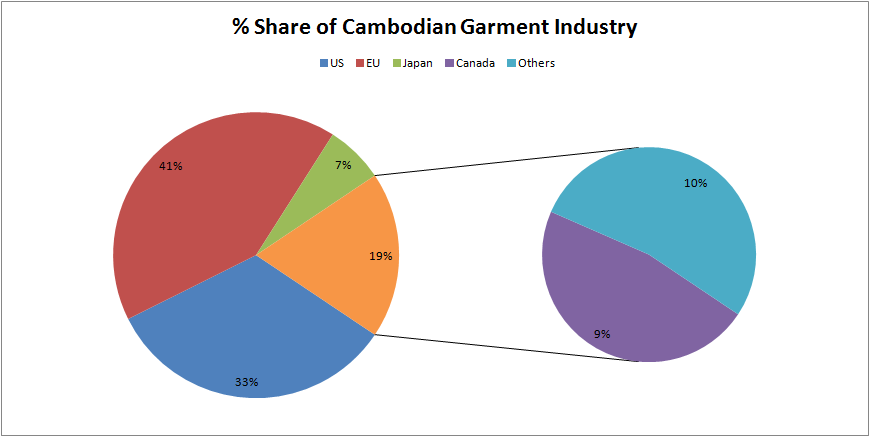
The garment industry of Combodia earns 80 percent of Cambodia’s foreign exchange earnings and employs an estimated 350,000 people in more than 300 factories. As companies which buy from Cambodia-like H&M, Inditex, Marks & Spencer, New Look, Adidas, Nike, Levi’s, Uniqlo-know very well, Cambodia benefits from preferential trade agreements with the European Union (EU), Japan, Canada, whereas China does not. Manufacturers in Cambodia benefit from duty-free access to the EU through the Union’s Generalized Scheme of Preferences (GSP) Everything But Arms (EBA) arrangement.
According to the Ken Loo, secretary general of the Garment Manufacturers’ Association in Cambodia (GMAC),Cambodian garment exports are only growing in markets with beneficial access, like Canada, Japan and especially the EU – its largest export market, accounting for 45% of the total, where imports have duty-free access under the generalized Scheme of Preferences (GSP) Everything But Arms (EBA) arrangement.
According to figures release by the local Ministry of Commerce the total value of exports from the garments from Cambodia was USD 5.7 billion . The break up of the exports stands divided among various markets as follows with the major share being taken by EU.
In this report, we did a detailed analysis of Denim Exports Of Men and Women Jeans To USA & EU during the period of 2011-2016 .
Table of Content
S.NO.
Particulars
1
Table showing the denim exports of Men and Women Jeans made to EU during the period of Jan’16 to August’16 and to USA during the period of Jan’16 to September’16 ( Pcs In Millions)
2
Graph Showing the denim exports of Men and Women Jeans made to EU during the period of Jan’16 to August’16 and to USA during the period of Jan’16 to September’16 ( Pcs In Millions)
3
Table showing the denim exports of Men and Women Jeans made to EU during the period of 2011-2015 ( Pcs In Millions )
4
Graphs showing average price of the denim exports of Men and Women Jeans made to EU during the period of 2011-2015 ( Euro/Pc)
5
Table showing the denim exports of Men and Women Jeans made to USA during the period of 2011-2015 ( Pcs In Millions )
6
Graphs showing average price of the denim exports of Men and Women Jeans made to USA during the period of 2011-2015 ( USD/Pc)
1. Exports of Men and Women Jeans to EU & USA
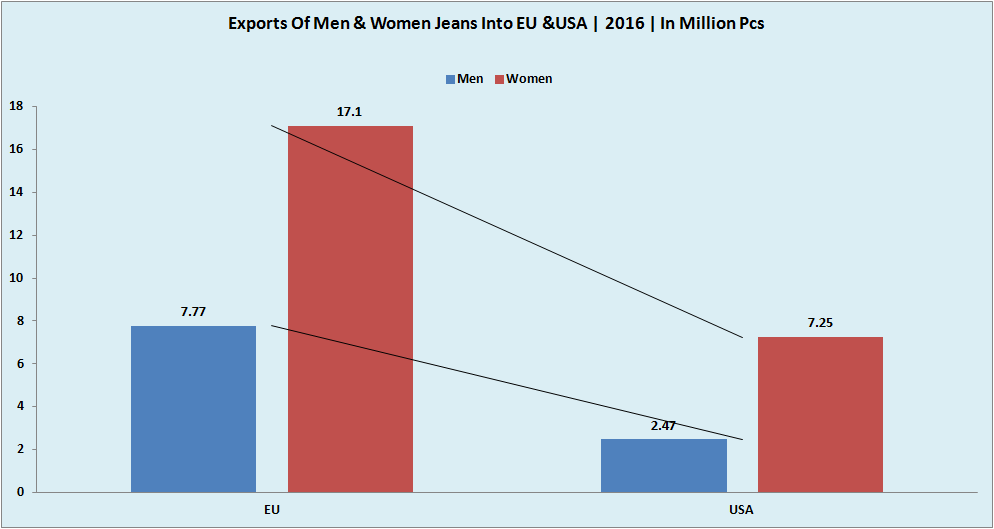
[private_special] The European Market is much better than USA for the Cambodian Denim Industry and it is very apparent by analysing the data of past five years . In the year 2016 ,till the month of August , the total exports of Men and Women Jeans made to EU was 7.77 million pcs and 17.1 million pcs respectively however for the USA the exports were saturated at the quantity of 2.47 million pcs for men and 7.25 million pcs for women during the period of Jan’16 to September’16 . So far as the average price is concerned , EU is cheaper than USA. For the period mentioned for EU , the average price for Men’s and Women’s jeans was Euro 6.67/Pc ( *USD 6.96) and Euro 5.83/Pc (USD 6.08) respectively. However for the USA, the average price for men’s and women’s jeans are USD 8.89 and 7.43 per pc respectively.
* The conversion rate is the exchange rate on December 28,2016
Pcs In Millions
Particulars
EU ( August 2016)
USA( September 2016)
Men
7.77
2.47
Women
17.1
7.25
2. Exports of Men’s and Women’s Jeans To EU during the period  2011-2015
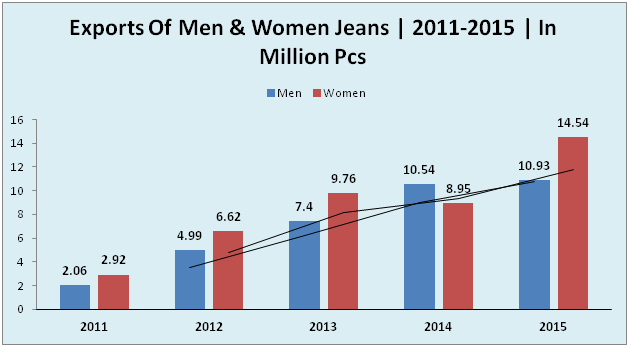
During the period of 2011-2015 , the denim industry of Cambodia grew very well. In the year 2011 the total Men’s denim export was merely 2.06 million pcs and Women denim export was 2.92 million pcs. Year after year the country has registered a fair growth rate and reached the level of 10.93 million pcs of Men’s Denim exports and 14.54 million pcs of Women’s Denim Exports by the end of the year 2015. However , analysing the year on year trend , the growth of men’s denim has not been so encouraging but for the women’s denim , the growth rate far better than Men’s denim. The year 2015 was better for Women’s Denim with a growth of over 60% !
Pcs In Millions
Year
2011
2012
2013
2014
2015
Men
2.06
4.99
7.4
10.54
10.93
Women
2.92
6.62
9.76
8.95
14.54
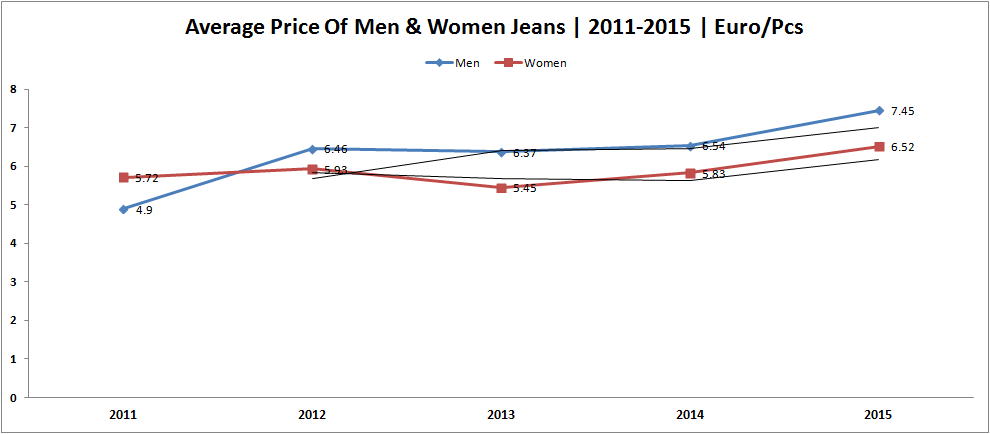
The average price increased continuously and as compared to the Chinese and Bangladeshi denim prices , the prices are not yet competitive. The increase in the prices are result of the Cambodia Government’s new labour policy which has increased the minimum wages substantially which have been reflected in the average price too. In 2011 , the average price of Men Jean was Euro 4.9/Pc which is Euro 7.45/Pc in 2015. The prices of Women jeans have been also increased but the increase is very marginal. In 2011 the average price of women jean was Euro 5.72/Pc and in 2015 it was Euro 6.52/Pc.
Euro/Pcs
Year
2011
2012
2013
2014
2015
Men
4.9
6.46
6.37
6.54
7.45
Women
5.72
5.93
5.45
5.83
6.52
3. Exports of Men’s and Women’s Jeans made to USA during the period of 2011-2015
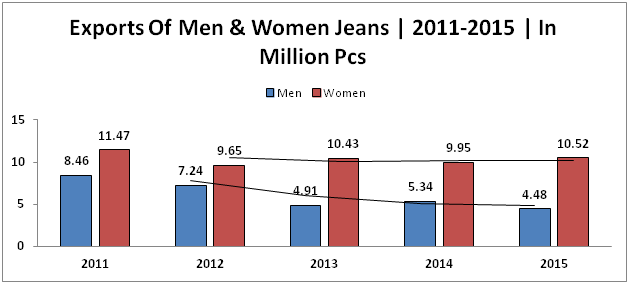
The denim exports to USA saw an adverse and inconsistent growth throughout the period of five years ending 2015.In the year 2011 the total Men denim export was 8.46 million pcs and Women denim export was 11.47 million pcs. Year after year the country has registered an adverse growth rate and dropped down to the level of 4.48 million pcs of Men Denim exports and 10.52 million pcs of Women Denim Exports by the end of the year 2015.
Pcs In Millions
Year
2011
2012
2013
2014
2015
Men
8.46
7.24
4.91
5.34
4.48
Women
11.47
9.65
10.43
9.95
10.52
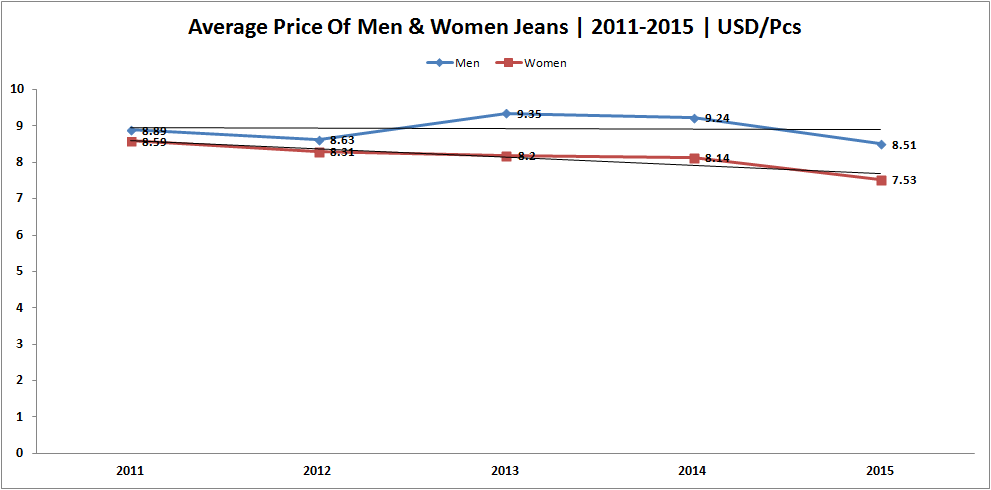
In 2011 , the average price of Men Jean was USD 8.89/Pc which is USD 8.51/Pc in 2015, though it has been reduced but is still not competitive . However the prices of Women jeans have been decreased over the period of five years . In 2011 the average price of women jean was USD 8.59/Pc and in 2015 it was USD 7.53/Pc.
USD/Pcs
Year
2011
2012
2013
2014
2015
Men
8.89
8.63
9.35
9.24
8.51
Women
8.59
8.31
8.2
8.14
7.53
Cambodia’s garment sector is doing fine. ANZ Bank recently predicted 7.2% GDP growth in 2016, mainly fuelled by rising clothing exports. And just-released data from the International Labour Organization (ILO) points to a 14.7% jump in the country’s clothing shipments to US$1.605bn during the first quarter of 2016. Garment exports to US have been falling for the past five years, dropping 14.2% toUS$1.2bn in the six months from January to June which is a matter of deep concern for the country. However there are strong hopes of revival for Cambodian industry in the coming years as China loses more and more of its share. [/private_special]
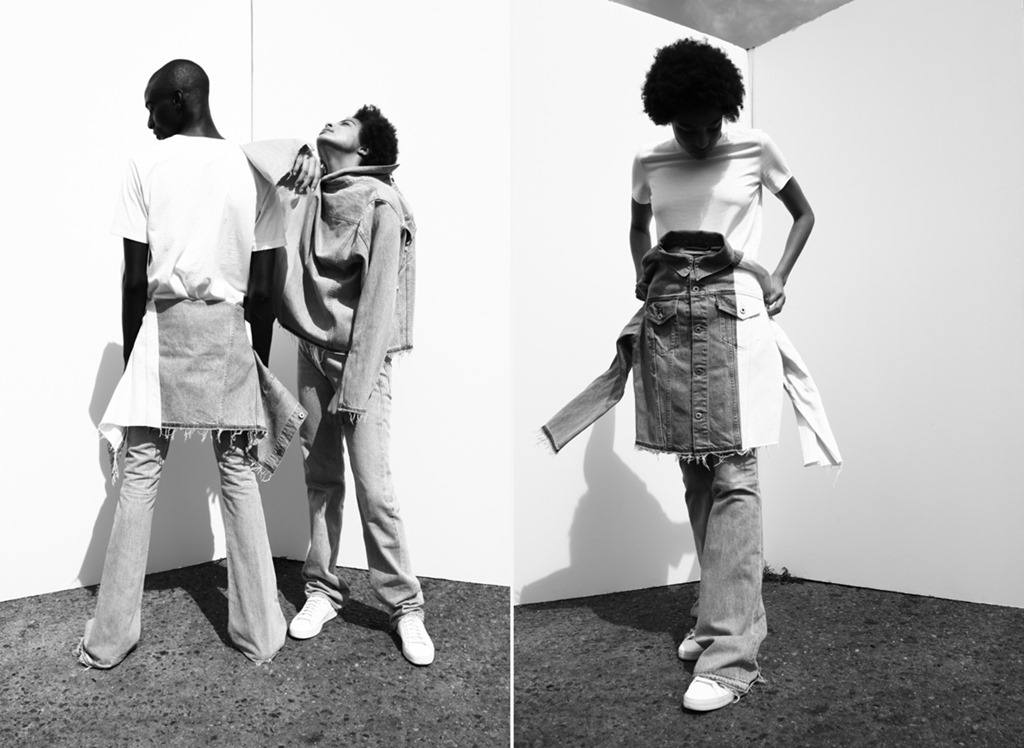
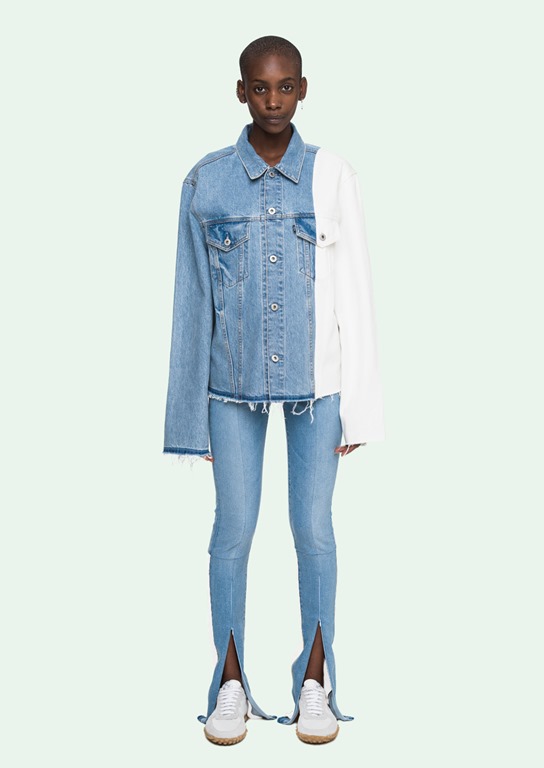
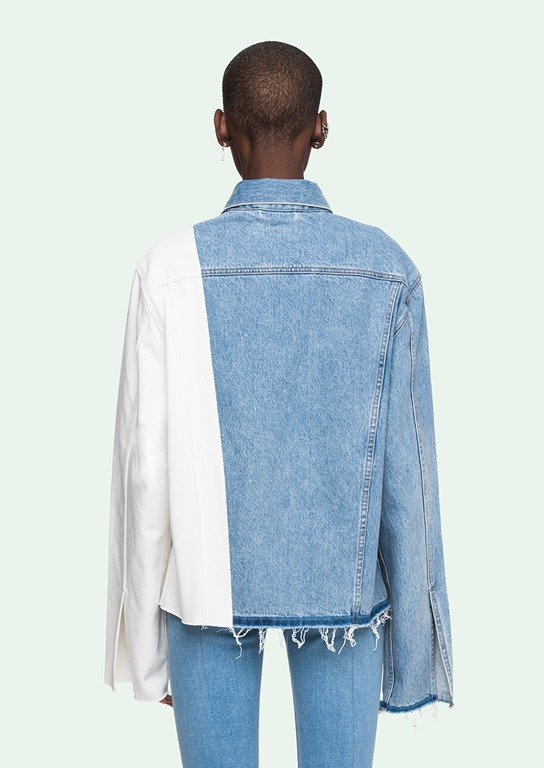
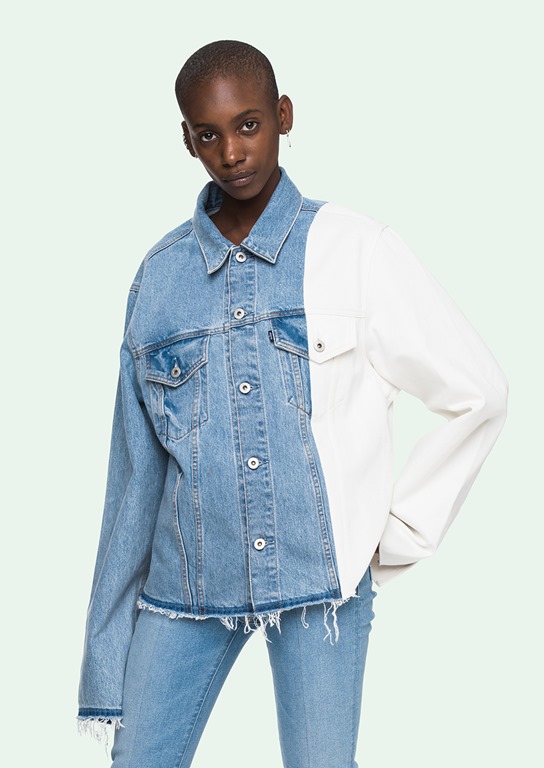
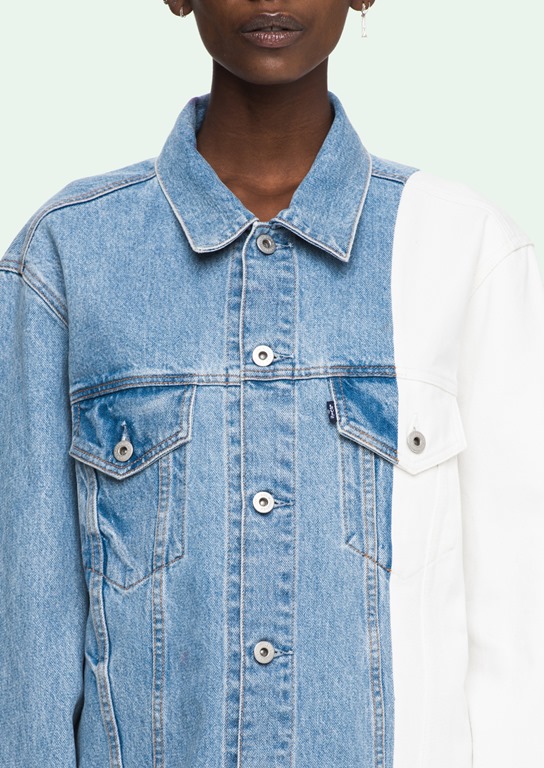
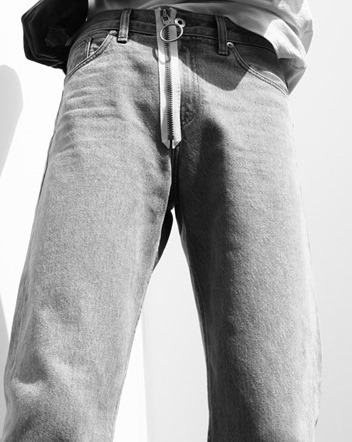
Recent collaboration of Levi’s Made & Crafted with Off White’s Virgil Abloh created a fine collection of  shearling trucker, a splice trucker in white and yellow, a bomber jacket, a staff coat, an insect skinny jean again in both white or yellow, a boyfriend jean in white or yellow, an oversized jean, and a flare jean which offer a very cool blend of past nostalgia and contemporary styles. The juxtaposition of white bleached fabric without any transition to the salt and pepper denim look is jarring initially and it takes few moments to sink in !
This coalition between both enabled them to combine their individual specializations . Levi’s® Made & Crafted™ has a rich brand history and known for its classic as well as contemporary approach .Virgil Abloh’s OFF-WHITE believes in fusing subculture with art, creating new forms of fashion.
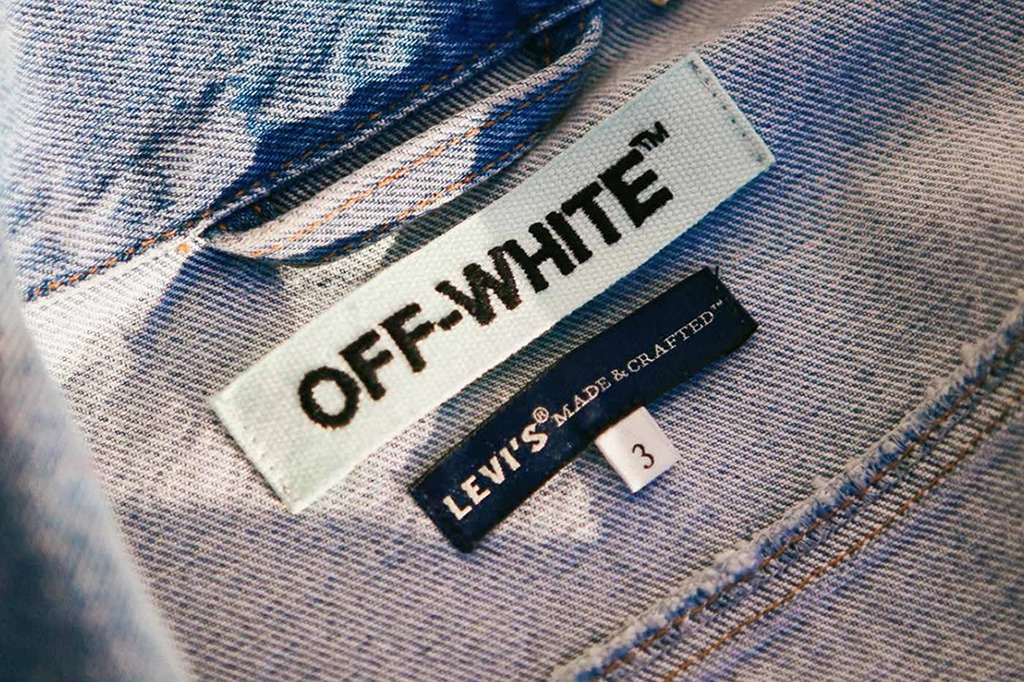
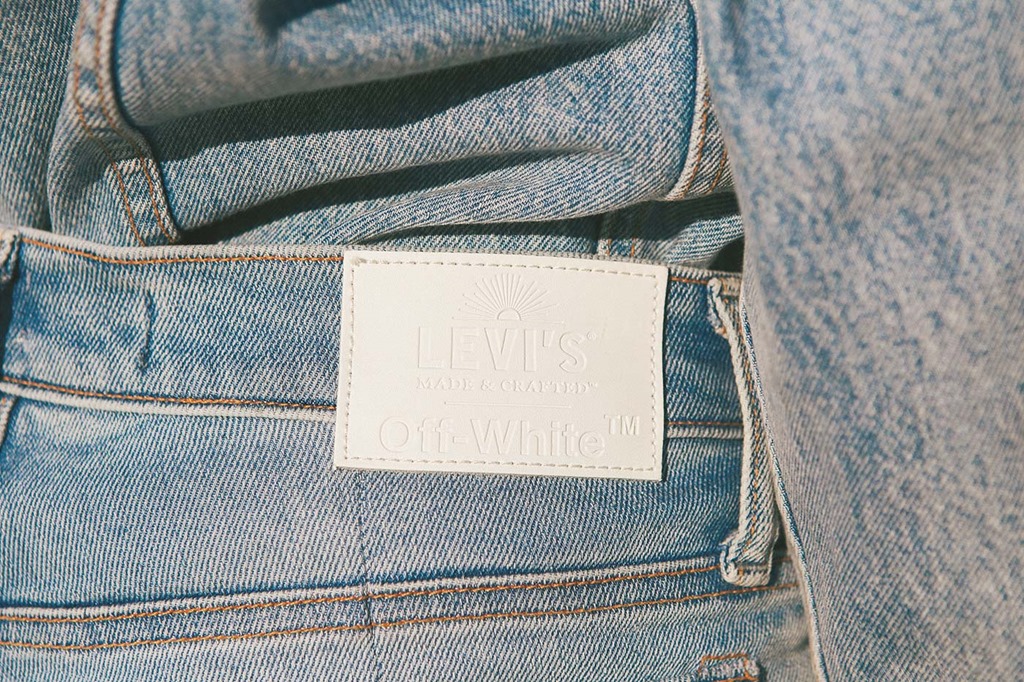
The Levi’s Made & Crafted x OFF-WHITE jeans have a very special tab too. It’s double sided. One side has Levi’s written on it, the other side has the OFF-WHITE stripes. Need to flip the tab to see both.
These items aren’t the most pocket friendly and will make it lighter from $691 to upwards of $1,679.
PRPS is renowned for its exquisite washes, super fabrics and its creator – Donwan Harell !. Its collections never fail to amaze and are looked forward to with great interest. Fall 2016 Collection of The PRPS Goods & Co.  featuring jeans with repair patches, antique dye detailing, and 3D crinkled effect for texture. The collection is very peppy and trendy and has been designed to attract the youths at large.
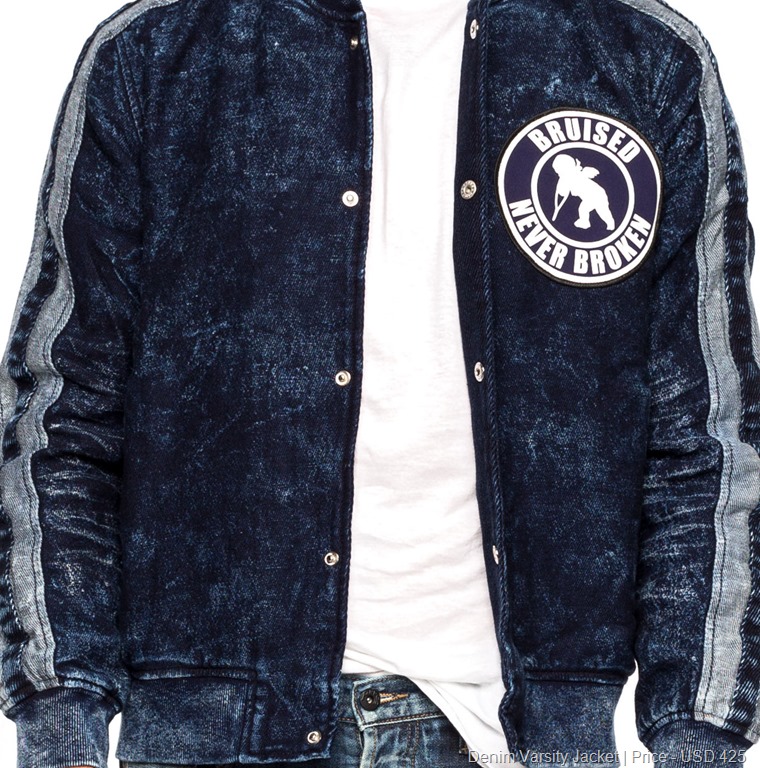
Denim Varsity Jacket  takes cues from a classic collegiate style, updated for streetwear sensibility. Made with  finest cotton denim dyed in classic deep indigo, the jacket is detailed on the inside with a plaid lining. On the outer, button and zip fasteners, textured sleeves and functional pockets seal the deal.
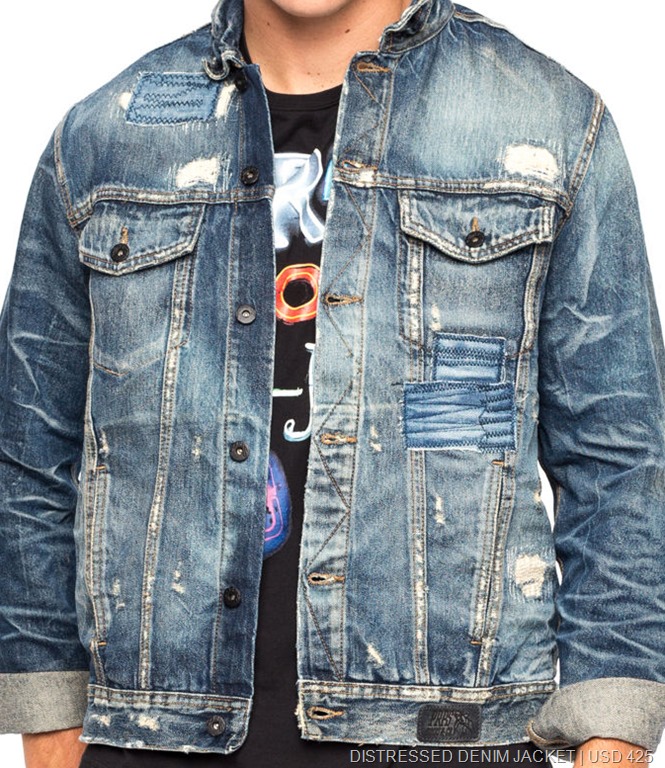
Another denim jacket in the bucket is – DISTRESSED DENIM JACKETÂ . Using unconventional treatments, a traditional denim jacket with button fasteners is transformed to show a faded, worn in look. Of course, the patches at bring out the Vintage and a kind of Boro look .
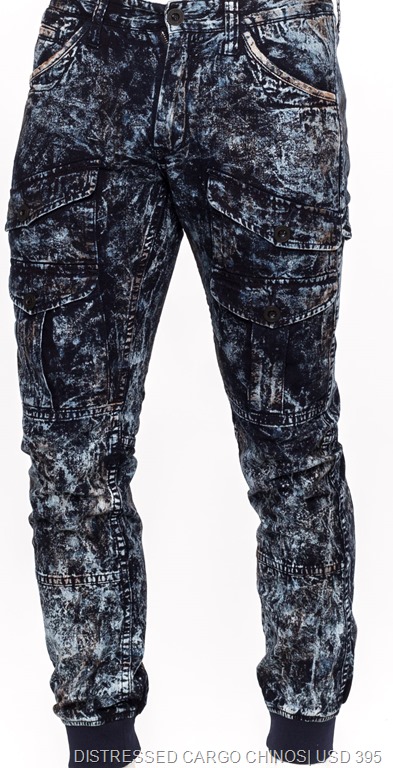
Distressed Cargo Chinos is a cotton denim cargo pant with a seamed straight leg, featuring cargo-style pockets on both sides. This chino pant is finished with signature distress marks.
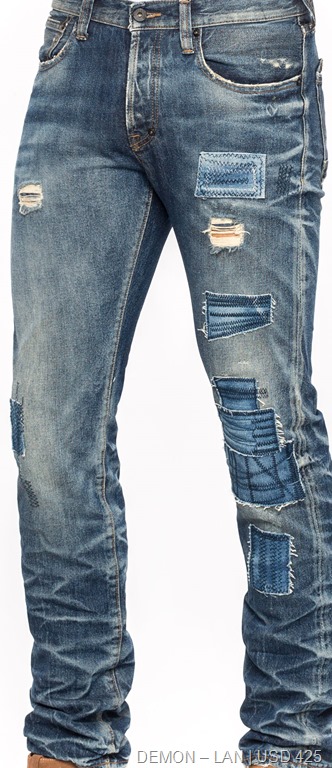
Showing off with repair techniques, the Demon Lan Jeans feature heavy repair and destroyed techniques on a natural indigo dyed distressed denim, detailed with black pigment spray. Demon fit is medium rise and slim in 11.5oz .
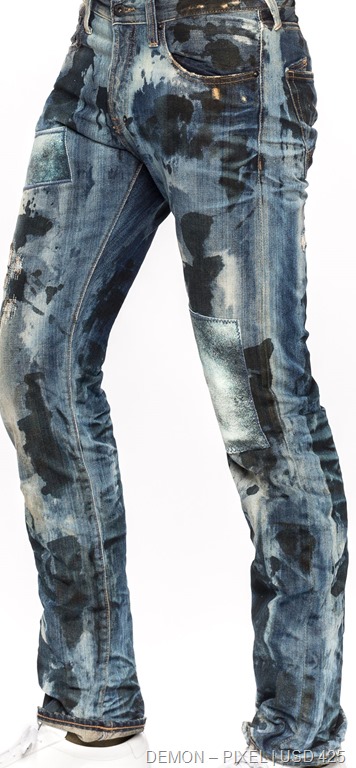
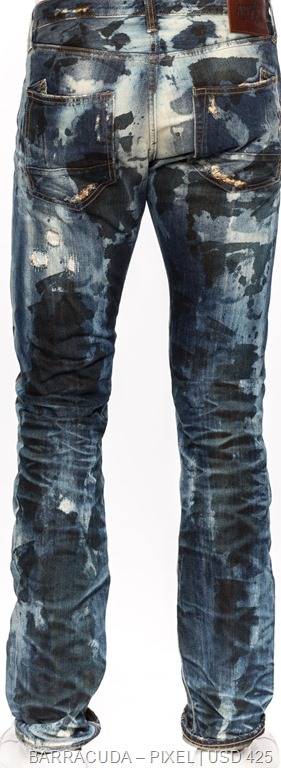
Demon Pixel Jeans are cotton denim jeans, bleached and heavy washed with blue leather patchwork. This 5 pocket style is detailed with logo patch at the back and a button fly closure in 12oz
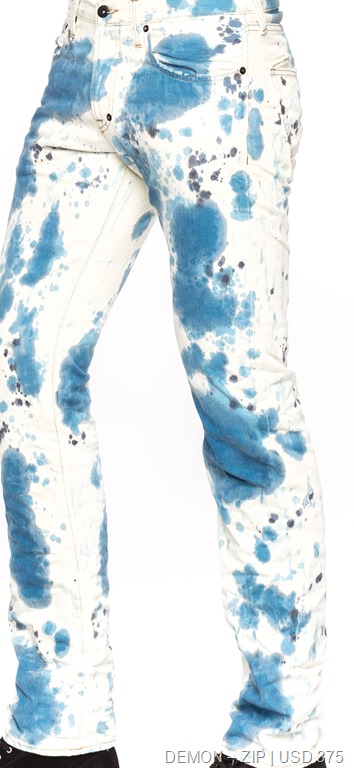
Demon-Zip , A white cotton denim features signature denim applique repair patches of PRPS on both pant legs. This 5 pocket style is detailed with a logo patch at the back and a lot of indigo patches !
Barracuda Pixel Jeans are cotton denim jeans, bleached and heavy washed with blue leather patchwork.  This 5 pocket style is detailed with logo patch at the back and a button fly closure.
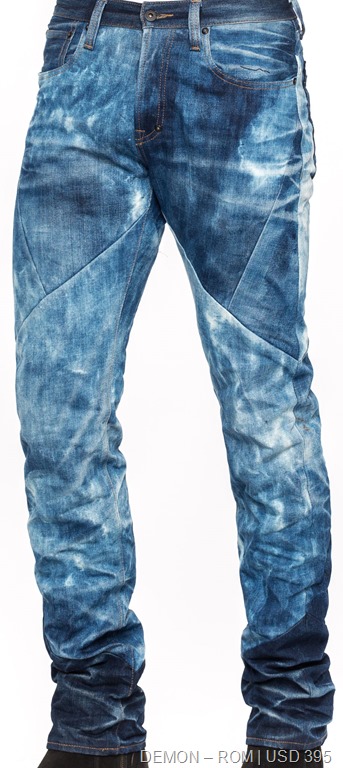
Demon –Rom feature signature construction of PRPS and treated with a heavy wash. The 5 pocket denim style is detailed with a logo patch and a button fly closure.
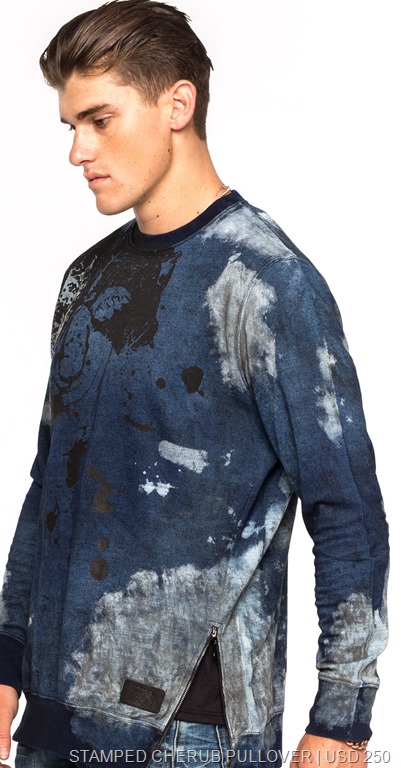
Stamped Cherub Pullover with a tritone marble dye, with blue, black and grey blending allover. This straight-line crewneck fleece pullover is detailed with with zipped vents and a stamped cherub print. Made with 84% cotton and 16% polyester .
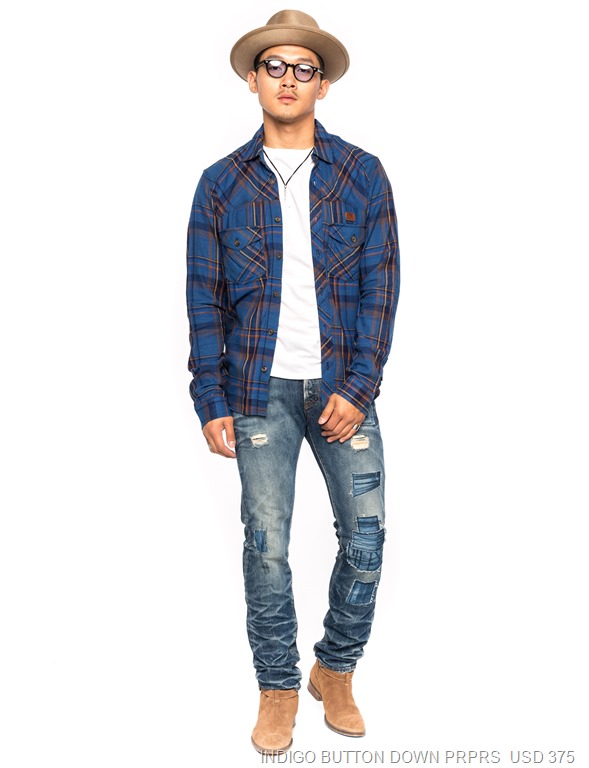
Indigo button down shirt – the indigo dyed woven shirts to pair with any of the jeans !
ABOUT PRPS
Donwan Harrell, the founder of PRPS, is the first American designer to bring Japanese denim jeans to the United States. Established in 2002, Donwan started the rise of the Japanese luxury denim jeans business in America. He doesn’t simply just make washed & selvedge jeans, Donwan constantly researches, selects premium denim and uses revolutionary washes. Prps has 3 collections that are shaping the men’s fashion industry: Prps Noir, Prps and Prps Goods & Co. Every characteristic of every garment produced by Prps is representative of Donwan’s penchant for meticulousness. No detail, no matter how minute, goes overlooked; creating the best jeans to date.
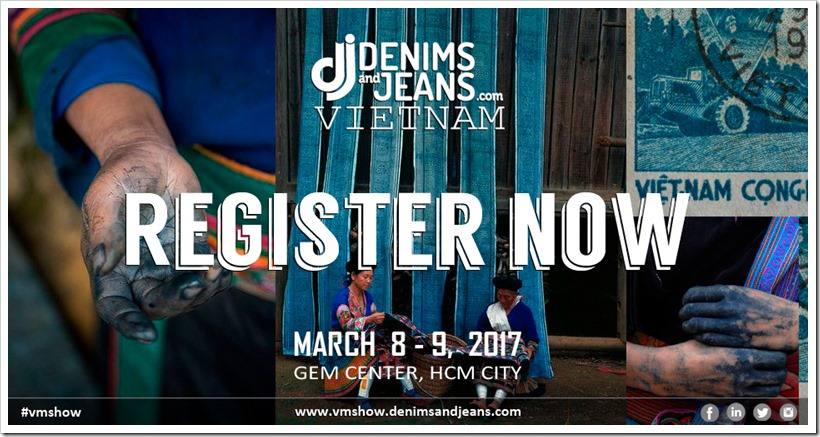
The second edition of Denimsandjeans Vietnam show is going to be held on March 8-9 at Ho Chi Minh City . This is will be a great opportunity for the sourcing as Vietnam is one of the fastest growing apparel destination in the world. So , to visit the show ,please register here.