


























 ” />
” />
” />
For Spring 2012, GUESS, the American lifestyle brand famous for its trend setting denim and unforgettable campaigns, introduces a women’s with classic American style that has always been synonymous with the brand. The line delivers trend-setting, versatile pieces with vibrant spring colors and unique washes. The core theme of the collection is COLORS COLORS AND COLORS ! .. The trend-defining styles and innovative denim treatments that make up this collection continue to position GUESS as an iconic fashion brand.
The women’s spring collection is broken down into three main deliveries.


Previous collections from Guess :
Guess Men’s Denim Spring/Summer 2011 Collection
Guess Women’s Spring/Summer Denim Collection 2011
Lets start counting the products where denim is being used as a basic input or as an additive providing an enhancement value :
Bottoms and Tops including jeans , jackets , shirts etc
Upholstery
Car seat covers
Ladies fashion dresses
Sarees for Indian women
Burqahs and other dresses for muslims
Towels !
Curtains..
Pet clothes
Helmets
The list is endless……………………
So if there is one more addition to this list , it should not be surprising at all. Applying denim fabric to accentuate the value of an ipad or an iphone is like bringing two iconic products together.
When Cone selvedge denim is lined with Merino wool to make sleeves for Ipad /Iphones, the product is expected to be still better. Its interesting to see these new applications for denim – but unforunately we will not be able to see the wash down effects on these products.. They will, as they say , age gracefully !


Though interesting as a product , the denim mills are not going to get a huge advantage in terms of meters sold …But its good to see another place product category being invaded by denim !
This is a technical post by Harry Mercer on Indigo dyeing. It is the third part of the article in series. The first part can be seen by clicking here and the second one here
As discussed in Part 2 of this series, most of the control of Indigo dyeing must be managed before the dye and chemicals reach the dye boxes in the machine. In order to measure the effectiveness of control measures of the dye and chemical mixes, it is necessary to measure concentrations of Indigo, reducing agent and alkali in the Indigo dye boxes. If the methods of measuring these concentrations in the dye boxes are accurate and reliable, then those measurements will be able to predict the Indigo color of the yarn and the colorfastness of the denim in the garment laundry as well as providing a benchmark of dyeing management capability. By analyzing the data for each dyeing method with simple statistical tools such as Standard Deviation, the level of control for each color, for each dye lot and each group of workers can be measured and improved. In this way, continual progress can be made towards perfect denim color which has been achieved in a few companies. This wins business with jeans producers that pay the highest prices.
In 1992, I published an article, “Quality Assurance Methods for the Continuous Dyeing of Cotton Yarn with Indigo†that was the most advanced treatment of the subject. After years of research into test methods for Indigo dyeing, several conclusions could be made:
The primary cause of Indigo variation is changes in the reduction potential of the dyebath which consists of a combination of reduced Indigo and free sodium hydrosulfite. The total hydrosulfite in the Indigo bath is divided between the hydrosulfite that is consumed for reduction of the indigo dye molecule and free hydrosulfite that is not consumed in dye reduction. Where the dye circulation is adequate and the dye feeding concentrations are consistent, the grams per liter of reduced Indigo and the alkali levels are consistent. The free hydrosulfite is unstable and requires the most effort in control for Indigo dyeing. As the concentration of free hydrosulfite increases, the Indigo shade becomes greener and more wash-fast; as the free hydrosulfite decreases, the indigo appears less green or redder and loses color faster after washing. If the free hydrosulfite changes by 0.3 grams per liter in the indigo bath, a different indigo shade results. Many denim companies have 10-15 shades per dye lot where a true color difference of 0.2 Delta is used as a measure.
In the above-mentioned article that I published, I mentioned a number of possibilities for measuring reduced Indigo and free hydrosulfite in Indigo dye boxes. One was the permanganate method that uses a 2-endpoint, potentiometric reduction-oxidation titration.This method has come into common use in many companies, but is not reliable for measuring the Indigo dye. The method has been in use for over a hundred years and I found it useful in conducting research into Indigo dyeing in order to develop Indigo formulations in the laboratory. This method was occasionally useful at the Indigo machine when developing new Indigo colors, but only with manual titration. Automatic titrators usually proceed too quickly and produce erroneous endpoint identifications. Also, the sample sizes used are too small to be representative of the average Indigo and hydrosulfite concentrations for all of the dye boxes. In addition, the test is too slow for quick response in dyeing and laboratory personnel often are not aware of maintenance and calibration requirements.
The vat-ometer, on the other hand, offers simplicity, speed and reliability. This device was invented about 150 years ago and research into Indigo dyeing has demonstrated that the vat-ometer results are consistent and are predictive of actual color variations in Indigo dyeing. The vat-ometer consists of a rounded glass flask and a measuring tube. Water is added to the vat-omter, then dyebath is entered, the vat-ometer is sealed to prevent entry of additional air and then the mixture is shaken for about 1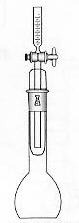 minute. The principle involved is to titrate the hydrosulfite with oxygen from the air. This causes oxygen trapped in the flask to be consumed by the hydrosulfite,which creates a partial vacuum in the flask. Then water is added to the measuring tube, the stopcock on the measuring tube is opened and a quantity of water is pulled into the flask that equals the number of cc’s of oxygen consumed. The number of cc’s of oxygen consumed multiplied by 1.1 yields an accurate and reliable measure of total hydrosulfite in the dye. Repeating the test after adding some formaldehyde to the water will provide the grams per liter of reduced Indigo. By subtracting the reduced indigo number from the total hydrosulfite number, the grams of free hydrosulfite is provided- this number determines the color and wash-fastness of the Indigo.
As mentioned previously, the practical number is the average hydrosulfite for all of the dye boxes. As a rule the hydrosulfite concentrations in indigo dye boxes will vary from box-to-box, from top-to-bottom and from side-to-side. In order to know the machine average, at least 2 dye boxes should be sampled. For example, on a 6-box Indigo machine, normally an average of the 2nd and 5th box will equal the machine average.
The vat-ometer offers the advantages of larger sample sizes for better accuracy faster results. The vat-ometer can be constructed in the laboratory to use dye samples as large as 100 cc’s, however the portable vat-ometer which yuses a 10 cc sample has long been proven to be accurate enough for Indigo dyeing production eg the one from Tudorscientific here.
 This is a guest post by Harry Mercer. Mr. Mercer has 30 years experience in the denim business including 3 prominent U.S. denim companies. He is an expert colorist for measurement and color matching as well as textile testing and is considered to be a leading authority for denim dyeing, finishing and fashion denim development.
Subscriber Report Contents:
a) Denim Apparel exports from Vietnam to US : 2000-2010
table showing including values, quantities and prices. For 2011, the same details for Jan – Sept are provided in comparison to same period in 2010
b) Men’s Jeans exports from Vietnam to US : 2000-2010 table including values , quantities and prices.
c) Women’s Jeans – with same details as b above.
d) It would be interesting to see how denim fabrics from EU are being routed to Vietnam for garment production. The volumes were low till 2007 but suddenly picked up and have again showed a slowdown in 2011. Some details on the volumes and prices of such EU denim fabrics being converted into apparel in Vietnam.
e) 4 large denim apparel exporters from Vietnam – Brief details of their contacts and at least one of their customers in US.
f) Denim Jeans imports into EU from Vietnam for 2007-2011 including prices, values and volumes.
Vietnam is becoming one of the important centres of production of denim apparel. With China getting more expensive , the regional countries like Vietnam, Cambodia, Laos etc are getting more and more important for apparel manufacturing.
Lets have a look at how Vietnam has been performing on the front of export of denim apparel to US and to EU.
![image_thumb[1]](http://www.denimsandjeans.com/wp-content/uploads/2011/12/image_thumb1.png "image_thumb[1]")


Vietnam is clearly much stronger in women’s denim apparel as compared to men’s. This also indicates that the manufacturing units there have to much more responsive to changes in fashion and respond to quick turnaround requirements of buyers. Lets also have a look at the shipments made from Vietnam of all denim apparel during Jan-Sept’2011 as compared to similar period in 2010
| Year | Quantity (million pcs) | Value (million USD) | Av. Price ( USD/ mtr) |
| 2010 (Jan – Sept) |
17.2 |
115 |
$6.68 |
| 2011 (Jan-Sept) |
15.1 |
119 |
$7.78 |
| Change% | -12.2% | +3.5% | +14.74% |
In line with trends in export reduction from the world to US (for denim apparel) , the exports from Vietnam have also shown a decline and have simultaneously increased the average price due to cotton price impact.
The denim apparel companies are not only using denim fabric from different countries from around the world but also from EU27. Lets have a look at the figures of denim fabrics from EU with their prices, quantities and values into Vietnam from 2007 to 2011
| Year | Quantity sq mtrs |
Value (million Euros) | Av. Price (Euro/ sq. mtr) |
| 2007 | 94,000 | 0.46 | 4.95 |
| 2008 | 374,000 | 1.87 | 5.0 |
| 2009 | 699,000 | 3.30 | 4.72 |
| 2010 | 477,000 | 1.51 | 3.18 |
| 2011 (Jan to Aug) | 187,000 | 0.86 | 4.30 |
The shipments of denim fabrics from EU27 to Vietnam seem to have peaked in 2009 and have considerably dropped in 2011.

Dong Nai garment co. is a manufacturing unit for Saitex – an important denim apparel company from Vietnam.Saitex consists of three units in different parts of HochiMinh City , Vietnam and 1 in Bangladesh associated with garment manufacturing. Saitex International Inc – Saigon- Hochiminh City is a modern product development centre. Saitex International (Vitenam) Ltd – Dong Nai specializes in the production of denim jeans and cotton twill and corduroy garments.

Dong Nai also ships to buyers like Fresh Ink and Fresh Produce Sportswear in US. 
Fresh Produce Sportswear is a $50 million company having casual, resort and sportswear lines in America. Creating products for females 6 months to 60-plus , Fresh Produce can be found in Nordstrom, Walt Disney resorts and stores, and over 800 specialty boutiques and resort retailers.

Garment Resource Co. from Vietnam ships to buyers like Forever 21 . Forever 21 is an American chain of clothing retailers throughout the United States, Canada, Singapore, Indonesia, Malaysia, United Arab Emirates, Jordan, Oman, Kuwait, Saudi Arabia, Bahrain, Thailand, China, South Korea, Japan, Puerto Rico, Philippines and soon the United Kingdom & Republic of Ireland offering fashion and accessories for young women and men. Forever 21 typically serves the same audience and competes with Urban Outfitters, Wet Seal, H&M, New Look and Charlotte Russe. Headquartered in the City of Los Angeles. 

With over 2,800 employees , Saigon 3 is a large garment company – the company ships to buyers like Levi’s Strauss , Uniqlo USA , JC Penny etc. 
Uniqlo is one of the big apparel company from Japan. UNIQLO enjoyed superb growth by providing high quality casual wear at remarkably low prices. With over 800 stores in Japan and with the opening of new stores in US, the company is experiencing strong growth . Uniqlo specializes in providing the highest quality of denim products including those made from Japanese denim and retails them at reasonable prices. It also has jeans manufactured in Bangladesh besides other countries like China and Far East.

Contact Person: Mr. Toney Ang
Telephone :+84-4-38582246
Fax:+84-4-38582302
Email: may19woven@hn.vnn.vn
Hanoi May 19 Textile Group ships to buyers in US including Oshkosh B Gosh Inc. 
OshKosh B`Gosh is a children`s apparel company founded in Oshkosh, Wisconsin in 1895. It is currently a subsidiary of Carter`s.
 Having recently acquired a denim manufacturing facility in Argentina, and with denim production of about 140 million mtrs pa, the Brazilian company Vicunha is now the second largest denim fabric company in the world. With such a huge production to sell , the company is still very nimble and responsive to market needs for quick productions . The company explains how it has to cater to produce fabrics to cater to three different seasons at the same time:
“Imagine being a denim or flat-woven
manufacturer having to deliver large quantities to such hyper-fashion brands as COS, H&M, Massimo Dutti and Zara, on demand “today†i.e. in the current season. Imagine delivering to companies that can often only decide in November what will be under the Christmas tree in December. Imagine already now having to satisfy highest trend expectations of such global players as Calvin Klein, DKNY, Hugo Boss and Tommy Hilfiger for “tomorrowâ€, i.e. the coming season. And also imagine offering these labels and hot denim brands such as Diesel and Replay the latest future styles for “the day after tomorrowâ€, i.e. the next but one season. This means covering three seasons at a time and providing fast and reliable large scale deliveries and optimum customer service plus technical support for a very sensitive market that reacts like a seismograph to change.â€


Here is a brief forecast from the company for the Spring/Summer 2013 season


At the beginning of the year, VICUNHA became the very first Brazilian company to join the BETTER COTTON INITIATIVE. Vicunha’s first priority is the sustainable, clean production of cotton. As a pioneering member of the BETTER COTTON INITIATIVE in the Brazilian market, their main priorities are sustainable, clean cotton production, environmental protection and social responsibility.
“Pricing policy is important, but not at the expense of environmental and social responsibility,” commented Thomas Dislich, CEO of VICUNHA Europe, on membership in the BCI.
The denim giant is also setting standards within the company for social standards, workplace security and environmental protection. Alongside membership in the BCI, the company has permanently invested in recycling. Polyester is produced from recycled plastic bottles and biomass instead of oils or fossil fuels; organic materials such as cashew nut shells and raw sugar pulp are used in the production processes. As a result, the company reduced their monthly carbon dioxide emissions by about 10,000 tons.
The company is not wanting in its ability to serve different markets of the world with a speedy delivery service that ensures that clients can respond to the latest fashion changes. Vicunha has currently a market break up as :
Brazil 75%
Argentina 10%
Other America 10%
Europe 5%
It has a large warehouse in Europe to serve its clients with a quick delivery service and now the company has set its sight on the growing denim apparel region of South Asia – Bangladesh, Pakistan, Sri Lanka and India. The company just announced setting up of a 500,000 mtrs warehouse at Sri Lanka which will be able to deliver fabrics within 7 days of order to this region. Thomas Dislich says :
“This strategic and very advantageous positioning makes us very flexible for the Asian market, especially for Bangladesh, one of the main production locations for Western brands and verticals. Goods can be delivered by ship less than seven days after they are ordered,” says Thomas Dislich.
For the upcoming Denim by Première Vision in Paris, from November 30th to December 1st, 2011, the Brazilian denim giant shows their “lifestyle” colors with a new stand concept, as at the previous fair. The stand’s design and atmosphere embraces the season’s moods. For more details ,contact Vicunha Europe at this email address
Arvind launches its Spring and Summer – 2013 for European Brands at Denim by Premiere Vision, Paris. The collection brings the best in Denim for Spring and Summer – 2013. Some key products to be showcased by Arvind are :


Arvind shall also be presenting the Excel Denim in Trend Area at Denim by PV on 30th Nov. Arvind Denim has a very strong positioning on ‘ Sustainability’. Various products like Organic Denims, BCI cotton based denims, Recycled cotton and Recycled Polyester based denims are an important part of Arvind Denim portfolio. This commitment to sustainability also had led Arvind to develop its Excel Denim in collaboration with Birla Excel. The third generation Cellulose fiber – Excel is made from Wood Pulp, a natural and renewable resource. Arvind and Birla claim the following eco benefits of Excel Fiber :
“Excel Plantations have higher air purification per hectare of land in comparison to cotton. Solar heat absorption prevents generation of black holes. The water used for producing per unit kg of Excel fiber is significantly lesser than compared to the water used for producing any other cellulosic fiberâ€.


Excel denim offers a unique combination of sustainability and fashion and is being added to collections of major brands worldwide.
Arvind shall also be presenting their Future Denims at the show which includes the
Authentic Denim includes denim from Organic Cotton, dyed in Natural Plant Indigo and woven on the vintage shuttle loom with selvedge. Denims range from a true authentic heavy weight 14.8 Ozs, Selvedge toa Natural Indigo with Natural Indigo fill to one with a Natural Linen. All of them are very comfortable to wear and age naturally.
Modern Denim includes denim made with all modern technologies available. New age yarn design, new combinations of dyeing, compact weave constructions, hybrid stretch combinations and super-tech coatings.


Contact Arvind by clicking here

Its time for Denim By Premiere Vision again ! The famed denim show is being held again on Nov 30 and Dec 1, 2011 . Over 80 exhibitors – denim mills, jeans manufacturers , laundries , accessory suppliers etc- will be exhibiting their Spring/Summer 2013 Collections at the show. The show is expanding with keen interest by denim mills and other companies in the supply chain worldwide to be a part of the show.
Almost all the well known denim mills around the world will be a part of the show and here are some excerpts on some of the major players who will showcase their products.
Arvind is one of the largest producers of denim worldwide, with a capacity of over 120 million metres per year. At Arvind, business units span the entire textile and apparel chain: from growing organic cotton, through spinning, weaving, processing and finally manufacturing and retailing its own repertoire of diverse brands. The company proposes eco-friendly manufacturing at every stage, across the entire life-cycle of its products.
Special highlights this season include Future Denim, Excel Denim, Hybrid Stretches and Indigo Shirtings.
This edition, INVISTA is introducing for the first time their new LYCRA® dualFX™ fabric technology, for patented fabrics that are uniquely super stretch. These exceptional denims integrate LYCRA® fibre and LYCRA® T400® fibre into a single fabric for added stretch and, even more importantly, extra fabric recovery.
 Drawing on its development of special spinning and weaving processes, Vicunha’s autumn-winter 12-13 collection proposes products with an extra degree of softness. Some compositions include combed yarns, worked in new ways to achieve extreme fineness in colours and finishings. Another area the company has been researching is sustainable development, including fabrics that make use of recycled polyester from plastic bottles, while maintaining a cotton feel. Their new collection includes some 69 references, broken down in 8 product families.
 This season, Tavex puts the spotlight on a new selection in their fabric offer: Denim Couture, an exclusive collection of selected creations carefully designed to impart more sophistication, more chic. The line is the product of ongoing research and development aimed at combining traditional and hand-executed techniques with the latest innovations. This results in articles that stand out, offering a surprising vision of denim in two complementary lines: Satine and Sculpture.
+ And also: Alsoft® Amazontex
This natural, ecological and sustainable finish is derived from Cupuaçu, a fruit obtained directly from cooperatives in the Brazilian Amazon. Silicon-free, hypoallergenic and biodegradable, the finish produces a softening effect and improves comfort by absorbing moisture and solar radiation.
 “Suave Plus” concept from Royo (Spain)Â offer a range of textiles with special handle treatments, extra softness, and easy-care properties all produced through an environmentally safe process. All the “Suave Plus” fabrics employ Lyocell Tencel, made from eucalyptus pulp.
ISKOâ„¢ (Turkey) presented at Denim by Première Vision the special “Neo Vintage concept“. Neovintage reflects the combination of vintage story with high-tech finishes. The effect of usage throughout the years are given to the fabrics with the help of unique treatments: Turbotechâ„¢ patented by ISKOâ„¢.
With the special weave and indigo dyeing process, the garments made with Turbotechâ„¢ quickly take on a vintage, stone-washed effect look that’s always changing. After a few washes the garments fade.
Neovintage is one of the most important concept which ISKOâ„¢ really keen on. Fabrics are constructed by old yarn characters and latest ISKOâ„¢ finish techniques applications and they offer a dirty, shadowy look that meets a techno touch and natural brightness with vintage construction.
ISKOâ„¢ focused combining old and new hot aspects in denim to re-interpret the vintage soul in a modern and update way offering a neo-vintage concept.
Orta Blu, the sustainability division of Orta Anadolu(Turkey) , aims to communicate Orta’s efforts to save energy in their processes, and to develop an extensive global community dedicated to social and sustainability issues. One of its operations is launching a hands-on global ‘Social Missions’ using Orta products in collaboration with NGOs around the world. One example is the creation of school uniforms for children in Sierra Leone. Since 2005, Orta has been pursuing a number of “Best Practices” in energy and water conservation. The most visible result is a notable decrease in energy consumption per unit of production. A review of energy records shows a roughly 20% reduction in electricity and gas per metre of denim produced.
 US denim mills is a denim company from Pakistan with great products.The company has been working hard to optimize the idea of recycling denim. The first ideas of recycling old jeans proved to be impractical for various reasons, mainly consistency. The use of waste from the denim cutting tables proved to be more controllable and more consistent. This reprocessed fibre is used to spin yarn that is reworked into denim. The recycled yarn also requires new dyeing techniques, resulting in unique denim with a unique cast.
Here is a list of participating companies – if you have the will to go through the list !
ABSOLUTE DENIM CO., LTD., ADM ARTISTIC DENIM MILL LTD, ARTISTIC MILLINERS, ARTISTIC FABRIC MILLS, ARVIND LIMITED, ATLANTIC, ATLANTIC MILLS CO. LTD, BERNING, BERTO E.G. INDUSTRIA TESSILE S.R.L, BEST ONE, BLUE LOFT-ALLIANCE GROUP, BLUE FARM TEXTILE LIMITED, BOSSA DENIM & SPORTSWEAR, CALIK DENIM, TRC CANDIANI, CAPPIO TESSUTI S.R.L., CENTRAL FABRICS LTD, CEPEX, CITY CORPORATION, CLOSE TO CLOTHES, CONE DENIM, CONFECTION RAS JEBEL, CROSSING, DENIM AUTHORITY, DENIM DE L’ILE LTD, DENIM VALLEY BY ROYO, DERIDESEN ETIKET, DORLET, DYNAMO DENIM KUMASCILIK LTD, ECLAIR PRYM MAROC, LAVANDERIA EMMETRE(MALWA) , EREKS GARMENT CO., FASHION POINT TEKSTIL URETIM AS, FG GROUP OF COMPANIES, GFM TEXTILES PARRAS SA DE CV, GLOBAL DENIM TEKSTIL, GONSER GROUP TUNISIE., LA GRIFFE INTERNATIONALE S.A, GTX SRL, HECKING DENIM, HELLENIC FABRICS SA, ICOMA, INCI BUTTONS, INDICOTT, I.T.V – INDUSTRIA TESSILE DEL VOMANO, ISKO, ITALDENIM SPA, J-VAL SRL, KIPAS DENIM, KUROKI CO. LTD, MARASSI DENIM-SIRIKCIOGLU MENSUCAT SAN. VE TIC. A., MAROC EXPORT, MATESA TEKSTIL SAN VE TIC A.S., MESURA TEKSTIL SAN. VE TIC. LTD., MION SPA, MONTEBELLO S.R.L., NIHONMENPU TEXTILE CO.,LTD, ORTA ANADOLU T.A.S (DENIMUS), ORTA ANADOLU – ORDENIM, PANAMA TRIMMINGS SRL, PARIS TEXAS, PROSPERITY TEXTILE (HK) LTD, REALKOM TEKSTIL URUNLERI, REALTEKS TEXTILES COMPANY LTD, TEJIDOS ROYO, S.L., R.S.P. 51, S.A., TEXTIL SANTANDERINA S.A., SANTANENSE, SARTEX, SPECIAL FABRICS, TAVEX, TURTEKS TEKSTIL ETIKET SAN. TIC. A.S., UCO RAYMOND WORLDWIDE DENIM, US DENIM MILLS LTD, VICUNHA EUROPE, YKK EUROPE LTD.
Bangladesh is one of the major exporter of denim jeans and apparel in the world. If fact, it is one of the fastest growing manufacturing base of denim apparel in the world. With duty free benefits to EU and impending duty free benefits to US , this country is already the third largest exporter of denim apparel to US and second largest to EU. The country has among the lowest wages in the world and for sure lowest in Asia. According to ILO report the minimum wages of $58 is the lowest in Asia and the nearest to it are the wages in Vietnam and Laos, the nearest competitors to Bangladesh, at $84. In South Asia, the minimum wage in Pakistan is $229, Nepal $151, India $121, Bhutan $108, Sri Lanka $93, and Afghanistan $89. Asian countries and much lower than that in China , India and other countries. This and availability of skilled labor makes the country very suitable for garment manufacturing.
Lets have a look at how the denim exports from Bangladesh to EU and US are faring .
Denim Jeans Exports From Bangladesh to EU 2000-2010


Jan – Sept 2010 vs Jan-Sept 2011 Prices , Quantity and Value
| Period | Quantity in Million pcs | Value is Million Euros | Average Price (Euro/pc CIF) |
| Jan-Sept 2010 | 68.22 | 302 | 4.24 |
| Jan- Sept 2011 | 71.41 | 363 | 5.08 |
| Change % | +4.67% | +20% | +19.81% |
The exports are showing a consistent growth and it is surprising to see the high % of growth of increase in exports to EU in this year when the economy in EU is not doing well.
Lets look at what has been the break up of men’s and women’s jeans in exports from Bangladesh to EU


Note: The details of 2011 in the above two charts represent details for the first quarter .
We can clearly see that the exports of men’s jeans are much more than that of women’s jeans showing a capability of the manufacturers in Bangladesh to cater better to the jeans for men’s..
Lets look at the exports to US from Bangladesh of denim apparel :


Bangladesh to US
Jan – Sept 2010 vs Jan-Sept 2011 Prices , Quantity and Value
| Period | Quantity in Million pcs | Value is Million USD | Average Price (USD/pc CIF) |
| Jan-Sept 2010 | 59.98 | 309 | 5.16 |
| Jan- Sept 2011 | 50.94 | 316 | 6.20 |
| Change % | -17.74% | +2% | +19.81% |
The overall fall in exports of apparel from world to US in 2011 has been about 14.3% and Bangladesh has had a higher % of fall showing that it is not doing as well in the US market as it is doing in the EU. However, with US considering to give Bangladesh duty free benefits on lines similar to AGOA(African Growth Oppurtunity Act) countries in Africa, Bangladesh is sure to increase its exports to US also.
Lets see the breakup of the exports to US from Bangladesh by mens and womens jeans ..


Note: The details of 2011 in the above two charts represent details for the first quarter .
We can again see that the exports of men’s denim jeans is more than that of women’s jeans from Bangladesh to USA . This reflects not only on the manufacturing strength in respect of men’s jeans but also shows that either Bangladesh is not very competitive in respect of women’s jeans or is either lacking in the speed and adaptability required to cater to the more fashion oriented women’s denim apparel market.
 The US imports of denim have been a cause for concern this year. The fall in imports has been consistently rising and almost touching a negative growth of 14.3% from Jan to Sept compared to similar period in 2010.
The current market reports coming from EU are not very encouraging .Many retailers are believed to be holding their purchases or delaying them. In fact , one of the major retailer from EU is believed to have postponed a major part of a 20million pcs order .. The situation does not look so good.
But when we look at the figures of imports of denim apparel from Jan to July 2011 as compared to the similar period in 2010, we find a totally different situation. The imports of jeans into EU has actually increased by 5% over the same period in 2010.
| Year | Imports of Jeans in million pcs | Average price (Euro /pc) |
| 2011 |
286.04 |
7.35 |
| 2010 |
271.56 |
6.85 |
| Change % | +5.31% | +7.22% |
The figures are quite inspiring and confusing at the same moment. They do not reflect the current economic turmoil that Europe is going through. The price increase , though seems justified as the impact of cotton price increases of last year have continued to be felt this year at the retail level. Many countries have increased their exports with China having increased about 3% and
However, what happens in the next few months shall be very important and indicative for the industry . The reports coming from major exporting(to EU) countries including Bangadesh , China, Pakistan etc have not been very good. Most of the apparel exporters have indicated that they are short of orders or have requests from the buyers to postpone the orders to next year. The psychological impact of developments in Italy , and other EU countries is perhaps taking a toll with the retailers and many of them not wanting to take a risk in this situation.
Sponsored Link: 
From Denimsandjeans.com Stable :
| A cool video | Vintage Levi`s from the 1930`s – 1960`s Big `E` Levi lnc selvedge |
| Denim Brands | From Japan |
| Denim Jobs | Missy Denim Designer – Jones Group |
| Denim Mills | The Directory of Mills |
This is a guest post by Harry Mercer on Indigo dyeing. It is second part of the article in series. The first part can be seen by clicking here
In the previous article, the basic machine factors in Indigo dyeing were discussed. There are many other details required to achieve the highest quality Indigo dyeings , but ultimately the most important factors involve the preparation of Indigo and chemical feeds to the machine. Approximately 80% of Indigo dyeing control depends on the stability and consistency of the dye and chemicals being sent to the machine.
1) Raw materials: The basic ingredients for Indigo dyeing are the Indigo dye, sodium hydroxide and the hydrosulfite (sodium dithionite). Indigo is an insoluble vat dye which means that it cannot enter the cotton fiber until it is made soluble by the process of reduction .Reduction is basically a process where hydrogen is produced which opens up the Indigo dye molecule allowing it to attach to a water molecule which carries the vat dye into the fiber. The most commonly-used
2) The reducing chemical is known as “sodium hydrosulfiteâ€, but this nomenclature is incorrect because the molecule does not contain hydrogen. The “hydrosulfite acts on the sodium hydroxide to split it into NaO and hydrogen, both of which attach to the dye molecule in the reduction process.
3) The reduction of Indigo with sodium hydroxide and sodium dithionite is known as vatting and has been used for thousands of years. Vatting refers to mixing the dye and chemicals into a tank or “vat†with some stirring and then waiting from 1-4 hours usually for the complete reduction of the dye to occur which is noted when the solution color is a clear, yellow-brown.. The solution then is referred to as “leuco†Indigo, a Greek word meaning “without colorâ€. The concentrated Indigo mix is then ready to pump into the dye machine for dyeing.
4) Most of the variation in Indigo dyeing is a result of instability in this concentrated mix. Sodium dithionite can be extremely unstable, with the concentrations in this feeding mixture becoming smaller with the passage of time. For example, the initial recipe may specify 100 grams per liter of sodium dithionite, but by the time the last liter goes into the machine, the concentration often drops to 20 to 30 grams per liter and each 5 gram per liter loss in dithionite concentration produces a small Indigo color variation. This is evidenced in many denim operations that suffer 10-15 colors after fabric washing per dye lot.
5) There are several causes for the decomposition and strength losses of the reducing agent in the feeding mix: Oxidation at the surface of the tank, unnecessary stirring and high concentrations of ingredients. The stirring should be only enough to maintain consistent concentrations of dye and chemicals from the top of the feeding tank to the bottom. Stirring beyond that will result in more reducing agent being oxidized. Also, in many Indigo operations the stirring units are badly designed with small propellers that turn at high speeds. The Indigo feeding mix is of very high viscosity and in order to stir the entire mix out to the edge of the tank, large propellers that cover the tank diameter are needed. These stirrers should turn at only 10-15 RPM in order to avoid turbulence that would lower the strength of the mix. With regard to concentrations, if the viscosity of the dye mix is too high, the reduced Indigo will not disperse uniformly resulting in areas of varying concentration in the tank that will cause color change as the mix is fed to the machine. Concentrations above 23% solid have a tendency to settle, so that there are very high concentrations of reducer in the bottom of the tank, making a greener Indigo tone when pumped to the dye boxes, and lower concentrations of reducer at the top of the tank, making a redder Indigo tone later in the dyeing. No more than 80 grams per liter of indigo should be added to a feeding mix as this is the maximum amount that has long been proven that can be completely reduced. The amount of reducing agent should also be limited to 80 grams per liter since greater amounts will cause more rapid decomposition due to aerobic and anerobic decay.
6) The concentrations of indigo and reducing agent must be actively managed so that the same concentrations of dye and reducer are feeding to the machine every minute,otherwise the color will change. Management of the feeding mix requires an understanding of the chemistry of reduced dye solutions, measurement of concentrations and skill in correcting strength losses of ingredients in the feeding mix especially of reducing agent and alkali. There are 2 simple , but special test methods to measure the concentration of alkali and sodium dithionite in the feeding mix: a 2-endpoint titration for alkali and the glass plate test which have been in use by the best denim companies for over a century and will be covered in a future article.
The problem of Indigo color variations is principally a result of inconsistent dye and chemical concentrations going to the machine. A glance at the design of flow of dye and chemicals into Indigo dye machines should make this obvious. The multiple dye box arrangement and circulation in the dyeing section of indigo machines allow the blending of indigo and reducing agents, so the problem of variation obviously starts at the mixing tank.
Sponsored Link:

This is a guest post by Harry Mercer. Mr. Mercer has 30 years experience in the denim business including 3 prominent U.S. denim companies. He is an expert colorist for measurement and color matching as well as textile testing and is considered to be a leading authority for denim dyeing, finishing and fashion denim development.
 There has been a general slackness in the denim and other apparel biz in the US since the beginning of the year . As mentioned in one of our previous reports , the fall in imports of denim apparel into US had been high – at about 6.3% in the first two months of 2011. However, when we look at the figures that have come out for the period of Jan – August ‘2011 , the figures are more disturbing and indicative of a consistent fall in imports. Lets have a look :
Imports of denim apparel into US from Jan-Aug ‘2010 vs Jan-Aug ‘ 2011
| Imports from | 2010 | 2011 | Change % |
| World | 408 million pcs | 350 million pcs | –14.3% |
| China | 132 million pcs | 101.6 million pcs | -23.5% |
China has shown the most significant fall in export figures and some other countries like Bangladesh, Cambodia etc also follow but in smaller percentages.
The imports have fallen significantly in 2011 when compared to the same period in 2010. This fall is significant since we have seen that denim sales have ditched the recessionary pattern in the past that other apparel products have shown. In 2010 , apparel sales and (correspondingly imports) were falling for most of the products but denim continued to bulldoze its way to growth . This was reflective of the need by consumers to substitute other apparel items (specially trousers) with jeans as jeans is a ‘Multi Occasion Apparel’ and buying a good pair of jeans actually cuts down the budget of some consumers who wish to substitute a number of other trousers with that jeans.
However, the consistent fall this year reflects that there is some saturation point reached due to the continuous increased spending on denim . We need to , however, wait till the beginning of next year to see if this falling trend carries off in the next year.
But there are no huge reasons to worry. Denim has always shown a trend where it surges ahead for 3-4 years and then goes down a bit for about 1 –2 years and then rebounds sharply. So , what we all can do at the moment is keep our fingers crossed and wait for some good news in the coming months.
