Category: Denim Reports

Find out the latest reports on Denim Fabrics and Jeans

  • Denim By PV At Shanghai Oct ‘12

    denim by pv shanghaiFor the first time , Denim by PV – the famous denim supply chain show – is being held at Shanghai , China .  The show is dedicated to jeans fabric, which in five years has become the must-attend event for the international jeanswear community (with its last May 2012 edition registering a record 10% growth rate). Denim by PV now exports its unique concept to the Asian continent.

    China is the largest manufacturer as well as consumer of denim fabrics worldwide .. It is not a wonder that Denim by PV chose this place to hold its show .The new event, Denim by Première Vision Asia, addresses the premium jeans market in China, Hong Kong and neighbouring Asian countries such as Japan, South Korea and Taiwan. Attendance by the top denim buyers and other participants from the denim supply chain is expected from this region as well as from other countries.

    For its first edition, Denim by Première Vision Asia will bring together some forty exhibitors. Worldwide key players such as Soorty Denim , Absolute Denim, Artistic Fabrics Mills, Artistic Milliners, Arvind, Bossa, Candiani, Freedom Denim, Golden Win, Isko, JWS, ITVomano, Montebello, Orta, Realkom, Sartex and Tejidos Royo.
    Also present will be major Japanese denim producer Kaihara which, since 1893, has been creating fabrics of exceptional quality, thanks to production methods unmatched in the world of denim.
    12 exhibiting countries are represented: Turkey (24%), Pakistan (15%), Italy (12%), Hong Kong (12%), China (10%), Spain, France, Japan, Thailande (5%), Bangladesh, Tunisia, India (2%).
    The offer consists of exhibitors from the Paris show joined by companies selected from the region (China, Japan, Southeast Asia).
    Denim by Première Vision Asia aims to underline the added-value of premium jeans and the differentiation it provides, by supplying content that both informs and inspires current or future denim brands.
    63% of the exhibitors are denim weavers, 20% integrated denim garments makers, 5% trimmings, complete by Designer Office, Equipment, Fiber and Technology. To show what premium denim is and to illustrate this specific know-how in terms of choice of materials, washing-out, finishing and cut, etc., a Denim by Première Vision Asia collection will be specially created for the event, in collaboration with Italian experts well known in jeanswear : Umberto Brochetto and Massimo Munari from Creative Room and the laundry Martelli. The collection will be revealed at the show in a denim scenography. To support the understanding of premium denim to the market, Massimo Munari will give a seminar “Premium blue wave” at 11.30 each day. Denim by Première Vision Asia will be held in a building whose spirit is certain to resonate with the denim community: a former cotton mill dating from 1929, whose generous volumes were designed by a Japanese architect.

    Première Vision China will take place Tuesday 23 and Wednesday 24 October at East Dock in Shanghai. The show offers 2 days for business exchanges and meetings between top textile companies and the best of Chinese fashion professionals. For this 18th edition, dedicated to the Autumn Winter 13/14 season, the show has  61 participants coming from 11 countries (France, Italy, Turkey, China, Japan, Spain, South Korea, Bulgaria, India, Germany, United Kingdom).
    denim by pv show shanghai

  • World Denim Production And Consumption Report :2012

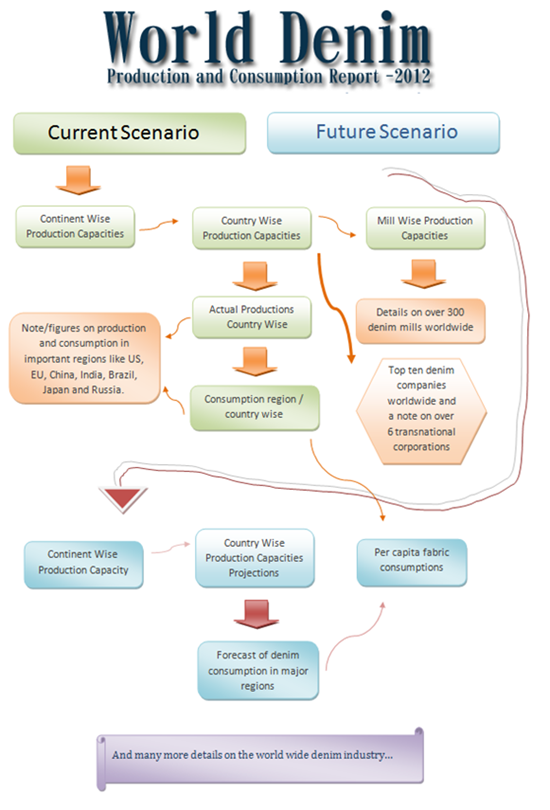
    We are very happy to announce the release of  a report on the world denim industry. We had been working on this report titled “ World Denim Market – Production and Consumption Report 2012”  and researched and collected information from various parts of the world gathering real time data from  over 100 denim professionals in the last few months  and diving deep into our database. It helped that I am associated with the denim industry since 1993 and running Denimsandjeans.com since last 5 years.

    The report shows the breakup of over 7 billion yards of denim capacity worldwide by Continent –> Country –> Individual companies. It analyses the future growth of the industry by region and shows where the production of over 9 billion yards would be done in 2021and also the consumption of the same..  It covers capacity /key persons/contacts and other details on over 300 denim mills worldwide . The report runs in  170 pages, has over 50,000 words  and is a large compendium on worldwide denim industry. It is divided into 5 chapters . A large number of tables and graphs accompany the information provided to help in easy understanding of the global denim scenario including how the world market for denim jeans is currently valued at over US$66 billion . Here are details on some contents of the report.Chapter 1 : Global Denim Production

    • Continent and country wise breakup of denim capacities
    • Actual Productions of denim fabrics (estimated) in 2011 – by country and total for the world.
    • Top 10 Denim groups worldwide.
    • A note on 8 Transnational corporations having denim productions in multiple countries /continents alongwith details of their capacities in each country .

    Chapter 2: Global Denim Consumption

    • Region wise breakup of denim fabric consumption.
    • A note on denim production and consumption in some major regions worldwide.
    • US – denim production and consumption – a note.
    • EU- denim production and consumption – a note.
    • China- denim production and consumption – a note.
    • India- production and consumption – a note.
    • Japan- denim production and consumption – a note.
    • Brazil- denim production and consumption – a note.
    • Russia – denim  consumption – a note
    • Forecast of denim production and consumptions in 2014,2016 and 2021
    • Estimated growth rates in increase of denim capacities in different regions 2011-14, 2014-16,2016-21 and 2011-21.
    • Estimated denim capacities in different regions of the world 2011-14, 2014-16,2016-21 and 2011-21.
    • Estimated growth rates in consumption in different regions 2011-14, 2014-16,2016-21 and 2011-21.
    • Estimated actual consumption in different regions of the world 2011-14, 2014-16,2016-21 and 2011-21.
    • Per capita consumption of denim fabric in different regions 2011 Projection of per capita consumption of denim fabric in meters in different regions in 2021.
    • % share of US, EU  and other regions in the total market of jeans (by value and by volume)

    Chapter 3: World denim capacity changes

    • Denim mills /capacities shut down in recent years.
    • Proposed expansions / new denim mills coming up in various regions around the world (this section will be updated again in few months for the buyers of this report)

    Chapter 3:  List and details of Denim Mills Worldwide

    • List of over 300 denim mills alongwith a short note on each.
    • Countrywise breakup of mill wise denim capacities.
    • Key Persons/ contacts in the companies .
    • Address/ phone/ fax / email etc coordinates in tabular form.

    Chapter 5: Data Section

    • US Import data for denim apparel , men’s denim and women’s denim jeans in US 2000-2012 with volumes , value and average prices.
    • EU Import data for denim apparel , men’s denim and women’s denim jeans in US 2000-2012 with volumes , value and average prices. (more details are given in list of tables below)
    • Japan – Exports and Imports of denim fabrics 2011-12
    • Exports of denim fabrics from Mexico 2011 Imports of denim fabrics into Mexico 2008-2011


    global denim market production and consumption 2012

    List of tables and Graphs

    The report has a large number of tables numbering over 75 and a number of charts and graphs . 
    Here is the list of tables (not  exhaustive).

    • Denim fabric production capacities – by country
    • Country wise actual denim fabric production –2011
    • Top 10 denim companies worldwide – by capacities
    • Tavex denim production units with capacities
    • Vicunha denim production units with capacities
    • ITG denim production units with capacities
    • Santana denim production units with capacities
    • Raymond UCO denim production units with capacities
    • Kaltex denim production units with capacities
    • Nien Hsing denim production units with capacities
    • Gap Guneydogu denim production units with capacities
    • Region wise breakup of denim fabric consumption
    • Imports of all denim apparel into US 2000-2012 : Value, volume , average prices.
    • Imports of denim apparel into USA – Jan-July 2012 vs Jan-July 2012
    • Fabric Consumption in USA
    • Denim Apparel Consumption In USA: 2009-2011
    • US Men’s Vs Women’s Jeans market ratio
    • Top denim fabric exporting countries to USA
    • Jeans Consumption in EU 27 Countries
    • Men’s-Boys’ and Women’s-Girls’ Jeans market in EU – a ratio based on imports
    • Production Capacities in India 2007-11
    • Denim Apparel Consumption in Japan –2011
    • Projected Denim Fabric Productions :2011-14, 2014-16,2011-2021
    • Projected Growth Rates of Denim Fabric Production Worldwide in % age 2011-14,2014-16,2011-21
    • World Denim Consumption Forecast 2011-2021
    • Per Capita Consumption Of Denim Fabrics Worldwide in 2021
    • Capacities Shut Down In Recent Times
    • Proposed Expansions / New Mills
    • 32 Tables for denim mills in each country with capacities
    • Data section
      1) Report on Imports of Men’s / Boys’ Denim Apparel to US: 2000-2012
      2) Report on Imports of Womens Jeans to US: 2000-2012
      3) 6 tables Top Exporting Countries to US 2012(Jan-June) For All Denim Apparel, mens jeans, womens jeans for 2011 and 2012
      4) Imports of All Women’s  Jeans Into EU : 2001:2012
      5)Top Exporting Countries to EU27 for All Jeans : 2011 and 2012 (Jany- May)
      6) Top Exporting Countries to EU27 for Mens’ Jeans/Breeches : 2011 and for 2012 (Jan-May)
      7) Top Exporting Countries to EU27 for womens’ Jeans/Breeches : 2011 and for 2012 (Jan-May)
      8) Top Exporting Countries to EU27 for Denim Fabrics : 2011 and 2012 (Jan-May)
      9) Exports of Denim Fabrics from Japan – Worldwide : Jan- June 2012 vs 2011
      10) Imports of Denim Fabrics into Japan from around the world : Jan- June 2012 vs 2011
      11) Exports of Denim Fabrics in 2011 from Japan to major countries in the world
      12) Japanese Imports of Denim fabrics from around the world in 2011 – Top Few Countries
      13) Denim Fabric Exports From Mexico – worldwide in 2011
      14) Mexico Imports of Denim Fabrics 2008- 2011 and more charts and tables.

    Price of the report

    The report, in pdf format,  is priced  at US $1900 for Company use license (within a single office ) license and US$2900 for  Enterprise use License( for use in multi location offices).. However, for some of our readers who are early birds , we are giving some copies at a discount and for the same discount coupons are mentioned below :

    Discount Coupons for the Denim Report

    Code Company use price Enterprise
    Use
    Copies available
    LAUNCHDIS2 $1630 $2530 Coupon
    Expired

    To avail the discount and to buy the report , you will need to go to this page and enter discount coupon along with other details for a registration. We shall then revert to you with a confirmation .We are currently accepting  payment by Paypal and Bank Wire modes.

    If you need any clarification , pl contact me at this email

  • EU- Over 12% Fall In Denim Imports Jan-May 2012

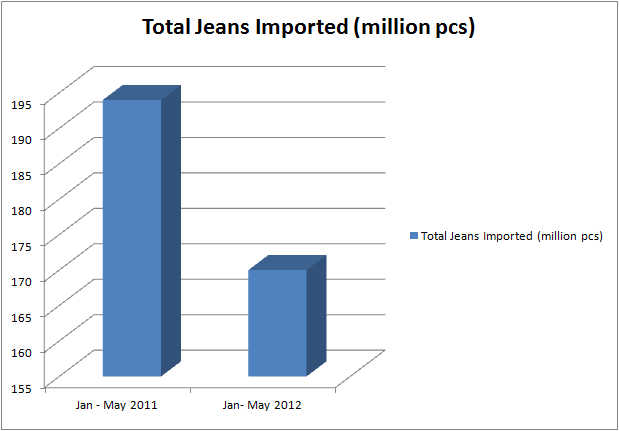
    The poor economic situation of the EU region is reflected in the relevant fall in the imports of Denim Jeans into EU. For the period Jan- May 2012 , the imports of all jeans into EU27 fell by about 12.37%  over the same period last year. This had been already been anticipated by most exporters and the exporters to EU have been feeling the brunt of this fall in terms of reduced orders. Exporters in countries like Bangladesh have felt the heat with reduced order positions, shorter lead times being given by the buyers and in some extreme cases, cancellation of confirmed orders.
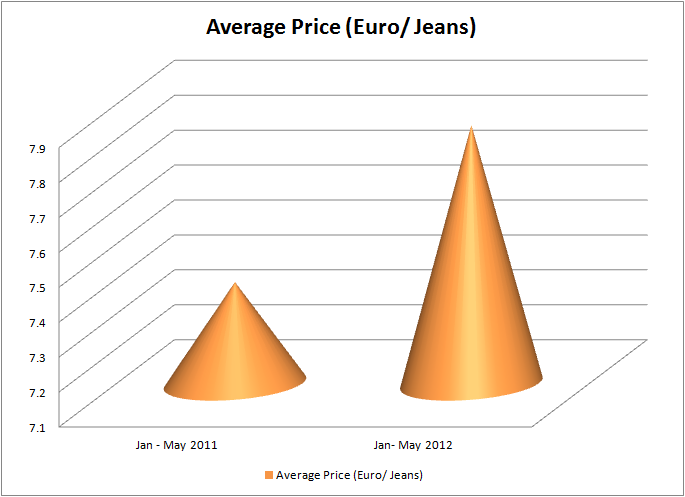
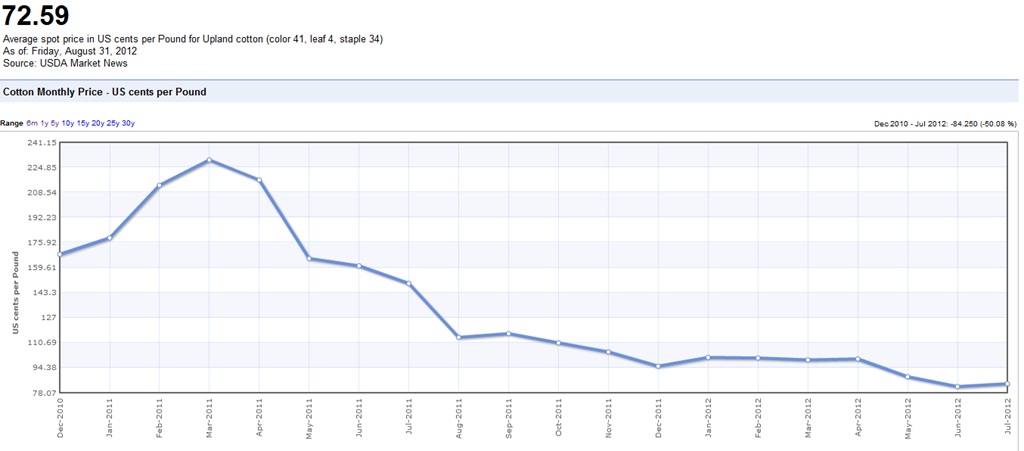
    However, the average price of imported jeans continues to rise with over 6% rise in this period . The effect of increased prices of cotton are still reflected in these jeans to some extent – even though the cotton prices are about 1/3rd of what they were in Feb 2011 – see chart at end ..

    EU Jeans imported 2012

    Whereas the quantity imported decreased from about 194 million pieces to 170 million pieces, the average price increased from Euro 7.39 /pc to Euro 7.84 per piece.

    Average price of Jeans in EU 2012

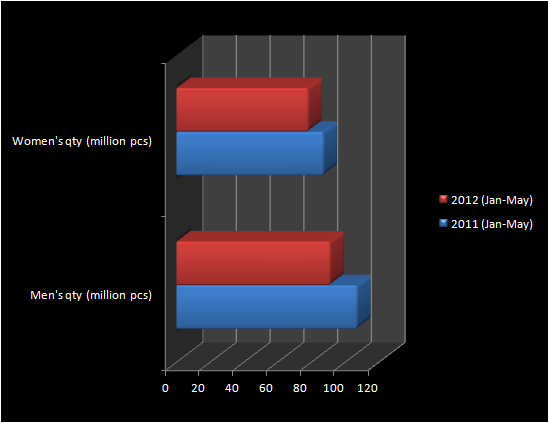
    It would be , however, important to understand whether both the men’s and women’s jeans imports have been equally affected . The men’s jeans imports fell by a larger % of about 14.95%  from 107 million pieces to 91 million pieces. On the other hand  the women’s jeans imports fell by 10.3% from 87 to 78 million pieces. This shows that the women’s import market is still comparatively better than that of men’s jeans and economic factors have affected the purchase of men’s jeans to a higher extent.

    mens and womens jeans exports eu

    This has consequently hurt countries which are more focused on exporting men’s denims . We will cover in another report shortly , the impact on top exporters and the changing market dynamics of jeans exports to EU.

    Cotton price chart for last 20 months
    cotton price chart
    Source: Indexmundi.com

  • Turkish Denim Demand

    Cotton Inc regularly comes out with lifestyle monitor surveys across various countries around the world. In this survey in Turkey(2012) , they come out with interesting facts on denim purchase by Turkish customers. Turkey is already a large denim producing country with both fabric and garment production. Famous denim brands from the country include Mavi, LTB, Cross etc and world  famous fabric producing mills like Orta, Isko etc have their base in Turkey. So how does the consumers in Turkey buy denim … Lets have a look at the highlights from the report.

    • The Global Lifestyle Monitor survey found that Turkish consumers shop more often for clothes than their European counterparts and agree about the value of durable apparel and good prices.
    • 65% of  Turkish shoppers say they love or enjoy wearing denim.
    • Younger consumers are more likely than older consumers to say they love or enjoy wearing denim (76% versus 49%).
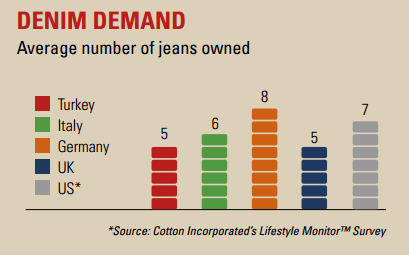
    • Turkish consumers own an average of eight denim garments,  five of which are denim jeans. When compared to the U.S. and Europe, denim ownership is lower among consumers in Turkey.
    • However,  younger Turkish consumers’ denim ownership is more in line with their European counterparts, as they own more denim garments (10 versus 7) and jeans (6 versus 4) than older Turks.
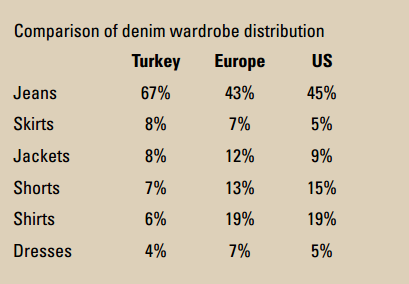
    • Overall, Turkish consumers’ denim wardrobes are less fragmented than the denim wardrobes of consumers in the U.S. and Europe; two-thirds of Turkish consumers’ denim wardrobes are dedicated to jeans, compared to 45% in the U.S. and 43% in Europe.

    denim demand turkeydenim wardrobe turkey

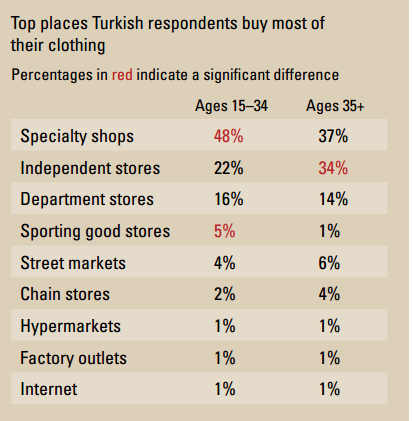
    The Turkish consumers reduced their purchase from unorganized retail – as happens in most economies which are growing fast. In 2012, 32% of Turkish consumers shopped at unorganized retail channels, down significantly from 41% in 2008. Specialty stores, where 43% of Turkish consumers purchase most of their clothing, are the most popular shopping destinations.

    turkish purchase of denim from stores

    However, internet shopping is still nascent and at a miniscule 1%..

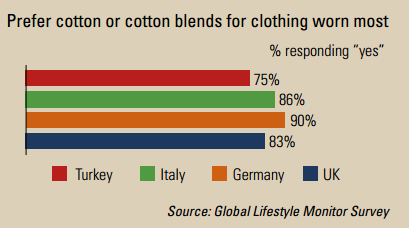
    The consumers also showed their preference for cotton clothes but at 75% of consumers saying so, it was significantly lower than those from countries like Germany and UK where almost 85-90% consumers want Cotton…!!

    cotton clothes turkey

    Turkish Exports of Denim Fabric / Mens and Women’s Jeans to US and EU

  • What Are Consumers Looking For When Buying Denim?

    What are the factors that influence the purchase decision of a consumer when he/she is buying denim jeans?  Is it the quality or the fit or the  color, wash, fabric, price, feel etc which influence  the decision of a man or woman when he is in a store selecting jeans..
    While we know that all of these factors in some measure affect the purchase decision , but which factors are more important compared to other factors?

    Cotton Inc USA did an annual survey  of US consumers in 2011 to work out a report on the factors affecting the purchase of denim by Men and Women. Here

    What factors are important for women to purchase denim jeans in USA?

    Denim Jeans Purchase Factors Women

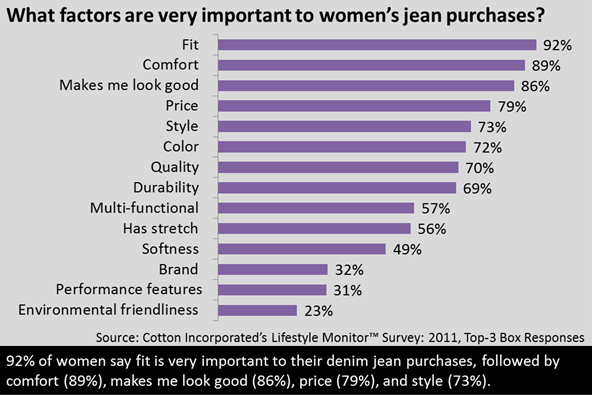
    As we can see from the results of   Cotton Inc survey in US ,for women FIT IS THE MOST IMP. Attribute.  Over 92% feel that fit is very important to their jeans purchase decision. Comfort comes second  and -though very important – falls behind the fit . Other important factors are ‘Makes me look good’ (of course ! ) , price , style etc..
    Stretchability as a factor which is showing low in the rankings seems strange because women jeans are almost 80%+ stretch. However, the biggest loser is the ENVIRONMENTAL FRIENDLINESS factor – which comes in the last and does not seem to be very  important for the women in US while purchasing denim.. Environmental consciousness is actually conspicuous by its absence in most of the markets around the world where the buyers are not really aware of the actual damage that jeans production is causing. However, I am sure the importance of this factor is increasing slowly everyday and in the near future this factor coming up . Already initiatives like Organic Cotton, BCI and others are gaining in strength and harmful production processes like sandblasting are being controlled to some extent and water saving in jeans manufacturing encouraged. However, at consumer level, the awareness is still very low.

    What factors are important for men to purchase denim jeans in USA?

    Denim Jeans Purchase Factors Men

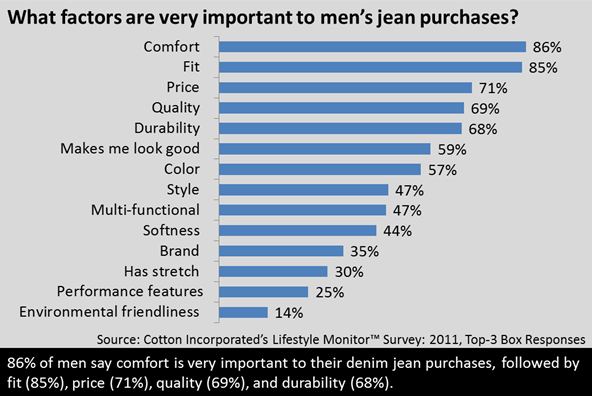
    Men are most concerned with comfort with FIT coming close second. And of course they are more concerned about price than women !!  For them multi functionality of denim is not as important (compared to women) – seem happy if the jeans performs its normal function of feeling comfortable. Brand consciousness is more than women while stretchability is not really very important. Last , but not least , their environmental consciousness is much below that of women (kudos to women !! )…

    Finally , the message for the denim brands – if you have great FITS , the consumers may ignore other factors to some extent. !!!

    Denimsandjeans Resource Snippets
    J Brand Jeans- Designer Denim Fit Guide
    All Denim Apparels Into USA From China:2000-2012
    R By 45rpm Denim Jeans – A Chat With Ehren At NY Store
    Levi’s? Master Denim Tailor-Union Square job
    Current/Elliott – Denim Brand From U.S
  • ITG– Financials 1st Quarter 2012


    imageITG Group is one of the most important textile group related to denim industry. Cone Denim is a part of the ITG group and Cone needs no introduction having being serving denim industry for over a 100 years.. In this report which is a partial reproduction from company’s own report for the 1st quarter of 2012 , it is reflected that the company has been badly affected by the economic downturn and the increase in raw material prices in 2010/11. The company is trying , through various cost reduction and marketing initiatives to reduce the impact of these macro economic factors.

    ITG Financial Report For Jan-March ‘12

    International Textile Group, Inc.is a global, diversified textile manufacturer headquartered in Greensboro, North Carolina, with operations principally in the United States, China, and Mexico. ITG’s long-term focus includes realizing the benefits of its global expansion, including reaching full production at ITG facilities in China, as described below, and continuing to seek other strategic growth opportunities.

    The Company believes it is one of the world’s largest and most diversified producers of denim fabrics and the largest producer of better denim fabrics for products distributed through department stores and specialty retailers. In addition, the Company believes it is one of the largest worsted wool manufacturers and commission printers and finishers in North America, and is a leading developer, marketer and manufacturer of other fabrics and textile products.

    The Company is organized and managed primarily according to product categories and manufacturing processes rather than by markets or end-use customers. The Company currently has five operating segments that are reported to the chief operating decision maker (“CODM”) and four reportable segments that are presented herein.

    • The bottom-weight woven fabrics segment includes heavy weight woven fabrics with a high number of ounces of material per square yard, including woven denim fabrics, synthetic fabrics, worsted and worsted wool blend fabrics used for government uniform fabrics for dress U.S. military uniforms, airbag fabrics used in the automotive industry, and technical and value added fabrics used in a variety of niche industrial and commercial applications, including highly engineered materials used in numerous applications and a broad range of industries, such as for fire service apparel, ballistics materials, filtration, military fabrics and outdoor awnings and covers.
    • The commission finishing segment consists of textile printing and finishing services for customers primarily focusing on decorative fabrics and specialty prints as well as government uniform fabrics primarily for battle fatigue U.S. military uniforms.
    • The narrow fabrics segment consists of narrow webbing products for safety restraint products such as seat belts and military and technical uses.
    • The all other segment consists of expenses related to the idled Cone Denim de Nicaragua and ITG-PP joint venture plant facilities, transportation services and other miscellaneous items.

    International Greenfields

    The Company’s facilities in China experienced increasing capacity utilization during 2011 as the economy improved from the significant downturn starting in 2008. As previously disclosed, in April 2009, the Company idled its Cone Denim de Nicaragua facility until further strategic alternatives are finalized. In addition, as previously disclosed the Company idled its Vietnam facility while in arbitration with its joint venture partner.

    Business and Industry Trends

    The global economic environment continues to be uncertain and volatile. Concerns related to continued high unemployment, government and municipal budgetary issues and the prospects for sustained economic recovery continue to impact consumer, military and municipal spending and our businesses, which could continue to have adverse effects in the significant markets in which we operate. The Company has taken, and expects to continue to take, steps to counter this continued economic uncertainty. These actions include, among other things, negotiating higher sales prices for certain products, negotiating new working capital financing arrangements, focusing on new product development projects and implementing cost saving initiatives.

    During the latter part of 2010, cotton prices began increasing dramatically and reached historical highs in the first half of 2011 due to weather-related and other supply disruptions, which, when combined with increasing demand for cotton, particularly in Asia, created concerns about continued short-term availability in addition to increased costs for the Company’s products. While cotton prices have recently declined from the historical highs, cotton and wool prices continue to fluctuate and remain high as compared to historical levels. The Company’s bottom-weight woven fabrics segment has historically entered into firm purchase commitments for cotton and wool commodity raw materials used in the manufacture of apparel fabrics. Such non-cancellable firm purchase commitments are secured to provide the Company with a consistent supply of a commercially acceptable grade of raw materials necessary to meet its operating requirements as well as to meet the product specifications and sourcing requirements with respect to anticipated future customer orders. Because of the Company’s commitments related to raw materials, declines in selling prices below the committed price have had, and could continue to have, a negative impact on the Company’s results.

    While we have been able to pass on some of these increased raw material costs through to our customers, the Company’s margins were negatively impacted in 2011 and in the three months ended March 31, 2012 by higher raw material prices. In response to the cost increases in raw materials, we have increased sales prices and we expect to continue to attempt to increase sales prices as necessary in response to higher costs or committed purchase contracts in order to provide sufficient margins. However, the Company has had difficulty maintaining higher sales prices as certain raw material market prices have fallen despite the higher raw material costs that remained in the Company’s inventories through the three months ended March 31, 2012. If the Company incurs increased raw material or other costs that it is unable to recoup through price increases, or experiences interruptions in its raw materials supply, our business, results of operations, financial condition and cash flows may be adversely affected.

    Restructuring Charges and Asset Impairments

    As a result of the macro-economic conditions discussed above and the continued financial challenges facing the Company, the Company initiated a restructuring plan in late 2011 that focused on reducing overall operating expenses by including manufacturing and other cost reduction initiatives, such as

    • workforce reductions at the bottom-weight woven fabric segment’s White Oak denim facility
    • and administrative functions to improve efficiencies.

    As described above, the Company announced in December 2011 that the ITG-PP joint venture facility(at Vietnam)  would be idled for an unknown period of time beginning in January 2012 and ITG-PP incurred direct costs related to the decision to idle the facility . The 2012 restructuring charges are primarily related to the idling of the Company’s ITG-PP joint venture facility in the amount of $2.5 million and workforce reductions at the Company’s White Oak denim facility in the amount of $0.1 million. The 2011 provision for restructuring charges of less than $0.1 million was primarily related to the Company’s multi-segment selling and administrative cost reduction plan.

    Results of Operations

    Net sales and income (loss) from continuing operations before income taxes for the Company’s reportable segments are presented below (in thousand US Dollars). The Company evaluates performance and allocates resources based on profit or loss before interest, income taxes, expenses associated with refinancing activities, restructuring and impairment charges, certain unallocated corporate expenses, and other income (expense) – net. Intersegment sales and transfers are recorded at cost or at arms’ length when required by certain transfer pricing rules. Intersegment net sales for the three months ended March 31, 2012 and 2011 were primarily attributable to commission finishing sales of $4.9 million and $5.0 million, respectively.

                                                                Three Months Ended
                                                           March 31,           March 31,
                                                             2012                2011
    
    Net Sales:
    Bottom-weight Woven Fabrics                         $       140,970     $       135,766
    Commission Finishing                                         11,839              10,690
    Narrow Fabrics                                                7,530               6,665
    All Other                                                     6,393               9,905
                                                                166,732             163,026
    Intersegment sales                                           (4,870 )            (5,040 )
                                                        $       161,862     $       157,986
    
    Income (Loss) From Continuing Operations Before
    Income Taxes:
    Bottom-weight Woven Fabrics                         $         1,459     $         8,525
    Commission Finishing                                            407                 136
    Narrow Fabrics                                                 (361 )              (327 )
    All Other                                                    (1,393 )            (5,334 )
    Total reportable segments                                       112               3,000
    Corporate expenses                                           (3,001 )            (3,844 )
    Other operating income - net                                      3                 403
    Restructuring charges                                        (2,033 )               (14 )
    Interest expense                                            (13,791 )           (11,557 )
    Other income (expense) - net                                 (2,501 )              (972 )
                                                                (21,211 )           (12,984 )
    Income tax expense                                             (890 )            (1,014 )
    Equity in loss of unconsolidated affiliates                    (378 )               (24 )
    Loss from continuing operations                             (22,479 )           (14,022 )
    Discontinued operations:
    Loss from discontinued operations, net of taxes                   -                 (29 )
    Gain on disposal, net of taxes                                    -               2,110
    Income from discontinued operations                               -               2,081
    Net loss                                                    (22,479 )           (11,941 )
    Less: net loss attributable to non controlling
    interests                                                    (1,874 )            (2,019 )
    Net loss attributable to International Textile
    Group, Inc.                                         $       (20,605 )   $        (9,922 )

    ($ in ‘000s)


    Comparison of Three Months Ended March 31, 2012 to Three Months Ended March 31, 2011

    Consolidated: Consolidated net sales in the three months ended March 31, 2012 and 2011 were $161.9 million and $158.0 million, respectively, an increase of $3.9 million, or 2.5%, in the three months ended March 31, 2012 compared to the three months ended March 31, 2011. This increase was primarily due to an improved product mix in the Company’s technical fabrics business and higher selling prices charged to recover higher raw material costs at most of the Company’s other businesses. Net sales also increased due to sales volume increases primarily in the airbag and selected synthetic fabrics businesses due to improved economic conditions in the automotive industry and selected synthetic fabrics retail apparel markets. These increases were partially offset by volume declines in most of the Company’s other product lines primarily due to continued general unfavorable economic conditions affecting those markets as well as increased pricing pressures and municipal government budget cuts affecting demand at certain businesses. The Company also experienced reduced sales of $2.9 million at its cotton fabric and garment manufacturing complex in Vietnam due to the idling of that facility in January 2012 as described above.

    Gross profit in the three months ended March 31, 2012 was $9.2 million, or 5.7% of net sales in the three months ended March 31, 2012, compared to $12.6 million in the three months ended March 31, 2011, or 8.0% of net sales. Gross profit margins were negatively impacted primarily by higher raw material costs that were not fully offset by higher selling prices as well as manufacturing inefficiencies at certain locations due to volume declines, partially offset by reduced losses at the idled ITG-PP facility of $3.2 million. Operating loss in the three months ended March 31, 2012 was $4.9 million compared to $0.5 million in the three months ended March 31, 2011 with such reduction primarily due to the lower gross profit margins described above and higher restructuring charges of $2.6 million mainly related to the idling of the ITG-PP joint venture facility, partially offset by lower selling and administrative expenses described below.

    Bottom-weight Woven Fabrics: Net sales in the bottom-weight woven fabrics segment in the three months ended March 31, 2012 increased $5.2 million to $141.0 million as compared to the $135.8 million recorded in the three months ended March 31, 2011. The increase in sales primarily resulted from $14.9 million of higher selling prices charged to recover higher raw material costs and improved product mix primarily as the result of the development of new higher margin products, as well as higher sales volumes of $5.0 million primarily in the airbag and synthetic fabrics businesses due to improved economic conditions in the automotive industry and selected synthetic fabrics retail apparel markets. Improvements in this segment were partially offset by lower sales volumes of $14.7 million primarily in the denim business due to general unfavourable economic conditions affecting demand in that market, as well as increased pricing pressures, and, to a lesser extent, in certain of the technical fabrics businesses due to municipal government budget cuts.

    Income in the bottom-weight woven fabrics segment was $1.5 million in the three months ended March 31, 2012 compared to $8.5 million in the three months ended March 31, 2011. The decrease in income was primarily due to higher raw material costs of $9.5 million primarily in the denim business, lower selling prices of $0.6 million and higher energy costs of 0.3 million. These reductions were partially offset by an improved product mix of $1.7 million primarily in the technical fabrics business, lower labor costs of $0.9 million due to reduced production volumes and favourable impacts from changes in foreign currency exchange rates of $0.9 million.

    Commission Finishing: Net sales in the commission finishing segment were $11.8 million in the three months ended March 31, 2012 compared to $10.7 million in the three months ended March 31, 2011. The increase from the prior year period was primarily due to sales volume increases of $1.3 million due to increased sales to certain U.S. and foreign militaries. Commission finishing markets in the 2012 and 2011periods were also negatively affected by diminished discretionary income and consumer spending in the U.S. as well as increased competition. Income in the commission finishing segment was $0.4 million in the three months ended March 31, 2012 compared to $0.1 million in the three months ended March 31, 2011. The increase in operating results was primarily due to higher sales volumes in the government sector and lower raw material, energy and labor costs, partially offset by manufacturing inefficiencies.

    Narrow Fabrics: Net sales in the narrow fabrics segment were $7.5 million and $6.7 million in the three months ended March 31, 2012 and 2011, respectively. The increase from the prior year was primarily due to higher sales volumes of $0.3 million primarily related to the segment’s seat belt business due to improved economic conditions in the automotive industry, and $0.6 million related to higher selling prices to recover higher raw material costs and a more favourable product mix related to certain government contracts. Loss in the narrow fabrics segment was $0.4 million in the three months ended March 31, 2012, compared to $0.3 million in the three months ended March 31, 2011. The decrease in operating results was primarily due to higher raw material and energy costs and manufacturing inefficiencies, partially offset by higher selling prices and a more favourable product mix of $0.6 million.

    All Other: Net sales in the all other segment in the three months ended March 31, 2012 and 2011 were $6.4 million and $9.9 million, respectively. The decrease from the prior year period was primarily due to lower sales at the ITG-PP facility in Vietnam which was idled in January 2012. Loss in the all other segment was $1.4 million in the three months ended March 31, 2012 as compared to $5.3 million in the three months ended March 31, 2011. Operating losses in this segment were primarily due to depreciation and other carrying costs related to the idled ITG-PP facility and, to a lesser extent, the idled Cone Denim de Nicaragua facility. Operating losses at the ITG-PP facility were lower in the 2012 period as compared to the 2011 period as a result of the idling of the Vietnam facility in January 2012 as described above.

    Sponsored Link:

    image

  • Bread and Butter–Spring Summer 2013


    Bread and Butter - Temple of Denim

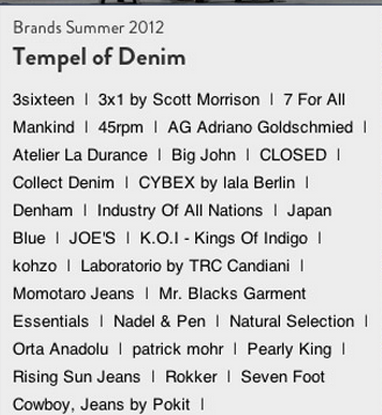
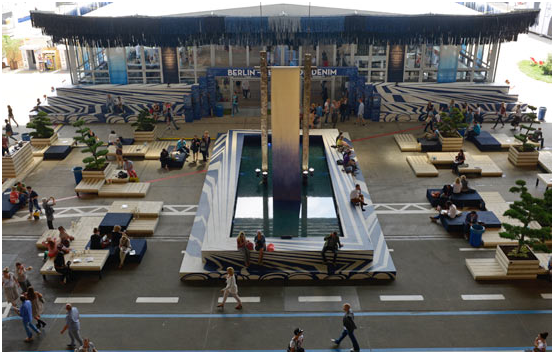
    The Bread and Butter show for Spring/Summer 2013 was successfully concluded last week.  This year’s theme wasThe Rock – a testament to B&B’s presence and prominence in the industry.  Though the show experienced some setbacks with the withdrawal of major brands – Levi’s, Lee and Diesel , new niche brands found place and a new concept  ‘ Temple of Denim’  was created  with exclusive high-end Japanse, American and European denim brands. For the moment, Temple of imagedenim will only there for this one time, but there are a lot of possibilities for the future. The Temple of Denim became the new heart of the show . With about 27 denim brands including 45rpm from Japan, Denham, Adriano Goldschmidt, 7 For All Mankind, 3×1, Natural Selection, Rising Sun Co., Momotaro, Japan Blue, and others. Something new was the recognition given to two highly innovative denim mills – TRC (Italy ) and Orta Anadolu (Turkey) – who were included in the Temple area alongwith the brands.

    Housed in over 3000 sq mtrs of roofed terrace, the show explored the theme of religion and was  a visual treat with  imitations of several religions from around the world. The show, in the wild spirit of denim,  ran on the wooden tables around which the visitors were seated. Temple of denim - BBB - Spring Summer 2013

    Among the trends noticed at BBB  can be included Colored jeans – but which have  also undergone a transformation for the 2013 summer season; with textured , metallic and ombre jeans most noticeable. Indigo on Indigo was a popular theme as well.

    We shall be publishing complete trends from BBB shortly. Check out some images from BBB and a video showing the Temple of Denim show

    Bread and Butter - Spring Summer 2013

    Bread and Butter - July 2012

    Bread and Butter - July 2012

    Video from Temple of Denim Show

    Data Sections at Denimsandjeans.com

  • US Columbia Trade Promotion Agreement (TPA) In Force

    US Colombia Trade : DenimMore than 80% of U.S. exports of consumer and industrial products to Colombia become duty-free as part of the U.S. – Colombia Trade Promotion Agreement which came into force on May 15,2012. This includes agricultural and construction equipment, building products, aircraft and parts, fertilizers,textiles, information technology equipment, medical scientific equipment, and wood. The United States remains the largest supplier to the Colombian market, with Colombian imports from the U.S. in 2011 totaling $13.7 billion, or one-quarter of Colombia’s imports.

    Other top Colombian import markets include China, Mexico and Brazil. The U.S. is the largest market for Colombia’s exports, representing nearly 40 percent of the Colombian export market.

    • Between 2001 and 2011 U.S. goods exports to Colombia quadrupled, growing from $3.6 billion in 2001 to $14.3 billion in 2011. U.S. goods exports in 2011 were 19 percent higher than the previous year.  
    • Colombia has grown from being the 33rd largest market for U.S. goods exports in 1991 to become the 22nd largest market in 2011.
    • Manufactured goods represented 92 percent of U.S. goods exports to Colombia in 2011. 
    • Increasing exports to Colombia has benefits at the local level as well as the national. In 2011, more than half of U.S. States (26 total) reported merchandise export shipments to Colombia above $75 million.
    • In 2011, the largest state exporters of merchandise to Colombia included Texas ($5.1 billion), Florida ($2.8 billion), Louisiana ($894 million), California ($534 million) and Illinois ($454 million).

    Impact On Textiles Trade

    Lets see how this act would impact the trade of textiles between the two countries. Many of Colombia’s textile and apparel inputs, including fibers, yarns, and fabrics, are purchased from U.S. suppliers. Until the entry into force of the U.S.-Colombia Trade Promotion Agreement (TPA), these inputs have been subject to duties of up to 20 percent, with the exception of inputs used in apparel qualifying for trade preferences under the  Andean Trade Promotion and Drug Eradication Act(ATPDEA). The Andean Trade Preference Act (ATPA) was enacted in December 1991, to help four Andean countries (Bolivia, Colombia, Ecuador, and Peru) in their fight against drug production and trafficking by expanding their economic alternatives.
    With the TPA in place, tariffs will be eliminated, reducing costs, and providing greater incentive for Colombian firms to buy U.S. fibers, yarns, and fabrics and for U.S. firms to invest in Colombia.  It’s a win-win for both the U.S. and Colombian textile and apparel industries.

    In addition to duty-free benefits, the TPA contains several important flexibilities and protections to make sure that the U.S. industry is not harmed by the flow of imports from Colombia. For example, the TPA contains a textile-specific safeguard mechanism that allows most favoured nation (MFN) tariffs to be temporarily re-imposed if a surge in duty-free imports from Colombia is shown to be causing or threatening to cause serious damage to domestic industry. The TPA also includes specific customs cooperation language for enforcing measures affecting trade in textile and apparel goods to help prevent the circumvention of the agreement’s rules on the origin of inputs and finishing processes.

    Current Status of Denim Trade And Likely Impact

    • What is the status of export of  denim apparels from Colombia to US since 2008 to now ie March 2012…. ? What are the quantities , values and prices of such exports ?
    • Is this trade showing an uptrend ?
    • Lets have a look a the table below :

    Year

    Qantity (million pcs)

    Value(Million USD)

    Av. Price (USD/pc)

    2008

    7.80

    75.38

    9.66

    2009

    5.07

    51.34

    10.12

    2010

    6.69

    73.72

    11.01

    2011

    3.24

    40.14

    12.38

    2011 (Jan-April)

    1.04

    12.46

    11.96

    2012(Jan-April)

    1.03

    12.23

    11.82

    The exports of denim apparel from Colombia to US have consistently decreased over the period of 4 years. The reasons are varied including the current economic situation in the US. However,  lately there have been efforts by some retailers to shift the sourcing to South / Central America given the increasing costs of production in China. This has already given fillip to near sourcing and this is also going to help increase the trade between US and Columbia .

    Sponsored Link:
    Fall/Winter Denim Collections ‘13/14 (video)

  • Denim By PV–May 2012

    Denim by PV – the famed denim show – shall be held again on 23rd-denim by pv 2013-201424th May at La Halle Freyssinet and the denim players shall display their Autumn/Winter 2013-2014 collections. We are giving herebelow the list of exhibitors (about 84) who shall be participating in this show . Also here is a note on some of the companies and the new products that they shall be showcasing:

    Orta Anadolu , Turkey

    Orta shall be displaying their new concepts for A/W   2013/14 which include :

    • Sharkskins : Sharkskin suits were a staple of 1960s fashion. With two flavours of ‘Angelshark’ and ‘Reefshark’ with a differing variety of coating intensity , these fabrics provide a great sheen on hot press.
    • Glitter: Shining sparkles on lightweight fabrics keep on shining after homewash and Orta glitter revives the Motown fashion with this innovation.
    • Vintage nature fabrics in heavy constructions and colors like Toffie, Caramel, Rosehip, Burlywood, Army green form part of the immortal spirit of Orta Vintage.
    • Slowfits– superior performing fabrics in stretch constructions.This season, thanks to Dual Core Technology, Orta takes these efforts to a higher level with a wider choice of fabrics especially in new flat  and sateen constructions.
      Orta Anadolu

    Invista

    INVISTA innovations will be  classified in 3 themes.

    • ETHNIC – Here, LYCRA® dualFXâ„¢ fabrics provide outstanding recovery for super stretch garments, allowing even the skinniest jeans and jeggings to keep their shape.
    • ECOLOGY – INVISTA worked with expert-finishers Jeanologia to create garments combining INVISTA fibres with Jeanologia’s innovative finishing techniques.
    • EMERGING – features fabrics made from emerging technologies and/or emerging parts of the world, such as India, Pakistan and Bangladesh. .

    ITV

    ITV shall present :

    • A new 3D collection
    • Super soft fabrics
    • Color denims

    Kuroki, Japan

    The manufacturer of  denim from Japan will be introducing softer jeans fabrics and denims with specially elaborated stretch.
    The accent is on the silhouette for the women’s market, with a denim that clings to the body, and a fluid denim.

    Here is a list of exhibitors with a link to their sites. Also their contact emails are given.

    Denim Weavers

    ABSOLUTE DENIM CO., LTD THAILAND Email
    ADM Artistic PAKISTAN Email
    ARTISTIC MILLINERS PAKISTAN Email
    ARTISTIC FABRIC MILLS PAKISTAN Email
    ARVIND LIMITED INDIA Email
    ATLANTIC MILLS CO. LTD THAILAND Email
    BERTO E.G. INDUSTRIA TESSILE S.R.L ITALY Email
    BLUE FARM TEXTILE LTD HONG KONG Email
    BOSSA DENIM & SPORTSWEAR TURKEY Email
    CALIK DENIM TURKEY Email
    TRC CANDIANI ITALY Email
    CAPPIO TESSUTI SRL ITALY Email
    CENTRAL FABRICS LTD HONG KONG Email
    CONE DENIM UNITED STATES Email
    DENIM VALLEY BY ROYO SPAIN Email
    DYNAMO DENIM KUMASCILIK LTD TURKEY Email
    GTX SRL ITALY Email
    HELLENIC FABRICS GREECE Email
    ICOMA MOROCCO Email
    INDICOTT TURKEY Email
    I.T.V – INDUSTRIA TESSILE DEL VOMANO ITALY Email
    ISKO TURKEY Email
    ITALDENIM SPA ITALY Email
    KIPAS DENIM TURKEY Email
    KUROKI CO. LTD Email
    MARASSI DENIM SIRIKCIOGLU MENSUCAT TURKEY Email
    MATESA TEKSTIL TURKEY Email
    MONTEBELLO SRL ITALY Email
    NIHONMENPU TEXTILE CO LTD JAPAN Email
    ORTA ANADOLU TAS TURKEY Email
    PROSPERITY TEXTILE (HK) LTD HONG KONG Email
    REALTEKS TEXTILES COMPANY LTD TURKEY Email
    R.S.P. 51, S.A. SPAIN Email
    TEXTIL SANTANDERINA SA SPAIN Email
    SANTANENSE BRAZIL Email
    SWIFT DENIM FRANCE Email
    UCO RAYMOND WORLDWIDE DENIM Belgium Email
    US DENIM MILLS LTD PAKISTAN Email
    VICUNHA EUROPE Switzerland Email

    Accessory Manufacturers

    BERNING FRANCE Email
    CADICA GROUP SPA ITALY Email
    CLOSE TO CLOTHES FRANCE Email
    DERIDESEN ETIKET TURKEY Email
    DORLET FRANCE Email
    LA GRIFFE INTERNATIONALE TUNISIA Email
    INCI BUTTONS TURKEY Email
    J-VAL SRL ITALY Email
    LANDES LEDERWARENFABRIK GMBH GERMANY Email
    MION SPA ITALY Email
    LANDES LEDERWARENFABRIK GMBH GERMANY Email
    MION SPA ITALY Email
    PANAMA TRIMMINGS SRL ITALY Email
    PRYM FASHION GERMANY Email
    TIMAY & TEMPO TURKEY Email
    TURTEKS TEKSTIL ETIKET TURKEY Email
    YKK EUROPE LTD ITALY Email

    Garmenters and Finishers

    BLUE LOFT -ALLIANCE GROUP MOROCCO Email
    CITY CORPORATION MOROCCO Email
    CRESCENT BAHUMAN LTD PAKISTAN Email
    CONFECTION RAS JEBEL TUNISIA Email
    CROSSING MOROCCO Email
    DEMCOINTER SARL TUNISIA Email
    DENIM AUTHORITY TUNISIA Email
    DENIM DE L’ILE LTD Mauritius Email
    ECO DENIM TUNISIA Email
    EREKS GARMENT CO. TURKEY Email
    FASHION POINT TEKSTIL URETIM TURKEY Email
    FG TEKSTIL TURKEY Email
    GONSER GROUP TUNISIA Email
    LAVASSER SARL MOROCCO Email
    LEFAXX JEANS TURKEY Email
    MESURA TEKSTIL TURKEY Email
    PARIS TEXAS MOROCCO Email
    REALKOM TEKSTIL URUNLERI TURKEY Email
    RIMAKS TURKEY Email
    CONFECTION SABRINA MOROCCO Email
    SARTEX TUNISIA Email
  • Denmark : Denim Jeans Imports 2010-2011

    denmark denimDenmark , with a population of only about      is a small country  compared to many other countries in EU with a population of only about 5.5 million . The Danish apparel retail is valued at over $6.5 billion and is sizeable for the country of such a small population.   The country has a decent consumption of denim garments due to popularity of denims and it is estimated that the per capita consumption is about 4 jeans per person p.a with over 20 million pieces of jeans sold in Denmark.

    So where do the jeans come to Denmark from ?

    The jeans most come to Denmark in big quantities from

    • China
    • Turkey
    • Bangladesh

    and small quantities from Pakistan , India etc. China enjoyed a market share of about 50% in the total jeans imported into Denmark in 2010. However , within a year , it lost about 4-5% points and the share is being taken up countries like Bangladesh, Turkey, Pakistan and India. This reflects the growing

    Lets have a look at the quantities and prices at which the jeans are coming to Denmark  from some of the important exporting  countries in 2010 and 2011 …

    Country

    2010( qty in million pcs)

    2011
    (qty in million pcs)

    2010 (Price in Euro/pc)

    2011
    (price in Euro/pc)

    China 10.21 8.76   6.28   6.58
    Turkey 5.22 5.44 14.37 16.27
    Bangladesh 1.84 2.84   4.21   5.85
    India 0.35 0.91   8.50   9.42
    Pakistan 0.29 0.34   8.14   9.24

    Looking at the table above , it is clear that China is losing market share rapidly due to rising costs. Also, its surprising to see that Turkey is gaining share – reflecting that speedy turnaround and very high quality garments are required for this market and the prices touching Euro 16+ are not less either. 
    Bangladesh and India are quickly gaining share of the market though the prices that India gets are far above those of Bangladesh.

    Sponsored Link:

    image

  • AGOA–Denim Exports 2011

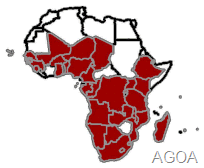
    imageThe African Growth and Opportunity Act (AGOA) was signed into law on in May 2000 as Title 1 of The Trade and Development Act of 2000. The Act offers tangible incentives for African countries to continue their efforts to open their economies and build free markets.

    AGOA provides duty-free and quota-free treatment into US  for eligible apparel articles made in qualifying sub-Saharan African countries through 2015. Qualifying articles include:

    • apparel made of U.S. yarns and fabrics; apparel made of sub-Saharan African (regional) yarns and fabrics until 2015, subject to a cap;
    • apparel made in a designated lesser-developed country of third-country yarns and fabrics until 2012, subject to a cap;
    • apparel made of yarns and fabrics not produced in commercial quantities in the United States;
    • textile or textile articles originating entirely in one or more lesser-developed beneficiary sub-Saharan African countries;
    • certain cashmere and merino wool sweaters; and eligible handloomed, handmade, or folklore articles, and ethnic printed fabrics.

    Under a Special Rule for lesser-developed beneficiary countries, those countries with a per capita GNP under $1,500 in 1998,  enjoy an additional preference in the form of duty-free/quota-free access for apparel made from fabric originating anywhere in the world. The Special Rule is in effect until September 30, 2012 and is subject to a cap.

    During the 2011 review process, President Obama determined that all the countries currently eligible for trade preferences and other benefits under the African Growth and Opportunity Act (AGOA) would remain eligible and that no new countries would be added as AGOA beneficiaries.

    President Obama also signed a presidential proclamation reinstating Côte d’Ivoire, Guinea and Niger as eligible for AGOA benefits. Each of these countries was previously ineligible, but during a separate review process, the president determined that they had met the act’s eligibility criteria.

    The top five beneficiary countries were Nigeria, Angola, South Africa, Republic of Congo and Chad. Other leading AGOA beneficiaries included Gabon, Lesotho, Kenya, Mauritius and Swaziland.

    Denim Apparel Exports– What is the Status ?

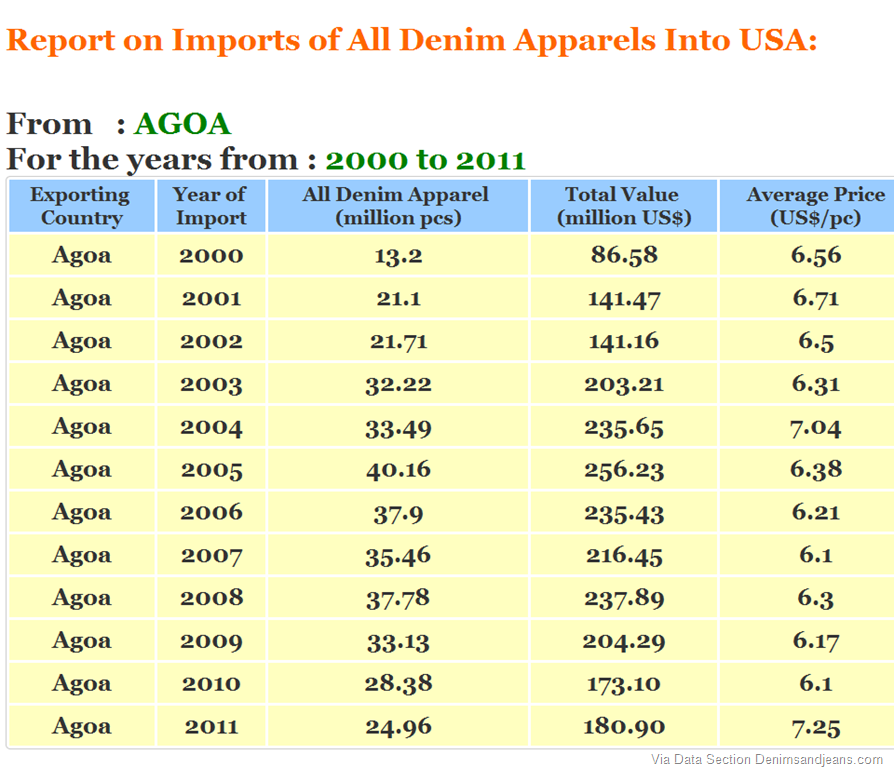
    How has AGOA region countries been doing when it comes to denim apparel exports ? Lets have a look at the data of the last 10 years of exports from AGOA region to US.

    denim apparel exports to us from africa

    When we look at the data , we find that the exports of denim apparel from AGOA to US actually peaked in 2005 when quota regime was just being dismantled. After that , the apparel exports have been more or less flat. In 2010 and 2011 , the exports have actually dipped substantially – reducing the importance of AGOA as a region for export of denim products. In 2011 alone – there has been a fall of over 15% in exports from this region to US. Almost similar fall was there in 2010 over 2009 .. When we look at specific countries , we find the scenario not too rosy for some countries:

    • Madagascar : 84% reduction in quantities exported in 2011 over the same period in 2010
    • Mauritius : 34% reduction in 2011

    However, some countries from AGOA like  still remain interesting for denim production.

    List of countries that fall in AGOA region

    Angola,Benin,Botswana,Burkina Faso,Burundi,Cameroon, Cape Verde, Chad, Comoros,Congo (DROC),Congo (ROC), Djibouti , Ethiopia,Gabon, Gambia ,Ghana ,Guinea ,Guinea-Bissau,Kenya ,Lesotho,Liberia ,Madagascar ,Malawi,Mali,
    Mauritius,Mozambique,Namibia,Niger ,Nigeria ,Rwanda ,Sao Tome & Prin ,Senegal,Seychelles , Sierra Leone, South Africa, Swaziland,Tanzania ,Togo ,Uganda and Zambia

    Sponsored Link:

  • China Apparel Market–Brands, Sales , More…

    An interesting report by Li and Fung brings out some of the important aspects of the Chinese apparel market and shows how it is growing rapidly making it an important destination for the brands worldwide.  Here are some excerpts from the report….

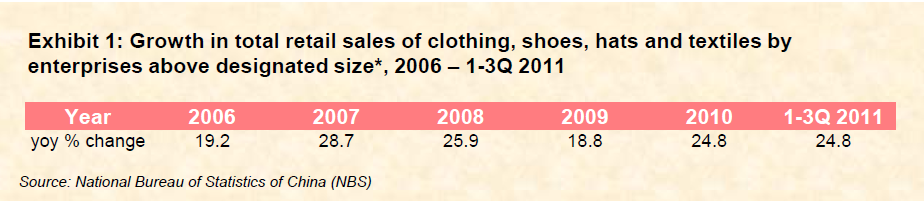
    Total Apparel Market size in 2010 : 587.1 Billion Yuan(about $92 billion)  . The growth in the market over last few years is given below :
    china apparel market growth

    Spending :

      • Urban households on average spent 1,444.3 yuan on clothing, accounting for 10.7% of their total annual expenditure in 2010; while rural households spent 263.4 yuan, which was 6.8% of the total annual expenditure on clothing in the same year.

    Consumers aged 26-35 spend more on clothing compared with other agegroups. Boston Consulting Group’s survey results show that urban residents aged 31-35 spent the most on clothing, followed by consumers aged 26-30.

    Distribution Channels :

    • Department stores and specialty stores are major distribution channels for branded apparel in China. Meanwhile, wholesale markets and hypermarkets are popular retailing channels for lower-priced apparel; many of which are with poor brand recognition or unbranded.

    Top Apparel Companies

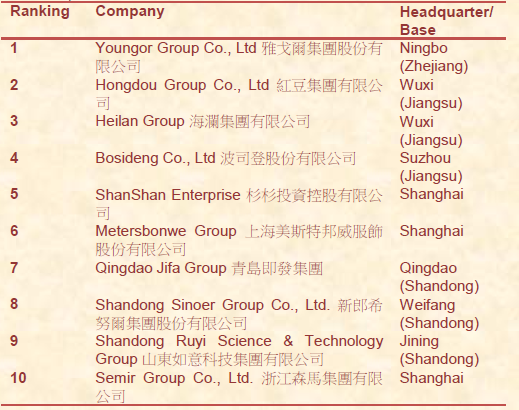
    Top apparel companies by sales are :
    top apparel companies china denim

    How are foreign brands expanding in China :

    Established players accelerate their expansion in China
    − Zara planned to expand to 42 cities in China in 2011.
    − Uniqlo targets to open 100 stores in China each year starting from 2011.
    − H&M expects China to be one of largest expansion markets in 2011.

    Some apparel enterprises see Hong Kong as the springboard for China’s entry
    − FOREVER 21 planned to open flagship stores in the prime locations of Hong Kong in 2011; Abercrombie & Fitch’s sub-brand “Hollister” opened its first Asian flagship store in Hong Kong in August 2011.

    Recent Developments

    Some enterprises, especially luxury companies, prefer to retain full control over the ownership of Chinese operations from franchisors or distributors. − Bestseller, which owns ONLY, VERO MODA, Jack & Jones, etc., retained control of shops in Xi’an and Jinan; it also opened more direct-owned stores. − Burberry bought 50 of its Chinese franchised stores in a deal worth 70 million pounds .

    Online Retailing

    Online retailing is getting very important in China and accounted for about 3% of total apparel sales in 2010. This is a good number and expected to increase further . Apparel continues to be the most favoured product category for online purchase.

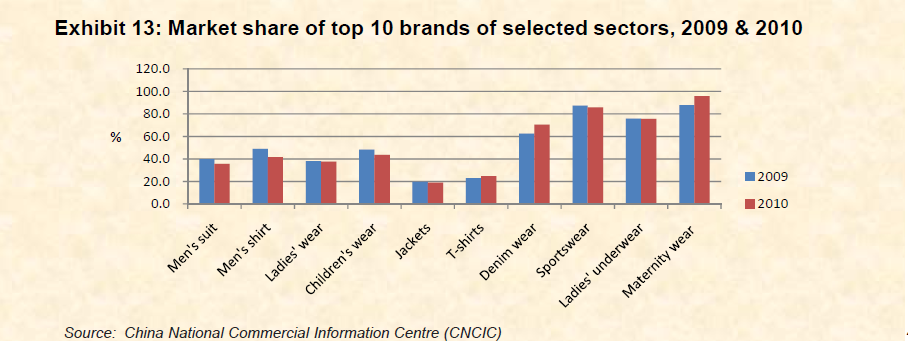
    Market Shares

    The market shares of top 10 brands in different sub sectors are given in the bar graph below. It is interesting to see that many sectors have a huge share of the market dominated by top players.

    market share apparel companies

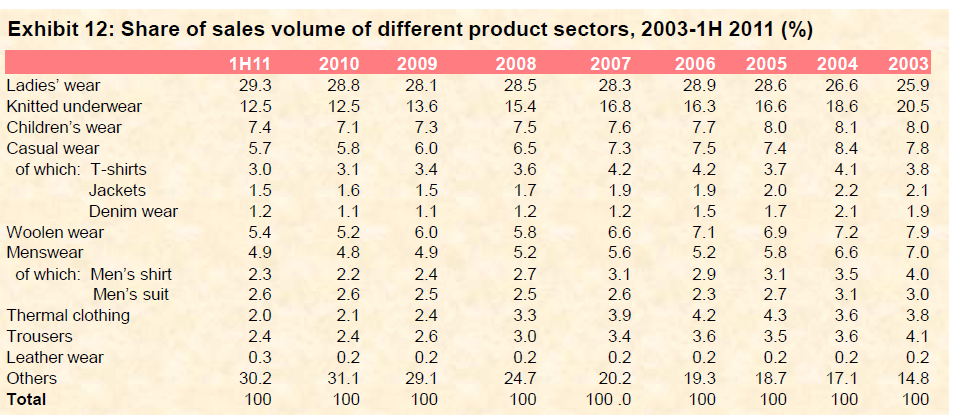
    Share of different products

    Share of different products in Apparel , China

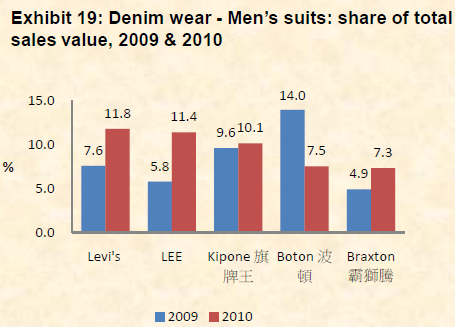
    Top Brands in Denim Wear

    market share denim companies china

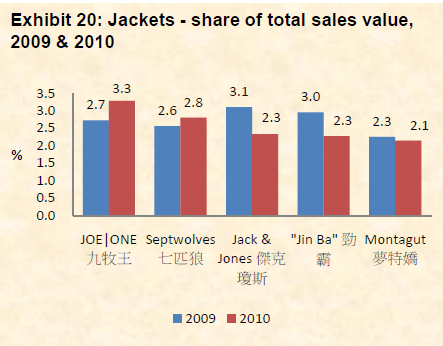
    Share in Jackets space :

    market share denim companies china jacket

    The Chinese market will get more important as the buying capacity of buyers increases there.
    Chinese market is already larger than the US market  when it comes to denim fabric consumption and it is expected that over the years it shall maintain its growth and shall continue to be the  leading country in denim space.