Category: Denim Reports

Find out the latest reports on Denim Fabrics and Jeans

  • $300 Jeans! – How Do They Cost So Much?

    An interesting article on Wall Street Journal explores how the premium denim labels cost $300 or more. For those who buy $50 jeans from Levi’s , it is at many times unpalatable to see that the jeans are priced at $300 +.

    true religion brand jeans The market had started moving  in a direction since early 2000’s when a  good amount of manufacturing started happening in the US. A True Religion jeans which costs $50 in US can end up being wholesaled at $150 and retailed at $335!! 
    The margins in the chain are very high to cover the huge marketing budgets and other costs of working the line  in the US and with retail markups touching 2.6 to 3 times.. But there are also benefits for the manufacturers to produce in the US – keeping a close tab on fashion and reacting quickly. When Jeff Rudes, founder and chief executive of J Brand, saw designer Jil Sander’s electric colors in New York’s Jeffrey boutique earlier this year, he asked his designers to come up with a hot pink and an emerald green color for jeans. Five days later, the first, small run of jeans were shipping into Barneys New York. It would have taken months to get the same product out of a manufacturing unit in China. This kind of quick turnaround is a major factor for the premium brands to survive despite high prices.

    But it is not that the prices of premium denim have not taken a hit due to the ongoing recession. Most of the brands have reduced their average prices below $200 and $150 is claimed to be about the minimum level to be qualified as a premium label – though we still have companies like Gap selling their 1969 jeans at around $70 or even Uniqlo selling at lower prices with fabrics still being from Japanese mills ! .  It is anybody’s guess at what can be termed as premium jeans. If only very high priced labels are termed as premium jeans, we would have a very small % of jeans in US qualifying for the same – maybe around 1% – though their sales value at over $1 billion would not be insignificant.

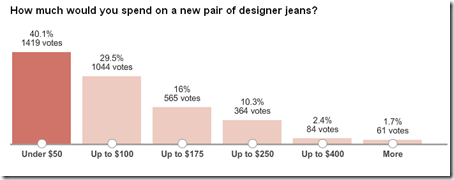
    It is also interesting to see the results from the WSJ poll on what average price the consumers are ready to pay for their jeans. Interestingly , about 15% consumers in the poll are still ready to pay over $250 for their jeans.. So the craze for premium denim continues !!

    denim poll

  • Pakistan Denim Fabric Industry – An Analysis

    Pakistan denim industry

    Pakistan had always strong textile industry due to historical reasons and an abundance of cotton . With over 380 million mtrs produced and over 150 million mtrs of denim fabrics being exported by Pakistan in 2009-10 , denim is probably the most imp segment of the Pakistani textile industry.

    In a recent report  Dr Noor Ahmed Memon from Pakistan mentions that top global denim fabric exporting countries are China, followed by Hong Kong, Turkey, Italy, Pakistan, the USA, India, Japan, Spain and Brazil. Together, these countries accounted for as much as 83% of world denim fabric exports. Almost all of these countries witnessed a decline in their denim fabric exports in 2009-10. The only exception was Pakistan, whose exports rose by a remarkable 75% during the year 2009-10. On the other hand export of cotton denim fabrics from Pakistan increased from 45 million sq meters in 2005-06 to 229 million sq meters in 2009-10, thus showing an average increase of 50% per annum in terms of quantity.

    What are the major markets for Pakistani denim fabrics ?

    Lets see which are the major markets for Pakistani denim fabrics for the year 2009-10

    Country Quantity (mill. sq mtrs) Qty. Linear mtrs (160cm width)
    Bangladesh 71.4 44.62
    Turkey 61.36 38.35
    Italy 9.09 5.68
    Hong Kong 4.30 2.68
    India 4.08 2.55

    Source : FBS Pakistan

    Turkey is one of the major markets for denim fabric exports from Pakistan .  With about 39 million mtrs of denim fabric being exported to Turkey in 2009-10 , it is a major market  for Pakistan . However, this export is going to be severely affected with Turkey increasing duties on imports and which will be now 24.5% from 24th July 2011 . The duties on garments also would be 52% – which again will be quite prohibitive . This step by Turkey is going to further affect the denim mills in Pakistan which are already facing the brunt of worldwide fall in demand of denim fabric during the current year.

    The other markets for Pakistan like Bangladesh (the most imp one) and others are expected to  keep on performing unlike Turkey. The surprising point to note is that India is becoming an important market for Pakistani denim fabrics . Though the quantities of about 2.5 million mtrs in 2009-10  is still small, it is indicative of the potential of the Indian denim market and it seems that it will become more important in the coming years.  Both the garment exporters from India as well as the local brands are becoming important in India as they are getting more aggressive and to differentiate themselves , they buy fabrics from around the world – Italy, Turkey  , Spain  etc and with Pakistan becoming an imp. source.

    The challenge for mills from Pakistan would be to find destinations for denim fabrics as shipments to Turkey go down. Also, the continuously depreciating currency of Pakistan has helped in maintaining the competitiveness of the industry but it is not a factor which can be depended upon for long . Some mills in Pakistan have definitely tried to invest heavily in product development and innovation and this is probably the best way  which will keep the industry going strong in the coming years.


  • Denim Shipments To US From Bangladesh, China , Mexico :Fall In 2011

     demand of denim in usa There has been a fall in demand of denim apparel in US and even the EU in the last 6 months.  The fall in demand and hence imports to US had started setting in the last quarter of 2010 itself and is continuing since then.  Lets look at the figures of denim exported by two important exporting countries to the US in the first quarter of 2011.


    Country Year/ quarter Total Denim Apparel (pcs) Total Value (in USD) Average Price ( USD/pc) Change in qty. over last year
    Bangladesh 2010 / Jan- March

    11.72 million pcs

    $62.23 million

    $5.30

     
    Bangladesh 2011/ Jan- March

    11.44 million pcs

    $60.65

    $5.29

    -2.44%

    Mexico 2010/Jan-March

    27.93 million pcs

    $214.70

    $7.68

     
    Mexico 2011/ Jan- March 2011

    25.52 million pcs

    $202.59

    $7.93

    -8.6%

    Source: US customs
    We can see that the figures of  two important exporters of denim jeans and apparel to US are not very encouraging and are indicative of a steady fall in denim demand. The figures from China are also not too encouraging – in fact they are worse than the above . The Chinese exports of denim apparel fell by over 11% in the first quarter of 2011 !!
    These figures are indicative of a tough year for denim ahead and also a reminder to the denim exporters that they have to continuously search for and invest in newer markets and reduce their dependence on the traditional western markets which are still not out of recession in real terms.

  • Price Of Denim Jeans Imports in 2011: How Much Affected By Cotton Prices?

    cotton price copy We all know that cotton prices have been killing the textile industry till a few months back . The unrelenting rise in the price of cotton had led to the increase in fabric prices for most of the garment factories and hence ultimate buyers.  The fabric prices were increased by almost each denim mill and sometimes to the tune of 50% or more .  The apparel buyers  and retailers had no option but to bear the increased costs.
    However, the prices at the retail level in the major markets of US and EU did not undergo or reflect the changes in the costs. So , how much was the actual increase in prices for denim apparel shipped to US ?

    The major impact of these increased prices has been visible in the shipments made in the first few months to the US and the EU .  It would be interesting to see how the prices of imports were affected in the first few months of 2011 (January to April) compared to the average prices in 2010.

    Import of Denim Apparel Into USA – 2010 and 2011 (Jan-April)

    From Price (US$/pc)
    2010
    Price (US$/pc)
    2011  Jan- April
    Difference
    World

    7.15

    7.71

    +7.26%

    China

    7.27

    7.9

    +8.66%

    Pakistan

    6.44

    7.48

    +16.1%

    Vietnam

    7.05

    7.74

    +9.78%

    We can see from the above table that the average increase in the prices of imports of all denim apparel from around the world into US is 7.26%       .   But when we see individually , we find that the increase in prices is different from different countries . The increase in prices from Pakistan was the maximum with the prices in first four months of 2011 crossing the prices in 2010 over 16% !
    Other important countries too had their share of increase in prices . But if we really see , the increase in prices of apparel is still not justifying the increase in fabric prices – which increased at places by even more than 50%

    This shows that the various players in the supply chain have absorbed part of the increase in prices . There is also a possibility of impact of cost reduction measures taken at various levels of production and sourcing.

    We have also seen that the retail prices in US did not show much of increase and as a result some of the retailers like Gap have to suffer huge loss of income . Now, with the prices of cotton crashing by over 40% , it remains to be seen how the prices of apparel will move. Will these retailers be pressurizing their suppliers to reduce prices significantly to cover their own losses. Will the sourcing price of denim apparel fall to below pre cotton increase levels ?
    It remains to be seen. However, the lesson that can be drawn from the entire episode are  that  :

    • There is a constant need to monitor the possibilities of supply chain efficiencies to reduce costs of production . Companies should not wait for events like sudden increase in raw material increase to focus on this aspect.
    • The prices at the consumer level are very difficult to increase especially when the economies are not in that great a shape.
    • Innovative products are the only way to get higher margins from the market and basic products will always be under price pressures.
  • Retailers Cutting Costs To Make Up For Increased Prices

    cost cutting The retailers worldwide are resorting to increases in prices to make up for the increased costs – most of which have been attributed to the increase in cotton prices. Though the cotton prices have started to ease, the impact on the supply chain will be visible for some time to come.  As previously mentioned , GAP announced its forecast of reduced earnings leading to the largest fall of share price in over a decade . Businessweek now reports that the apparel brands are finding that they do not have much pricing power over budget conscious consumers and the only way to fight the increased prices is to cut costs .

    Companies are resorting to “Deconstruction Experts” – companies who help to reduce the cost of the garment . These companies , eg Kurt Salmon – are helping a number of their clients to find the ways to cut costs without making the change felt to the consumers.

    Various suggestions being given by these experts to cut costs. Fabric comprises as much as 50 percent of a garment’s costs. Cutting it more carefully to reduce waste can reduce by a few cents, Zippers that come in a big roll are cheaper than ones custom-made for specific garments .Brown – Vice Chairman , Kurt and Salmons ,  recently examined a pair of men’s khakis that sell for $29.50 and spotted a coin pocket. Eliminating it zaps a nickel, he says. Watch pockets are an easy cut, since few men use them anymore. So are logos and decorative stitching inside the waistband—visible to men only when they put on their pants.

    However, this cost cutting cannot be taken beyond a point . The customers can easily switch over to another brand if they find cheaper plastic buttons, smaller pockets  or reduced quality of waistband or other visible changes.

    However, i feel  that the brands/retailers which have been able to absorb these increased costs and have not made significant changes to their prices or product quality will be able to get the benefits in the next one year. The impact of increased prices of cotton is  going to go away as we are seeing the prices of cotton falling and the retailers will not have to work too much on cost reductions. We might see GAP’s share price rising in the next 6 months again !!!! 

  • Denim Mills In India :Facing Some Tough Time

    The denim players have seen some tough times in the last 1 and half years. With the cotton prices going through the roof (having almost doubled), the mills were  previously hard pressed to make their buyers understand the increase in costs and tried to get the prices increased. The process was slow as getting sharp increases in prices from buyers is never too easy. However, the awareness of the cotton price increase was there among buyers and many of them , reluctantly , agreed to increase the prices . Now, with cotton prices crashing, the strike by garment manufacturers against govt. duties , reduced demand etc has suddenly led to a situation of oversupply of denim fabric with prices falling . According to reports, most of the mills have large stocks   and the next 2 months look tough for the denim market. The players who were specializing mainly in the polyester denims and with no exports have been hit more hardly. The prices of polyester denim seem to have fallen about Rs 15-20 per mtr (35-45 cents/mtr)  and those of cotton in the range of Rs 10 (2o cents approx). However, with festive season sale starting from July, it is expected that the demand would stabilize during this period.

    Cotton Prices

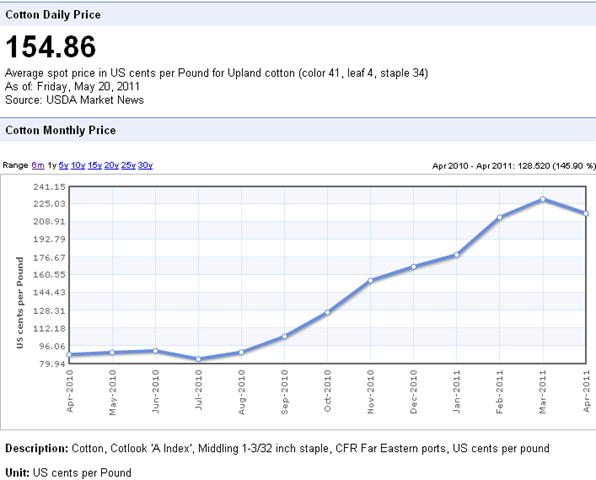
    Cotton price increase in the last one year  have actually played a spoilsport and have not helped anyone – neither the mills, nor the retailers and of course not the consumers. It has created a lot of uncertainty in the market and is still doing so. The cotton prices  had increased dramatically last year and peaked during Feb this year. However, suddenly the prices have started crashing with a better forecast of cotton production.  In India, the prices have come down from almost Rs 65000 a candy (35 to Rs 42000 a candy – about 33% fall  in 2 months !! Internationally , also prices have been reducing on a similar note :

    Month Price Per Candy Price Per Kilo in Rs Price per kilo in USD(@Rs45/USD) Difference
    Feb 2011 63000 Rs 177 3.93  
    May 2011 42000 Rs 118 2.62 -33%

    The movement of international cotton prices over the last year can also be seen here.

    image

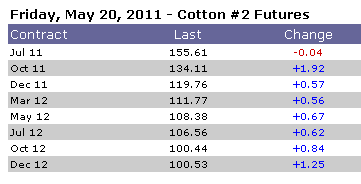
    The outlook of future prices of cotton also do not look that good. The crop for 2011-12 is expected to be very good at about  127 million bales with cotton planting around the world projected to rise by 7% in 2011/12 to 36m hectares– the largest in 17 years.. The cotton futures market in US is projecting prices much lower than current levels . See below :

    cotton future prices 

    The international retailers too had to bear the brunt of the cotton price increases. Many of them could not pass on the price increases in the denim and other fabrics to their consumers.  Eg GAP management said late thursday

    “….second-half product costs per-unit, factoring rising cotton and other costs, are now expected to rise about 20%, more than it anticipated, as it began to purchase goods for the holiday season. Its lower-priced channels such as Old Navy and the outlet stores that compete on price would be hit the hardest and would have the least room to pass on any cost increases…..”

    As a result the share price of Gap plunged 18% – its biggest fall in a decade -on hearing this news of increased costs.  Chief Executive Glenn Murphy said

      Gap has been testing the depth, frequency and length of discounts to help offset margin pressure. It plans to be less promotional and experiment with marketing ideas to drive traffic that do not involve discounting.For instance, at the company’s struggling Gap brand in the U.S., instead of having a 40% off the entire chain, the company plans to have promotions such as 40% off women’s products excluding denim, he said.

    Similarly , many other retailers have not been able to pass on the increase in sourcing costs to their consumers and are feeling the heat of increased costs.

    Now, with falling prices of cotton, the mills will be faced with the prospect of reducing prices for the retailers and other customers when already many of them have a stock of 3-4 months of cotton at higher prices. It would be a double whammy for the mills as they try to deal with their customers again and try to hold on their prices as costs have not gone down.

    Another problem related to exports for denim mills in India would be the DEPB – a scheme under which they got incentive of about 7.5% on exports is coming to an end and being replaced by Duty drawback scheme where they would get almost 4% less. This would further shave off another 4% from the margin of exporters and will not give any help .

    As mentioned before, the strike by garment manufacturers in India – which lasted about a month , left a huge impact for both fabric and spinning mills. The companies are reeling under the impact of the reduced production for this time which can hardly be covered up . Most of the spinning mills are running under capacity and holding huge stocks with prices of yarns falling on a daily basis.
    It is hoped that the market would get some sanity after end of June when demand starts to pick up for festive season .

    Follow us on   FACEBOOK   or   TWITTER to get more reports on denim industry directly.

  • Denim Apparel Imports Into US Continue To Fall In 2011

    Roller Coaster Denimy As we mentioned in our previous report on last quarter imports in 2010 , the denim apparel import continues to fall in the first 2 months of 2011. The fall is not small  –at about 6.3% – compared to the same period  in 2010. The fall is even more when one considers that the last quarter of 2010 , the imports had fallen by 6.8% .

    Period 2009 2010 2011 Fall %
    Oct – Dec 157 million pcs 148 million pcs   -6.8%
    Jan – Feb   74.5 million pcs 69.8 million pcs -6.3%

    This fall is even more surprising when we consider that retail sales of clothing in US is not falling and had in fact increased in the last quarter of 2010 by about 5% .

    What could be the possible reasons for this fall of denim imports ?

    There could be a number of reasons for this continued decrease in imports of denim jeans and apparels into US . Some of these could be :

    • The rising price of cotton had the max impact on the jeans costing and forced retailers to promote other bottoms as they were not really able to pass on the price increase to the consumers.
    • The continued boom in denim consumption in the last three years has peaked out and is in a consolidation phase where inventories need to cleared from the system.
    • The recession in US and EU had actually helped increase the sales of jeans since jeans are a- MOG- “Multiple Occasion Garment” -ie they can be worn on various social and even official occasions . Thus it made economic sense for consumers to buy jeans compared to other bottoms. Hence the increased sales of denim in past few years cannabalised on the sales of other bottom products.
    • The competing products of denim like piece dyed bottoms , corduroys have been suffering as compared to denim when it came to consumer choice . Is there time coming back ????

    Whatever the actual reason , it seems likely that the fall in consumption in jeans will continue this year. The industry needs to brace up for the situation in the short term . However,  there no long term worries as Denim is an Evergreen product and it only seems to be a correction phase.

    amefird leaders in denim threads

  • Why Are Cotton Prices Increasing And Affecting Prices Of Denim Jeans And Other Apparel ?

    This is a guest article by Robert Antoshak – Managing Director , Olah Inc.

    clip_image002[4]This week, cotton futures prices topped $2.00 per pound. A year or so ago, the big debate in the cotton world was whether cotton could reach the history-setting level of a $1.00 per pound. How things can change!

    For jeans and denim companies, the recent run up in cotton prices has significantly impacted costs and at a time when consumer demand remains uncertain in the U.S. and elsewhere.

    So how did this shortage sneak up on us?

    Simply stated, there is a shortage of the stuff. Causing the shortage were a number of factors that came together to create a supply imbalance not seen in cotton since World War I.

    1. First, global stocks of cotton were drawn down sharply as less cotton was grown and shipped through the global supply chain due to competition from other crops. Many farmers switched to different crops when cotton was below 80 cents per pound. In particular, the ethanol boom of a few years ago convinced many farmers it was time to switch into corn production as corn paid better than cotton. Previously, cotton had been stuck in an anemic price range of about 40 cents to 70 cent per pound. Corn, on the other hand, soared when government support of ethanol production pushed that commodity up to unheard of price levels with corn now worth more as a fuel additive for our cars than as fuel for our stomachs!
    2. Next, there was bad weather. Flooding in Pakistan, a poor crop in China and a bad Monsoon in India combined to seriously undermine global cotton production in the season leading up to the recent surge in cotton prices. As much as one quarter of the global cotton crop was somehow affected by this bad weather and at a time when there was less cotton grown because it was more profitable for farmers to grow other crops.
    3. Finally, government actions further aggravated the situation. India, one of the world’s largest cotton producers, slapped export quotas on raw cotton and yarn in an attempt to maintain a good supply of moderately priced cotton for its textile industry. But cotton prices in India did not moderate and all this policy did was to cause an acute shortage of cotton and yarn in China, the major export market for these products. What a way to treat you customer! As a result, stocks of cotton in Chinese government warehouses began to run low. Without the ability to freely import cotton and yarn from India, and faced with a poor domestic crop and low country-wide inventories Chinese mills have had little choice but to enter the world markets and buy everything in site.
    4. And there’s more. When the grip of the global recession began to ease on economies everywhere, demand for textiles and apparel rose. Over the past 50 years or so, the U.S. and Europe often led global recoveries. But this time something was different. China played a major role as an end consumer of products. The Chinese government pumped huge amounts of money into their economy in an effort to ward off recession. It largely succeeded. Domestic demand soared, a recession was avoided in China, but demand for cotton jumped to levels not seen in years as local mills struggled to produce enough product to not only meet restored demand in the U.S. and Europe — but the demand of local consumers as well. Chinese textile producers are no longer solely reliant upon the global markets for their livelihood. Domestic sales have now become a new standard for the world’s largest textile industry and have placed even further demands on the cotton supply chain.

    There are also other factors that have contributed to the run up in cotton prices, some more obvious than others. Higher energy costs have played a role not only terms of shipping cotton but also to physically grow the crop. There’s another factor too – speculators in the cotton market. A weak U.S. dollar has helped to inflate commodity prices. It is often said that the wherever gold goes so does cotton. During this run up, a safe haven for investors has been gold and other commodities. When the stock markets were shaky during the recession, there was a lot of money to be made betting on higher commodity prices. In terms of cotton, sensing a quick buck, hedge funds swooped into the market just as the run up in prices began and the sheer size of their positions elevated prices well beyond what has normally been the case in the cotton markets.

    And, yes, there is one other factor: psychology. Panic is driving the market these days. Fear of not being able to secure a supply of cotton has left many clothing companies scrambling and even more mills wondering if they can stay in business if the price continues to rise and if there will be a consistent supply of cotton to be had at any price. It is this panic in the marketplace that has helped to elevate cotton prices even more. For many years, the retail and apparel side of the textile supply chain set the rules for what it was willing to pay for its raw materials be it fabrics or raw cotton. But the panic in the market has weakened the grip of these companies. Raw material suppliers appear to have at least temporarily gained some ability to push higher costs on their customers and, indirectly at least, to the customers of those customers.

    Needless to say, all of these factors have put the cotton industry in the precarious position of meeting soaring demand from a reduced production base.

    The bottom line: There’s simply not enough cotton to go around.

    Of course not all textiles are made of cotton and the fabric is only one component of the final price of the item. Unfortunately, polyester and other synthetic fabric prices trend to track with cotton and have risen significantly as well. Labor has become more expensive as has electricity, and pretty much all of the input costs of producing a final product. Sounds like an end of the world scenario…

    But there’s hope on the horizon. Production will return. $2.00 cotton will move many farmers back into the game. A few years ago, many in the cotton trade forecast a reduction of U.S. cotton acreage from about 10 million acres to just six million. Funny how things change: Today, most analysts feel the US market will actual grow to about 13 million acres this year. As the U.S. is the world’s largest exporter of cotton, that’s a good thing.So all is not lost. Production will return and prices should moderate over time.

    Will we go back to 40-cent cotton anytime soon?

    No. Cotton prices will remain high for next couple of years — certainly above $1.00 per pound and it is possible that the record run-up in cotton prices will continue. But eventually prices will moderate as more supply comes on line. It just takes time. It takes almost 200 days to grow a cotton crop. Because of this long lead-time it will take time to bring production to a level that meets world demand.

    But, then again, there’s only so much acreage to grow cotton. Perhaps that’s best left for another discussion on another day!

    About: As Managing Director of Olah, Inc., Mr. Antoshak supervises the firm’s global cotton marketing and consulting services. Olah Inc runs the famous Kingpins Denim  Shows besides other activities. Mr. Antoshak has more than 30 years of experience in the fiber and textile industries. He has held analyst positions with the Fiber Economics Bureau as Editor of the Fiber Organon, American Fiber Manufacturers Association as Director of International Trade, American Textile Manufacturers as Associate Director of International Trade,  as President, Werner International as Vice President of Information Services, . Most recently, Mr. Antoshak was Managing Director of the Fibers & Textiles Division of FCStone, LLC.  Mr. Antoshak has strong experience in trade negotiations and worked as a FBI-cleared industry advisor to the U.S. government on numerous bilateral quota trade agreements, NAFTA, the MFA and the WTO.

    Contact him on this email address.

  • Cheap Chinese Denim – Getting Killed By Rising Labor And Cotton Prices

    chinese exports of denim The era of Cheap Chinese denim is over – says a report by Telegraph , UK.
    The rising labour costs in China coupled with the effect of Cotton price is killing the Chinese denim exports. The retailers who had a great time buying very cheap denim and retailing them as low as $5 – $10 will now have to shelve out much more amounts to get similar quantity .

    Xintang , the Denim capital of the world – with over 260 million pieces of denim production and a very large quantity of jeans production is the worst hit . This city is DEDICATED TO DENIM with over 5000 factories from the very small ones to those who make over 60,000 pairs of denim  a day can be found here. The quantity of jeans produced here is so high that the Pearl River which flows nearby has actually turned Indigo Blue !!!

    So what’s ailing Denim Production in Xintang and China in General ?

    • Rising Labour Costs: The labour cost used to be as low as GBP 30 /month  – about 350 Yuan and now is as high as GBP 470 ($760 or 5ooo Yuan)  in some places .Though the actual labor rates will fall somewhere between, it is still a huge increase.  This phenomenal increase in labour cost is crippling the industry and many factories say that they have not made profits for 2 years.  Since the labor class cannot get the price they want to survive in expensive South China, they are moving towards inland China where large construction projects etc are coming up and the cost of living is cheap. This has led to a reduction in availability of labor for production. So its double whammy – high labor costs and reduced supply !
    • Cotton Costs : Cotton prices have hit all the countries around the world and China is no exception. It has been hit more by the reduced production in Pakistan, Australia and reduced exports by India have complicated the position in China which is highly import dependent when it comes to Cotton.  This has led to a very high increase in denim prices in China. Though the buyers are trying to reduce the impact of cotton prices by using polyesters  and marketing as shiny denim,  it is not really compensating too much. However, cotton impact may fade out in a year or so..
    • Factories Loosing : The jeans manufacturers are hardly making profits where they previously could make up 20 percent easily. Now if they make 5% , they consider themselves lucky. The Chinese Govt. is not able to give the kind of support that it used to give before and the units are finding it difficult to survive on their own.
    • Currency Impact : The stronger currency is not helping the matters at all.  Just to give an example, the Chinese Yuan was 7.29 to USD on 1st Jan  2008 and is now 6.57 . That is a 10% increase in about 2 years.
    • Chinese Govt. Apathy : Chinese government seems to have become apathetic to the denim industry . It is tightening the screws on the polluting denim industry and is enforcing the environmental regulations more strictly – closing many of the factories in the process. The govt. has probably reduced priority for this industry and is focusing on generating employment from alternative projects especially in Inland China.  This is not going to help the industry.

    So What Does Future Hold For Jeans Manufacturers In China ?

    With the current trends, it seems that the jeans manufacturers in China – especially South China –are going to have a tough time making money. They can only survive if they get high priced orders – which are few to come. This will lead to the survival of the fittest with many factories having to either close down or to shift to alternative products.  China may still manage to have the productions shifted to inland China where costs are low, but they cannot do it overnight. It will take a long time .

    What are the alternatives to China for sourcing denim garments ?

    A number of other countries in the vicinity have developed their industry and are coming up well – whether its Cambodia, Vietnam, Bangladesh etc. However, none of them has the capacity to produce the volumes or has the infrastructure to match that of China.  Even countries like India and Pakistan would benefit  directly by way of increased garment exports or indirectly by way of increased fabric exports.  It will take time for them to come up and match the potential of China.  The US and EU are encouraging these alternative destinations as production centres , one of the reasons why EU passed the New GSP Regulation.

    Will all the impact on prices of denim products , can there be a scenario where the demand for denim products actually fall as the retailers try to promote alternative products ?  We have already seen a massive fall in imports of denim products in US in the last quarter of 2010. Is it an indication of things to come ?

  • 4.6% Growth In Import Of Denim Jeans Into USA In 2010 Over 2009

     up-or-down-denim The denim apparel imports into USA has increased by a marginal 4.6% in 2010 over the volumes of 2009 . This is quite surprising as the increase in imports during the first 6 months of the year was 12.6% and as I mentioned in a previous report. This actually means that the imports in the second half of the year have actually dropped in second half. Let’s see from the table below :

    Imports Of All Denim Apparel Into US  2009-2010

    Period

    2009 million pcs

    2010  million pcs

    % change

    Ist Half

    238

    268

    +12.6%

    2nd Half

    346

    343

    -.87%

    Total

    584

    611

    +4.6%


    From the table above, we can clearly see that the volumes of denim apparel import into US have actually shown a declining trend in the second half of the year 2010 .  This declining trend actually set in the last quarter of 2010. The imports in the
    • last quarter of 2009 were 157 million pcs
    • last quarter of 2010 were 148 million pcs .

    That means that in the last quarter itself, the fall in imports is to the tune of 6.8% – a very large fall . If this trend of falling imports continues in the first half of 2011 , then we are looking at a very negative story on denim consumption in US . But since only one quarter in 2010 has shown a negative story, there is still hope and maybe the first quarter of 2011 will make the things more clear ..

    There can be many possible reasons why this fall is happening . One of the main reasons could be the increase in prices of denim due to rising cotton prices, which is making the highest impact on Denim as denim is almost the heaviest product using cotton. It would be interesting to study whether the sales of all clothing has also shown a similar downward trend during 2010. Though , there is a time lag between the imports of a product and its actual sales at retail stores, the imports also are indicative of the sentiments of retailers which are based on their sales forecasts which depend on actual sales happening in the stores.

    The following table shows the total sales in clothing stores in US during 2009 and 2010

    Total Clothing Sales in US – Last Quarter of 2009 and 2010

    Period

    2009  $billion

    2010
    $ billion

    Change

    Jan – Dec

    $152.21

    $158.91

    +4.4%

    Oct – Dec

    $45.93

    $48.42

    +5%

    Though these figures are for values (USD) , they clearly show that the sales of all clothing stores put together have actually shown a very positive increase during the year with about  4.4% increase in the year and about 5% increase in the last quarter itself. 

    The denim imported in the last quarter of 2010 would be retailed in the first quarter (mostly) and the actual retail sales of clothing stores in the first quarter of 2010 would indicate whether it is only denim which is losing steam or not..   Lets keep our fingers crossed..


  • International Denim Conference– On DVD

    conference denim dvd2

    The first ever two-day “International Conference on Denims & Jeans” was held at IIM Ahmedabad on 29th and 30th October under the chairmanship of Dr. PR Roy, Director – Fibre2Fashion and Former Group CEO, Arvind Ltd. The event was well attended by more than 500 delegates from the industry wherein the distinguished speakers presented an enlightening discourse on the global and Indian Denim & Jeans industry.

    The topics lined up at the conference ranged from Overview of the Indian and US jeans industry, Technology Developments and Innovations as well as Marketing Strategies in the Denim & Jeans sector, Recovery and Recycling of cotton waste, Branding and Retailing, Indigo wool and silk, Organic cotton denims and many more. The highlight of the conference was a panel discussion on denims.

    Speaking about the overall success of the denim conference, Dr PR Roy, Father of Denims in India had this to say;

    "I am extremely delighted the way the industry participated and supported this great event. This for the first time, allowed the denim and jeans sector stalwarts, to come under one roof and interact. I sincerely believe that this will substantially help India, to position itself as a leading global denim player in the foreseeable future".

    Supplementing to his views, Chakor Jain from VF Corporation added that "It was an honor to get an opportunity to present at the conference".

    Mr. Aroon Hirdaramani from Sri Lanka acknowledged "The conference was a great success. We found it very informative and were able to meet a large number of people from industry"

    Mr. Kunal Lekhadia from Kunal Organics made an indeed flattering remark by saying;

    "I must congratulate Fibre2Fashion for organizing such a great event. Your efforts were indeed commendable. I have never seen a textile show of this magnitude organized in India in such an efficient manner"

    To extend to the entire industry, a complete knowledge of this conference, Fibre2Fashion has come out with a DVD covering the full proceedings of the “International Conference” along with expert panel discussion on current and future prospects for Denim & Jeans Industry.

    Here is a detailed list of topics covered by various speakers during the conference.

    1. Inaugural Address
      Maheshwar Sahu, Principal Secretary, Govt of Gujarat
    2. Denim and jeans: A global perspective and India’s potential in a competitive marketplace
      Robin Anson, Managing Editor, Textiles Intelligence, UK
    3. Overview of Indian Denim Business
      Rajiv Dayal, Mafatlal Denims
    4. New Product Development in Denims
      Dr. PR Roy & Dr. JJ Shroff, Malwa Group
    5. Premium Denims & India "Branding & Retailing"
      Darshan Mehta, Reliance Brands
    6. Recovery and Recycling of waste in Denims
      Dr. Burger & SK Joshi, Truetzschler
    7. Denim" Offering From Ring & Rotor Systems
      Gerd Moche, Oerlikon Schlafhorst
    8. Organic Cotton & Denims
      Mahesh R, Arvind Ltd
    9. Sustainable Denims
      Manish Bansle, Dystar
    10. Jeans Manufacturing
      Manish & Sumit, Juki
    11. Panel Discussion on Denims
      Session Chairman: Mr. SK Gupta, Raymond Uco Denims
      Panel: Arvind Ltd, Chirpal, Aarvee, Bhaskar, LNJ Denims, Prashant, Ukil
    12. Overview of Indian Jeans Business
      Chakor Jain, VF Corporation
    13. US Denim & Jeans Industry
      Jenna Caccavo, Cotton Inc, USA
    14. Future Trend and Technologies in Jeans Treatment
      Enrique Silla, Jeanologia, Spain
    15. Marketing Strategies of Indian Denim Players to compete
      Rajesh Narkar, Malwa Group
    16. Innovations in Denim Weaving
      Terada, Tsudakoma, Japan
    17. Denim Warp Preparation
      Navin Agarwal, ATE
    18. Garment Finishing
      Sai Prasanna, Dystar
    19. Modified Starch for Textile Sizing
      Pradeep Bora, Anil Ltd
    20. Cotton Reuse, An Indian Perspective
      VV Mundhe, Acetex
    21. Advanced Functional Denims
      K Suresh, Clariant
    22. Spykar
      Sanjay Vakharia
    23. Reliance Trends
      Vipin Tyagi

    To buy the international conference DVD , just click here
    or on the image below .

    conference denim dvd2

  • EU GSP – Changes In Rules Of Origin From LDC Countries Incl. Bangladesh – Jan 2011

    EU has recently notified the changes in the rules of origin from certain LDC countries which will simplify the procedure of granting the GSP benefits to the exporting countries and will also benefit other countries involved in supplying raw materials to the country exporting the final product.

    There are basically three formats under which EU provides GSP benefits to exporting countries :

    • The standard GSP : , which provides preferences to 176 Developing Countries and Territories on over 6200 tariff lines;
    • GSP + : The special incentive arrangement for sustainable development and good governance, known as GSP+, which offers additional tariff reductions to support vulnerable developing countries (currently 16) in their ratification and implementation of 27  international conventions in these areas;
    •  Everything But Arms (EBA) arrangement, which provides Duty-Free, Quota-Free access for all products for the 49 Least Developed Countries (LDCs). Under this arrangement , started in 2001, EU granted duty free access for all products except arms without any quantitative restrictions . These countries are :

    Afghanistan  Angola  Bangladesh Benin  Bhutan Burkina Faso Burundi Cambodia  Cape Verde Central African Republic Chad  Comoros Islands (Islands)  Congo, Democratic Republic of  Djibouti  East Timor Equatorial Guinea Eritrea  Ethiopia  Gambia Guinea  Guinea-Bissau  Haiti  Kiribati  Laos  Lesotho  Liberia  Madagascar Malawi  Maldives  Mali  Mauritania  Mozambique  Nepal Niger  Rwanda  Samoa  São Tomé & Principe  Senegal  Sierra Leone  Solomon Islands  Somalia  Sudan  Tanzania  Tuvalu  Togo  Uganda  Vanuatu  Yemen  Zambia

    As per the new notification of EU regarding change of rules or origin, it seems that all the above countries are going to benefit and can export duty free to EU even if only stage of processing (ie garment making in case of apparel) has happened in that country. Consequently , these countries will be able to import fabrics from any country in the world and export apparel duty free to the EU. A maximum content of 70% of non-originating material can be used for getting the GSP benefit. However, this percentage will differ from product to product.

    There is also a possibility that the following countries also get the benefit of zero duty export based on the second criteria of vulnerability . These countries are : Tajikistan, Uruguay, Turkmenistan, Peru, Panama, Paraguay , Nigeria, Fiji, Dominican Republic , Kenya and some others. This list keeps on updating each year and has to be referred with the EU to see the latest status.

    Who is going to Benefit ?


    1. Apparel Exporters in LDCs : The main winners of this change would be the garment exporters in these LDC countries – specially Bangladesh, Cambodia , Lesotho etc. 
    2. Fabric Exporters in nearby countries : Fabric exporters to Bangladesh from countries like India, Pakistan, China, Thailand, Indonesia would be greatly benefitted as currently they are at a disadvantageous position against the local mills in Bangladesh who enjoy easy sales due to the GSP benefit that is received by garment exporters using their fabrics.
    3. EU Importers : The importers of apparel in EU would be benefitted due to reduced costs of apparel . Or rather , we should say that they would benefit from the costs of apparel which do not increase as much as they would normally due to the highly increased cotton costs.
    4. Other industries in Bangladesh etc LDCs : Eg the plastic industry in Bangladesh would greatly benefit from using imported materials to export plastic products to EU.

    Who can be the losers ?


    1. Bangladesh textile mills : The textile industry can be the biggest loser as it loses its main advantage ie the GSP benefit. It will now have to compete with the strong textile industry in India, Pakistan, China and other countries in the open market. To take an example, currently most denim mills in Bangladesh  enjoy a sold out position and some mills do not actually have a marketing department ! . This situation is likely to change.  However, we have seen before that the powerful textile lobby of Bangladesh has fought against the benefits being passed on to other countries . Eg , under current rules, EU allows the fabric of India and Pakistan to be used for getting GSP benefit. But Bangladesh, under pressure from its textile lobby , has not passed this benefit.  It is now  fighting hard against changes also and it is anybody’s guess how much they will be successful.  But the chances of reversion of EU decision or the capacity of the Bangladesh Textile Mills to put a spanner in the works seems limited as they are pitted against all the other industries in Bangladesh including apparel – who are benefitting from this development. However, this  loss of profit for the Bangladesh textile mills could be for short term period . In the longer run, it would help the industry to upgrade itself and compete with the best in the world. In any case, they will continue to enjoy the logistic benefit .
      Taking some examples, we can also see that the textile industry in Bangladesh may also benefit from the changed rules in some sectors :

      Example 1 :  Chapter 58  Special woven fabrics; tufted textile fabrics; lace; tapestries; trimmings; embroidery etc. For these products, either the weaving can be done in Bangladesh or Printing accompanied by at least two preparatory or finishing operations (such as scouring,  bleaching, mercerising, heat setting, raising, calendaring, shrink resistance processing, permanent finishing, decatising, impregnating, mending and burling) can be done  where the value of the unprinted fabric used does not exceed 47,5 % of the ex- works price of the product. This may raise possibility of  increased production of some textile items in Bangladesh.

      Example 2 :  A yarn, of heading 5205, made from cotton fibres of heading 5203 and synthetic staple fibres of heading 5506, is a mixed yarn. Therefore, non-originating synthetic staple fibres which do not satisfy the origin rules may be used, provided that their total weight does not exceed 10 % of the weight of the yarn.

    2. Garment industry in India and other Non-LDC countries : The impetus that the garment industry in Bangladesh receives or for that matter Cambodia receives, will be at the cost of the garment industry in the vicinity countries. India is already unable to compete with Bangladesh in garment exports and when the duty free advantage comes into place, India’s garment exports will be further eroded as buyers flock to the LDC countries to source their goods. India, China, Indonesia, Vietnam and some other countries could be big losers in the garment export game. Pakistan may not be that affected as it has the currency advantage with it.

    Calculating The Benefits

    If the garment exported from Bangladesh using Pakistani / Indian  fabric was priced at $6 / pc  (CIF) previously ,  it attracted a duty of 72 cents @12% . The whole of this duty amount would now be saved. Currently , for denim fabrics, the mills in Bangladesh enjoy a premium of about 20-50 cents per mtr over other suppliers from Pakistan, India, Indonesia etc. This translates into a benefit of about 30 to 70 cents per garment.  Once the new rules of origin are in place, this margin will actually be reduced to very little or almost nil. Hence the denim mills in the surrounding countries can expect an increase in the prices of their denim fabrics from 10 cents to 25 cents per mtr assuming that the importer in EU will try to take away  50% of advantage by way of reduced garment prices.

    And it is not only the denim industry that is going to be affected. Lets take some examples of exports from Bangladesh for products other than apparel which also open up possibilities for exporters.

    The EU notification no. 1063/2010 for the change of rules is given here in a presentation . You can also search within this document or just select fullscreen to see complete document.

    EU -Rules of Origin Changes for GSP From 2011