Category: Denim Reports

Find out the latest reports on Denim Fabrics and Jeans

  • US Denim Imports Fall 14.7 %Cent In 2011

    Denim imports downThe last year had not been a great year for the US denim market. The retail sales were not so great and for the first time since 2007, the imports of denim apparel fell by a large number – 14% over those in 2010.

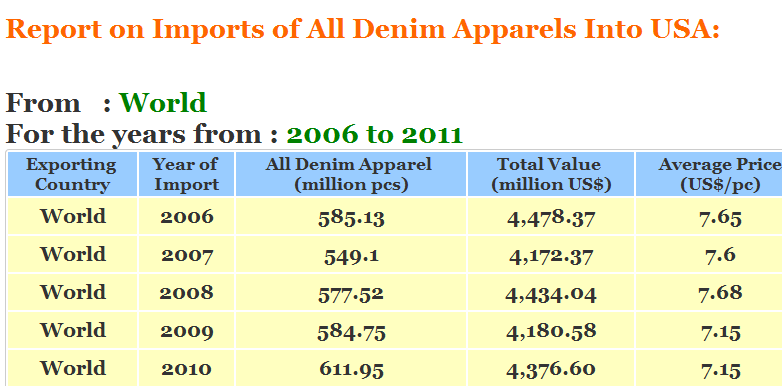
    First lets see how were the imports of denim apparel into US were faring in the last 5 years from 2006 to 2010. As we can see below, the imports only fell in 2007 and thereafter there has been a steady increase in the quantities of imported products. However, the average price did fell in 2009 and 2010.

    US Denim Apparel Imports 2011

    Now, for 2011

    Total quantity : 521 million pieces
    Value : $4,344 million
    Average Price per piece :
    $8.33

    The average prices for the imports rose significantly in 2011 due to average increase in prices of cotton and other fibers. The increase in price was actually huge – about +16.5%

    The countries which lost out the most during 2011 were the following :

    Country 2010 (million pcs) 2011 % Change
    China 192 151 -21.6%
    Bangladesh 82 66 -20%
    Egypt 28 23 -18%
    Pakistan 22 18 -17.5%
    Cambodia 25 21 -16%

    Among the gainers  or the countries not much affected were
    Mexico and Nicaragua  and some other countries like Lesotho , Guatemala etc.

    Country 2010 (million pcs) 2011 (million pcs) % change
    Mexico 132 127 -3%
    Nicaragua 19 24 +19%

    The statistics give an indication that the concept of near sourcing is catching on with the buyers in US. The effect of the rising costs in China is particularly being felt and though the options of shifting bases to countries in Asia like Bangladesh, Cambodia, Vietnam etc remains, the buyers also want to put more eggs in the South American markets !!

  • How Much Were US Apparel And Textile Imports in 2011?

    What is really the quantum of apparel and textile imports into US ?
    How do these imports compare to those made in 2009 and 2010 ?
    Did the recessionary conditions affect the imports of textile and apparel in 2011 ?
    How much of these imports were under Free Trade Agreements ?
    Lets find answer to these questions in the following  table :

    Import From 2011 (Jan –Nov) 2010 (Jan-
    Nov)
    2009 (Jan- Dec) 2010 (Jan – Dec)
    World $106.1 billion $96.7 billion $90.5 billion $104.6 billion
    Under Free Trade Agreements $15.7 billion $13.99 billion $13.6 billion $15.2 billion
    % under Free Trade Agreements 14.8% 14.46% 15.02% 14.53%

    Source: Otexa

    The total textile and apparel imports into US in 2010 were about $104 billion and those in 2011 (Jan-Nov) have touched $106 billion. Also when we compare with 2009, the imports increased from $90.5 billion significantly rose to $104 billion in 2010 and continue to rise in 2011. This reflects the inherent strength of the US market that  inspite of the economic recession the textile and apparel imports continue to rise .Though the increased cotton prices may have played some role in increasing the value of these imports, still the sentiment for imports seems positive for the entire industry..

    Also, it is interesting to note that almost 15% of all imports fall under the various Free Trade Agreements like CAFTA, AGOA etc. The govt. has been maintaining this figure at around 15% for last 2 years .

    What is the % of denim apparel imports out of these total imports ??
    Its around 4% !. Though it looks small, denim is still an important apparel category when viewed in comparison to other categories.

  • Denim Fabric Exports From EU To Tunisia

    We all know that Tunisia enjoys the EUR1 benefit from  EU.
    Eu TunisiaA EUR-1 certificate is an origin form with which a reduction or exemption on the import duties can be obtained in the country of destination. These reductions or exemptions are part of a preferential agreement. The tariff preference on the ground of a EUR-1 Certificate is only granted in those countries with which the European Union have concluded a free trade agreement. These foreign countries are

  • Switzerland
  • Norway
  • Iceland
  • Liechtenstein
  • Turkey (only for expressly named agricultural goods and EGKS products)
  • Syria
  • Egypt
  • Jordan
  • Lebanon
  • Morocco
  • Tunisia
  • Algeria
  • Ceuta and Melilla
  • Faeroe Islands
  • West Bank/ Gaza strip
  • Israel
  • South Africa
  • Mexico
  • Chile
  • Macedonia
  • Croatia
  • Bosnia Herzegovina
  • Albania
  • Montenegro
  • Serbia
  • Tanzania

    Tunisia has become a large center for production for conversion of  fabrics received from EU countries and exporting the garments back to EU.

    Lets see how much denim fabric is being sent from EU to Tunisia for conversion in the last couple of years .

    Denim fabric Imported Into Tunisia From EU 2008-2010

    Year Million Sq mts Average Price in Euro / sq mtr

    2010

    23.73

    4.2

    2009

    24.65

    3.7

    2008

    30.35

    3.65

    Over the 3 years from 2008 to 2010, the fabric being sent from EU to Tunisia has reduced by over 20% – showing a logical reduction in manufacturing activity in Tunisia related to denim garment manufacturing due to increasing costs and also the effect of EU slowdown. However, we have seen that in the year 2011 , the imports of denim jeans into EU has actually increased. Hence , the reasons for reduced conversion in Tunisia are related more to increasing costs than the economic situation in EU.

    Denim Job : Technical designer needed by a Denim company in Vernon, CA

  • Denim By Premiere Vision–2011 Dec Edition

    Its time for Denim By Premiere Vision again ! The famed denim show is being held again on Nov 30 and Dec 1, 2011 . Over 80 exhibitors – denim mills, jeans manufacturers , laundries , accessory suppliers etc-  will be exhibiting their Spring/Summer 2013 Collections at the show. The show is expanding with keen interest by denim mills and other companies in the supply chain worldwide to be  a part of the show.

    Almost all the well known denim mills around the world will be a part of the show and here are some excerpts on some of the major players who will showcase their products.

    Arvind Mills –Future Denims

    Arvind is one of the largest producers of denim worldwide, with a capacity of over 120 million metres per year. At Arvind, business units span the entire textile and apparel chain: from growing organic cotton, through spinning, weaving, processing and finally manufacturing and retailing its own repertoire of diverse brands. The company proposes eco-friendly manufacturing at every stage, across the entire life-cycle of its products.
    Special highlights this season include Future Denim, Excel Denim, Hybrid Stretches and Indigo Shirtings.

    Super Stretch Solutions from INVISTA

    This edition, INVISTA is introducing for the first time their new LYCRA® dualFX™ fabric technology, for patented fabrics that are uniquely super stretch. These exceptional denims integrate LYCRA® fibre and LYCRA® T400® fibre into a single fabric for added stretch and, even more importantly, extra fabric recovery.


    Vicunha: Softness and eco-friendly denims

    vicunhaDrawing on its development of special spinning and weaving processes, Vicunha’s autumn-winter 12-13 collection proposes products with an extra degree of softness. Some compositions include combed yarns, worked in new ways to achieve extreme fineness in colours and finishings. Another area the company has been researching is sustainable development, including fabrics that make use of recycled polyester from plastic bottles, while maintaining a cotton feel. Their new collection includes some 69 references, broken down in 8 product families.


    News from Tavex

    tavexThis season, Tavex puts the spotlight on a new selection in their fabric offer: Denim Couture, an exclusive collection of selected creations carefully designed to impart more sophistication, more chic. The line is the product of ongoing research and development aimed at combining traditional and hand-executed techniques with the latest innovations. This results in articles that stand out, offering a surprising vision of denim in two complementary lines: Satine and Sculpture.
    + And also: Alsoft® Amazontex

    This natural, ecological and sustainable finish is derived from Cupuaçu, a fruit obtained directly from cooperatives in the Brazilian Amazon. Silicon-free, hypoallergenic and biodegradable, the finish produces a softening effect and improves comfort by absorbing moisture and solar radiation.

    Royo’s key concept for next season

    iskoSuave Plus” concept from Royo (Spain)  offer a range of textiles with special handle treatments, extra softness, and easy-care properties all produced through an environmentally safe process. All the “Suave Plus” fabrics employ Lyocell Tencel, made from eucalyptus pulp.

    Neovintage by ISKO

    ISKOâ„¢ (Turkey) presented at Denim by Première Vision the special “Neo Vintage concept“. Neovintage reflects the combination of vintage story with high-tech finishes. The effect of usage throughout the years are given to the fabrics with the help of unique treatments: Turbotechâ„¢ patented by ISKOâ„¢.
    With the special weave and indigo dyeing process, the garments made with Turbotechâ„¢ quickly take on a vintage, stone-washed effect look that’s always changing. After a few washes the garments fade.
    Neovintage is one of the most important concept which ISKOâ„¢ really keen on. Fabrics are constructed by old yarn characters and latest ISKOâ„¢ finish techniques applications and they offer a dirty, shadowy look that meets a techno touch and natural brightness with vintage construction.
    ISKOâ„¢ focused combining old and new hot aspects in denim to re-interpret the vintage soul in a modern and update way offering a neo-vintage concept.


    Orta Blu: a network to promote sustainability

    Orta Blu, the sustainability division of Orta Anadolu(Turkey) , aims toorta communicate Orta’s efforts to save energy in their processes, and to develop an extensive global community dedicated to social and sustainability issues. One of its operations is launching a hands-on global ‘Social Missions’ using Orta products in collaboration with NGOs around the world. One example is the creation of school uniforms for children in Sierra Leone. Since 2005, Orta has been pursuing a number of “Best Practices” in energy and water conservation. The most visible result is a notable decrease in energy consumption per unit of production. A review of energy records shows a roughly 20% reduction in electricity and gas per metre of denim produced.


    US Denim Mills: a forerunner in the field of sustainable denims

    usdenimUS denim mills is a denim company from Pakistan with great products.The company has been working hard to optimize the idea of recycling denim. The first ideas of recycling old jeans proved to be impractical for various reasons, mainly consistency. The use of waste from the denim cutting tables proved to be more controllable and more consistent. This reprocessed fibre is used to spin yarn that is reworked into denim. The recycled yarn also requires new dyeing techniques, resulting in unique denim with a unique cast.

    Here is a list of participating companies – if you have the will to go through the list !

    ABSOLUTE DENIM CO., LTD., ADM ARTISTIC DENIM MILL LTD, ARTISTIC MILLINERS, ARTISTIC FABRIC MILLS, ARVIND LIMITED, ATLANTIC, ATLANTIC MILLS CO. LTD, BERNING, BERTO E.G. INDUSTRIA TESSILE S.R.L, BEST ONE, BLUE LOFT-ALLIANCE GROUP, BLUE FARM TEXTILE LIMITED, BOSSA DENIM & SPORTSWEAR, CALIK DENIM, TRC CANDIANI, CAPPIO TESSUTI S.R.L., CENTRAL FABRICS LTD, CEPEX, CITY CORPORATION, CLOSE TO CLOTHES, CONE DENIM, CONFECTION RAS JEBEL, CROSSING, DENIM AUTHORITY, DENIM DE L’ILE LTD, DENIM VALLEY BY ROYO, DERIDESEN ETIKET, DORLET, DYNAMO DENIM KUMASCILIK LTD, ECLAIR PRYM MAROC, LAVANDERIA EMMETRE(MALWA) , EREKS GARMENT CO., FASHION POINT TEKSTIL URETIM AS, FG GROUP OF COMPANIES, GFM TEXTILES PARRAS SA DE CV, GLOBAL DENIM TEKSTIL, GONSER GROUP TUNISIE., LA GRIFFE INTERNATIONALE S.A, GTX SRL, HECKING DENIM, HELLENIC FABRICS SA, ICOMA, INCI BUTTONS, INDICOTT, I.T.V – INDUSTRIA TESSILE DEL VOMANO, ISKO, ITALDENIM SPA, J-VAL SRL, KIPAS DENIM, KUROKI CO. LTD, MARASSI DENIM-SIRIKCIOGLU MENSUCAT SAN. VE TIC. A., MAROC EXPORT, MATESA TEKSTIL SAN VE TIC A.S., MESURA TEKSTIL SAN. VE TIC. LTD., MION SPA, MONTEBELLO S.R.L., NIHONMENPU TEXTILE CO.,LTD, ORTA ANADOLU T.A.S (DENIMUS), ORTA ANADOLU – ORDENIM, PANAMA TRIMMINGS SRL, PARIS TEXAS, PROSPERITY TEXTILE (HK) LTD, REALKOM TEKSTIL URUNLERI, REALTEKS TEXTILES COMPANY LTD, TEJIDOS ROYO, S.L., R.S.P. 51, S.A., TEXTIL SANTANDERINA S.A., SANTANENSE, SARTEX, SPECIAL FABRICS, TAVEX, TURTEKS TEKSTIL ETIKET SAN. TIC. A.S., UCO RAYMOND WORLDWIDE DENIM, US DENIM MILLS LTD, VICUNHA EUROPE, YKK EUROPE LTD.

  • EU Imports Of Jeans In 2011 Has Actually Increased!!

    eu denim imports 2010 - 2011The US imports of denim have been a cause for concern this year. The fall in imports   has been consistently rising and almost touching a negative growth of 14.3% from Jan to Sept  compared to similar period in 2010.
    The current market  reports coming from EU are not very encouraging .Many  retailers are believed to be holding their purchases or delaying them. In fact , one of the major retailer from EU  is believed to have postponed a major part of a 20million pcs order .. The situation does not look so good.

    But when we look at the figures of imports of denim apparel from Jan to July 2011 as compared to the similar period in 2010, we find a totally different situation. The imports of jeans into EU has actually increased by  5% over the same period in 2010.

    EU27 Imports of Jeans :Jan-July 2011 vs 2010 

    Year Imports of Jeans in million pcs Average price (Euro /pc)
    2011

    286.04

    7.35

    2010

    271.56

    6.85

    Change % +5.31% +7.22%

    The figures are quite inspiring and confusing at the same moment. They do not reflect the current economic turmoil that Europe is going through. The price increase , though seems justified as the impact of cotton price increases of last year have continued to be felt this year at the retail level.  Many countries have increased their exports with China having increased about 3% and

    However, what happens in the next few months shall be very important and indicative for the industry . The reports coming from major exporting(to EU) countries including  Bangadesh , China, Pakistan etc have not been very good. Most of the apparel exporters have indicated that they are short of orders or have requests from the buyers to postpone the orders to next year. The psychological impact of developments in Italy , and other EU countries is perhaps taking a toll with the retailers and many of them not wanting to take a risk in this situation.

    Sponsored Link:
    denim threads

    From Denimsandjeans.com Stable :

    A cool video Vintage Levi`s from the 1930`s – 1960`s Big `E` Levi lnc selvedge
    Denim Brands From Japan
    Denim Jobs Missy Denim Designer – Jones Group
    Denim Mills The Directory of Mills
  • US Denim Imports Fall 14.3% Till August 2011

    us denim imports 2011There has been a general slackness in the denim and other apparel biz in the US since the beginning of the year . As mentioned in one of our previous reports , the fall in imports of denim apparel into US had been high – at about 6.3%  in the first two months of 2011. However, when we look at the figures that have come out for the period of Jan – August ‘2011 , the figures are more disturbing and indicative of a consistent fall in imports. Lets have a look :

    Imports of denim apparel into US from Jan-Aug ‘2010 vs Jan-Aug ‘ 2011

    Imports from 2010 2011 Change %
    World 408 million pcs 350 million pcs –14.3%
    China 132 million pcs 101.6 million pcs -23.5%

    China has shown the most significant fall in export figures and some other countries like Bangladesh, Cambodia etc also follow but in smaller percentages.

    The imports have fallen significantly in 2011 when compared to the same period in 2010.  This fall is significant since we have seen that denim sales have ditched the recessionary pattern in the past  that other apparel products have shown. In 2010 , apparel sales and (correspondingly imports) were falling for most of the products but denim continued to bulldoze its way to growth . This was reflective of the need by consumers to substitute other apparel items (specially trousers) with jeans as jeans is a  ‘Multi Occasion Apparel’ and buying a good pair of jeans actually cuts down the budget of some consumers who wish to substitute a number of other trousers with that jeans.
    However, the consistent fall this year reflects that there is some saturation point reached due to the continuous increased spending on denim . We need to , however, wait till the beginning of next year to see if this falling trend carries off in the next year.
    But there are no huge reasons to worry. Denim has always shown a trend where it surges ahead for 3-4 years and then goes down a bit for about 1 –2 years and then rebounds sharply. So , what we all can do at the moment is keep our fingers crossed and wait for some good news in the coming months.

  • True Religion Posts Cool Q3 2011 Results

    True Religion

    The denim brand from U.S – True Religion – beat the impact of cotton prices , low demand and other negative factors to achieve a cool 10.2% growth in the third quarter of 2011.  The company is not depending on the domestic US market for its growth. During the quarter, True Religion said it granted the Envols International Trading Co exclusive distributorship in China and non-exclusive distributorship in Hong Kong through an agreement that extends to December 2016. 
    Envols, known for expanding the wholesale and retail
    presence of the Giorgio Armani brand in China, will fund and
    operate True Religion Brand Jeans retail stores, shop-in-shops
    and other premium retail concepts in the region.  
    It is not surprising to see True Religion targeting the Chinese market as China, India and Brazil are now being targeted by most retailers to achieve growth.

    True Religion retails its denim for as much as $300 and it was in a better position to reduce the impact of risen cotton prices. However, it also performed well in international markets . Here is a breakup of its third quarter sales :

    Sales in third
    quarter 2011
    $108.4 million (against $92.8 million in 2010
    Sales in US (33.5% growth) $61.8 million
    International Sales $23.5 million

    Note: True Religion Apparel, Inc. designs, manufactures, markets, distributes, and sells through its wholly-owned subsidiary Guru Denim, Inc under the True Religion Brand Jeans trademarks. The Company sells its jeans in the United States and abroad to upscale retailers and boutiques. This includes Nordstrom, Bloomingdales, Bergdorf Goodman, Urban Outfitters and other fashion boutiques.

  • Duty Free Benefits For Textile And Apparel Imports Into US

    import duty free The lawmakers in the US Congress introduced a legislation in July to provide provide duty-free treatment to textile and apparel imports from the 13 least-developed countries that are not currently beneficiaries under any U.S. trade preference programme. These countries are Afghanistan, Bangladesh, Bhutan, Cambodia, Kiribati, Laos, Maldives, Nepal, Samoa, Solomon Islands, East Timor, Tuvalu and Vanuatu. Called the the Asia-South Pacific Trade Preferences Act (S. 1443) , this act , once enacted , would provide effective from 1 January 2012 duty-free treatment to garments and other products similar to those afforded to beneficiary countries under the African Growth and Opportunity Act (AGOA) from African and Sub Saharan region. To be eligible for preferential duty treatment:

    • A beneficiary country would have to demonstrate that it is making continual progress toward establishing the rule of law, political pluralism, the right to due process and a market-based economy that protects private property rights.
    • Preferential treatment would be available for ten years and would be limited each year to no more than the applicable percentage (beginning at 11 percent and gradually increasing to 14 percent) of the aggregate square metre equivalents of all textile and apparel articles imported into the United States in the most recent 12-month period for which data are available.
    • A third-country fabric provision would grant preferential treatment through 31 December 2019 for textile and apparel articles made with yarn or fabric originating in any country.

    US textile industry and even the lawmakers have been  historically vary of giving duty benefits to Bangladesh , Cambodia etc because of two reasons. One reason is that providing this benefit to these countries would have an adverse impact on the countries in the AGOA region  The AGOA region mainly comprises of the following countries

    Angola,Benin,Botswana,Burkina Faso,Burundi,Cameroon, Cape Verde, Chad, Comoros,Congo (DROC),Congo (ROC), Djibouti , Ethiopia,Gabon, Gambia ,Ghana ,Guinea ,Guinea-Bissau , Kenya  ,Lesotho, Liberia,Madagascar,Malawi, Mali, Mauritius ,Mozambique , Namibia,Niger ,Nigeria ,Rwanda ,Sao Tome & Prin ,Senegal, Seychelles , Sierra Leone, South Africa, Swaziland,Tanzania ,Togo , Uganda and Zambia.

    The second reason has been that US has been aware that China would benefit in terms of yarn and fabric shipments to Bangladesh and Cambodia once the duty benefit is given as imports of yarn and fabric from third countries would be allowed under the treaty..
    However, if enacted, the treaty would also chip into the already reduced pie of Chinese exports which are reeling under the increased cost pressures. 
    But it would help in creating alternative medium sized apparel manufacturing hubs to slowly replace the large Chinese apparel hubs over a period of time and reduce the dependence of US on China.

    Which country would benefit the most ?

    Apparently it looks like Bangladesh , Cambodia and Laos would be the main winners from this treaty. Bangladesh is already enjoying the huge benefits of duty free imports to EU and if it also gets the same benefit from US, it would be party time in Bangladesh !
    However, one thing to consider is that in 2011  Bangladesh has exported about $2.5 billion worth of goods under chapter 52 and and 62 out of the total exports of about $27 billion. This is about 9% of the imports of these items into US.  So Bangladesh is very close to the 11% limit that the treaty may initially impose and will restrict the amounts to which Bangladesh can increase its exports. On the other hand Cambodia and Laos would have substantial scope of increase in exports .  For denim fabric exports, these countries would become an important destination as apparel exports increases from these countries.

    Congress Approves Biggest U.S. Free-Trade Agreement Since 1994

    On another note , a treaty for duty free trade with Colombia , Panama and South Korea has been passed by the Congress yesterday . A number of products would be covered and US is seeking to increase its chemical, pharmaceutical and farm exports to these countries. Duties on almost 95% industrial and consumer would be phased out within 5 years ..
    More details on this treaty would be provided in a separate report.  Till then , keep reading Denimsandjeans.com 🙂

  • Jeans – Made In Britain !

    In UK –in western Wales, a small town charmingly called Cardigan with a population of 4000 once churned out 35,000 pairs of jeans every week for 30 years. In this small town , over 400 people worked in the jeans factory . With the closure of the last denim factory in Britain, these craftsmen have nowhere to practice their skills. Some of them have spent close to 30,000 hours honing these techniques of denim making.

    A company called HIUT is trying to bring the humming sound of jeans manufacturing again to this town. The difficult task is being undertaken by the David Heiatt and he is trying to make moves to change all this in this centuries-old town. The company HIUT is being built with money invested by a number of small shareholders all around UK – another unique experiment in building a denim company ..  But  it is really not an easy task  with the costs of production on UK being so high !

    However, there are factors which are supporting such endeavours. Recession has made the consumers in Britain reassess consumerism. They are realizing the disadvantages of outsourcing. The local manufacturing Made In Britain Logoskills are dying and Britain is continuously facing a reduced share of manufacturing in its GDP and is now close to only 12% of GDP.  Consumers  are starting to realize the importance of manufacturing being done in UK to lift the country out of recession. Hence , “Made in Britain” goods are finding increasing support from the consumers.  Govt. has realized this and a made in Britain logo was issued last year so that consumers could easily identify the goods made locally and , hopefully, not get put off by the higher price tag.
    This is a sure step by the govt. to promote local manufacturing and to help Britain regain at least some of its manufacturing prowess.

    The failure or success of such experiments will determine whether in the future we can look at a decent amount of manufacturing shifting back to the western countries. The factors are supporting such exercise at the moment with the consumers there realizing that the cheap “throwaway consumption” is actually happening at their own cost in the long run. There is an increasing trend to buy “Less but Better Goods”  which are of course more expensive. We have seen the success of premium denim brands in the US with local manufacturing and that gives strength to this concept.
    Also, with governments in EU and US realizing that losing manufacturing capabilities has huge impacts in the long run – not only direct in terms of losing such mfg. capabilities , but also in terms of losing innovative capabilities which emanate from manufacturing.  And they will be whole heartedly supporting initiatives to increase manufacturing activities .

    So lets wait and watch whether the consumers will lap up the costly locally produced jeans in the UK or not !! Because whatever said and done ,  “ Consumer is the King" !!

    Here is a classic  story from Britain on “Less but Better” . I found it on HIUT’s website !

     After watching a lecture given by Jacques Maxim in the 1980’s, imageFerran Adria decided to close his restaurant for 6 months a year. He would use the time to research and create new dishes. Today, El Bulli only opens 160 nights of year and never at lunch. The restaurant seats no more than 52 diners. The number of chefs and house staff is greater than the number of guests. It may not make for a great business, but it does make for great food. Two million people apply each year for the 8000 odd seats. That means 1,992,000 are disappointed each year.

    Follow us on

    Sponsored link :

    Amefird :Global leader in denim threads

  • ASEAN : Exports Of Denim Products To US From 2000-2011

    ASEAN region comprises countries like Brunei, Burma(Myanmar), Cambodia , Indonesia , Laos,  Malaysia, Phillipines , Singapore and Thailand . These countries have been getting important in the denim world . Lets see what denim apparel they are exporting to US and at what prices .

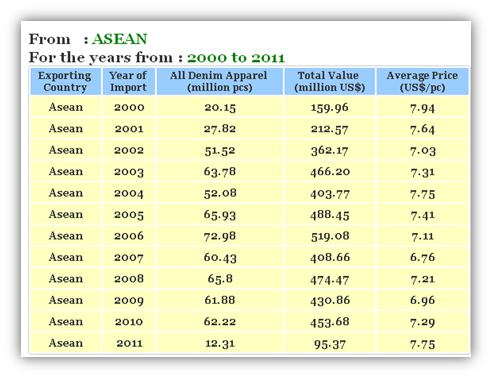
    Here is a snapshot from our data section on the figures of exports to US from ASEAN countries for the last 10 years including the first quarter of 2011.

    US Imports Of Denim From Asean Countries

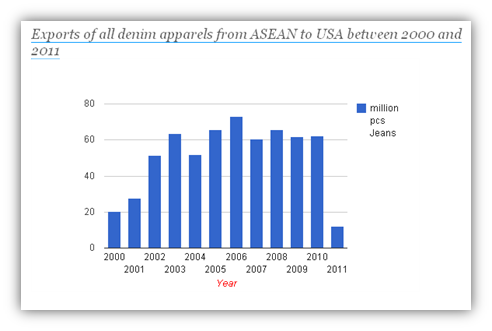
    Denim Apparel Exports from ASEAN to US

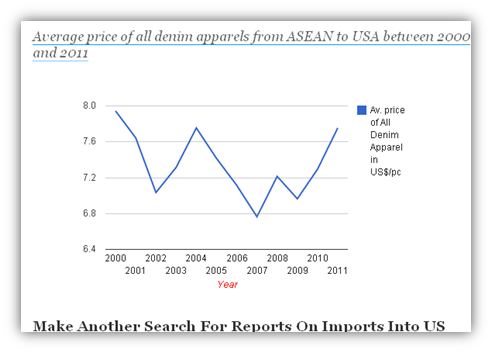
    Average price of Denim Exports From Asean To US

    So , we can see  from the above images that :

    • The total exports from ASEAN to US is almost stable.  However, if we go into individual country exports , we will find that there is a realignment with some countries losing their exports and countries picking up the volumes.
    • The average prices of exports have started to pickup from the last 2 years and specially in 2011 – showing the impact of cotton prices.
    • The first quarter of 2011 has not been very good and the volumes are below the average of previous year. This reflects the trend of falling denim exports to US.
  • Premium Denim Jeans Made In L.A !

    Here is a an interesting article from LA times which shows how the premium denim is still going strong and how Los Angeles is still the mecca for the premium denim manufacturing in the USA.
    Jerome Dahan , CEO Citizens of Humanity , says that he could make the jeans in China or other places at 30-40% lesser cost ,but he prefers to do so in L.A . Michael Geller , CEO of Paige Premium Denim agrees with him and says the production being in L.A , it is very easy for him to just hop into the car and reach the washing or sewing site to rectify any errors that may crop up in production. 

    The production of jeans in L.A is NOT cheap ! The fabrics that are being used by such brands can be  costly as $25 per yard !.  Simple  style details such as 5 stitches per inch (which have to be done by hand ) , using different threads , having a cool embroidered back pocket  etc can set you back by 20-30 dollars. Sampling is a huge cost . Geller says that it costs about $400-$500 to create a single sample that has to be shown to prospective buyers. 
      citizens seasonal super stretches

    citizens ponte linen denim jeans

    But despite all these odds of high costs of manufacturing in L.A , the customers are still ready to pay the very high retail prices which may reach over $500 per pair of jeans. Brands like Citizens of Humanity are not deterred and produce over a million jeans a year . This is a phenomenal number for jeans to be made in costly production centre like L.A.  With the premium denim market (Over $100 a jeans) estimated to be over 20 million pieces in US and value of the same being around $2 billion, the numbers are not small though not very big either.

    But what will happen if the economy slides further in US or EU. Will the high prices of premium denim jeans be still acceptable. We have seen in the last three years that the volumes of premium denim have not affected too  much due to the recession though of course the growth of this segment  has been affected. One of the purported reason for the same was that premium denim cannabalized on other apparel categories ie consumers in the west thought it was better to buy a pair of good jeans and replace their buying for a few other bottoms that they were buying as jeans could be wore at a multiple occasions . Also , the desire of the consumers to own at least a pair of premium denim is strong and that desire is keeping this segment of the industry on the push. Big retailers like Gap have been trying to bring out premium denim products at lower prices , consumers are yet to wholeheartedly accept them. A question that comes to mind of many a consumer is

    “ We are ready to pay the extra cost  for the high quality that we are getting . But why do we need to pay the multiple times that number to pay everyone in the chain till retail point so that an extra $1 of cost ends up being charged to the consumer as $4 or $5 .. Is there a way to retain the high quality without being required to pay the entire supply chain the multiple?

    May be in near future we may develop new methods of retailing which may do away with a part of the chain which brings the product to the consumer at a lower cost . The web has done its part in reducing that cost , but still it is not satisfactory . Consumers are not satisfied unless they see the product and feel it . We look forward to the day when an innovative way of retailing brings high quality products to consumers with very small additions to cost in the chain.

  • Chinese Denim And Textile Industry Suffers As Costs Rise

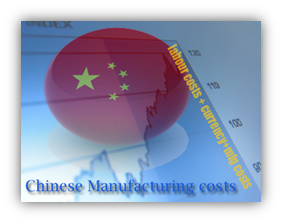
    image China has been dominating the textile industry scene for over 2 decades. The low cost , high volume model of Chinese manufacturing did wonders for the Chinese economy as well as enabled the retailers worldwide to provide cheap clothing to their consumers year after year. It also enabled China to create huge clusters of textile and garment manufacturing – eg Xintang – which is supposed to be producing and processing over 1 billion mtrs of denim !

    However, all is not so well in China nowadays . The days of cheap labour seem to be thing of the past . A recent report by WWD is insightful and brings out the changes in the Chinese economy as it tries to move to its next stage of development. Some excerpts :

    • The cost of labour is continuously rising . Three years ago a skilled worker would make less than $400 a month , but now the wages are in the range of $550 to $600+ . Guangzhou province has raised the minimum wages which is again affecting the costs of production.
    • The labour is getting assertive and restive and there are reports of strikes and riots by workers in different manufacturing areas . Recently , over 4000 workers staged a three day strike at a Korean owned factory. Such incidents were unheard of before in China.
    • As the prices are going up , the orders are going down. Many units in the Xintang area have shut down for not availability of orders .
      Though there are no numbers available,  a large number of factories have closed down as per people having a pulse on the place.  Many orders are being lost to Vietnam and other neighbouring countries.
    • The soft demand from EU and US is not helping the units in any way and is only adding to the woes.

    The Chinese govt. seems to have already decided that low cost model of Chinese production will no longer work in the future and its emphasis is to create an economy based on innovation rather than manufacturing by 2020 . This vision will have profound effect on the world manufacturing industry as we will see a large number of textile and other products shifting bases of production to other countries. Countries like Vietnam, Bangladesh, Cambodia are sure to gain from this change. But will larger countries like India  also benefit ???   Possibly yes, because the large retailers and brands would not like to be over dependent on smaller countries for their entire productions. We have recently noticed interest by a few international retailers, who did not have presence here ,  to set up the shop in India.

    Sponsored link
    Morrison Chain Mercerizing Range