Author: Sandeep Agarwal

  • A Chat With Stefano Aldighieri – Ex-Creative Director 7 For All Mankind

    stefano1 On my recent visit  at Hong Kong , I met Stefano Aldighieri . Stefano has worked as creative director at ‘7 For All Mankind’ and ‘Hudson Jeans ‘ and as design director at Levi’s. He has been involved with the US denim industry for a very long time . He is currently running his own design studio – Another Design Studio – which provides design services on denim concept to pre-production and marketing.I had a long chat with him on the  situation of the denim industry in the US . Excerpts  from the  same are being reproduced below :

    Tell me something about yourself  and your company ?

    I have been in this industry for a long time and I have a design studio based in L.A  where we do design consultancy and marketing consultancy for different brands.

    How many years you have been in denim business ?

    Almost 25 years . “Eternity” – interjects  Michael from Kingpins  who had been listening to our conversation !.

    How do you think the denim business has changed in the last 5 years?

    It’s a very interesting and a fascinating business and is never boring. It  changes all the time. Last 2-3 years have been very challenging for all companies. A few companies have had a significant drop in their business and unfortunately we are going to see more fall by the wayside in this year and the next year. But I think the companies that managed to survive and manage to hold their position would do ok.

    Premium denim wave. Is it going to continue ?

    It’s changing. Lots of brands who were selling jeans at a very expensive price are now finding it very hard to justify their price points. We had a good run for a while. People were very excited about these new jeans and were ready to pay pretty much any money for the same. The reality is now sinking in, and even the end user is realizing that could be a little  too much. I think if the garment is very special and has something to offer and differentiates with whatever else is out there , then it’s justifiable. Just slapping a ‘premium’ label on a pair of jeans and sell it a high price point  is probably not so realistic

    Have the denim prices come down in the recent times?

    I believe so , yes. There are still cases where people sell jeans for lot of money but most of the high end brands are either reducing their price points or introducing new brands at lower price points to keep their sales volume.

    Has the introduction of Gap 1969 Premium denim jeans affected the market in any way?

    It probably has. Between Gap and few other large companies which are aggressively promoting nicer denims at reasonable price point , they are kind of showing people that it is possible to wear a nice pair of jeans without breaking the bank.

    Does it mean that regular denim brands like Levi’s, Gap, VF etc could  take away a major share of the premium denim market?

    You have to keep in mind that the whole high-end jeans segment is a very small percentage of the market . Even if it were to disappear completely  tomorrow, it would not have such a huge impact on the overall market. The US jeans market is about 600 million pairs of jeans per year, and out of that the so called ‘premium jeans’ is probably 5-6 million pairs. So we are looking at less than 1% of the market. It is not really significant .Where it is significant, is the shift that it has caused in the market. If you look back at the US 10 years ago, it was absolutely unthinkable that people would pay $100 for a pair of jeans –never mind $200 or $300. You could buy expensive jeans if you wanted to – but had to import them  from Italy or Japan. Pretty much until the day when Diesel opened their first store in New York and Adriano Goldshcmied moved to US, and Earl jeans started in L.A . These things kind of showed to major retailers and market in general that it was possible to sell expensive jeans.

    What would be number of premium denim brands in  US , specially in L.A?

    I don’t know how many brands are there right now. I know that in the last few years you would see a new brand popping a up  almost every week  . Specially in L.A because you had access to  the contractors, the laundries, the fabric sources – so it was comparatively easy to put together a line. And Quite frankly , a lot of people would think , ‘wow’ those people are making so much money selling jeans – why not do the same thing. Everybody just jumped the bandwagon without having knowledge of the product .

    As a consulting company what kind of value do you add to the profile of the brands you consult?

    Our company offers a pretty comprehensive range of services . It goes from initial concept development , custom product development , research, development of fabric, development of styles . We can do trims & accessories , we can do patterns, washing – pretty much the whole package up to production . We also do marketing and branding . A couple of projects that we are doing right now specifically over branding and positioning initiatives.

    Thanks Stefano. I hope that  your business keeps on increasing and so does the business of the denim world!

    I don’t think we are going to see denim disappear any time soon. It evolves , it changes – but its always going to be around for us !

    Stefano Aldighieri can be contacted at this email address.
  • Denim Processing & Finishing in Environmentally Friendly Context

    Nowadays, when it comes to eco-friendly treatments within the denim industry, there seems to be no shortage of innovative views, technological progression or the investments as witnessed by the attendees of last December’s AATCC Denim and Sustainability symposium. Instead, the difficulty lies in the power to implement the green solutions into the apparel market. Naturally, no long-lasting change happens over night.

    Reasons vary throughout the supply chain: from short term pricing issues to lack of education concerning the production methods and or simple reluctance of companies as well as consumers to embrace a breath of fresh air in the way they conduct their business and or lead their lives.

    Having identified the problems, three potential answers echoed throughout the guest lectures.

    1. A first observation is that there is an enormous need for an interdisciplinary consideration, education and open dialogue regarding the methods and technologies involved from the beginning phase of raw material sourcing through design, production and the consumer use stages.
    2. Secondly in order for the fresh ideas to fully materialize, one should not disregard the importance of the collaboration between the ground-breaking developments and the capital intensive apparel manufacturers.
    3. Thirdly, we can all agree that retail is saturated with insincere “green” claims which cause mass confusion. To deliver honest products into the market manufacturers must adhere to the existing laws, employ appropriate testing policies and allow for transparency throughout the value chain. Putting the same into practice seems to be the most problematic as it requires additional research, time and advanced education. As a remedy to these issues, a multidisciplinary minded team of faculty and students at the University of Delaware Department of Fashion and Apparel Studies have joined forces with key industry partners and developed 10 business policies which aim to cultivate positive economic, environmental, and social benefits for the world and its inhabitants.

    The two day AATCC conference was packed with informative presentations and inspiring discussions between academics, industry professionals, policy makers and students. Considering the nature of Denims and Jeans blog, this article will highlight four environmentally friendly dying/laundering solutions presented at the symposium. Notably, the examples discussed below have actually surpassed the market barriers and are becoming vastly embraced.

    1.The “Holy Grail” of denim the Levi’s ® brand-did research regarding a life cycle assessment of pair of their Levi’s ® 501 jeans. They found 58% of climate change impact happens at the consumer-use phase. Together with Goodwill International, Levis Strauss & Co. launched the “Care Tag for Our Planet” campaign. This collaborative project shares the data from the lifecycle assessment and educates consumers about the benefits of cold washing, line drying and donating used clothing to keep it out of landfills.

    2.The Advanced Denim presentation by Clariant addressed Diresul RDT® range of dyes and the PAD-OX® Process. Their new low sulphide content dyestuff can achieve various indigo shades without the actual use of imagesynthetic indigo. The Pad-OX® process manages to condense the typical 10-12 step indigo dying procedure into 4, consequently reducing water consumption and water clean up by 60%. Furthermore, these dyes are superior in their fabric adherence affinity and are available in other colors. The entire color pallet is highly compatible with ozone technologies in achieving faded or bleached looks, minimizing the need for harsh chemicals. Replay has used the Diresul RDT® products in their “Just Add Water” campaign.
    3. Genencor– exhibited a line of enzymes called PrimaGreen ® which can achieve a collection of stone washed, vintage and bleached looks. The biodegradable nature of enzymes serves as a great substitute to other harmful agents such as bleach or potassium permanganate which are habitually used by laundries in attaining the above mentioned aesthetics. In addition, PrimaGreen® products provide substantial savings in overall water process and energy consumption.

    4.Perhaps the most remarkable and technologically sophisticated was the “0” Means “0” presentation by Mr. Enrique Silla, president of Jeanologia™. His team did a case study on consumer perception, asking the following question:

    Given a choice when buying a jean with labels expressing the following ecological characteristics:
    -No water used in the finishing of the jean
    -No energy used in the finishing of the jean
    -No chemical used in the finishing of this jean.

    Which would you choose and why? (keeping the price, fit and style being equal)

    99% responded no chemicals, 1% responded no water. Most noted reasons were chemicals contaminate more, chemicals are toxic, chemicals are hazardous to my skin and chemicals are not natural.

    imageInspired by their findings, the Jeanologiaâ„¢ team set on a mission and forever marked the apparel history by introducing a garment finishing process with zero chemical use. Their presentation showed a collection which included 3d resin, vintage fading, whiskering, bleaching, handsanding, blasting; pretty much any denim effect one can imagine. Instead of chemicals they used laser technology to mark the wash details. If desired, they showed one can further manually add grinding scrapping and tagging.

    • After the laser has mapped-out the garment, it undergoes a short hot wash and or stone wash-depending on the look one whishes to achieve.
    • Subsequently, the washed garment is placed into one of the most revolutionary machines in garment finishing called G2.
    • This device uses air, transforms it into plasma which brings out the laser details and or the aged look.
    • Following the G2 process, garments are rinsed and dried.

    Moreover, Jeanologia™ also introduced another ground-breaking device called e-Soft. e-Soft is a garment softening technique which operates based on electro –flow technology. It uses a continuous electricity flow and wet air to create positively charged microscopic air bombs. When the air bombs hit the fabric, they change its surface tension yielding a very soft handfeel without weakened tensile strength.
    It is truly extraordinary what a bit of water, pumice stone, sand paper, grinder combined with Laser, G2 and e-Soft technologies can achieve. Thanks to Jeanologiaâ„¢, brands now have an opportunity to process their garments with zero chemical contamination, save water and energy while maintaining same or even better cost margins.

    There exist limitless opportunities in every industry. Where there is an open mind, there will always be a frontierCharles F. Kettering

     Adriana Galijasevic is an American designer of Yugoslavian descent currently residing in Amsterdam.Her passion for denim, educational,professional and personal experiences prompted her to start up a Denim Institute. In collaboration with other denim enthusiasts and educational institutions, Denim Institute’s mission is to research the past, confront the present and open doors to the future innovation in denim design and production. Contact her at this email address

  • The Highest And Lowest Priced Exporters Of Denim To USA In 2009

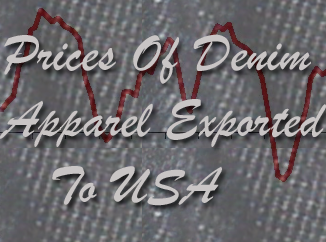
     denim prices About 580 million pieces of denim apparel were imported into US from various countries around the world in 2009. This apparel included mainly jeans and some small quantities of  denim skirts, denim jackets, denim blazers etc. The average price of all this apparel was USD7.15/ piece CIF US .

    It would be interesting to know which were the countries whose exports of denim apparel  to the US were very high priced and which were the ones which were priced low and we can see the marked difference between the two as also compared with the average prices .Lets have a look

    Countries Exporting High Priced Denim Apparel

    Italy , Japan and and Tunisia were the countries from where the denim jeans and apparel were the costliest for imports into US.  Naturally the volume for the same was also much lower as compared to low priced exporters.

    Japan – $46.47/piece   CIF US Ports
    Tunisia -$32.75/piece    –do–
    Italy -     $31.21/piece    –do–

    As expected Japan had to get the distinction of the highest priced exporting country . However, it was surprising to see that apparel from Tunisia were more expensive that from Italy. It is however to be noted that Tunisia exported much lesser volume to US than Italy.

    Countries Exporting Cheap Denim Apparel

    This is the category of countries most of the buyers of denim jeans/apparel from US are interested in knowing.  Bangladesh, Pakistan and Vietnam were the countries from where these exports were really very cheap.

    Bangladesh : $ 5.19/piece  CIF US Ports
    Vietnam      : $5.92/piece   —-do——–
    Pakistan      : $5.97/piece   —-do——-

    So we have an interesting matrix where ,against the average price of denim apparel at $7.15/piece, we can see the prices to be as high as $46.50 and as low as $5.20. This also shows the difference in prices  at which jeans and other denim apparel retail in the US – from $9.99(or lower) a jeans to $500 for a pair jeans.

  • Indigo Blue Dye: Not Only Blue – Some Interesting Facts

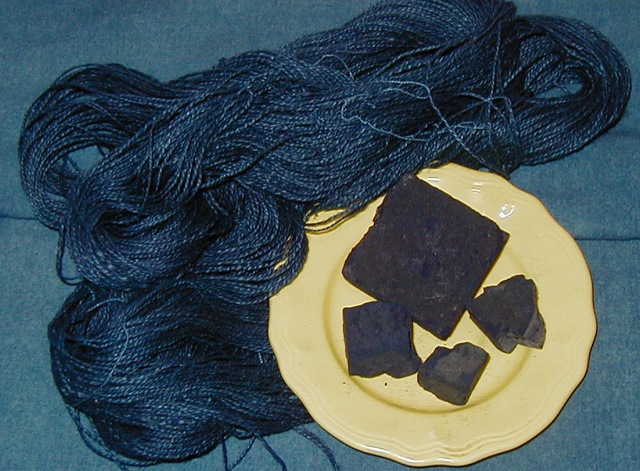
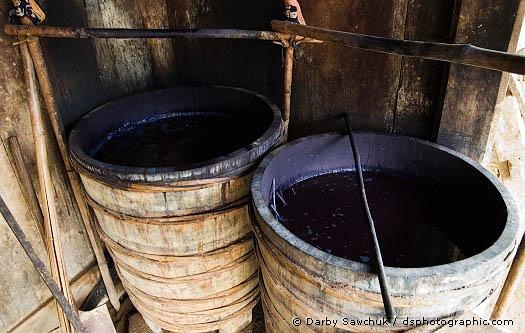
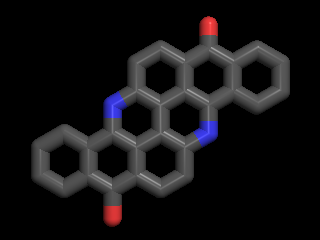
    indigo dye Indigo has been in use as a blue colorant for thousands of years as a natural dye, which was produced from the Indigophera plant in India and China and with woad in Europe. Indigo cultivation was introduced in the Americas in the 18th century, first in the West Indies and then in South Carolina. Indigo has throughout history been the colorant most in demand and current production levels are reported to be around 17,000 tons per year. Indigo was employed as a blue dye for wool primarily, until the 20th century, in fact, Indigo is a better dye for wool than cotton, being much easier to apply. There was another natural Indigo that was produced by shellfish at the eastern end of the Mediterranean Sea, known as Tyrian Purple, famous for producing the “royal purple” shade in antiquity. This dye is chemically different from the plant-derived Indigo only by the presence of bromine in the structure.

    In 1897, the BASF company began marketing synthetic Indigo which 002 - Indigo Dyegreatly increased the supply of Indigo-dyed fabrics. Once the technology for production of synthetic vat dyes was developed, a wide range of new colorants based on Indigo were available by the 1920’s. The COLOUR  INDEX , published by the Society of Dyers and Colourists in the 1924 edition, lists 54 colorants that were variants of Indigo !. The color range included the

    • Reddish brominated Indigo
    • Indigo Red
    • Indigo Yellow
    • Indigo violets
    • Oranges
    • Browns
    • Greys
    • Scarlets.

    In the 19th century natural Indigo was commonly used for printing and many of these new colorants were used for printing, especially of calico fabrics. The blue Indigo that is familiar as C.I. Vat Blue 1 is also referenced as C.I. Pigment Blue 66, when it is applied in printing.

    Other Indigoid colorants include:

    C.I. Vat Blue 5 produced by brominating Vat Blue 1 in nitrobenzene. In the 1990’s one U.S. denim company, Avondale, used this dye on a small 12-rope range to produce a fabric that was wildly popular in the fashion denim business.
    C.I. Vat Red 41, a bright red thioindigo which can be produced withindigo molecule thiosalicylic acid. This is a very versatile vat red in that it can be blended with blue Indigo in alkaline sodium hydrosulfite as in normal Indigo dyeing, be applied like a sulfur dye with sodium polysulfide in continuous or batch opertions as well as garment dyeing. Thioindigo possesses the unusual characteristic of photochromism, changing color on exposure to light. One way to test the dye in order to assure that it is thioindigo, is to disperse it in chloroform in which the color shifts from a violet to a yellowish-red.

    C.I. Vat Black 1 and C.I. Vat Brown 42 are simply mixtures of blue Indigo and thioindigo.

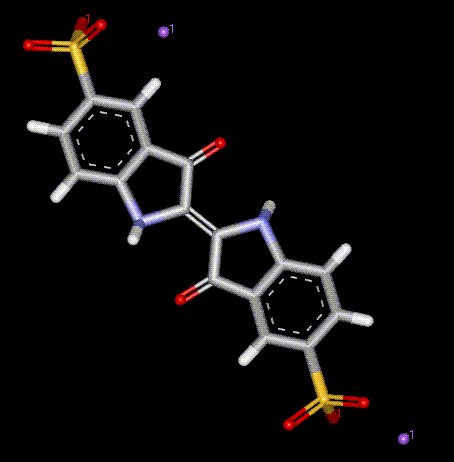
    C.I. Food Blue 1 is produced by sulfonating Vat Blue 1 in order toindigo food molecule produce 5,5′ indigotin disulphonic acid. This version is also listed as C.I. Acid Blue 74 and when insolubilized with aluminum salts becomes C.I. Pigment Blue 63. The highly-pure Food Blue 1 is used for coloring beverages, toothpaste, candy, mouthwash – in short, anything edible that is blue will use this form of Indigo, as well as use as a hair dye. Indigo has also been long in use to produce the blue color in fireworks !.

    Is Indigo Safe For Living Things?

    Indigo is so safe for living things that is has long been used to color medical sutures of  polyester, which is required because undyed-white sutures appear much like nerves and when the surgeon removes the sutures, the color prevents a nerve from being mistakenly cut. Originally, medical sutures were dyed with Indigo with solvents under pressure, but since then Indigo is dispersed in melted polyester resins, which are then extruded as filaments.
    All forms of Indigo exhibit the special brightness that is characteristic of the Indigoid structure and a full range of Indigo colors can be achieved readily on standard Indigo dyeing equipment by blending. Most of these dyes have steadily disappeared from market, having been largely replaced by the anthraquinones, however, they are simple to produce and perhaps there is a dye supplier that is interested in marketing this range of dyes, especially for the denim market !.
    imageThis is a guest post by Harry Mercer. Mr. Mercer has 30 years experience in the denim business including 3 prominent U.S. denim companies. He is an expert colorist for measurement and color matching as well as textile testing.

  • Mount Vernon Mills , USA – An Interview

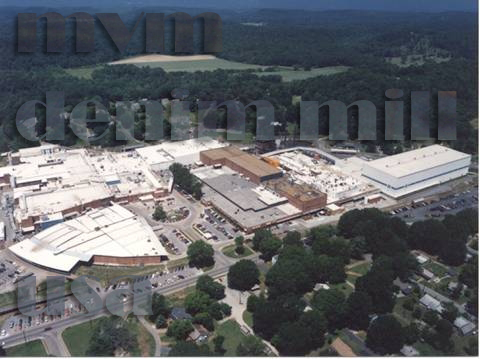
    mvm denim mill usa Mount Vernon Mills(MVM) is one of the oldest mills in the USA with its roots in mid-nineteenth century. MVM also makes some great denim fabrics in USA awhere most of the denim mills have either shut down or have shifted operations. We thought it might be a good idea to know what makes MVM tick and interviewed Mr Dale McCollum – Vice-President(Merchandising-Denim).

    Q.Tell us a little about Mount Vernon   Mills (MVM) and its history

    Mount Vernon Mills, Inc. ("MVM") is a diversified and integrated manufacturer of textile and chemical products. Beginning with flour mills converted to cloth production in the 1830s in the Baltimore, Maryland area, MVM became an important producer of cotton duck and canvas fabric by the late 19th century. The company’s focus shifted south in the 20th century as it expanded into polyester/cotton blends in addition to cotton fabric. As the last mills in Maryland were closed, production increased at plants in North Carolina, South Carolina, Georgia and Alabama.

    MVM became part of the R.B. Pamplin Corporation family in 1982. This gave MVM much more opportunity to grow, both internally and by acquisition. The 1985 purchase of Riegel Textile Corporation quadrupled MVM’s revenues, and made MVM a key producer of finished apparel fabric (especially denim and piece dyed twills), consumer products and home furnishings. Pocketing, findings and related product manufacturing was added in the 1990s, firmly establishing MVM as a leading U.S. supplier to the apparel industry. MVM also retains important market share in other textile markets, such as woven paint roller fabric, table linens, and transportation of fabrics. MVM now operates plants in six states in the Southeastern U.S.

    Largely because of its need for textile chemicals, MVM has also moved into the chemical blending and processing business. This includes dry chemicals like size, and wet chemicals such as softeners and lubricating aids. These operations are also allowing MVM to enter non-textile markets like adhesives and personal care

    Q.Denim is one of the main products of MVM . What other products do you manufacture and what are their individual capacities?

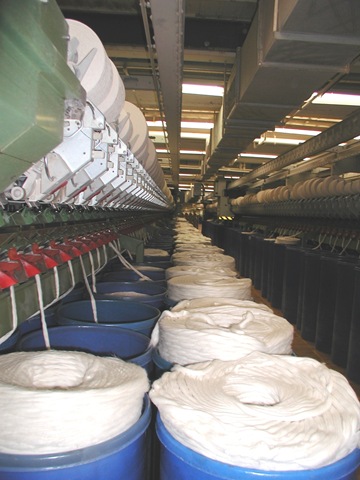
    denim yarn spinning Apparel Fabrics– denim capacity 1,500,000 yards weekly(about 78 million yards annually); piece dyed fabrics 2,000,000 yards weekly (including flame retardant fabrics) for career apparel, military uniforms, sportswear and work wear

    Brentex– pocketing; waistbands and interlinings, greige apparel fabrics; industrial fabrics

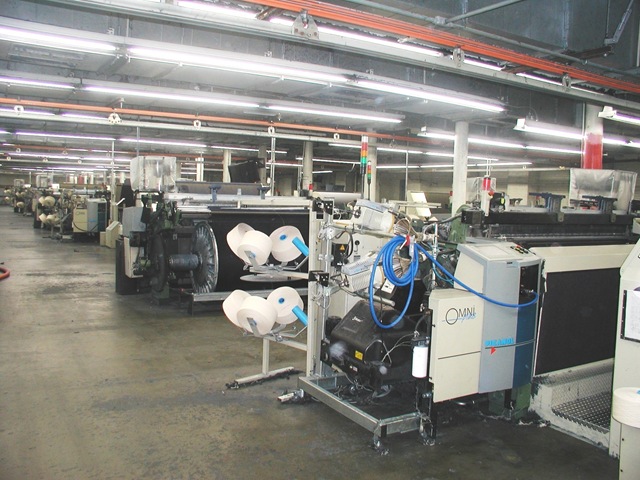
    Consumer Products– table linens; sheets and towels for hospitality market; infant beddingWeaving denim

    LaFrance– woven paint roller fabric; fabrics for cars, trucks, buses and other vehicles; industrial fabrics

    Chemicals– speciality chemicals (wet and dry) for textile, personal care, paper and other industries

    Q.MVM makes some great denims. Can you tell us something about your denim product line?

    Denim and Jeans photos 3-26-10 009 Mount Vernon Mills offers a complete product line of quality denim fabrics.  From heavy weight denims yielding maximum performance for industrial use – to the lighter weight premium stretch fabrics for a night on the town, we can provide it all.  We feature new shades and constructions each season to maintain trend alignment.  We offer a variety of pure indigo shades, indigo/sulfur combinations, as well as deep black and a host of other yarn dye colors.  Variety does not stop with shade.  Mount Vernon Mills also offers a wide range of fabric finishes as well. Flame resistance, custom tints, over dyes, and resin treatments are just some of the options available.  We have the capability to source all of your Denim needs.

    Q.How does MVM stand out (or is different) from other denim mills in North and South America?

    A couple of things that stand out in regards to MVM are:

    • We are privately owned, so we do not have to carry the debt burden that many of the other mills have to cover.
    • MVM is also very diversified into other product categories as detailed above.
    • We have our piece dye plant at the same location as our denim facility, 3.5 million yards of capacity in the little town of Trion, GA.  This piece dye plant gives the flexibility of specialty finishes on denims as well as the ability to run non-denims in our weaving facility if the market demand moves us in that direction.

    Q.As a denim mill solely producing in USA , how do you find the competition from other lower cost countries? How do you cope up with the same?

    The competition is really tough, especially form the Asian denim producers.  Mount Vernon is able to compete by providing top notch service and quality, on time delivery, quick turnaround for chase business and a constant infusion of innovative new product lines.

    Q.Are there any plans for expansion in US or overseas?

    At this time we do not have any expansion plans on the table; however, we are constantly reviewing the possibility of acquisitions outside of the US.

    Q.Premium denims are the in thing for the last couple of years. How has the growth of premium denims affected the denim mills in US?

    I feel that the growth of the premium denims has forced the US mills to re-examine the way they develop new products with this market in mind.  While the premium market is still a small portion of the overall denim market it is a very important one.  Many of the premium looks have filtered down to the middle tier markets and have given the US mills new opportunities to upgrade their product offerings.  At Mount Vernon Mills we keep an eye on the premium market and introduce some of the characteristics of those products into our more affordable product lines.


    Mr Dale McCullum is the Vice-President (Merchandising-Denim) at MVM and one of the key persons at the company. He can be contacted at this email address .

  • Women’s Denim Jeans – Street Trends Around The World

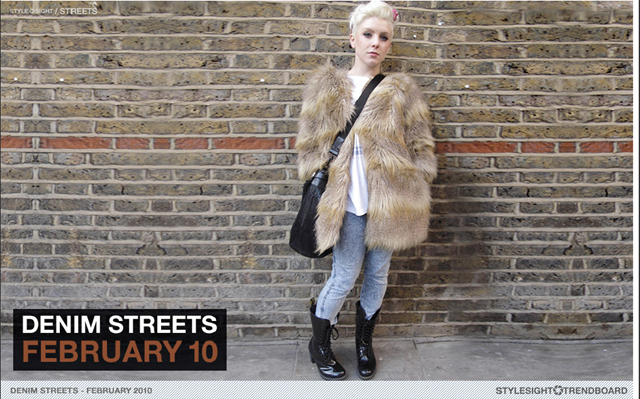
    What trends in women’s denim can be seen on streets in Paris, London, Tokyo, Berlin and other cities around the world? Is Skinny jeans still going strong ? Is Boyfriend jeans witnessing  new variations and silhouettes ? What new looks can be seen in Jeggings ?
    To find answers to many of these and similar questions, lets take a look at the Denim Street Trend Report from Stylesight.com . The report covers street looks from various cities.
    Skinny Jeans still looks like one of the top trends on the streets and has added new silhouettes and finishes . Among the washes, acid wash seems to be invading all types of styles. Check the full report below. The report is in two pages, find the second page here

    Denim Streets  Report From Stylesight

    1 

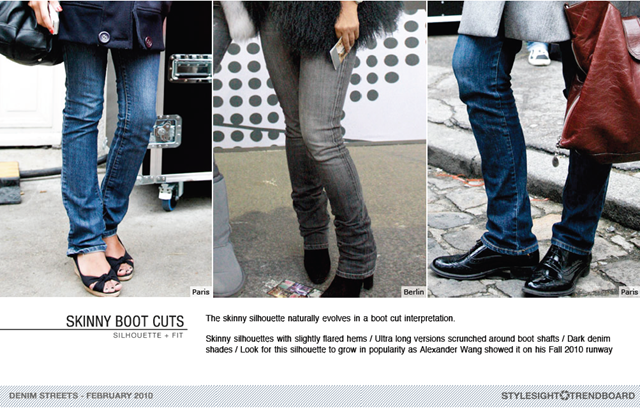
    1. Skinny Bootcuts:

    The skinny silhouette naturally evolves in a boot cut interpretation.
    Skinny silhouettes with slightly flared hems / Ultra long versions scrunched around boot shafts / Dark denim shades / Look for this silhouette to grow in popularity as Alexander Wang showed it on his Fall 2010 runway.

    denim trends women

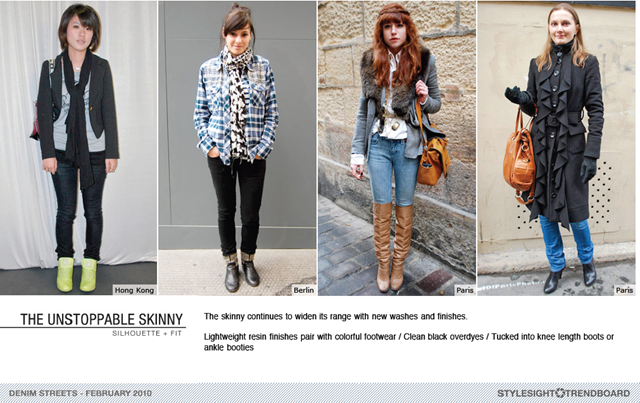
    2. Skinny Jeans – New Washes & Finishes

    The skinny continues to widen its range with new washes and finishes.Lightweight resin finishes pair with colorful footwear / Clean black overdyes / Tucked into knee length boots or ankle booties.

    skinny jeans trends women


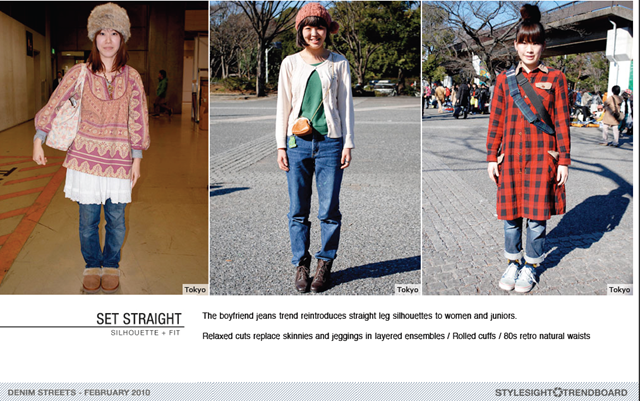
    3.Boyfriend Jeans Straight Legs 

    The boyfriend jeans trend reintroduces straight leg silhouettes to women and juniors.Relaxed cuts replace skinnies and jeggings in layered ensembles / Rolled cuffs / 80s retro natural waists.

    boyfriend jeans straight legs

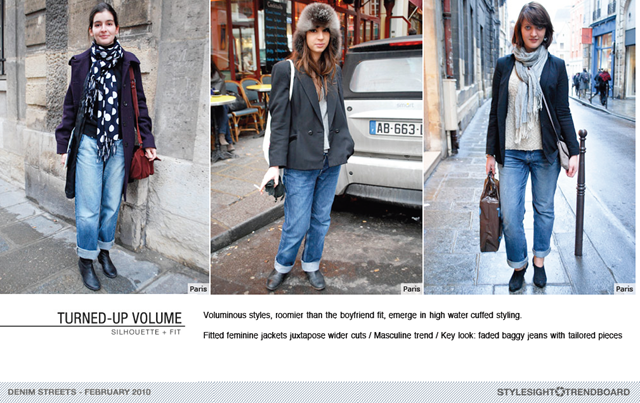
    4. Turned-up Voluminous Styles

    Voluminous styles, roomier than the boyfriend fit, emerge in high water cuffed styling. Fitted feminine jackets juxtapose wider cuts / Masculine trend / Key look: faded baggy jeans with tailored pieces.

    Turned up jeans trends


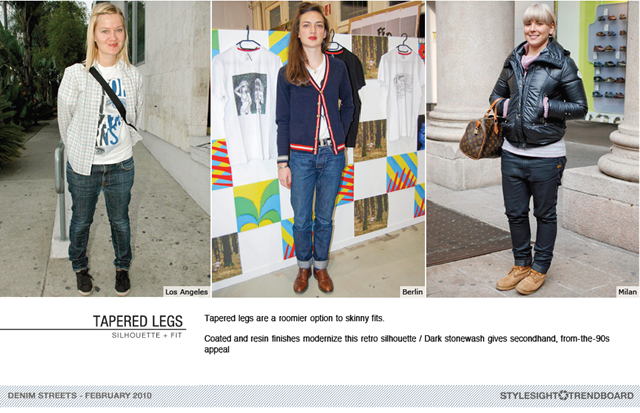
    5.Tapered Legs

    Tapered legs are a roomier option to skinny fits. Coated and resin finishes modernize this retro silhouette / Dark stonewash gives secondhand, from-the-90s appeal.

    tapered legs jeans trend

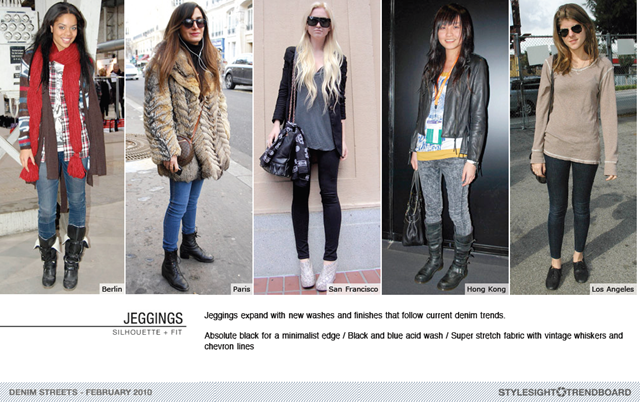
    6.Jeggings – New washes and finishes. Acid wash catches up on Jeggings too

    Jeggings expand with new washes and finishes that follow current denim trends. Absolute black for a minimalist edge / Black and blue acid wash / Super stretch fabric with vintage whiskers and chevron lines.

    jeggings washes and trends

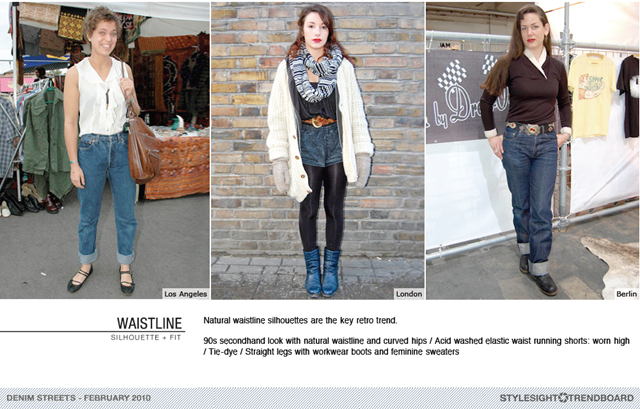
    7. Natural Waistlines –Worn High.

    Natural waistline silhouettes are the key retro trend.90s secondhand look with natural waistline and curved hips / Acid washed elastic waist running shorts: worn high/ Tie-dye / Straight legs with workwear boots and feminine sweaters.

    natural waistlines jeans

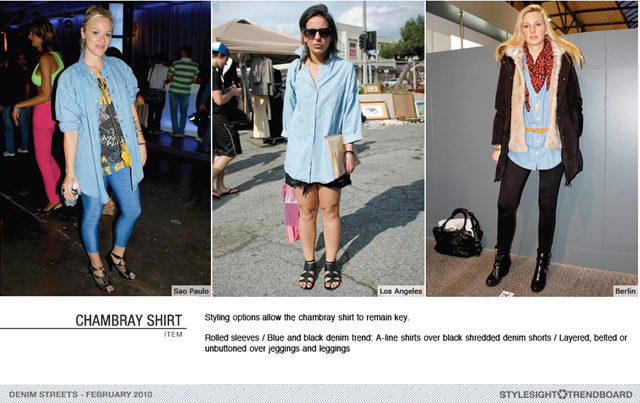
    8. Chambray Shirts – Interesting combinations with Jeggings.

    Styling options allow the chambray shirt to remain key.Rolled sleeves / Blue and black denim trend: A-line shirts over black shredded denim shorts / Layered, belted or unbuttoned over jeggings and leggings.

    chambray shirts denim trend

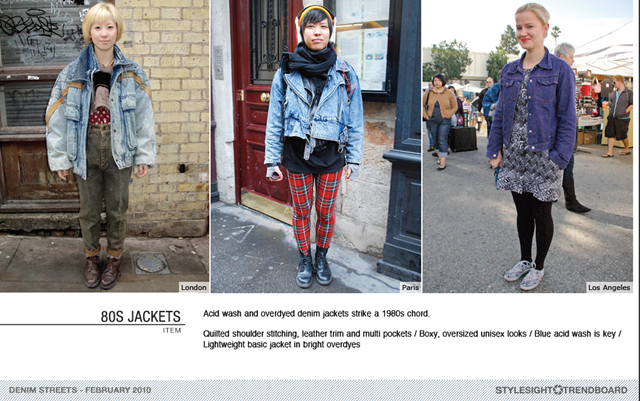
    9. Denim Jackets : 80s looks with acid washes.

    Acid wash and overdyed denim jackets strike a 1980s chord.
    Quilted shoulder stitching, leather trim and multi pockets / Boxy, oversized unisex looks / Blue acid wash is key /Lightweight basic jacket in bright overdyes.

    denim jackets trend 80s

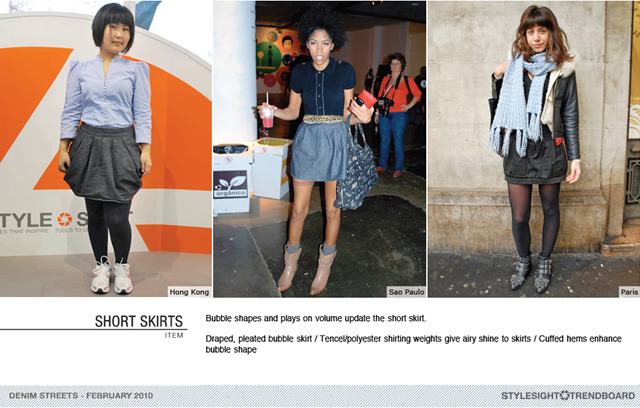
    10. Short Skirts

    Bubble shapes and plays on volume update the short skirt.Draped, pleated bubble skirt / Tencel/polyester shirting weights give airy shine to skirts / Cuffed hems enhance bubble shape.

    short skirts denim trend

  • Pocketing for Denim Jeans That Go With The Vintage Looks

    Pocketing material is used in most trousers including denim jeans. It comes in various qualities going from 100% cotton to nlyon and polyester pocketing. 
    Normally denim jeans use white, cream or similar lighter shades of different qualities of  pocketing fabrics . But what pocketing do you use if you are creating a vintage jeans and want your pocketing material to completely align with the looks of the jeans ? You want to show that your pocketing is as aged as your jeans ?

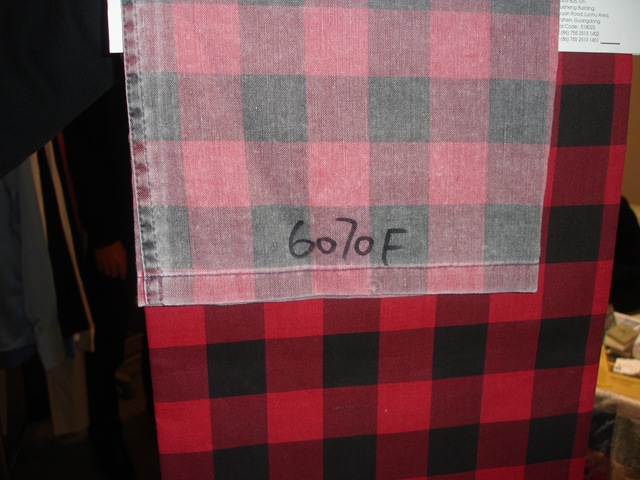
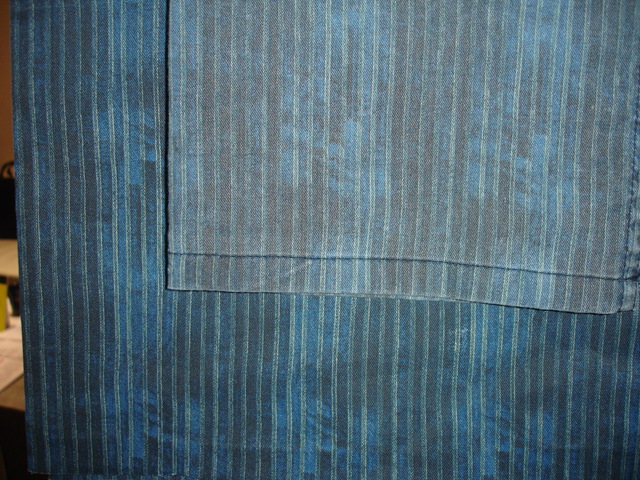
    Normal pocketing fabrics do not work in such a case . One has to use specialised pocketing fabrics which actually fade with the washing processes done on the jeans.. However, that is not enough – one has also to ensure that the fading of the pocketing fabric stops at certain stage and it retains color which does not bleed on to the undergarments.

    I came across some fabrics from Copen at Kingpins Hongkong , which actually have all the characteristics mentioned above.  I found the fabrics quite interesting – some of them are shown below :

    DSC05019 DSC05020

    DSC05023

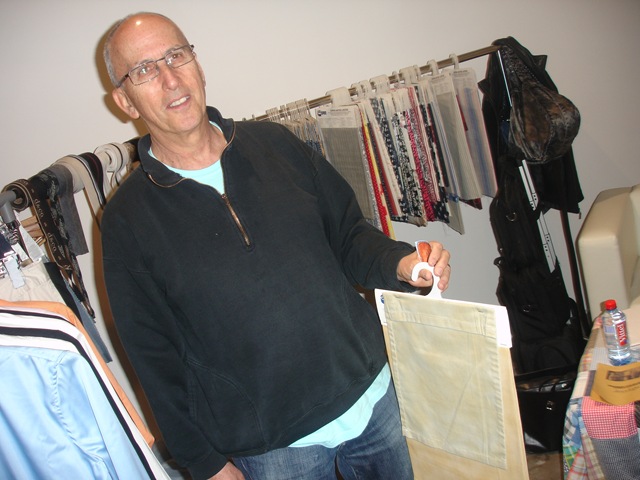
    Barry Emanuel from Copen showed me a number of such interesting fabrics which they supply to almost all major denim brands in the US. With the premium denim space getting more competitive, the brands are always looking at various ways to distinguish themselves from other brands and as Barry told me

    “ In a premium denim jeans everything has to be premium whether it is fabric, the pocketing, the rivets, tags or any other accessory’ .
    He also says “We have made pocketing fabrics – which is otherwise a very boring product – into a very interesting and lively product”. Agreed..

    About Copen :
    Copen was established in 1946 and has been in business for over 55 years. The company was originally a waistband manufacturer with a factory located on a military base in Jackson Tennessee. The company manufactures pocketing fabrics , waistbands ,printed bias tapes etc at various locations around the world.

  • Kurabo’s New Kantanmen Super Soft Wrinkle And Shrink Resistant Denim

    kurabo denim The famous denim mill from Japan – Kurabo – has come out with a great product  once again . Known for bringing out  innovating denim products from time to time – some of which have defined the denim developments the world over- Kurabo has brought out a Wrinkle Free and Shrink Resistant Denim which is Super Soft and remains so after a large number of washes. I met Mr Kenshi Kawano from Kurabo at Kingins Honkong( I am writing this post from the Kingpins show in Hongkong!)  explained the product to me :

    Kurabo Kantenmen Denim  – A Description

    Kanatanmen is a new functional 100% cotton material made by Kurabo’s innovative production method and it actually makes it difficult to shrink the or wrinkle even after washing. The wrinkle resistant effect of this product is much cleaner than the conventional cotton fabrics and enables the clothe to remain neat after washing.

    • Kantanmen does not become hard and keeps the softness after repeated washing.
    • Less scuffing; and maintains a neat  quality and appearance.
    • Products made of 100% conventional cotton become hard in texture after repeated washing but Kantanmen remains soft.
    • Ensures a long lasting beautiful shape and neat fit.

    What is meant by Kantanmen ?

    “Kantan” in Japanese means “ Easy Care” and “Men” in Japanese means “Cotton ”. So Kurabo has appropriately named their new product Kantanmen.

    The Technicalities In Kantanmen Finished Denim

    Kurabo’s Kantanmen is a shrink and wrinkle resistant material developed using a unique method of  manufacturing from an alternative perspective, after an analysis of of the factors that cause shrinkage and wrinkles . In conventional cotton textiles, variations in the degree of agglomeration of cotton molecules cannot be avoided. For this reason, large amounts of resin were needed to produce shrink and wrinkle resistant effects. This left practical issues such as decrease in strength and significant changes in the textile.

    In Kantanmen, the quality of cotton was improved in order to produce cotton with a  uniform monomolecular structure . Kurabo has succeeded in significantly improving the above effects in comparison with conventional cotton. Additional processes at the spinning and finishing stages lend the feature of remarkably low shrinkage  and super soft handle (that lasts) to the fabric. In normal  cotton fabric, the shrinkage after 50 washes can go upto 8% whereas in Kantanmen finish fabric , the shrinkage will be under 5% – see graphical image below:

    denim shrinkage

    Lets have a look at two fabrics – one with Kantanmen finish and one without (other parameters remaining the same) and see the difference.

    kantanmen denim kurabo

    And Mr. Cotton from Kurabo will be glad if you like the product !

    kenshi kawano About Mr Kenshi Kawano : Mr Kenshi Kawano is the President Kurabo Denim(HK) Ltd. and Kurabo Denim (China division) and has been with Kurabo for over 25 years. He has been a key person in the growth of Kurabo denim and of Kurabo name around the world.

  • Dirty Denim – A Look Into L.A Denim Business

    The wave of upscale jeans started in 2003 when a large number of national and international players descended upon Los Angeles and it became the centre of the denim growth story and  home to master denim technicians .

    Here is a series of some very interesting videos on the denim business – “Dirty Denim”- in L.A. The documentary created by Douglas Keeve is web exclusive and runs in 4 parts .Why the documentary has been named Dirty denim ? – Probably because of the stealing and cutthroat activities of many denim brands.

    Dirty Denim – First Episode

    In the first episode, we hear from top denim designers and technicians including Jeff Rudes(J Brand), Mik Serfontaine(Serfontaine), Gavin and Drew Foster(Chip & Pepper), Peter Kim(Hudson Jeans) and more…

    It is interesting to see that how serious or dirty the denim business is . Gavin and Drew Foster(the twin brothers at Chip & Pepper) mention that  they foresaw the premium denim wave coming and just plunged into it creating a multi million dollar business.

    Dirty Denim – Episode 1 Video

    Dirty Denim – Episode 2

    The second episode is quite interesting too. It shows the importance of the washing process in the creation of premium denim or any denim for that matter.
    And hitting the nail on its head, Chip & Pepper brothers  say–“ You can get the best denim in the world , but if you don’t have the right guy that knows what he is doing, he will f… it up”. Its a very interesting to watch the passion that the denim manufacturers put into their production. It is also clear that the manufacturers have to be on their toes all the time getting the right washes, creating new looks to beat the competition.

    Dirty Denim Episode 2 Video


    In the next post , the other two videos in the series will be posted and we will come to know why denim is dirty ?

  • Planet Denim -Re-designing The Denim Jean For a Sustainable Planet

    The project “Planet Denim”  with the prestigious MA Menswear course at the Royal College of Art in London, challenged the students to focus on the design and finish of the iconic “5 pocket” denim jean and to develop new techniques for pattern making, construction and especially finish, which take into account the long-term impact the design would have on the environment. Thus the idea was to create “Denim jeans for a sustainable planet”. The project was hosted and instructed by NYC based designer Johnny Diamandis. (ex design director Evisu Jeans). He was invited  to do the project by Ike Rust (Head of Menswear at RCA). Denimsandjeans.com also got involved in the project by providing useful inputs to the students.

    A number of students participated in the project and the works of three students was shortlisted . We would quickly go through their project work as below :

    Student 1 : Aleksandra Domanevskaya

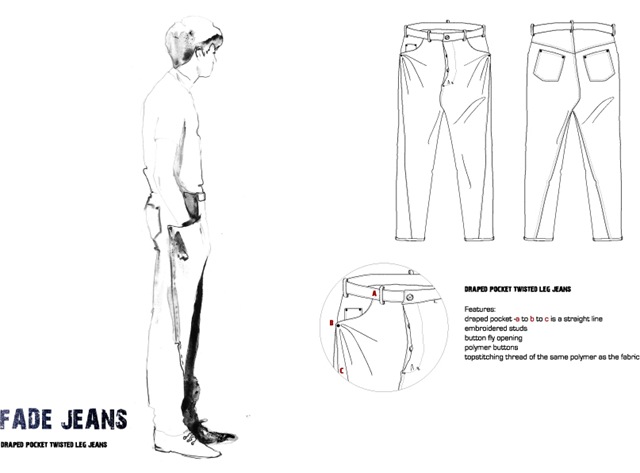
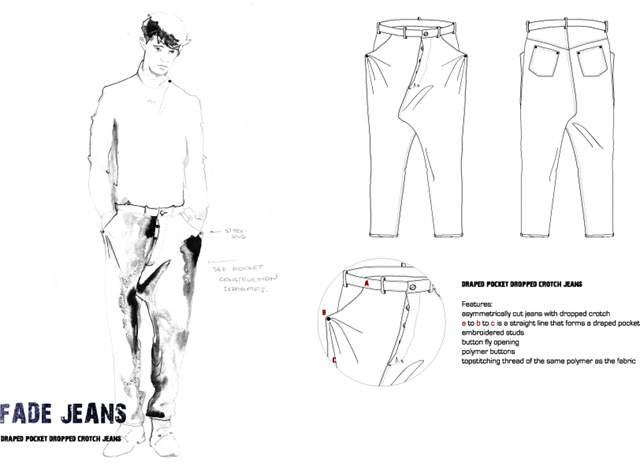
    Aleksandra brought out the concept of ‘Fade Jeans’ .Here is the summary of his project.

    Fade Jeans – The Concept

    Fade Jeans aim to make a small but important step towards changing consumer’s relationship with products.For the environmental form of production to succeed, western consumption habits need to change.

    We value things that we have made ourselves more than something that’s been bought. Fade Jeans offers customers an opportunity to modify their jeans and partake in the process of design. Consumers decide on the appearance of their jeans in terms of colour and wear.

    How it works:

    The dye on the jeans is left semi-fixed, so it fades quicker than normal jeans. Consumers wear the jeans in, wash them to their desired level of fade and then fix the colour of the jeans in the washing machine with a sachet of dye fixative provided.

    The Jeans are made of two fully recyclable materials, which can be easily separated, and up-cycled at the end of their life.The Fabric and Stitching threads are made of Lyocell. Lyocell fibre can be produced to meet any specifications and woven into twill fabric; it can also be melted back into polymer; up cycled, dyed and is biodegradable.

    Screw-in Buttons are made of Ingeo Biopolymer.
    Jeans are dyed with reactive dyes in a closed loop production system, using C2C principles for the choice of dyes, auxiliaries and finishing chemicals based on their impact on human and environmental health.
    Up-Recycling and Shipping
    The company will utilise existing postal networks. Jeans would be shipped in Ingeo crates, which can be reused unlimited amount of times. This way a pair of jeans comes useless-packaging-free at the shop level.
    On the inside back pocket area jeans have pre-paid envelope embroidered, so that when the useful life of jeans is over, they can be returned to the factory and moulded back into new fibre. Buttons, made of Ingeo can be reused infinite amount of times.

    Aleksandra Domanevskaya FADE JEANS 2

    Aleksandra Domanevskaya FADE JEANS 3

    Student 2– Emily Murry

    Emily brought out the concept of  “Generation Jeans”.

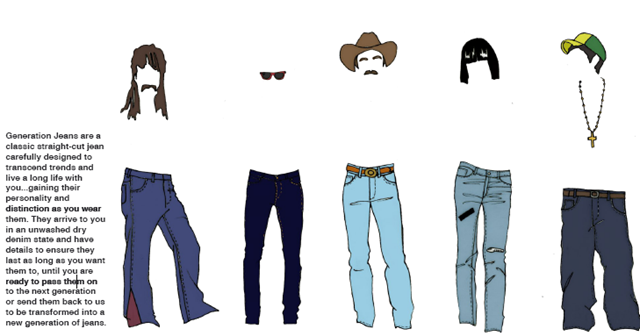
    Generation Jeans – The Concept

    Generation Jeans are a classic straight-cut jean carefully designed to transcend trends and live a long life with you…gaining their personality and
    distinction as you wear them. They arrive to you in an unwashed dry
    denim state and have details to ensure they last as long as you want them to
    , until you are  ready to pass them on to the next generation
    or send them back to us to be transformed into a new generation of jeans.
    Generation Jeans will basically have “An Extended Life” so that the same jeans can be used for a longer period of time.

    Details
    1. 60% Organic cotton 40% Organic hemp .Hemp is easily sustainable and uses considerably less water in the processing than cotton. It is naturally antibacterial and extremely  durable, helping to prolong the life of the jeans. The cotton however, helps retain the softness of the denim making them more comfortable against the skin.
    2. Two-piece Tagua Nut buttons – strong and durable but biodegradable and sustainable also.
    3.Reinforced gusset piece cut on bias – to allow easier movement but prolong life of jeans in thei weak area.
    4.Unbleached organic cotton waistbanding and pocketing – biodegradable and non-toxic. Waistband has internal drawstring to adjust fit further, prolonging wearers use of jeans.
    5.Cross-stitching reinforcement at pressure  points, no use of metal rivets.
    6.Contrast triple top-stitching on inside and outside leg with non-toxic dyed organic cotton thread, heavy weight for strength. Chain stitch used meaning if stitch breaks anywhere on seam it will not run, thus making jeans more durable.
    7. Waistband and centre back seam with 2.5cm additional seam allowance to take trousers out.
    8. Reinforcing patch behind pocket corners to prevent tearing.
    9. 10cm deep button-up hem which can be let down or buttoned higher with growth or changing trends.
    10. Woad -dyed denim. Woad is a natural, non-toxic dye which does not require the use of mordants or toxins for fixing. Fully biodegradable
    and approved by the National Soil Association.

    generation jeans

    How it works ?

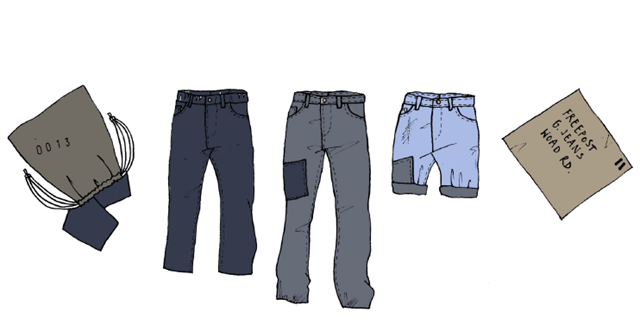
    You receive your jeans, along with repair patches and thread, in a protective felt bag. The felt is made from the jeans textile waste and remains unbleached or dyed. It is fully biodegradable and non-toxic. With the drawstring waist pulled in and the button-up hem at its shortest, you start
    the love affair with your dark, dry denim Generation Jeans. Your legs have grown, so you let down your hem to the longer length, and after years
    of wear the colour has faded and you require a patch
    . The jeans look lived in and loved, and still fit you and feel as good as when you first got them.
    Many years later, your jeans have faded further and you had to let the waistband out a little, but your Generation Jeans are still your good old
    faithful in the front of your wardrobe.
    Finally, after years shared with you favourite jeans, its time to say goodbye. So you pack what is left of them into a freepost envelope (available from the website or store if you lost the original from years ago!) and send them back to us, where we compost them or re-use still strong parts for new generations of jeans

    jeans environment friendly

    Student 3 -  Fah Chakshuvej

    Fah brought out the concept of  ‘By-Product Jeans’

    By-Product Jeans

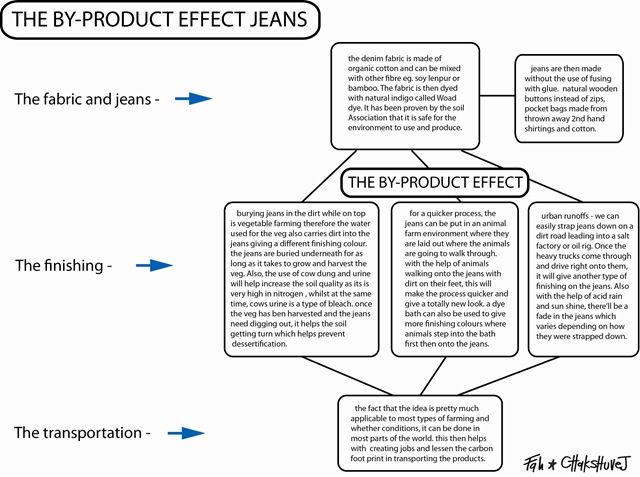
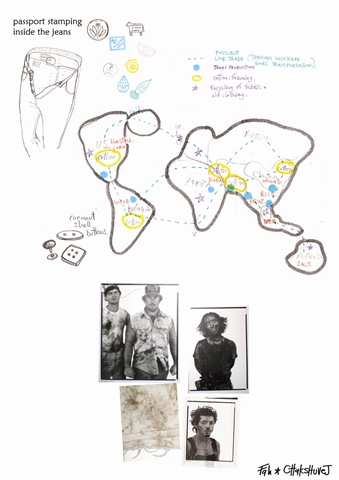
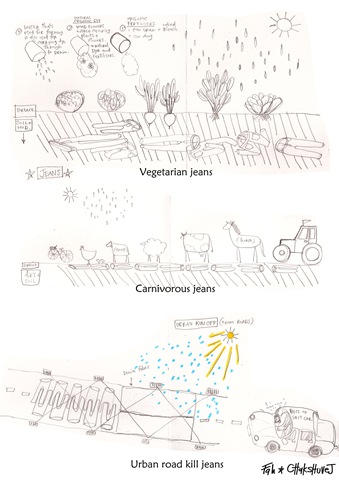
    The basic concept behind By-Product jeans is to use environmentally friendly ingredients and also environment itself to provide the various effects on jeans.The jeans are basically buried in various places like farms, dirt roads etc to provide various effects on the jeans.

    Here is a complete picture of her project . Click on the photograph to see the larger size .

    by product jeans

    Fah Chakshuvej-BY PRODUCT JEANS 1

    Fah Chakshuvej-BY PRODUCT JEANS 3

    So, this was a very brief summary of some students work related to the “Project Denim”.

    To which of these students does your vote goes to ?

    About RCA: The Royal College of Art (often abbreviated RCA) is the world’s only wholly postgraduate university of art and design, offering the degrees of MA, MPhil and PhD. The University is located in South Kensington and Battersea  in London, United Kingdom.The College has an international reputation for its teaching in the fields of architecture, automotive design, photography, industrial design, communication design, interior design, fashion, ceramics and silversmithing.

  • Denim Product Development – An Analysis

    This is a guest post by Harry Mercer

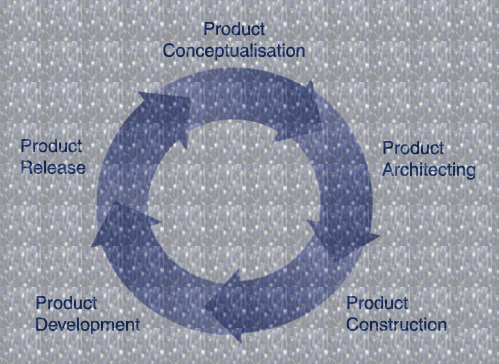
    denim product development Product development is especially important in the denim market because of demands for novelty and performance, both on the fabric production side and from the garment processing side.

    There are 2 aspects to product development of fabrics. Product development is usually thought of as creating a product for the market with significantly different colors, appearances (flat, slubs), hands (soft, raspy) or performance (stretch, permanent press).

    The other aspect of product development, equally important, is product improvement, which includes reducing defects, improving performance (shrinkage, stretch, reducing costs).

    The leading denim companies in the U.S. conducted extensive research into solving the mysteries of denim production, especially in dyeing and finishing, Outside the U.S., there are some denim companies in countries like Italy, Turkey and Japan that are well-known for their quality.

    The leader in denim quality, Burlington, developed a reputation for quality such that active marketing was not necessary in some years. In fact, their denim was in such high demand because of its quality, that Burlington could not produce enough and resorted to rationing their fabric to their best customers. Of course, the prices that they received were much better simply because they could deliver the highest quality consistently.

    While most of the denim factories in the U.S. were closed by the late 1990’s, there are still 4 operations remaining, no large establishments are left, only 2 small and 2 medium operations.

    The 2 small operations (Cone and Denim North America) are dedicated to high-fashion denim, while the 2 medium-sized companies rely primarily on producing large quantities of a few basic styles, but with high levels of quality.

    One of the medium-sized operations, Mount Vernon, also produces significant quantities of non-denim fabrics which provides financial stability and flexibility in textile markets. The other, American Cotton Growers, also produces a line of fashion denims that are in strong demand.

    Producing the highest-level quality denims may be the surest route to long-term success. The higher-fashion market is unpredictable and makes sudden changes that has had the effect of a financial earthquake on denim producers that struggle with specialty denim. Mixing basic and specialty denim in the same production operation can complicate manufacturing to the point where effective control is lost.

    WHEN PRODUCT DEVELOPMENT CAUSES PROFIT  OR LOSSES

    The product development function can also be a financial liability, if it lacks FOCUS and DISCIPLINE. The FOCUS of product development must be company profits; to maintain that focus, marketing managers must exercise DISCIPLINE by not trying to provide every fabric requested by customers.

    • Producing a new product involves additional costs which must be absorbed by manufacturing.
    • These costs include set-up costs in affected production departments; disruption of planned production; material costs for special fibers, yarns, dyes and chemicals; and the cost of carrying inventory when no buyers can be found for the new fabrics.
    • While the previously-mentioned expenses can be quantified, there can also be a significant loss as a result of deterioration in process control and quality assurance.
    • Producing denim fabrics is complex with many variables. When additional variables are introduced, complexity increases and additional variability results. Too often, denim marketing managers force manufacturing to make sudden changes in order to book an order that creates a net financial loss.

    NOT MUCH REALLY NEW

    • There have been thousands of different denim fabrics produced and only a few hundred have experienced significant commercial success.
    • With the exception of minor variations, such as the use of unusual fibers like bamboo or application of special chemicals like polyurethanes, very little truly original denim has appeared in many years.
    • For the most part, the same denim fabrics are re-cycled in cycles of perhaps 5 or 10 years.They merely seem to be new because of their long absence from the market.An excellent example of this is “antique” or “authentic” denim as it is called. Around1980, the U.S. denim industry had nearly eliminated all shuttle-weaving in favor of rapier or projectile weaving. The denim that we were weaving on the shuttle looms was less than a meter wide, which  was no longer acceptable to the market. The fabric weight was 12.5 oz/square yard,- the yarn was ring spun, 7.5/1 Ne in the warp and 6.75/1 Ne in the weft. The reed had 6.5  dents per centimeter and the speed was very slow, around 100 rpm.
    • All of the shuttle looms were sent to the warehouse and no one expected to see them again.
    • By 1990, however, the fabric was back in demand for high denim fashion and has remained strong in the market for 20 years.


    POTENTIAL FOR NEW FABRICS

    The remarkable appeal of this “antique” denim is probably because it has a home-made or hand-woven character. The shuttle loom is the closest automatic weaving machine to handloom weaving with its large shed opening and low tensions.

    For denim executives that are struggling in the current market with its increasing demands for lower prices, organizing an effort utilizing hand-loom weaving could offer a new source of revenue. There are millions of hand-loom weavers all over the world and denim operations, especially those with sheet Indigo machines, produce large quantities of waste yarn, as a result of dye machine stops or slow speeds and is not suitable for automatic weaving and( that is already dyed and sized, ready for weaving.

    In this way, yarn waste could be used for a very high value-added product, which would also employ many people in developing countries and also contribute to “sustainability”.

    Further, by applying special hand-finishing techniques, a new fashion trend could result.

    imageThis is a guest post by Harry Mercer. Mr. Mercer has 30 years experience in the denim business including 3 prominent U.S. denim companies.He is an expert colorist for measurement and color matching as well as textile testing.

  • Donate Your Old Jeans, Get 30% Off GAP And Help Insulate Homes

    image image

    Have some spare old jeans which you can dispense with ? Go to any Gap store and return your old jeans and get 30% off denim purchases at (selected) Gap stores till March 14th.

    Initiated by the Cotton Incorporated , the Cotton: From Blue to Green Project takes your old jeans and converts them into Ultra touch Natural Cotton Fibre Insulation for communities in need.

    The first From Blue To Green denim drive in 2006 collected 14,566 denim pieces across the US, more than double the anticipated amount. Since then, the project has expanded its reach through partnerships with national retailers and organisations including American Eagle Outfitters, Bloomingdales, National Jean Company, Ernest Sewn and G by Guess.

    To date, the UltraTouch Natural Cotton Fiber Insulation manufactured by Bonded Logic Inc. has recycled enough denim to create natural cotton fibre insulation for over 540 homes.The COTTON. FROM BLUE TO GREEN.® denim drive is a call-to-action to donate denim and give it “new life” by converting it to UltraTouch™ Natural Cotton Fiber Insulation. The insulation is then provided to communities in need to assist with building efforts. UltraTouch™ is composed of 85% recycled cotton fibers and is an environmentally safe, non-itch insulation without carcinogenic warnings, formaldehyde or chemical irritants. It provides exceptional thermal performance and acoustically provides 30% better sound absorption than traditional fiberglass insulation. In addition, it is one of the only insulating products that contain an active mold/mildew inhibitor.

    image


    PS:This offer is not valid online, at Gap Outlet, Gap Factory Store, or The Gap Generation stores. Not valid on Converse® or Stella McCartney for GapKids/babyGap.