Author: Sandeep Agarwal

  • Levi’s Uses Facebook Social Buttons To Improve Sales

    levis facebook like Social media has become a very important component of marketing efforts of  top companies  worldwide.  With hundreds of millions of people around the world connected through various social media sites like Facebook (400million+ subscribers) , Linkedin

    (65+ million subscribers) , Youtube, Twitter and a host of other sites,  it is only natural that companies would like to convert the visitors on these sites to their customers. Many brands have already taken the social media route to promote their brands. With new tools being provided by the social networking sites, it is becoming  easier for various companies to develop a community around their products – which helps the companies to get sales through peer recommendation. 
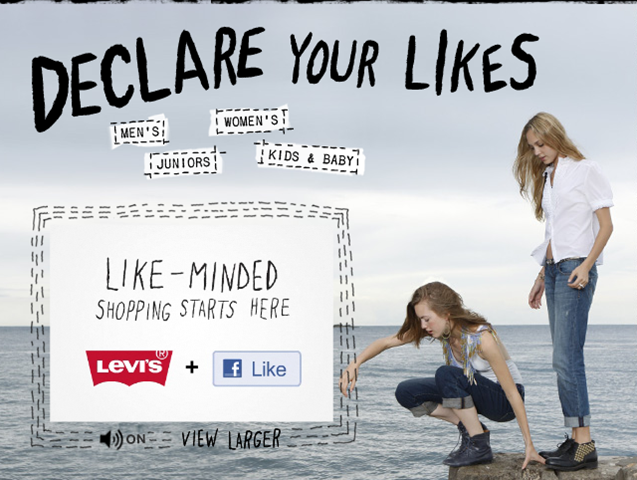
    Facebook has introduced new social plugins which can be easily incorporated in the websites to create user experiece which is more personalised and social. Levi’s has announced that it will be using the Facebook plugins , specially the ‘Like Functionality’ to provide innovative shopping experience to their buyers on their site Levi.com . They are also building a ‘Friend Store’ which would be visible to the logged in users of Facebook.

    How does these Social Plugin Work On Levi’s Store

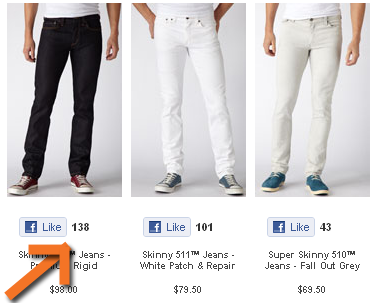
    Levi’s has  paired the ‘Like’ button alongwith their products. As a result , visitors can see how many facebook users actually like that particular product. One can add one’s like to this list by just clicking on the button and logging in with the facebook login details.
    facebook levis jeans

    As in the example above, this particular jeans has been liked by 138 facebook users. And if you click on the ‘Like’ button, you will be able to login to facebook and add your liking to this jeans.   And once you click on the button, there will be a pop-up message poster to facebook from where you can add comments to this liking which your friends can see those comments on your facebook page .

    levis jeans facebook button

    Not only this, you would be able to see the images of your friends who have liked this particular product on the Levi’s Friend Store. So , it becomes a nice recommendation tool where facebook users can see which of the Levi’s jeans their friends like and (maybe) why ! . Its like meeting friends  in college cafetaria and discussing ones favourite jeans .

    How is Levi’s Going To Benefit From This

    Levi’s , with its substantial customer base around the world will get  great  benefits from this Facebook tool.

    • They will get more sales since peer recommendation is a powerful incentive to  purchase a product.
    • They will get great feedback on all their products and will be able to generate seasonwise, productwise liking report which will help them to forecast their sales better and to build more customised products for their users.
    • They will be able to know region wise liking of their products – which will again be a great customer  input for future marketing campaigns and product directions.
    • For the customers, there is the comfort of knowing that their friends have already used or liked a particular Levi’s product and they will be more  at ease buying the same.

    With all these benefits, it is not surprising that Levi’s has gone with the Facebook  ‘Like’ functionality plugin  and taken it a level up by creating their ‘Friends Store’.  They may adapt some of the more social plugins which are coming up  if they find it useful to promote their products on the net.
    Some of the other early adopters of this Facebook application include CNN and movie site IMDB.  And there is no reason why other denim brands , or for that matter any apparel brand, should not follow suit. Already major retailers have their own facebook accounts. However, for this particular functionality to be useful ,an important  requirement would be  that the brand needs to have a respectable online store which gets sizeable traffic . Without a sizeable traffic, the advantages of these plugins would be minimal.
  • What Quantity Of Denim Fabrics Is Used For Production In USA?

    denim consumption What is the actual quantity of denim fabrics consumed in USA? We have seen previously the reports on Per capita consumption of jeans in  USAimports of denim jeans into US and imports of women’s denim jeans.  

    But what exactly is the denim fabric used for production of various denim items in US ?. We can arrive at this figure only if we know the actual production of denim fabrics , imports and exports of denim fabrics. It would give us the net amount of denim fabric that has been used in US for various purposes . Lets have a look at this chart which gives the figures for the year 2008 . The figures for 2009 would be available shortly.

    Production,Imports And Exports of Denim Fabrics In USA

    Production (mill. sq. mtrs) Production
    (mill. linear mtrs)
    Imports (mill. sq. mtrs) Imports (mill. linear mtrs) Exports(mill. sq. mtrs) Exports(mill. linear mtrs)
    141.66 88.53 40.61 25.38 125.57 78.48

    Note: Linear meters are taken at an average of 160cm

    The actual production figures for denim fabrics show the extent to which the denim fabric production has gone down in US. There were times when over 500 million mtrs of denim used to be produced annually .But this fall  is only to be expected since the costs of production in Asia are much lower and US mills find it difficult to compete with them.

    We arrive below  at the consumption figures for denim fabrics in USA.

    Consumtion Of Denim Fabrics In USA In 2008

    (In Million Linear Mtrs.)

    Production 88.53 million mtrs
    Imports 25.38 million mtrs
    Total 113.91 million mtrs
    Less Exports 78.48 million mtrs
    Consumption In USA 35.43 million mtrs

    Thus we can see that about 35 million mtrs was actually consumed in US in 2008 for various purposes . Though the figure seems small, it is not insignificant once we consider the costs of denim jeans production in USA.

  • Denim By Premiere Vision 2nd – 3rd June 2010

    image Denim by Premiere Vision is again coming back for its 6th edition . To be held on 2nd-3rd June , it will be held in the Halle Freyssinet in the interiors of Paris – in an industrial building . This is not the only difference this time. Denim By Premiere Vision has opened itself  to a number of participants from around the world. This includes a number of known denim manufacturers , labeling companies and a natural dye company from countries like India, Pakistan, South Korea , Thailand etc. This has enabled the fair to increase the number of exhibitors from 62  in the December 2009 edition to 68 exhibitors this time. This is a natural progression for the fair since the the major part of denim world is outside Europe (particularly in Asia)  and that is where the real growth is happening. It can ill afford to ignore the major segment of the denim industry.  The new exhibitors include  :
    Arvind – India : The only new addition from India ,and with about 110 million mtrs of denim production and licenses of a number of international denim brands, Arvind was a natural choice for being included as a new participant.
    Isko – Turkey :  With a capacity of over 200 million mtrs p.a , Isko is a major  denim player worldwide .
    Artistic Milliners – Pakistan : Founded over 60 years ago , this company has a production capacity of 31 million mtrs/year and proposes 2 collections each year.
    Artistic Denim Mills -Pakistan :  Integrated denim mill which specialises in dyes and coatings.
    AMC Atlantic Mills -Thailand : Though with a capacity of only about 18 million mtrs pa, the company makes some very cool denim fabrics including super dark super soft denim.
    Eco Yaa – South Korea : Manufactures natural dyes from plants and particularly grapes – a technique for which it has submitted a patent.

    Future Denim Designer Awards

    Denim by Premiere Vision has asked students from the prestigious  fashion and design school – Central Saint Martins – to design jeans (of the future) . The project shall be supervised by Adriano Goldschmied( of Diesel and AG fame). The six finalists shall present their fashion silhouettes (a top + a skirt or trouser) with material supplied by three exhibitors – Orta, TRC  Candiani and Berto . The garments shall be displayed in the show in a special area designed by Saint Martin students.

    Here is a complete list of the exhibitors for reference:

    Denim Exhibitors

    Company Name Country Core Activity
    Artistic Denim Mills Pakistan Weaver
    Alliance Textiles Morocco Garments/Finishings
    Artistic Milliners Pakistan Weaver
    Arvind Ltd India Weaver
    Atlantic Confection Morocco Garments/Finishings
    Atlantic Mills Co. Thailand Weaver
    BA-TU Tekstil Turkey Garments/Finishings
    Berto Italy Weaver
    Best One Morocco Garments/Finishings
    Bossa Denim Turkey Weaver
    Cadica Group Italy Accessories
    Candiani Itay Weaver
    Cappio Tessuti Italy Weaver
    Central Fabrics Hong Kong Weaver
    CEPEX Tunisia Promotion
    Close to Clothes France Accessories
    ConfectionRas Jebel Tunisia Garments/Finishings
    Crossing Morocco Garments/Finishings
    Denim Authority Tunisia Garments/Finishings
    Denim De L & ILE Mauritius Garments/Finishings
    Denim Valley Spain Weaver
    Denimo Turkey Weaver
    Deridesen Turkey Accessories
    Dorlet France Accessories
    Dynamo Denim Turkey Weaver
    Eclair Prym Morocco Accessories
    Eco Yaa South Korea Garments/Finishings
    Layanderia Emmetre Italy Laundry
    Ereks Garment Turkey Garments/Finishings
    Eroglu Group Turkey Garments/Finishings
    Etiquettes Et Accessories Tunisia Accessories
    FG Tekstil Turkey Garments/Finishings
    Gap Guneydogu Turkey Weaver
    GFM Textile Germany Weaver
    Global Denim Turkey Weaver
    LA Griffe Tunisia Accessories
    GTX Srl(Gentex) Italy Weaver
    Hellenic Fabrics Greece Weaver
    ICOMA Morocco Weaver
    INCI Buttons Turkey Accessories
    Indicott Turkey Weaver
    ITV Italy Weaver
    Isko Turkey Weaver
    Italdenim Italy Weaver
    J-Val Italy Accessories
    Kipas Denim Turkey Weaver
    Kurabo Japan Weaver
    Kuroki Co. Japan Weaver
    Marassi Denim Turkey Weaver
    Matesa Tekstil Turkey Weaver
    Okinawa Italy Accessories
    Orta Anadolu(Denimus) Turkey Weaver
    Orta Anadolu T.A.S Turkey Weaver
    Panama Trimmings Italy Accessories
    Paris Texas Morocco Garments/Finishings
    Piovese Fashion Italy Accessories
    Prosperity Textiles Hong Kong Weaver
    Real Kom Tekstil Turkey Garments/Finishings
    Realteks Turkey Garments/Finishings
    Tejidos Royo Spain Weaver
    RSP 51 Spain Weaver
    Textil Santanderina Spain Weaver
    Sartex Tunisia Garments/Finishings
    Special Fabrics Turkey Garments/Finishings
    Tavex Spain Weaver
    Texpro Tunisia Garments/Finishings
    Turteks Turkey Accessories
    UCO Belgium Weaver
    Vicunha Europe Switzerland Weaver

    The maximum number of exhibitors – about 22 ( 32%) – are from Turkey and much higher than Italy which has 12 ( 17% ) exhibitors participating. Surprisingly, there was no participant from China – but that may be we will that happening soon.

  • Guess Women’s Jeans Fall/Winter 2010 Look Book

    Here is the Guess Women’s Fall/ Holiday 2010 women’s denim look book which they have shared with us. The Men’s Fall / Holiday Look book can also be found here.

    The fall 2010 collection fetaures Power Stretch Fabrications, Unique Washes, Fashion Silhouettes, and 80s and 90s Styling. Skinny jeans and leggings continue to be a strong trend and acid washes are used – reflecting their growing popularity.
    Fabric:  Light Weight Power Stretch Denim is present in Dark Indigo, Coated qualities, and bleached out colors. Medium Weight Denims with comfort stretch and Stretch Corduroys are also included in the fashion assortment.
    Wash Finish: Stone Washed and Potassium Sprayed Indigo washes, Knee Fading and Whisker Detailing, Natural Worn looks, Foil Treatments on Denim, Tie-Dye Wash Techniques, Washes down shades of Grey and Black, Brush, Splatter and Spray Accents are all incorporated into the newest denim collection.
    Silhouette:  The assortment centers around super slim legging / jegging fits.
    Detailing
    :  Fashion Silhouettes get detailed with the following: Contrast piecing with fabric and leather, Power Shoulder Details, 80s Styling, Re-Constructed Seams, Zipper and Chain Detailing with Metal Fringe and Black Enamel Hardware Finishes, Faux-Fur Trim Detailing

    beverly jeans   denim harem pant

    leather skinny purple power skinny jeans guess.png copy

    power acid synth skinny jeans power resolute skinny jeans

    rinse skinny jeans guess back zip power skinny jean

    melia ruffle denim dress guess britney motto legging guess

  • Production Of Denim Jeans In The EU

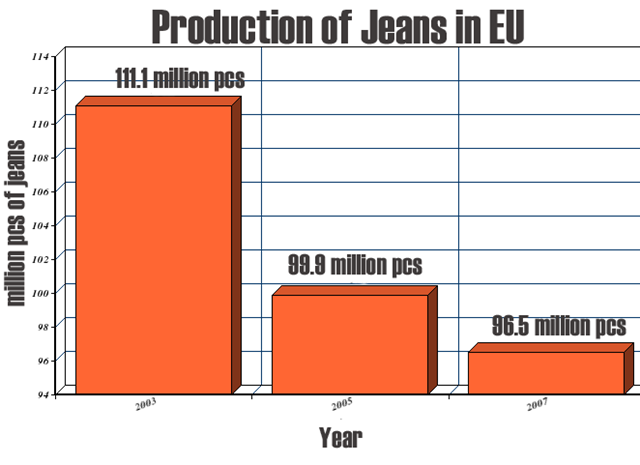
    Here is a summary of the production of denim jeans in the EU for the period 2003-2007. This report has been compiled by the CBI . It is interesting to see that till 2007 , the production of jeans in Italy is still the largest in the EU and followed closely by Romania and Spain. Italy is increasingly becoming an expensive place to produce the jeans – however, the production of jeans is still quite high. This production has actually seen a significant fall in the last 2 years as per industry estimates and the production is moving to low cost countries like Romania, Spain, Portugal etc. Italy is slowly expected to become more of a design centre than a production center.
    Even countries like Romania and Spain are now producing which are middle to high end. The low end jeans are almost entirely being imported from third world countries. This is only to be expected.

    Value and Units Of Denim Production In EU From 2003-2007

    Place 2003
    million units
    2003
    value in
    million Euros
    2005
    million units
    2005
    value in
    million Euros
    2007
    million units
    2007
    value in
    mill. Euros
    Italy 63.9 959 56.1 994 59.3 1276
    Romania 14.2 42 20.2 76 14.2 151
    Spain 15.9 278 9.4 152 11.7 196
    Portugal 4.7 75 4.9 81 5.2 78
    UK 6.7 96 2.5 35 3.2 30
    France 0.9 32 0.6 18 0.5 17
    Greece 0.5 8 0.6 13 0.5 11
    Germany 0.8 12 0.5 7 0.3 7
    Others 3.5 42 5.1 54 1.6 15
    Total EU 111.1 1,544 99.9 1,430 96.5 1,781

    It is interesting to note that in case of Romania, the average value of the jeans produced in 2003 was Euro 2.5 only. However, just within 4 years , the average value has increased to Euro 10.63 . This shows that the country has quickly migrated from being a producer of lowest end jeans to that of higher quality jeans in a very short period. This is perhaps the case in most of the EU countries as the wage structure there does not allow to produce low cost jeans which can be easily sourced from the less developed countries. In case of Romania, it is specially so since a large number of Italian jeans manufacturers have set up base there and having their designing base in Italy, they produce in Romania.

    When we come to the average value of the jeans produced in EU in 2003 as compared to that in 2007, we again arrive at the same conclusion. In 2003, the average value per pair of jeans was Euro 13.90  . The same increased to Euro 18.45.  This has perhaps increased further in the last 2 years.

    Average Value Of  Jeans Produced In EU 2003-2007

    Place 2003
    (Av. Value per jeans in Euros)
    2005
    (Av. Value per jeans in Euros)
    2007
    (Av. Value per jeans in Euros)
    Italy 15 17.71 21.51
    Romania 2.95 3.76 10.63
    Spain 17.48 16.17 16.75
    Portugal 15.95 16.53 15
    France 35.55 30 34
    Greece 16 21,66 22
    Germany 15 21.66 23.33
    Others 12 10.58 9.37
    Total EU 13.90 14.31 18.45

    It is also  interesting to note that almost 89% of total jeans manufacturing in EU is concentrated in Italy, Spain and Romania and out of which Italy and Spain can count as fairly developed countries. Though manufacturing in these countries will reduce in the coming years, it goes on to prove that low cost may not always be the reason for a region to develop a large manufacturing base. The supporting infrastructure, the systems, proximity to  market and the entire knowledge base is equally , if not more, important.  Similar  arguments could perhaps be used to justify the increase of jeans manufacturing in L.A in US.

    Note : An unrelated but interesting comparison is the figure of production of jeans in the town of Xintang in China which is supposed to be close to 200 million pcs  per annum. Thus this single town in China produces more  than double the jeans produced in the entire EU  !!!!

    eu jeans

    The complete report on Jeans can be downloaded for free from CBI website. CBI is the Centre for Promotion of Imports from Developing Countries.

  • Guess Men’s Jeans Fall/Holiday 2010 Look Book

    GUESS BY MARCIANO
    Guess shared the men’s jeans fall/winter 2010 look book with us and here are the salient features of this collection.

    The latest focus of men’s fall / holiday denim can be seen in fabric, wash finish, silhouette, and sophisticated detailing.
    Fabric: The biggest story in Mens Denim is that Raw is the new Coated.  Both fabric directions play a key fashion trend thru the rest of the year in clean looks with a twist.

    Wash Finish: Garment finishing gets lots of attention with emphasis on soft touch and special surface finishing from coating effects to subtle dimensional whiskers.  Vintage wash looks continue to play an important role with attention to authentic wear detailing, and aged indigo casts.

    Silhouette:  Slim is the main focus with an additional focus in fashion silhouettes with: chino styling, twisted seams and darted detailing.  GUESS continues to offer Straight Leg and Boot Cut silhouettes to rounds out the assortment.

    Detailing: Heavy embellishments are Out….and IN are  updated stitch details, using mixed stitch lengths, narrow double and triple needles, and varied thread gagues to create a new look for the standard 5 pkt silhouette.  Guess Heritage plays a key role in packaging, with emphasis on the classic branding of the triangle.

    guess jeans 2010 fall winter mens

    guess jeans 2010 fall winter mens

    guess jeans 2010 fall winter mens


    guess jeans 2010 fall winter mens

    guess jeans 2010 fall winter mens

  • Interview With Mauro Maria Angelini- MD Martelli Europe

    mauro maria angelini Martelli is one of the most reputed name in washing laundries around the world . For over 50 years Martelli Lavorazioni Tessili, provides new ways to add personality to the fabric and garments, bringing to the world of fashion its vibrant colours and effects, mixing creativity with the style sense of great fashion leaders.
    I spoke to Mauro Maria Angelini – MD Martelli Europe – to learn more about the company and the latest trends in denim washing.

    Please tell me something about Martelli and its operations  in various countries.

    The Martelli Group is present in Italy, Romania, Turkey, Morocco and Tunisia. Romania was the first international Facility.In general we try to follow our manufacturing customers  and most of these have moved to these countries for labor costs reasons. It is much harder for Martelli to move because of the complexity of our plants and start-up costs, however we are going in this direction.

    How do you think is Martelli different from other washing laundries in Europe?

    I think the main difference is the fact that we are fortunate that the owner and founder of Martelli has always invested heavily in systems and technologies. The other difference is that we satisfy all our customers both big and small , for us the customer is sacred.

    How important is denim washing in your total washing operations?

    Denim washing is a major part of our business. Our strength is in garment finishing as dyers which is more technical and chemical orientated, however we are also experts in laundry and denim treatment. Now probably denim is the core business. It is true that today it is no longer enough to be an expert in washing and dyeing, but we must be able to offer our customers solutions ranging from ‘import-export  to supply chain organization, when required.

    We hear you do washing for all major denim brands in Europe. Could you name a few?

    At group level I think almost all popular brands were and still are our customers. This happens because Martelli has over 50 years experience and was one of the pioneering companies in garment finishing. Our customer base includes Diesel, Armani, Levi’s, VF, Replay, D & G and many others, the list is long.

    What are the washes your customers demand the most .

    Complicated washing, resin treatment and complex manual work.

    Vintage denim washing.Has it peaked or do you think it will still grow in popularity?

    Fortunately, a simple rinse is not required anymore, we just specialize in vintage finishing and our customers continuously ask for more

    What are the basic requirements of a denim fabric to be given severe vintage washing effects?

    Resistant fabric, low fault, the yarn should only be indigo dyed and indigo ought to be dyed without the addition of sulfur dyestuff or hydronic.

    I believe you developed some great washes on hemp denim. Can you tell us something about them?

    Thank you, these are washes that I love very much. In fact the Martelli Hemp Project was born on a known debate among experts on your Denim People’s Group on Linkedin. For me hemp is a very interesting material, for example in Italy there was a tradition for this material in the past. Now I see it is less than probable it will completely replace normal cotton which has a market niche , this seems to be correct since it has good features and is probably a step towards environmental sustainability. We wait the response of customers.

    What do you think about the rebound of the acid wash trend? How is it different from that of 80s trend?

    In the 80s Acid Wash was intended primarily for a discoloration with permanganate, after it passed the dichloro (but gave problems on metal accessories, such as rivets) today there is a clear return of washes where the request is for the total discoloration indigo thread. They are very beautiful and evocative, we are working on this with the help of new raw materials (chemicals).

    What do you think about the increase in the  popularity of Organic Denim? Is it really useful for environment in the current form?

    I think we do our best to take into account environmental and the eco-sustainability of products. Organic denim is a trend that I see well because it opens up the debate on product although many industry insiders have doubts, I think the organic denim will drive a series of products with reduced environmental impact. In my humble opinion, we need more consistency by all, such as our plant is certified ISO 14001 (as well as ISO 9001 and OHSAS 18001) we very open to requests from customers on environmental issues, we only ask to be compared not only for the final price, which of course will be a little higher than competitors who do not respect the law or the environment.

    What, according to you, are the most popular washes this summer of 2010?

    Acid Wash, Overdye, Vintage Look.

    Where do you think a washing laundry adds more value to a denim garment – in dry processing or wet processing?

    On reviewing the rigid garment from manufacturing  you see the added value from laundries. Both processes, wet and dry are crucial. It is not easy to discuss seperately because they are complementary, however if I have to give my opinion  then laundry is always necessary and indispensable.

    Conciousness about the environmental impact of denim washing is increasing. Has it started impacting the denim washing processes?

    For the moment there is no change and I think to be more environmentally friendly washing does not automatically mean ugly or unattractive. Furthermore, we as a company are ready to invest again and to meet requests coming in this direction. To me it seems that in general customers are not willing today to pay a little more in return for products with low environmental impact. All this will happen when the mass market will require more of these type products, I think there will be a push on this from top-down and there will almost certainly have an impact in the coming years, in the meantime, we should develop and offer these products to the brands.

    We hear about a lot of new machines,chemical products which help in saving water, energy etc. Do you think these  kind of products make a difference ?

    Of course new technology helps us, also I think we have to consider the suppliers as sources partners and not only press them for cost reduction. In this direction and cooperation I am sure we could find the solution. For me business environment and natural environment move together.

    Any washing advice you would like to give to our readers – many of whom are denim manufacturers ?

    My suggestion is visit us at one of our locations! Thank you very much Sandeep.

    Mauro Maria Angelini has a law and an MBA degree and is the Managing Director of Martelli Europe since 2001.

    Martelli Europe Washing Plant

    denim washing italydenim washing italy

    denim washing italy

  • Denim Pollution In Xintang- The Blue Jean Capital Of The World

    image

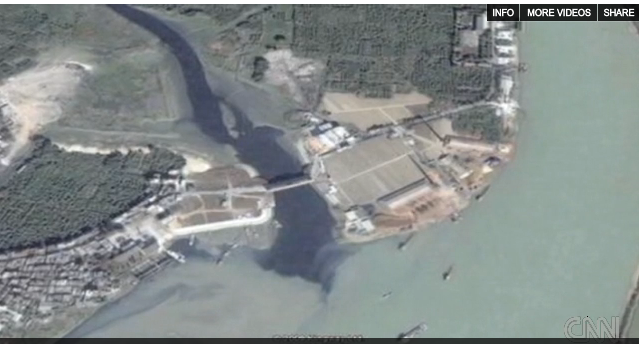
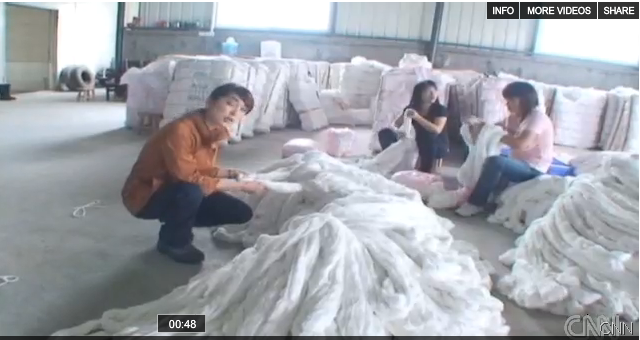
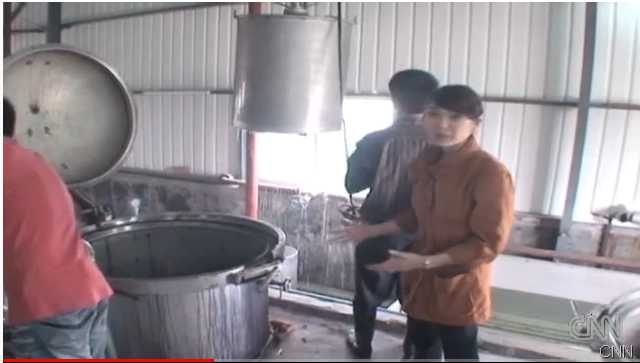
    CNN reports that the  Pearl river on the banks of Chinese town of Xintang  in Guangzhou– also known as the Blue Jean capital of the world – looks like this when seen from a satellite.. The river  has actually turned blue black with a large portion of denim production wastes being discarded into the river. The town is an amalgamation of thousands of textile, denim and dyeing facilities. The denim is also being made here by traditional dyeing methods where cotton yarns are being dyed by dipping them into small(hot) indigo baths as against the factory dyeing of denim by Rope Dyed or Slasher dyed methods. This kind of cottage dyeing produces more indigo waste and the small dyeing units are not equipped with the requisite water treatment facilities.

    denim yarn denim dyeing

    According to Chinese government estimates, the town produces a whopping 200 million +  pieces of denim garments a year. Though these estimates could be off the mark, but still the town has a huge denim garment production base. The size of this figure  could be properly comprehended properly when one knows that the total imports of denim garments into US stands at around 585 million pieces.

    The factories seem to be discharging their wastewater into the river through pipes extending into the river. These wastes contain all kind of harmful metals and substances.

    According to Dr. Tony Lu, Chief Medical Officer at Guangzhou’s International SOS Clinic, these kind of toxins can be seriously hazardous to human health.

    "If there are a lot of heavy metals, they are neurotoxic, carcinogenic, they disrupt the endocrine system," Lu said. "They cause cancer of different organs."

    "The number one problem (China) faces is water pollution," said Deborah Seligsohn of the World Resources Institute. "The textile industry is one of China’s larger industries and one that uses a lot of water so it’s traditionally had a lot of wastewater problems."

    Such a huge denim production base is a great asset for the Chinese denim and the whole textile industry. But China will have to monitor its water pollution to ensure its continued growth and dominance over the textile industry of the world.

    See more details on the story from CNN here

  • Arvind Entering Into Deal With Italian Denim Group – Sixty

    ARVIND SIXTY Arvind Ltd is entering into a deal with the Italian fashion denim maker – Sixty Group – to sell its products under various brands  in India. The Sixty group had previously entered into a pact with the Reliance Brands in 2007 , but which was later called off.  Reliance, however, entered into a 49:51 joint venture with Diesel to launch the Diesel brand in India.   Interestingly, Diesel had called off their pact with Arvind to enter into a deal with Reliance Brands. Arvind is entering into a deal with Sixty group when all is not well there . It has recently closed half of its 20 Miss Sixty  stores in the US  and is entering bankruptcy procedures in the UK after having lost Euro 19.5 million in 2008.

    Sixty group is one of the most famous denim brands from Europe and of course Italy. It owns brands like Energie, Miss Sixty , Killah, Refrigiwear , Murphy & Nye, Richlu and Baracuta.  Out of these brands, Miss Sixty –the women’s denim brand established in 1991 – and Energie – the men’s lifestyle brand started in 1989 – are the most famous ones. It is expected that Arvind would first launch the Energie brand in India to  enter the men’s  premium and super premium denim segments and with prices starting from Rs3,500 ($78 approx) . These prices would be above that of Levi’s which operates in the price segment of Rs 1200 to Rs 3000 ($26 to $66) but way below that of Diesel which has prices starting from Rs 8000($177 approx.) .

    Arvind owns denim brands like Flying Machine, Ruf & Tuf and New port – all of which cater to lower priced segments of the market. Arvind’s JV with VF also enables it sell the Lee and Wrangler jeans in India and compete in the same price segment as that of Levi’s. Hence, covering the lower and the middle segments of the market, Arvind was in need of a denim brand which could be positioned in the super-premium category. Hence the efforts to tie up with Diesel and now Sixty Group. Arvind has been trying hard  to gain a larger share of the continously growing organised denim market in India(currently estimated at around $450million) , but it still lags behind the market leader Levi’s which is  already touching a turnover of $100 million.

    Diesel Vs Sixty

    Diesel has a very high brand recall value in India as compared to Sixty. Reliance Brands will not have to invest much in creating brand awareness for Diesel in India whereas Arvind will have to invest a sizeable amount of resources in developing the awareness for Energie or other Sixty brands. Even though priced much lower than Diesel , Arvind will have to work hard to prove the worth of the brand to Indian consumers. Though its experience of handling other international brands and its huge denim infrastructure back-up will come in good use to this end, it seems that  Arvind will be  able to reap the benefits of this association only after a couple of years .

    arvind denim brands

    Source : ET and others

  • Denim Jobs Board Launched At Denimsandjeans.com

    denim jobs1

    We are pleased to announce the launch of our Denim Jobs Board . This board enables you to find the most lucrative denim jobs – especially from USA. We had previously also provided to our readers the facility to search for denim jobs on our  Denim Jobs Search Engine.

    However the denim jobs board goes a step further and enables you to see the most recent denim jobs – as sooner as yesterday.. The jobs are from reputed companies including Gap, 7 For All Mankind, VF, Lucky Jeans, Express , Liz Claiborne etc – to name a few.

    Another facility that is available on the board is that the companies can post there own jobs on the board and reach our large number of readers who are denim professionals from around the world. 

    So with the facility of two search engines for searching denim jobs, you will never be missing a new job posted around the world !.

  • Denim Fabric Imports Into US Fall 26.72% But Prices Rise 19.40% in 2010

    The Denim Fabric imports into US in the first quarter of 2010 showed a negative growth of 26.72%  compared to the same quarter in the year 2009. However, what was surprising to see was that the average prices  of imported denim fabrics rose by 19.40% . It was clearly a reflection of the fact that the volume of premium denim jeans production in US has taken a hit but the manufacturers are trying to use better fabrics to differentiate themselves in the highly competitive premium denim market space. This trend of increasing average prices had actually started in 2009 itself and the prices kept on increasing with each passing quarter. 

    Imports of Denim Fabrics Into USA 2009- & 2010 – 1st Quarter

    Year Quarter Qty(million sq mtrs.) Qty. ( million mtrs at 160cm) Value
    (Million
    US$)
    Average Price / Linear mtr of 160cm
    2009 1st 8.27 5.17 18.92 $3.66
    2010 1st 6.06 3.78 18.71 $4.95
    Change %= -26.72%   -1.1% +19.40%

    Lets have a look at some of the  main exporting countries which exported denim fabrics to USA in 2010 first quarter.

    Country 2009  1st quarter
    (million mtrs 160cm width)
    2010 1st quarter
    (million mtrs. 160cm width)
    % Change
    Mexico 1.24 0.35 -71.78%
    China 1.41 1.87 +32.64%
    Italy 0.88 1.30 +47.72%
    Taiwan 1.05 0.89 -15.23%
    Japan 0.27 0.56 +107%

    We can see that the largest %  increases in imports have been from Japan and Italy – prices from where have been traditionally the highest. This is also reflected in our figures in the first table where the average prices of imports have increased by almost 20%. China is also becoming an important exporter of denim fabrics to US. Mexico has taken the biggest hit in terms of exports – reflecting the inability of the Mexican mills to meet the  requirements of the US importers.

  • G2 Waterless Denim Washing Machine From Jeanologia

    image Jeanologia is  a company from Spain dedicated to providing eco friendly finishing solutions for  garments – specially denim.  With a corporate tagline of  “The Science of Finishing” it has been their mission for last 15 years to enhance industrial garment finishing through technology & know how.

    The concept of ‘Sustainable Denim’ – an eco friendly approach to denim is being enhanced by their various machines , the foremost of which is the G2 Waterless Washing Machine. This is a unique washing machine which washes denim jeans with about 60% less water  and almost no chemicals…….!!  In  Hongkong, Jeanologia had a large hall dedicated to their “Truth & Light show” where they displayed their uniquely washed garments.  The visiting denim experts were asked to select , from pairs of jeans, the jeans which had naturally aged and the one which had been made by Jeanologia with the help of their laser technology and unique G2 washing machine.Most of them could not differentiate between the two . It was an interesting way to understand that real aging effects could be achieved with eco friendly washing methods.

    How does G2 work ?

    Air from atmosphere is transformed into a blend of active oxygen and ozone called ‘Plasma’.This plasma is used to age garments. The plasma is transformed into purified air before it is returned to the atmosphere.

    What kind of  washing effects can it provide on the jeans ?

    G2 can provide various effects on the jeans like

    •Casting:

    • Aged Cotton – unique yellow cast for true vintage looks in Pure Indigosimage
    • Gray casts for a retro look

    •Cleaning:

    • Removes backstaining & loose indigo without detergents

    •Bleaching without the bleach!

    •Eliminates the need for Potassium Permaganate spraying.

    •Blacks and grey denim fade without turning brown.image

    •Eliminates yellow from bleach look.

    •Improves crocking in dark finishes.

    •Provides various other fashion finishes.

    If so less chemicals are used, how are these washing effects attained?

    Jeanologia use laser technology instead of chemicals to mark the washing details.If desired, further effects can be given manually by grinding and scraping. The laser maps out the washing details required and then the garment is given a short wash. The garments are then placed in G2 where the laser effects are brought out with the plasma. The garments are then rinsed and dried. This is how the washing details are attained.

    Is it possible to duplicate washing effects of an existing jeans ?

    Yes, with their laser technology, the washing effects of an existing jeans can be mapped out and then replicated on new garments . This does away with the trial and error approach to replicating vintage washing effects.

    What is capacity of the G2 machine in terms of load factor ?

    The machine has a capacity of 50 kgs ie it can wash about 3000 jeans in a day. G2’s programmable software system automatically adjusts gas concentrations to reflect load conditions (i.e., jeans, tees, wet, dry, etc).

    From a case study of actual production in the US,the company claims that using G2 can result in 67% savings in energy and water, 55% savings in time and 85% saving in chemicals and can thus provide a saving of $0.44 per garment washed besides contributing to environmental protection and reducing health hazards for the workers.

    Denim jeans  washing is one of the most environment polluting activity in  the apparel industry . According to Professor John Anthony Allan from Kings College London, a Kg of jeans comes to us after about 10,850 litres of water has been used ie 1 Kg of jeans has this much of embedded water . Of course this includes even the water used in growing cotton. But the carbon  footprint of jeans is very high.  In the recent years , the increased requirement for specialized washes has further increased the environmental impact of denim production. In such a scenario, any technology that makes it possible to cater to fashion requirements and at the same time contributes to environmental protection, should be welcomed .

    Here is a slideshow presentation on G2 Machine

    Jeanologia can be contacted here : Michelle Branch