Author: Sandeep Agarwal

  • Denim Maniacs – Publicize Yourself

    Are you a denim maniac ??

    Well actually let me try to define who is a denim maniac.

    1. A person who loves denim :)  .
    2. A person who can think about denim even in his dreams !
    3. A person who has worked with denim – either at fabric, garment or marketing stage for a long period of time.
    4. A person who has specialized knowledge on denim production, finishing, marketing ,fashion trends ,or other aspects of denim.


    If you are the person described above, you fall in the category of ‘Denim Maniac’. If you are one and would like to show your knowledge on various aspects of denim to the world, denimsandjeans.com is the right place for it.


    We are publishing articles from various denim experts around the world with full credit to the article contributor and a link to his/her site. You can check a sample article here .


    If you are a the person described above and interested in publishing an article on Denimsandjeans.com , just send me a small email at sandeep@denimsandjeans.com  with a brief profile of yours and the topic that you might be interesting in writing on. Remember, I shall help to refine the article if need be – so don’t worry if you have never written an article..

  • Kurabo Earth Denim – Making Cool Money From Waste..


    earth denim kurabo

    Making economic sense from environmental conciousness is not an easy task. Taking care of environment takes money, but if you can make more money than you spend, it makes great business sense.

    Kurabo Denim’s Earth Denim does precisely that.  Kurabo has ventured to contribute to reduction in Carbon Dioxide emissions by not burning its denim waste and instead recycling it back as a premium denim !


    The Earth Denim is made in three steps:

    1. Textile wastes from Kurabo’s manufacturing process are collected and dyed.
    2. Then they are broken up into fiber forms, mixed with virgin cotton, spun into yarn.
    3. This yarn is  then dyed in indigo.
      Because parts of the newly spun yarn are already colored at the beginning of the process, Kurabo doesn’t need to use a sulphuric dye necessary for deep color. Only indigo dyeing is required and it further reduces the requirement for chemicals.


    The best part is that this denim is positioned as a premium denim and it sells at $8/yard.. The Denim features features a white core and super-dark-blue color due to its unique makeup. West Coast (USA) designers  re-sponded to stretch and rigid denim with a vintage look.

    I think this is a good example of innovative thinking whereby the company shall be helping the environment as well their own kitty.

    However, it also needs to be remembered that only mills with this kind of fame can encash such innovative developments as lesser known mills will not get the price that may be required to cover the cost of such a product.

    Another noteworthy point is that the need to recycle such wastes is a more urgent requirement for developed nations as in developing economies, such wastes are automatically recycled because there is a market for almost every kind of waste ..


    Note:Check out the Denim Mills Directory for links to Kurabo and other Japanese denim mills.

  • Sewing Denim Fabrics – Some Recommendations

    sewing denim jeans

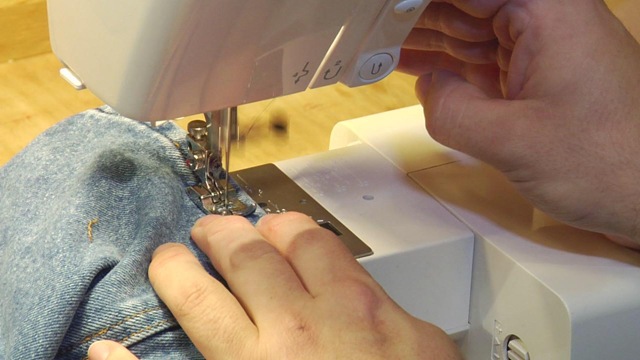
    Sewing is an important part of the entire process of the creation of correct jeans. In this article, we shall find the main types of sewing , sewing yarns normally used and some do’s and don’ts on sewing.

    Types of Stitch For Denim Fabrics


    A)Double Backstitch

    This type of stitch is important not only with regard to the finish of the jeans but is also used for the

    1. Preparation of the fly.
    2. Placing patch pockets
    3. Decorative backstitching on pockets
    4. Extra Strong seams
    5. Preparation of the waist


    B)Double Chainstitch

    Though many of its end uses are similar to double backstitch, some other applications are :

    1. Double extra-strong seams
    2. Preparation of the waist
    3. Closing seams as safety seams


    C)Overedging

    This type of stitching is applied to polishing or overedging jobs, such as folds over flies, visible pocket seams and hems and jointly with the double chainstitch, as safety stitch for closing seams , such as side seams or seasm as used on crotches a, as well as for closing pocket sacks.

    Sewing yarns for Denim Fabrics

    The ideal yarns for manufacturing jeans ar e the contiuous polyester yarns lined in cotton. Thye offer advantages as regards the high resistance of the Polyester core, with the cotton improving the  safety of the seam , even on automation and perfectly harmonising with the denim fabrics.

    There are various degrees of yarn thickness available for the manufacture of jeans..

    1.Polyester-Cotton Yarn H25 (Nm25/3) and H35(Nm25/2)

    Both the degrees of thickness are used for trimming seams , both in double backstitch and dboule chainstitch. H25 yarns is mainly used for getting a marked effect  and H35 for a subdued effect.

    Thickness of needle suggested : Nm.120 to 140 for H35 and Nm 130 to 160 for H25

    2. Polyester-Cotton Yarn H50 (Nm35/2)

    This sewing yarn is ideal as lower yarn for spools or anchors , combining with thicker yarns for trimming stitches as well as for trimming stitches for lower relief seams.

    Thickness of needle suggested :Nm 100-120

    3. Polyester Cotton Yarn H75 (Nm 50/2)

    Mainly used for non-visible closing seams , both in double backstitch and in double chainstitch,. Due to concentration , this i s also used for overedging.

    Thickness of needle suggested – Nm 100-120

    4.Polyester Cotton Yarn H120(Nm 80/2)

    To Overedge the pocket sacks , preference is give, sometimes due to cost, to specially fine seewing yarn since the consumption of thread for overedging is much higher as against dobule backstitch or double chainstitch on the same length of seam.

    Thickness of needle suggested – Nm 80 -100


    Suggested Stitches per cm – for denim fabrics using the above yarns.

    H25 – 1.5  to 2.5 stitches/cm

    H35 – 2 to 3 stitches/cm

    H50 – 2.5 to 3.5 stitches/cm

    H75(Nm 50/2) – 3.5 to 4 stitches/cm

    H120 (Nm80/2) – 3.5 to 5 stitches/cm


    Some recommendations for sewing stretch denim fabrics

    Stretch denim is different from other normal fabrics and sewing has to take into account that the lycra thread should not get damaged during the stitching. Some recommendations:

    a)Pattern making : Front and back trouser trouser legsmust be sewn with the weave.

    b)Sewing guide notch : It is important that the front/back components of the jeans have sewing guide nothces in order to avoid possible shifts when sewing, since the notches erve as reference for the sewing process along the seam.

    c)Spreading out : Maximum 6 –7m lenght and 30-35 layers , and spreading out must be done with machine to avoid different tensions.

    d)Cutting : not before 2 or 3 hours have lapsed in order to allow the fabric to relax.

    e)Sewing :Use chain type sewing machine, with minimum 5-6 stitches per cm and sewing RPM at 3000-5000

    A difference of 0.5 cm between components could cause twists.

    f)It is important that the inside legs and sides of garments should be made in the opposite directions.

    g)If there is surplus fabric in one component on making up the garment, do not cut this off , as this would lead to different shrinkage on washing in the cut component and therefore deformation.

    h)Washes: Since stretch fabrics have  elastane in the weft or even sometimes in warp also, they must never be subjected to the same washing procedures as applied on Denim Fabrics made of 100% cotton. Stone washing must be effected with enzyme products (but they should not be acidic as they reduce the weight and resistance) , together with used stones at 50%. Hypochlorite must never be used as this damages the elastane.

    i)Ironing : A temperature over 180 degrees celcius begins to damage the elastane. Hence care should be taken accordingly.

    denim jeans

  • Women’s Jeans – 75th Anniversary. Ironical repeat of Denim Trend..

    levis women's jeans 1934levi's women's jeans 1934

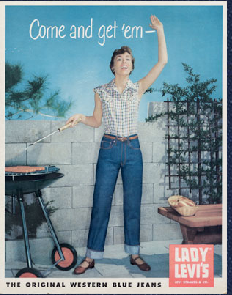
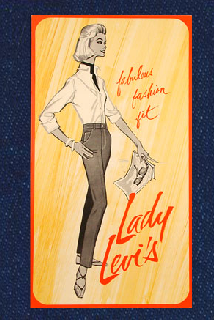
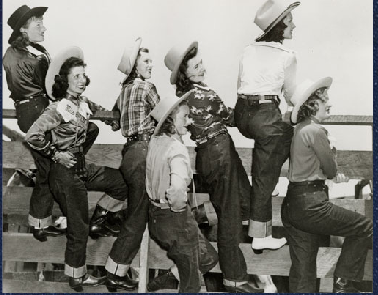
    Its difficult to believe that first women’s jeans were introduced 61 years after the men had been wearing them ! . Levi’s had introduced the first men’ jeans – mainly meant for working men- in 1873 . In the Fall of 1934 , it decided to introduce the Lady’s Levi’s Jeans and forever changed the course of women fashion.

    levi's women's jeans

    Levi’s would have never thought that about 75 years after the introduction of women’s jeans, the denim fits, finishes  and fabric innovations would be driven by women’s needs and that the sales of women’s jeans would surpass that of men’s (in fact it was done in 2000)!  . Women’s jeanswear are currently leading the denim trends each season and it is difficult to imagine denim seasons without women’s jeans.

    Another irony in this 75th year is the popularity of the Boyfriend Jeans  and Skinny Jeans trend . Despite the latest high finishing techniques for women’s jeans , today’s most popular styles – The Boyfriend and Skinny Jeans – trace their ancestory to the earliest jeans developed by Levi’s. In the early 1900s, when women had no options available for them , they used to wear the men’s jeans and the Boyfriend Jeans was a ‘Fashion by compulsion’ or due to ‘Lack of choice’.

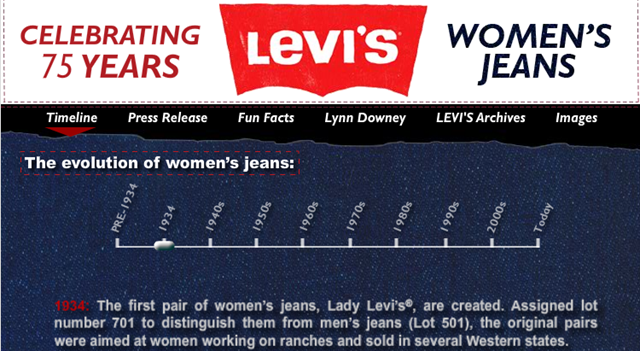
    The evolution of women`s jeans:

    
    * Pre-1934: Women in the West began wearing their husbands` or brothers` Levi`s
    501 jeans.
    * 1934: The first pair of women`s jeans, Lady Levi`s, are created. Assigned lot
    number 701 to distinguish them from men`s jeans (Lot 501), the original pairs
    were aimed at women working on ranches and sold in several Western states. 
    * 1930s and 1940s: Sales of women`s jeans begin to take off due to the growing
    popularity of dude ranches. High-end department stores Best & Co. and H.
    Kauffman & Sons Saddlery Company carried Levi`s jeans to meet this new demand.
    Women`s jeans also switched from button-fly to zipper. 
    * 1960s: Amid a tumultuous cultural revolution, denim becomes a staple in
    women`s wardrobes. Jeans become a icon of rebellion that`s adopted by both men
    and women. 
    * 1970s: Levi`s women`s jeans range offers a variety fashion fits, including the
    "full" and "straight" leg jeans, and the "jean cuffs." Flares and bell-bottoms
    also become popular styles. Levi`s jeans for women are introduced for the first
    time overseas. 
    * 1980s: The Levi`s brand introduces the famous 501 jeans for women in 1981. The
    brand introduces stonewashing to women`s jeans just two years later in 1983. 
    * 2002: The premium denim trend takes off and Brands like 7 For All Mankind, True Religion,
    J Brand become popular with celebrities  and a wave of premium denim fashion kicks in. Hundreds
    new denim brands come on the scene.
    *2009: Trends like Boyfriend Jeans, Skinny Jeans , High Waisted Jeans become popular.
    Denim leggings is another trend which is picking up..

     
     levi's women's jeans 
    Via Reuters
  • Men’s/Boy’s Denim Jeans Imports Into USA – Jan-July 2009

    The latest figures of imports of men’s/boy’s denim jeans into US reveal that the imports of Men’s Jeans are down by 3.9%  during the period Jan-July 2009 as compared to the same period in 2008..

    Imports of Men’s/Boy’s Denim Jeans –2009 (million pcs)

    Particulars Jan-July 2009 Jan-July 2008 % Change
    Men’s Jeans 108.79 113.26 -3.95%
    Boy’s Jeans 43.92 36.87 +17.67
    Total 152.71 150.13 +1.35%


    Boy’s jeans , on the other hand, have increased in imports by over 17% !. However, since the actual import size of Boys’ Jeans is small, the net impact of both the categories put together is slightly positive and gives a healthy figure of +1.35% . This augurs well for the coming times if seen with the figures of Imports of Women’s Jeans also – which have shown a 6.3% rise during 2009

    What is the reason for a great surge of imports in the Boy’s Jeans ?? No clear explanation seems to be available for this as of now. But it is seen during previous years that Men’s Jeans imports are concentrated more in the last 5 months of the year than the first 7 months. Last year almost 50% of the imports of Men’s Jeans were during the period September – December.. On the other hand, Boys’ Jeans imports seem to be evenly spread out during the year ..

  • Indigo Rope Dyeing : Some Important Technical Considerations

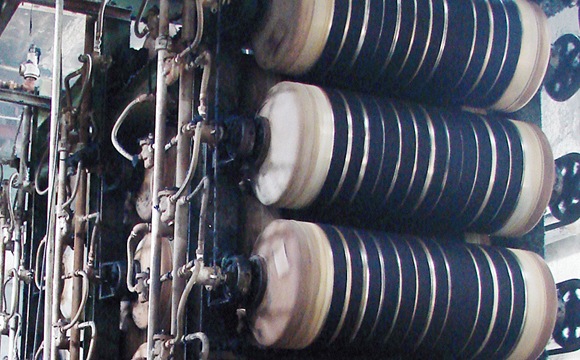
    rope dyeing

    Rope Dyeing is considered a superior dyeing technology where the dyeing uniformity achieved is better than other Indigo Dyeing technologies like Slasher Dyeing.
    However, Rope Dyeing is a also a more difficult dyeing technology. One needs to master its nitty gritties to get the best out of the system.

    I , recently came across a very well written article on Rope Dyeing and thought it appropriate to share here.  The article mentions in great details the technical points to be kept in consideration while using Rope Dyeing..

    Read on only if you are very technically oriented !

    Notes on Yarn for Rope Dyeing

    * Yarn faces stress and stretch at ball warping, rope dyeing, rebeaming, sizing and loom shed so elongation of yarn should be more than stretch at (ball warping + Robe Dyeing+ Rebeaming + Sizing )= (2-3%) + Loom shed (about 5%)

    * Tension at Ball warping should be less by 7-8% of single yarn strength.

    * Strength CV should be within limits as it may give rise to weak points

    * The tendency of yarn to migrate at rope dyeing can be countered by less micronaire of yarn ( should be around 3.8-4.2)

    * More dropping of short fibers at long chain beaming is good

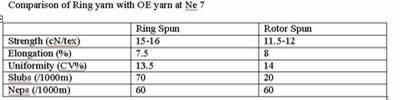
    *The sensitivity settings for neps is set at +280 for rotor spun yarn and not +200 as in case of ring spun yarn. The reason for this is that the structure of rotor spun yarn is intrinsically different from that of conventional ring spun yarn. Neps in rotor yarn tend to be spun into the solid yarn body rather than remaining on the yarn surface, which is typical of ring spun yarns. Although embedded in the yarn core, these neps still represent a short mass defect and will therefore trigger the imperfection counter upon exceeding the preset value. However, compared to neps that are attached to the yarn surface, fully embedded neps are barely perceptible for the human eye. Thus, in order to balance the typical visual appearance of rotor spun yarn with the imperfection counts, +280 sensitivity setting is a common convention for rotor spun yarns.

    Comparison of Ring Yarn with OE yarn at Ne 7
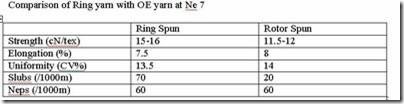
    oe yarn ring yarn for denim

    1.

    Process of dyeing of sulphur color in Indigo Dyeing Range:

    1st Wash tank: mercerisation by taking 22% NaOH ie. 250 gpl
    2nd Wash Tank: Hot Wash
    3rd Wash Tank: Cold Wash
    2. In 1st and 2nd dye bath take sulphur color 6-8% on the weight of the yarn sheet. Temperature 90 deg. cel. The solution contains the following:
    1. solubalised sulphur color: 150 gpl
    2. Na2S–> reducing agent: It is added to increase its reducing power
    3. Caustinc Soda –> 10 gpl–> reducing agent
    4. Wetting agent–> 2gpl
    5. Antioxident Sulphide ( Glucose paste–> 5gpl). This is added to prevent the oxidation of of Sulphide solution. It will always remain in reduced form
    ( Alos if the shade is slightly greyish, one can add tiny tinge of sulpher blue–> 20gpl)
    in III, IV and V dye bath–> cold wash
    in 6th dye bath. We take H2O2(30%)+Acetic Acid(2:1 by weight). H2O2 acts as an oxidising agent. But as it acts on neutral pH (=7) and after cold bath the solution is slightly alkaline, to make it neutral wil add acetic acid. Acs in alkaline pH, oxidising action of H2O2 will be similar to the bleaching action, which may cause tendering in the fabric.
    7th and 8th Dye Bath: Cold Wash
    Wash Box Number 4: Here washing is done with detergent and soda ash at 60-70 deg.c
    5th and 6th Wash Box: Hot Wash
    7th wash Box: Here softner is added at 25 gpl. It is cationic softener with pH 4.5 to 6.5. As during oxidation of sulphur, strength is reduced by 10%. On a yarn sulphur is of two types :
    1. Free Sulphur
    2. Reacted Sulphur.
    The free sulphur will react with moisture in the atmosphere to form:
    H2O + S –> H2SO4
    Which tenders the yarn. Now at acidic pH reaction is much faster. So we add only a small amount of softener (25 gpl) as against that in indigo which is 100gpl.
    3rd Point
    Over all during sulphur dyeing and storing, the yarn strength is reduced by 15% as compared to Indigo.
    4th point
    If ball formation takes place of sulphur dyed warp at loom shed, then we can taken in 4th dye bath little Na2S+Caustic to reduce the free sulphur.

    Technical Considerations in Rope Dyeing for Indigo dyed Denim.

    The passage of yarn in rope dyeing is as follows:
    Pre-scouring –>hot wash–>cold wash –> Dye baths–> hot wash–>cold wash–> application of softener
    lets discuss these processes one by one:
    Pre-scouring
    1. The objectives of pre-scouring are the removal of wax content from cotton, removal of trapped air from cotton yarn and Making yarn wet
    2. This is done at 90 o C
    3. We use the following ingredients at pre-scouring stage:
    Caustic Soda: Its quantity depends upon the quality of cotton fibres used in the mixing. Generally we take 2-4% of caustic soda. It removes the wax by the action of soapanification.
    Wetting agent: It is anionic in nature
    Sequestering Agent: Even with the use of water softening, it is very difficult to find the desired softness in water ( about 2-3 ppm) . So we use the agent to make the water soft.
    4. Why Trapped Air should be removed. The reason for this can be understood as follows:
    In 1 kg of yarn, there is approximately 2 litres of air. 1 litre of air decomposes 1.8 litres of Sodium Hydrosulphide. It will cause uneven dyeing and more consumption of Sodium Hydrosulphide ( hydro).
    5. Absorbency of yarn may be checked after scouring.
    Hot wash
    As some caustic is carried by the yarn after pre-scouring, so hot water is given at 70-800C. If this is not done, this yarn will go into the dye-bath which will change the pH of the dye-bath.
    Cold Wash
    After hot wash, yarn temperature is more. To bring it back to its room temperature, cold wash is given to it.
    INDIGO DYEING

    1. Indigo is not a perfect vat color. It may be called a trash vat color. The constant of substantivity for other colors is 30, for indigo it is only 2.7. So there is a need of 5 to 6 dye baths and make the use of multi-dip and multi-nip facility to increase the penetration.
    2. The dyeing is done at room temperature as indigo belongs to Ik class of vat dyes, where dyeing is done at room temperature and oxidation is done by air only and not by chemicals. If oxidizing agents are used, they will cause stripping of colors.
    3. Indigo is not soluble in water. So it is reduced with Sodium Hydrosulphide. Then caustic soda is added to make sodium salt of vat colors to make it soluble. To reduce 1 kg of Indigo, 700 gms of sodium hydrosulphide is required. However some extra SHS needs to be taken to avoid some decomposition of SHS.
    Practically it is prepared in the following sequence
    -Take indigo
    -Add caustic
    -Then reducing agent
    4. When caustic is added to indigo, it is an exothermic reaction. It is allowed to cool down, then before sending it to feeder, sodium hydro-sulphide is added. Reducing agent is not added first as it will be decomposed first, so consumption of it will increase. It is also not advisable to take solubalised vat, as offered by some companies due to the following reasons:
    a. If it is used after 6 months, there will be a decomposition of sod. Hydrosulphide. It will become partially soluble. Then to make it soluble again, more SHS has to be added.
    b. Transportation is difficult
    c. Cost is more
    5. Feeding System
    Rat of flow of yarn is given by
    ((No of ropes x no of ends x speed of machine)/ count x 1.693 x 1000)
    in kg of yarn / minute
    So we can determine the rate of feed of indigo. It is very important that replenishment of indigo is there as any variation will result in the change of shade and also if level is more, there is a problem of over-flow.
    6. If total capacity of dye bath for example is 15000 litres, then circulation must be 3 times the volume. If it is less then there are 100% chances of getting a lighter shade.
    7. Core and ring dyeing effect
    This effect is obtained by multidip-multinip facility
    8. pH of the Dye bath should be kept in between 10.5-11.5. At this pH , sodium salt of Indigo is mono phenolic form. At this form, the strike rate of dye is very high. So after washing, there will be a better dye effect. At pH 11.5 to 11.7, at this affinity is less, so dye effect will be less prominent.
    pH is controlled by the addition of caustic soda.
    9. Testing of Hydro
    TOTAL HYDRO
    We take 10 ml of indio with SHS in 30-35 ml of water. It is set for one minute and shaken. As air will decompose SHS. So vacuum created will fetch the water from above. If 3 ml of water is required, then concentration of hydro is 3 gpl. As a thumb rule, concentration of total hydro should be min. 1.5 gpl.
    REDUCED HYDRO
    It is the hydro that is used for the reduction of Indigo. It should be around 0.7 ( 1000 kg of Indigo needs 700 kg of hydro to reduce it). For testing we take 10 ml of dye solution and 30 ml of water and 5-6 drops of 40% formaldehyde and shake it for one minute. The water that goes gives the readings of the reduced hydro.
    Total Hydro- Reduced Hydro = free hydro
    If Total hydro is min. 1.5 gm/lit. then free hydro must be min. 0.5 gms/ litre which acts as buffer
    10. Also hydro reduction capacity is measured by mV meter which measures the Redox Potential.
    It should be around 760-800
    Through the day, the redox potential should be +- 20 mV of the norm. If it is more then the process control is a failure.
    Caustic–> It is around 0.4 to 0.5 times the hydro used.
    Washing
    Rubbing fastness of indigo is very important. On a scale of (1-4), it is 2. Washing is done to improve the rubbing fastness.
    Wash at 60 deg.–> Wash at 60 deg.–> Wash at room temperature–> wash with softener
    Why Softener:
    1. The rope is going to be opened at Long Chain Beamer. It the softener is not used, opening will be hampered.
    2. It is generally 1.2% of the weight of the yarn. It is a cationic softener. It is always having pH in the range of 4 to 55. Softening is done at room temperature. If high temperature is used there is always some chance of tendering of yarn.
    3. Concept of Buffer pH is given by Virkler USA, they say by addition of this, there is 40% less consumption of Indigo for same shade depth.
    4. Metering Consumption
    If solution is of 900 litres
    10% Indigo–>90 litres
    Hydro–> 90*.7 = 63 kg
    Caustic–> 63*0.445= 28 kg.

    It belongs to a VAT class of dyes. It has a dark blue color wit a bronze lustre. It belongs to KI class of dyes. In this class, dyeing is done at cold and air oxidation is done to reoxidise the dye. It can be applied on both cellulosic and protein fibres. For protein fibres, a weaker alkaline solution is used. It can be reduced by NaOH and Na2SO4 in water to give monophenolate and biphenolate ions as complete solution. Reduced form of Indigo is called leuco indigo. Leuco has got low affinity for cellulosic fibres. Dye take up can be improved by:
    1. Either mercerisation of cellulosic fibres before by dyeing
    2. or by adopting multidip, squeeze and airing process, so that dye is coated on the fibre layer by layer
    Indigo can be further developed into Halogenated derivatives and sulphonated derivatives. Halogenated derivatives give better fastness properties and brighter shades, whereas sulphonated derivatives gives a soluble blue dye, good dye and is applicable on protein fibres.
    reaction :
    Image 1
    Although indigo is a vat dye, it can be regarded as a ‘trash’ dye, the dyeing and fastness properties are in no way comparable to other class of vat dyes. It is due to these properties, that make it an excellent dye for denim. The on tone fading and the bleach down properties of indigo blue has generated a lot of denim jeans fashions like stone, ice faded looks, etc. These special effects cannot be simulated by the other classes of dyes.
    During Preparatiuon of stock vat, the following points must be remembered:
    1. Vatting temperture should be as close to room temperature as possible.
    2. Stirring should be minumum, unnecessary stirring affects the stability of reduced vat.
    3. Volume of the reduced vat should be kept constant for every stock vat batch, as the constant volume will ensure a constant replenishing amount.
    For rope dyeing system, with chemical replenishment
    with Stock replenishment
    Indigo: NaOH: Na2SO4 :: 1:0.8:0.8
    Without stock replenishment
    indigo: NaOH: Na2SO4:: 1:1:1.2
    Chemical Feeding
    NaOH: Na2SO4: : 1: 1.2-1.6
    ie. for approximately 60 gpl of NaOH–> 120 gpl of hydro is required

    Indigo Dyeing process control

    1. Concentration of Hydrosulphite
      It is measured by vatometer. It should be from 1.5 gpl to 2.5gpl , or by redox potential of dye bath which should be from -730 mV to -860 mV.
      2. Caustic Soda or pH value
      Should be from 11.5-12.5
      3. Dye concentration in Dye bath
      it is measured by spectrophotometer. It should be in g/l
      Guidelines
      High Indigo Concentration –> Shade is greener and lighter
      Low Indigo Concentration –> Shade is dull and Red.
      High pH or Caustic Concentration –> Redder and lighter
      Low pH or caustic concentration –> greener and darker
      Dipping Time
      Longer the dipping time, better will be the penetration and lesser will be the ring dyeing effect. It varies from 15-22 seconds.
      Squeeze Pressure
      High pressure will lead to lower wet pick up and result in lesser color and better penetration. At rope dyeing, squeeze pressure is 5-10 tonnes, ie. wet pick up is as low as 60%. Hardness of squeeze roller is about 70-75 deg. shores. It sqeeze rolls are too hard then there are chances of slippage and uneven yarn tension.. If squeeze rollers are too soft then shading will occur. Surface of the squeeze rolls should be ground twice a year.
      Airing Time
      It should be 60-75 seconds. Longer airing time results in high tension on the yarn and subsequent processes will become difficult.
      Drying
      Insufficient or unevenly dried yarns will result in poor rebeaming
      Calculation of Replenishing Dye feed/min
      Conc. of stock vat is g/l= 90
      range speed in yards/min=25
      count = 7s
      totoal ends = 4100
      Wt of yarn dyed /min= (4100*25*1000)/(7*840*202)= 7924 gms
      shade desired = 2%
      Amount of dye to be replenished/min= 158.5 gms
      Effect of pH
      At pH of 10.5 to 11.5, there will be formation of more monophenolate ions, which lead to higher color yield, as strike rate of the dye to the yarn bundle is very high, and wash down activities will be very good.
      At pH higher than this, dye penetration will be less and wash down characteristics are also poor.
      Testing
      1. Alkalanity in Dye Bath Liquor
      Pipet 10.0 ml of vat liquor into 100ml of distilled water in a 150 ml beaker. place under continuous agitation and insert the electrodes of a pH meter caliberated at pH 7.0 with standard buffer solution.
      Titrate with tenth normal HCl ( 0.1 HCl) to pH 7.0 (ml = A)
      calculate
      g/l of NaOH = A *0.40
      2. Hydro in Dye bath Liquor
      Add 2 ml of 37% HCHO to 150 ml beaker. Add 2 ml of dye range liquor . Add 6 ml of 25% glacial acetic acid solution prepared by diluting 1 part acid with 3 parts water. Add 2 ml of starch/KI indicator. Add ml of water. Titrate with 0.046 N ( prepared by diluting 460 ml of 0.1 N Iodine to one liter ) solution until the color changes from emarald green to bluish purple.
      G/l of hydro= mo fo 0.046N of Iodine
      Importance of High Concentration of Free Hydrosulphite
      The clearest shades with minimum reddish streaks are observed at by relatively high conc. of hydrosulphite. On the other side, with lack of hydrosulphite, the leuco indigo is less dissolved and thereby adheres to a greater extent to the fibres. With lack of hydrosulphite furthermore, the amount of unreduced dyestuff by oxidation at the upper level of the liquor and through activiation of unfixed dyestuff, gets separated from the fibrous material would constantly rise as the reducing agent for creating leucoform would be missing. Under these circumstances a reddish bronze like shade results due to dispersion of not reduced dyestuff in the yarn. The min. proportion of hydrosulphite should be around 1.3 to 1.5 gpl in case of rope dyeing and 3-4 gpl in case of sheet dyeing. Also to avoid the lack of hydrosulphite or Indigo at certain places in the immersion, vat, the whole quantity of the liquor should be circulated 2-3 times every hour.
      Reaction Time
      At very short reaction time, an adequate liquor exchange ( i.e. the amount of chemicals consumed and replaced by fresh addition of reduced indigo) is not assured. This has a negative influence on dyeing and depth of dye penetration. In addition to this the time available for diffusion of dyestuff until oxidation commences is too short. To ensure an even and good depth of dye penetration by dyeing in several passages, the reaction time should be 20-30 sec. for each vat (eg. at a speed of 20m/min for a reaciton time of 10 seconds, the immersion path should be maximum 3.3 meters).
      A reaction time exceeding 60 seconds should be avoided as the amount of dyestuff again get reduced and released may again supersede that of additionally take up dye stuff, resulting in higher shades.
      Softening Agent: 8 g/lit
      Drying: Rest humidity should be 30% and then sized.
      Addition of chemicals
      1. Red Tinge: reduce addition of NaOH, increase slightly Na2S2O3
      2. Darkish Red: increase Hydro
      3. Light Greenish: decrease Hydro
      4. Dark Green: Increase Caustic

    Indigo dyeing calculations

    For 12 ropes, at 24 m/min, of 344 ends of 14000 m length of 7s count.
    wt of yarn = (12*344*14000*100*453.6)/(7*840*36*2.54*1000) kg= 5000 kg
    at 24 m/min, a lot of 14000 m will be completed in 14000/24 = 583.3 min
    at 1.8% shade
    100 kg of yarn needs–> 1.8 kg of Indigo
    5000 kg of yarn needs –> 90 kg of dye
    at 100 gpl
    100 gms of dye = 1 lit of solution
    90 kg of dye = 900 litres
    900 litres should be completed in 583.3 min
    1 litre would be completed in = 583.3/900= 38.8 seconds
    so flow rate will be 38.8 seconds / litre
    Similarly flow rate of caustic and hydro can be determined
    Hydro is taken around 100 gpl
    caustic is taken around 90 to 100 gpl

    Indigo preparation sequence

    In a tank of 1000 liters:
    a. take 400 litres of water (soft)
    b. add setamol ws–> 4 g/l (stirring) ( dispersing solution)
    c. Add 100 kg of Indigo ( at 1.8 % shade -see the indigo calculations- stirring)
    d. add caustic soda –> stirring ( for solubilising and pH)
    e. allow to cool it for 2/3 hours
    f. Add hydrosulphide ( As reducing agent)
    g. Make the solution to 1000 l by adding water.
    If pH is fluctuating, if it is > 11.7 then hydro is added (2-3 kg), if (<11.2) then caustic is added.
    For 100 kg of Indigo,
    Caustic Required= 90 kg
    Hydro Required= 80 kg

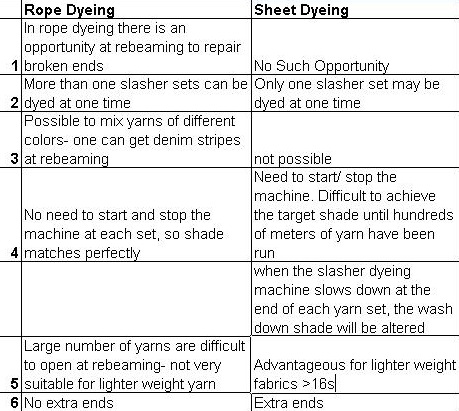
    Difference Between Rope Dyeing and Sheet Dyeing
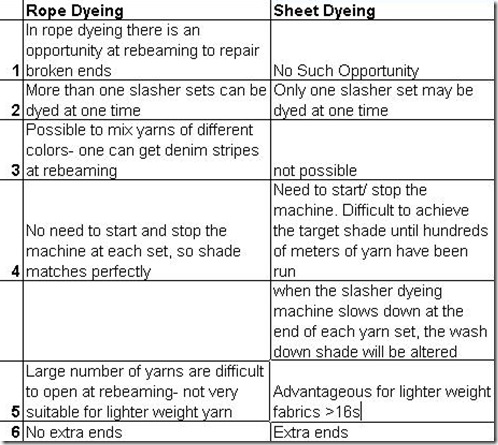
    rope dyeing slasher indigo

    About the author : M Bilal Tariq has worked as a Deputy General Manager in a reputed Denim Mill in Pakistan . He is a textile Engineering Graduate and also maintains a Denim Blog
  • 7 For All Mankind – First Ever Warehouse Sale.. Get Ready !


    7 for all mankind jeans discount saleimage

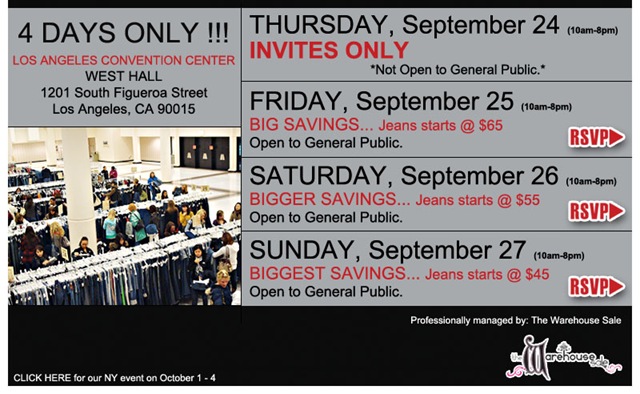
    The first ever official sale from the VF owned 7 For All Mankind is coming to LA (September 25-27) and New York (1st –4th October)  . Better be prepared to grab the famed jeans for Big Discounts ((Jeans Starting $65) on the first day to Biggest Discounts (Jeans starting $ 45) on the third day and register on their website to get invited and get a hassle free entry.


    Over 25,000 discounted 7 For All Mankind Men’s & Women’s Jeans, Tops, Jackets, Handbags, Dresses , Kids Apparel etc shall be available in a full fledged sale.


    A brief bio: 7 For All Mankind is credited to have started the Premium Denim trend and has always been on an upswing ever since it launched in the year 2000. With a first year sale of $13 million (!), it exploded on the fashion scene and ultimately was acquired by VF in the year 2007 for $775 million.

  • Hudson Jeans – Designer Q&A with Benjamin Taverniti

    In this ever expanding world of Premium Denims ,with over 200 denim brands fighting for mindspace, some brands stand apart and one of them is Hudson Jeans  . Hudson Jeans collection was founded in Los Angeles in 2002 and is best known for unparalleled fit and craftsmanship, the iconic union jack logo and signature triangle flap back pocket. Created from the best premium denim from the finest mills in Europe and Japan, all Hudson products are hand finished and tailored to be truly one-of-a-kind pieces. The line ‘Marries California Freedom with British Cool’ and recently launched a hot new ad campaign featuring Georgia May Jagger, the 17 year old daughter of Mick Jagger and Jerry Hall.  With all the hype going on with this new ad campaign, I thought it was time to catch with the designer  BENJAMIN TAVERNITI (Ben) for a Q&A :

    1) Why do you think jeans continue to remain so popular in spite of economy being in recession?

    Denim is now the pillar of the outfit… Especially in a ‘recession’, it is much easier to accessorize what you already own around a new pair of jeans. Also, the utility and value that a premium pair of jeans offers is unbeatable. A $200 pair of jeans is not really expensive if you can wear them a lot.

    2) How do Hudson Jeans stands out from hundreds of other brands of premium denim brands out there?

    We are very confident in who we are and the denim we create. We stay true to the brand and provide both women and men with the ultimate premium denim that combines British cool with California freedom. We will never ride a trend for trend’s sake and fans of our brand love that about Hudson Jeans.

    3) What kind of denim fabrics do you use?

    We only use the best fabrics from the best mills in Japan and Italy. We are very tedious in our research and we always look for the best of the best, which makes our denim like none other. We like to incorporate new fabrics to take Hudson Jeans to the next level, making the line even more high fashion. I love to enhance denim with materials like satin and jersey.

    4) Who is your typical customer?

    The Hudson girl/guy is effortlessly stylish, takes chances, irreverent, and creates their own destiny, always. Style is woven in to who they are and the way they live their life.

    5) Which are your best selling jeans?

    We offer a wide variety of fits and styles, so it is hard to lock in on just one. If I had to pick, I’d say the bootcut and skinny have always been popular styles for us and consistently continue to perform well.

    6)What do you think are the latest trends in denim for Fall 2009 and Spring 2010?

    Some upcoming trends to look forward to are the flare, distressed, babyboot (a mix of straight leg and boot cut that hits just right at the ankle), baggy skinny, high-waist skinny, vintage distressed patchwork … That’s all I can say for now, I wouldn’t want to give away all of my secrets!

    7) What is the source of your inspiration for designing the jeans?

    My design inspiration comes from my everyday surroundings and life experiences. I pull inspiration for everything I read, the places I go…it’s usually a mix of travel, books, magazines, and my interactions with interesting people. If you are sensitive enough to your surroundings, you pick up on them and they are woven into who you are and what you love.

    8) What is your favorite pair of jeans and why?

    My favorite jean right now is the black distressed super skinny jean with 12” leg opening…repaired and patchwork…undoubtedly Hudson. We make them for women, too.

    9) Is there any place you won’t wear jeans to?

    Swimming !

    10) What do you think is the one single most important factor for jeans purchase  – brand name, fit, fabric, wash & finish or any other?

    It’s the combination of the fabric, fit, the wash, the design…it really depends on what you are looking for from your denim. A perfect brand needs to create jeans that combine all of these factors successfully into a jean.

    11) Which celebrities are currently wearing Hudson Jeans?

    Gisele Bundchen loves the Hudson Signature Bootcut. Jennifer Aniston, Leighton Meester, Sienna Miller, Sandra Bullock…there are so many!

    12) What would be your dressing advice to denim lovers?

    Don’t be afraid to experiment with new styles, washes, colors or cuts. Denim is a fabric that encourages women to have fun and express their personal style.

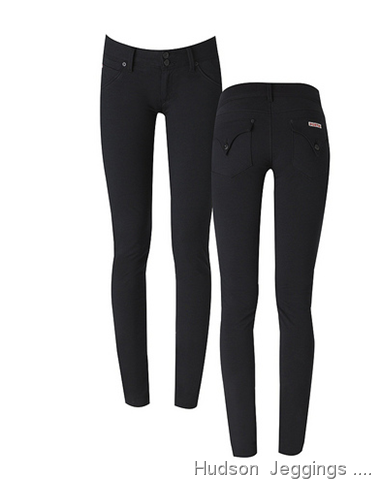
    13)We hear a lot about  the Denim Leggings – ‘Jeggings’ .Are they in fashion ? How do you style  ‘Jeggings’?

    The jegging is a fashion essential this season because it provides the comfort of the legging and chic design of the jean. It’s something that is very easy to wear and goes with anything in your closet. To dress up your new jeggings, wear them with Christian Louboutins or dress them down with a beat up pair of Converse tennis shoes. You can wear them with a tank top or a more dressy top, a canvas bag or a Balenciaga. The jegging gives your look an edge, no matter how you style them.

    geogia jagger denim jeans

    jeggings denim leggings

    A brief bio of Benjamin Taverniti : Born in 1980, Ben is a very young and talented head designer of Hudson Jeans. In 2002, Ben became the head designer for Kristina Popovich in Paris for 2 years.  In 2004, Ben relocated to Los Angeles, California and lead the design team for Yanuk Denim.  In early 2007, Ben joined the Hudson Jeans’ family.  Ben is currently the head designer and creative director at Hudson Jeans..

  • Premium Denim Rules At Las Vegas Project Show

    project las vegas denim show

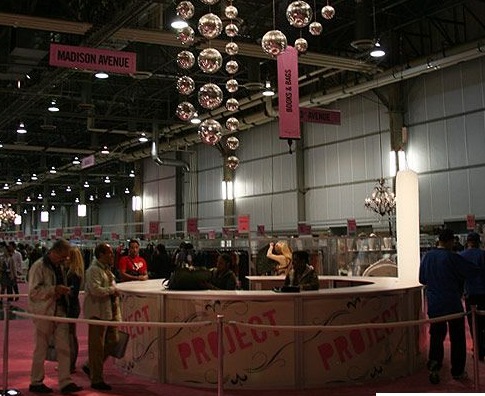
    At the Las Vegas Project Show last week, premium denim turned out to be hot favourite.. And the lines of crowds that could be seen  were not in the buffet line  but were of apparel buyers trying to place orders for jeans.


    "Walking the show, denim as a category was the busiest category. And True Religion was by far the busiest," said Needham & Co. analyst Christine Chan.


    At rival denim brand, Citizens of Humanity, orders logged on the first day of the show were double those of a year ago, said Chief Operating Officer Gary Freedman.
    As per NPD  Group – the research firm -  the premium denim market is valued at around $1.32 billion and grew 5% in the 12 months ending June 2009..
    The premium denim brands continue to attract investor interest because the category still enjoys high margins. One of the premium denim brands to have registered super growth this year is True Religion – its stock has grown over 77% this year !

    However, though this Reuters Report generalizes the state of premium brands, the Super Premium Brand category has suffered some setbacks in the first half of this year and many brands have lost their sales . But on the whole, the denim sentiment is positive  and it portends well for both the basic and premium denim categories.

    originalfake-levis-kaws-denim


    Also, check out here a list of Summer 2009 Brands by Project Show..

  • Is Denim In For A Boom Period?

    denim jeans boom copy

    Despite the economic recession ,denim was one of the few apparel items to have maintained positive growth during the last one year. However, some segments of Denim like Super Premium Denim had been had been hit by the recession ,causing sales to slump.

    However, now it seems that Denim Industry is in for a boom period.  What is the reason for this optimism. Well, it has got to do something with the  increased sales figures of denim jeans in USA and orders with the denim mills around the world.

    1. Sales of denim (women’s) into USA has increased 6.3% in the first six months of this year. The import figures for men’s jeans is also positive (I shall post the report on the same shortly)
    2. Denim fabric companies are full of orders. Companies in countries like India are full of orders for their denim fabrics. This portends well for sales of the next season. In my discussions with some other mills in China and Pakistan, the same positive sentiment was reflected.
      I am hoping that this positivity pervades in denim mills in other parts of the world too.
  • Levi’s Jeans Now On Credit !


    denim on credit levi's edited2 

    Levi’s India has recently launched a pilot promotion programme under which they are selling their Jeans in Bangalore on credit. The $30 +(Rs 1500+) jeans are being sold on a credit of 3 months. And the customer is not charged anything extra for the same.

    The process goes thus :

    1. Customer buys the jeans from a store which swaps his/her ICICI Bank credit card.
    2. The customers takes away the jeans.
    3. He/She is charged $10 every month for three months.

    Why is Levi’s of selling denim on credit ?

    The recessionary economy is forcing companies to think of innovative ways to sell . Apparel sales are easily affected in not so good times as these purchases can be easily put off without causing too much self discomfort.  Levi’s logic behind the marketing exercise is clear – sell the jeans to those who find it difficult to bring themselves out to spend $ 30+(Rs 1500 & above) on a pair of jeans . It gives a psychological comfort to the customer that he is apportioning his cost to  a number of months rather than getting the hit in a single month ..

    Initial Results and Reactions On This Denim Experiment ?

    Shumone Chatterjee, MD, Levi’s India, says the success of the programme over the past few weeks has already convinced them of the need to roll it out nationally. ‘‘By this month-end, we hope to rope in several more banks into the scheme,’’ he says.

    Being a new experiment there is bound to be a lot of doubt around this and some people in the retail industry are doubting its success . However, I am reasonably sure that this scheme will at least not fail . It may or may not be a run away success , but it will surely not fail….

    WHY?

    1. Famous brands always have ,besides their customers, a number of people who are ‘Brand Lovers’ but NOT regular ‘Brand Customers’. They are not regular customers because of the cost of the brand. These ‘Brand Lovers’ may actually be more than the actual customers.However, if any window of oppurtunity arises where they are able to afford the brand, they do not miss it. 
    2. Getting the branded item on credit may not be actually getting the item at a discount, but it does provide a psychological comfort to the customer that he/she is not spending too much money in too short a time.. Have you seen people buy TV, Furniture etc on credit ? Why do they do it ? Some of them may not be able to afford a one time payment, but many of them have a comfort that they are spreading their costs over a long period of time.Similar logic can be applied to brand also ..

    I won’t be surprised if this marketing tool is copied by Levi’s offices in other parts of the world.

    And would you buy a 7 For All Mankind Jeans if you are charged $20/month for next 10 months ?? Probably many people would..  
    Are the Premium Denim Brands listening …?

  • Munich Fabric Start – Denim Fair from 1st to 3rd September 2009

    For those wishing to be in constant touch with the latest denim fabric trends , Munich Fabric Start is one of the important fairs where denim mills from around the world shall be displaying their latest products. The Munich Fabric Start is a bi-annual fair with the last fair held on 3rd Feb 2009.

    When and where  is the show ?

    The show shall be starting on the 1st Spetember through 3rd September at Munich ,Germany.

    Which Denim Mills are expected to participate  in the show ?

    The  core group comprises of Denim Mills like Hellenic Fabrics (Greece), Ortaanadolu(Turkey),Italdenim(Italy),KuraboDenim (Japan) ,Raymond UCO Denim (India), Kuroki (Japan)  etc .
    Some new mills are expected to participate this time including  Rainbow Denim (India) , Kassim Textiles (Pakistan) , Swift (France) etc..

    What is the denim trend motto this time ?

    The bluezone is oriented towards the motto “Sonic Youth”. This trend theme stands for an anti-establishment movement and the individual lifestyle of a rebelling youth ready to fight for its ideologies – whatever it means !
    WSGN – a leading fashion and style forecaster will present the denim trends in the forum area..

    Some highlights of the last fair in Feb’09

    1. Last time around, about 59 denim mills, washing plants and finishers participated in the the denim zone – The Blue Zone – exhibited their fabric collections and new finishes.  In the last show, an interesting highlight was the presentation of  over 16 styles of  jeans and tops  of Xfit lycra created by the students of the University of Hanover under the auspices of the Bogner Jeans .
    2. Denim fabric trends : Bleached ocean blue ranging from light blue to almost white, bold destroyed effects, fabrics in washed medium colours, arty and moon-washed fabrics, coloured and washed-out denims, striking graphics, colourful prints, raw denim,
      but dark, denim shirts, glitter effects.
    3. Download the report on the denim zone – the Blue Zone – here
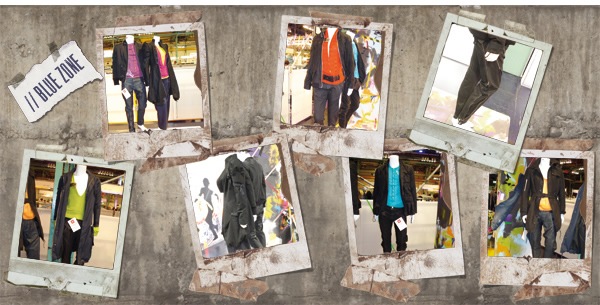
    4. Some denim related photographs from the last Munich Start Fair
      teaser_bluezone
      Denim trend
      munich fair denim
      ortaanadolu