Category: denim

  • Interview With Andreas Kurz : Ex CEO 7 For All Mankind

    Andreas KurzHere is a very interesting  interview with Andreas Kurz – ex CEO 7 for All Mankind and ex President Diesel USA. Andreas has been associated with the global fashion industry for a long time particularly the denim industry. Here are some of his erudite answers to the questions that I put to him.

    Hi Andreas. Welcome to Denimsandjeans.com ? Its a pleasure to have you with us. Please tell us something about yourselves and your company – Akari Enterprises..

    I have worked in the fashion business all my life, since 1985, first with Hugo Boss in Germany, then with various companies in the US: Diesel, Versace, Ralph Lauren and then I became CEO of 7 For All Mankind in Los Angeles. Since 2006 I have my own consulting firm Akari Enterprises. I work in three areas: global business development for my clients (mostly premium denim companies), M&A and Executive Search. Currently, I work with Joe’s Jeans, Agave Denim, Kuyichi and Robert Graham. My site is www.akarienterprises.com.

    You have held some of the most senior positions in the denim industry ..What do you think really is the moving spirit behind this product ?

    It’s all about the product and particularly in denim, about the fit and the fabric and wash. Jeans will never go away and are the most versatile piece of clothing that goes through life with you and tells your story. Jeans are something very personal. They represent a lot of things for many people: adventure, rebellion, youth, sex appeal, independence, etc. Jeans bring up emotions in people, that’s why they are here to stay.

    How do you think it is going to evolve in the future..?

    Jeans will always be an important part of everyone’s wardrobe, however, the way people look at jeans is changing and it will be more important in the future for jeans to more conscious of the environment. Many brands have now incorporated the use of organic cotton and/or switched to laser wash techniques, which use much less water and no chemicals. Some companies, like Kuyichi, use only organic cotton and the new denim line from Girbaud is entirely made with their WattWash technique (with Laser and Ozone).

    Despite regular recessions and downfalls, denim refuses to bow down.. Do you think this product has an eternal life ?

    Denim will never go away. It is the most versatile garment and can be used for the office and for leisure and going out at night. Jeans are loaded with sex appeal and that will always be an important factor or wearing them.

    Many companies and celebrities want to jump into the denim bandwagon by launching a denim brand . What do you think about such a trend ? Can the market sustain and absorb such an increasing number of brands?

    The number of denim brands has significantly decreased since the crises in 2008. The bigger companies have benefited from this by growing their market share and the entry into this market for newcomers has become much more difficult. It used to be easy to come up with a pair of jeans, get some celebrity to wear it and become an overnight success. That is not so easy anymore with the consolidation that has taken place. Buyers are more cautious and concentrate on the brands that have made them money in the past.

    Its sometimes said that whatever needs to be done with denim has been done . Do you think this is a gross  underestimation of denim potential ?

    I think there is revolution going on right now with denim and we are just beginning to see a new era of denim from many points of view: alternative fabrics (tencel, hemp, etc.), organic cotton, laser wash techniques, ozone treatment. Cotton in itself already uses a lot of water to grow and the washing techniques used so far account for an enormous amount of water being used and polluted with all the chemicals. All of this is about to change in a big way. Sandblasting has already been prohibited by many big brands and more developments in this field will follow. That is very encouraging .

    Coming to ‘Premium Denims’. There is a lot of confusion regarding the definition itself . How do you define it ?

    Premium denim is foremost referring to superior material: sturdy quality yet soft at the touch. The best material comes from Italy and Japan. It’s like with food. If you want to make a great meal, you have to have great ingredients. Then the washing is obviously very important and the keen attention to fit. There is a noticeable difference between premium denim and other denim jeans and consumers are willing to pay the difference.

    What do you think would be the market size of Premium Denims in US ?

    The US market for denim is about $16.5bn. Premium denim (jeans that retail for $100 and more) makes up about 5% of that, so roughly $1bn. In 1990, when the LA premium denim boom started, the total market was only $11bn and the premium market then was only 1.8% or roughly $200m at retail. There has been an explosion of both the total market and of the premium denim market from 2000 – 2007 and since 2008 things have slowed down considerably, but the big brands are, for the most part, still growing their business and market share.

    Some experts say that in recession it is the lowest priced and the highest priced products that sell well . Do you subscribe to this view ?

    In the good years, from 2000-2007, there was a clear high-low market development: the segment below $50 and the segment above $100 grew at the expense of the middle market from $50-$100, however, since the crisis, the middle segment has picked up again and jeans that retail for about $85-$140 have become stronger again.

    How long do you think would it take for mid priced retailers to really give a serious challenge to the high priced denims from premium denim brands ? Current efforts by retailers like Gap have had mixed responses ..

    Once a brand is in one particular segment it is hard to make an inroad into another segment and obviously the hardest thing to to is to trade up. When you are perceived as a low or middle priced brand it is nearly impossible to enter the premium denim market, even though your product may be equal or superior. At the end of the day, it’s also a lot about perception and branding.

    Denim fabrics from Japan and Italy are reputed to be the best .. How far do you think mills in Asia are in comparison ? Do they have the right ingredients to take up the mantle ?

    Other Asian manufacturers are definitely stepping up and will be more important players going forward. One example is Arvind. They are one of the largest denim manufacturers at low prices, but have also successfully gone into premium denim with what they call denim lab and have developed beautiful materials.

    Something on your personal choices.Which is your favourite pair of Jeans and why ?

    I have many different pairs of jeans obviously, but I keep coming back to my favorite: Citizens of Humanity. Their fit for me is perfect and the softness of the fabric, combined with great styling and understated styling is what I like the most. Jerome Dahan is doing a superb job and since a few years, he is working with Adriano Goldschmied, the godfather of denim and both of them just keep coming up with fantastic products. In terms of revolutionary washing techniques, I would have to mention Marithe+Francois Girbaud as the pioneer and my favorite socially conscious jean.

    How many times do you wash a single pair of jeans in a year ? What advice would you give our readers on this ?

    Wash as little as possible. I wash mine about 4 times per year, inside out and with cold water.

    Thanks for being with us Andreas.. It was really a pleasure interacting with you..

    Same here, thank you.


    denim social missions

  • Sustainability in Denim Washing With Flexible Fading System

    What is the reason behind the increased focus  for sustainability in textile products ? Lets look at some facts ..

    • 7 Billion people in 2011 / 9 billion people by 2050. Feeding, clothing, and providing shelter for everyone does not come free. Everything has a cost. This cost has to be borne by the environment.
    • According to textile exchange , about 20% of industrial fresh water pollution comes from textile treatment and dyeing.
    • About 2700 liter of  fresh water is used to make one cotton T-shirt.  About 920 gallons to make one pair of Levi’s 501(and similarly for other jeans) . Other textile products also consume huge amounts of energy and water in processing and finishing.
    • 1 Trillion kwh used by the global textile industry . This equals  approx .10% of global carbon impact .

    With this growing realization of need to have  sustainable products  and looking at this huge impact of textile industry on the environment – of which denim is an important segment – the natural way forward is only devising new products, ways and processes which can help in reducing the environmental footprint of textiles. A number of companies are contributing towards this end and we just interviewed Steffi Zhao of  Primagreen (Danisco)  to discuss their Flexible fading enzymes for denim which is a product in this domain contributing to reduced energy and water consumption.

    Hi Steffi ! . Tell us a little about Flexible Fading for Denim from PrimaGreen®..

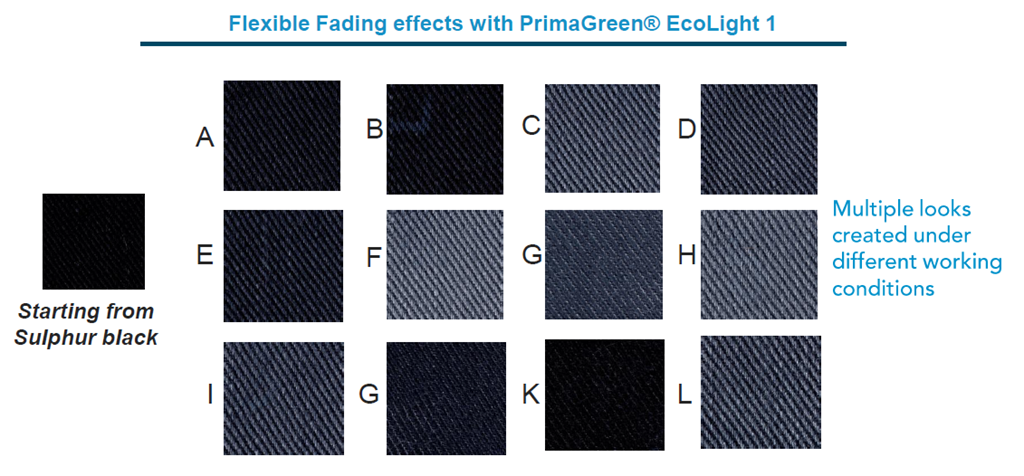
    PrimaGreen® enzyme solutions from Genencor/DuPont are biodegradable, made from renewable resources, and manufactured using the latest biotechnology methods providing highest efficiency. The enzymes can replace corrosive chemicals such as caustic soda, potassium permanganate and  hypochlorite.  "Flexible Fading" for denim garments allows multiple looks on one basic denim fabric with PrimaGreen® EcoFade LT 100 laccase and  PrimaGreen® EcoLight 1 esterase.  Both solutions are more sustainable and controllable compared to traditional washing and deliver high-quality fabrics.

    What is the difference between Traditional Denim processing and the processing done with Primagreen?

    Denim fading
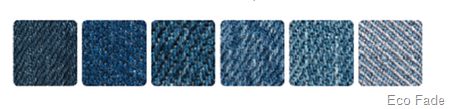
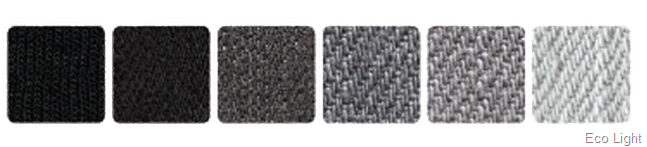
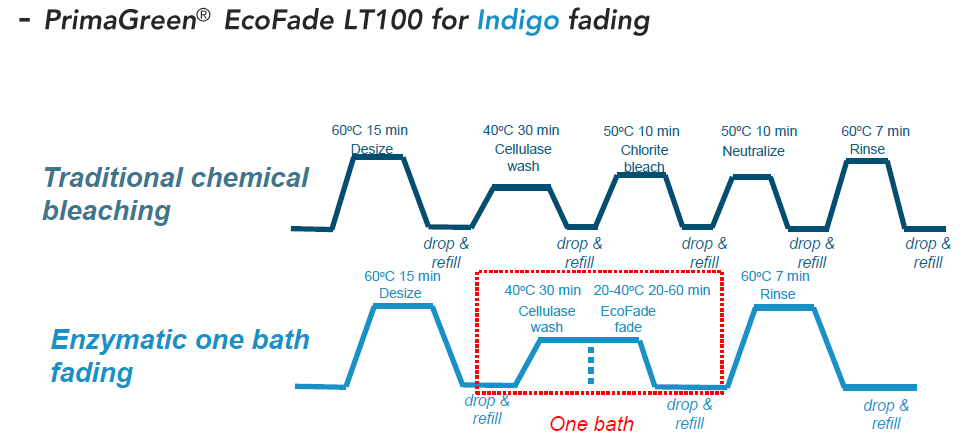
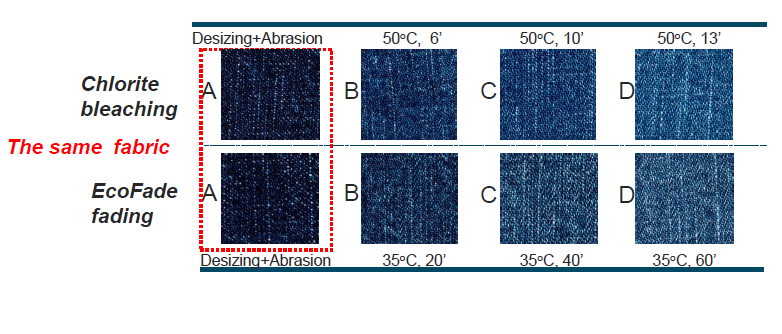
    EcoFade LT 100 laccase is specific for Indigo fading while EcoLight 1 esterase technology fades sulphur black dyes. Compared to the traditional denim bleaching process, PrimaGreen® processing combines enzymatic denim abrasion followed by fading in a single bath with no drop and refill. These ready-to-use solutions provide excellent and reproducible effects in the fading of denim, -all at lower temperature and with less water. Meanwhile the enzymes allow designers to take one base denim fabric and create multiple looks with lowest fabric damage. That’s why we call this "Flexible Fading": Abrasion with IndiAge® cellulase and fading with PrimaGreen® laccase and esterase
    Denim fading 

    Denim fading

    The definition of ‘Environmental Friendly’ is sometimes vague.  How can a denim mill be assured that they really contributing to the environment by changing their processes?

      PrimaGreen® solutions provide significant, measurable reductions in environmental impact, including:
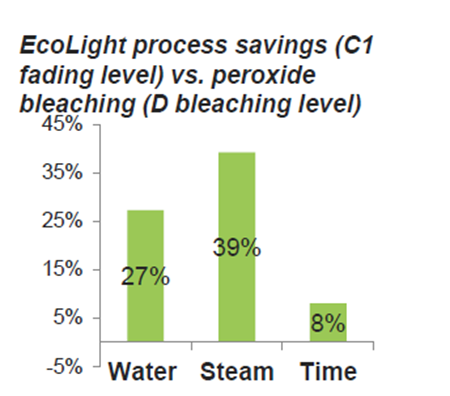
           • Lower processing temperatures resulting in reduced energy use.
           • Less fabric washing and rinsing resulting in reductions in water use and effluent.
           • Decreased energy consumption resulting in reduced carbon dioxide (CO2) emissions.
    These environmental benefits also allow for safer working conditions and reduce the total processing cost!

    The final consumers- brands , retailers etc– are probably the most important in the value chain to help in awareness for  environment friendly products. Do you think they are doing enough in this direction?

    Pressure is growing to lessen the amount of water and energy used to produce textiles. The current approach is not sustainable given a world of finite fossil fuel resources and a growing carbon dioxide burden. There are always early adopters with the advent of any new technology and those that follow.  It is often difficult to get companies to change a practice that they have been doing the same way for years or even decades.  With the biotechnology resources we have at Genencor/DuPont we now have, within our reach, solutions to problems which we could not even imagine a few years ago. Fortunately, we see that brands and retailers take responsibility and look for more sustainable garment manufacturing practices. To do so, they need to fully understand these practices and this requires transparency within the total textiles supply chain. Initiatives such as "Textile Exchange", "RITE" and "Planet Textiles" allow direct communication between all involved stakeholders. As a positive result for us, garment brands are retailers are now starting to "prescribe" PrimaGreen® to the denim laundries, thus demanding more sustainable processing. Retailers that thrive in the future will feature the latest fashion looks produced with responsible processes; and consumers won’t tolerate anything less.

    Black denim processing has , always , for various reasons not been the easiest. There are issues on color retention, rubbing fastness etc. How do you  address these issues ?

    One of the main issues we see with the traditional chemical fading of sulphur black fabrics is reproducibility, or the lack of it. Additionally, it is difficult to achieve an even effect on the whole garment; it’s too reactive and there is no control. With EcoLight 1 enzyme different aspects of the washing process can be adjusted such as: working time, temperature or application recipe.  The milder -or more natural- processing conditions simply allow for more flexibility and highest reproducibility, resulting in the designed fading looks.

    Reproducibility of effects on denim is a matter of great concern for processors and clients. How is the such consistency in fading effects created using your enzymes ?

    Both PrimaGreen EcoFade and PrimaGreen EcoLight enzyme technologies provide reproducible fading effects, significantly reducing batch to batch color variations of treated garments. Our Textile Application experts around the world have conducted many trials, in our laboratories and in full scaled denim laundries, and optimized the washing processes with our customers. We have gained considerable experience with the products in different processing facilities with many different types of denim fabrics. And this type of collaboration-approach has become our approach to implement these new technologies, ensuring the best results. It’s a lot of work -preparing, conducting trials, evaluating- but the positive results are benefiting our customers and us!

    Another important aspect is the processing of  ‘Stretch Fabrics’ . The loss of stretchability in various processes is well known. It affects the life and the looks of the garment. Is it possible to have desired effects on stretch fabrics without affecting the elastane?

    That’s the beauty of enzymes: they work in mild conditions and that is always a benefit to any type of fiber and fabric. Yes, our above mentioned Primagreen products allow you to get the desired effects on stretch denims without any damage when compared to chemical bleaching processes.

    What is the ‘Single Bath System ‘ ?

    It means the denim washing step with cellulase for abrasion and the step of enzymatic fading can be combined into one bath, thus saving water and energy. As part of our commitment to innovation, we continue to invest in developing and optimizing enzyme products and one of the many requirements is combined processing. We just launched a new neutral cellulase for denim abrasion:  IndiAge® ONE. This is a super concentrated granular cellulase enzyme has a broad pH and temperature range and has the ability to attain high contrast and low backstaining on denim fabric upon formulation. It is the only enzyme you need to produce a wide range of denim abrasion looks in different working conditions.
    chlorite bleaching denim

    chlorite bleaching denim

    What would you define as contribution to environment in terms of water and energy saved by the denim mills and garment processors using Primagreen ? Does it translate in any monetary savings for them as well ?

    Due to single bath system and processing at low temperature compared to traditional chemical bleaching, PrimaGreen® "Flexible Fading" solutions can reduce water consumption and save energy. When working together with our customers we calculate the costs of the recipes, the use of water, effluent, and energy. Considering all these aspects, the benefit is cost reduction and therefore monetary savings for our customers. Of course this is a case-by-case evaluation, again emphasizing the need to work together with the brand, the retailer, the formulator and the laundry to find the best solutions.

    image

    To contact  Primagreen – click here

    Denim Fading Made Flexible

    View more presentations from Denimsandjeans.com

  • Denim Trends From PV : F/W 2012

    Though we are a bit late in posting it , but nevertheless , its good to have see some of the denim and related fabric trends visible in the Premiere Vision held in Paris in September 2011. The trends are shared by Stylesight , a leading provider of trends .

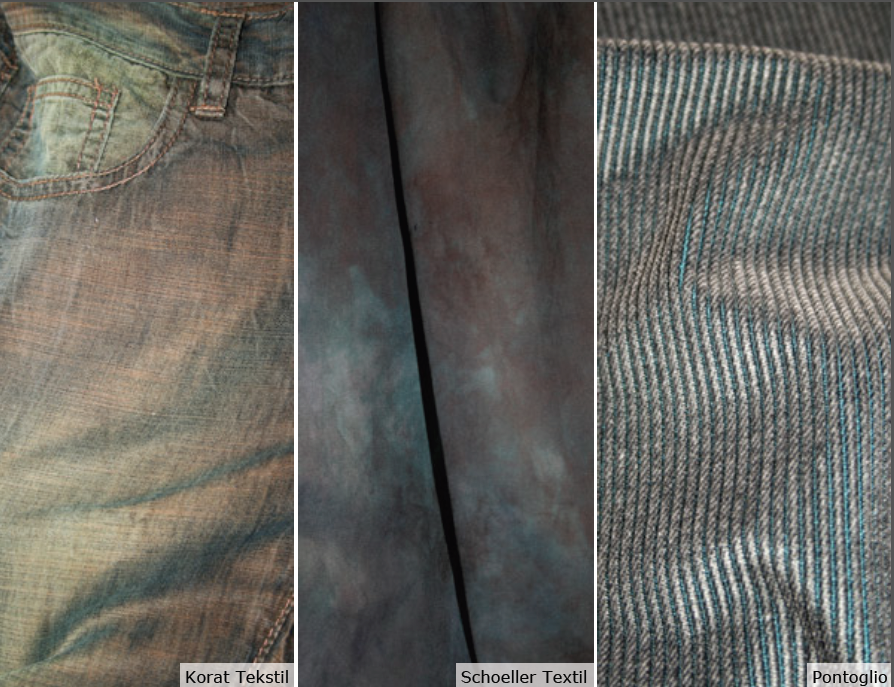
    Gently Damaged Textures

    Denim Trends PV - Gently Damaged

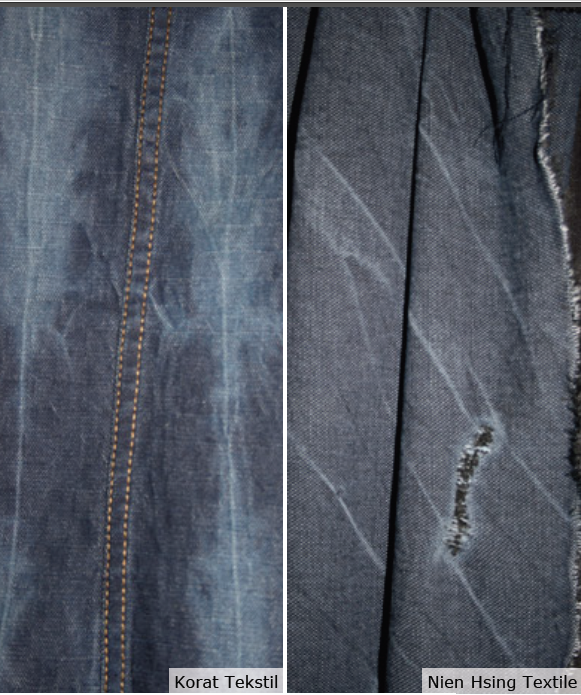
    Gently aged denim effects were visible via enzyme washing , laundering and over dyeing . Similar looks could be seen in flats also .

    Denim Trends PV - Uneven Color

    Uneven Color :

    Denim Trends PV - Uneven Color

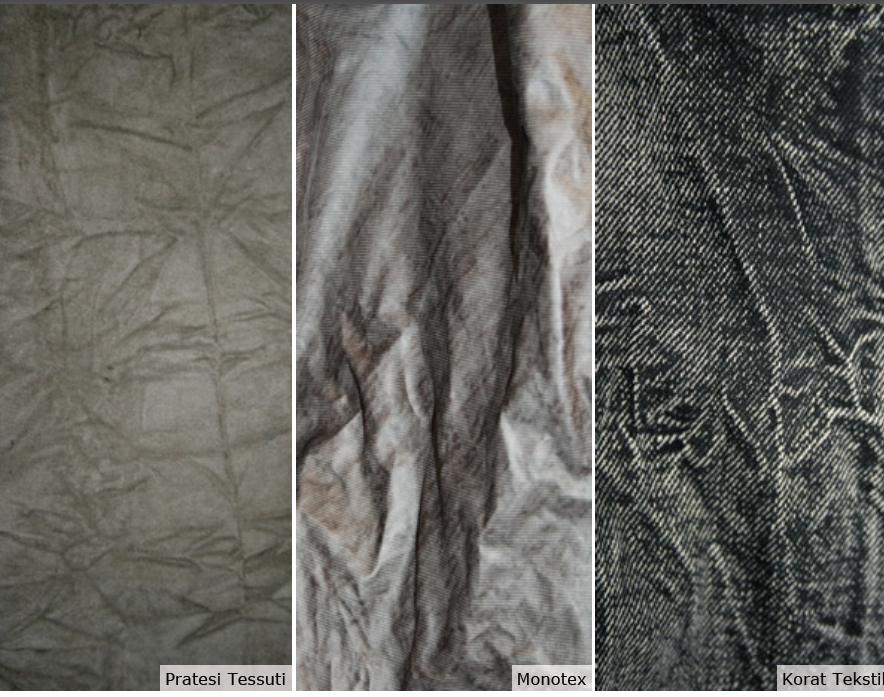
    Irregular dye techniques and exaggerated flock or pile textures create uneven color qualities. Cloudy patinas and washed-out surfaces / Uneven flocking or velvet piles / Corduroy with colored backs / Basket wash cotton and sensor-coated / Random, non-uniform appearances

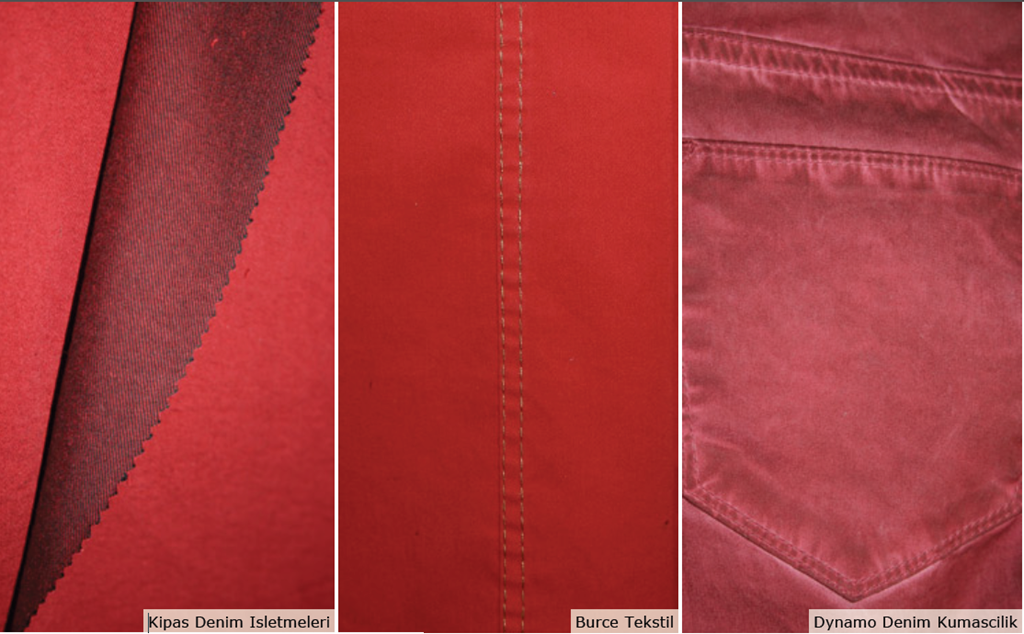
    Red Energy

    Denim Trends Fall Winter 2012 - Red Color

    Red is the “In” Color . With colored coatings, colored wefts , strong satured colors , Over Dyed and Garment Dyeds – the red color in denim is achieved in many ways.

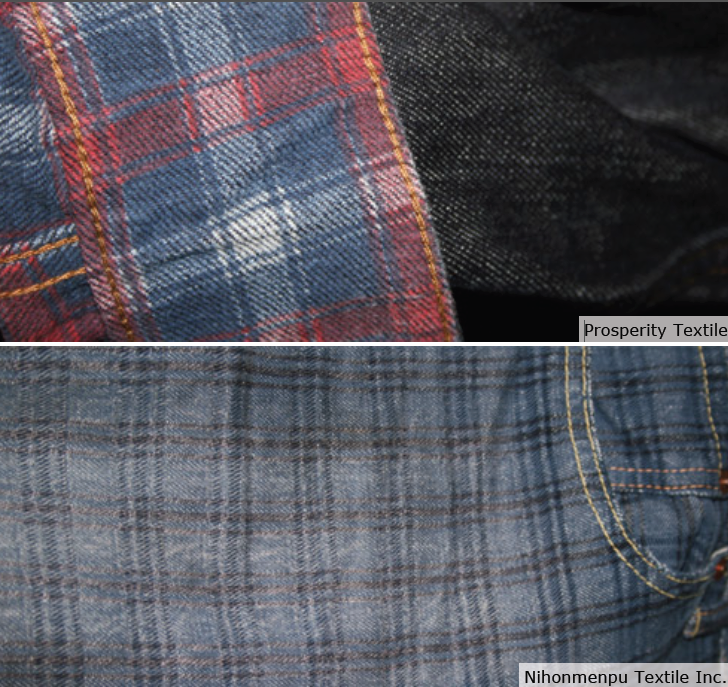
    Casual Checks

    Denim Trends Fall Winter 2012 - Casual Check

    Indigo checks have been around for some time. But they come back in different avatars with deep indigo dyed wefts being used.

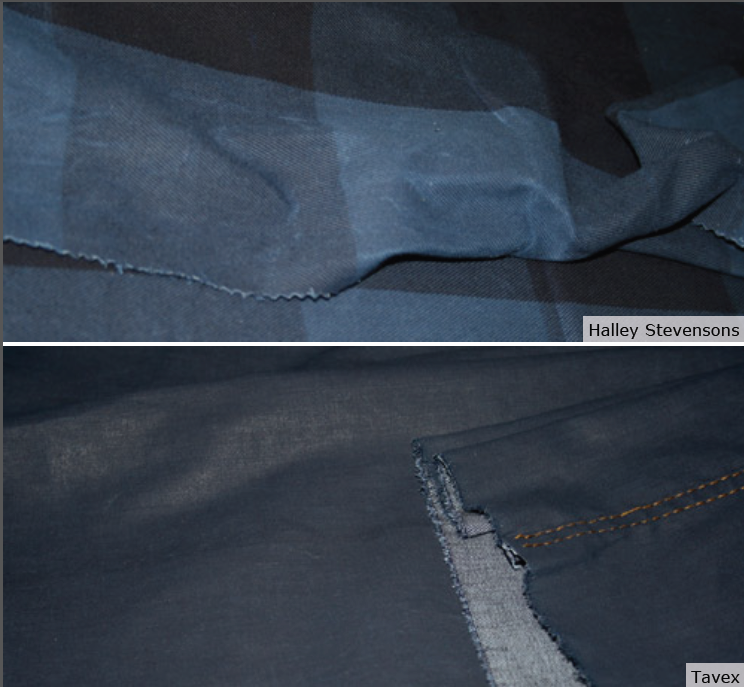
    Waxed Treatments

    Denim Trends Fall Winter 2012 - Waxed

    A key treatment for Fall / Winter 2012 is hardwearing or waxy coatings that offer durability and waterproof performance.

    Double Faced Fabrics

    Denim Trends Fall Winter 2012 - Double Faced Fabrics

    Double-faced wool and cashmere in contrasting and complimentary hues update denim and cotton flats for
    winter. Denim can be seen in double faced stripes.

    About Stylesight:  Stylesight  is a leading provider of trend content, tools and technology for creative professionals in the fashion and style industries.

  • Indigo Dyeing : Problems And Potential–Part 4

    This is a technical article by Harry Mercer on Indigo dyeing. It is the fourth and the last part of the article in series. The first part can be seen by clicking here and the second one here and the third one here

    Part 4 of 4: Denim Dyeing Done Right

    Indigo Dye BathIndigo dye is unique among textile dyes with the unusual color and appearance that it imparts to any fabric, and is along with the extreme comfort of 100% cotton denim is the source of denim’s enduring appeal. Attempts to replicate the Indigo color with other dyes ,like sulfurs, only results in a poor imitation.The process of dyeing Indigo is also unique because of the necessity for repeated applications in multiple dye baths. Indigo is actually a better wool and silk dye and has been used to dye those fibers for centuries.

    All other cotton dye types- reactives, directs, sulfurs, naphthols and vats- have simple application methods usually only requiring only a single bath application and simple machinery arrangements.

    Indigo dyeing on the other hand presents complexities with regard to machinery design that includes multiple dye baths and a circulation system that is needed to keep the Indigo dye in motion with pipes through which the dye flows into and out of each box and in a circuit around the dyeing section which can have a total dye volume of from 1000 to 30000 liters while ordinary dyes need only a few hundred liters for application. This is necessary because Indigo dye, exists not in a true solution like acid or basic dyes, but are in colloidial state- clusters of dye molecules in a reduced condition that will sink to the bottom of the dye bath due to gravity if not stirred constantly. The degree of circulation pressure must be balanced so that there is a uniform concentration of Indigo from top-to-bottom and from side-to-side for consistent dyeing. If the circulation pressure is too high there will be excessive turbulence in the dye baths which will result in the reduced Indigo and the reducing agent breaking down. In engineering terms (Reynold’s Number), the flow should be greater than laminar, but in the low transitional range and never approaching turbulent conditions. Unfortunately, a number of Indigo dyeing machines offered in the last 20 years, are badly designed for maintaining uniform bath circulation, especially sheet ranges which usually have entry- and exit pipes that are too small to achieve even dye distribution in the boxes, which results in serious problems like Cross-Shade Variation. These problems have been complicated in many denim companies by the feeding of sodium hydrosulfite as a dry powder which is highly unstable when mixed into the dye, most of it being wasted through unnecessary decomposition. Hydrosulfite should never be added to the dye unless in a stable liquid mixed with alkali, which was the method used by all U.S. denim companies.

    More importantly for achieving the desired tone(red versus green), consistency of color and color-fastness (to rubbing , washing and staining) is understanding the complicated chemistry of Indigo. Other dyes are mixed and applied in basically the same chemical state. When Indigo is mixed with sodium hydroxide and sodium dithionite (hydrosulfite) a series of reactions occurs in which the Indigo is combined with hydrogen and sodium to form the reduced indigo form. Additionally, approximately half of the sodium hydroxide is converted into sodium carbonate and other alkalies while the sodium dithionite reducer decomposes into an acid and simpler reducing agents like sodium sulfite. Three ingredients are mixed and between 9 and 12 new chemicals are created. Because of this phenomenon and the special design of the circulation system, Indigo dyeing can only be correctly understood with a basic knowledge of chemical engineering. I have found in training programs in many denim companies, that only trained chemical or mechanical engineers are readily capable of understanding the Indigo dyeing problem well enough to have perfect results

    In order to measure the chemical concentrations for Indigo dyeing there are only certain methods that have proven to correlate with the yarn color, which is after all, the measure of effectiveness for any test method. If test results are plotted comparing the measures of dye and chemical concentrations vesus the yarn color and colorfast-ness and changes in concentration measurements do not reflect similar changes in the color, then the wrong test method is being used.

    Extensive research has demonstrated that for testing the strength of the Indigo mix, the glass plate method and the 2-endpoint titration for caustic/carbonate have always proven reliable. For testing the concentrations of reduced Indigo and hydrosulfite in the dye bath, the vat-ometer , mentioned in a previous article will correlate well with the color produced and can also be used to control color-fastness.

    Unfortunately, the most commonly used methods, will not correlate with color and therefore are not useful for solving Indigo dyeing problems. These include:

    pH and millivolt meters which are incapable of quantitatively measuring concentrations of sodium hydroxide and sodium hydrosulfite. They provide only a general qualitative measure of the number of particles in a liquid indirectly by measuring electrical currents. The only difference between a pH meter and a millivolt meter, other than the electrode used is that one converts electrical measurements into a logarithmic scale(pH) and the other to a linear scale(ORP) which reflects a buffered condition and not concentrations-only concentrations matter in chemistry.

    Automatic titrators for use with the 2-endpoint ORP titration are not useful in monitoring Indigo dyeing for production. The sample size is too small for accurate results and there is a persistent problem with the titrator trying to identify the correct endpoints. 20 years ago, I introduced the potassium ferricyanide method to the public in an article. It had been in use by a small group of denim experts in the U.S. for many years, but only worked with manual titration with a large sample size. As a denim consultant for the last 18 years, I have never observed results from automatic titrators that correlated with the Indigo color.

    Dye strength measurement by colorimetric transmission measurement is false sophistication. In order to measure the strength of a dye by transmission and converting it to absorbance requires application of the Beer-Lambert Law. The basic principle is that light absorbance is directly proportional to the concentration of a dye is correct, however there are limitations which include the need for a true solution at very specific concentrations (<0.01 M) that avoid light scattering. Indigo dye, as mentioned earlier, exists as a colloidial dispersion which produces turbidity, which, in turn, causes light-scattering and defeating attempts to measure absorbance.

    Indigo dyeing can, in fact, be conducted at nearly perfect levels with a properly designed training program that illustrates the chemistry, mechanics and management methods required to get the dyeing right which I have provided for many years.

    This is a guest post by Harry Mercer. Mr. Mercer has 30 years experience in the denim business including 3 prominent U.S. denim companies.He is an expert colorist for measurement and color matching as well as textile testing and is considered to be a leading authority for denim dyeing, finishing and fashion denim development.
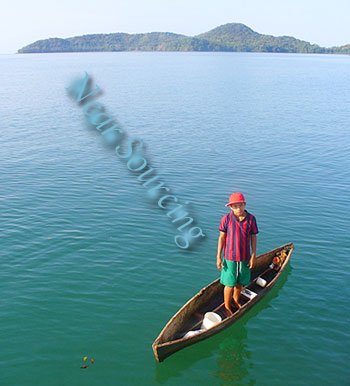

  • Near Sourcing Denim And Other Apparel

    near sourcing apparel denimEU and US have learnt an important lesson during recession. A strong manufacturing base helps in creating jobs and income and creates a cushion in recessionary period. But financial realities makes it difficult to bring manufacturing specially of low technology products like apparel back to these regions. Asian countries specially China has, in the last two decadeds, literally gobbled up a major part of manufacturing capacity  to become the “factory of the world”.

    However, as Financial Times notes , few factors are changing that.

    • China is becoming more expensive due to rising wage costs. The wages in the apparel industry are reaching $500 to $700 per month in many provinces.
    • The cost of transportation is increasing by the day due to increased energy prices.

    This is leading many retailers to move to lower cost destinations like Bangladesh, Vietnam, Cambodia, Pakistan etc.  The US retailers also feel it might be a good idea to be in Latin America and the Carribean.  South America tends to gain when China is losing . 

    The retailers in EU , on the other hand, are trying to get things back into nearby countries in Eastern Europe and South Europe. The crisis in Europe and efforts to improve its manufacturing prowess, are also contributing to the trend. Asda , the British arm of Walmart  – as FT mentions – is buying some fabric from UK this year. This is not a surprise as we have seen companies trying to bring up jeans production in UK . All these developments are symptomatic of  “NEAR SOURCING” – terminology for getting products from near home.
    However, there is also lot of caution as retailers just don’t want to go long on sourcing near. Tesco wants  to avoid long term contracts with European suppliers as there is still an element of risk.  But if “Near Sourcing” accounts for even a couple of % points, it can make a huge impact on the region.

    What is your take on Near Sourcing ? Do you think it is for real and it is a developing trend? Do share your thoughts …

  • Indigo Dyeing : Problems And Potential–Part 3

    This is a technical post by Harry Mercer on Indigo dyeing. It is the third part of the article in series. The first part can be seen by clicking here and the second one here

    Part 3 of 4: Monitoring of the Indigo Dye baths

    As discussed in Part 2 of this series, most of the control of indigo dye bathIndigo dyeing must be managed before the dye and chemicals reach the dye boxes in the machine. In order to measure the effectiveness of control measures of the dye and chemical mixes, it is necessary to measure concentrations of Indigo, reducing agent and alkali in the Indigo dye boxes. If the methods of measuring these concentrations in the dye boxes are accurate and reliable, then those measurements will be able to predict the Indigo color of the yarn and the colorfastness of the denim in the garment laundry as well as providing a benchmark of dyeing management capability. By analyzing the data for each dyeing method with simple statistical tools such as Standard Deviation, the level of control for each color, for each dye lot and each group of workers can be measured and improved. In this way, continual progress can be made towards perfect denim color which has been achieved in a few companies. This wins business with jeans producers that pay the highest prices.

    In 1992, I published an article, “Quality Assurance Methods for the Continuous Dyeing of Cotton Yarn with Indigo” that was the most advanced treatment of the subject. After years of research into test methods for Indigo dyeing, several conclusions could be made:

    • 1) the most commonly-used methods of measurement, pH and millivolts were unreliable and could not be correlated with the dyeing results. They gained popularity because of simplicity and because that the results were consistent- the color changed, but the pH and millivolts were consistent. Dye managers used these numbers to claim that they had good dyeing control when customers complained about color variation.
    • 2) Statistical Analysis comparing test results with the actual fabric color and wash-down demonstrated that the glass plate, vat-ometer and a special alkali titration correlated perfectly with instrumental color measurements of denim(L*a*b* or L*c*h*) and were the only reliable test methods for correcting Indigo dyeing problems.

    The primary cause of Indigo variation is changes in the reduction potential of the dyebath which consists of a combination of reduced Indigo and free sodium hydrosulfite. The total hydrosulfite in the Indigo bath is divided between the hydrosulfite that is consumed for reduction of the indigo dye molecule and free hydrosulfite that is not consumed in dye reduction. Where the dye circulation is adequate and the dye feeding concentrations are consistent, the grams per liter of reduced Indigo and the alkali levels are consistent. The free hydrosulfite is unstable and requires the most effort in control for Indigo dyeing. As the concentration of free hydrosulfite increases, the Indigo shade becomes greener and more wash-fast; as the free hydrosulfite decreases, the indigo appears less green or redder and loses color faster after washing. If the free hydrosulfite changes by 0.3 grams per liter in the indigo bath, a different indigo shade results. Many denim companies have 10-15 shades per dye lot where a true color difference of 0.2 Delta is used as a measure.

    In the above-mentioned article that I published, I mentioned a number of possibilities for measuring reduced Indigo and free hydrosulfite in Indigo dye boxes. One was the permanganate method that uses a 2-endpoint, potentiometric reduction-oxidation titration.This method has come into common use in many companies, but is not reliable for measuring the Indigo dye. The method has been in use for over a hundred years and I found it useful in conducting research into Indigo dyeing in order to develop Indigo formulations in the laboratory. This method was occasionally useful at the Indigo machine when developing new Indigo colors, but only with manual titration. Automatic titrators usually proceed too quickly and produce erroneous endpoint identifications. Also, the sample sizes used are too small to be representative of the average Indigo and hydrosulfite concentrations for all of the dye boxes. In addition, the test is too slow for quick response in dyeing and laboratory personnel often are not aware of maintenance and calibration requirements.

    The vat-ometer, on the other hand, offers simplicity, speed and reliability. This device was invented about 150 years ago and research into Indigo dyeing has demonstrated that the vat-ometer results are consistent and are predictive of actual color variations in Indigo dyeing. The vat-ometer consists of a rounded glass flask and a measuring tube. Water is added to the vat-omter, then dyebath is entered, the vat-ometer is sealed to prevent entry of additional air and then the mixture is shaken for about 1Vatometer minute. The principle involved is to titrate the hydrosulfite with oxygen from the air. This causes oxygen trapped in the flask to be consumed by the hydrosulfite,which creates a partial vacuum in the flask. Then water is added to the measuring tube, the stopcock on the measuring tube is opened and a quantity of water is pulled into the flask that equals the number of cc’s of oxygen consumed. The number of cc’s of oxygen consumed multiplied by 1.1 yields an accurate and reliable measure of total hydrosulfite in the dye. Repeating the test after adding some formaldehyde to the water will provide the grams per liter of reduced Indigo. By subtracting the reduced indigo number from the total hydrosulfite number, the grams of free hydrosulfite is provided- this number determines the color and wash-fastness of the Indigo.

    As mentioned previously, the practical number is the average hydrosulfite for all of the dye boxes. As a rule the hydrosulfite concentrations in indigo dye boxes will vary from box-to-box, from top-to-bottom and from side-to-side. In order to know the machine average, at least 2 dye boxes should be sampled. For example, on a 6-box Indigo machine, normally an average of the 2nd and 5th box will equal the machine average.

    The vat-ometer offers the advantages of larger sample sizes for better accuracy faster results. The vat-ometer can be constructed in the laboratory to use dye samples as large as 100 cc’s, however the portable vat-ometer which yuses a 10 cc sample has long been proven to be accurate enough for Indigo dyeing production eg the one from Tudorscientific here.

    This is a guest post by Harry Mercer. Mr. Mercer has 30 years experience in the denim business including 3 prominent U.S. denim companies. He is an expert colorist for measurement and color matching as well as textile testing and is considered to be a leading authority  for denim dyeing, finishing and fashion denim development.

  • Indigo Dyeing : Problems And Potential–Part 2

    This is a guest post by Harry Mercer on Indigo dyeing. It is second part of the article in series. The first part can be seen by clicking here

    Preparation For Dyeing

    In the previous article, the basic machine factors in Indigindigo dyeingo dyeing were discussed. There are many other details required to achieve the highest quality Indigo dyeings , but ultimately the most important factors involve the preparation of Indigo and chemical feeds to the machine. Approximately 80% of Indigo dyeing control depends on the stability and consistency of the dye and chemicals being sent to the machine.

    1) Raw materials: The basic ingredients for Indigo dyeing are the Indigo dye, sodium hydroxide and the hydrosulfiteindigo dye (sodium dithionite). Indigo is an insoluble vat dye which means that it cannot enter the cotton fiber until it is made soluble by the process of reduction .Reduction is basically a process where hydrogen is produced which opens up the Indigo dye molecule allowing it to attach to a water molecule which carries the vat dye into the fiber. The most commonly-used

    2) The reducing chemical is known as “sodium hydrosulfite”, but this nomenclature is incorrect becausesodium hydrosulphite the molecule does not contain hydrogen. The “hydrosulfite acts on the sodium hydroxide to split it into NaO and hydrogen, both of which attach to the dye molecule in the reduction process.

    3) The reduction of Indigo with sodium hydroxide and sodium dithionite is known as vatting and has been used for thousands of years. Vatting refers to mixing the dye and chemicals into a tank or “vat” with some stirring and then waiting from 1-4 hours usually for the complete reduction of the dye to occur which is noted when the solution color is a clear, yellow-brown.. The solution then is referred to as “leuco” Indigo, a Greek word meaning “without color”. The concentrated Indigo mix is then ready to pump into the dye machine for dyeing.

    4) Most of the variation in Indigo dyeing is a result of instability in this concentrated mix. Sodium dithionite can be extremely unstable, with the concentrations in this feeding mixture becoming smaller with the passage of time. For example, the initial recipe may specify 100 grams per liter of sodium dithionite, but by the time the last liter goes into the machine, the concentration often drops to 20 to 30 grams per liter and each 5 gram per liter loss in dithionite concentration produces a small Indigo color variation. This is evidenced in many denim operations that suffer 10-15 colors after fabric washing per dye lot.

    5) There are several causes for the decomposition and strength losses of the reducing agent in the feeding mix: Oxidation at the surface of the tank, unnecessary stirring and high concentrations of ingredients. The stirring should be only enough to maintain consistent concentrations of dye and chemicals from the top of the feeding tank to the bottom. Stirring beyond that will result in more reducing agent being oxidized. Also, in many Indigo operations the stirring units are badly designed with small propellers that turn at high speeds. The Indigo feeding mix is of very high viscosity and in order to stir the entire mix out to the edge of the tank, large propellers that cover the tank diameter are needed. Theseindigo dye box stirrers should turn at only 10-15 RPM in order to avoid turbulence that would lower the strength of the mix. With regard to concentrations, if the viscosity of the dye mix is too high, the reduced Indigo will not disperse uniformly resulting in areas of varying concentration in the tank that will cause color change as the mix is fed to the machine. Concentrations above 23% solid have a tendency to settle, so that there are very high concentrations of reducer in the bottom of the tank, making a greener Indigo tone when pumped to the dye boxes, and lower concentrations of reducer at the top of the tank, making a redder Indigo tone later in the dyeing. No more than 80 grams per liter of indigo should be added to a feeding mix as this is the maximum amount that has long been proven that can be completely reduced. The amount of reducing agent should also be limited to 80 grams per liter since greater amounts will cause more rapid decomposition due to aerobic and anerobic decay.

    6) The concentrations of indigo and reducing agent must be actively managed so that the same concentrations of dye and reducer are feeding to the machine every minute,otherwise the color will change. Management of the feeding mix requires an understanding of the chemistry of reduced dye solutions, measurement of concentrations and skill in correcting strength losses of ingredients in the feeding mix especially of reducing agent and alkali. There are 2 simple , but special test methods to measure the concentration of alkali and sodium dithionite in the feeding mix: a 2-endpoint titration for alkali and the glass plate test which have been in use by the best denim companies for over a century and will be covered in a future article.

    Conclusion:

    The problem of Indigo color variations is principally a result of inconsistent dye and chemical concentrations going to the machine. A glance at the design of flow of dye and chemicals into Indigo dye machines should make this obvious. The multiple dye box arrangement and circulation in the dyeing section of indigo machines allow the blending of indigo and reducing agents, so the problem of variation obviously starts at the mixing tank.

    Sponsored Link:

    spectrum_rope_dye_thumb

    This is a guest post by Harry Mercer. Mr. Mercer has 30 years experience in the denim business including 3 prominent U.S. denim companies. He is an expert colorist for measurement and color matching as well as textile testing and is considered to be a leading authority  for denim dyeing, finishing and fashion denim development.

  • Indigo Dyeing – Problems And Potential -Part 1

    This is a highly technical article on Indigo dyeing by Harry Mercer. Read on if you are technically oriented..

    This is the first of a series of 4 articles addressing the problems and potential of Indigo dyeing. The Indigo color is the principal source of the almost magical appeal of denim. The dyeing process is unique among all methods of commercial dyeing, with the unusual design that is necessary for cotton dyeing with Indigo. Indigo has been used for thousands of years, principally on wool and silk fibers for which Indigo is more suitable The difficulties in dyeing cotton with Indigo are apparent with the numerous different shades that result, up to 15 per dye lot and also with side-center side variation. Elimination of this variation has been accomplished, but it requires a deep understanding of the unusual variables of Indigo dyeing. The 2 keys to success in manufacturing denim is firstly the dyeing, then the finishing, both of which are more complex to conduct at a high level of quality. The failure of most denim companies to overcome the challenges in denim wet-processing is the reason why they are held hostage to low profit margins.

    Part 1 of 4 MACHINERY

    Indigo dyeing is a unique process that makes denim special and distinguishes denim operations from all other types of cotton fabrics. No other method of cotton textile dyeing requires the multiple application of dye to achieve a dark color, thousands of liters of dye bath, slow production speeds and extremes of color variation and color-fastness. Indigo dyeing has been conducted without these problems. The 2 most significant sources of Indigo dyeing are the

    • control of chemical concentrations, which will be addressed in future articles, and
    • the machine itself.

    Machine factors that affect Indigo dyeing results

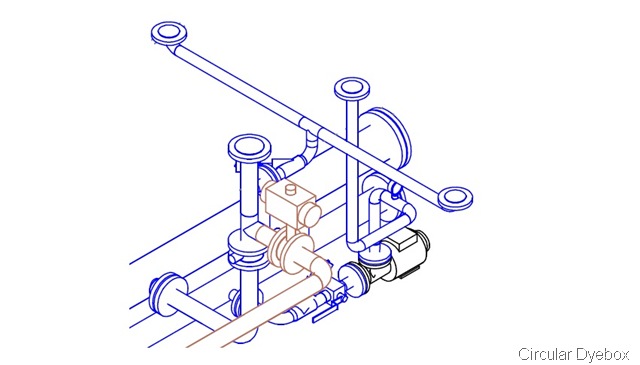
    1) Circulation system design: Indigo dye in its reduced form consists of dye particles that have been partially solubilized and exists in the form of charged colloidial particles. Colloidial dispersions will sink due to the influence of gravity and require some agitation to keep them uniformly dispersed in the dye box. If sample are collected from different parts of an Indigo dye box(top, bottom, front and back), the concentrations are usually different. The uneven distribution of dye in the box as the machine operates contributes to color variation. For many years, BASF, a leader in indigo dye for most of the 20th century, recommended that the volume of the dye box be “turned over” 2 or 3 times an hour. This means that if the box volume is 2000 liters that 4-6000 liters of flow into and out of the  dye box is needed to prevent low concentrations in part of the box and high in others. Indigo machines produced in recent decades have been furnished with pipes that are too small to deliver the right kind of flow. In terms of Reynold’s number , the flow should be slightly beyond laminar, in the low transitional range to ensure uniform disper-sion while avoiding turbulence that would destabilize the dye. Also, for uniform dispersion of Indigo, the entry line should be positioned in the yarn exit side of the box near the top, while the exit line should be at the yarn entry side near the bottom. Many Indigo machines have the dye entry line on one side and the exit line at the yarn entry, which is a cause of cross-shade variation.Circ_Dyebox

    2) Dye box design: In a previous article I discussed the effect of dye box design on the color consistency of Indigo. In most indigo machines the box design is responsible for massive losses of hydrosulfite at the surface of the dye boxes during operation which results in economic losses as well as variations in hydrosulfite concentrations in the machine which leads to color variation. The principle is known as Specific Surface Area which means that the larger the surface area of the Indigo box to the volume, the faster the hydrosulfite is lost. So, in a 2000 liter box with 2 square meters of surface area , the hydrosulfite will decompose at twice the rate of a 2000 liter box with 1 square meter of surface area. The total hydrosulfite losses in a typically larger box of a rope range will average around 15%, while in the smaller boxes of a typical sheet range the losses will be from 45-70%.

    3) Tension Control: High yarn tensions on continuous Indigo dyeing machines has 2 significant effects- the yarn loses strength and the ability of the dye to penetrate the cotton fibers is reduced. The loss in yarn strength results in higher warp breaks in weaving, meaning lower efficiency and higher weaving off-quality. The reduced penetration of Indigo into the fibers results in rubbing fastness problems and a higher per cent Indigo on weight of yarn for a specific depth of shade.

    4) Immersion time: Indigo dyeing is a form of wet-on wet processing. The yarn is normally scoured and washed before entering the dyeing section, which means that it is already wet. In order for the Indigo dye to enter the wet yarn efficiently’ a process known as “liquor exchange” is necessary in which the Indigo dye/water displaces the water already in the yarn. This is a slow process and the longer the immersion time , the more easily the dye penetrates into fibers and yarn, resulting in better colorfastness and darker color. Until the 1970’s, Indigo machines operated at speeds of 12 meters per minute through the much larger boxes of rope ranges, so the immersion time was 2-3 times longer than on modern sheet ranges. The dye penetration was complete which resulted in the darkest possible color with 3% Indigo and that would never fade.

    spectrum_rope_dye_thumb

    This is a guest post by Harry Mercer. Mr. Mercer has 30 years experience in the denim business including 3 prominent U.S. denim companies. He is an expert colorist for measurement and color matching as well as textile testing and is considered to be a leading authority  for denim dyeing, finishing and fashion denim development.

  • 12 Million Waterless Jeans From Levi’s In Fall /Winter 2011

    Last year Levi’s had launched Levi’s® Water<Less™ collection which used upto 96% less water in washing. With about 1.5 million jeans manufactured , Levi’s was targeting to save about 16 million litres of water..

    For the Fall/ Winter 2011 , Levi’s will have about 12 million jeans in the Waterless collection and it hopes to save over 150 million litres of water. That is a significant amount of water saved and the increase from 1.5 million pieces to 12 million pcs is also quite a jump within an year.

    In an effort to reduce the impact on workers  , Levi’s had previously banned its vendors from using the sandblasting operation to protect the health of their workers. This step by Levi’s was emulated by many other retailers and brands including H&M  . I think that even the waterless jeans concept would be similarly emulated.

    12 million jeans , though a big quantity, is not even 0.3% of total jeans  manufactured in the world .  But , when Levi’s is strongly pushing the waterless jeans concept, it is highly likely that the positive impact of this step on environment would be realized by other important retailers and brands. And if over the next few years , this concept snowballs into a major trend  , it would be really helpful in offsetting a part of  the constantly increasing negative impact of jeans production on the environment.
    As Erik Joule, SVP, Levi’s Men’s Merchandising & Design   rightly says

    “I’ve always believed the businesses not only have the ability to change the world — they have a duty to do so….”

    Scientists and researchers are already forecasting that there will be a severe shortage of water   for over 1 billion urban dwellers by 2050.. Though the year seems quite far away, it is imperative for various industries to understand the importance of developing water saving techniques for their own survival.


  • Sulphur Dyeing In Denim

    This is a guest post by Harry Mercer. It tells about the  best practices in Sulphur dyeing for fashion denim and was  a part of the presentation made at Dhaka  by him on a seminar on Sulphur Dyes by Fenazol

    The Nature of Sulfur Dyes

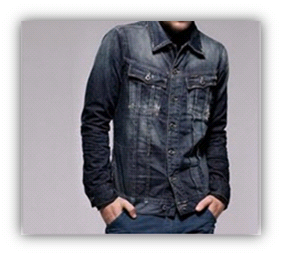
    • Sulfur dyes are a form of vat dyes – they are water-insoluble and in order to apply to fibers must be made water-soluble through the process of reduction.  sulphur denim jacket
    • Reduction is a chemical process in which hydrogen is liberated. The hydrogen reacts with the dye and permits a water molecule to attach to the dye. The dye is transported into cotton fiber by the water.
    • This reduced dye must then be oxidized. Oxygen reacts with the hydrogen producing water. Removing the hydrogen makes the dye insoluble, which results in the dye becoming physically trapped inside the fiber.

    The Uses of Sulfur Dyes

    • Sulfur dyes are commonly used for black, blue, brown, khaki and green colors.
    • Sulfur dyes are applied to cellulosic fibers and blends of cellulosics with polyester, nylon and acrylics.
    • Sulfur dyes can be applied with little difficulty and with excellent results at a relatively low cost.
    • With good application methods, sulfur dyes are extremely wash-fast, however, they are usually not fast to chlorine bleaching.

    Dark and medium colors are the most common with sulfur dyeing. Light colors can be produced by special procedures involving blended reducing agents, blends of surfactants, controlled oxidation and preparation methods like Mercerizing and bleaching.

    Dark, dull sulfur dyeing

    •Sulfur blacks are commonly applied in the 1st box on Indigo machines.

    •The sulfur black dye molecule exists as very large polymers which require high temperatures for penetration into fibers (90-95 degrees).

    •The maximum amount of sulfur black dye that can be efficiently applied is 4%on weight of cotton of a pure sulfur powder or 20% of a standard liquid (20% dye strenght). Darker sulfur blacks can be achieved by adding a sulfur blue.

    •Sulfur blacks are best oxidized with an air passage like Indigo.

    indigo dyeing sulphur

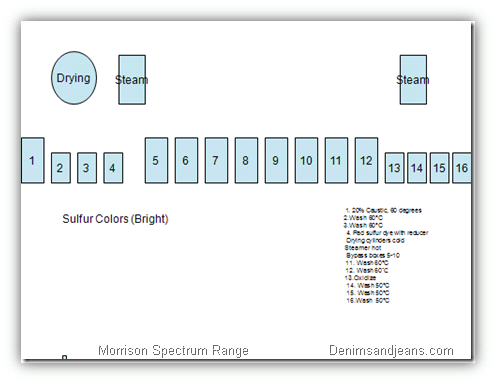
    Boxes :
    1. 20% Caustic, 60 degrees
    2.Wash 60°C
    3.Wash 60°C
    4. Pad sulfur dye with reducer
    Drying cylinders cold
    Steamer hot
    Bypass boxes 5-10
    11. Wash 60°C
    12. Wash 60ËšC
    13.Oxidize
    14. Wash 50°C
    15. Wash 50°C
    16.Wash 50°C

    Light Sulphur Colors

    color denim sulphur

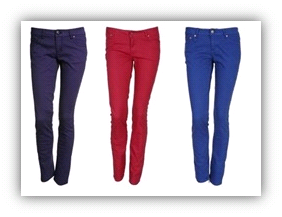
    • Sulfur dyeing procedures have been used to create a full range of colors including browns, yellows, greens, violets, reds, orange and neutrals  (light/medium greys)
    • Producing special colors with these processes involves the use of true sulfur dyes alone or in combination with sulfurized vats or special direct dyes that  can be applied with special sulfur dyeing procedures.
    • For success in fashion markets with these colors, marketing is focused on color “themes” such as “earth tones”, “urban”, sport or university colors.

    Control Of Light Sulphurs

    • In order to match specific colors, dyes with greatly different affinity factors are mixed.
    • Different affinity factors result in these dyes being picked up at different rates, so special methods are necessary to avoid color variation.
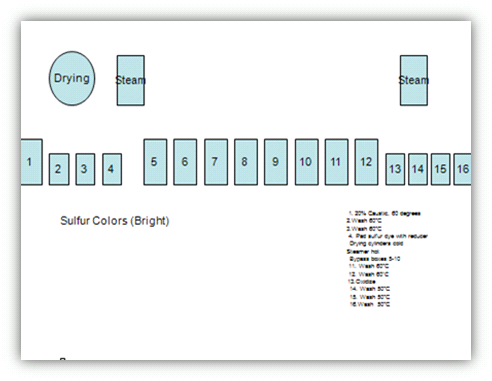
    • Sulfur colors should be applied from 30 to 60 degrees to avoid color variation and must be chemically oxidized.


      image
    Boxes:

    1. 20% Caustic, 60 degrees
    2.Wash 60°C
    3.Wash 60°C
    4. Pad sulfur dye with reducer
    Drying cylinders cold
    Steamer hot
    Bypass boxes 5-10
    11. Wash 60°C
    12. Wash 60ËšC
    13.Oxidize
    14. Wash 50°C
    15. Wash 50°C
    16.Wash 50°C

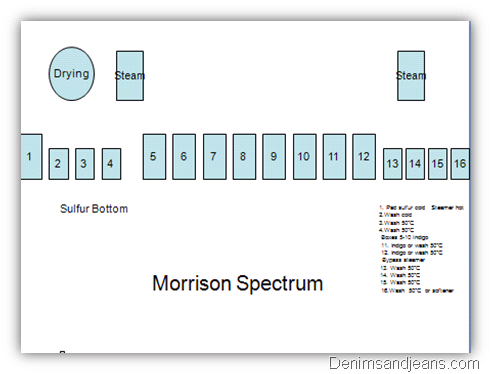
    Sulphur Bottoming

    • Bottoming of Indigo dyed yarns produces a darker, brighter effect with Indigo.
    • The purpose of bottoming originally was to produce a darker color with less Indigo.
    • While large amounts of sulfur dye can be applied in the 1st box, most of the sulfur is removed by hydrosulfite in the Indigo dye.
    • Unlike other sulfur dye applications, a pH of 12 with sodium hydroxide is helpful to retard the dyeing for color consistency.
    • A temperature of 60 degrees or less should be used to lower the affinity factor for consistent color.

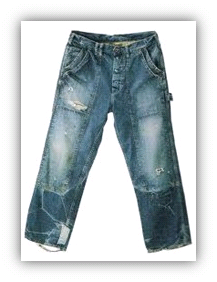
    Problems With Sulphur Bottoming sulphur bottom denim

    • Sulfur bottoming can provide lighter shades because most of the dye applied in the 1st box is removed by the hydrosulfite in the Indigo boxes.  
    • The affinity factor (rate of dyeing) at high temperatures of sulfur dyes results in shade variation.
    • If sulfur black is applied as a bottom, the Indigo boxes are contaminated with a yellow compound which causes discoloration of pure Indigo shades. Sulfur blacks are typically produced by polymerizing 2,4 –dinitrophenol(reddish-yellow) with sulfur. Hydrosulfite in the Indigo boxes-reduces the sulfur black to this yellowish compound.
    • Sulfur bottoming should be conducted at temperatures of 30-60 degrees for consistency. Unlike other sulfur dyeing which should be conducted at pH 11, sulfur bottoming can be conducted better at pH 12 with sodium hydroxide which acts as a retarder to slow the rate of dyeing.

    indigo dyeing range sulphur morrison

    Boxes

    1. Pre-wet 2% caustic 90°C
    2.Wash 60°C
    3.Wash 60°C
    4. Wash cold
    By pass drying cylinders
    Bypass steamer
    Boxes 5-10 Indigo
    11. Wash 60°C
    12. Pad sulfur topping
    Steamer hot
    13. Wash cold
    14. Wash 50°C
    15. Wash 50°C
    16.Wash 50°C/Softener

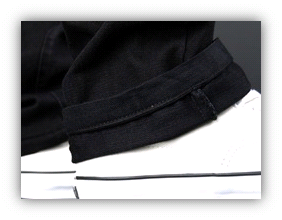
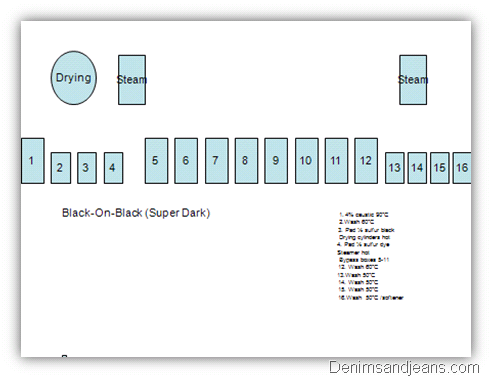
    Black-on-Black Dyeing black over black denim

    • Sulfur black dyes are low-intensity dyes that require large amounts for dark shades.
    • The amount of sulfur black that will produce the darkest shade when applied properly is 4% of a 100% powder or 18% of a 20% liquid.
    • It is difficult for cotton to easily absorb that quantity of dye in a way that produces a very dark shade. 
    • One method that has been used to produce darker, more colorfast sulfur blacks on yarn is to apply 50% of the dye, then dry the cotton, air oxidize and without washing, proceed to a second dye-box where the dye is applied again, dried oxidized with air again and washed.

    indigo dyeing sulphur

    Boxes:

    1. 4% caustic 90°C
    2.Wash 60°C
    3. Pad ½ sulfur black
    Drying cylinders hot
    4. Pad ½ sulfur dye
    Steamer hot
    Bypass boxes 5-11
    12. Wash 60°C
    13.Wash 50°C
    14. Wash 50°C
    15. Wash 50°C
    16.Wash 50°C /softener

    Reducing Agents For Sulphur Dyes

    • Because sulfur dyes cannot be dissolved in water directly, reducing agents must be utilized to produce hydrogen which allows the dye to attach to water.
    • Any standard reducing agent can be used to dye sulfurs including reducing sugars (dextrins), sodium hydrosulfite, sodium bisulfite, sodium sulfide, sodium polysulfide and sodium hydrosulfide.

    Selection of reducing agents

    • Reducing agents for sulfur dyes should be selected according to the type of dyeing (batch or continuous), temperature of dyeing (cold or hot) and depth of color (light or dark).
    • The reduction potential measured in millivolts for continuous sulfur dyeing as on Indigo machines should be at least -600 for dark, dull shades and at least -700 for bright, colorfast shades.
    • The best sulfur dyeing for bright, consistent and colorfast shades requires blends of reducing agents.

    Advances in sulfur dyeing

    • Cold dyeing of sulfurs is possible on Indigo machinery in a full range of colors.
    • This procedure has long been utilized by craft dyers in Asia.
    • Cold dyeing of sulfurs have the advantage of requiring only 50% as much sulfur dye,
    • Energy savings, excellent colorfastness, no polluting dye waste and less cotton damage for a soft touch and higher weaving efficiency.

    Special Notes

    • Dyeing with 100% sulfur blacks on yarn results in lower weaving efficiency. Normal yarn break levels with black can be achieved with improved washing and the use of buffers in dyeing.
    • Sulfur blacks can be dyed with special procedures that provide wet rub-fastness of 4 and good washfastness even after 20 launderings.

    Caution And Care

    • The recommendations of many sulfur dye suppliers result in dye waste of 50% or more, which increases dyeing costs by twice that is necessary. Also, most of the additional chemicals used in sulfur dyeing, especially for blacks, are unnecessary.
    • The use of fixatives after sulfur bottoming are often recommended to increase dye shades, but these are destroyed by the hydrosulfite in the Indigo boxes.

    For more details on sulphur dyeing , check the site of FENAZOL

    imageThis is a guest post by Harry Mercer. Mr. Mercer has 30 years experience in the denim business including 3 prominent U.S. denim companies. He is an expert colorist for measurement and color matching as well as textile testing. 


    Sponsored Link :

    Denim Threads From A & E

  • How To Stitch Quality Denim Garments?

    Want to learn more about how to resolve everyday stitch and seam  quality problems with denim? 
    If you do , a free workshop by American and Efird  will give you useful knowledge on how to overcome the most typical seaming problems. A&E develops the content and creates these programs as a special means to help companies  increase productivity.  Topics covered include:

    • Review of common stitches used in denim and why each is used. 
    • Detailed overview of 5 pocket Jean construction techniques .
    • How to overcome common seam quality problems?
    • Minimizing broken stitches after stone-washing, hand sanding, etc.
    • Minimizing thread breakage & skipped stitches .
    • Minimizing Ropey Hems, Twisted Legs, Sagging Pockets.
    • Minimizing problems commonly found on Stretch Denim garments .
    • Dealing with thread color-fastness issues .
    • How quality sewing threads can help make better quality garments?
    • Introduction to common sewing threads for denim and how they impact the performance and appearance of your products .
    • Review of A&E’s denim thread selection matrix .
    • Introduction of special threads for a distinctive look.
    • Maximize sewing and seam performance but keep thread cost to a minimum.
    • How to improve the quality and appearance of your denim sewn products ?
    • Better understanding of denim seam construction methods .
    • How to Trouble-shoot Common Stitching Problems and offer Suggestions to your Sourcing Companies ,Vendors and Contractors on ways to improve the  quality of Your Products.

    This 2 hour Seamology – Making Quality Denim Garments  workshop is loaded with practical, helpful ideas that can assist companies in resolving everyday sewing issues. The companies just need to provide a space for the presentation and A and E provides the handouts and the workshop Free!
    For more info on the workshop , contact  Mark Hatton or Al Irvine