Category: denim

  • Shade Control In Indigo Dyeing | Part 3

    This is a technical article by Harry Mercer on the process of Shade control in Indigo dyeing. This is the  third in the series. The first  and second part of this article were published before .

    Standard Illuminants
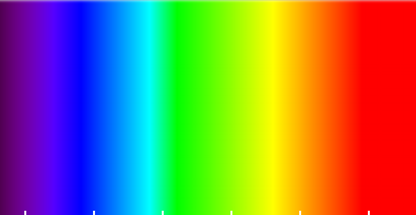
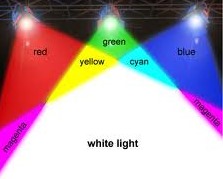
    standard light illuminantsAs stated earlier in this series, colour starts with a light source or illuminant. Illuminants have been standardized since 1931 by the Commission Internationale d’Eclairage (CIE). Illuminants are specified by a reference colour temperature such as 6500 degrees Kelvin., which is commonly referred to as D6500, (D identifying as a “daylight source). D6500 is a standard daylight illuminant in the United States and Northern Europe, originally to replicate light on the north side of a building in Chicago at noon. This specification of a light source by a colour temperature was originally established with a device known as a blackbody radiator. This is a small metal sphere with an opening which emits this specific illuminant when heated to a temperature of 6500 degrees Kelvin. Another example is Illuminant A, basically the colour of a tungsten filament lamp, which has a heavy red influence and a correlated colour temperature of 2856 degrees Kelvin.

    Specular Component

    “Specular” refers to the mirror-like quality of a fabric surface-the manner and directions in which light is scattered, which is a separate consideration from the colour itself. Appearance of a fabric is a combination of color and surface effects. The specular reflection of a sample differs depending on fiber characteristics, yarn count, yarn twist, fabric construction and finishing. These surface effects are neutralised during visual colour evaluation by using specific viewing geometries which relate the angle of the light source to the fabric and the angle between the human observer and the sample. For example, the 45˚/0˚viewing geometry, which neutralises the specular component, allowing a clear view of the colour only, means that the angle between the light source and the sample is 45˚ and the angle between the observer and sample is 0˚ or perpendicular to the sample. Colour measuring instruments offer this and other special viewing geometries to eliminate the specular or surface factors in measurement. If it is desired to include the specular component, then the option known as Specular Excluded (SEX) can be selected. The other option is include the specular component known as Specular Included (SIN). The Specular Excluded is superior for focusing on dyeing variation and prediction of washed colours, while Specular Included measurements are useful for rating the combined colour and physical differences of denim.

    Tolerances

    A tolerance, in regard to colour measurement, is a numerical difference between the standard color approved by the customer and the colour measurement of the fabric that was provided to the customer. In order to be indicative of a true visually noticeable colour difference, the tolerances should be established based on what a human being would recognize as a visual difference between 2 colours. As a general rule, if there is a total colour difference of ΔE equal to 0.2 between 2 samples, these samples can be considered visually different. With Indigo-dyed denim, this is also true if the colour difference between 2 samples has a value of ΔL = 0.2 in light-dark difference or Δb = 0.2 in yellow-blue difference. However, shades of Indigo are more sensitive in the Δa, red-green difference. In the U.S., it was standard to use a tolerance of only 0.08 for Δ a, meaning that if 2 samples differed by that much, they were considered different shades. This is not only because of the greater visual contrast in red-green differences, but also because of Indigo colour after washing. As Indigo develops a redder or less green shade, it loses colour in washing more quickly. For that reason, the Δa is a good general indicator of how easily Indigo will fade. Δh (hue difference) provides the same indication and is a more precise predictor.

    Many denim operations, as well as other textile operations use larger tolerances to specify shade differences from standard. These can be as high as 1.0ΔE to distinguish a slight shade difference, but this tolerance size allows up to 5 different shades to be shipped to the customer as the same colour.

    By the numbers

    Only by intelligent use of available colour data can the extensive problems with managing shade variation in Indigo dyed denims be systematically brought under the control needed to conform to the customer’s expectations. Colour measuring instrument programs provide massive amounts of direct information that is objective, but the data must be studied and analyzed in order to effectively manage colour, which is the most critical factor in denim success. Factors such as Standard Deviation are the most useful in determining progress, or the lack of it, in reducing Indigo shade variation. The Standard Deviation will demonstrate the relative degree of variation in Indigo dyeing between companies, products, machines, procedures, workers etc. and is the best tool for setting objectives for managers. In far too many denim companies, little concern is demonstrated within the production areas for identifying the sources of colour variation. The standard approach is to resort to shade-sorting or tapering programs that only establish the degree of failure in colour management.

    Recommendations

    1) ILLUMINANT- Illuminant A has long been recognized as a better light source for distinguishing true colour differences in denim, because of the greater sensitivity of Indigo to red-green colour difference. This will increase the number of to allow the laundry to sort the fabric more reliably in terms of wash-fastness.

    2) SPECULAR COMPONENT-While the Specular Included is normally used for fabric shipments, the Specular Excluded is more useful for evaluating the effects of dyeing directly, avoiding the influences of weaving and finishing on denim which is significant.

    3) TOLERANCES-Review the colour tolerance used in shade sorting or tapering to determine if it is realistic and allows conformance to the customer’s expectation.

    4) COLOUR ORDER SYSTEM- While the L*a*b* colour arrangement is in common use, the L*c*h*(chroma and hue) arrangement allows better communication between denim producers and customers. While the L*a*b* arrangement orders colour in a way that approximates how garment buyers see colour, the L*c*h* arrangement relates more directly to how colour managers, as in dyeing perceive colour.

    5) EDUCATION-In order to raise the level of professionalism of those responsible for colour management, detailed, scientifically-based training is badly needed in the denim business in every sector in order to minimize dissatisfaction on the part of customers. There are training resources available from colour instrument vendors on line or colour experts for in-factory training. Selection of staff for colour nmanagement is critical since less than 5% of people are able to grasp the concepts involved, so objective evaluation of colour staff is necessary to maintain an image of professionalism.



    image
    This is a guest post by Harry Mercer. Mr. Mercer has 30 years experience in the denim business including 3 prominent U.S. denim companies.He is an expert colorist for measurement and color matching as well as textile testing. He can be contacted here


    Denimsandjeans.com   Bangladesh – The first denim show in Bangladesh on 1st and 2nd March 2014. Don’t miss it !!  Want to visit ? Get an invite here
  • Merry Christmas And Happy New Year 2014

    Wishing all our readers , friends and well wishers A Merry Christmas and A Very Happy New Year! May this new year 2014 be full of Success, Happiness and Contentment for you all..
    And of course, wishing you all a deeper love with denim !

    merry christmas 1

  • Denimsandjeans Bangladesh Show

    Bangladesh is the  second largest  producer of denim apparel worldwide. In 2012 it shipped over 117 million pieces of denim apparel to EU , second only to China (at 148 million pcs) and  67 million pieces of denim apparel to USA , third only after China and Mexico . Besides , it exports a large quantity of denim quantities to other countries around the world , including South Amercia, Africa , Japan and other countries in  South East Asia. It has preferential treatment in EU with its GSP and duty free access to markets in India , besides some other countries.  The unique thing about Bangladesh is that most of its 5600 factories are concentrated in a  limited geographical area around capital city Dhaka and the port city Chittagong. This creates the most unique cluster for denim and other apparel manufacturing worldwide. Another major factor that goes in favour of Bangladesh is its huge pool of over 4 million skilled and semi skilled labour , including women, which is difficult to find in other countries. 
     
    Most of the major world retailers and brands either have  their own offices or use the over 300 buying offices located mainly in Dhaka,  to source about $20 billion of  apparel from Bangladesh. This concentration of buyers and manufacturers creates a microcosm of intense apparel related activity which has been multiplying in the last few years at a fast pace.  Though Bangladesh has been in  adverse news recently on compliance issues, they have set in motion forces which will enable it  to  focus  on and further strengthen the weak areas as it moves forward to take the next leap in apparel production. Rapid development of an industry  ,concentrated in a short period of time , many times causes some imbalances which need to be corrected  as it poises for further growth.

    Denim is one of the most important woven denim apparel being manufactured in Bangladesh with a number of large and small factories a part of this group. In the initial years after the MFA phase out, Bangladesh’s main USP was its low price and attracted retailers looking for basic low priced jeans, shirts, children garments etc. However, the industry developed rapidly as skills improved  , with large contributions from a number of expats employed from India, Turkey, Italy etc leading many of the companies to evolve out of the basic levels and move on to higher levels of denim productions. This enabled them to cater to a number of highly quality conscious brands like G-Star, Uniqlo etc. This was also greatly helped by the strides made in washing development in the country with a number of good washing units (out of an estimated total of 650) using Italian and Turkish expertise to upgrade the washing capabilities. This upward movement in the value chain became very important for Bangladesh as it enabled it to now cater to all kinds of price , value and quality points in denim apparel – from the lowest to the highest . This has also enabled it to cater to markets like South East Asia, China, India , South America , Russia etc apart from its conventional markets – EU and US. The rapid  development of a local denim fabric base with about 200 million mtrs of annual capacity  to support its apparel production also further strengthened its supply chain – backed up by an increasing spinning capacity.

    imageRecognizing this importance of Bangladesh in the world denim scenario, it was felt by us that it was very important to bring a platform specially designed for the denim industry where the key players  in the supply chain can come together at one place to add value to each other’s efforts. To this end , we are launching the firstgreen denim copy_thumb[6] Denimsandjeans Show Bangladesh  where a number of key denim suppliers ,who have already signed up for the show, will showcase their products to a select and invite only audience of denim buyers, designers, sourcing people etc. The products displayed by these companies will cover all the major trend areas currently prevalent in denim. ECO SUSTAINBILITY and RECLYING aspects of the industry would be a very important component of the show  This show to be held at Dhaka on 1st and 2nd March’14 , in association with Denim Expert Ltd , shall have some of the best companies in the denim industry worldwide bringing their latest developments to the select audience of buyers who are individually being invited by us. Since this will an invite only show,  visitors wishing to join the show, and connected with the buying/ sourcing/ designing and other related  activities,  should visit our registration page and fill up the same for getting an invite.

    For more info on the exhibitors and buyers attending the show , pl email us here

  • Shade Control In Indigo Dyeing | Part 2

    This is a technical article by Harry Mercer on the process of Shade control in Indigo dyeing. The first part of this article can be found here

    While it cannot be disputed that, ultimately, how the individual consumer values color with their human subjectivity is the true test of coloration, in large-scale manufacturing of fabric and garments, the resort to evaluation of color visually is extremely unreliable. Color vision is denim eyedifferent among human observers and varies with the same observer depending on factors like fatigue, age, emotional state and even race Color blindness related to difficulty in distinguishing red-green color differences is most common among Caucasians, affecting 8% of males, but only 0.6% of females, 5% of Asian males and 0.25% of females and 4% of African males, 0.16% of females. The Ishihara test is used to quickly identify colorblindness problems. Many fashion houses require colorists to pass the Farnsworth-Munsell 100 Hue test for employment. This test provides a rating of ability to distinguish colors and demonstrates how different individuals are in this regard. When I had the test, it showed that I have excellent color vision in terms of distinguishing violet and Indigo, but hopeless with shades of red. These differences in individual color perception result in endless disputes regarding conformance-to-standard expectations. For final determination of whether a sample and a standard are identical, the eye is still the best instrument, it fails in describing the exact quantity and quality of the differences in a submitted sample to the approved standard. Color measuring instruments, on the other hand, will objectively and precisely measure the exact differences in multiple dimensions, how the standard and sample are related to each other and will determine if the sample is acceptable within a given tolerance through thousands of tests with extreme accuracy and repeatability which nearly impossible with visual measurements.

    How Color Measuring Instruments Work

    Without engaging in the complex physics and mathematics of color science and measurement, the basic principles of determining color involve a standard light source, an object to bounce the light off of and an observer (human or color measuring instrument). Color starts with light. In a color white light color measurement in denim measuring instrument, a standard white light source illuminates the sample to be measured. This white light can be thought of as containing equal amounts of all visible light colors at a high level-100 units of red, orange, yellow, greens, blues, Indigo, violets etc. Dyes and pigments absorb these colors of light in different amounts and allow the rest to escape, which the instrument measures. With a light shade of Indigo, of 100 units of each light color illuminating the sample, perhaps reflected are 50 of violet, 70 of Indigo, 60 of blue, 50 of blue-green, 30 of green, 20 of yellow-green, 10 of yellow and 25 of red. The instrument collects these quantities and converts that into various numerical values. A curve is produced from this data that serves as a “fingerprint” of a color that distinguishes it from all other colors. The data collected by measuring the escaping light colors is mathematically converted into basically 3 numbers that are coordinates in a 3-dimensional color space. This color space is roughly like a sphere in which all colors thatcolor measurement in denim hunter scale can be perceived by the human mind are contained. The distance and direction in 3-dimensions precisely relate each color to all other colors. From these mathematically precise locations the differences are calculated. These values are then mathematically transformed into a color coordinate system, most often L*a*b*.

    Color Descriptors

    The starting point of these color spaces is the L-scale which is a vertical axis around which all colors are organized. The L-scale establishes the differences in lightness between samples-how dark or light a sample is. The L-scale starts at the top of the sphere with a value of 100, for a perfect white and ends at the bottom with 0 for a perfect black. In between are degrees of grayness. This axis is neutral with regard to color, having no color or hue, meaning without red, green, blue etc. A dark shade of Indigo may have an L-value of 30 while a light shade may have an L-value of 60. If a color difference were calculated between the dark and light values it would be a minus 30, reported as a DL -30 (delta L, or ΔL, Δ being the scientific symbol for “difference”). Starting from this neutral central axis of this sphere where are colors are mathematically located, moving outward hue is added, hue being the scientific name for color.

    From the central, neutral axis, color is added gradually so that when the outer edge of the sphere is reached a saturation limit is reached at which the human eye perceives that the color is too dark to be at the same level of lightness. For example, at a lightness (L*) level of 85, which is very white, as you move outwards at first there is a small amount of red added and you have a color that would be identified as pink. If you add the maximum amount of red, then the color becomes a dark, but bright red. When the maximum amount of red has been added, more than the human eye can recognize at the L* level of 85, the lightness level will drop to 80 because the color had increased to a darker level.

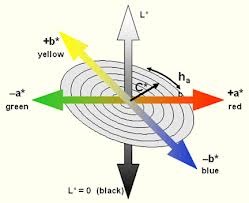
    If this color sphere is bisected into a series of planes that go from top to bottom of the sphere, these planes are initially divided into 4 quadrants. In the most commonly used color space (L*a*b*), there is one line labeled a* that represents red-green differences and a line labeled b* that represents yellow-blue differences. Red and green are considered to be opposing colors as are yellow and blue, just as east and west, north and south are opposites.

    On the a* line a positive number like +3.5 indicates a red color and a negative number like -3.5 indicates a green. If a standard has an a* value of +3.5 and a sample has a value of +0.5, then the difference between standard and sample is expressed as Δ a*-3.0, simple subtraction. However if the standard has a value of +2.0 and the sample has a value of -1.0, then the total red-green difference is Δa*-3.0 because these are Cartesian coordinates. The total color difference is the same, but the overall visualcolor measurement in indigo denim color chart difference is much greater because crossing the boundary between the red and green sides of color space results in much greater contrast. Red-green differences are the most significant with Indigo, not only because of the visual contrast, but also red-green differences are good predictors of wash-fastness of Indigo and even small differences in the a*values means higher variation in the laundry.

    The b* line is similar for yellow-blue differences. The –b* values should be monitored as a way to evaluate changes in the original dyed color of Indigo on yarn.

    The third part of the article Shade control in Indigo Dyeing follows shortly..


    image
    This is a guest post by Harry Mercer. Mr. Mercer has 30 years experience in the denim business including 3 prominent U.S. denim companies.He is an expert colorist for measurement and color matching as well as textile testing.

  • Shade Control In Indigo Dyeing | Part 1


    For customers of denim, color is the quality that distinguishes denim from other apparel fabrics, especially the unique appearance of Indigo. Indigo has been in use for perhaps 5000 years, originally as a natural dye and in the last 100 years primarily available in the synthetic form. No other commercially available dye can match the appearance of Indigo, especially when faded to light shades which produces a special appearance known as a “patina” which is similar to the glow of a blue sky. The color of Indigo is associated in lore with notions of intuition, religion, spirituality and loyalty.

    Indigo-dyed denim presents unique problems in garment production because of variations in color, especially after washing. Fabric shipments to indigo shadeslaundry customers can contain literally dozens of visibly different shades  after washing which requires special efforts in cutting and sewing to avoid mixing garment panels that produce a garment with parts that do not match in color.

    The most basic method of organizing shipments of Indigo-dyed denim is to cut small samples of fabric from each roll of fabric that will go into a shipment and sew them together in a “blanket”. This blanket is then washed so that there is some representation of the eventual color after fading indigo shades during laundering. Then these samples are compared by the customer and “shaded”, sort usually from dark to light. Then, the fabric rolls with the most similar after-wash colors are combined on the cutting table in order to minimize variation in the garments produced. This technique is often favored by denim mills. This approach can be generally satisfactory, however has a number of deficiencies.

    First, the fabric samples are taken usually from one end of the roll, when both ends should be sampled. Almost all denim companies fail to control Indigo dyeing so that multiple shades are produced in each dye lot and these changes can occur quickly, so that even within a short fabric roll of 100 meters the washed color can change. By sampling from both ends of a fabric roll it can be determined if the roll needs to be cut again in order to isolate different shades.

    Secondly, these washed fabric samples are often graded visually, by human eye, which is unreliable because of its subjective nature. Consistent visual evaluation of color requires careful training and management due to problems with eye fatigue, differences in evaluator skill and carelessness. When a poor job has been done during visual shade sorting, it is impossible to supervise the reliability of the evaluation because it is based on subjective individual opinion. The visual approach is favoured by fabric suppliers and customers because of its simplicity. There is also a conceit factor that interferes with reliable color management because of a common assumption that color is obvious and those that have roles in judging color that they are natural masters of judging color which is rarely true.

     Thirdly, the fabric supplier will rely on one wash method, usually a rinse wash to produce these blankets for sorting, while with other procedures such as stonewashing, bleaching or enzyme treatments, the samples will fade differently than in a rinse wash so that samples that are close in color in a rinse only will not match well when subjected to other laundry techniques.

    Indigo is the most difficult and complicated of all dyes to apply to cotton. Until the 20th century, it was used primarily for wool and silk which are more suitable for Indigo dyeing. The Indigo dyeing process is inherently unstable as normally practiced. The dye must be reacted with a reducing agent, normally sodium hydrosulfite, which begins to lose strength as soon as it is mixed and the concentration available in the dye mix changes during the dyeing operation unless it is buffered, which results in the Indigoindigo dyeing shades shade changing during the long periods of dyeing. This in turn, results in from 8 to 15 washed Indigo shades per set, assuming a tolerance of 0.2 Delta E for a visually-noticeable color difference. The lack of dyeing control for Indigo is nearly universal, so that customers have accepted the variation as unavoidable, which is not actually the case since a few companies have mastered the problem and can produce around 95% single shade consistency

    While the Indigo dye molecule does not itself change color during dyeing, the yarn does develop different color tones , usually with reddish or greenish effects occurring. These tone differences are almost always a result of variations in reducing agent levels during Indigo dyeing, with greenish green cast on indigo effects appearing with higher levels of reducing agent and reddish with relatively lower concentrations of reducer. What actually occurs is that the Indigo is more finely dispersed with high levels of reducer which increases the number of points of color (higher chroma) resulting in a greener, brighter, lighter color while low levels of reduction, there are fewer points of color (lower chroma) resulting in a redder, darker and duller Indigo color with the same % of Indigo on weight of yarn. The greener tone is more difficult to wash to lighter shades and is more colorfast to rubbing, while the reddish tone fades quickly and will have greater rub-fastness problems.

    The article will be continued in Part II shortly…………


    image
    This is a guest post by Harry Mercer. Mr. Mercer has 30 years experience in the denim business including 3 prominent U.S. denim companies.He is an expert colorist for measurement and color matching as well as textile testing. He can be contacted here

  • Matching Threads For Overdyed Denim Garments

    Colors in denim have been quite strong in the last few seasons with all kinds of shades from pastel to very bright and neon colors. While some of the these fabrics have been yarn dyed , most of the colors have been achieved with overdyeing of ecru fabric. The process of garment overdyeing provides the flexilibity of achieving any kind of color in the garment with smaller lots. The manufacturer does not have to depend on the limited fabric colors provided by the fabric supplier.

    However, one of the important requirement for such overdyed garments is that the cotton threads be used so that they can be overdyed along with the garment and achieve similar color . Many times these garments go through complex dyeing and finishing processes which tend to degrade or destroy the 100% cotton sewing threads which are typically used.

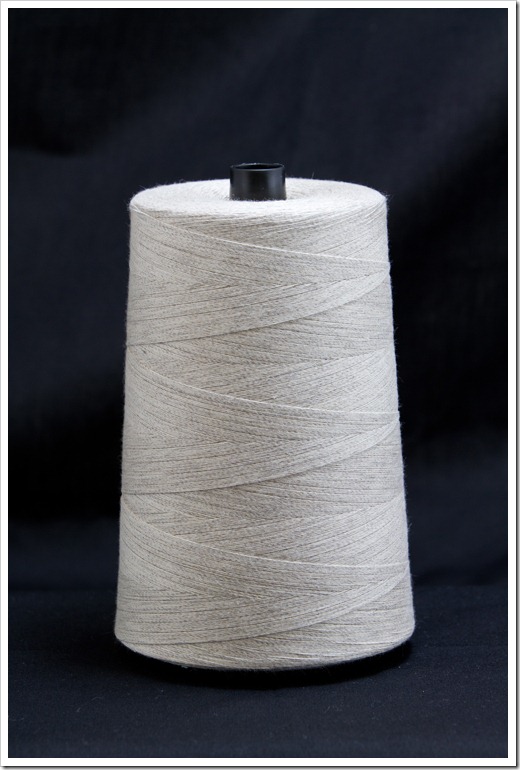
    A & E (American & Efird) brings out a core spun thread – D:Core RFD – specially for the purpose of garment overdyeing by the garment manufacturer. This thread has a core polyester with cotton wrapped outside.

    Core Spun Thread For Overdyed Garments

    As per the A & E team

    “To assist our customers with enhancing the quality of their garment dyed products, we developed D-Core RFD which is a Cotton Wrapped Polyester Core thread, with an enhanced cotton wrapper which is prepared for dyeing.  Traditional Cotton Wrapped Polyester core threads do not have sufficient cotton content to cover the filament polyester core, which does not take the dye during the garment dyeing process.  This leads to a speckled seam appearance.  
    Our D-Core RFD is available in light and dark versions, which allow our customers to select a version which will best blend with the final garment color.  We always encourage our customers to sample both Light and Dark versions, as often the dark version looks good in light colors.” In many cases D-Core RFD is used in both the needle and the looper position.  In some cases, where a customer may dye and finish a garment "inside-out", they will use our 100% Cotton Anecot Plus RFD (A&E’s 100% Cotton thread offered especially for garment dyeing)  in the needle, and use D-Core RFD in the looper (the inside of the jean sees the most abrasion during the dyeing and finishing process when the garment is processed inside out.   Both combinations have helped customer reduce or even eliminate repairs, increase the range of dyeing and finishing options, and offered customers an improved experience.

    A & E Denim Overdyeing Threads

    Core Spun Thread For Overdyed Garments

    Contact  A & E team for more info

  • Denim Videos–4th May 2013

    Denimsandjeans has a large denim videos section where the latest videos from around the world are entered in the library.We shall be brining out in  regular posts some of the interesting denim videos for our readers and , of course, you can always see other videos in the collection.

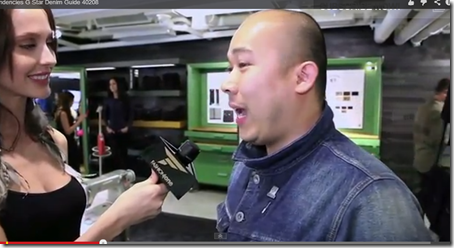
    The first of these videos we are featuring today is about G-Star custom made jeans at G-Star store at Causeway bay at Hong Kong.  Peter, Raw, the country manager of G-Star  Asia tells more about the tailored jeans from G-Star which enable consumers to customize their own jeans.

    Tailred Jeans from G-Star

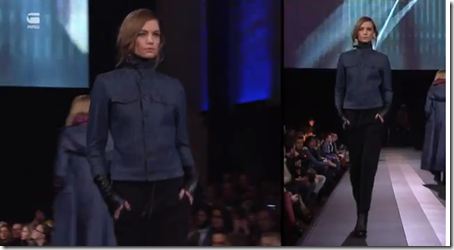
    The second video is also from G-Star , actually showing the G-Star Fall Winter 2013 /14 runway show . The extended version of the G-Star Fall/Winter 2013 runway show at St. Agnus Kerk in Berlin, Germany. Featuring performances by Anne Soldaat, a ballerina, and Michael Madsen.

    G-Star Fall Winter 2013 Denim Collections

    Also check out this one on Nudie jeans dry selvedge jeans  and the one from Gas Jeans on their new Pop-Up jeans is an interesting watch too !

  • Denim Production And Consumption In Italy

    italy denim consumptionWhen one speaks of denim fashion in EU , the first nation that comes to mind is Italy. Italy has been the harbinger of denim developments with a number of important mills like TRC  and denim brands like Diesel  having originated from here.

    But what is the consumption of denim jeans in Italy ?  How many jeans are produced in Italy? How many of these are men’s and how many are women’s jeans ? What are the exports and imports of the same ? Is the production of jeans going down ? Does men’s jeans sell more than women’s ? What is the net consumption of jeans? Is this consumption stable or is it changing?  What is the per capita consumption of jeans in Italy ?

    We will look at these  and more figures in this data report for the years 2009 – 2011.  [private_special]

    Production of Jeans in Italy 2009-2011


    Year Men’s Jeans Production Quantity(million pieces) Women’s Jeans Prod. qty
    (million pcs) 
    Total Jeans
    (million pcs)
    2009 27.44 12.54 39.98
    2010 22.31 13.42 35.73
    2011 21.34 12.61 33.95

    As we can see that the production of jeans is continuously falling and not without reason. The increasing costs of production and cheaper imports have affected the production of jeans in this fashion capital of Europe. However, the men’s jeans production has falle almost 23% from 2009 to 2011 whereas Women’s jeans production is almost constant. This also shows that it is important for quick fashion requirements of women’s jeans that the jeans be produced in Italy.

    Consumption of Jeans in Italy 2009-2011

    Year Production Import Exports Consumption
    2009 39.98 43.03 26.36 56.63
    2010 35.73 46.13 26.62 55.25
    2011 33.95 42.86 23.68 53.13

    The  consumption of jeans in Italy seems to be sliding with a fall of about 5% over the three year period of 2009-2011. This shows that the jeans market is saturated in Italy . Great changes in consumption patterns are not expected barring small year to year changes .

    Per Capita Consumption of Jeans in Italy

    What is the per capita consumption of jeans in Italy ? Lets see below :

    Population Consumption of Jeans (2011) Per Capita Consumption (2011)
    60.5 million 53.13 million 0.87 jeans

    The per capita consumption of jeans in Italy seems to be around 0.9 jeans per person – which is in line with the European consumption. This looks quite low in comparison to US where the consumption is about 2 jeans /person. However, it needs to be kept in mind that Italian consumption of denim jeans is about 50% of the total consumption of denim apparel . A large quantity of denim fabric is consumed in the form of shirts, jackets,  skirts and other denim apparel.  Check out some figures from Cotton Inc survey regarding the approx consumption of jeans vs other denim apparel. 
    The consumption of denim fabric in Italy during 2011 is expected to be more than 150 million meters taking into account all the products including jeans, jackets, shirts, skirts etc.

    [/private_special]

  • Denim Product Ideas For 2013

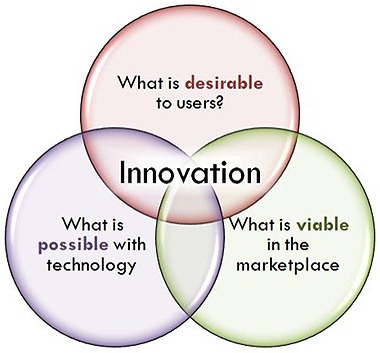
    This is a guest post by Harry Mercer where he shares some ideas on denim product developments.

    innvoation in denim

    1) More Softness In Fabrics Made With Open-End Yarn: Ring spun yarns are preferred in denim because of a feel that is more soft than open-end. The softness of open-end denim can be raised to the level of ring yarns in the warp by reducing the twist. For example, in a 14 ounce denim, the warp yarns are often a 7 Ne with about 470 turns per meter in the open end yarn. This can be reduced to about 415 to 420, with almost no loss of weaving efficiency and little decrease in fabric strength. The face of the fabric with the warp yarns is the important side for an appealing touch. However, if the weft yarns are made with a similar low twist, the fabric strength will suffer. This method has been used in 3 denim operations that I have advised with excellent market acceptance. In one company it was found that after mercerizing, the washed garments were softer than ring spun. Also, by reducing the twist in the warp, yarn production is faster and less expensive.

    2) Making Denim With A Flatter Appearance: Almost all denim operations have tried flat finishing which is usually a form of wet-treatment with sodium hydroxide on the fabric. The results are variable messy with a great deal of water and energy consumption for the flat finishing. A super flat denim can be produced only with fabric construction, avoiding the additional processing steps which in some companies includes a de-sizing process as well as the sodium hydroxide application, both requiring heavy consumption of water and steam energy in drying. This can be avoided by constructing the fabric with yarns having opposite twist directions Yarn can have either a Z-twist (to the right) or an S-twist. For example, by using the standard Z-twist yarn in the warp and S-twist in the weft, the twill will be diminished, producing a fabric with a flatter appearance than any type of flat finish. S-twist yarns are not often available, but are easy to produce on ring spinning equipment by a simple change of gear direction. The problem in producing them is that when the ring bobbins are wound onto yarn packages for use in warping and weaving, a special attachment in winding is needed for the different twist direction.

    Have any more ideas on denim products ?? Leave your comments below !


    image
    This is a guest post by Harry Mercer. Mr. Mercer has 30 years experience in the denim business. He is an expert colorist for measurement and color matching as well as textile testing.

    world denim production

  • Denim Sustainability Project: Dyeing Process Survey

    “Sustainability” in textiles refers to methods employed in the production of fabrics that are more environmentally friendly. “Sustain” means “to uphold” or “maintain”, which in regard to manufacturing calls for establishing practices which maintain a balance in nature. A sustainable fabric is one that is produced in such a way that reduces the effect on the environment including recycling of water and raw materials, heat recovery from waste water and steam generation and reduction of dye and chemical usage and chemical substitution.

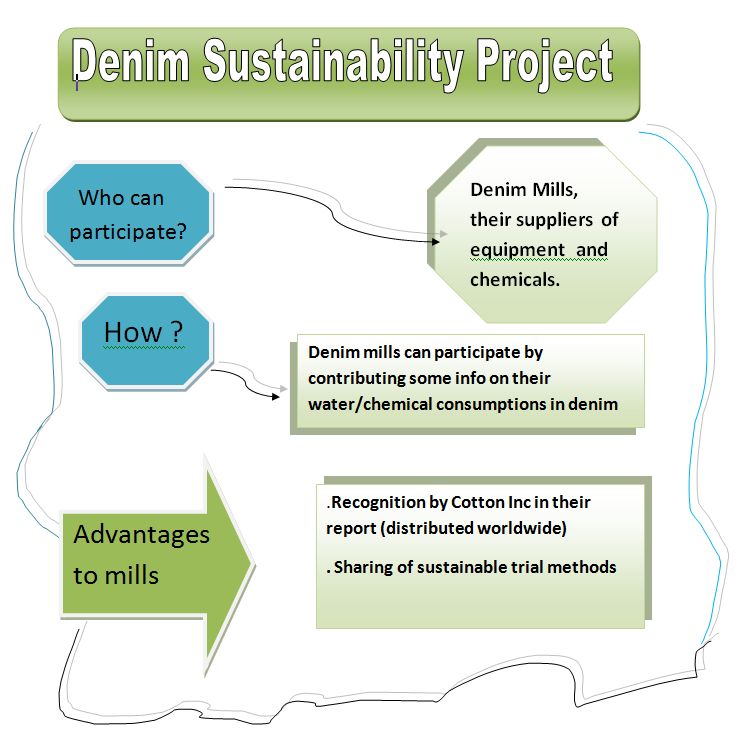
    Cotton Incorporated, USA,  is sponsoring a study of sustainability related to dyeing in denim fabric to be published and distributed world-wide in January 2013. Companies and individuals that participate and contribute includable material will be afforded recognition for their efforts to reduce effects on the environment.

    The issue of sustainability with regard to dyeing in denim (fabrics)  has for many years been a matter of concern to environmentally-concerned garment consumers as well as leading jeans retailers. By demonstrating a commitment to reducing demands on resources like water and energy, pollution of water and air as well as wastefulness of dyes/chemicals for denim dyeing and waste and degradation of cotton yarns and fabrics, participating denim producers establish themselves as truly responsible providers of the world’s most popular fabric.In the area of denim dyeing, there is enormous potential for reducing demand on resources including unnecessary dye/chemical consumption, water treatment and energy.

    Sustainability in denim  jeans


    The benefits of employing sustainable practices in the denim dyeing include:

    • Improved brand reputation to concerned garment producers, retailers and jeans consumers.
    • -Improved customer satisfaction by establishing your company as an environmentally-responsible fabric producer.
    • Improved profitability by reducing waste, especially reducing excessive use of dyes and chemicals which occurs in most denim operations.
    • Reduction of waste water treatment by identifying and correcting causes of unnecessary dye losses in washing.

    BENEFITS OF BEING INVOLVED

    -This project will be surveying denim producers and their suppliers of equipment and chemicals for methods that they have already implemented in order to reduce water, energy and raw material waste.

    -Additionally, participants will be asked to conduct trials using methods that have been employed in a few denim companies that reduce consumption of resources and have reported to have produced significant savings as well as quality and weaving efficiency improvements. Those that provide study results will receive recognition in the Cotton Incorporated Report when distributed world-wide next year.

    HOW TO BECOME INVOLVED

    • Nominate a responsible manager from your company along with contact details.
    • Provide a report of those activities that you have already undertaken in the last 10 years to promote sustainability.
    • Answer as many of the questions on this initial survey and provide the details by November 15th.

    Questionnaire

    A) Mention Dyeing method

    1) ROPE

    2) SLASHER

    3) LOOP

    4) SKEIN

    B) Mention Water Consumption

    1) Liters of water consumed in washing per kilogram of yarn

    2) Kilograms of steam used per kilogram of yarn.

    3) Liters of water recovered per kilogram of yarn.

    4) Liters of water used in dye/chemical mixes per kilogram of yarn.

    C) Dye Consumption : % Dye on  weight of yarn  (average)

    1) INDIGO

    2) SULFUR (BLACK)

    3) SULFUR BOTTOM

    4) SULFUR TOP

    5) OTHER DYES(STATE TYPE)

    D) Dye Reducing Agents

    TYPE: GRAMS/KILOGRAM YARN

    1) SODIUM SULPHIDE (Naâ‚‚S)

    2) SODIUM HYDROSULFIDE (NaSH)

    3) DEXTROSE

    4) SODIUM DITHIONITE (HYDROSULFITE-Naâ‚‚Sâ‚‚Oâ‚„)

    5) HYDROGEN

    YARN WASTE

    1)Kilograms of cotton yarn delivered to dyeing versus kilograms of yarn delivered to weaving.

    2)-Disposition of waste yarn: disposal as waste, sold as waste with price per kilogram or reuse in fabric as reclaimed fiber, leader yarn or in special fabric constructions.

    For more information and/or for getting involved in this project , pl contact Harry Mercer (from Indigo BLue) and Michael Tyndall from Cotton Inc on email here

    Also check out our comprehensive report on the world denim market launched recently.

    world denim frontpage5

  • Levi’s Wasteless : 8 Bottles = 1 Jeans !

    8 BOTTLES, 1 JEAN – THE LEVI’S® BRAND INTRODUCES
    WASTE<LESS DENIM COLLECTION
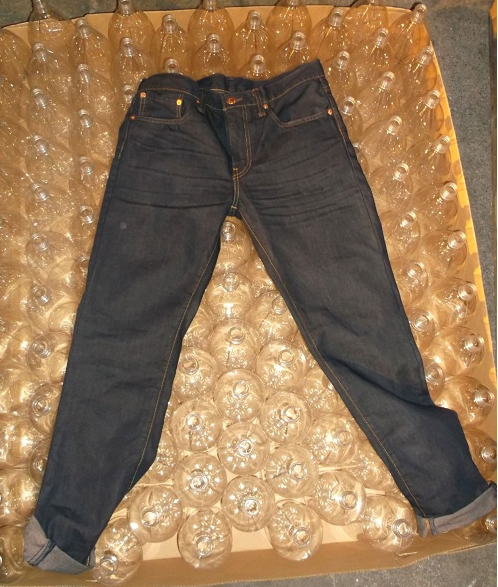
    Levi’s introduces innovative denim collection made from recycled bottles as the next chapter in its sustainable design initiative. This new collection incorporates the  denim incorporating post-consumer waste, specifically recycled plastic bottles  and food trays.

    Levis Waste Less Jeans

    Each Levi’s® Waste<Less

    The product will include a minimum of 20 percent postconsumer recycled content, or, on average, eight 12 to 20-ounce bottles per jean. The Levi’s®  Waste<Less TM products, which will be available for both men and women as part of the Levi’s Spring 2013 collection, represent the next chapter in the company’s ongoing commitment to sustainable design.
    James Curleigh, global president of the Levi’s brand says

    “From the beginning, we have designed our products with purpose and intent. By adding value to waste, we hope to change the way people think about recycling, ultimately incentivizing them to do more of it.This collection proves
    that you don’t have to sacrifice quality, comfort or style to give an end a new beginning.”

    The Spring 2013 Levi’s® Waste<Less collection will utilize over 3.5 million recycled bottles. The Spring 2013 men’s products, which will be available globally, will feature

    •  Levi’s® 511 Skinny jeans
    • A new modern-looking Levi’s® 504 Straight Fit jean
    • And the iconic Levi’s® Trucker jacket.

    For women, Levi’s® Boyfriend Skinny jeans in a progressive fit will be available in the U.S. and Europe.Through the company’s partners, PET plastic, or polyethylene terephthalate materials – including
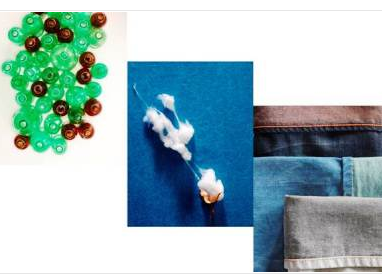
    brown beer bottles, green soda bottles, clear water bottles and black food trays – are collected through municipal recycling programs across the United States. The bottles and food trays are sorted by color, crushed into flakes, and made into a polyester fiber. Next, the polyester fiber is blended with cotton fiber, which is finally woven with traditional cotton yarn by Cone Denim to create the denim used in the Levi’s® Waste<Less jeans and trucker jackets. The color of the
    bottles used adds a beautiful undertone to the denim fabric creating a unique finish in the final product.

    image

    The new Waste<Less collection is only the latest chapter in the company’s commitment to doing more with less. In 2009, Levi Strauss & Co. introduced “A Care Tag for our Planet,” an
    initiative to educate consumers on how to clean their clothes with less environmental impact; it also encourages them to donate used jeans to Goodwill rather than throwing them out. This initiative was followed up by the development of Water<Less , a revolutionary finishing technique designed to reduce the use of water in the finishing process by up to 96 percent for some styles. This year, the Levi’s® Water<Less collection saved over 360 million liters of water. Additionally, the company is a member of the Better Cotton Initiative, which reduces water and pesticide use during the cotton growing process, and economically supports hundreds of  thousands of cotton farmers. Better Cotton Initiative is a group of companies that work with local nongovernmental organizations in Pakistan, India, Brazil, and Mali to teach farmers how to grow cotton with less water. The first of the cotton was harvested last year, and Levi’s blended its share into more than 5 million pairs of jeans.. Each has about 5 percent of the low-water cotton, though the members of the initiative agreed not to label products using that special cotton as such.

    Levi’s® Waste<Less products will be available in Levi’s® stores globally and on Levi.com in January 2013. the jeans will retail for $69 to $128
    Global Denim Market

  • Cone Burlington : Affinity Dyeing Process

    Cone is probably the most famous denim mill in the denim industry ever. A recently formed business unit, Cone & Burlington Apparel Solutions, is bringing new dyeing innovation and flexibility to apparel brands with the introduction of Affinityâ„¢. Using an entirely new Eco Friendly way to dye fabrics, the Affinity process allows water to be recycled from one dye bath to another without the worries of remaining dyes and chemicals. The Affinity process mimics the ring dye look of indigo dyeing but with the flexibility of dyeing smaller quantities, as little as 100 units per color.

    Gary Kernaghan, executive vice president Apparel Solutions, says

    “Initial customer interest has been good. Currently Levi, Quiksilver Fossil, Esprit and Hugo Boss are sampling the product. Consumers can expect to see product at retail around the Spring/Summer of 2013”.

    “The Affinity process catches people’s attention because it is different and it answers several different needs,” says Kernaghan. “It is early yet, but we believe it has good potential.” As he explains, colors are a big fashion item right now but they lend themselves to smaller lot sizes, and this season’s hot color may not be next season’s hot color. With Affinity garments, you can dye as many or few garments as you want and with more color choices. The Affinity process also supports the environmental commitments of apparel brands with the use of fewer chemicals, less water and energy, and virtually no residual dyes or chemicals left to dispose.

    The Affinity Difference

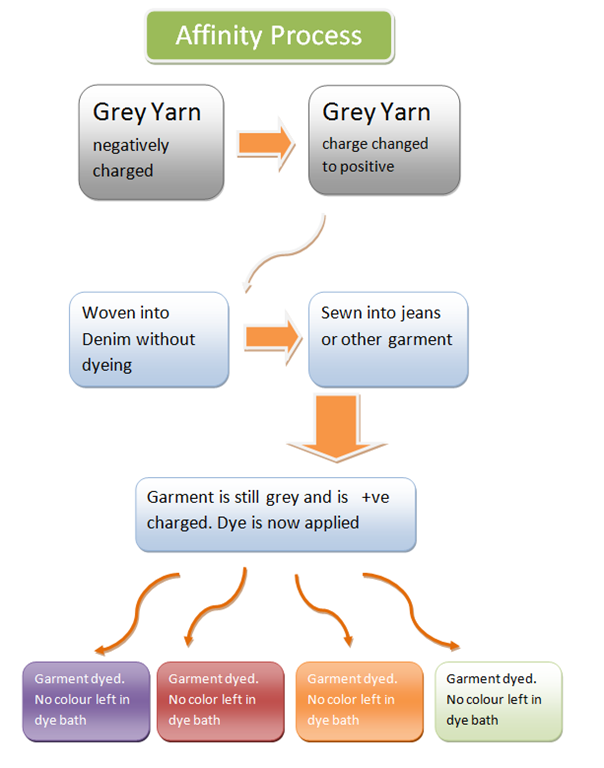
    To understand the Affinity process and why it is different you need to first understand the basics of dyeing and specifically indigo dyeing. The dyeing process involves chemical reactions that cause the dye to adhere to yarn or fabric. In its natural state, cotton yarn has a negative charge. Likewise indigo dye has a negative charge. As you know from basic chemistry, you must have opposite charges to attract. So in their natural states the dye would not stick to the yarn. To overcome this, salts and soda ash are added to the indigo dye bath to change the dye charge and allow the dye to adhere to the yarn. Another unique feature of indigo dyeing is that only the outside of the yarn is dyed while the core of the yarn remains the natural color. The Affinity process dyes the same so garments, when stonewashed or hand-sanded, can achieve the character commonly found in traditional indigo denims.

    So what makes the Affinity process different? Using a two-step process,

    1. The yarn is first treated using a patented process that changes the chemical charge of the yarn to positive. No dye is applied at this point. The yarn is then woven into denim using treated yarns in the warp and untreated yarns in the fill, and sewn into a garment as usual.
    2. Next the garment is dyed in specially designed dye equipment. Because the yarn, now fabric, has a positive charge and the dye added has a negative charge, the dye adheres to the garment without any additional chemicals. This is where the process derives its name — the dye has an Affinity for the yarn.

    image

    See the process of Affinity dyeing in this video

    Affinty dyeing proces : Denimsandjeans.com

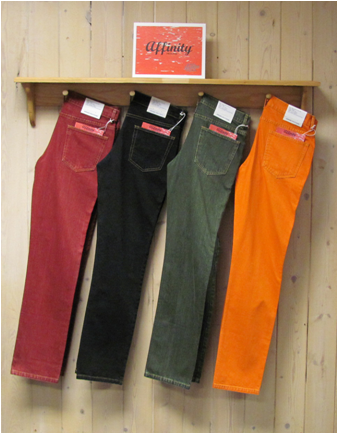
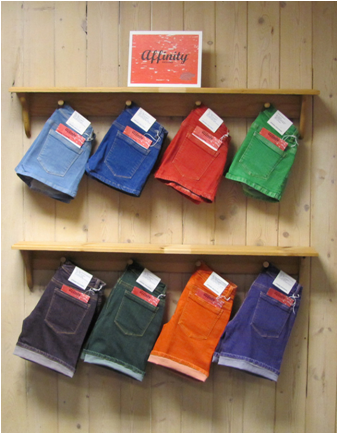
    The Affinity process uses reactive and/or direct dyes, in a full array of colors – neutrals, brights, darks and pastels. There is no limit to color as there is in traditional indigo processes.

    Almost all the dyes are completely exhausted or absorbed, onto the garment, leaving the water clear and ready for recycling to the next load. Cone Burlington claims that affinity dyed garments also have superior color fastness so that even the brightest of these shades maintain their vibrant shades throughout home launderings.

    Currently Affinity garments are made in China using partner mills and garment factories. Trials are currently underway with ITG’s Cone Denim Jiaxing (CDJ) facility to supply certain yarns for the garments.

    To understand more about the process , we spoke to Gary Kernaghan and Sonny Fong from Cone Burlington and asked them about whether the normal indigo dyeing is possible once yarn is treated by their process and also to understand the extra costs involved in this process.  They replied-

    “Affinity process is a part of invention  with machineries and combined with yarn treatment technique. The machines can adjust yarn size, quantity and volume in order to fit the requirements. Mechanical information in under patent process….

    Average cost  is approx. 20+ % higher then normal pigment / wet garment dye. Remember, it is no minimum, no need to pre-plan stock or inventory and is a green and sustainable process. ” 


    Cone Denim Affinity Dyeing Process


    Cone Denim Affinity Dyeing Process

    Check out our latest report on the World Denim Industry :

    world denim frontpage5