The seventh edition of the Denim by Premiere Vision will be held in Paris at Halle Freyssinet on Dec 1st and 2nd , 2010. with about 69 exhibitors exhibiting their denim related products. It is about the similar size as the June edition but larger than the December edition . The seventh edition of the Denim by Premiere Vision will be held in Paris at Halle Freyssinet on Dec 1st and 2nd , 2010. with about 69 exhibitors exhibiting their denim related products. It is about the similar size as the June edition but larger than the December edition .
Apart from the products from the exhibitors, there will be some interesting areas to visit in the show . Blue Garden: A garden… out of the blue at Bossa stand. An interaction of sunlight (lasers), water and plants (indigo dyes) – almost like nature intended. The project is the brainchild of the Turkish denim mill Bossa, Italian design consultants Meidea, and Itaclab, a centre of expertise noted for its innovation and research into washing techniques. Invista – Blue Tonic Bar Here is a list of all exhibitors (with their website links) for ready reference !
Here is the address of the venue : Halle Freyssinet |
Category: Denim Reports
Find out the latest reports on Denim Fabrics and Jeans
-
Denim By Premier Vision : Dec 1st and 2nd, 2010
-
2010 :Increase Of 14% In Imports Of Denim Jeans Into USA During First Half
US is the most important market for denim jeans exporters around the world. Any changes in demand in US affects a number of exporters worldwide . With the recession having hit US , the demand for most textile and related products had taken a hit . Luxury goods imports had been particularly hit . However, if we see the trend of denim imports over last 2-3 years , we find that that it has been mostly positive and quite encouraging in the current economic scenario. The year 2010 has seen a marked increase of over 14% in imports of these items into the US as compared to last year with both Mens/Boys and Womens/ Girls jeans showing a vast increase in imports over the same period last year . When we speak of Men’s / Boys jeans , they showed an increase of about 12.8% in volumes from 116 million pieces last year to 131 million pieces this year. In terms of prices, the same increased marginally by 1.54% adding icing to the cake . See the table below :
Import of Mens’/ Boys Jeans & Breeches into US 2009 and 2010
Year
Volume
Av. Price
2009 (Jan- June)
116.79 million pcs
$ 7.01 /pc
2010 (Jan- June)
131.76 million pcs
$ 7.12/pc
% Change
+12.81%
+1.54%
Source: US Dept of Commerce
The total Mens/Boys jeans imported into US in the year 2009 was 241 million pieces reflecting that imports in the first half of the year are lower than those in the second half. This normally remains the trend in most of the years . Going by the rate of increase in imports in the first half of this year , we could see Men’s/Boys jeans touching a record import of about 270 million pcs in the year 2010 . It is also interesting to see who are the main exporting countries for Men’s/Boys’ Jeans into US . Let’s have a look at the table below :
Major Exporters of Men’s / Boys jeans and Breeches to USA (figures in million pieces)
Country
2009
2009 Jan- June
2010 Jan- June
% Change
Mexico
100.90
42.98
48.92
– 5%
Bangladesh
45.52
16.78
21.07
+28.30%
China
44.28
15.33
19.78
+26.80%
Egypt
14.78
5.98
7.04
+30%
Pakistan
14.70
5.66
6.48
+37%
Nicaragua
8.29
2.94
4.24
+105%
India
2.4
0.75
0.82
+8.9%
We see from the above table that most of the countries increased their exports of Men’s/Boys’ jeans to USA in 2010. However, certain South American countries like Mexico , Honduras etc suffered reductions in their export figures indicating clearly that the source of jeans is shifting to Asian countries. Mexico, however, remains the largest exporter despite the fall and maintains substantial lead over the second highest exporter – Bangladesh. Bangladesh stands out very strongly as a denim exporter and clearly overshadows its large neighbour – India – in terms of denim jeans exports. India has been poorly lingering at these levels of exports and is clearly non-competitive in terms of pricing and also not being a receipent of tariff and other benefits for imports into US.
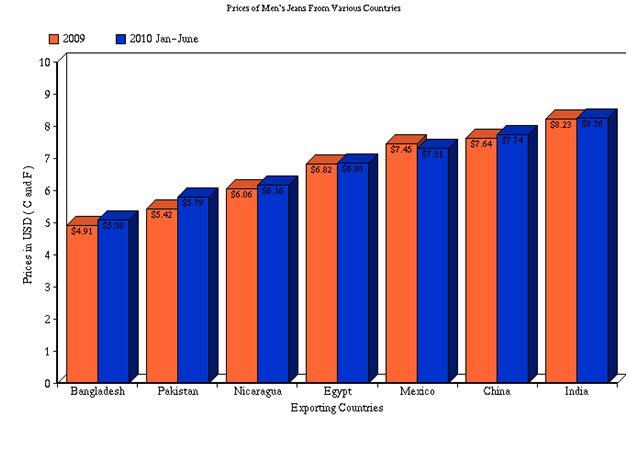
Lets also see if the average prices for exports of jeans has changed in this period from these countries.
Country
2009
2010 Jan- June
% change
Mexico
$ 7.45
$ 7.31
-1.88%
Bangladesh
$ 4.91
$ 5.08
+3.46%
China
$ 7. 64
$ 7. 74
+1.31%
Egypt
$ 6.82
$ 6. 86
+0.5%
Pakistan
$ 5.42
$ 5.79
+6.82%
Nicaragua
$ 6.06
$ 6. 16
+1.52%
India
$ 8.23
$ 8. 26
0.36%
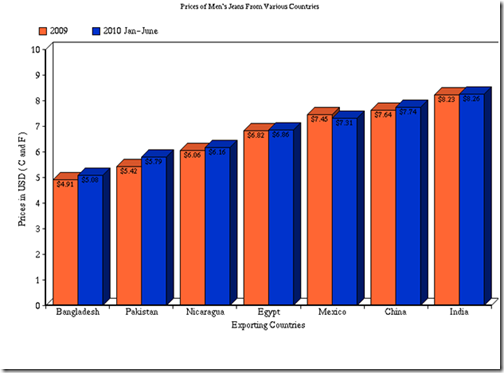
As we can see from the graph above , Bangladesh is the cheapest source of denim jeans to USA . On the other hand , ironically , China is one of the most expensive country exporting denim jeans to US. The costs in China have been continuously rising and with their currency not remaining as favourable as it was before , China will not be looked upon as a source of cheap denim garments. However, it is also a fact that there is a renewed emphasis in the Chinese textile industry to move up the value chain and it is showing in their export figures as more and more value added garments are added. Pakistan got the highest increase in prices of 6.82% over 2009 on top of 37% increase in volumes and strengthened its place among the Men’s denim market in US .
Now , lets also have a look at the figures related to imports of Women’s/ Girls denim jeans into USA during 2009 and 2010.
Import of Women’s/ Girls’ Denim Jeans and Breeches Into USA
Year
Volume
Av. Price
2009 (Jan- June)
110.86 million pcs
$ 7.04 /pc
2010 (Jan- June)
129.10 million pcs
$ 6.98/pc
% Change
+16.50%
-0.90%
The imports of the Women’s/Girls’ denim jeans into US have shown even more robust growth in the first half of the year with a whopping 16.%% increase over the same period in 2009. This growth trend in both the segments is indicative of strong growth in demand and sales in US for the entire denim sector. Though the prices of the women’s denim showed a slight decrease of 0.90%, it hardly dampens the positive sentiment on this front. This trend is expected to continue over the whole year and , like Mens/Boys jeans, expected to produce record import figures this year.
It would be interesting to see where this increase in denim imports is mainly coming from :Imports of Women’s / Girls’ Denim Jeans and Breeches into US 2009-1010
Country
2009
2009 Jan- June
2010 Jan- June
% Change (Jan-June)
China
115.72
41.95
60.70
+44.70%
Mexico
27.09
10.94
11.32
+3.5%
Bangladesh
23.14
7.98
10.64
+33.38%
Egypt
14.72
6.82
5.97
-12.47%
Vietnam
16.32
7.78
6.70
-13.86%
Cambodia
11.07
5.23
6.02
+15.13%
Pakistan
6.92
2.94
2.67
-8.9%
India
4.17
1.34
1.62
+20.53%
As we can clearly see from the table above, China is totally dominating the scene when it comes to the jeans in the women’s category. It already has a share of close to 40% (of imports ) and which it is adding on to rapidly with a growth of 44% in 2010 export figures over last year. Women’s denim is high fashion oriented with smaller lead times , a large number of styles and washes which change frequently .. China’s dominance in this segment clearly indicates its strength in catering to these market needs and demands . Besides China the other countries showing great volumes and growth are Bangladesh and Cambodia. Vietnam and Egypt are also high volume exporting countries – though it seems that both have suffered a temporary setback in exports during 2010. Pakistan is not very strong in the women’s denim and India is again at the bottom of the table with hardly any impressive figures.
To understand how prices are moving in a continuum over the last year , lets compare the prices of the whole year 2009 with those in the first half of year 2010.
Prices of Women’s/ Girls denim jeans during 2009 and 2010
Country
2009
2010 Jan- June
% change
Bangladesh
5.27
4.96
-5.82%
Mexico
9.25
9.31
+0.60%
China
7.04
6.92
-1.79%
Egypt
6.30
6.73
+6.82%
Pakistan
6.31
6.49
+2.84%
Vietnam
5.50
6.46
+17.63%
Cambodia
7.47
7.22
-3.38%
India
7.43
7.04
-5.32%
A look at the figures of prices from various countries throws up interesting facts. Jeans from Mexico are the highest priced , expectedly , as it provides enables turnaround and serves the quick fashion category. A large number of brands like to push products into the market quickly by getting them manufactured in nearby countries like Mexico and then based on customer response, place the repeat orders (with longer lead times ) in countries like China or Bangladesh. Bangladesh again remains the cheapest source followed by Vietnam and Egypt . Vietnam has shown a strong performance with a 17% increase in prices over last year .
On the whole, the denim scenario in US seems quite positive in the near term. Coming during these recessionary times , this performance is highly encouraging and bodes well for the industry . However, it also needs to be noted that denim sales are actually cannibalizing on the sales of other non-denim products as consumers are looking for clothing which they can use at multiple occasions to reduce their overall expenditure. As the economy improves significantly , we may , ironically , see some negative impact on sales of denim jeans into US.

-
Denim Conference at Ahmedabad – Very Informative and Successful
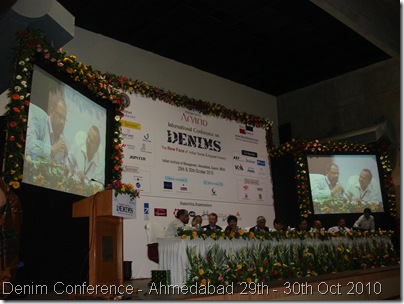
The ‘International Denim Conference’ was held at Ahmedabad on 29th and 30th October and was a big success having been attended by over 500 delegates including the who’s who of the Denim Industry in India. CEOs and Top executives of various denim companies were present at the conference and most of them gave their views on the various aspects of the Indian and world denim industry .
Organized by Fibre2fashion.com and the Textile Association of India , the conference brought out some very interestings revelations and informations about the denim industry . Dr P R Roy – the father of Indian Denim Industry in India – and Managing Director at Fibre2fashion.com was instrumental in bringing up this conference. Some of the important points related to the conference are summarized below :
Comments on History of Denim
Dr Roy informed that Indigo was cultivated and grown in India over 5000 years ago and it was used to dye cotton and wool . However, it did not see much commercialization in India till late eighties. Denim industry was born in India in 1980s from the need to compete with the decentralized sector and gave rise to the ‘Blue Ocean’ strategy – meaning moving to the denim sector to avoid the competition from decentralized sector. From just over 35 million mtrs produced in India in 1987 , we now have over 650 million mtrs of denim production produced by about 24 mills.
He also presented the unique products – Indigo Wool and Indigo Silk – from the stable of reputed denim company – Malwa Industries.Some Statistics on the World Denim Demand and Supply
Keynote address was presented by Robin Anson of ‘ Textiles Intelligence’. He made an excellent presentation on how the denim is being demanded , produced , exported and imported in the last few years. The biggest denim fabric exporter without question is China which shipped fabric valued at around $920 million in 2009 to seize a global market share of 24.5 percent. The second slot was surprisingly held by Hong Kong (a large part of it probably represents intra China – HK trade) with around $860 million and a share of 18.8 percent, Turkey with $325 million and 8.6 percent, Italy $300 million and 8.0 percent, Pakistan around $225 million and 6.6 percent, India around $180 million and 4.2 percent, followed by Japan, Spain and Brazil.
Denim fabric imports by the US and the 27-member European Union have been plunging since 2005. From around $150 million in 2005, US imports have sky-dived to just round $75 million in 2009 and those of EU have sunk from €255 million to €150 in the same period.
In the case of men’s jeans, the US imported around 110 million pieces from Mexico in the period Sept 2009 to Aug 2010. China and Bangladesh followed Mexico with exports totaling to around 70 million pairs, each. India stands at 14th place with exports amounting to around 1.5 million pieces in the same period and is preceded by countries like Nicaragua, Lesotho and Guatemala in jeans exports to the US. He mentioned that China was not a big threat in the denim industry since rising costs of labor and probable appreciation of Yuan would reduce the competitiveness of the Chinese fabrics.
A very interesting point made out by him was that China is considering connecting its backward and remote regions by high speed trains to the western Europe . If this happens over a period of next few years, it would revolutionize apparel sourcing in Europe as goods would reach from China in less than a day !!
The global production of denim fabrics stands at about 5.5 billion mtrs currently.Growth in Indian Denim Industry , its Future and Growth Rates Worldwide
A number of speakers gave details about the current situation of denim industry and its future prospects. Mr Rajiv Dayal , MD at Mafatlal Denims , mentioned that the value of denim fabric produced in India was:
In 2005 : Rs 46 billion (about USD 1.00 billion at exchange rate of Rs 45/dollar) . Out of this about 70% was for domestic market.
In 2010 : Rs 78 billion (about USD 1.73 billion ) out of which again about 70% would be for domestic market. (average price about Rs 120 per mtr or about $2.67 )
In 2020 (projected) : Rs 220 billion (about USD 4.9 billion) and domestic market would again have a share of about 70%. Total estimated production – 1.2 billion mtrs .
Global denim markets have grown at about 2 – 5% over last few decades and current global fabric production of 5 billion mtrs is valued at about $13 billion (an average price of $2.60 / mtr).
Indian Denim markets have grown at a CAGR of about 10-12 % in the last decade . The main drivers for this growth are the demographics – a population of about 50% between 15-35 years. The domestic apparel market in India (all apparels) is estimated at about $36 billion currently and will increase to about $61 billion in 2015 and $100 billion in 2020.
US and EU market : –1% to 5% growth expected and averaging around 3%.Focus on Environment – Organic Cotton
An interesting presentation was made by Mr Mahesh of Arvind Ltd regarding the status of organic denim – demand and supply. According to him , cotton is produced in over 65 countries and consumes over 16% of world’s insecticides – more than any other crop. India produced over 29.5 million bales (170kg) of cotton in 2009-10 and used over 54% of all pesticides in India despite using only 5% of land.
To counter the use of such high volumes of pesticides, Organic cotton is an alternative. The current demand for Organic cotton stands between $3-$4 billion and it outstrips supply.
Consumer interest in ‘Green’ products has enabled retailers like Wal-Mart, M & S , Woolworth , C & A and Carrefour to focus on and expand the sales of Organic cotton products. C &A (Belgium) , Nike (US) and Wal-Mart (US) are the three top consumers of organic cotton worldwide.
Organic cotton grown worldwide represents just 0.76% of world cotton production. This is likely to slowly increase as large increases are not possible immediately in Organic cotton.
Organic Cotton Denim : Arvind has been focusing on organic cotton – producing 1 million mtrs in 2007 and currently manufacturing 8 million mtrs . Wal-Mart, Patagonia, H&M, C&A, Timberland, etc are the major supporters of Arvind’s organic denim initiative.New technologies for reducing environmental impact
A very interesting presentation was made by Enrique Silla – Chairman of the Jeanologia group of Spain. He explained how water consumption can be Significantly reduced using the G2 Machines which use ozone to do the washing. This technology has a great potential for reducing the environmental impact of denim manufacturing as almost 42 litres of water are used for making one jeans. Stressing on the urgency of reducing the usage of water in jeans manufacturing, Levi’s has recently announced that it would introduce about 1.5 million pairs of jeans using 28% to 96% less water.
Another technology that Enrique Silla talked about was using laser machines to get the scraping and other finishing effects on jeans. This reduces the adverse impact on humans during the finishing process . In view of the recent ban on Sandblasting by Levi’s and H & M , such technologies have a bright future.Impact Of Cotton Prices On Denim
Most of the industry stalwarts expressed great concern at the rising prices of cotton which have almost doubled in the last one year. The prices are on a 15 year high and with no sign of reducing. This has affected the margins of most denim mills and they have been frantically trying to pass this on to consumers. Mr S.K. Gupta – Director at Raymonds UCO denim raised this question in the panel discussion and this was taken up as a serious issue . Mr Sudhir Mukherjee of Arvind felt that the prices would see a correction in the near future and Mr Deepak Chiripal (CEO Chiripal denim ) felt that there was no need to panic and impose taxes on yarn exports from India . Robin Ansen of Textiles Intelligence mentioned that the final impact of increased cotton prices would be less than 5% on retail level and hence it should not be unduly worried about . Some retailers have already increased their prices by as much as 8% . However, worries were clearly visible on the faces of denim professionals with margins under sever pressure !!
On Competition and Threat From Pakistan Denim Exports
Pakistan has been ramping up its exports of denim and is currently a very strong player in the denim market. The panelists felt that the currency advantage of Pakistan played a great role in increasing their competitiveness. The latest provision of Duty advantages to Pakistan by the EU to the tune of Euro 200 million was also discussed by the panel . This would greatly benefit the denim industry of Pakistan and was a source of increased competition for Indian industry. The panelists felt that Indian denim industry should make a joint presentation to the Govt. to take up the matter with the EU so that the industry does not suffer due to the advantages given to exports from Pakistan.
Denim Trends and Sales in US
An interesting presentation was made by Jeannah of Cotton Inc , USA . Some details from her presentation :
- Most of the denim jeans are priced between $10-$39
- 12% of consumers have purchased a jeans over $100 jeans in 2009.
- Consumers own over 3 brands of jeans on an average .
- Import of 569 million jeans in 2009 is second highest imports of jeans of 580 million jeans in 2005.
- In 2010 – the figure would be much higher than 2005 figures.
- Denim Trends for Fall 2011 and Spring Summer 2012 :
Scout : Influence of bands, military , hunting , uniform type aspects. Smoky blues , Green Blues , Khaki crease and military looks, stitches etc.
Industrial : Architecture trend related to warehouses , exposed pipes , ruptured sockets will inspire denim . Displayed by brands like G-Star, Versace .
Influence of 30s & 40s : Inspiration will be taken from Gangster movies from Hollywood of this period .
There were a number of other interesting presentations including those by Darshan Mehta – CEO of Reliance Brands on the advantages of being ‘ Stupid – referring to an ad campaign by Diesel’. As a consequence of this presentation, “STUPID†became a ‘Respectable Word’ and on a lighter note, panelists referred to some industry stalwarts as ‘Stupid’ inviting laughters from the audience. !!!!. This presentation considerably lightened the atmosphere at the conference. Another one by Chakor Jain of VF Corp – gave insights into the growth possibilities in Tier 2 and 3 cities in India with the young people demanding branded products. This augurs well for the growth of the sales of ‘Branded Jeans’ in India .
There were still some more presentations including those related to Denim processing and finishing but due to limited time and space, I will take them up at a later time. On the whole, the conference was very good, the atmosphere was charged and (not to forget ) the food was superb !
-
Exports Of Denim Fabrics and Apparel From Turkey To USA 2009-2010
Turkey is an important country for denim products – both as an importer and well as an exporter. As an importer, Turkey imports a large amount of fabrics from various Asian countries including India, Pakistan, Indonesia, China etc. As an exporer, Turkey is one of the most important exporter of Denim garments to EU. It has a special relationship with Italy and Turkey has imbibed a lot of Italian denim designing techniques – besides developing their own.
When it comes to US, Turkey has seen a mixed relationship . Whereas the exports from Turkey to US were quite strong , exports of denim jeans have seen a fall in the recent times as US increased its imports from countries like Bangladesh, China , Vietnam, Cambodia etc. However, it was quite interesting to note that the exports of denim fabrics from Turkey to US jumped more than 75% in the first six months of 2010 (Jan-June) as compared to same period in the last year .
Exports of Denim Fabrics
to USA 2009 – 2010Year Quantity (million sq mtrs) Quantity (million mtrs @ 160cm width) Average Price
(USD/mtr at 160 cm width) CIF2009 (Jan- June) 0.975 .609 7.35 2010(Jan – June) 1.717 1.07 7.16 Change + 76.1 % + 76.1% -2.35% Though the total exports of denim fabrics from Turkey to US are still miniscule at about 1 million mtrs p.a , the average prices at which they are exported are quite good indicating . Denim jeans production in US is confined to making expensive premium denim and they require good denim fabrics in small quantities and it is to this market that Turkish denim exporters are catering partly.
Lets see how the exports of denim jeans and other garments from Turkey to US fared during the last one year .
Exports of Denim Jeans and other Denim Garments to US 2009-2010
Year Quantity
( pieces)Value in Million USD Average Price per pc (USD)
2009 (Jan- June) 2,40,000pcs 3.879 16.16 2010(Jan – June) 3,60,000 pcs 5.685 15.79 Change +50 % + 46.6% -2.29% Again the market for Turkish denim garments in US is very small. The reason is probably the prices at which Turkey is able to export its denim jeans . Whereas US imports denim jeans from around the world at an average price of $71.5 ( in 2009) , Turkish prices are averaging about $16 . Turkey is basically catering to a small segment of garment importers who do not want to produce in US and still need to make high quality garments with prices that are much lower than that of Japanese denim or Italian denim . But the trend of exports of Denim fabrics and garments to US from Turkey aligns with the general trend of imports of these products into US. There has been a general increase in imports of denim jeans and fabrics into US indicating a strong trend in denim consumption .
-
Bread and Butter Berlin (BBB) July 7th – 9th 2010 – A Review Of Denim Trends
This is a guest post by Rik Vanniewenbourgh
The Bread and Butter this season was an extravagant party with lot of enthusiasm and energy showing up in the show . The video below catches some of this energy from the party.
First impressions from the Bread and Butter
Some of the key denim trends at the show were :
Vintage Denim
A lot of attention towards vintage denim came from brands like Levi’s / Wrangler / G- Star / Tommy Hilfiger etc.
ADRIANO GOLDSMIED with his name already well know in the World as designer (design jeans) had a very good collection which shows how you need to make and present vintage denim!!!!
Retro and Vintage IS IN…….Color Trend
Trend is towards more and more dark colors.
Style Pattern
Jeggings for women is an increasingly popular trend with small special designs and smaller legs .
Fabric Trends
Slubs are disappearing towards more even qualities . But the fabrics are slightly shiny (achieved with hot calendering and under pressure) .
Garment Washing Trends
Trend is more towards unwashed or slightly rinsed washes.
A Note On Turkish participation
Turkish brands have paid much attention to the fair and there were many people on the fair , including brands like MAVI / CROSS etc.
Turkey is very important for Europe as supplier and it reflected in the fair. The reasons for this importance are :
-short lead time
-price / quality is excellent
-quality is good and consistent and trust full
-small orders possible to get from Turkey
-already years experience and regards communication excellent with their
customers and are very open.
Here are some very cool visuals from the show .


 Â


And here is slideshow for the visuals from the show .
Bread and butter july 7th to 9th 2010View more presentations from Denimsandjeans.com.
This is a guest post by Rik Vanniewenborgh who has over 30 years experience in Denim Industry. He has worked over 25 years in the VF Corporation(Belgium) in various capacities (including quality control). This post is from his recent visit to the BBB Berlin Jeans Fair.Contact him on email here
-
Chinese Denim Market – Consumer Preferences
The Chinese denim market is growing at a fast pace with almost all major world denim brands having established a presence there to tap the increasing disposable incomes of the growing middle and upper middle class. Being the largest producer of denim fabric and apparel has helped in the penetration of the denim apparel in China. A report by USFDA brings out various aspects of the patterns of consumption of denim apparel in China.
Because of smaller housing in China, most Chinese consumers have smaller closets than Americans. Thus, Chinese tend to purchase and own fewer apparel. The report cites a survey by Cotton Incorporated – according to which - Chinese consumers on average spent 7 percent of their apparel purchases on denim products, while the figure in the US was slightly higher at 10 percent.
The survey revealed that denim jeans are getting more popular in China, especially among the younger set. Denim products’ share of apparel purchases is 8 percent among the consumer group aged 15 to 29, compared with 6 percent of those from 30 to 54.
Denim jeans are the most purchased denim apparel. On an average, each Chinese consumer owns 4.2 denim jeans. The average unit purchase price of denim apparels is US$12 (RMB89). However, 26 percent of consumers said they don’t have any denim garments.
Denim Products Owned By Urban Chinese Consumers
Product Average Quantity Denim Jeans 4.2 Denim Skirt 0.5 Denim Short Pants 0.6 Denim Jacket 1.0 Denim Shirt 0.4 Total 6.7 The retail sector in China is getting sophisticated, from modern shopping malls to open market stalls. However, Chinese consumers’ buying habits differ sharply from that of the US. Nearly half of denim products are purchased at department stores, compared with only ten percent in the US. Thirty-one percent is purchased through supermarkets in the US, and only two percent for Chinese consumers. The clothing market – a traditional sale point – provides 16% of the denim sales .
Retailer Chinese Consumer(%) US Consumer(%) Department Store 44 10 Speciality or Chain Store 25 58 Clothing Market 16 N.A Small Clothing Shop 13 N.A Supermarket / Hypermarket 2 31 Internet 0 1 Sales and demand potential demonstrated by the China market has successfully attracted more international brands as well as luxury products. All top ten denim brands are available in the China market and Chinese consumers are becoming more brand conscious. When shopping for apparel, 38 percent of Chinese consumers prefer domestic brands and 22 percent prefer western brands. A quarter of Chinese consumers said they usually shop for a particular brand, which is very similar in the States at 24 percent.
The following graph by Cotton Inc shows the Chinese love for denim across various age groups . It shows that though the denim is , understandably, more popular with the younger age groups , the love is there even in higher age groups – portending well for the growth of the denim market in China.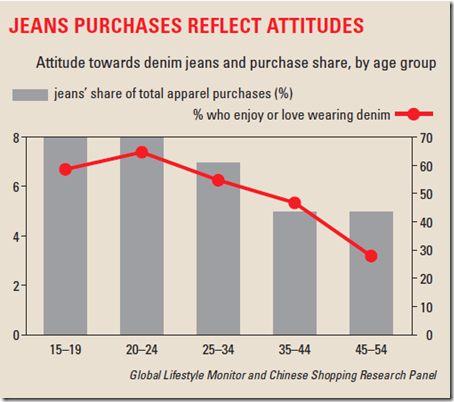
-
Bangladesh Export Of Denim Jeans To EU : 2005-2009
Bangladesh is a major exporter of denim jeans to EU27. Being low priced and with special and indefinite duty free and quota free access under ‘Everything but arms’ initiative to EU , Bangladesh continues to dominate the EU denim import business. Currently, it has about 19% share of the denim jeans import market in EU27 countries.
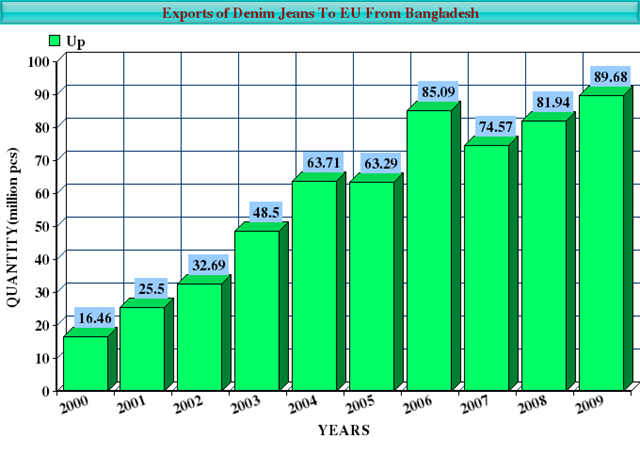
Lets have a look at the figures of imports of denim jeans from Bangladesh for the last 10 years .
Year Total Denim Jeans (million pcs) Value (million Euros) Average Price
(Euro/pc CIF)2000 16.46 87.92 5.34 2001 25.50 120.26 4.72 2002 32.69 144.69 4.43 2003 48.50 190.87 3.94 2004 63.71 247.52 3.88 2005 63.29 245.42 3.88 2006 85.07 341.78 4.02 2007 74.57 289.98 3.89 2008 81.94 317.23 3.87 2009 89.68 373.93 4.17 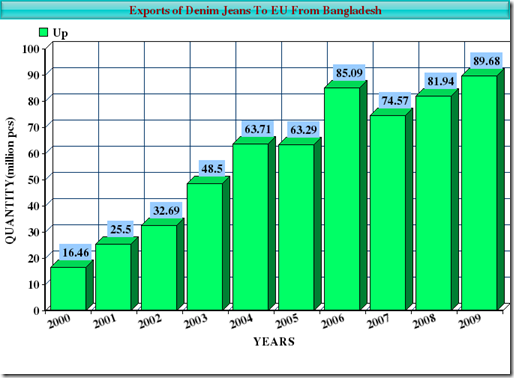
Thus we can see that the exports of denim jeans have increased by almost 400% from 2000 to 2009 . There have been some years in which the exports increased by a large % as compared to the previous year . These years have been :
2001 : Increase 54%
2002 : Increase 28%
2003 : Increase 48%
2004 : Increase 31%
2006 : Increase 34%
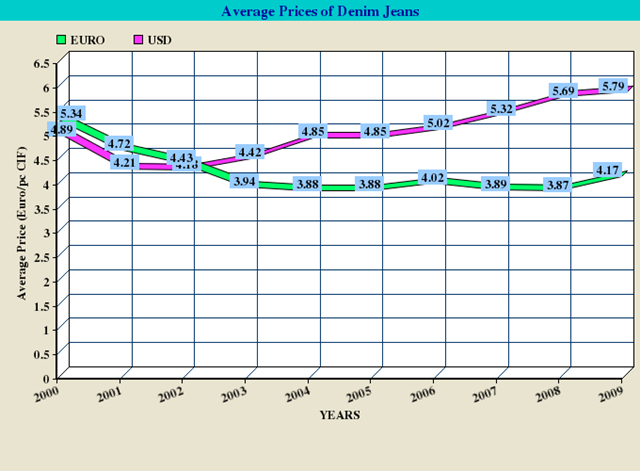
2009 : Increase 10%The prices from Bangladesh have been more or less moving in a narrow range of Euro 3.8 to 4.20 since 2003. Though in earlier years, the prices were much higher, but recent years have seen the prices move around in this range. There is no clear trend in the prices from Bangladesh if we consider these figures. However, would it be the similar situation if the Euro prices were converted to dollar prices . In the table below, we have taken the average conversion factor (from Euro to USD) for each year from 2000 to 2009 and applied the factor to the average prices for that year. This gives us the average dollar prices for export of denim jeans from Bangladesh to Eu . With this table we will come to know whether there is really no trend for prices from Bangladesh:
Year Euro To USD
average factorAv Price (Euro) Av. Price (USD) 2000 1.09 5.34 4.89 2001 1.12 4.72 4.21 2002 1.06 4.43 4.18 2003 0.89 3.94 4.42 2004 0.80 3.88 4.85 2005 0.80 3.88 4.85 2006 0.80 4.02 5.02 2007 0.73 3.89 5.32 2008 0.68 3.87 5.69 2009 0.72 4.17 5.79 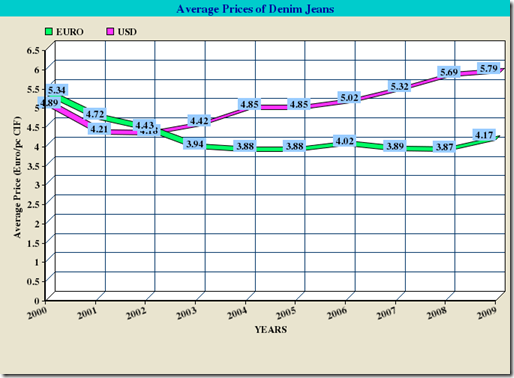
In the table and chart above, we can see that actually the prices from Bangladesh are quite different than what Euro prices show. We can see that since 2002 the average prices in Euro terms (from 2002 to 2009) have declined by more than 5% whereas there is an uptrend in dollar terms and the prices have increased from $4.43 per piece in 2002 to $ 5.79 in 2009 – actually showing an increase of about 30%
Dollar being the ruling currency worldwide, gives a better picture of the prevailing price situation and it clearly reflects that the prices from Bangladesh are continuously and steadily rising over the years. This is despite the fact that the volumes have increased manifold during this period. The Bangaldesh denim export industry is only expected to grow stronger in the coming times . We have seen a number of denim mills also come up in Bangladesh and this strengthens the supply chain making it easier for Bangaldesh to go deeper into these markets.
Also check : Exports of Jeans from Bangladesh to USA
-
Difference Between $20 and $240 Jeans – An Evaluation
 What really is the difference between a $20 and a $240 jeans? There is a world of difference in the prices but how much should be the difference in quality to warrant this price difference. Normally it should be a lot and it could be on many inputs that go into a jeans :
The difference could be related to :
- fabric quality
- stitching quality
- attention to details
- washing effects
- accessories used
- fit
- brand name
- life of a jeans
or a combination of a number of these or more factors.
ConsumerReports – a non-profit consumer welfare organisation - evaluated evaluated seven women’s cotton/spandex boot-cut jeans in that price range, looking for sewing and fabric flaws, washing one pair of each five times, opening stitching at the waist to examine construction, and checking zippers . They produced a report with their findings and excerpts from this report are shared in this article.The seven jeans selected were :
- Signature by Levi’s – Totally Slimming : $20
- Old Navy – The flirt curving dark balboa :$30
- Gap 1969 – Perfect boot :$70
- Levi’s – Skinny Dusk :$70
- Lucky Brand – Stockton Lola : $80
- 7 for all Mankind – Flynt : $155
- True Religion – Becky Silver Chainball : $240
Their findings were :
- Some cheaper jeans have better construction features such as interfacing under the waistband .
- Levi’s Signature jeans shrunk maximum in the width at 2.5% while 7 for all Mankind shrunk maximum in length at 3% .
- Lucky brand was the only jeans which did not shrink at all. It was , however, a highly distressed jeans . Zipper locks only in ‘down’ position.
- Levi’s and Old Navy jeans had stitching under waistband which limits stretching.
- 7 for all Mankind had some features to justify their high price eg the silver bling (on back pockets and hiding inside a front pocket), a nice print fabric for the pocket bags (where it can’t be seen), big white stitches as an accent, and a zipper that won’t stay up unless it’s locked down.
If we look at their findings above, we will find that even the less expensive jeans can have features which may be better than those of the more expensive premium denim jeans. An expensive jeans does not necessarily translate into a better jeans.
(Note: However, since the sample size of this experiment has been small, we do not say that a particular brand of jeans is better than the other.)However, having said that , we also need to understand that denim jeans are not bought for their technical features alone. In fact, most of the consumers are not even aware of technicalities of denim fabrics . They are , mostly, looking for a jeans which has a good hand feel, a great looking wash, a reasonably good fit ( this sometimes is the deciding factor for buying jeans) etc. Brand name , celebrity endorsements and company name are also big factors in deciding regarding the jeans purchase as they provide the necessary ego massage to the buyer !.
Normally , luxury products have a high proportion of brand value input and it combines with other factors to make them worth the money. But it is also to be ensured that the quality of such high priced products needs to constantly outshine the quality of that of lower priced products . A $150+ premium denim jeans may sell well during a boom time and on the strength of its brand name, but it will not keep on doing so if it does not provide quality that is much much better than the cheaper jeans available in the market. The owner of such high priced products need to feel proud of their purchase for a long period of time to sustain the high brand value that has been charged.
About : ConsumerReports.Org is run by Consumers Union (CU) – an expert, independent, nonprofit organization whose mission is to work for a fair, just, and safe marketplace for all consumers and to empower consumers to protect themselves. The organization was founded in 1936 when advertising first flooded the mass media.
-
China To EU – Denim Jeans Export Quantities , Prices etc : 2007-2009

China is a major exporter of denim jeans – men’s and women’s to the EU.
China is very competitive price wise and seems to have been continuously investing in improving quality also. The exports from China to EU have been continuously rising and China is currently the largest exporter of denim jeans/breeches to EU27.Let’s have a look at the figures of exports of denim jeans/breeches from China to EU27
Year Jeans Exported (million pcs ) Total Value
(Euro)% inc. in qty. over last year Av. Price
per pc CIF
(Euro)2007 101.24 559.42 +51.82% 5.53 2008 180.85 827.13 +78.63% 4.57 2009 195.80 926.71 +8.26% 4.73 For the years 2007 and 2008, China has experienced a phenomenal growth in exports of denim jeans with more than 50% and 78% growth in the two years respectively. This kind of growth in exports over an existing large base is really good and shows the power of Chinese denim manufacturers to compete with the rest of the world , specially their competitiors like Bangladesh , Vietnam etc who are cheaper to them. During 2009, the growth in exports slowed down during to general slowdown in Europe , but still maintained decent 8% plus levels. We may see decent increase in exports in the year 2010 also.
However, this growth that we are witnessing in the last 3 years would fade in comparison to the growth of 960% !that China got in the year 2005 over 2004 when quotas were lifted. China was only restricted by the quota regime and currently nothing seems to hold it back.
Price wise , Chinese exports have registered slight downfalls but their prices still cannot be called as the cheapest as there are other countries exporting at lower prices. But China will not always remain very price competitive. It has issues on its currency – which it may have to devaluate slowly – and it may not always be able to provide the kind of export subsidies it is currently providing with export tax rebate at 16%.
Note: The EU27 region comprises of the following countries -:
Austria , Belgium , Bulgaria , Cyprus , Czech Republic , Denmark , Estonia , Finland , France , Germany , Greece , Hungary , Ireland , Italy ,Latvia , Lithuania , Luxembourg , Malta , Netherlands , Poland , Portugal , Romania , Slovak Republic , Slovenia ,Spain , Sweden and United Kingdom.
-
Denim Industry In South China – History, Production Costs & More..
 Hong Kong and Taiwan started to produce denim fabric and apparel in the mid-70’s. To take advantage of cheaper labor cost and abundant resources, Hong Kong manufacturers later relocated their factories to the mainland, mainly in Guangdong, Shanghai and Jiangsu province, about three decades ago. The Guangzhou No. 1 Cotton Textile Factory and the Shanghai Shenshi Textile Company were the first two Chinese companies that manufactured denim fabrics and apparel from cotton.
With about three decades of experience , Guangdong province has a developed denim industry supply chain, support systems and hence a fully integrated industry. In addition to OEM exports, Guangdong manufacturers have developed their own brands for the domestic market. Guangdong produced about 1.26 billion mtrs of denim fabrics in 2007-2008 ie nearly half of the entire production of China. To put that into perspective, the total production of denim in India is about 600 million mtrs and in US the production is only about 90 million mtrs !! . The total production of denim fabric is estimated to be anything between 2.3 and 2.6 billion mtrs.
Main Denim Production Centres
Xintang, Kaiping, Jun’an and Dachong of Guangdong province are the major denim manufacturing bases in South China. Xintang wholesale market is the world’s largest for denim apparel. Xintang houses over 2600 denim related factories and produces about 31% of total Chinese denim production. The top three export markets for Xintang are US, Panama and Hong Kong.
Kaiping : Three hours drive southwest of Guangzhou , Kaiping has developed a comprehensive denim production chain from raw materials to garment sewing. The area has over 450 companies involved with the denim industry with a denim related turnover of over US$ 600 million .
Ju’nan : An another area of important denim manufacturing base in China is Ju’nan where over 1000 denim related companies produce over 100 million mtrs of denim apparel each year ! .
Costs of denim production. Are they increasing ?
Labor Cost :Denim production requires skilled labor and the cost of skilled labor seems to be increasing in China with some factories claiming the monthly cost of skilled labor to be in range of US$ 190-220 and this cost is on the increase. The Chinese Labor Contract Law implemented on 1st Jan 2008 require the employers to the employee’s social security fund – which has further increased operational costs (around $30 per person per month).The increased costs have pushed many factories to relocate to less developed regions in central China, such as Hunan province and Jiangxi province
Environmental issues : According to the Chinese Ministry of Environmental Protection , the textile dyeing industry discharges over 7.5% of national wastewater. Only about 7 % of the waste water produced by the textile industry is recycled . The Pearl river delta is one of the most polluted areas in China and the main reason for this pollution is denim production.The denim manufacturers are being forced by the government to recycle and reuse effluent waste chemicals such as dyes. The pressure from the US and the European governments , the Chinese textile manufacturers are forced to upgrade their technology and manufacturing facilities – forcing add on costs .Appreciation of Yuan : Yuan has appreciated over 8% during the period from 2007 to 2009 and that has again eroded the margins . The currency is further expected to strengthen in the coming times and will further affect the margins of the manufacturers.
Export rebates : But where on the one hand, the costs are increasing, the government has increased export tax rebates for textile and apparels to balance the same. The same was increased on 1st Jan 2009 to 16% from 11% . This has helped the industry suffer the impacts of increased costs , exchange rate losses etc.
The denim industry is China is still growing and with increasing costs, it is trying to upgrade itself with new technology, product innovations , design skills, local brand development . To take an example , a Zhongshan denim factory has adopted the latest nano technology to produce lighter and more durable denim fabric.
-
Retail Price Structure Of Denim Jeans Imported Into EU
 CBI provides a detailed table for analysing the price structure of the imported jeans in the EU. Basically, this table helps to find how the retail prices of the jeans can be approximately derived from the CIF prices of the jeans at which they arrive in EU. The jeans , after they arrive , add various kinds of costs which are reflected in their final retail price. However, due to market segmentation, the table is divided into three categories under which jeans might be sold. These are the Low, Medium and High segments of the market. The wholesaler and retail margins vary significantly under these different segments – thus causing a different ratio of retail price to the CIF cost . The starting index is taken as 100 and different costs are added as % to this base index.
 Price Structure Of Jeans In EU
Details Low Medium High CIF Rotterdam/Amsterdam 100 100 100 Import Duties * * * -handling charges, transport,Insurance, banking services 8 8 8 Sub-total 108 108 108 Wholesaler’s Margin(25/33/50%) 27 36 54 Sub-total 135 144 162 Retailer’s Margin (40/60/75%) 54 86 122 – net selling price 189 230 284 VAT (19% of net selling price) 36 44 54 Gross selling or consumer price 225 274 338 Ratio CIF/Consumer Price 2.2 2.7 3.4 - Import tariffs( 0-12%) are not included in this calculation. The ratios will change a little when the tariffs are incorporated for individual countries.
- VAT is taken for Netherland and will be different for different countries.
Thus we can see that the ratio of retail prices varies from 2.2 times to over 3.4 times the CIF value of the jeans into EU. This could vary a little when we consider the additional factors of duty and different VAT structures. However, it helps us to have an approximate idea of how the price structure of denim jeans is done in EU. For more details, visit the CBI Market Info and download the report from there.
-
What Quantity Of Denim Fabrics Is Used For Production In USA?
 What is the actual quantity of denim fabrics consumed in USA? We have seen previously the reports on Per capita consumption of jeans in USA, imports of denim jeans into US and imports of women’s denim jeans.
 But what exactly is the denim fabric used for production of various denim items in US ?. We can arrive at this figure only if we know the actual production of denim fabrics , imports and exports of denim fabrics. It would give us the net amount of denim fabric that has been used in US for various purposes . Lets have a look at this chart which gives the figures for the year 2008 . The figures for 2009 would be available shortly.
Production,Imports And Exports of Denim Fabrics In USA
Production (mill. sq. mtrs) Production
(mill. linear mtrs)Imports (mill. sq. mtrs) Imports (mill. linear mtrs) Exports(mill. sq. mtrs) Exports(mill. linear mtrs) 141.66 88.53 40.61 25.38 125.57 78.48 Note: Linear meters are taken at an average of 160cm
The actual production figures for denim fabrics show the extent to which the denim fabric production has gone down in US. There were times when over 500 million mtrs of denim used to be produced annually .But this fall is only to be expected since the costs of production in Asia are much lower and US mills find it difficult to compete with them.
We arrive below at the consumption figures for denim fabrics in USA.
Consumtion Of Denim Fabrics In USA In 2008
(In Million Linear Mtrs.)
Production 88.53 million mtrs Imports 25.38 million mtrs Total 113.91 million mtrs Less Exports 78.48 million mtrs Consumption In USA 35.43 million mtrs Thus we can see that about 35 million mtrs was actually consumed in US in 2008 for various purposes . Though the figure seems small, it is not insignificant once we consider the costs of denim jeans production in USA.